Home Blog Page 1078

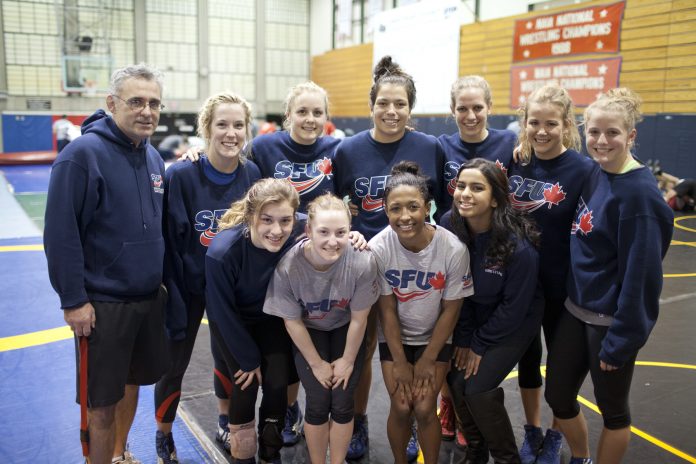
Women’s wrestling look to improve after season openers

0
SFU won 43 out of their first 48 matches on the first day.

The SFU women’s wrestling dual team opened their season in Oklahoma City, OK at the Cliff Keen Duals on October 24 and 25. Starting strong, the women won 43 of their 48 matches during the first day of the tournament.

However, the women would fall short of their goal on the second day of the competition, placing fourth overall in the tournament. Though it was not the outcome the women’s team had anticipated, wrestling coach Justin Abdou was not disappointed in their performance, keening in on areas for improvement.

“In our matches we gave up too many [extra] points.” said Abdou. “In the final dual the girls simply ran out of gas, [with] the girls wrestling their 10th match of the weekend.”

Accolades were also expressed by coach Abdou for senior Bailey Halvorson, 155 lbs, “[who] was solid all weekend, [competing] with poise and control, [wrestling] the way we expect our seniors to.”

Additional members of women’s wrestling traveled to Calgary for the Dino Open, where freshman Alyssa Wong won the 67 kg weight class, with mentionable performances from Maegan Kuruvita and Vanessa Gonzales. 

“For [their] first tournament of the season, it went how [one] would expect,” said women’s assistant coach Justina Di Stasio. “The girls showed their strengths when [winning], and showed the areas they need improvement on [within the matches] they lost. Hopefully we can correct some of these areas before our next competition.”

The women’s wrestling team then returned to Burnaby to compete in the Clan International, along with the men’s team.

Clan lose rematch against Western Oregon

0

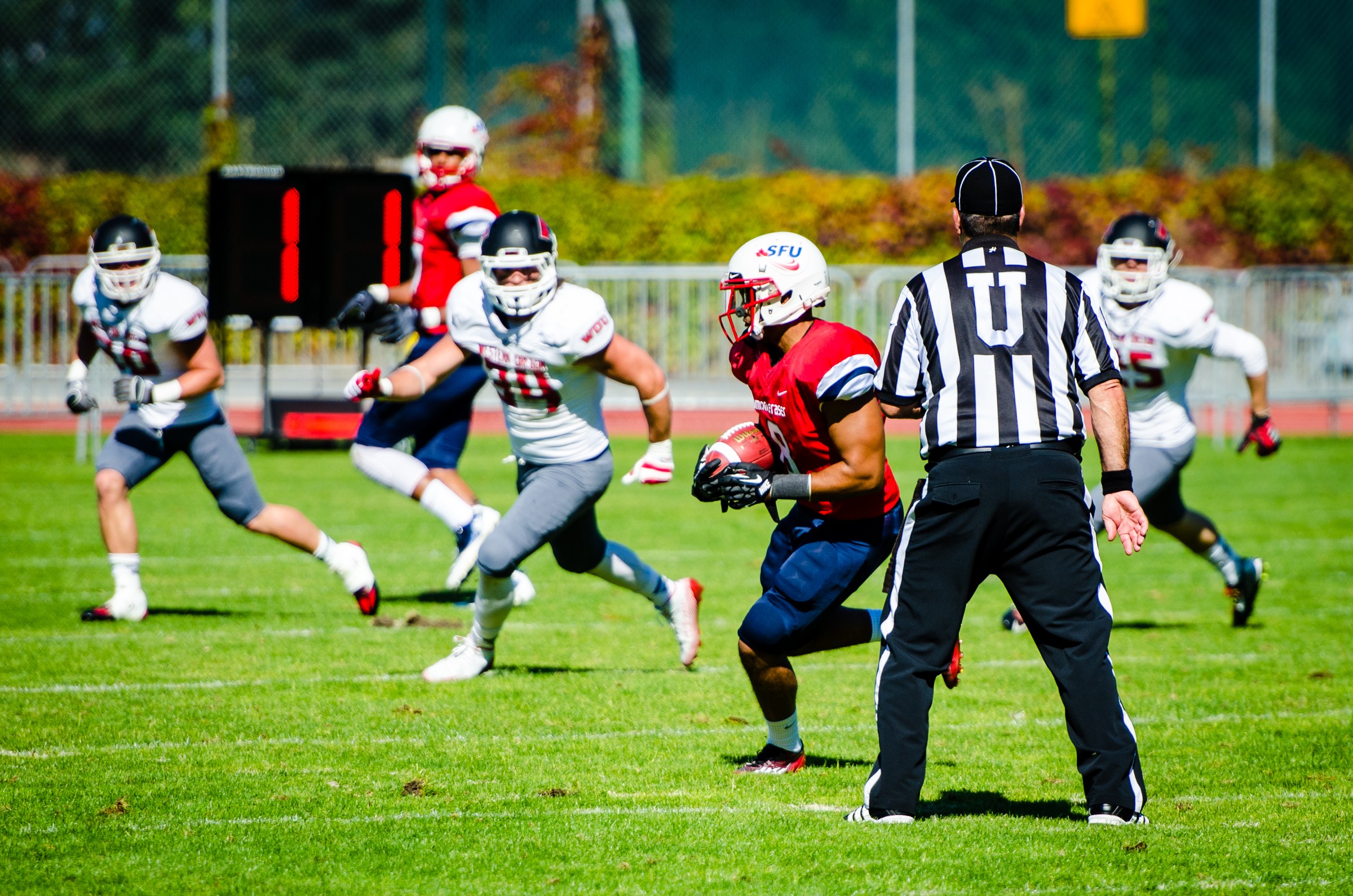
Last Saturday, the Clan travelled to Monmouth, OR for a rainy, windy rematch against the Western Oregon University (WOU) Wolves, who bested them at home on September 13.

In that game, the Wolves won 38-14, and gameplay was marked by little offence in the first half; SFU did not take the lead once.

Saturday’s game was not very different — at least, not in the beginning. In the first half, only 17 points were scored between the two teams, with a touchdown each, and an SFU field goal.

SFU’s opening drive seemed to hint at momentum: they gained 50 yards, 18 of which were on a pass, caught by running back Stephen Spagnuolo from quarterback Ryan Stanford. However, after that play, the Clan were only able to notch three more yards and were forced to punt the ball.

SFU made some decent yardage in their drives throughout the first quarter, but it would be the Wolves who drew first blood, scoring the only points of the first quarter — a touchdown..

WOU quarterback Ryan Bergman threw a 35-yard pass to Wolves receiver Tyrell Williams, putting the Wolves on the board, up by seven, and ending the scoring in the first quarter.

SFU, though, answered rather quickly in the start of the second quarter. Having only gained one yard before the quarter switch, Stanford threw a 60-yarder to wide receiver Lemar Durant, putting the Clan at WOU’s 19-yard line. Spagnuolo would gain five and seven yards in two consecutive rushes to put the Clan at first and goal.

However, they lost two yards on their next play, and Stanford was unable to pass into the endzone for the touchdown. SFU was able to put up their first points of the night, however, with a 26-yard field goal by Tiernan Docherty.

With three points on the board, the Clan did not wait long to put up their own seven-pointer.

After the Clan were able to keep the Wolves to just one yard on their previous drive, middle linebacker Jordan Herdman intercepted a Bergman pass. This time, Stanford wasted no time, and threw another bomb — this one 51 yards — to Durant.

SFU had the 10–7 lead going into the half, and with a tight defence, they looked to be headed to their third victory of the season.

Looks can be deceiving, though, and the Clan would only muster two more field goals, while the Wolves found their offence in the second half, putting three touchdowns on the board.

“The weather was a factor and with the lead at halftime that we had, I really thought we could take the extra possession in the second half and try to build on our lead,” head coach Jacques Chapdelaine told SFU Athletics. “We did not do [that] unfortunately.”

Western Oregon scored their second touchdown of the afternoon, just under five minutes into the third quarter, when SFU allowed a 35-yard Wolves pass.

The Clan responded with two consecutive field goals, to reclaim the lead. The first one was a 39-yarder by Docherty, after a 52-yard drive. The second came at the beginning of the fourth quarter, after a 5:33 drive that took the Clan to Western Oregon’s eight-yard line.

The failure to convert for a touchdown, though, on either of these drives foreshadowed the direction in which the game was heading.

After preventing the Wolves from gaining a single yard, the Clan looked primed for another touchdown, or at least a field goal, having made it to the goal line. However, a bad hut would cause Stanford to panic and throw an interception. Although the Wolves only made six yards on the resulting drive, this signalled the end for the Clan.

Western Oregon scored two more touchdowns, off of 29- and 54- yard passes, and the Clan could not manage a first down in either of their responses, feeding the Wolves the 27–16 victory.

Despite the late game turnover, Stanford had a solid night putting up 299 passing yards. However, he had a below 50 per cent passing percentage and had a hard time converting for touchdowns, despite multiple lengthy passes to take the Clan near the endzone.

Durant had a great night, notching 184 receiving yards, as did Spagnuolo who led the team in rushing yards with 132 yards. Jordan Herdman once again led the team in tackles with six solo tackles and four assists.

The team is now 2-2, and remains at sixth place in the Great Northwest Athletic Conference (GNAC), and will play their remaining games at home at Swangard Field.. The Clan have three more games remaining, and will play them all at Swangard Stadium.

Meet the Clan: Bayne Bosquet

0
On the field, captain Bayne Bosquet plays an agressive game, and isn't afraid to make the big hits.

Screen Shot 2014-11-06 at 5.18.40 PM

Most sports, including lacrosse, are team games; they are not necessarily driven by one individual, but by a group of players working together putting up a cohesive effort.

However, on most teams there are leaders, those that push their teammates to work that much harder, and who keep the team focused and ready for the win.

Defenceman Bayne Bosquet bears that responsibility on SFU’s lacrosse team. One of four players voted by the team to be captain, he now enters his second season carrying that honour.

It’s not a responsibility that Bayne takes lightly, saying, “It’s a big honour being the leader up here, I try to lead by example. I think a big role that I have to take on [. . . is] being a senior captain up here.”

He is one of two senior captains on the team, along with midfielder Sam Clare, and he explains how his role changed as he transitioned from a junior to a senior captain: “I think it’s just the maturity level, going from junior to senior you just have a little bit more experience, and a little bit more awareness of the game.”

WEB-MTC-1-Anderson Wang

As a senior, he has gone through many of the things that his teammates are experiencing, such as joining the team as a freshman, and having to learn to focus on the smaller details.

When I first came to SFU, I was pretty raw — I’d say uncoached,” Bayne said. “I think there’s a lot of things that are just minor but have shifted my game to the next level.”

Elaborating, he adds, “[Like] just being aware of where everyone will be for your slide, in defence when [you] go to the net, someone has to fill your position, so just being aware you know who’s got your back and who doesn’t have your back, and just being able to do that without thinking about it.

“[I learned that] there’s shifts in the game, going up and down, that you just have to ride it at a common motion all the way through. There’s always a lot more time than you think on the clock,” Bayne explained. “Don’t rush things; there’s a time to go super hard, and there’s a time that you just have to sit back on your man and just wait for that opportunity to arise.”

He also remembers the process of bulking up as a young player: “There’s a lot of physical prep coming up here. I came into [SFU] 165 lbs and I’m 200 lbs [. . .] I think in my freshman year I gained 25 lbs, that’s a pretty good amount of weight to gain.”

He recalls the academic experience of being a freshman, having learned the importance of time management, saying, “I think going from a freshman thinking, ‘Oh, I’ve got so much time’ and then realizing, ‘Oh no, I’ve got a midterm next week, or two days from now and I should start studying’, it’s been a big step up being like, ‘I’m going to prep for my midterm two weeks in advance.’”

Bayne tries lead by example in many ways, but his hard-hitting play stands out among these. “I feel like I play a pretty aggressive style of defence, I like to push out on the man, I like to get in their hands, I like to be a takeaway defender, really, with good body and I like the big hits.”

Despite the inevitable individual focus of an interview such as this, it became quite clear that Bayne greatly values his team, attributing his passion for lacrosse to the team environment.

“I think what really drew me to lacrosse was the fact that it is pretty close-knit, and a lot of the kids who were older than me played lacrosse,” he says.

It also doesn’t hurt that he comes from athletic parents: his mom was a volleyball player and his dad a golfer. As a tribute, he combined their numbers, two and eight, when choosing his own jersey number 28.

Rounding out the interview, Bayne returned to the benefits of team sports, explaining that  lacrosse has helped him academically: “Just being in a team atmosphere always helps, [it has helped me be] able to work with people, be a problem solver, and my people skills are definitely improved.”

FUN FACT:
FAVOURITE NHL TEAMS:

Initially, he said that the Boston Bruins are his favourite team. However, he was wearing a Vancouver Canucks hat, and when this was pointed out, he said with a laugh, “I know! They’re my two favourite teams!” He assures us, though, that he was cheering for the Canucks during the 2011 Stanley Cup Finals.

Shirley Gnome brings her provocative music back to Vancouver

0

At 8:00 p.m. on a Saturday night, my boyfriend and I found ourselves at Little Mountain Gallery, an intimate, down-to-earth venue on a side street off of Main. The next street light was 20 metres down the road. The odd car passed by every so often; other than that, it was relatively quiet, with the occasional laugh from a nearby cafe drifting lazily across the night air.

There was a completely different vibe inside the gallery — that of the perfect intimate theatre. We were enveloped in positive energy that radiated off of the bare walls, hummed beneath the music, and burst forth from exuberant conversations taking place around the room. We were right on time for the show, but there were still people trickling in.

Shirley Gnome stood by the ticket booth and welcomed us, excitedly recognizing The Peak and offering me a small clip-on pink hat. It was a miniature version of her own sparkling cowboy hat, and every woman in the room was wearing one; for 90 minutes, we all sat in smiling, laughing, female solidarity.

Shirley Gnome wowed me — and just about everyone else in the room — with her stunning personality and gorgeous voice. Gnome gives off a very light-hearted vibe that pulls all those in the room together. She would purposely mess up on camera (it was a live recorded show), joking that they could always edit it out later. You know you’ve got a commanding, likeable presence up on stage when you can get the entire room to erupt into enthusiastic, loud farts in amazing synchrony on command.

I can’t speak highly enough of Gnome’s voice; she was so versatile, able to sing anything from songs with a country spin to soft rock and pop. She captured the entire room from the very first note she let out. She was preceded by Scarborough, a singer-songwriter who impressed the crowd with his improvised songs about household items, and gave her just as much praise as the average audience member.

What makes her truly talented is her keen and discerning consciousness about the world, which really shines through in her lyrics. The greatest compliment you can pay a writer is to tell them that they listen well, and Gnome definitely listens to what the world is telling her. She skilfully gleans social norms, cues, and mannerisms from conversations with friends, and from random observations of the most normal, everyday situations, giving birth to her brilliant, subversive, and ironic lyrics.

The show was pure gold, flowing through the audience and making us all feel rich. Don’t be fooled by the most obvious theme of her albums, with titles such as C*untry Music; even though all of her songs are about sex, most of them have really positive messages, and are downright hilarious. I can’t really say more without giving too much away, but during those 90 minutes, we heard songs about bad sex dreams and glittery vaginas (literally). Shirley Gnome is a magical musical wonder. Look out for her; she’s a star on the rise.

Elspeth Pratt honoured with Mayor’s Arts Award

0
Portico (2011) is part of the Vancouver Art Gallery’s permanent collection.

Three years ago, when looking to pursue a second degree in visual arts, one characteristic made me choose Simon Fraser University over the multitude of art schools that offer post-secondary education in the Vancouver area: the art practices of the faculty members themselves. Among all of the practicing artists teaching courses in Vancouver, one of them stood out to me more than any other — Elspeth Pratt.

By a turn of coincidence, Pratt evaluated my entry portfolio during the admission process, though, as of yet, she has not been one of my professors. That being said, it was a pleasure to conduct a short phone interview with her, to get a sense of her teaching career prior to becoming the associate director of the School for the Contemporary Arts at SFU in 2010, and then obtaining the director position in 2013.

Hailing from both Winnipeg and Toronto, and earning her bachelor’s degree from the University of Manitoba in Winnipeg, Pratt finished her M.F.A. studies at UBC before going on to teach at the University of Victoria in the mid-80s. Afterwards, she also held positions at the Emily Carr College of Art and Simon Fraser University.

I discovered that one of the first exhibitions of her work was as a participant in the now legendary October Show in 1983. This exhibit was the first artist-run warehouse show to take place in Vancouver, and was organized in order to contest the Vancouver Art Gallery’s selection of artists during their historical retrospective that same year — Vancouver: Art and Artists 1931-1983.

Of course, there have been many other exhibits of her works in Vancouver since then. In 2008, Kathy Slade curated a solo show of her art entitled Nonetheless, which took place at the Charles H. Scott Gallery. A monograph of Pratt’s work bearing that same title was later published in 2011. (I happened to pick up a copy of this publication at last year’s Vancouver Art/Book Fair, as it is the main reference tool when studying her work.) Also in 2011, Pratt was commissioned to produce a site-specific installation at the Vancouver Art Gallery’s offsite location titled Second Date. The piece was presented from June 29 until January 8, 2012.

I even stumbled upon one of her pieces this past summer when visiting the VAG. The work, titled Portico (2011), was part of the Out of Sight exhibit that featured recent acquisitions to the gallery’s permanent collection, and I remember taking the time to examine it carefully.

This particular wall study is assembled from wood, particle board, and laminate, which are basic construction materials for today’s urban spaces. Through a succinct selection of diagonal shapes and the presence of two triangular negative spaces, Pratt manages to maintain a constant struggle with gravity that places her work at the crossroads of painting and sculpture, while addressing the architecture of the gallery space itself with her selection of materials.

It seemed only logical to me when I read that Elspeth Pratt had been honoured with a Mayor’s Arts Award in the Visual Arts category a few weeks ago. Even more exciting to me though, was learning that she will be teaching my fourth year Studio course next term.

Stickboy tackles bullying at the opera

0
Dealing with a universal theme, audiences can relate to this powerful story.

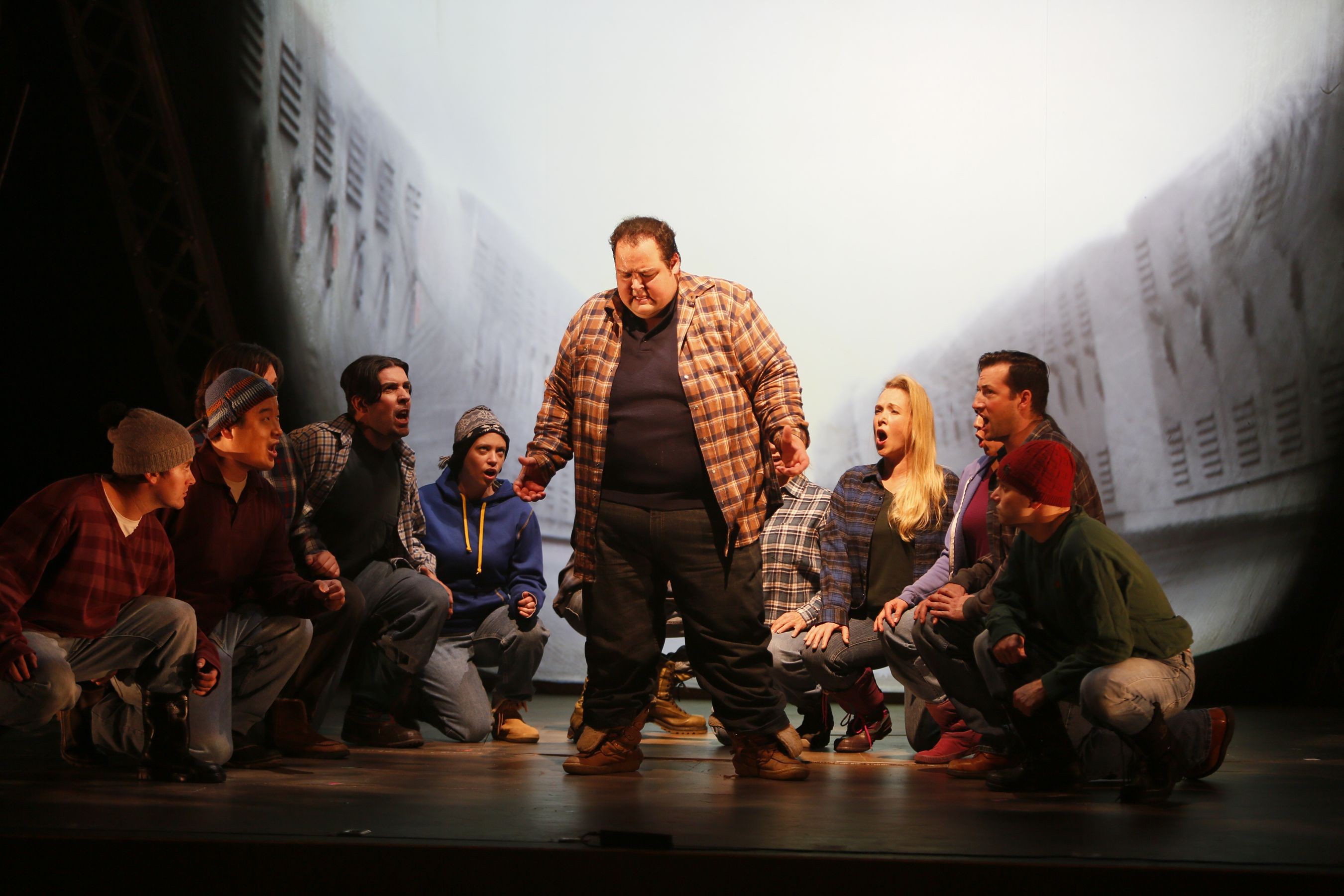
Fans of opera be warned, this show is far from typical. It is, in fact, so much more. Part beauty, part tragedy, and many parts pain, Stickboy did not fail to deliver at the Vancouver Playhouse.

The show, directed by Rachel Peake, was adapted from Shane Koyczan’s autobiographical book of poetry of the same name, with music composed by Neil Weisensel. According to Leslie Dala, the Vancouver Opera’s music dramaturge, they first approached Koyczan in September 2013 and asked him to transform his story into libretto for the opera to perform. 

Mixing classical with contemporary styles of music, traditional operatic libretto with spoken word, and live theatre with animated visuals created by Giant Ant — the company behind Koyczan’s viral “To This Day” video — Stickboy pushes boundaries to its advantage. The busy, visual opera certainly had something for everyone, but focused on one universal theme: bullying.

From the perpetrator, to the victim, or even a bystander or someone close to someone who has been affected, bullying can greatly alter the lives it touches. Stickboy took the story of bullying one step further. Based on Koyczan’s real life experiences in Yellowknife and Penticton, it illustrates just how destructive bullying can be. It also plays on the realization that we all have a monster inside of us, and that we all have the capacity to do terrible things.

According to Dala, the show “talks about the thing we all have within us — the capacity to harm others, or to just be bystanders who do nothing about it. All of us can think of times we’ve been one, or both, of those.”

The story follows ‘the boy,’ played by Sunny Shams, as he navigates the tough terrain of childhood, with scenes at age 10, age 13 and age 17. The settings range from classrooms, playgrounds, and treacherous hallways, to his sanctuary at home, featuring both graphics and Koyczan’s pre-recorded narration between scenes.

Some of the most poignant scenes revolve around his bedroom door, as a caring and concerned grandmother passes a notebook under the doorframe. Conversations are splayed across the pages, and moving visuals play on the screen behind them. Differing, perhaps, from many shows, Stickboy does not provide its audience with any reasoning for its horrors; it only offers “because” as an answer, and doesn’t feature any precise ending, because one generally doesn’t get either in real life. 

With it’s ability to tackle themes that many shy away from, Stickboy seems to resonate with audiences, and was well deserving of the minutes-long standing ovation it received. There are plans to adapt the opera into a shorter play, with the aim of traveling to elementary schools throughout BC.

Stickboy is presented by Vancouver Opera October 23 to November 7 at the Vancouver Playhouse. For more information, visit vancouveropera.ca.

Nightcrawler thrills and repulses

0
Jake Gyllenhaal stars in this film that plays with our desire for violence.

A horrible tragedy happens, the news gets the story, and then the circus starts. Anchors talk about the school shooting or terrorist attack for hours, speculating and spinning without proof. They depict the event graphically, instilling fear in their viewers. People watch for hours, craving more and more details. It’s a form of twisted entertainment and we love it; Nightcrawler explores this.

A current topic appearing in many different movies is that of media, and the bias behind corporations that run media outlets. Deserving culprits include Fox News, for their shifty and deceptive perspectives and manipulation of uneducated and less discerning viewers, as well as the political and social left wing cheerleader, CNN, whose stories may spin the truth better than the Democratic Party. 

Nightcrawler is about the media, but less about the behind the scenes of a station. Admittedly, it does focus on how ratings drive the material put on television, but its master stroke lies elsewhere — it shows you the horrors of a news station that picks its stories based on their visual power and fear factor, and then tells you how you are a part of the process.

This is an ingenious film that thrills you with its images and graphic violence, and then repulses you as you begin to realize that you crave these violent depictions. We go into these kinds of dark, gritty movies looking for someone to die, and then are thrilled by the spurting of their blood. The spectator is as involved with the unethical situation as the characters.

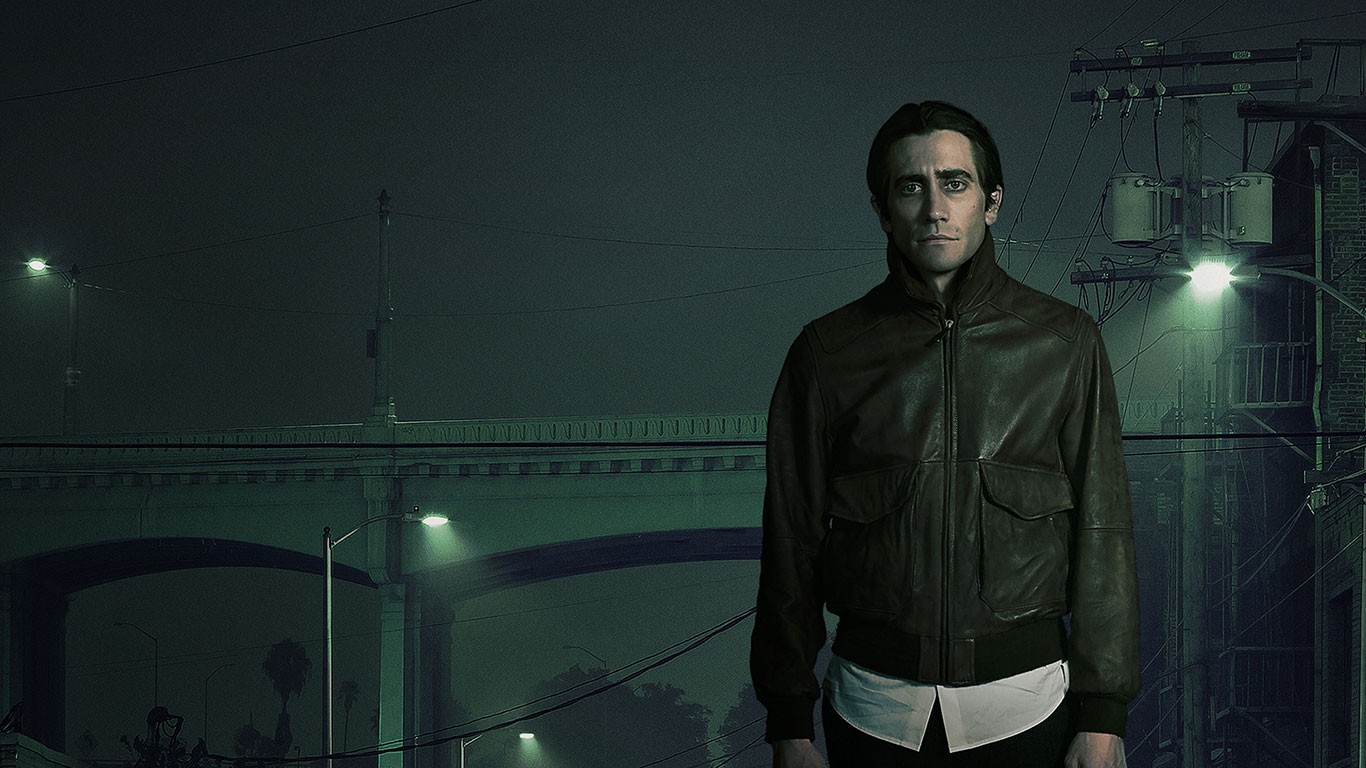
Dan Gilroy’s directorial debut presents a sordid story of underground crime journalism in LA. Lou Bloom (Jake Gyllenhaal), a man struggling for work, videos car hijackings, fires, and murders for the news. He captures raw images of dying, upper class whites, and sells them to Channel 6 News; they take the footage and manipulate it, so that viewers are drawn to their station. Lou doesn’t care about ethics; his aim is to capture the perfect shot of the dying, struggling victim, as these images can be sold to the station at a higher price. Everyone in Nightcrawler has a monetary value; people cease to be human. They are products for Lou to capture and sell, commodities for the station to publish, and a pathway to high ratings.

As Lou drives from crime scene to crime scene, the audience is invigorated by the proceedings. We don’t know the victims, but we are intrigued and thrilled by their horrible situations. We voyeuristically watch their final moments, as those who watch Channel 6 News do. I was simultaneously enraptured and repulsed.

Nightcrawler is a daring movie that succeeds on its surface level and leaves you thinking about more than a roaring mustang on the streets of LA. It’s an art-house action film with brains and brawn. Long takes and fluid hand-held cinematography build tension with slow movement within the frame, before the sequence explodes and the average shot length diminishes, cutting more frequently, and consequently increasing the tension in scenes.

This is the odd movie that you want to see, then not see, then see again, before not seeing it. Nightcrawler is action-packed, playing on our desire for violence before making us look in a mirror and revealing us as the culprits who fuel this immoral form of journalism. We demand the violence; they provide the supply.

Empirical observations in 16mm

0
Bunte’s films at Or Gallery document technological advancements of the former German Democratic Republic.

If a revolution is a release of pressure, what becomes of the force following its release? Andreas Bunte, a recent SFU Audain Visual Artist in Residence, attempts to address this question by looking at two spaces of differential pressure in the former German Democratic Republic (GDR).

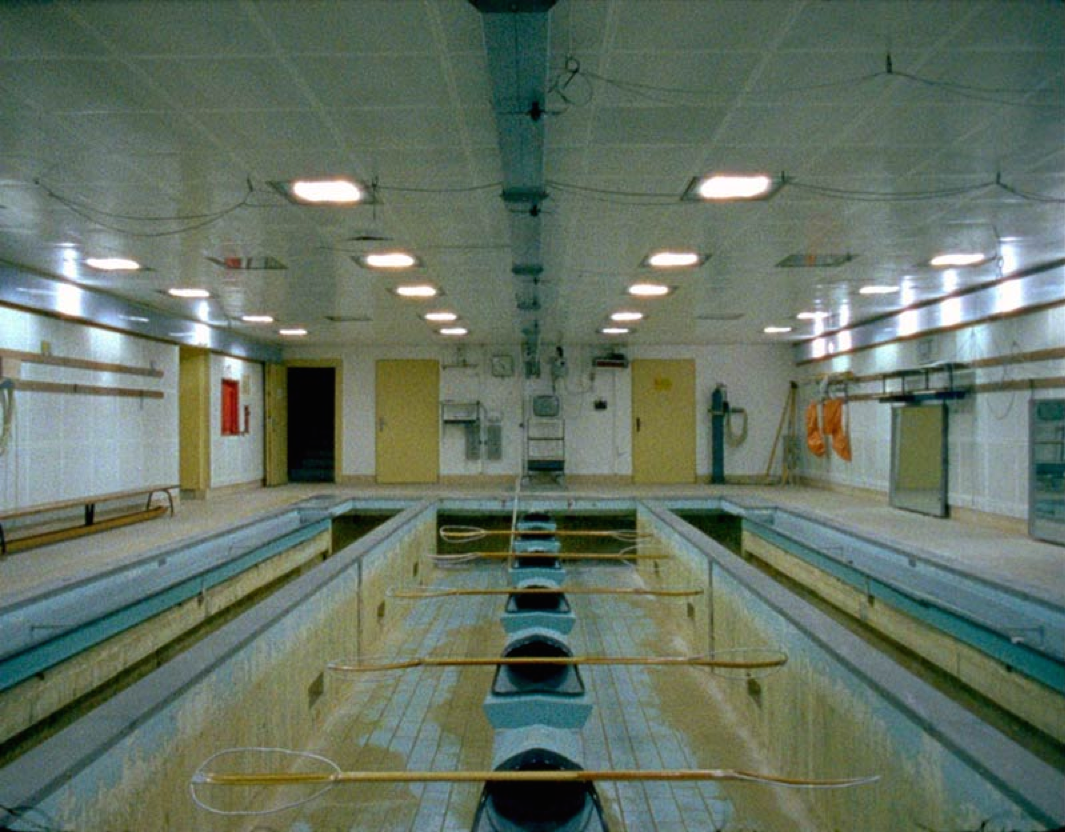
Bunte’s two films, presented as a double film installation at the Or Gallery, use an athletic training facility, Underdruck (Low-Pressure), and a synthetic diamond manufacturer, Künstliche Diamanten (Synthetic Diamonds), as respective subjects to document the technological achievements of the GDR.

Bunte primarily works in the medium of 16mm celluloid film. The grainy, anachronistic look of 16mm is congruous to the subject matter being depicted. After the fall of the Berlin Wall, each of these spaces was affected. The synthetic diamond institute lost its state funding. It then had to relocate and become a private enterprise. The training facility, designed to simulate the low pressure of high altitudes, fell into disuse due to the cost of renting the space. Because of the way it was built, it was also too costly to destroy, ostensibly becoming a monument to the era in which it was created.

Both spaces feel lost in time due to the prevalence of the dated, analogue technologies that they contain. Through these short films, Bunte affords the viewer a privileged look at processes and spaces rarely seen, while also framing the banality inherent in each.

A diamond is created over billions of years in high-pressure areas kilometres beneath the earth. In Künstliche Diamanten, we witness the transformation of graphite into a diamond over the course of several minutes. The final product is cut out of its casing using a tool that looks like a butter knife.

In Underdruck, Bunte takes us into what looks like a Cold War-era spy bunker, straight out of a Roger Moore James Bond film, but then reveals the banality within: the faded plastics in the offices, the humming frequencies of the rooms, and the blinking fluorescent lights.

Due to its isolation, the GDR had to rely on synthetic processes to maintain its independence. Whether it was through the production of plastics, synthetic fibres, or synthetic diamonds, a GDR state-owned economy had to rely on technological innovation to keep up with its Western counterparts, let alone stay afloat. The two subjects of Bunte’s films are a testament to the stubborn ingenuity of the GDR, which reduced the need for its people to bring in outside goods or travel outside the country — not that the GDR populace ever had much choice.

A couple blocks away from the Or Gallery, Andreas Bunte also has an exhibition at Republic Gallery. This exhibition, Lettuce Partially Emerging from a Shopping Bag, features another 16mm film, titled Suspended Durations. The film documents actors performing everyday tasks, such as unpacking a bag of groceries, using a swipe card machine, and untangling a set of earbuds. In each film there is a grid background placed in the frame of the action, and as each action is performed, sometimes in multiple takes, the sound of the 16mm camera whirs in the background, along with the artist’s voice calling out directions over sections of black in between shots.

The placement of the grid within the frame of action, along with the uncut sound and occasional flash frames, give the sense that we are watching a scientific motion study — normally conducted to improve work practices by maximizing the efficiency of the body’s movement — while also referring to what is taking place behind-the-scenes. By juxtaposing the mundane activities in a makeshift setting of empirical observation, Bunte questions the motives behind these motion studies, while also creating absurd scenarios of everyday life.

Two Films About Pressure is at the Or Gallery until November 22. Visit orgallery.org for more information. Lettuce Partially Emerging From a Shopping Bag is at Republic Gallery until November 8. Visit republicgallery.com for more information.

SFU researcher develops allergy-fighting database

0
Getting a household pet might reduce your chance of developing allergies.

While you may be stuck with that annoying cat allergy for some time longer, the face of allergy research is about to change in a big way.

The Allergy and Asthma Portal (AAP), an online database and search engine developed by SFU’s own professor of molecular biology and biochemistry, Fiona Brinkman, will help uncover key risk factors in the development of asthma and allergies.

The AAP acts as a catalog for some of the information already known about the human body at the genetic and protein levels. As researchers add more information to it, they will be able to look for trends that might otherwise be invisible on a small scale.

With time, this means that the database will become more and more useful, allowing researchers to overlay their own findings in order to understand the big picture of what’s going on in the human body.

Similar resources exist for other diseases, such as cancer, but allergy and asthma are relative newcomers to the ‘big data’ scene. The AAP’s direct predecessor, InnateDB, was a resource used to help research the immune system.

“It’s essentially a natural progression for us to extend this to allergy and asthma, and we’re quite enthusiastic because it’s only the start,” Brinkman told The Peak.

The human immune system is made of dozens of cell types which sometimes overreact to something otherwise harmless, causing allergy or asthma. The AAP already contains over 4,500 of those cellular interactions, and over 3,000 genes that are implicated. These interactions could be used as specific targets for therapies that could prevent, or even reverse allergy.

Brinkman went on to say that “what we’ve found is by looking at complex diseases as more of a network [. . .] things become a little more simple.”

 “One of the most protective things you can do to avoid developing allergies is to basically get a dog.”

Fiona Brinkman, SFU professor of MBB

However, Brinkman explained that another part of the picture is getting attention from the scientific community: “There’s a lot of information coming out showing the role of microbes in development of allergy and asthma and the importance of exposure, appropriately, to microbes as an infant.”

The principle, sometimes referred to as the ‘hygiene hypothesis,’ suggests that an environment that is too clean may actually cause disease in the form of allergy. In more economically developed countries, like Canada, allergy rates are significantly higher than in less economically developed countries, and this may have something to do with insufficient exposure to microbes in the environment.

However, according to a recent study of certain households, pets may be of significant help. “One of the most protective things you can do to avoid developing allergies is to basically get a dog,” Brinkman said, explaining the theory that a dog brings microbes from outside into contact with its owners, though there may be other factors involved.

While the AAP is set to integrate data on a vast scale, Brinkman stressed the importance of organizing data to make it legible and useful.

“One of the biggest challenges we have in biology is it’s becoming more of an information science, and we need to get that data properly organized and we need to get it more integrated,” Brinkman said. “We really want to find discoveries more efficiently.”

University Briefs

0

UBC Researchers develop test for vitamin B12 deficiency

Researchers at the University of British Columbia have developed a new testing method for vitamin B12 deficiency that only requires a single drop of blood. The technique is sensitive enough to work on anyone, including newborn babies.

“This minimally invasive approach helps us measure deficiency in an easier and more convenient way, especially in large samples of people,” says the author of the study, Yvonne Lamers, a professor in the Faculty of Land and Food Systems, and Canada Research Chair.

This method is important because it can be used to test and collect blood samples in rural or remote areas where elaborate lab equipment is inaccessible. Presently, the technique is being used in a research project in rural Indonesia.

With files from UBC News

University of Calgary opens energy research institute in Beijing

Collaborating with Chinese partners, the University of Calgary (U of C) has opened a jointly funded research institute in Beijing to take advantage of the country’s potential for gas development.

The goal, according to U of C president Elizabeth Cannon, “is to develop new innovative technology that we’ll not only bring back to Canada, but will help China move from a coal economy over to gas through unlocking some of their unconventional oil and gas reserves.”

One partner, industrial giant Kerui Group, will put $11.25 million in funding towards collaborative research and training programs to improve the extraction process for tight oil, natural gas hydrates, and oil-sands bitumen.

With files from The Globe and Mail

Musicians are better multitaskers

If you’ve ever had trouble trying to do homework while also watching TV, a new study from York University may make you want to add a guitar into the mix as well.

According to their research, trained musicians appear to have a “superior ability to maintain and manipulate competing information in memory, allowing for efficient global processing.”

The study was comprised of a series of tests that measured task-switching ability, and showed that musicians have a stronger ability to “shift flexibly between mental sets,” an advantage not found within other groups, including those who are bilingual.

With files from Pacific Standard