

SFU hosted another puppy therapy event; the dogs were as cute (and calming) as ever!
Arts Club’s Saint Joan is a long epic about a brave woman
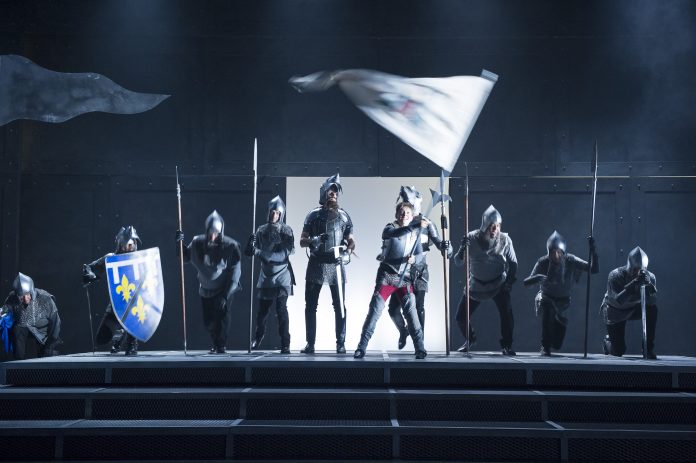
George Bernard Shaw is widely considered to be the greatest playwright after Shakespeare, and Saint Joan is one of his final great works, written when he was 67. The play is long. Even though director Kim Collier, leading lady Meg Roe, and dramaturge Rachel Ditor spent some time editing the script, it still clocks in at over three hours. I’m not against long plays — Shakespeare’s plays, even when edited, are still lengthy — but this didn’t seem to have enough dynamism to hold our undivided attention.
This production reminded me of Bard on the Beach with its modern set and score, sharp costuming, and actors who have no trouble delivering their lines, but it didn’t have the same level of humour and action that draws you in and holds you the entire show. There are some humourous scenes, such as Joan approaching Captain de Baudricourt (Bob Frazer) and telling him that he will order her to defeat the English. Frazer’s looks of incredulity were met with laughs from the audience, and Roe’s fearless innocence was perfect for her role.
Haig Sutherland as the Dauphin also provides some comic relief when he talks back to the Archbishop (Nigel Shawn Smith), and Dean Paul Gibson was wonderful as the gluttonous Earl of Warick. Warwick and Bishop Cauchon (Scott Bellis) have a lengthy discussion about Joan’s fate that is lively at times, but drags on a bit as they seemed to sit at the table in discussion for far too long.
The exciting moments came when the troops scaled the balcony and Joan hung off the edge of it to scream her war cry. I also loved the two singers flanking the stage who added the perfect sonic atmosphere to this eerie, sombre story of a young woman who was burned for her beliefs. The claim that her heart would not burn is an image that sticks with you, and I think this cast paid tribute to Joan through their insightful performances.
The play ended with a beautiful sentiment, but the decision to have the actors out of character and in plain clothes caught me a bit off guard. Meg Roe walked to the front of the stage addressing the audience directly as she quoted the ghost of Joan from Shaw’s epilogue: “O God that madest this beautiful earth, when will it be ready to receive Thy saints? How long, O Lord, how long?”
Saint Joan is presented by Arts Club Theatre Company October 23 to November 23 at the Stanley Industrial Alliance Stage. For more information, visit artsclub.com.
Professors compete in Faculty Smackdown Debate
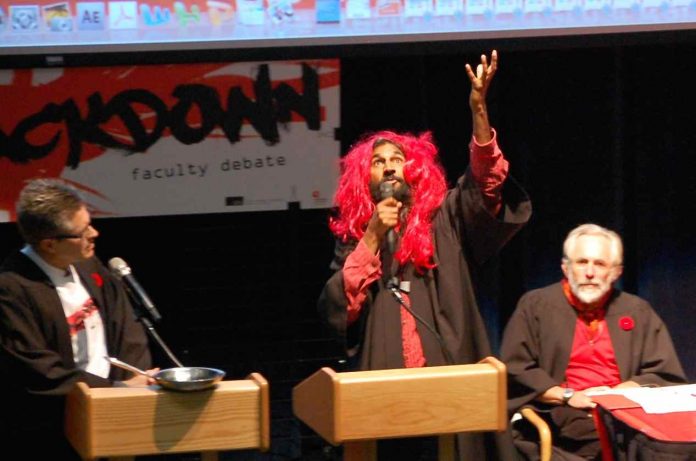
SFU’s third annual Faculty Smackdown Debate appealed to fans of smack talk and non-profit organizations alike, as professors battled it out in the SFU Theatre on Thursday, November 6.
Teams of professors were pitted against each other to debate high profile topics such as: “The frying pan is better than the fire,” and “Debates don’t actually resolve anything.”
The debaters were nominated by students, based on their sense of humour, ability to talk about anything, and spirit of volunteerism. Organizers received almost 300 nominations, but narrowed these down to four teams of three.
The debates included arguments about everything from firemen, sociopaths, and 4chan, to SFU professor of English Paul Budra’s chili pepper rating on RateMyProfessors.
Gwynne Roseborough, chair of SFU’s United Way Campaign and an organizer of the event, said, “[The professors are] such unique characters in themselves, it’s just so great to see a different side of them outside of classroom.”
A big fan of CBC Radio’s The Debaters, Roseborough wanted to use humour to encourage faculty, staff and students to engage with a more serious cause: United Way.
United Way acts as an umbrella organization, Roseborough explained. They partner with institutions like SFU to hold events and fundraise money, which is then distributed to local charity organizations. Roseborough said, “One of the nice things about the United Way is that the money goes back to the community we live and work in.”
United Way anti-poverty organizations are funded mainly by donations, and all proceeds from the Smackdown and partial proceeds from a Post-Smackdown Debrief at the Highland Pub were donated to the cause.
Roseborough applauded employee generosity in donating to United Way but said, “I think we can be even more generous.”
SFU’s partnership with United Way is about to enter uncharted territory, however, as this is Roseborough’s third and final year as chair. She said that a lot of SFU employees and long-time contributors will be retiring this year.
Roseborough hopes that events like the Smackdown — as well as upcoming events such as book and bake sales at the Burnaby and Harbour Centre campuses, and Market on the Mez at the Surrey campus — will help increase United Way’s profile on campus and make it easier for students and faculty to become involved.
“I’m trying to focus on a way that we can all give a little to give a lot,” Roseborough said.
The winning professors were presented with a garden “Gnome It All” trophy and the satisfaction of raising awareness for United Way. Audience applause was used to determine the winning teams, and came to the following conclusions about the debate topics: fire is better than frying pans and debates really do resolve something.
Injunction granted against Kinder Morgan opponents

The BC Supreme Court has granted an injunction requested by Kinder Morgan to prevent protesters from obstructing crews’ access to work sites on Burnaby Mountain.
Those who are camped out at the sites have until Monday, November 17, at 4:00 p.m. to clear out of the area, or they may face arrest.
Five protesters, including three current and past SFU professors, are also facing a multimillion dollar civil lawsuit brought by the Texas oil company.
Pipeline opponents gathered this morning at Burnaby Mountain Park to express their discontent with the decision.
Various people at the blockade took turns with a megaphone, speaking and singing out against the injunction. Some speakers indicated that they intend to stand their ground on Monday, even if they risk being arrested.
Brigitte DePape, activist and Council of Canadians representative, asked the crowd how everyone was feeling, to which one man replied, “Committed.”
“It’s not our political leaders that are going to make these changes. It’s going to be us, standing in front of these pipelines.”
Brigitte DePape, Council of Canadians
DePape referred to the Keystone XL Pipeline project that was just approved today by the US House of Representatives: “It’s really frustrating to hear the Keystone Pipeline being approved, but I think that just shows us that it’s not our political leaders that are going to make these changes. It’s going to be us, standing in front of these pipelines.”
The court transcripts outline the details of the injunction and the reasoning behind the decision to grant it.
One of the allegations made by Kinder Morgan in the injunction was that, in physically impeding workers and with snarling facial expressions, protesters were assaulting the surveyors. This has inspired a rash of ‘Kinder Morgan face’ posts on social media, where people post aggressive selfies with the hashtag “#KMFace.”
On the matter of the threat of assault, the judge concluded that it was legitimate, “given the misuse of the bullhorns, when coupled with the aggressive and threatening language, and the general and specific efforts to physically block the plaintiff’s representatives from accessing their work sites.”
The judge continued, “In other words, the plaintiff’s representatives were faced with either physical confrontation or retreat. They wisely chose the latter.”
“It’s not the way anyone in this world should be behaving right now.”
Stephen Collis, SFU professor of English
It was noted that the ruling was not made without dilemma: “The courts must be careful not to act in ways that dissuade concerned and engaged citizens from expressing their opposition to activities which they view as destructive of the social or political good.”
But ultimately, it was concluded that, in this case, the work to be done was largely “temporary” and “minimally intrusive,” causing no irreparable harm to the defendants.
SFU professor of English Stephen Collis is one of the defendants named in the injunction and, along with the other four, is currently being sued by Kinder Morgan for $5.5 million in damages. He was present at the site this morning with other pipeline opponents before heading over to SFU Burnaby to teach one of his classes.
Collis told The Peak, “This is of crucial importance. It’s important locally, to people that live here, work here, go to school here.
“The threat of oil spills and of damage to this park is all very real. It happens. It happened in 2007, here. In fact, this existing pipeline has had over 70 spills in 60 years.”
Collis also brought up the larger regional significance of the proposed pipeline project: “Here is this massive, massive project to bring the grossest, dirtiest, most carbon-producing oil in the world out of the Alberta tar sands, right under our feet. It’s ridiculous. It just shouldn’t be happening. It’s not the way anyone in this world should be behaving right now.”
He encouraged students to seek some understanding of the issue, which is taking place “literally just under our feet up here.” Referencing the anger expressed on the mountain that morning, he concluded, “I hope that students can tap into that and feel some of that moral outrage too.”
Interstellar is an epic study of evolutionary possibility

The theory of evolution proposes that all of mankind developed through natural selection from a single-celled organism to the species we exist as today over the passing of millions of years. Should this be true, there are implications that run farther than just the facts of our origins; philosophy, science, human nature, religion, politics and purpose of being are all impacted. Interstellar is about all these elements, using general relativity as a plot device and time as the motivator of suspense.
Christopher Nolan’s (Inception, The Dark Knight, Memento) monstrous three hour epic concerns an ambitious farmer, Cooper (well played by the resurrected Matthew McConaughey), who is launched into the cosmos, as the pilot of a NASA crew, in order to discover a new home for the human race since the earth has decayed beyond repair. Cooper is of a generation that has accepted the role of caretakers, not explorers who further the progression of our species.
The screenplay, written by Christopher and brother Jonathan, includes multiple recitations of Dylan Thomas’ “Do Not Go Gentle Into That Good Night” wherein characters utter the stanza, “Though wise men at their end know dark is right / Because their words had forked no lightning / They do not go gentle into that good night.” Nolan sees everyone’s purpose to live, die, and make an impact towards a collective technological and biological progression. As Cooper puts it, when indirectly referencing this idea of natural selection, “Once you’re a parent, you’re a ghost for your kids’ future.”
Nolan’s latest will mostly please as popcorn spectacle with jaw-dropping visuals and a grounding emotional centre in the form of a tale of separation between a father and his daughter. But for discerning audiences, it’s an optimistic view on life which borrows heavily from philosophical ideas engraved in Stanley Kubrick’s 2001: A Space Odyssey.
Kubrick’s influential masterwork is a stoic examination of human evolutionary development from apes all the way to the monumental, transcendent star child in the closing shot. Space Odyssey hints at the idea of an alien race aiding us in our biological development and exploration of the cosmos.
Interstellar posses no such mysticism; it is through and through a humanistic tale infused with optimism and sentimentality. Space Odyssey was devised to inspire awe; Interstellar is intended to stir the soul. For a film marketed as a mega-budget spectacle, it has many poignant moments of characters crying out for connection and bridging of separation.
The link between the two works, other than when Nolan pays homage to Kubrick, is that they both centre on humanity’s evolution. Nolan sees it in humanistic terms, denying all possibilities of the supernatural. Like Kubrick before him, Nolan is one of our most audacious and best filmmakers, but as he reaches to make his grandest achievement to date, he overextends himself.
Interstellar boasts mesmerizingly imaginative imagery in the form of faraway galaxies, undiscovered planets, and most impressively a trippy different dimension that depicts a physical, perceivable view of time. Yet for all its beauty, the storytelling tumbles as many of the characters are solely mouthpieces for exposition making the supporting relationships cold and uninteresting. He tries to weave a complex plot but ends up making something overly complicated instead.
Hans Zimmer’s ear piercingly loud score often drowns out dialogue to the point where we get the sense that Nolan doesn’t care what his characters have to say because “THIS IS (SUPPOSED TO BE) EPIC”!
For a film entirely about evolution, it’s ironic that Interstellar represents a slight devolution for the director Christopher Nolan.
VIDEO: SFU community rallies against Kinder Morgan expansion
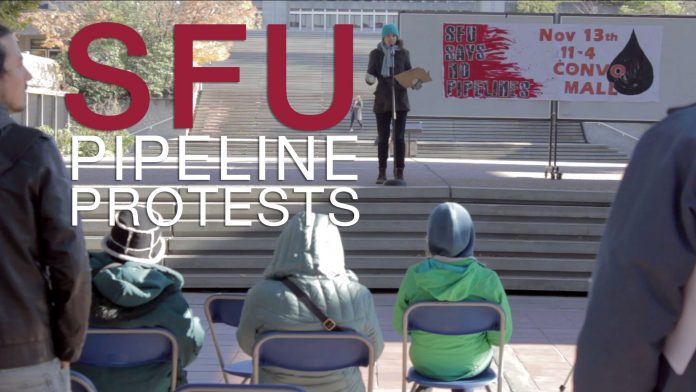
Pipeline protests pickup steam, while three SFU professors deal with injunctions filed against them by Kinder Morgan.
Check out The Peak’s written article about the rally for more information.
Reviews: Urinetown, Ballet BC, Joaquin Grilo, Flashdance

Urinetown
November 1 – 29, Firehall Arts Centre
What if there comes a time when water shortages are so severe that it becomes a privilege to pee? Urinetown is back at the Firehall to explore this possibility with hilarious characters and songs, while playing with established musical theatre tropes.
Unique to this show is the narrator who breaks the fourth wall to welcome us to Urinetown, “the musical not the place,” and explain what we’re about to see. His conversations with the inquisitive Little Sally throughout the show explain what is going on, and as he explains in detail what we’re about to see, he says things like, “too much exposition can kill a show,” while Little Sally asks “what kind of musical is this?”
As the citizens count their pennies and line up to pee at the public amenity, Caldwell Cladwell discusses his plan for higher fees and his trip to Rio de Janiero. Bobby Strong works at the public amenity and after meeting Cladwell’s daughter, Hope, finds the courage to let people pee for free and stand up to the corporation, Urine Good Company. Officers Lockstock and Barrel try to calm the crowds as Bobby leads the rebellion and Hope is torn between supporting her father or her newfound love, Bobby.
While self-aware and verging on cliche in its mimicry of common musical theatre devices, this show manages to be fresh and inspiring. Anton Lipovetsky’s performance as Bobby was particularly impressive, along with Tracey Power as the precocious Little Sally who never broke her childish persona, and Andrew Wheeler as the headstrong Cladwell.
More information: firehallartscentre.ca.

Ballet BC No. 29
November 6 – 8, Queen Elizabeth Theatre
Ballet BC’s 29th season opener was another triple bill of bold contemporary ballet. The show’s title, No. 29, also refers to their 29th new creation since renewing the company in 2009.
A.U.R.A. (Anarchist Unit Related to Art) by Jacopo Godani was first presented by Ballet BC in 2012, and this stark, minimalist work was worth seeing a second time. The lines of bright fluorescents hanging above the stage moved up and down to create very different moods throughout the piece. This work provided beautiful partner work between two of the male dancers and had a strong, aggressive tone that was emphasized by the blunt music of 48nord.
My favourite piece of the evening was Fernando Hernando Magadan’s world premiere of White Act. Inspired by La Sylphide and the romantic era, when tutus were long and ballets were lengthy love stories, this work dealt with the idea of the unattainable and temptation of the unknown. The desire to find true love sometimes leads us down dangerous paths, and this idea was represented through stunning emotional choreography, as the dancers seemed to embody and break free from the tropes of classical romantic ballets.
The final piece, An Instant, was a world premiere by Lesley Telford that had a beautiful, cinematic quality. It was inspired by a poem called “Could Have” by Wislawa Szymborska that was recited as the dancers represented the themes it contained. The cinematic quality of this work was emphasized in the way the choreography seemed to pause, rewind, and move in slow motion as some sections were repeated or slowed down for emphasis. We were left with a haunting image of one dancer backing away from another as if in slow motion, and the poetic words, “It could have happened. It had to happen. It happened earlier. Later. Nearer. Farther off,” ringing in our ears.
More information: balletbc.com.

Grilo in Concert
November 8, Vancouver Playhouse
Joaquin Grilo is a powerhouse of flamenco talent. His fiery footwork and ability to embody the music was simply magical. His whole body was used to translate the flamenco guitar playing of Juan Requena and singing of Jose Valencia into fluid, precise movement. As the headlining show of the Vancouver International Flamenco Festival, Grilo showed why flamenco is so powerful.
Grilo has won many awards, and his traditional flamenco technique is superb — this is what allows him to take that knowledge and add his own personality to his work. This show was full of Grilo’s sense of humour as he slyly looked at the audienced or paused for comedic effect. The crowd loved him.
Flamenco isn’t just about the dance though, it’s about the relationship between the dancer and the music. Valencia and Requena were on stage with Grilo as the music and dance became one entity, and they also had solos which showed off their tremendous talent.
Shouts of “Ole” could be heard from the audience throughout the show, and Grilo, Valencia, and Requena didn’t get away with a simple bow, the crowd clapped and cheered until the curtains opened again and they treated us to an improvised jam session of pure flamenco passion.
More information: vancouverflamencofestival.org.

Flashdance
November 11 – 16, Queen Elizabeth Theatre
Everyone can picture the iconic scene from the film Flashdance, when Alex Owens (Jennifer Beals) drenches herself in water, but unfortunately this iconic image was missing on opening night. Alex did the dance and arched her back over the chair, but the water was a blatantly missing element that everyone was expecting. The image used to advertise this show involves the main character on a chair with water spraying off of her hair as she puts her head back, so it was too bad that the opening night crowd missed out on this essential piece of the show. I’ve been assured that this won’t be a problem for the remaining performances.
This technical malfunction may have been out of their control, but my other complaint is that the role of Alex Owens, while dance heavy, should still require a stunning singing voice, yet that element was missing. Once you get over these issues, however, it is a really enjoyable show, and the classic songs from the soundtrack “Maniac” and “What a Feeling,” were performed with the right amount of passion.
Alex is a steel worker by day and exotic dancer by night, but her dream is to be a professional dancer and attend Shipley Academy to receive formal training. She ends up falling for Nick Hurley, son of the steel mill’s owner, and their relationship is stormy as Alex struggles to accept his help to get her an audition at Shipley. Alex’s best friend, Gloria, is a fellow dancer at Harry’s Bar, but she is convinced by C.C., a competing bar owner, to dance on his Chameleon stage instead. While the girls at Harry’s pride themselves on “putting it on,” Chameleon is all about taking it off.
While the story itself isn’t realistic and some of the technical aspects of this show left something to be desired, it was still a hugely entertaining show that will please Flashdance fans.
More information: broadwayacrosscanada.ca.
SFU community rallies against Kinder Morgan expansion
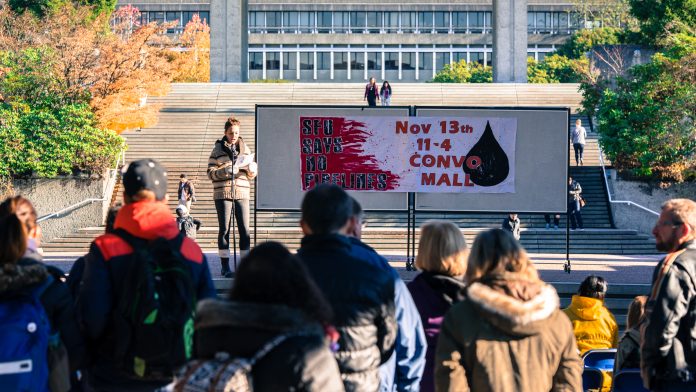
Anti-pipeline activists and observers gathered in Convocation Mall on the chilly morning of November 13 to voice concerns regarding the planned extension of the Kinder Morgan pipeline through Burnaby Mountain.
The rally, “SFU Says No to Pipelines,” was put on by the Simon Fraser Public Interest Research Group (SFPIRG) and united a plethora of student and community groups in opposition of Kinder Morgan.
Running from 11:00 a.m. to 3:20 p.m., the rally had a full list of speakers who spoke to the crowd over the course of the afternoon.
Pipeline opposition groups set up information tables on the sidelines to answer questions, collect signatures, and provide some much-needed warmth in the form of hot chocolate by donation, with the money going toward paying the legal fees of activists charged in the current Kinder Morgan lawsuit.
Various SFU organizations had a presence at the rally, including Sustainable SFU, Divest SFU, the SFU Women’s Centre, Out on Campus, and the First Nations Student Society. Both the Graduate Student Society (GSS) and the Simon Fraser Student Society (SFSS), who have intervenor status, also spoke to the potential impacts of the project.
Devon Cass, external relations officer for the GSS, said, “Kinder Morgan’s actions have blatantly disrespected our democratic processes and civil rights.”
In his speech, representative Jonathan Catliff of Sustainable SFU expressed that, “[Sustainable SFU] is deeply concerned about the overall risk to our environment, our economy, and our campus community.”
He went on to say that the National Energy Board (NEB) — on which Sustainable SFU was a commenter — had chosen to ignore the environmental impacts when they approved surveys for the project.
Catliff also touched on the power of the community to collectively enact change: “It’s events like this, and it’s people like you, that give me hope that we can make these much needed changes.”
Representatives from the Indigenous community brought up issues regarding Burnaby Mountain’s status as unceded Coast Salish territory.
The Wild Flower Women of Turtle Island Drum Group performed several songs, interspersed within the speaker’s schedule, in tribute to those “standing in solidarity” against the pipeline expansion through unceded territory.
Other members of the Burnaby community were present as well, such as the Council of Canadians, the Wilderness Committee, and PIPE UP Network. Burnaby Residents Opposing Kinder Morgan Expansion (BROKE) supported the rally and is currently facing legal charges from Kinder Morgan.
A speech given was by John Clarke, a Burnaby resident living near the Kinder Morgan tank farm, who took part in the establishment of Burnaby Mountain Park — the location of the two Kinder Morgan survey sites — in the 1970’s. Looking out on the crowd, he said, “I can tell you, if this had happened in the 1960’s [. . .] the convocation area would be absolutely filled with students.”
Four of the five defendants named in the injunction were present at the rally, including self-proclaimed Burnaby Mountain caretakers Adam Gold and Mia Nissen.
Two of the three SFU professors named in the injunction, Lynne Quarmby, SFU professor of biochemistry, and Stephen Collis, SFU professor of English, were closing speakers at the rally. SFU professor Alan Dutton did not attend.
Quarmby made an announcement to those present in Convocation Mall that she had just learned via text that the judge would announce a verdict tomorrow morning at 10:30 a.m, instead of November 17 as previously stated.
She encouraged people to head out to the sites on Burnaby Mountain to await the decision: “What we need is a large presence of support. There will be safe space where people can congregate as witnesses, as observers to see what happens.”
Quarmby continued, “If there is no injunction, there will be a pretty amazing celebration on Burnaby Mountain tomorrow at 10:30.”
Collis took the stage at the end of the event, asking ralliers to engage with him: “When I say ‘people,’ you say ‘power!’ People! (power!) People! (power).”
He added, “Whatever happens tomorrow morning, there’s still a long way to go.”
After the rally, attendees were invited to participate in a nature walk through Burnaby Mountain Park and the Kinder Morgan survey sites, as the sites may not be as freely accessible in the near future.
Punishing the Victim

It is evident to anyone who watches the game that the heart of the NHL’s player conduct apparatus is ridiculous. Crimes are punished strictly on the basis of outcome rather than intent, creating spacious grays that players often find themselves lost within.
For a game stepping into an uncharted world, where the public and its pool of gladiators are aware of the immediate and lingering risks of traumatic and sub-traumatic brain injuries, the NHL is lagging behind in properly evaluating the dangers of its sport, running the risk of compromising its future.
As a counterpoint, consider the NFL, long derided by purists for diluting the game by draining out its very heart and soul: extreme violence and aggression. The introduction and strict application of on-field penalties hasn’t unbloodied the game, but has signalled a concrete shift away from the game’s roots.
Chief amongst the league’s concerns — precipitated by an expensive lawsuit filed by former players — is the mitigation of violent blows to the head in an attempt to protect the run-away missiles who staff its fantasy leagues. And while fans complain and the game changes, the NFL’s efforts are commendable, which makes the NHL’s lackadaisical action all the more conspicuous.
Like football, hockey is the product of a society that embraces gleeful barbarism.
Like football, hockey is the product of a society that embraces gleeful barbarism and lionizes the woefully misguided lot who are willing to sacrifice their health and well-being to play the game. Canadians still harp on about ‘old school hockey players’ and ‘good ol’ Canadian boys’ who are evaluated by purely subjective metrics such as ‘grit’ and ‘toughness.’ This cultish preoccupation, which equates ‘character’ to punching another man in the face, has created an uber-masculine environment that ignores safety and common sense.
When Alex Burrows delivered a violent and extremely late hit to Alexei Emelin, the biggest talking point was the surprise within Vancouver’s organization that he was suspended at all, let alone a preposterously few three games.
Indeed, the commentators noted that Emelin bore a measure of the blame for not “keeping his head up,” an absurd reasoning within hockey that each individual is entrusted with their own safety. The burden of responsibility rests on the defenseless player behind the play, not the other guy charging across the ice to finish his check come-Hell-or-high-water.
There needs to be a zero tolerance approach to NHL discipline. In football, merely brushing your hand against the quarterback’s helmet merits a flag. It may seem absurd, but it heavily discourages any contact — intentional or inadvertent — with the head of another player.
In the NHL, an illegal headshot with no ill consequences bears nothing beyond a two-minute penalty, whereas an identical action that happens to cause injury is slapped with a suspension. How is this not double jeopardy?
The greatest sin of the fluid discipline apparatus is that it creates an atmosphere of uncertainty on the ice. Instead of players erring on the side of caution — avoiding unnecessary contact — they continue to seek it out, by an antiquated mindset that labels them ‘tough’ for dishing out punishment, or ‘soft’ when refraining from it. It is the same caveman attitude that allows fighting to flourish, despite knowledge of its all-too-tragic side effects.
Reform the system; a high-stick should either be two minutes or four (not either/or). And a headshot should be a major, triggering an automatic suspension of a pre-determined length. Abstaining from fighting or heavy checking hasn’t reduced the quality of international or Olympic hockey — it’s about time the NHL decided to protect its assets and ban these from North American play.
Men’s soccer notches playoff spot
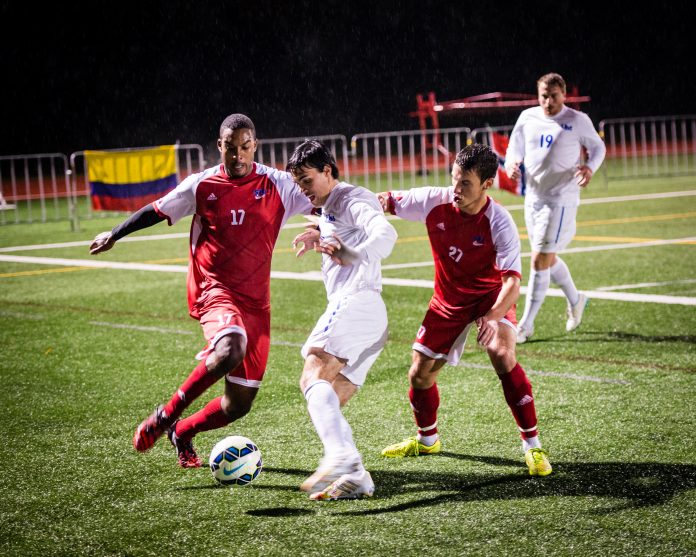
On Saturday night, in their last regular season game, the Clan faced the Western Washington Vikings, who came in with a 9-7-1 overall record. This was an important game for the Clan, as a victory would almost assure their continuing on to the nationals.
In the first half, SFU came out intending to play the ball wide and create scoring chances. The Clan’s game plan from the outset was clear: play the ball wide and cross it into the box; force the back four of Western Washington to be sharp at all times.
Despite this, the Vikings proved extremely difficult to break down, which resulted in few chances at either end of the pitch. The lone exception of the first half occurred when Clan midfielder Ryan Dhillon was sent in on a partial break in the 28th minute, only to be stopped by the sprawling right leg of the Vikings keeper. The half ended in a scoreless draw.
In the second half, however, the Clan really pushed the pace and got the goal they were desperate for from leading Great Northwest Athletic Conference (GNAC) scorer Jovan Blagojevic. Off a turnover, Blagojevic calmly buried the ball, which sent both the crowd on hand and the bench into a frenzy. It was a terrific campaign for the Coquitlam product, who finished the season with 18 goals in 17 games.
The Clan almost scored right after as well, as midfielder Nico Espinosa had a great individual effort to get a shot off, only to be stopped by the Vikings keeper.
The second goal of the evening came from Dhillon, who picked up the ball after a botched goal kick and shot it into the bottom left corner, giving the Clan some breathing room for the rest of the game.
“To be honest, we were playing very nervous in the first half, and I think Western Washington were playing very nervous too,” said head coach Alan Koch. “Obviously this game had big postseason implications for both teams. I told the team to just relax, go out and play, do what you’ve been doing the last few weeks, and they did in the second half, which was great.”
With the win, the Clan earned a spot in the Division II playoffs; they will face the Northwest Nazarene Crusaders on Thursday, against whom they split the season series. The winner will go on to face Seattle Pacific University on Saturday.


