Home Blog Page 1065

Obese modelling encourages unhealthy lifestyles

0
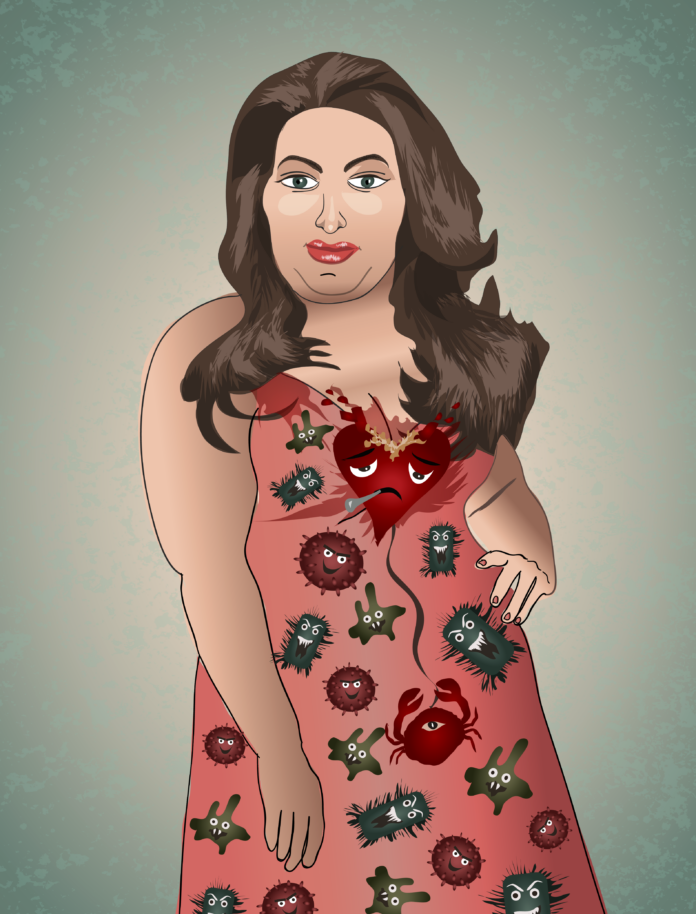
Illustration by Saida Saetgareeva

I’ve never been able to watch shows like America’s Next Top Model because I cringe at how unnaturally thin most of these models are. I simply can’t celebrate the accomplishments of these women; many of them live, and promote, unhealthy lifestyles to achieve the figure that they want.

Recently, I’ve considered the opposite side of the modelling spectrum, and I’ve found that the situation in this case isn’t any different. Models who are grossly overweight, like those who are dangerously underweight, shouldn’t be encouraged, as both promote unhealthy lifestyles.

Tess Munster, also know as Tess Holliday, is the first model of her size to sign a contract with MiLK, a major modeling agency. Tess is 5’5”, weighs approximately 260 pounds, and gained popularity through social media as a makeup artist and model. Tess is also behind an online movement entitled #EffYourBeautyStandards, which encourages body positivity and diversity. 

Now, let me be clear: I believe that shaming people who are overweight is wrong. However, there is a problem with praising Tess’s figure as a model; someone who is at a weight considered by medical professionals to be associated with a variety of diseases. Her recent ascent to fame now makes her a role model for millions, and sends the message that having a weight labelled as obese is okay, or even cool.

Is there no healthy way to model one’s body? I’ll make it clear that, in a world dominated by models who display bodies that are realistically too thin, I understand that many models deemed “plus-sized” actually show off realistic portrayals of what a healthy body should be. Many of these models aren’t overweight in the slightest, and I praise them for stepping out and providing the world with a sense of realism. This is the way modelling should be.

However, very overweight models fall into line with the underweight ones. Their bodies are related to serious risks such as cancer, cardiovascular disease, diabetes, hypertension, infertility, stroke, dementia, inflammatory arthritis, depression — the list is extensive. In North America, these health issues are already a devastating problem, and one that the media should encourage us to avoid.

A study conducted in 2013 by Roland Sturm and Aiko Hattori indicates that morbid obesity is still on the rise in the US. In Canada, we’re not much better. Obesity rates have nearly doubled in males and females of all age groups between 1981–2009. With this fact in mind, why are we adding gasoline to the fire?

It’s further disappointing that a company such as MiLK now exerts its ideological influence by glorifying someone for their unhealthy lifestyle, and successfully disperses a message to others that they should encourage this as well.

I agree that beauty is in the eye of the beholder, but when you glorify obesity and promote serious health issues, it becomes a problem. Whether you think fat is beautiful or ugly is irrelevant, the fact is that that being extremely overweight is correlated with  a shortened life — one that we should strive to lengthen as much as possible.
Archie Andrews walks with the zombies

0
Photo courtesy of Archie Comics.

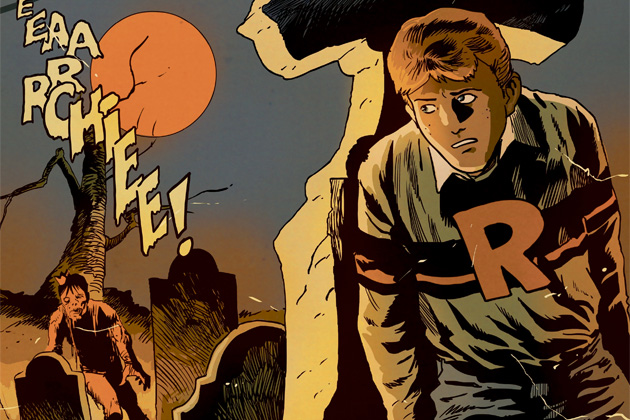
Afterlife with Archie is the most grounded storyline featuring America’s favorite redhead to be published in the past few decades. We have seen Archie team up with Marvel’s Punisher at prom night, jam with the rock band KISS, and hang out with the characters from Glee. In a couple months from now, he will even be sharing an uncomfortable vacation with the Predator.

Archie Comics have never shied away from odd mashups over the years, and it’s a wonder the publishers didn’t set their sights on the zombie genre ages ago. When the book was first announced, I could not help but roll my eyes at the prospect of another zombie-centric storyline. It seemed like another decaying corpse thrown upon a pile of so many other similar storylines.

Yet, somehow, Afterlife with Archie manages to stand out. It remains fresh while so many among it have gone stagnant.

One might argue the storyline borrows from Tim Burton’s Frankenweenie, and simply replaces science for magic. It is functional and somewhat paint-by-numbers, but this never takes away from the overall experience. That is in part because of Roberto Aguirre-Sacasa’s strong script.

Photo courtesy of Archie Comics.

In as little as a few pages, Sacasa establishes the characters long-time fans have come to know, but in a way that is accessible to new readers as well. Archie and his friends remain true to their original incarnations, but with added depth. For example, the indecisively lovesick Archie Andrews is replaced with a version who seems more nauseated with Betty and Veronica.

In this story, more emphasis is given to the strong friendship between Jughead and Archie, an element sometimes not placed in the spotlight due to his uproarious love life. It’s a breath of fresh air, and part of what makes this story so compelling.

Sacasa moves the story along at a steady pace, but never sacrifices character development. Every character gets a moment to shine in this horrific tale. As the story progresses, we are given more intimate looks into their psyches, and a chance to establish strong connections with the often-flawed characters.

Francesco Francavilla’s artwork stands as nothing less than a perfect pairing to go along with Sacasa’s frightening script. On the surface, the pencils are simple enough and get the job done. However, the shading and limited use of colours is what really makes this comic unique.

Using only oranges, blues, and pinks, Francavilla succeeds in striking a horrific tone throughout the whole comic. Whether it be a horrific scene of Riverdale’s undead or an emotionally poignant character’s flashback, Francavilla never misses a beat. His artwork alone is worth the cover price.

Afterlife with Archie is an emotional tour de force, one that will leave old fans as well as new ones on the edge of their seats. Its richly characterized cast will leave you wishing that everyone might live to see a happier ending.

Private comments incite debate at SFSS meeting

0
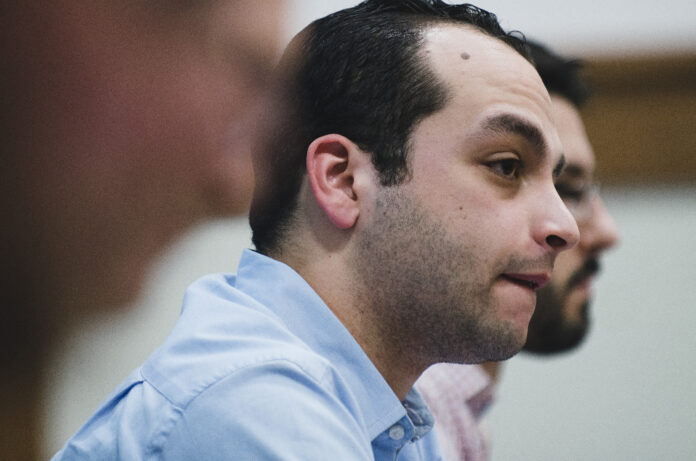
VP student services Zied Masmoudi asked the SFSS president to apologize in front of all the board members.
VP student services Zied Masmoudi asked the SFSS president to apologize in front of all the board members. – Brandon Hillier

Several board members engaged in a heated discussion at the Simon Fraser Student Society (SFSS) Board of Directors meeting on Feb. 4, where concerns were raised over the use of in camera sessions.

At the meeting, VP student services Zied Masmoudi raised his concerns that personal comments had been made against him during the in camera session on Wednesday, Jan. 28.

In camera sessions occur when the board needs to discuss private information without members of the press or the public present. Although these sessions are confidential, Masmoudi referred to its proceedings at the end of the meeting on Feb. 4.

Masmoudi explained that he had been asked to discuss his plans regarding how to move on from the Special General Meeting (SGM) held last month.

“To my biggest surprise, the president responded [to my comments] in a very hostile way, and I was very offended,” he said during the meeting.

He continued, “If doing our due diligence is a reason for us to be accused of dishonesty and to be called shady, [. . .] then I am very concerned.

“I would like the president to apologize in front of all the board members.”

SFSS president Chardaye Bueckert asked Masmoudi to cite the specific instance to which he was referring. He replied, “In the in camera session last week, you called me dishonest and shady for presenting the plan in the in camera session.”

Bueckert responded, “I’m sorry if you interpreted that, but I have no recollection of using those exact words.”

She continued, “My concern, raised in the in camera session — which I guess we’re going to talk about publicly — was that matters that were not meant to be discussed in camera [. . .] were being discussed while concerned members stood outside.”

According to the SFSS bylaws, in camera sessions are to be used for discussion of staff relations, legal matters, or “matters of a sensitive or confidential nature.”

Bueckert told The Peak after the meeting: “While the first two [categories] are pretty clear, I think the third is fairly subjective, so it’s to the board as a whole to decide when and whether or not it is appropriate.”

Bueckert was concerned that these rules were not being observed when Masmoudi began to discuss matters related to the SGM.

After Bueckert explained this during the board meeting, VP student life Kayode Fatoba questioned whether Masmoudi’s request for a public apology was an appropriate use of board time. “Asking a person to offer an apology for something that was done in secrecy itself is cause for question,” he asserted.

Masmoudi defended his raising of the issue: “The attack was very personal, so I don’t care if it was in camera or ex camera.”

Bueckert returned, “So, if we’re done with public admonishments and requests for apologies, if there’s nothing further, can we move on from this?” The board then resumed discussing agenda items.

After the meeting, Bueckert declined to say whether she felt Masmoudi’s comments at the meeting were appropriate, but responded that “in camera sessions are confidential, the contents of which are not to be discussed publicly.”

VP external Darwin Binesh explained how confusion might occur between board members regarding in camera. “While some members of the Board may feel that a conversation is of a sensitive nature and should be in camera, others may not feel the same way,” he said. “This is where disagreements occur, which is natural when decisions are made through votes.”

When asked how the public can be sure that board members are discussing appropriate issues in camera, Binesh replied that all motions and decisions are public and have to be made ex camera.

Binesh also encouraged students who are not satisfied with the decisions of the board to contact them via email or during their office hours.

Omphile Molusi discusses his new political piece of theatre, Cadre

0
Photo courtesy of The Cultch.

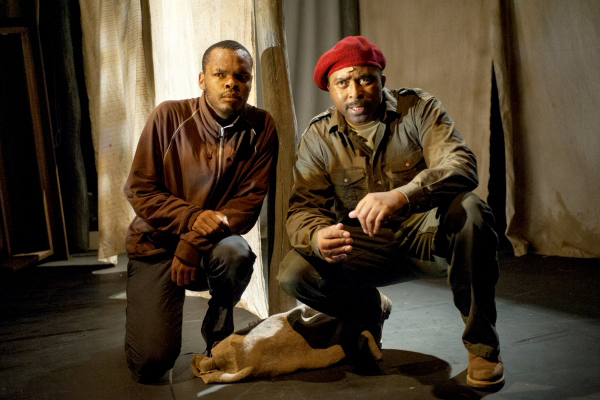
Inspired by Omphile Molusi’s uncle, who spent time in jail, Cadre is loosely based around two events of his uncle’s life as a soldier. It is also a story about becoming an activist from a very young age.

“It is a story about black power. It is the story of Africa, not just South Africa,” said Molusi. The writer and director took a break from what he enjoys most, writing and spending time with his family, to speak with me about his new show.

Molusi began writing Cadre in 2008, and it took him two years to complete a draft. Patience paid off when Chicago Shakespeare Theatre and Market Theatre of Johannesburg joined forces to produce the show’s world premiere in Chicago in February 2013.

The play shows how the same people who fought for democracy have come to betray that freedom, and how, when you can take a look at the past and the present, you are pushed to create a better future.

Photo courtesy of The Cultch.

In 2007, Molusi was the first recipient of the Brett Goldin Royal Shakespeare Company Bursary and had the golden opportunity that “every theatre major dreams about”: he had a chance to spend a month at the Royal Shakespeare Company. He recalls his time there as a “wonderful experience that changed my life and helped me grow so much.”

Molusi mainly writes personal stories, but his background as an activist inspires his writing as well. He started writing family shows, then transitioned into personal stories that double as character studies — much like the style of his idol, William Shakespeare, with whom he shares a birthday.

Molusi started his career in theatre back in 2001 after graduating from Market Theatre in South Africa, where he studied drama. He had recently dropped out of studying electrical engineering; what pulled him into studying drama was the joy of telling stories and touching an audience through language.

He explained that he connects his love of writing with his memory of growing up in South Africa. “When an adult [tells] you something, you are not supposed to talk back,” he recalled. “I chose to respond to the adult through writing, and this created my love for writing.

“It is amazing what writing can do for as you as person individually. It is like something spiritual that no one can see except you.”

Molusi hopes that Cadre’s audiences “will receive the show with [an] open heart and empathize with the characters.” He explains that, in his native South Africa, “the show has been met with two kinds of responses: a white response and a black response.”

He hopes the show has a similar effect during its Canadian premiere at The Cultch. However, Molusi also emphasizes that he hopes audiences will chat in the lobby after the show.

My favourite piece of wisdom that Molusi shared is something that his grandmother told him, and something I personally aspire to. “‘You tell stories of people because as performers, we perform people. And when you perform people, you understand people,’” his grandmother told him. “‘When you understand people, you can respect people. And when you respect people, you learn to live in harmony. And hopefully, we live in harmony.’”

Molusi feels the same way. “Generally, that is the philosophy of my theatre.”

Cadre will be presented by Chicago Shakespeare Theater, Richard Jordan Productions Ltd., and Market Theatre of Johannesburg from February 24–March 8 at The Cultch. For more information, visit thecultch.com.

Woodward’s Watch: found object frescoes in the SCA office

0
Photo courtesy of Adrienne Evans.

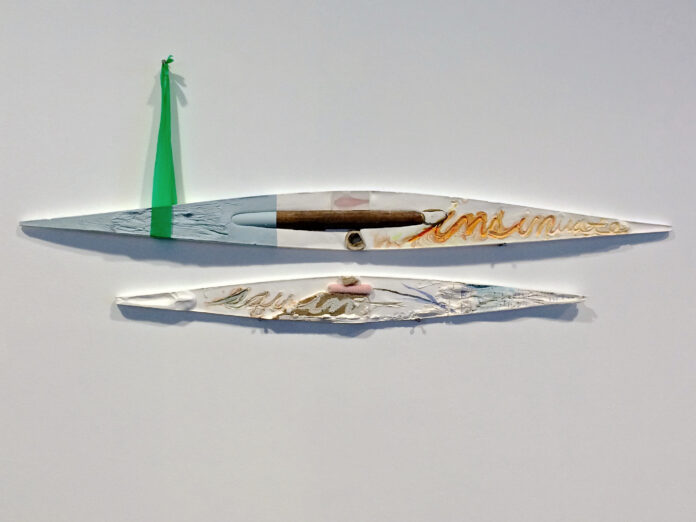
Pulling Through, the current exhibition at the School for Contemporary Arts office at the Woodward’s campus, is a series of paintings on plaster by Adrienne Evans who recently completed her BFA with the school.

While plaster is generally used as a sculptural material by artists both as a medium for creating casts as well as a medium unto itself, Evans uses the material to create distinctly shaped surfaces that are painted on while still wet.

Either kayak-shaped, or cast from paint tubes, these paintings refer to the history between the artist and landscape, as well as to the tradition of fresco painting, but show a sense of humour in their handmadeness and use of found objects.

Photo courtesy of Adrienne Evans.

In this interview, Evans and curator Curtis Grahauer discuss the inspiration for this exhibition and the unique medium.

Curtis Grahauer: In your artist statement, you describe these works as “inspired by a summer spent road tripping and camping in BC.” What is your process of interpreting these experiences?

Adrienne Evans: I start by recalling what I consider to be the “tone” of the experience — the scent, the temperature and the scale of the place — and find colours, textures, and emblematic images that help to conjure them up. It’s kind of synesthetic, kind of symbolic, and also kind of revisionist in that I inevitably reinvent the memories while I’m in this process.

CG: How did you arrive at using plaster this way, to paint in fresco? 

AE: I wanted to paint spontaneously, so I chose a more dynamic surface, liquid plaster, which, for a little while, is almost indistinguishable from the paint itself.

CG: Where does the exhibition’s title, Pulling Through, come from?

AE: It is an allusion to the window-like quality of landscape paintings by artists such as J.M.W. Turner and contemporary painters like Peter Doig. Standing front of some of them, I feel like I’m being pulled through into these amazingly vast spaces, not only in terms of the scene depicted but also the emotional tone. I wanted to make work that pulled me back to my own grand experiences of wild places.

CG: The cast paint tubes are funny. Up close, you can see the seams from where they were cast, but from a distance, they look as though they were taken off of a shelf from a painter’s studio.

AE: Because of their generally lumpy, fluid-filled shapes with little cap heads, I painted them in fleshy, mottled hues like human bodies — inspired by the dramatically lit bodies often shown in classical paintings — and thought of them as little compositions of people on the shelves and slings I placed them in.

CG: What is the relation between the tubes and the kayak-shaped paintings?

AE: Both are an attempt to use a brittle, opaque studio material to evoke something deep and atmospheric. The earliest painting, Squint, was a reference to the eye and how I often squint while out in the sun on the water. While the “eyes” and “kayaks” delineate the scene from an inside perspective, the paint tubes reference the vulnerable body of the seer from the outside. If the kayak-shaped paintings are the vessels, then the little paint tubes are the travellers. Like a tiny human figure depicted in a landscape painting, they give scale to the other paintings in the show.

Pulling Through is on until February 27 at the School for the Contemporary Arts office (GCA 2860). For more information, visit sfu.ca/sca.

Shay Kuebler premieres Glory at the Chutzpah Festival

0
Photo courtesy of David Cooper.

What does it mean to achieve glory? Shay Kuebler wrestles with this question in Glory, his new dance work premiering at this year’s Chutzpah! Festival. The work is a follow up to his debut, Karoshi, and serves as a bold study of violence and its glorification.

The idea for the show came out of Kuebler’s experience growing up watching action stars like Sylvester Stallone, Steven Seagal, and Jean-Claude Van Damme. “I was in martial arts and theatre, and I grew up with a love for action films,” said Kuebler. “I used to make up imaginary fight sequences. I realized how much violent material we were referencing and just [accepting] to be around.”

Kuebler has noticed a trend of violence becoming more acceptable, as viewers become increasingly desensitized. “It keeps being glorified and amplified, and there is a loss of the essence or truth [of what is actually happening],” he explained.

“In some ways it’s just part of human culture; war is something we never escape.”

Photo courtesy of David Cooper.

Abandoning the usual association between victory and glory, Kuebler explores the grey areas of those fighting who don’t want to and the implications of associating something positive with war. Cycles of revenge that lead to endless wars can also be fueled by cultural or religious influences. “The passion they feel for their cause pushes forward this idea of glory,” he said.

Films also support this glorification of war, Kuebler explained. “The more we’re exposed to violence, the more we normalize it. Then it has no bearing on the truth of the matter.” The idea of what is honourable is also an idea that is dealt with in Kuebler’s choreography, and he believes that the idea of honour has also been sensationalized by the media.

Along with an ensemble of five other dancers, Kuebler will perform his athletic, martial arts-inspired choreography, drawing on hip-hop and contemporary dance styles. The show also involves many technical video, sound, stunt, and costume elements that will add to the excitement. 

In particular, Kuebler will be using a special stunt harness, commonly seen in action and kung fu movies. Worn like a vest, ropes can be attached to the harness in many different places, and it is used to secure a stunt person when they are blown back in an explosion or similar scene.

“For some people, a glorious life is having a huge house and a couple cars, but for some it’s sharing it with their family,” he said. In the end, Kuebler, an advanced martial artist of Shaolin kung fu, tai chi, and chi gong, describes his idea of glory as serving a purpose greater than oneself.

“To live with glory is to live with some form of selflessness,” he said.

Glory will be presented by Shay Kuebler Radical System Art from February 21–23 as part of the Chutzpah! Festival. For more information, visit chutzpahfestival.com.

Vancouver International Mountain Film Festival provides inspiration through natural beauty

0
Photo courtesy of VIMFF.

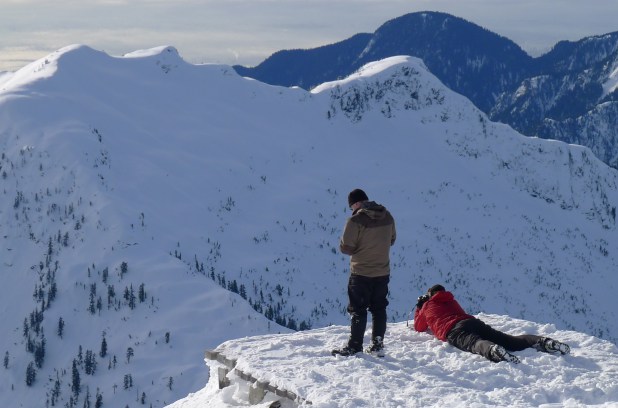
Are you finding yourself daydreaming about ditching the books and getting outside? Look no further for escape and inspiration than the 18th annual Vancouver International Mountain Film Festival (VIMFF). Whether you are already an avid mountain adventurer or someone who gazes longingly out at the snowy peaks extending into the horizons from Burnaby Mountain, you will be sure to enjoy this year’s lineup of films.

Starting in North Vancouver in 1998, VIMFF events have grown to attract over 15,000 attendees from North Vancouver, Greater Vancouver, and other cities across the country. The festival provides a venue for the integration of filmmaking, photography, athletics, exploration, and storytelling, the result being an accessible opportunity to learn and walk away feeling inspired by the natural world and those who choose to navigate and document it.

Photo courtesy of VIMFF.

Each event will be focusing on a theme by bringing together films showcasing mountain sports, adventures, culture, and the environment.

These films will engage the viewer in mountain sports and culture from across the globe. There will be films from the Netherlands, South Africa, New Zealand, Afghanistan, and of course, Canada. The activities featured in these films include ice and rock climbing, mountaineering, mountain-biking, skiing, snowboarding, trail running, paragliding, and more. The diversity and quality of these films will allow viewers to appreciate the beauty and thrill of exploring some of the highest peaks and strongest rivers in the world, along with the sky above it all.

“I always find that after a week at VIMFF I am more psyched to follow my own dreams,” Tom Wright, the festival’s programming manager, told The Peak. But this feeling is not only reserved for the outdoorsy. For those who may not have spent a lot of time exploring the outdoors, the festival offers a unique introduction or gateway to some new adventures from the comfort of your cinema seat.

In addition to films, Wright explained that many of the events will also be hosting guest speakers who will share their stories: “We also have a lot of live presentations that are a mixture of some local adventurers, local filmmakers, and world-renowned adventurers.”

The list of these speakers includes Will Gadd, a celebrated Canadian climber and paragliding pilot who recently became the first person to climb the iced-over rock wall at Niagara Falls; he will be speaking on February 21 at the Canadian Mountain Adventures show.

There will also be a presentation by Adam Ondra, one of the best rock climbers in the world. He will be making the trip all the way from the Czech Republic to speak on February 16 at the Climbing Show.

As Wright accurately put it, VIMFF is “great for sharing stories and getting inspiration.” This year’s festival will provide nothing less, so if you are looking for a reminder that there is more to the world than school and midterms, get your tickets for VIMFF now.

The Vancouver International Mountain Film Festival runs from February 13–21 at various locations. For more information, visit vimff.org.

Cinephilia: Jupiter Ascending doesn’t reach great heights

0
Photo courtesy of Warner Bros.

Two years ago, Cloud Atlas was released. Andy and Lana Wachowski made one of the best films of the decade. Now they have made one of the worst.

You may have seen the trailer for Jupiter Ascending, advertised as “by the creators of The Matrix.” This is technically true. The pair of directors exploded into popular culture with that trilogy of inventive entertainment. The siblings have gone on to make critically divisive movies like Speed Racer and Cloud Atlas, separating most viewers into two camps: the haters who think the directors are pretentious hacks who make dumb, loud blockbusters, and the lovers who argue they are misunderstood genre artists that make baffling avant-garde cinema.

I am a lover — or at least I used to be.

Jupiter Ascending seems to fit with the Wachowskis oeuvre thematically, but qualitatively it resembles sappy YA adaptations and trite Marvel movies. The Matrix changed the generic style of action setpieces and Speed Racer’s disorienting racing sequences achieved a unique candy-coloured poetry.

With the exception of a breathtaking first action scene that is rhythmically edited and meticulously shot, Jupiter Ascending’s CGI design is on par with other space operas like Guardians of the Galaxy. For once, the siblings seem to be behind their competition.

Photo courtesy of Warner Bros.

Like The Matrix and Speed Racer, this film’s protagonist is yet another Chosen One with special abilities. This hero must overturn an evil capitalist system that turns human beings into commodities to be exploited. The villains are a quarrelling alien family fighting over Earth’s property rights. When the mother of the family is killed, her genetic material is reincarnated into a working-class orphan named Jupiter (Mila Kunis) — a young woman who cleans toilets for a living. This proletariat Cinderella is soon swept off her feet by a hunky alien police officer sent to protect her (Channing Tatum).

He’s dreamy, ripped, and half wolf; the latter is for you, Twilight fans. Jupiter’s insignificant life as a working-class maid on Earth becomes an epic adventure when the greedy alien landlords try to capture Jupiter so that she can sign over her planetary possession.

People are constantly double-crossing each other, and key characters randomly disappear. Exposition spews from the characters, but it hardly helps the viewer understand what has transpired. The world-building, plotting, and characterization are not developed visually with nuance, but instead progress with forced, unbelievable dialogue. Jupiter Ascending was scheduled to be in theatres last summer, but Warner Bros. delayed the release to perfect the visual effects and clarify the plotting by reshooting multiple scenes.

Had the plot made sense, I wouldn’t have cared anyway, mostly because none of the actors can sell the hokum. Mila Kunis appears disinterested while Eddie Redmayne, the Oscar-nominated actor who showed talent in The Theory of Everything, has no range here. He’s either whispering so lightly that we can’t hear him or screaming so loud we can’t make out what he’s saying.

Ascending descends because of bad performances from good actors and bad storytelling from good writers. This is the worst kind of horrible film: not a fun-bad movie but a bad-bad, really bad movie. Jupiter Ascending is the most unbearable experience I have had at the cinema in 2015. Don’t let it be yours.

Hot Tubbin’ in New Orleans

0
Photo courtesy of Paramount Pictures.

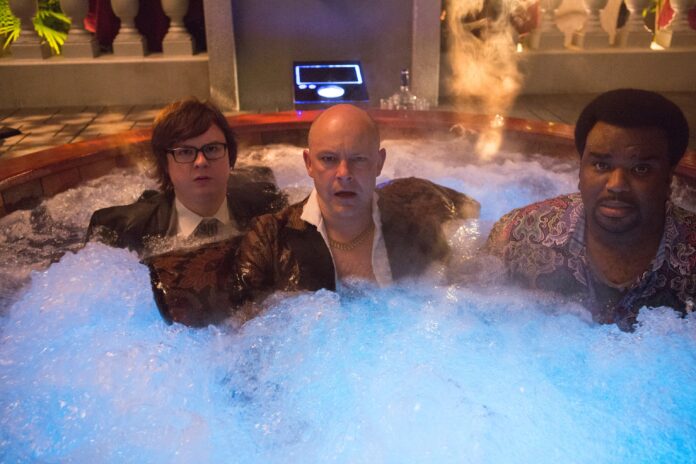
The gang from Hot Tub Time Machine return to the big screen on February 20. . . for the most part, anyway. Stars Rob Corddry, Clark Duke, and Craig Robinson reprise their roles — as Lou, Jacob, and Nick respectively — while Adam Scott takes the place of John Cusack, playing Adam Yates Jr., the son of Cusack’s character. The four of them participated in a conference call and answered questions from various campus newspapers.

Perhaps in the most challenging role as the newcomer to the series, Scott noted that he tried to take certain things out of Cusack’s performance in the first film, saying, “I think that Adam’s character in the first movie has sort of a thirst for knowledge, and I think that Adam Jr. is looking for his dad, he wants to find his dad whom he’s never actually met. And so, I think they have a similar sort of adventurous [side]. And somewhat similar eyebrows,” added Scott jokingly. “And also made a lot less. The difference would be only monetarily.”

One of the other main differences between the two films is the filming location. The first movie was filmed locally here in Vancouver, as well as a city in the southeast corner of British Columbia called Fernie, while the second one was filmed in New Orleans.

Photo courtesy of Paramount Pictures.

“[The attitude on set] was the exact same which was really comforting and fun and made it an easy work environment,” commented Corddry. “The difference was we were in New Orleans. So, there were a few more parties, the first time was in Vancouver.”

“It was cold,” added Robinson.

“And it was cold,” responded Corddry. “This was New Orleans, the height of the summer. And so, you know, alcohol and heat.”

“Our trailers were not as good on this movie because the budget was short,” said Robinson.

One thing that remained the same was the willingness to let the actors run with improvisation. “[Director] Steve Pink allows us to play around, and he encourages it, everybody is pitching jokes to each other,” said Corddry. “So the first Hot Tub there was barely a script, it was like we would come and we would say, ‘OK, we’re doing the scene in the [ski lodge].’ And then we kind of improvised it. I mean there was a script but we really did a lot of heavy improv. This one was a little more solid, except we got to play around a lot.”

“Neither film had a written ending. Not a joke,” noted Robinson.

“All the great films have no ending,” chimed in Scott.

With the last question, one student reporter asked if there would be a third film — interesting given that, though the first one wasn’t a huge box office success, it fared well in DVD sales.

“I think the real answer is, if this makes money, yes. If it doesn’t, then no,” said Scott rather bluntly. Robinson was a bit more diplomatic, saying, “If you’re asking will we come back together and work together, you’re goddamn right.”


The difference between hearing and listening at the Richmond Art Gallery

0
Photo courtesy of Stephane Bernard.

Painters today are faced with over 100 years’ worth of modernist experiments in painting on a flat canvas. For that reason, a select few have come to reinvent this millennial artistic practice through a change in process. In other words, by rethinking the act of painting itself, artists are producing new works that infringe on media usually considered as separate art forms, such as sculpture, video, and installation. Even the canvas as a support can be made to disappear entirely.

And this is where the central comparison of the Richmond Arts Gallery’s Close Listening exhibition comes from: the difference between hearing and listening. From an auditory standpoint, it is the same as the distinction between applying a coat of paint to a surface for decorative purposes and creating a work of art. In my opinion, if an artist isn’t challenging how the painting is being done by changing things up, they’re not paying close enough attention.

The trouble with painting in the present day, when compared to the difficulties of the past, is often a question of medium. I mean, why continue painting when photography, video, and the rise of hand-held digital devices now offer a multitude of easy ways to capture and share the world around you? Of course, this is simplifying things a bit, but it is essentially the dilemma that was faced by painters after the appearance of the camera at the end of the 19th century.

Photo courtesy of Stephane Bernard.

Artists of the day were scrambling to reinvent painting as a means of economical survival; one could argue that such movements as impressionism, cubism, and expressionism were born from a simple need to represent the human form in new and innovative ways. Likewise, abstraction appeared in Western painting around the same time, which is no mere coincidence; it’s because the presentation of shape, form, colour and line offered a visual language that was unique from the reproduction of images by novel technologies.

Luckily, a number of painters are pushing the art form beyond the picture plane, and Close Listening, curated by Ola Wlusek of the Ottawa Art Gallery, brings together four of the best-known Canadian artists pushing these boundaries to the Richmond Art Gallery.

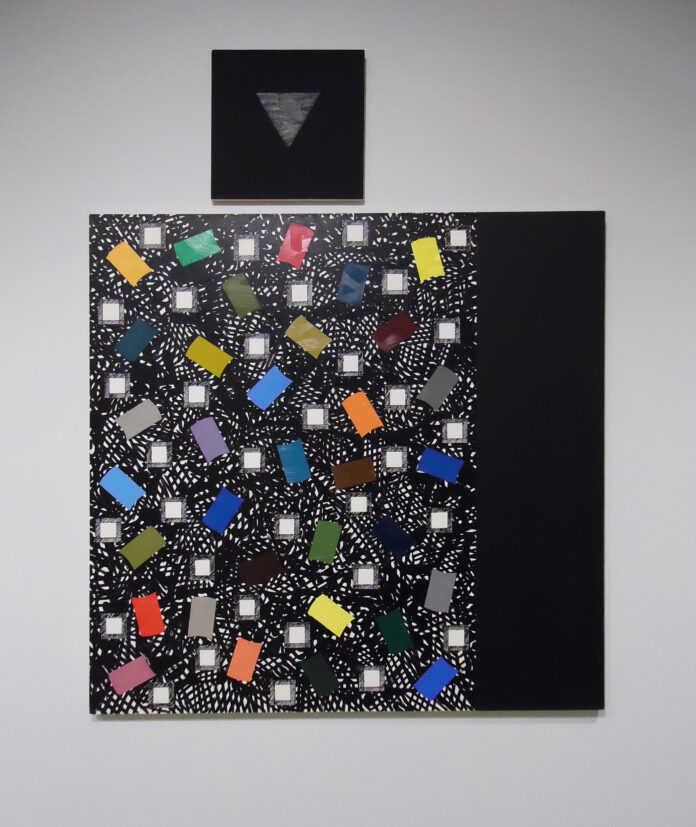
The first to be presented in the space is Eli Bornowsky. Having been widely exhibited in Vancouver, his large-format diptychs can appear somewhat familiar, though several smaller wooden pieces from 2013 breach the third dimension with the addition of coloured spheres. Punctuating this same space are works by New York-based Monique Mouton, oil paintings rendered on biomorphicly shaped wooden panels.

Just a bit further off, the work of Vancouver resident Jeremy Hof can be seen. In this case, layered coats of acrylic paint are excavated to lay bare the technicoloured strata of the medium. As such, both painstaking addition and judicious subtraction play a key role in the final work.

Lastly, the circular gallery space houses several pieces by Korean-born Jinny Yu, who now calls Ottawa home. Appropriating lengths of mirror, sheets of aluminum, or large industrial counter tops into the vocabulary of painting is no easy task, yet Yu’s works presented offer a formal consistency that speaks for itself.

Suffice it to say that the exhibition deals with painting from a conceptual point of view. At the risk of creating a show that is overly intimidating to casual art fans, the curator has selected an accessible number of abstract works that clearly survey the creative concerns of attentive painters in the present day.   

Close Listening is at the Richmond Art Gallery from January 31 to March 29. For more information, visit richmondartgallery.org.