Home Blog Page 1065

Volleyball team wins last game of season in Alaska

0
SFU capped off their best season in the NCAA last Saturday.

Last Saturday, four volleyball team members played their last game for SFU, capping off their time with the Clan properly with a 3-0 sweep.

Brooklyn Gould-Bradbury, Kelsey Robinson, Madeline Hait, and Amanda Renkema all played their final Simon Fraser game against the University of Alaska-Fairbanks Nanooks, who only had three wins on the season.

Despite the sweep, it was a close game with SFU winning by only two in each set.

The Nanooks jumped out to a 13-6 lead in the first set, but the Clan battled back thanks in part to a five-point streak which included two kills by sophomore Devon May. SFU would win the first by a score of 25-23.

The Clan scored first in the second set, but once again Alaska-Fairbanks would take the lead — this time they would hold it for much of the set. It looked as though the Nanooks would split the series, as they were up 23-21 and only needed two points to seal the deal.

SFU once again responded, however, with Robinson notching two straight kills (in a three-kill streak) to claim the lead, before May made the final, ending the set 27-25, putting SFU up 2-0.Screen Shot 2014-11-21 at 7.24.55 PM

The third set was truly a back and forth effort for both teams. After the Nanooks put the first point on the board, SFU put up four straight points — only to have the Nanooks score four right after.

In the end, the Clan were too much for the Nanooks, winning the third set 25-23, and completing the sweep.

The win further solidified SFU’s season to remember, putting their record at 17-9 total, and 11-7 in the Great Northwest Athletic Conference (GNAC). They nearly doubled their previous best in conference wins (six), notched last year. This is their first winning season since joining the NCAA.

For the Clan, one of the most significant challenges during their final game was keeping their emotions in check, however, head coach Gina Schmidt felt the team accomplished this.

“I think they did a good job of staying composed,” she said.

Robinson, who finished the game with 12 kills and 12 digs, was pleased with her final game, saying, “We ended up with a win and that’s probably the best thing you can ask for.”

For Robinson, the realization that this was her last game began to sink in as the game came to a close: “In our very last set — it was very close — so I was like, ‘This could be my last set.’

“I’m definitely going to miss it,” she added.

While the seniors move on, the Clan will have to replace the holes left by losing four starters.

“We’ll definitely look for our returners who didn’t get as much playing time this year to step in because they’ve now had one, two, three years to know what I’m looking for,” said Schmidt. “I think you’ll see some of those players step up and fill in those roles.

“We also have a very good recruiting class coming in and they’ll compete for those roles as well. My job is to put the best six or seven players on the court regardless of the year they are.”

The week in comics

0


online agoraphobia
The Adventures of Agoraphobia Man: World Defender (Jacey Gibb)

onlineCMYK- Roll Up The Rim-The Peak
Pun 2 3 (Sarah Walker)

Ski Ninja

CMYK Students pros and cons (Evgeny Vinnik) (1)
Pros and cons, according to your status in post-secondary (Evgeny Vinnik)

Proper campus lighting is a much better solution than Safe Walk

1

Before any late night exam at the SFU Burnaby campus, most instructors are required to present students with the phone number for SFU’s Safe Walk program. The necessity behind such an action should be obvious; anyone who has walked to the bus or parking lot after one of these late sessions will quickly realize just how dark the school actually is.

And if you are someone who usually finishes an exam early, there’s a real possibility that you’ll be walking to your destination alone, all the while muttering amazement at how empty a campus as big as SFU can suddenly become.

Having recently done this myself, it is remarkable that a school can prove to be so incapable of providing adequate lighting come night time, while simultaneously justifying the fees it charges to its students.

After all its years of existence, there are some areas of the school — such as the AQ pond — that are so dark that one feels overwhelmed upon stepping out the door. And depending on where you exit from, the darkness can be accentuated even more by trees, which seem to punctuate the blackness all around you.

SFU is so dark at night that one may feel overwhelmed.

But then, this is where the Safe Walk program is intended to help. “Call the number,” the instructor will say, “and you will have someone escort you through the school.” But as well-intentioned as this is, the onus should not be on the student to ensure their safety. One reason for this is simple pride. As a young male student during my first year at SFU, I was certain that I was never going to make use of this offer.

Women are not exempt from such mentalities as well. A friend of mine thought it would have been too selfish of her to utilize the program simply for her sake, and decided to risk the lonely trek.

I should tell you that I’ve had two near physical altercations while walking on campus at night. The sight of me alone was enough to invite people of the worst character to indulge themselves, shadowing my every move with curses and threats, until I managed to run into a building or dissolve into a crowd of people, the unexpected sight of which calmed the haunting fears that come with being threateningly stalked.

I can assure you that at both junctures, escaping was the only thought that occupied my mind, not the fact that a dark campus lodged somewhere on a mountain peak afforded them this opportunity.

SFU has an obligation to safeguard its students. The lighting structure at SFU has to be improved. To this day, there are areas that are pitch dark, and to manoeuvre around campus, students must walk through these areas. As dangerous as the Surrey campus is, one can at least be sure of a thick population of active people walking around it. The Burnaby campus must create a safer environment, rather than encouraging students to call a number.

Livin’ the small town life

0

Vancouver welcomed me nearly three years ago. While I’d visited the Lower Mainland a few times previously, the gargantuan metropolis provided me with a new context — these enormous buildings, this futuristic train whizzing through the sky, the never-ending sounds of man-made movement. I felt a stirring excitement interrupted by bouts of awe and uncertainty that were expected upon moving to my new home.

After bidding farewell to the small town in which I grew up, I vowed to myself that I would never return for periods lasting longer than four months at a time. I was fed up with the never-ending sea of trees, the terribly rusted pick up trucks, the horses that trot through the Dairy Queen drive-thru, and most prominently, with recognizing the same damn people every single day.

Let me paint a general picture of what living in a rural setting for 18 years can be like. The small group of people you graduate high school with are most likely those who you went to preschool with. As such, you can’t avoid learning of all the trials and tribulations in your peers’ lives.

Some of you may see the positives in this situation, but those positives are also accompanied by the sinking realization that these are the only people in your world. There are rarely any fresh faces in the crowd, no new individuals to get to know and form friendships with.

Additionally, I’ll attest to the stereotypes of small town gossip; because everyone seems to converse with one another, it can be incredibly difficult to maintain a private life. I even remember instances where certain community members suddenly passed away, and many people in the town spread word of the tragedies before the family members of the deceased had even learned what had happened.

Generally speaking, those who have rarely left the small town in which they grew up are secluded in a dome of specific ideologies, with limited knowledge on what the world is like beyond the town’s borders.

Those who have rarely left their small town are secluded in a dome of specific ideologies.

Moving to Vancouver was overwhelming in that many of the people here had endlessly different perspectives on life, and were diverse in how they interacted with each other and even in what they wore.

I understand if it’s difficult for you to grasp my feelings — many of the friends I’ve made in Vancouver usually tell me they can’t — but the contrast between each setting surprised me upon my arrival.

Returning to my land of ignorance this past summer had me critically assessing my surroundings. Working at the local tourist centre, I met with families from around the world who were “awe-struck by the natural beauty of this tiny place,” by “how friendly the people are,” and how “everything is so close and convenient.”

Yes, a few visitors were put-out that there was no Starbucks or McDonald’s, but my mindset on ‘nowhere-ville’ shifted slightly upon hearing that European families were vacationing in the area for a couple of weeks at a time.

So I spent the summer hiking and exploring some of the outdoor areas that I’d visited before but had never given much attention to while growing up. I placed myself in the shoes of a city-person, absorbing my environment as if for the first time. The conclusions I came to transformed my perspectives on rural living.

I came to understand that, while cities like Vancouver offer immense opportunity in the hustle and bustle of daily life, small secluded towns and their surroundings can offer a place of quiet, relaxation, peace, and natural beauty; mine is a place that I have a connection with and can return to should I need to unwind, breathe, and ponder my next steps in life.

Sure, visiting the grocery store is a chore, as I can’t turn an aisle without bumping into someone I know who’ll want a full report on what I’ve been doing the last three years, but I can say that I feel privileged to understand the true differences between rural and urban living.

I look forward to returning home for a quiet Christmas with my family and friends, and waking up each morning to the feelings of homey comfort without so much as the sound of a car passing by.

SFU achieves royal victory

0
Roderick Taylor-Evans notched 18 points, and was third on the team in scoring.

When the Clan met their non-conference provincial rivals, the Douglas College Royals, on Tuesday night, it was not expected to be a close game — nor was it. The score sheet displays a 90-point victory for SFU, 147-57.

However, the Clan were held off the scoreboard early, and despite clearly dominating the play from the first second, they couldn’t net one until about two minutes in, when freshman Patrick Simon scored twice in a row to put the Clan up 4-0.

“We [need to] shoot the ball a little bit better than we did in the first 10 minutes,” said head coach James Blake.

Once the vault opened, however, SFU started racking up the points. It took star guard Sango Niang just over nine minutes to score his first of the game, but he finished second in scoring with 20 points, and first in assists with 11.

Simon would be the star of the first half, putting up 15 points, but slowed down in the second half, only notching two more.

Although the Royals were clearly outmatched, the game was a back and forth effort, featuring blink-and-miss-it action. The Clan controlled possession more often, Douglas’ main weakness was an inability to put the ball in the net, despite an abundance of chances.

In particular, 6’9 Douglas forward Reng Deng was a pain in SFU’s backside, leading the Royals in scoring with 17 points.

The Clan went into halftime up 76-31, already a sizable lead, and a higher score for SFU than the final of many of last season’s conference games.

Douglas actually gunned to the quick start in the second half, taking their point total to 35, before Niang put in a three-pointer to open up SFU’s scoring in the second. The Clan would score another two three-pointers immediately, including another by Niang, to once again take control of the game.

At one point, SFU scored 25 straight points, showing off the fast-paced Clan offence at its finest.

Guard Justin Cole led the Clan in points with 21, and tied with Niang and Roderick Taylor-Evans for field goals, making eight of 15 attempts. Forward Michael Harper led the team in total rebounds with 13.

With the win, SFU remains undefeated (not counting their Division I exhibition matchups). They have yet to be tested in the Great Northwest Athletic Conference (GNAC), however.

Coach Blake was pleased with the team’s effort, noting that he was unhappy with the team’s previous game despite the fact it was a 135-103 victory.

“We responded, I thought Saturday night we were really sloppy and we just kind of took the game for granted,” he explained. “We worked on [. . .] attitudes: attitudes on the bench, attitudes pressuring the ball and not giving up on possessions.

“It doesn’t matter the level of competition, [. . .] you play the same way,” he concluded.

Before returning to the West Gym, the Clan will travel to California to face four different teams. On Saturday, December 6, when SFU returns, they will face their first GNAC opponent, the Western Washington Vikings, who finished second in the conference last season.

Reflecting on mental illness

3

My name is Alison. I’m 21 years old, and I’m just about to finish my undergrad degree. I know it seems silly to introduce myself with my name and photo right there in the byline, but I think it’s important that you know a little about me.

I’m a pretty average young adult. I have a good GPA. I have a job that I love, and that I worked hard for. I have a lot of things going for me. I also have a mental illness.

I had my first panic attack when I was 15. I didn’t know what was happening. It was incredibly frightening. My body rebelled, taking the stress I felt and turning it into very real, painful and — at its worst — debilitating physical symptoms. While I struggled through coming to terms with this new invisible obstacle, I missed a lot of school, not something that was easy to explain to my 10th grade peers. I was embarrassed. When I told my friends about what was going on, they would say things like “don’t worry, things will calm down after exams” or “yeah, I get stressed out a lot, too.”

Sometimes I’m perfectly fine. I’ve gone years without my anxiety causing any disruption in my life. But then it comes roaring back, reminding me that at any time my brain can overload and cause my body to effectively shut itself down, to go into survival mode.

Being able to share what’s going on inside my head is the most valuable thing in my relationships.

This year, my anxiety came back with a vengeance, in a completely different way than it had in my teens. The experience was so different that, again, I didn’t recognize what was happening. Being in university and dealing with a mental illness is no easy thing. Odds are that there are plenty of people you personally know who could attest to that difficulty, even if they’ve never breathed a word about it to you.

I can’t speak for every student dealing with a mental illness, and to do so would be presumptuous. For me, it’s been a very isolating experience. While my friends carried on doing things that university students do — going out, drinking, socializing . . . all things that I love to do, too — I started to stay home, feeling safer somewhere familiar, afraid of how my body may react in an uncontrolled situation.

It’s also nearly impossible to properly explain. Mental illnesses such as depression and anxiety have become less and less stigmatized over the past decade, but they are still incredibly difficult to understand for those who haven’t experienced them. For my friends and family who are unfamiliar with anxiety, it can be tough to understand why I’m not able to go to flag football this week when I’ve seemed fine and happy all day.

Understanding may come, but it’s okay if it doesn’t. Being able to share what’s going on inside my head — which I often don’t understand myself —  has become the most valuable thing in my relationships. Listening. Caring.

You can’t always know what’s going on with the friend who’s been skipping your shared tutorial lately. But you can listen if they find the courage to reach out.

Student groups investigate mould issues in Louis Riel

0
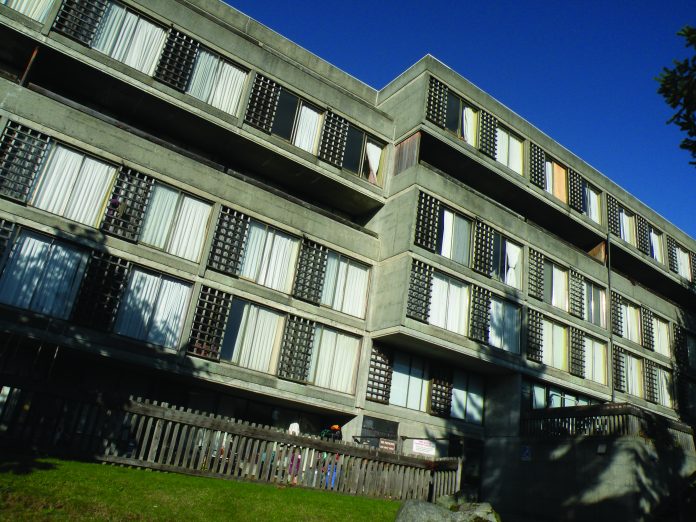
Louis Riel provides housing for SFU graduate students and their families.

Concerns have been brought to the Simon Fraser Student Society (SFSS) Advocacy Committee over the fact that students in residence are living with mould; this has been a persistent problem at the university over the past several years.

The problems are particularly concerning in the Louis Riel Building, which provides housing to graduate students and their families. Both the SFSS and the Graduate Student Society have taken a keen interest in the issue.

Students and university staff alike have raised complaints, including many reports regarding moulds growing on walls and those moulds becoming airborne.

According to Darwin Binesh, SFSS VP external relations and the Advocacy Committee chair, members from the SFSS and Student Council, as well as representatives from Teaching Support Staff Union (TSSU), held a meeting in order to come up with possible solutions and strategies for the issues in Louis Riel Building.

The first step that the Advocacy Committee discussed was to raise awareness of the situation amongst students and to bring the matter up to the university as well.

“One thing that we have been looking to do as a society is to speak to the City of Burnaby,” said Binesh. The SFSS plans to approach municipal politicians regarding the issue to see if there is an opportunity for funding for the improvement of Louis Riel Building.

When asked what the SFU administration was doing to address these concerns, Terry Waterhouse, SFU chief safety officer, said, “We are in the process of doing a full building assessment [on a room by room basis regarding moulds and indoor air quality], and we are expecting the [building] report to be finished by January 2015.”

As soon as the report has been released, Waterhouse said that they will make a determination on what type of improvements need to take place in Louis Riel.

Currently, if a severely damaged condition is reported, they have to relocate the occupants and initiate repair for the specific room.

“We are currently relocating the students who are impacted by the bad condition, and we will continue to do that until the repair is finished, and we would not bring new students in until the spaces in residences were remediated,” noted Waterhouse.

Even though the report is due in January 2015, Waterhouse emphasized that building assessment is an ongoing process.

With regards to financing necessary repairs, Waterhouse explained that the money will have to come from the university budget, and that it would be up to the Finance and Administration department to allocate these funds.

Concerns over mould in residence have been raised over the past two decades, and are due in part to a lack of maintenance by the university. There has been an ongoing discussion surrounding the possibility of toxic mould in other buildings on Burnaby campus, such as the Education Building and Robert C. Brown Hall.

Although the university has examined some of these issues previously, the administration is now taking a closer look at Louis Riel in particular. “This is the first time that we have to look at the entire building,” said Waterhouse. He explained that, in the past, there were some issues about moisture causing mould in other buildings, but the issues were handled on a one-by-one basis.

Waterhouse noted, “When we have reports and concerns, we respond to those as thoroughly as we can, and we have a very comprehensive set of methods that we use to determine the scope of the problem, and make sure we remediate [it]. We do not leave those spaces if they are problematic and we respond to those immediately whether [it is one room or the entire building].”

When asked what students can do, Waterhouse said, “We really encourage the students living in the residences to make sure that they are aware that they should be reporting the concerns they have about the quality of their rooms, especially regarding moulds, and we will be responding quickly.”

Dance team to perform at the Grey Cup

1
The SFU dance team was founded by dance major Allison Sidnell and secondary education student Caitlin McMahon.

You may not have heard of them, but SFU’s dance team is already making waves. They are poised to represent SFU at the Canadian Football League’s (CFL) 102nd Grey Cup hosted in Vancouver on Sunday, November 30.

Despite the fact that they are performing as part of the Grey Cup festivities, the club was only founded earlier this year — in March — by dance major Allison Sidnell and secondary education student Caitlin McMahon. Sidnell, who graduated from the University of Guelph with a bachelor of arts, was shocked at the lack of opportunities for dancers at the Burnaby Campus.

“I went to a basketball game last year sometime, and I realized we don’t have a dance team, then I looked into teaching classes,” explained Sidnell. “[But] there wasn’t really much offered for dancers [at SFU Burnaby].”

She continued, “There is a lack of opportunities for dancers outside of the dance program and those that aren’t majoring in the dance program don’t have an outlet for dance. That’s why Caitlin and I started the dance team — to offer a way for dancers with experience to dance and perform in the [non] professional world.”

Sidnell and McMahon proposed their idea for the creation of a dance team to SFU Athletics and got it approved. When the time came to actually get the group up and running, 40 students auditioned, with 17 making the final cut. Sidnell and McMahon had to turn away 15 more students because they were too late to audition — clearly, there was plenty of interest.

McMahon points out, though, that the level of experience is varied on the team: “It’s a range of dance experience within our team, which is what we wanted when we started this. We wanted it to be something that everyone with different dance levels could be a part of.

“We have people who have been dancing since they were three, [and people] who have been dancing for a year or two. So there’s a great range and it’s a great opportunity for people to just come in and harness their dance abilities,” she added.

Sidnell notes that many of the team members are from outside the dance program: “It’s a good mix, we’ve got some dance majors, and then we’ve got a lot of first years who don’t have time to be in the dance program for whatever reason, but they’re really committed, dedicated dancers in their high school years, and they come to university looking for dance experiences and that’s where we come in.”

The team did not take long to gel together, as Sidnell explains, “Within a couple of practices, they were already very close and a lot of them made friends with each other.”

Since then, the dance team has performed at many of SFU’s varsity games, including the homecoming football game and at both men’s and women’s basketball games this season.

The team’s most recent crowning achievement, though, is their being recruited to perform in the pre-game festivities for the Grey Cup.

“We just got an email one day, saying [the CFL] were just looking for some university involvement in the kickoff event,” said McMahon. “It was amazing to be asked to go to the Grey Cup because Allison and I never thought anything like this would come our way, especially in the first year, so it’s a great opportunity and we’re really excited.”

The dance team will participate in the Fan March, which takes place before the game, as the Grey Cup is carried from Jack Poole Plaza to BC Place.

The amount of practice required to pull off such a performance couldn’t come at a worse time of year, with papers and finals right around the corner, but Sidnell emphasized the dedication of the team: “We’ve got quite a few practices going and it’s the busiest time of the semester, so we’ve got a really committed group that comes to every practice.”

Sidnell hopes to see some SFU students at the celebration. “We’re really excited for the Grey Cup. We’re encouraging students to come and support us at the performance.

“We hope for SFU students [. . .] to participate in the march or some festivities at the Grey Cup this year,” McMahon concluded.

Sports Briefs

0

Hockey

Last Saturday, SFU Hockey achieved a tight 1-0 victory over the Selkirk College Saints, despite being outshot 32-22. Forward Michael Sandor scored the only goal of the game in the second period from Tyler Basham and Adam Rossi. Goalie Andrew Parent made 32 saves for his shutout performance. As of Thursday, November 20, SFU sits at fourth in the league with 10 points.

Women’s Basketball

Clan women’s basketball team opened their season with two wins last weekend on a road trip to California. Friday, November 14, they beat the Notre Dame de Namur Argonauts 93-64, and the next day, won 78-61 over the Academy of Art Urban Knights. In both games, Erin Chambers led the scoring, putting up 28 and 33 points respectively.

Football

Middle linebacker Jordan Herdman was named the Great Northwest Athletic Conference (GNAC) defensive player of the year. Herdman broke both the single game and single season records for tackles in the GNAC, and finished second in NCAA Division II for total tackles, averaging 15.0 tackles per game. Academically, Herdman dominates the GNAC as well, putting up a conference-best 3.99 GPA, making the 2014 GNAC Academic all-conference football team.

Gift cards, crisp $20 bills top this season’s list of most wanted gifts

0
Retailers are already reporting a shortage in gift cards of every numerical value.

With Christmas still over a month away, the crunch is already on for some people trying to get their holiday shopping done before crowds take over the mall. Though data is still emerging on what retail items will be the hottest sellers this December, a few early front-runners have already got parents fighting over limited supply: according to Business Sales (BS) magazine, the ‘it’ gift for 2014 just might be a tie between gift cards and slightly-worn $20 bills.

“It’s a definite departure from the Tickle Me Elmo and Buzz Lightyears of previous years, but it makes sense,” reports Steven Roy, one of the chief analysts for BS magazine. “Instead of wasting money on material goods and things we’ll lose interest in as soon as we actually own them, people want to participate in the thrill of direct consumerism themselves.”

Unfortunately for any last-minute shoppers, businesses everywhere have already started selling out of gift cards weeks ahead of Christmas.

“Just because the demand is up doesn’t mean the supply will adjust accordingly,” warns Roy. “Most businesses start preparing for Christmas around the summer time, so even if there’s a jump in popularity around October/November, there isn’t a lot retailers can do except try to avoid making the same mistake next year.”

Many parents have begun turning to eBay in hopes of finding a gift card for their child to open on Christmas Day, but reports say that prices online have been inflated by up to 300 per cent of their retail value.

“My five-year-old daughter wrote a letter to Santa months ago asking for a Dollar Giant gift card and the cheapest one I can find online is for $75,” an exasperated parent commented on Dollar Giant’s Facebook wall. “What am I going to tell her on Christmas morning when she unwraps all of her presents and none of them are a gift card? She’ll lose faith in Santa completely.”

Similar concerns are being voiced about the season’s other most-popular gift, a $20 bill. Demand for the increment of money has spiked over the last month and the Bank of Canada is saying they’ve had trouble keeping up.

“I’d say early November all the way into January is our busiest time of the year,” says Bank of Canada employee Maria Yoshida. “We implemented an annual pre-order system back in 2012 so people could order their $20 bills in October and have them guaranteed before Christmas but we always run out of stock regardless. I just wish there was something we could do to help people who are going to have to face Christmas without $20 bills.”

The Bank of Canada has begun a registry for people still interested in $20 bills, but they are unable to guarantee any new shipments between now and December 25.