Home Blog Page 1061

Lake tsunamis: the threat is real

0
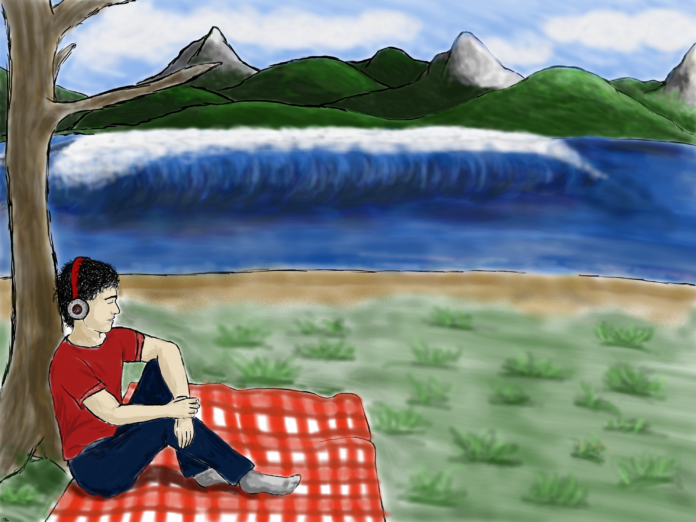
Watch out, unsuspecting lake-goers! - Talha Qadir
Watch out, unsuspecting lake-goers! – Talha Qadir

Lake tsunamis are a real and dangerous threat that an SFU professor believes British Columbians need to be more aware of.

According to John Clague, an SFU professor in the department of earth sciences, “The public and other government agencies don’t seem to be aware that this is a hazard that is potentially a deadly one.”

Clague became interested in this research after observing the consequences of the 2007 landslide into Chehalis Lake. The impact of the unstable shoreline hitting the water caused a wave that exceeded 30 metres.

If this event had occurred in the summer months when individuals had been camping along the lake, Clague asserts that it could have resulted in deaths. “If that had happened in July it could have killed 50 people!” he exclaimed.

When landslides cause lake tsunamis, the waves they create spread away from the point source much in the same way as they do when “throwing a pebble into a pond.” However, these waves can be very large, and have the potential to do a lot of damage.

These are distinct from the tsunamis caused by earthquakes that affect large areas and travel far distances. The effects of landslide tsunamis are highly dependent upon location. As Clague explained, “A big enough landslide falling at a high enough speed can produce very, very large waves, but they diminish faster away from the source”.

The 1958 tsunami in Alaska — the largest in modern history — was actually the result of a landslide that was triggered by an earthquake. The landslide drove a wave into Lituya Bay that ran 518 metres up the opposite slope of the inlet, stripping the old growth forest.

British Columbia contains many lakes and extensive fjords along its coastline that put it at a particularly high risk for this type of tsunami. In Norway, where there is a similar coastal geography and a more densely populated coastline, landslide-triggered tsunamis have lead to more than 100 deaths this past century.

With increasing coastal populations in British Columbia, Clague explained, “We need to look at our coastlines and look at our lake shorelines, and identify areas where there might be a hazard. Right now, we just don’t know.”

The American Dream is alive and well in McFarland, USA

0
Photo courtesy of Disney Studios.

Jim White loses his job at an affluent high-school where he coached football, and relocates to a poor rural area, McFarland California, where his white privilege is tested. There, he learns to accept his Mexican immigrant neighbours.

White coaches the school’s cross-country team of teenage boys to not only be fast runners, but educated young men with aspirations to do more than just work on the fields of their farming community. Do they win the championship? Does the coach begin to recognize his own sense of superiority? Do the teenage boys go to college? McFarland, USA is a Disney movie, so these things are never seriously doubted.    

This Kevin Costner film is set during the 1980s, but its message and conflict are attempts to rejuvenate today’s American culture that has lost its hope in the American Dream. Costner spoke to The Peak about his upcoming film and why he believes it will resonate with audiences even with a predictable story.

Photo courtesy of Disney Studios.

“Films are emotional experiences,” Costner said. “When movies are working at their very best, they become about moments that you’ll never, ever forget, and we carry the moments of films throughout our whole life.”

A hint of marital conflict, a strain in a father-daughter relationship, and a dose of economic hardship has Jim feeling like he’s being torn apart on and off the field. “Jim White had to balance his own life, his own daughters who maybe took a backseat sometimes to these boys, who may be asked a question point blank: ‘are we as important as these boys?’” Costner said.

The story is Disney-fied, but true. The boys of McFarland won nine cross-country state championships while changing aspects of a community’s culture in the process. “What makes it inspirational? Just the fact that there’s a level of authenticity,” said Costner.

According to Costner, the original script did not have this authenticity: “A writer writes a story in the way that he thinks.” Jim is presented in the film as a strict but caring coach. “As I read about Jim White in Sports Illustrated, as I read this story, to me some things that were in that script did not jive [with] what I thought would be possible. There’s no way that the results could have happened from these young men given some of the things that the character was doing,” Costner explained.

Consequently, the boys’ farmer parents recognized the value of education and they aspired for their children to have the opportunity of some other vocation. McFarland, USA follows almost every sports movie trope, but at heart it is about the power of the American dream. “And I think the things that get set in McFarland, seeing these people firsthand, up close in these fields that they’re simply working there, these incredible hours through very difficult weather conditions, every day of their life for one reason and one reason only: to advance their children and to give their children a better opportunity.”

At a time when people are calling into question their patriotism, McFarland, USA serves to inform us that the American Dream is “alive and well in McFarland.” Predictable and formulaic or not, Costner believes the film’s power is in its message: “There’s nothing more American than a parent trying to make their life better for their children.”

Louis Riel residents form working group to protest potential closure

0
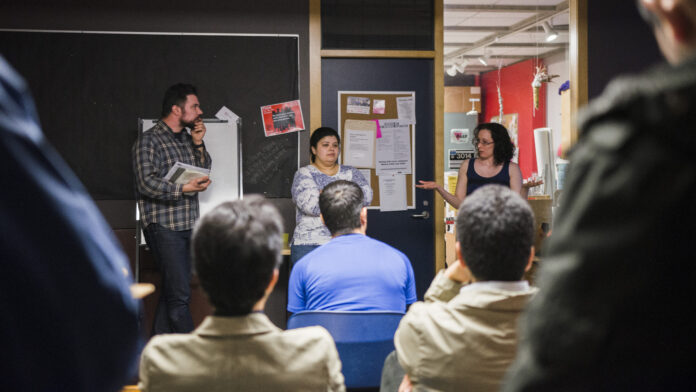
The working group has been meeting on Fridays at the SFU Women’s Centre.
The working group has been meeting on Fridays at the SFU Women’s Centre. – Brandon Hillier

Concerned residents of the Louis Riel residence at SFU Burnaby have formed a working group to advocate against the building’s potential closure.

Formed on Friday, Feb. 13, the group has launched a petition to ensure that “all the current and future low-income families and graduate students in Louis Riel House are provided with appropriate housing on the SFU Burnaby campus.”

Students have repeatedly raised concerns over the presence of mould at SFU’s Burnaby campus over the past few years. More recently, those concerns have centered around the condition of Louis Riel House.

The university is currently in the process of performing a full building assessment on a room-by-room basis regarding moulds and indoor air quality, and will be releasing the results of that survey in the upcoming weeks.

Teresa Dettling, a student and single mother who has lived in Louis Riel for the past two years, told The Peak that she is concerned that the university might close the residence. When asked whether she is nervous about the presence of mould in some units, she replied, “Even if we wanted to go somewhere else, we don’t have the money. It’s just not there.”

Louis Riel residents, which include graduate students, families, and mature students, currently pay $843 per month for a one bedroom suite or $991 per month for a two bedroom suite. This is comparable with the traditional-style apartments in McTaggart-Cowan Hall ($2,576 per term or $644 per month for four months) or the Townhouses ($2,972 per term or $743 per month for four months).

For Dettling’s neighbour, Mai Abdelmoaty, whose husband is finishing his PhD in electrical engineering at SFU, staying in Louis Riel also means keeping her family together. “This community let me keep my family in one spot, instead of me staying home and my husband coming here for his studies,” stated Abdelmoaty.

Louis Riel residents sign a four-year limited contract when they first arrive at SFU, which is meant to ensure that affordable housing is always available for new students. “I planned to stay for the maximum time I could stay,” Abdelmoaty said. “But now, if they really close it, I have to adjust my plans.”

Dettling is worried that instead of accommodating mature students and their families in other residences on campus, the university might advise them to look for housing in UniverCity or off of the mountain.

“SFU doesn’t want family housing because it’s not profitable,” Dettling asserted. “This is going to cost money. It costs money when you make a mistake. They gambled that we would leave quietly, they gambled that no one would know what they were doing. And they lost. Because this is gentrification. This is what slum lords do.”

Tim Rahilly, SFU associate vice president, students, responded to these comments in an email to The Peak. He explained that the university has “worked to develop a comprehensive review of the residence, and have been communicating with residents to keep them informed since last summer.

“The well-being and safety of our students is a top priority,” continued Rahilly. “With [Louis Riel House] coming to the end of its life cycle, we are now working towards a decision to ensure students and families are living in healthy and safe locations. We will continue to assist students and families as we develop next steps.”

For the working group, the next steps involve continued petitioning of the university for alternative, affordable housing, should the building be closed. The residents also discussed the possibility of pursuing legal action against the university at their most recent meeting on Feb. 21.

Ultimately, Dettling said that she is ready for a fight: “I won’t stop, and I won’t give up, and I won’t back down because I have so much to lose if this community is not continued.”

My night with Stephen Colbert

0
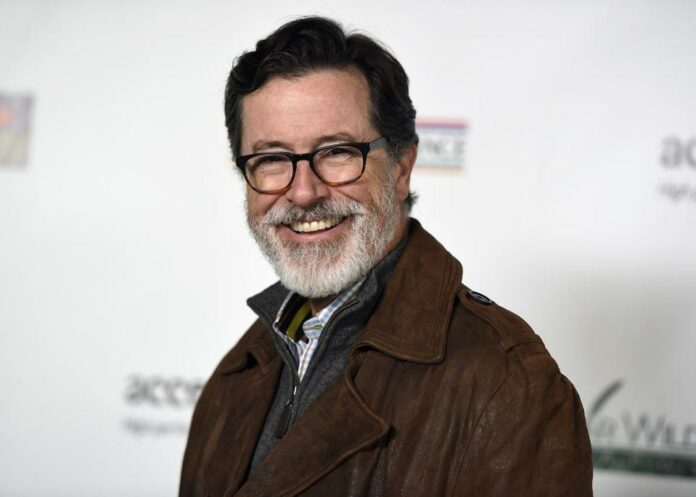
Photo courtesy of The Boston Globe.

December 18, 2014 marked the end of an era in the edutainment community, as Stephen Colbert achieved immortality and set off to the moon in Santa’s sleigh along with Alex Trebek and Abraham Lincoln.

Five days earlier, I set off to New York City with the aim of witnessing one of the last live tapings of The Colbert Report. It is a show that galvanized me to pack up my small suitcase with the most absurd (and most sought-after) favourite items that I found in my wardrobe. Keep in mind, this included my Humphrey Bogart-meets-Hellboy urban-demon style trench coat, my Superman t-shirt, my peach-yellow Chinese 100 per cent acryclic scarf, my one-size-fits-Sasquatch black shoes with extra width, and lastly, my Irish green jeans that I borrowed from Jim Carrey after he was done playing The Riddler.

After settling my accommodations, I headed straight to 513 West 54 Street for a chance to see my favourite comedian in person. I was number 45 in the standby line; the day’s show accepted only 25 of those. I grudgingly went away and decided to go sleep, if only to calm my excited nerves.

The next day, I was number two in the standby line. I got in. It was surreal.

After we were warmed up by a local comedian and practiced laughing exercises, Stephen entered with polite pomposity and heartwarming generosity as he began his favourite part of the show – Q and A with the audience members.

The show started when Stephen finished answering his 10th or 11th question. Topics discussed in the show’s segments included lowering prices of oil, letting a sponsor rebrand the show, and Jeb Bush eyeing a presidential run.

After seeing Kendrick Lamar debuting a new untitled song (which has since made its way onto his upcoming third album), Stephen thanked him and waved goodbye to signal the end of that night’s show. He then answered one last question from the audience, which was about advice for improv classes. I found Stephen’s answer to be great advice for life as well. Stephen said, “Listen to other people. They are more important than you.” And that was it. 

Even though I couldn’t get in for another live taping the next day, I was able to get an autograph and a rare Medal of Truthiness (only four other people in the world possess this artifact of a bygone edutainment empire).

Stephen Colbert was recently in the news again, this time for being honoured at the 10th annual Oscar Wilde Awards on February 19 for his contributions to Irish film and television. The event took place at the Bad Robot production company of JJ Abrams, located in Santa Monica. Abrams also honoured Irish painter Colin Davidson, and the ceremony featured performances from Gavin James and Megan O’Neill.

The Oscar Wilde Awards, hosted by the non-profit US-Ireland Alliance, has become known and appreciated for its casual and non-pretentious atmosphere, as well as introducing Irish performers to a broader audience. Previous recipients and presenters have included Tom Cruise, Al Pacino, Jodie Foster, Julia Roberts, Paul Rudd, and Kate Winslet.

It’s too bad that he is only receiving the award now, as it would have been a perfect addition to one of my favourite segments on The Colbert Report: “Who’s Honoring Me Now?”

Colbert is scheduled to take his new position at The Ed Sullivan Theatre on September 8, 2015 when he takes over The Late Show from David Letterman.

Twelve is a diverse showcase of SFU talent

0
Photo courtesy of the SFU School for Contemporary Arts.

Twelve is an SFU dance production featuring 12 student-choreographed pieces from different styles of contemporary dance.

It is a wonderful opportunity for students to showcase their talents in choreography and performance, and to give dancers a platform to participate in a well-produced program.  The choreographers were also given the unique chance to work with lighting designers. 

Students from every year of the dance program are participating in the show, either as a choreographer, performer, or both.

Photo courtesy of the SFU School for Contemporary Arts.

“The program provides a scope of talent at SFU, from graduating students to first years,” according to Kayla DeVos, one of the artistic directors for the show. “The show will be a comprehensive sample of the work SFU students are producing.”

From solos to duets and large group pieces to video projections, finding an underlying theme for the show is challenging. Each piece is diverse in style, origin, and process. 

A number of pieces were developed through classwork, stemming from the creation of movements that contrasted the dancers’ natural tendencies. “They needed to find something that is outside of their comfort zone and to think outside the box,” said stage manager Wilson Terng.

Other pieces were developed independently. Artistic director Desi Rekrut noted that some students drew from outside sources, while others searched inward for inspiration.

Development of the production began at the end of the fall semester last year, when students presented their pieces in auditions. The submissions were then selected by a panel of judges. The students have put tremendous amounts of hard work into each of the pieces, Treng noted.  Some have been rehearsing and refining their piece for months.

One of the two video projections featured in the show will be a summary of the students’ experiences within another culture; they explored the outer extremities of the human body as they reflected on the similarities found in diversity. Another piece experiments with the connection between light and sound, and their relationship with movement and space. 

“I personally have a preference towards group pieces. It’s just interesting to see the synchronization and then the whole group movement [where] everyone is all in sync and moving as one,” Treng said. “It’s quite elegant, I find.”

As Rekrut pointed out, the pieces “are all so different — it’ll be more of an experience.”

Post-civil war tensions run high in The Whipping Man

0
Photo courtesy of Emily Cooper.

This season, Pacific Theatre takes on The Whipping Man, a play about slavery and relationships set in post-civil war USA. Written by Matthew Lopez in 2006, this contemporary take on an era rife with societal tension promises to take audiences on an intriguing and emotional journey.

Set during Passover in 1865, Officer DeLeon returns from fighting for the Confederates in the American Civil War to find his family missing from their home, and two of his former slaves residing there. Badly wounded, the two emancipated men, Simon and John, are forced to nurse DeLeon back to health. The struggles they face trying to figure out complex relationships, sharing a common faith, and finding out secrets lead to many difficult discoveries, all during a holiday that celebrates the liberation of Jewish slaves from Egypt.

Photo courtesy of Emily Cooper.

The play itself has won numerous accolades, including Obie and Lucille Lortel Awards. Pacific Theatre’s production of The Whipping Man will raise the stakes, featuring stellar talents including director Anthony F. Ingram and actors Tom Pickett, Carl Kennedy, and Giovanni Mocibob.

Recently nominated for a Jessie Award for his role in Jesus Hopped the ‘A’ Train, also with the Pacific Theatre, Carl Kennedy sat down with The Peak to discuss this new take on the play. He will be playing John, a young, newly-emancipated slave.

Kennedy feels a deep personal connection to the piece. “[The play] is a part of my history; being from the south and being African-American, any of my ancestors could easily be the characters from the play,” he explained. “Growing up in the south, even present day there is still a lot of personality left from those former times.” As a metaphor, Kennedy stated, “if you watered down orange juice, you still know it’s orange juice.”

The play, he stated, “is about interpersonal relationships. The son of the family [that owned slaves] is coming back to a home that was completely ruined. Two slaves are left, Simon and John, and it’s them figuring out their relationships with Captain DeLeon.” The setting is one rife with social tension, stated Kennedy: “It’s set post civil war — the war is over, the South lost, and slavery is no more.

“I play the younger of the two slaves, John,” Kennedy explained. “There’s a big age gap between the two.” This age gap is also an ideological one, he argued, quoting telling dialogue between the two emancipated men in the show: “you survive your way, I’ll survive mine.”

The play questions the idea of ownership, and how the ex-slaves deal with the concept of their own freedom. Kennedy stated that his character can finally “own things just to own them,” a new and freeing experience for him.

The concept of freedom itself is explored in the play. “There is obviously an [exploration] of what freedom actually is, and taking it to another level,” Kennedy said. “You can be a slave to any addiction, to your old ideas.”

The Whipping Man will be presented by Pacific Theatre February 27 to March 21. For more information, visit pacifictheatre.org.

Moss-Haired Girl is complex story of family lore

0
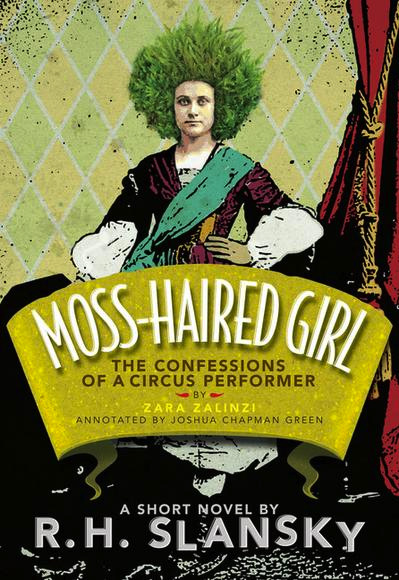
Photo courtesy of Anvil Press.

R.H. Slansky’s 2014 novella Moss-Haired Girl is a fictional autobiography of former circus performer, Zara Zalinzi annotated by the fictional author Joshua Chapman Green. The writing includes a detailed description of the fictional author’s introduction, as well as footnotes which offer further commentary on Zalinzi’s autobiography.

The autobiography is noted to include many falsifications, some exaggerations, and perhaps intentional misplacement of facts. The reader is informed of any contrary details through Green’s detailed footnotes, and is presented with a believable account of the life of circus performers during the 19th Century.

A notable feature of the novella is its use of narrative prose, which calls to attention the nature of the writing process. The book also presents a unique view into the curious nature of the circus, circus life, and the reliability of family lore.

Photo courtesy of Anvil Press.

The story-within-a-story follows Zara Zalinzi, a former circus performer who worked under the role of the Moss-Haired Girl or Circassian Princess; the titles appear to be interchangable, though for unspecified reasons. Zara was supposedly born under the name of Sarah Salinsky, and she travelled with a circus company under a director she called the Showman, who, according to Green, was most likely the “illustrious H.R. Putnam.”

The name H.R. Putnam seems to be a reference to real-life infamous showman P.T. Barnum, who founded a circus known as Barnum & Bailey Circus in America in 1919.

Throughout the novel, Green points out the clever nature of Zara’s writing and draws attention to the “facts” Zara paints in the autobiography in comparison to the evidence he has gathered through his research. This includes her use of unintentional — and sometimes intentional — misspelling of words and meanings to displace the reader’s full awareness of the actual facts.

One footnote that repeatedly appears focuses on Green’s search for the Salinsky family history, where he often recounts finding plausible listings of people mentioned in her autobiography under different variations of their surnames. It is interesting to note that the spelling of Zara’s actual last name, Salinsky, is similar to the spelling of real-life author R.H. Slansky’s family name. 

As the story progresses, more information and details about Zara’s life are presented through the footnotes, rather than the actual autobiography. At the same time, the differences between the “facts” and Zara’s version offers a deeper connection and understanding of her motivations, and the methods through which she chooses to write her truth. 

One fine example comes when Green discovers the true nature of Zara’s origin. Zara presents her mother as the daughter of a prestigious family living in Virginia, United States. Green points out the lack of evidence in the family registry, and the likelihood that her mother was actually a runaway slave of African-American descent. 

The contrary facts and the details of Green’s research are merely speculative, but they show in detail how simple truths can be hidden beneath other equally simple, yet falsified or exaggerated, untruths.   

Moss-Haired Girl is an enjoyable, light read with stylistic flair. Though Green’s annotations are ultimately just as fictitious as Zara’s autobiography, the elements of Slansky’s writing and the novella’s presentation offer the reader plenty to reflect upon.

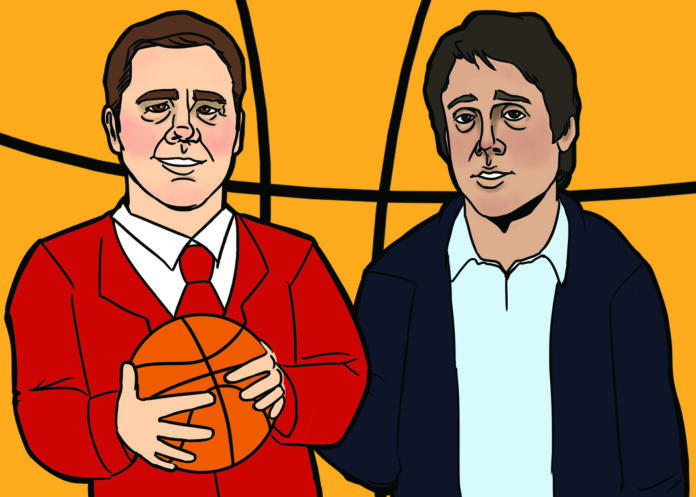
Moneyballers

0

Bball gangstas

Imagine a popular restaurant with a group of talented chefs. The owner wants to introduce a new dish — something that is both new and unique but also achievable based on the abilities of his chefs — but he doesn’t know how to go about it.

Let’s say a certain group comes along and offers their help, called ‘food analysts.’ These food analysts take all the recipes the restaurant currently owns and look at the history and current popularity of each dish. They then examine the ingredients and different methods used to put the dishes together.

They find that some dishes are more popular with different types of customers and some during different seasons. They also find that despite the popularity of one dish, some chefs are able to draw more customers because of their cooking style and their individual strengths.

The food analysts come up with a list of ingredients and a list of methods that could help create the popular dish, and give those suggestions to the restaurant owner. The restaurant owner creates various recipes based on the suggestions, and gives them to the chefs who then go on and create the dishes. Back and forth it goes; the chefs experiment with the recipes, and the analysts collect information on which dishes are the most successful.

This is how analytics works.

Now, imagine that the restaurant owner is a basketball coach, and the chefs are his players, and you might start to get an idea of the radical analytic experiment that the SFU men’s basketball team has embarked on this season.

Their final recipe? The dish they want to cook up? A winning team.

Chow-White Pages

The SFU team’s ‘restaurant owner’ is head coach James Blake, and together with ‘food analyst’ Peter Chow-White, the SFU men’s basketball program has been trying to find the secret recipe that will lead them to victory.

Chow-White is the director of the Genetics and Network Analysis (GeNA) Labs and an associate professor of communication at SFU. He was researching the “moneyball” phenomenon applied to basketball when he approached Coach Blake last summer.

Blake agreed to form a partnership with Chow-White and gave him access to the data he needed and offered his assistance. It was a natural development for both parties, and came out of a need to further the understanding of the way basketball was being played.

Before the opportunity with Chow-White, the basketball team did not have an analytics advisor working within the team, and held what Chow-White described as “fairly typical, but limited” amounts of statistical data.

There are different ways of capturing the game, but the advance analytics Chow-White has been investigating go beyond traditional box scores. In fact, Chow-White explained that “basketball analytics is using traditional statistics and transforming them into efficiency statistics.”

Statistics by themselves are not analytics, they are just numbers — until they are placed into a context. To put it simply, advanced analytics provides an in-depth perspective on how the game is being played. The difference is a set of data based on totals versus a set of data based on efficiency levels. The purpose for basketball analytics is to create a deeper understanding of the game on a more concentrated and individual level.

The experience has been a building process for everyone involved. Since its official establishment last summer, the analytic experiment has come a long way, and continues to develop at a steady pace. In a relatively short period of time, the research team have been able to create an advanced analytical program from the ground up.

Possession Obsession

The partnership with Chow-White has greatly affected the way Coach Blake approached coaching; instead of teaching the traditional methods and focusing on effort alone, it became more about “performance based on statistics”.

The difference was training the team with a knowledge on how to be more efficient, and drawing knowledge based on information about the individual player’s strengths and weaknesses, as well as their abilities when working as a team.

Analytics is really about finding a method that works for a team but also one that hasn’t been done before or it becomes pointless according to Chow-White.

When he began, Coach Blake had two goals in mind for the SFU men’s basketball team. The first was to increase the number of possessions per game, aiming for an average of 100.

Chow-White notes that the average amount of possessions for a team is about 75 per game. Possessions refers to the number of times a team had possession of the ball.

The highest this SFU team has had is 80 possessions per game. With a difference of 33 per cent, the goal is to go beyond the type of game normally played. An increase in possessions means creating more opportunities for the team to score a basket, which in turn increases the point difference and the winning advantage.

The second goal was to implement a high offence, high defence strategy. This means playing a fast-paced game and incorporating a pressing offence while consistently maintaining a strong guard against the opposing team.

The method that Blake has implemented is known as a ‘disruptive structure,’ which aims to use more traps and steals to increase the number of possessions.

While rival teams are trained under a typical program, the goal of the SFU team is to disrupt that patterning. At the same time, the SFU players also need to be able to function well in the moment, because they cannot fall back into a typical patterning. With this in mind, the players are constantly playing against the boundaries of their own comfort zones.They need to be quick while remaining calm and steady in order to sustain the pace of the game.

For Coach Blake, the biggest hurdle is the time it takes to implement such a system, and the challenge of pushing the players to sustain effort and play at a high level consistently.

“It’s not just doing and being comfortable with what you do,” Chow-White explained. “You’re trying to systematically take [the team] out of their comfort zone, over and over and over again, every single game.”

A slower system might still be successful if only a portion of the players were fully committed. However, the faster the game, the harder it is to coordinate as a team. For this reason, the strategy involves having a team that is fully committed to the system and its success. Fortunately, the SFU players have found the new system fun to play.

Major Communication

When Coach Blake and Chow-White first met, they quickly got to discussing the goals of the program. Afterwards, they met regularly, but concentrated largely on their individual roles from their side of the partnership.

During these meetings, the two looked at the game reports that Chow-White provided throughout the week and narrowed down what was essential based on the present state of the team and the current set of data. They discussed how the analytics were being applied, and whether adjustments were needed on multiple levels.

Within a few months, they built a multi-page game report. The report consisted of advanced analytics that were repurposed from previous box score data, in addition to other statistical data that was gathered from the games until that point.

Sometimes they changed their approach in reflection to what the analytics revealed, and realigned their goals based on that.

As Chow-White explained, there is a common assumption that shooting three-pointers will be the deciding factor to winning a game; however, sometimes the winning game might include a lower percentage of three-point shots.

“Developing the technology and making it usable for people is a conversation,” said Chow-White. “There’s a larger process going on here than just simply giving stats to coaches.”

Above all else, Chow-White has focused his efforts on constant communication, which has taken time, patience, and understanding — not to mention a passion for the sport. “The key is communication,” Chow-White explained, “which is why a communication professor is interested in analytics in the first place.”

As the basketball team continues to better realize their potential as a team, the analytical data evolves to becomes richer and more applicable.

It is important to note that analytics is a neutral system that can be used to adapt to the different systems of individual teams. Every team has their own needs, and a coach with their own goals in mind.

Analysts examine the data for common trends; these links are examined for a pathway that is most relevant to the advancement of their goals, and the goals of the team. Coaches can then use this data to further their understanding of the strengths, weaknesses, and potential of a given team.

Hind Insight

Coach Blake and Chow-White are two people who undoubtedly care a great deal about the game. But behind the scenes, there is also a research team of six individuals, including students working on the spreadsheet data, as well as computer programmers working with the “data-based technology.” All of them are equally dedicated to making this work, including former Clan basketball player, Scott Hind.

Hind began working with Chow-White at the beginning of the school year. Before that, he struggled with a concussion and fractured ankle, which led him to stop playing after two seasons with the team. Since September, he has been working as a research assistant. Along with a few others, he has regularly met with Chow-White to go over the data he’s collected while watching the games.

For Chow-White and the research team, the main goal is to build a database of information, and to use the data to help the coach and the team see and understand the game from a different perspective — as well as plan for the next game.

The data that is collected explains why things happened the way they did, and what future results can be expected from the individual, as well as the team.  This is the sort of information that cannot be found easily by watching the game or reading the box scores alone.

In his words, Hind explained, “a key skill in being an analyst is the ability to communicate the information to Coach Blake in a way that makes it easy for him to digest.”

But conversations go both ways. Just as the analysts need to explain their perspective of the game to Coach Blake, it’s equally important to learn about the way Coach Blake perceives the information; in some situations, he finds a connection and sees something that the analysts wouldn’t know without the intimate knowledge he has with the team and the games they’ve played.

“We’ve [the research team] actually had to adapt our own goals and that’s a discussion [and] a conversation between how the coach sees things and [how] the data is seen.” Chow-White stated.

Hind noted the advantage of having a receptive coach like Blake who was willing to be involved and listen to analytical advice. Throughout the process, Coach Blake’s receptivity and openness has contributed to the positive progression of this analytical experiment.

Winning Recipe

“There’s a gap in terms of what the numbers are telling me and what the outcome is being,” Chow-White explained. “They are not a top-tiered team but they definitely are not a bottom-tiered team.”

In his words, the team while not a top-tiered team, is definitely not a bottom-tiered team and has what it takes to win and be in the playoffs. The numbers have shown that the team is doing well in some areas but they are not playing at the level yet.

In order to improve as a team, it is important to be as efficient as possible, and this takes practice. Evidently, the team is proving this fact by gradually closing the gap, game after game.

Hind shared how it has been an enlightening experience to look at the game through an analytical lens. After many years of playing basketball, he realised the limitation of knowledge gathered from being on the inside differed from the analytical data gathered from the outside.

In some cases, the numbers told a different story to how the players might have felt. For example, what looked to be a relatively good shot may well have been an inefficient one.  This knowledge has given Hind and the rest of the team a better understanding for how the analytics translates to actual game play. In effect, perhaps this is the reason behind the growth of the analytics experiment.

In the end, the progress of the analytic experiment is determined in part by the efficient communication and proper understanding that all those involved have provided. Certainly, the process has been a fulling and well-endeavoured experience for all those involved, and would not have reached the same successes without the coordination and dedication of all the individuals.

For Coach Blake and the SFU team, it’s all about improving on their deficiencies while simultaneously trying to secure more wins.  Blake complements Chow-White’s mind for basketball, and stated that “it’s been lots of fun to coach and I just look forward to going to every practice.”

At the moment, the final recipe — the winning team — has not been discovered, but the process of experimenting and looking at the data have created many equally wonderful dishes, each one  providing a glimpse of what the final goal would look like.

With an enormous amount of data still left to analyze and the summer to come, Chow-White and Coach Blake hope the advanced analytics program will continue to develop and evolve. The ultimate goal? To create a program that can be transferred to other SFU sports teams, and provide an opportunity for those teams to analyse and improve their gameplay as well.

Bon appetit, SFU athletics.

Necessary NHL rule changes

0
It’s not necessarily a problem that shootouts decide games, but they should be worth fewer points. Photo courtesy of CBC.

As a hockey fan, I’m always debating with friends over which rules the NHL should change to make the product more enjoyable for fans. I’ve got a lot of problems with you, Gary Bettman — here are some changes you should make to the NHL starting immediately:

Get rid of the salary cap

The salary cap is flawed in a number of ways. First of all, it dries up the free agent market, leading to gross overpayments for players such as David Clarkson. The only true way to get top-end talent under a salary cap is to tank, which is happening to a number of teams this season, and will only become more prevalent in the future. Eliminating the salary cap would rejuvenate the free agency and trade market, as well as reduce the incentive to tank.

No more preseason

Preseason was important back in the ‘70s when players had to get rid of their beer guts. Today, being an athlete is a yearlong commitment, and players stay fit throughout the offseason — it’s big news when a hockey player shows up to training camp overweight or out of shape. This would allow the regular season to start earlier and end earlier, which would be good for business, as the Stanley Cup finals wouldn’t have to compete with the NBA finals for ratings, where it gets routinely trounced (in the American market, at least).

You could also say that the preseason is important for player evaluation, but the league could easily extend the number of games a rookie can play without a year of his contract counting from nine games to 15 — and give teams incentive to try out the youth in the first few games.

Three points for a win

The shootout isn’t necessarily a bad way to decide a game, the NHL just needs to make sure that it decides as few games as possible. Giving three points for a regulation win instead of two seems to be the easiest solution, as it would give teams chasing a playoff spot or teams trying to win their division more incentive to go for it at the end of a game. It doesn’t sit well with me that winning in regulation and winning in a skills competition gives you the same amount of points.

Contract at least two teams

Contracting at least two teams would help the business aspect, as the richer teams would not have to help prop up teams that are too inept to get fans to the rink. My vote is for the two unmitigated disasters that are the Florida Panthers and the Arizona Coyotes. Relocation would be a good idea as well, but with the Canadian dollar slumping, even the currently profitable Canadian markets aren’t a sure bet.

Woohoo, Boohoo:

0
Image Credit: Flickr

Woohoo: Wisdom

Where would our lives be without wisdom? Our society thrives — and is dependent — on wisdom to succeed. Generational knowledge and experience is passed down among family, at work, and at school; sometimes this knowledge is amended due to societal or ideological change before it is passed down further. Regardless, the experiences that past positions have had remain embedded in history, forever to be referenced and applied.

Wisdom is everywhere. I’m offered wisdom every time I flip on the TV or browse the Internet; this university is essentially wisdom in a concrete enclosure; my grandmother splurges neverending wisdom as she pounds back the whiskey. I don’t know what I would do without the knowledge that has been passed down to me. Three cheers for wisdom!

Boohoo: Wisdom Teeth

Who the fuck named those terrible, crooked teeth at the backs of our evolutionarily shrinking jaws? I associate wisdom with good judgement, peace and prosperity. When I had my wisdom teeth removed, I felt none of those things.

In fact, all I felt were the effects of the copious T3s, stool softeners, and ice packets I had to use during the week that my face resembled a grapefruit. The pain was astounding. I didn’t gain any knowledge or self-fulfillment as I drooled all over my pillow, practically suffocating on gauze. The only wisdom I took from the experience was that I never wanted to go through that hell again!