Home Blog Page 1033

A farcical Foreigner is touring the Lower Mainland

0
Photo courtesy of Ron Reed.

What does it take to get some peace and quiet for the weekend? Charlie (John Voth) would prefer if nobody spoke to him for the entire weekend, and his friend Froggy devises a plan to make that happen. Froggy (Ryan Scramstad), who has brought Charlie to Betty’s fishing lodge, tells her that Charlie doesn’t speak any English, and nobody should speak to him because he’s ashamed of the fact that he doesn’t understand.

Instead of peace and quiet, Charlie gets Betty (Erla Faye Forsyth) yelling slowly at him as if this will help him understand, Catherine (Kaitlin Williams) telling him all her secrets because he makes a great listener, and Owen (Byron Noble) insulting him because he finds it amusing.

Photo courtesy of Ron Reed.

Betty’s lodge is run down and at risk of being condemned by Owen, the property inspector, and Catherine and her fiancé David (Mack Gordon) are planning to buy the place from her using Catherine’s inheritance. Charlie quickly learns that some people are not what they seem, and finds it hard to keep up the farce.

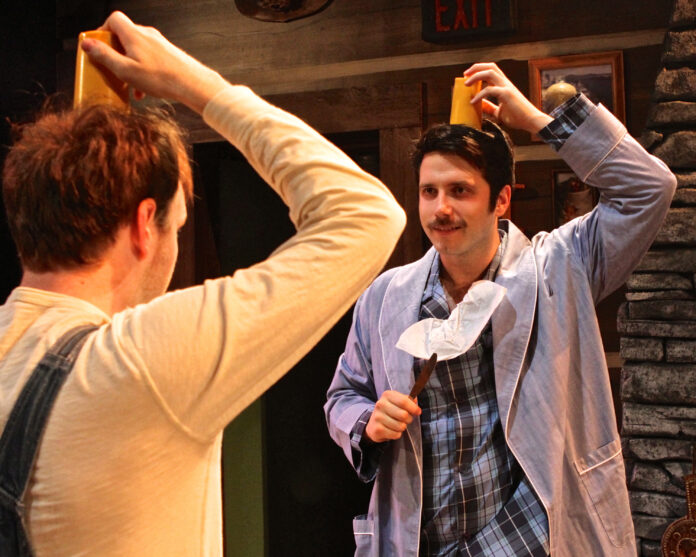
The funniest moments of the play are between Charlie and Ellard (Peter Carlone), Catherine’s younger, less intelligent brother. Ellard takes on the task of teaching Charlie English, and everyone is surprised how quickly he learns. There is one hilarious scene with Ellard and Charlie eating breakfast and Charlie begins to mimic what Ellard is doing. Soon, they are dancing around the living room with cups on their heads, and Betty thinks this must be a custom from Charlie’s culture.

Charlie’s storytelling in his native gibberish language solidified Voth’s performance as nothing less than extraordinary. Watching the way the other characters light up around the foreigner, it’s clear that Larry Shue’s award-winning play is a delightful exploration of our fascination with those who are different, and the way they can affect us.

When Charlie arrives at the lodge, he complains to Froggy that he is boring and wants to get himself a personality. Throughout his stay, he finds that pretending to be a foreigner gives him a unique personality and he becomes a lovable, exotic, quirky character, instead of just a boring proofreader.

Arts Club Theatre Company is touring Pacific Theatre’s production of The Foreigner around the Lower Mainland from February 18 – March 5. For more information, visit artsclub.com.

Stupeur et tremblements is a powerful one woman show

0
Photo courtesy of Emily Cooper.

A powerful one-woman show about cultural behaviours and repression, Amélie Nothomb’s play is captivating and profound.

A long monologue about the role of a Japanese woman opens the play, as Amélie (Layla Metssitane) sits at her dressing table and carefully paints her face white. She describes the way a Japanese woman must act, explaining that to sweat is worse than to die, and that she can never hope for any joy in life. She explains that not committing suicide is a brave act of protest for a Japanese woman.

This monologue immediately grabbed my attention, and had me alternately cringing and chuckling at her descriptions of the Japanese woman’s life of submissive obedience.

Photo courtesy of Emily Cooper.

Amélie is a young Belgian woman who grew up in Japan. She returns to her adopted country hoping to integrate completely into Japanese culture, but when she is hired as a translator by the Yuminoto company, she realizes the extent of her manager’s inflexibility and gets a crash course in Japanese social codes.

Gradually, Amélie descends the hierarchy of the office and ends up cleaning toilets. Just when she thinks she has hit the bottom, she realizes that things can always get worse.

Layla Metssitane was a tour de force. She held the audience rapt with simple staging and a powerful story. Stupeur et tremblements (fear and trembling) is adapted from the 1999 novel, winner of the Grand Prix at the Academie Française. It is a tragic yet comic play exploring powerful themes of modern chauvinism and cultural restraints.

Amélie finished off the performance by once again sitting at her dressing table and washing off her Japanese identity as she removed the white face paint. Through razor-sharp wit, vivid imagery, and a nuanced performance, Stupeur et tremblements held my attention and left me with a lot to think about.

Stupeur et tremblements was presented by Theatre la Seizieme February 17–21. For more information, visit seizieme.ca.

Local sock startup gives back

0
Julia Kreutz (right) is working with her two friends, Colin Cej and Tarah Hogue. - Colin Cej
Julia Kreutz (right) is working with her two friends, Colin Cej and Tarah Hogue. – Colin Cej

SFU alumna Julia Kreutz and her two business partners have reached the semifinals of the Start Something with Alesse competition with their non-profit startup, the East Side Sock Club.

The East Side Sock Club aims to support local Vancouver artists as well as help the homeless population in the Downtown Eastside by donating socks to its inhabitants. 

The non-profit plans to buy designs for socks from local artists, manufacture the socks, sell them to local retail partners, and, for each pair sold, donate a pair to local organizations. These organizations will then distribute the socks to the homeless population of Vancouver.

Kreutz, who graduated SFU in 2013 with a Bachelor of Education, is a curator at the Gam Gallery, which she started in 2009. Along with Colin Cej, a graphic designer who rents studio space at the Gam Gallery, and Tarah Hogue, her co-curator at the gallery, Kreutz entered the competition. The three entrepreneurs have been best friends since high school.

Kreutz explained that the impetus to enter came from Cej. He “saw [the competition ad] on the side of a bus in Vancouver. They had a billboard on the bus and he was like ‘Oh, that’s awesome,’” Kreutz told The Peak. “He was the one who actually came up with the idea.”

On how the project benefits the community, she said, “I think it speaks to the area of the Downtown Eastside. [The area] holds the largest number of studios and artists, but it’s also the home to many [single room occupancies] and homeless people who find shelter there, find help for their addictions, and find community there.”

Kreutz elaborated on how the project fits the collaborative spirit of the DTES. “It’s kind of a community that thrives off one another because artists have to always find the cheapest rent for their studio spaces and the same with people who are less fortunate,” she said.

The Start Something with Alesse competition is now in its fifth year of fostering both non-profit and for-profit startups across Canada. This year, 1,403 ideas were submitted to compete for the grand prize, which includes $5,000 and a mentorship program to help bring the winner’s idea to fruition.

The project is currently only in the beginning phases as the three try to secure partnerships and look into manufacturing. However, Kreutz intends to use the prize money and mentorship should they win to pay the artists, raise awareness about the project, and to move ahead with manufacturing the first batch of socks.

Kreutz spoke about the future of the organization: “We’re starting with socks and I guess we’re hoping it will grow to different clothing or things. We are just putting one foot in front of the other, trying our best to represent the artists in a positive way and give them a platform to present their art.”

The club has already chosen its first artists to be featured: Sean Karemaker, Tyler Robbins, and Ola Volo. Regarding the role of design in the project, Kreutz explained, “[We’re trying] to have them be funky and cool, but at the same time have it not just be about fashion and the art world but also to have it reach people who need help in our community at a more personal level.”

SFU beats Trinity Western University for second straight game

0
Image Credit: Austin Cozicar

The Clan went into Saturday night’s game looking to beat the Trinity Western Spartans — the best team in the league — for a second straight time.

SFU got off to a great start, scoring on their first shot on net. Forward Matthew Luongo quickly buried a wrister from the right wing to give SFU and an early 1–0 lead.

They weren’t done there, with forward Trent Murdoch scoring on the powerplay, quickly turning with the puck in the slot and putting it past the opposing goalie. At this point, SFU had scored two goals on their first three shots. Trinity Western were able to get one back on the powerplay, as captain and defenceman Blair Murphy skated down from the left point and scored.

“Well, it’s always good to get off to a quick start,” said head coach Mike Coletta after the game. “But then there was a lull there in that first period [. . .] I thought we could have been back to square one. But getting that jump, getting that energy, and having [Matthew] Luongo score that goal was really big for us.”

The second period was marked by lots of physical play. Around four minutes in, an SFU player crashed into the crease, sparking a large scrum spurred on by the Trinity Western goalie exaggerating the contact. The scrum resulted in two penalties for SFU and one for TWU, putting the Spartans on the powerplay. In total, the period featured eight total penalties, four for each team.

These two teams have developed a dislike for each other, evidenced in the seven games they’ve played together.

The third started off with equal chances on both sides. SFU had a couple of great opportunities to extend their lead, with forward Jono Ceci hitting the side of the net from in close. He later on scored the 3–1 goal and essentially sealed the game for the Clan.

Forward Graham Smerek, who already had one assist, scored to make it 4–1, turning in the high slot and shooting it high glove side to expand their lead. With the victory, the Clan win the season series against the Spartans 4–3.

The win, coupled with the University of Victoria loss, means the Clan move into third place in the standings, one point ahead of the Vikes. Next week’s game against these two teams will decide who will be third and play Selkirk College and who will be fourth and play Trinity Western.

“I think the game plan right now is to keep momentum going on our side, make sure we’re ready for the playoffs,” said coach Coletta. “Anything could happen in the playoffs, but we want to make sure that were rolling in the right direction and doing all those little things, and having some momentum.”

Score:
SFU: 4
TWU: 1

First Period:  
SFU Matthew Luongo (3) (Zerebecky) 18:29
SFU (PPG) Trent Murdoch (9) (Berry-Lamontagna, Ceci) 13:55
TWU (PPG) Blair Murphy (4) (Harcoff) 9:30

Second Period:
-No Scoring-

Third Period:
SFU Jono Ceci (10) (Smerek, N Sandor) 7:01
SFU Graham Smerek (4) (Ceci, N Sandor) 6:55

Shots:
SFU 38
TWU 29

Goalies:
Andrew Parent (SFU): 28 Saves/ 29 Shots .966 SV%
Silas Matthys (TWU): 34 Saves/ 38 Shots .895 SV%

Three stars:
1st: SFU #91, Jono Ceci 1G, 2A
2nd: SFU #89, Graham Smerek 1G, 1A
3rd: SFU #19, Nick Sandor 1G, 0A

Women’s basketball dominate on Senior’s Day

0
Guard Katie Lowen played her last game Saturday night. Image Credit: Hamed Yaghoubi Shahir

It was a proper send-off for seniors Erin Chambers and Katie Lowen; an early lead against the Alaska-Fairbanks Nanooks Saturday night paved the way for a victory in the pair’s last home game.

The night also marked the final home game for one-year French exchange student Perrine Fuchs, who averaged 4.9 minutes per night, as well as trainer Rachel Halipchuk, who spent her first two years playing guard with the team before joining the coaching staff.

The final home game is linked to another annual Clan tradition: pink game. Clan fans were encouraged to wear pink, and SFU players wore pink warmup shirts. The proceeds from the ticket sales went to the BC Children’s Hospital.

“It’s pink game [and] senior’s night, so there’s a lot of emotion running through, and I think the girls handled that well — it was a great game,” said Chambers. “It’s kind of sad that it’s over, but it happens and we move on.”

Lowen opened up scoring on a layup caused by a steal just under a minute into the game. She would also lead the team in three-pointers with three — two of them coming in the first 10 minutes.

“I was nervous, I don’t usually get that nervous before games,” said Lowen. “We always say, ‘teach the butterflies offence,’ and we did that — controlling the nerves and taking advantage of the opportunities that were on the floor for us.”

Much of the victory came down to SFU’s performance in the first 10 minutes, which gave them a 13-point lead. Though the Clan would continue to dominate much of the rest of the game, the gap between the two teams’ score remained fairly consistent throughout.

The first half ended 43–28 in the Clan’s favour. The second half saw a much tighter game — at least score-wise — as SFU only won the half by a margin of 38–34.

When the two seniors exited their final shift — Lowen at 1:00 left and Chambers at 57.7 seconds left — the crowd gave them a standing ovation. And with the game ending a minute later 81–62 for SFU, it wasn’t the only time the crowd felt the need to clap and cheer.

“It’s surreal, I can’t actually believe it’s the last home game — I don’t know if it’s actually hit me yet,” said Chambers. “I’m just humbled to play in front of all these people and be able to play with such great friends.”

With the win, SFU has clinched a spot in the Great Northwest Athletic Conference (GNAC) playoffs, which starts Wednesday, March 4, where they will have a chance to notch a national championship. Last year, the Clan made the NCAA Division II West Regionals before being knocked out by Montana State University-Billings.

SFU

Points: 81
Field Goals: 29–61 (47.5%)
3 Pointers: 11–31 (35.5%)
Free Throws: 12–14 (85.7%)

UAF

Points: 62
Field Goals: 19–58 (32.8%)
3 Pointers: 2–11 (18.2%)
Free Throws: 22–26 (84.6%)

Player of the Game: Erin Chambers

Fittingly, in her last home game with the Clan, Erin Chambers was the team’s best player. She led the team in points scored with 25, making her GNAC scoring record that much harder for future basketball stars to break, and she was also tied for first in rebounds, with seven total.

Points: 25
Assists: 4
Rebounds (Off-Def): 2–5

Derrival to play at Spring Jam

0
Deven Azevedo (furthest left) and Adam Mah (centre) are longtime friends in addition to being bandmates. - The Link

In anticipation of the Simon Fraser Student Society’s (SFSS) upcoming Spring Jam concert on Friday, March 20, The Peak sat down with two members of the opening band, Derrival. They will be playing alongside DJs Cash Cash and Stafford Brothers at the show, which will take place next month.

The local group recently won second place in The Peak Performance Project, and have been performing together for five years. The band also has an SFU connection; bass guitarist and bass synthesist Deven Azevedo is an environmental science student who also serves as a student representative on the university’s board of governors.

Derrival’s vocalist and rhythm guitarist, Adam Mah, is also a student, currently attending Capilano University for its arts and entertainment management program.

The Peak: How will the Spring Jam be different for you from other shows?

Mah: I don’t think we’ve ever played a university show of this scale. We’ve played Capilano before, but it’s super small. It will be really cool to get into a larger environment. Playing with two bands that are more EDM-based will be interesting.

Azevedo: I think it will be largely a different crowd, if they come early enough to see us [laughs] — a different crowd in terms of their taste for music, which is neat because I think we’re kind of going a bit more [towards] synthesis in our music. It will be interesting to see if they dig some of our stuff.

P: What can people expect from you at the concert?

A: Probably a few new songs. So, in terms of content, that will be something new and different. I guess we haven’t actually seen what the stage setup will look like, so there’s a potential for something different . . .

M: Back-up dancers, confetti cannons [laughs]. I’ve heard that one of [the other performers] dresses up as a kangaroo.

P: I think they actually bring an inflatable kangaroo.

M: So, we might have to get an inflatable animal. [. . .] I could just bring my cat.

A: We got a new instrument — a new bass synthesizer — which with these big subs they have will hopefully shake the ground.

P: What impact, if any, have events like these had on student life at SFU?

A: It seems like over the past two years that I’ve been here, or year and a half, it feels like something has been changed. I think that these concerts have had a role in that in terms of there’s something to do up here, occasionally. [. . .] So, I do think it’s part of a change for the better in terms of more of a community feel.

On the Facebook page, there are a few remarks that were expressed that they said it would be more broad and it’s still very EDM. [. . .] I think there are ways that could definitely improve it, that could help the community be stronger, but I think it’s a step in the right direction.

P: Where does the name Derrival come from?

M: When [Tokyo Police Club] released Champ, I watched an interview where they talked about how they used the dictionary to find the name of the album. I thought would be a cool idea, so we found the words ‘departure’ and ‘arrival’ in the dictionary and we mashed them together.

[Quoting David Bowie] The truth is, of course, is that there is no journey. We are arriving and departing all at the same time.

P: On a scale of ‘meh’ to ‘OH MY GOD,’ how excited are you for the concert?

Both: OH MY GOD!

Everything you need to know about the upcoming transit referendum

0
Illustrations by Esther Chang

Between March 16 and May 29, voters in Metro Vancouver will have the option to vote “yes” or “no” in the upcoming transit and transportation referendum. As is expected with any decision that will affect a large population, many sides to the debate have emerged, with people either supporting or opposing the 0.5 per cent tax increase. Here is a brief compilation of the different sides and perspectives that you need to know about before the referendum starts.

The “YES” side

With 232.5 million passengers reported in 2013, the amount of people already using TransLink’s services means a built-in group for those who might be in favour of increased/improved services. As well, mayors of four affected cities — Vancouver, Surrey, Port Coquitlam, and New Westminster — and several other civic representatives have come forward in support of a “yes” vote.

The “NO” side

Not everyone is singing high praise for the referendum, with several opponents, including the mayor of West Vancouver Michael Smith, claiming that TransLink should be using its current budget more efficiently rather than asking for more. Another group saying “no” to the referendum is the DDOV, or Debbie Downers of Vancouver, who are basically against everything all of the time.

The “no means yes” side

A newcomer to the debate, the “no means yes” side represents the part of the population who are obsessed with double-negatives and advocate for clarity anarchy. By voting “no” in the referendum, residents of the Greater Vancouver are saying “yes” to increased traffic congestion, longer wait times for buses, and less frequent SeaBuses.

The B-side

A lesser known — though equally important — side to the referendum debate, the B-side is often dismissed as having opinions that are less catchy than the mainstream groups, but they should still be appreciated for being a good argument regardless.

The flip side

The new, cool side to the debate that the youth of today can easily relate to. Their platform calls for more high-kicks and Slurpees for breakfast, but are generally opposed to going to bed early.

The Blind Side

Released in 2009, this film follows the story of NFL offensive lineman Michael Oher and his relationship with legal guardian Leigh Anne Tuohy. The pair were portrayed by Quinton Aaron and Sandra Bullock, respectively, and became one of Bullock’s most acclaimed roles, earning her the Academy Award for Best Actress.

The dark side

Formally known as TransLink.


Fifty Shades of Grey glorifies psychopathy

0
Photo courtesy of Universal Studios.

Fifty Shades of Grey, an adaptation of E. L. James’ book of the same name, grossed over $100 million in North America on its opening weekend and has become the centre of hype for many moviegoers. The film has promised audiences socially acceptable soft-core porn, despite the fact that the material on which the titillating images are based is radically unnerving and intensely disgusting.

Anastasia Steele is a broke university student that gets the opportunity to interview a young self-made billionaire, Christian Grey, when her roommate that works for the school paper falls ill. A spark ignites between the unlikely pairing. Anastasia is obviously enchanted and intimidated by Christian, but still she refuses to sign Christian’s sexual contract.

The businessman is flawless on the outside — rich, caring, and charismatic — but in reality he’s a psychopathic sadist. Despite the abusive sexual relationship, Anastasia stays with Christian because she sees glimpses of kindness and, more importantly, a wallet full of cash.

This movie wants to have its cake and eat it too; the cake being sexual abuse. The narrative is opposed to the disturbing nonconsensual sex in the film, but the aesthetics glamorize the act. There are two opposing elements fighting to dominate the film: one is uninteresting, and the other is immoral.

The story wants to be about how sexual abuse affects a person’s sexual relationships. We are told that Christian was molested as a child, which is supposed to explain his BDSM fetish. For him, Anastasia is merely an object to be used for his sexual gratification. She is clearly opposed to being flogged and beaten in the bedroom; her arc as a character is that she learns to stand up against her abuser and leave the relationship.

By contrast, Christian’s development throughout the rest of this series (beware, there are two more coming) appears to be that he learns to overcome his childhood trauma and to treat his sexual partners as people, not objects. Taken on this level, the film is feeble and stiff. The characters’ psyches remain relatively unknown to the audience, while the two leads, Dakota Johnson and Jamie Dornan, fail to hint at any deeper hurt through their interactions.

For all its ineptness as an examination of the effects of sexual abuse, the narrative, taken on its own, is not immoral. Films that depict immorality need not be immoral themselves. The film’s immorality lies in its voyeuristic tendencies meant to titillate the audience, and its aesthetic approval of nonconsensual sex.

The graphic sequences are backed by a risqué score (notably a slowed-down remix of Beyoncé’s “Crazy in Love”) and shot with vibrant colours that directly contrast the lifeless decor of Christian’s office or Anastasia’s apartment. Additionally, Dakota Johnson’s performance has a duality that can be interpreted as having intense pleasure or aching pain; however, the film’s form leads you to believe the former, despite the story implying it to be the latter.

It amazes me how sophisticated audiences have become at processing and piecing together fragmented images to understand stories, yet they are still lacking in understanding how or why a scene is constructed. Well-intentioned viewers may watch this film but fail to see the immorality.

Lake tsunamis: the threat is real

0
Watch out, unsuspecting lake-goers! - Talha Qadir
Watch out, unsuspecting lake-goers! – Talha Qadir

Lake tsunamis are a real and dangerous threat that an SFU professor believes British Columbians need to be more aware of.

According to John Clague, an SFU professor in the department of earth sciences, “The public and other government agencies don’t seem to be aware that this is a hazard that is potentially a deadly one.”

Clague became interested in this research after observing the consequences of the 2007 landslide into Chehalis Lake. The impact of the unstable shoreline hitting the water caused a wave that exceeded 30 metres.

If this event had occurred in the summer months when individuals had been camping along the lake, Clague asserts that it could have resulted in deaths. “If that had happened in July it could have killed 50 people!” he exclaimed.

When landslides cause lake tsunamis, the waves they create spread away from the point source much in the same way as they do when “throwing a pebble into a pond.” However, these waves can be very large, and have the potential to do a lot of damage.

These are distinct from the tsunamis caused by earthquakes that affect large areas and travel far distances. The effects of landslide tsunamis are highly dependent upon location. As Clague explained, “A big enough landslide falling at a high enough speed can produce very, very large waves, but they diminish faster away from the source”.

The 1958 tsunami in Alaska — the largest in modern history — was actually the result of a landslide that was triggered by an earthquake. The landslide drove a wave into Lituya Bay that ran 518 metres up the opposite slope of the inlet, stripping the old growth forest.

British Columbia contains many lakes and extensive fjords along its coastline that put it at a particularly high risk for this type of tsunami. In Norway, where there is a similar coastal geography and a more densely populated coastline, landslide-triggered tsunamis have lead to more than 100 deaths this past century.

With increasing coastal populations in British Columbia, Clague explained, “We need to look at our coastlines and look at our lake shorelines, and identify areas where there might be a hazard. Right now, we just don’t know.”

The American Dream is alive and well in McFarland, USA

0
Photo courtesy of Disney Studios.

Jim White loses his job at an affluent high-school where he coached football, and relocates to a poor rural area, McFarland California, where his white privilege is tested. There, he learns to accept his Mexican immigrant neighbours.

White coaches the school’s cross-country team of teenage boys to not only be fast runners, but educated young men with aspirations to do more than just work on the fields of their farming community. Do they win the championship? Does the coach begin to recognize his own sense of superiority? Do the teenage boys go to college? McFarland, USA is a Disney movie, so these things are never seriously doubted.    

This Kevin Costner film is set during the 1980s, but its message and conflict are attempts to rejuvenate today’s American culture that has lost its hope in the American Dream. Costner spoke to The Peak about his upcoming film and why he believes it will resonate with audiences even with a predictable story.

Photo courtesy of Disney Studios.

“Films are emotional experiences,” Costner said. “When movies are working at their very best, they become about moments that you’ll never, ever forget, and we carry the moments of films throughout our whole life.”

A hint of marital conflict, a strain in a father-daughter relationship, and a dose of economic hardship has Jim feeling like he’s being torn apart on and off the field. “Jim White had to balance his own life, his own daughters who maybe took a backseat sometimes to these boys, who may be asked a question point blank: ‘are we as important as these boys?’” Costner said.

The story is Disney-fied, but true. The boys of McFarland won nine cross-country state championships while changing aspects of a community’s culture in the process. “What makes it inspirational? Just the fact that there’s a level of authenticity,” said Costner.

According to Costner, the original script did not have this authenticity: “A writer writes a story in the way that he thinks.” Jim is presented in the film as a strict but caring coach. “As I read about Jim White in Sports Illustrated, as I read this story, to me some things that were in that script did not jive [with] what I thought would be possible. There’s no way that the results could have happened from these young men given some of the things that the character was doing,” Costner explained.

Consequently, the boys’ farmer parents recognized the value of education and they aspired for their children to have the opportunity of some other vocation. McFarland, USA follows almost every sports movie trope, but at heart it is about the power of the American dream. “And I think the things that get set in McFarland, seeing these people firsthand, up close in these fields that they’re simply working there, these incredible hours through very difficult weather conditions, every day of their life for one reason and one reason only: to advance their children and to give their children a better opportunity.”

At a time when people are calling into question their patriotism, McFarland, USA serves to inform us that the American Dream is “alive and well in McFarland.” Predictable and formulaic or not, Costner believes the film’s power is in its message: “There’s nothing more American than a parent trying to make their life better for their children.”