Home Blog Page 1031

SFU prof wants to close high seas to fishing

0
Oceans that lie 325 kilometres from the coastline are under international law. - Esther Chang
Oceans that lie 325 kilometres from the coastline are under international law. – Esther Chang

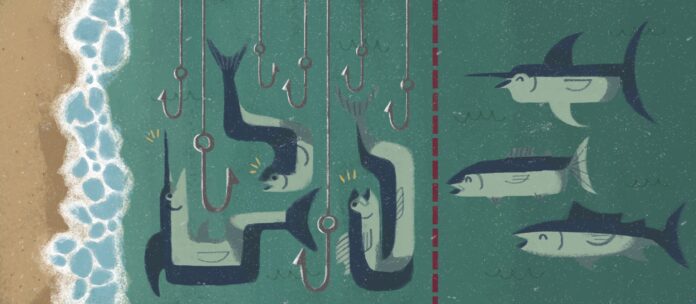
In a move that could leave the fish of the high seas breathing easier through their gills, one SFU instructor is advocating for international waters to be closed to fishing.

Isabelle Côté, a professor of marine ecology and conservation who was recently selected for the prestigious Leopold Leadership program at Stanford, has co-authored a new study in Journal of Scientific Reports.

“Intense fishing in the high seas has resulted in habitat destruction and declining stocks of fish such as tunas and swordfishes,” said Côté in her study.

The high seas are defined as those which do not belong to any country. Under international law, areas of the ocean that are within approximately 325 kilometres of any coastline — also called exclusive economic zones (EEZs) — are considered within the domain of that country, and they have economic rights over that land.

Outside of that area, however, the oceans fall under international jurisdiction. Thus, large swaths of the ocean are considered to belong to humanity as a whole.

According to Côté’s study, fishery practice around the world would be minimally affected by closing the high seas. It states that less than one per cent of fish caught globally are caught in areas outside of domestic control. “Under realistic assumptions, closing the high seas would result in no loss in fish catches or landed value of them on a global scale,” she wrote.

As part of the study, the authors also did an analysis of the economic impacts on individual countries. “People have been talking about this for a while,” she said in an interview with the Vancouver Sun. “What had been missing was an economic analysis. It’s fine to say, ‘Let’s close the high seas to fishing, there are likely to be some great ecological benefits to doing this.’ But at the end of the day, what’s going to happen economically to the countries no longer allowed to fish there?”

She notes that a few countries would be affected negatively, but most would actually gain, including Canada. “Once you allow the fish populations to recover, fish start spilling out of the no-take zones into the EEZs, and actually increase the catches there,” she explained.

“Given various assumptions, [Canada] would stand to gain in the ballpark of $100 million to $125 million.”

Côté hopes that the study will help spur national and international laws to protect the seas. “I hope our research increases understanding of the need for this,” she said. “I am delighted that the high seas are starting to be recognized as a valuable resource that deserves protection and stewardship.”

Non-humans of SFU

0

WEB

Americans condemn Human Rights Watch for publishing profanely-titled report

0
Photo by Momo Lin
Photo by Momo Lin
Illustration by Momo Lin

International research and advocacy group Human Rights Watch has come under fire for its most recent report: a 350-page document on the treatment of African-Americans in the United States titled “America officially still doesn’t give a fuck about black people.”

In the aftermath of the police killings of Ferguson resident Michael Brown, Staten Island resident Eric Garner, and countless African-Americans across the United States, the Human Rights Watch’s report says there is a lack of empathy towards black loss of life and an overlying sense of racial discrimination in the country that “seems to only be getting worse.”

However, many organizations and media outlets have condemned the report for its explicit language, saying it crosses a line when it comes to presenting objective research.

“The report to which you’re referring to is rudely titled and, quite frankly, inaccurate,” said White House Press Secretary Josh Earnest, when asked if he agreed with the urgency suggested in the report’s name. “Besides, last time I checked we have a black president. If the country’s so racist, than how do you explain that?”

The Republican Party has also issued a similar statement of dismissal, referring to the report as “absolute garbage” and “nonsense we should not have to worry about.” American news source Fox News — which has in the past been accused of misrepresenting news stories centred on black people — referred to the report as a “pinko commie Liberal lie that is defamatory against Americans.”

“We elected a Kenyan as President, so we’re clearly the most tolerant nation on the planet,” commented Fox News pundit Shane Flannity. “Too tolerant, if you ask me! Especially of people using the F-word in a report where children might hear or read it.”

Meanwhile, Jimmy Hodges Sr., Chairman of the Human Rights Watch, has defended the organization’s decision to say ‘fuck’ in the middle of a report’s title, arguing that it is in response to “the total lack of care for the plight of African-Americans by the government, media, and general public.

“It has the potential to grab people’s eye and actually make them look at the issue for once instead of simply ignoring it,” continued Hodges. “Honestly I think the overall reaction to the report is a clear indicator of where people’s priorities are [cough] not on the lives of black people [cough].”

Hodges’ response has done little to sway the opinions of the public, with some political opponents going as far to say that Hodges and the organization as a whole are promoting hate speech with their report.

“What the Human Rights Watch is doing is promoting hate speech,” commented Flannity. “Hodges and his cronies are encouraging people to use hateful language, like ‘fuck.’ Therefore, they’re promoting hate speech.”

Woohoo, Boohoo

0

Wooboo: Rebooting a franchise

Let’s face it, folks: Hollywood doesn’t have two original ideas to rub together. Reboots are about all you’re going to get until the next New York Times Bestseller gets adapted.

That being said, what is wrong with a rebooted franchise? Why are we so quick to grab our pitchforks and torches when one gets announced?

Reboots are a reinvigoration of stories for a new generation. They allow directors to take familiar tales in bold and different directions. They allow new and upcoming actors a chance to prove themselves and gain exposure. All franchises become dated after a while, and really should be placed in a more modern context.

Movies are reflective of the times we live in, and are a means for us to reflect on the world around us — especially as we become more intuitive towards things like sexual identity and ethnicity.

Boohoo: Rebooting your computer

It’s been a long week for you and Friday could not have come sooner. This morning, you found coffee grounds in your medium roast, and you got your midterm back. It turns out that skipping the club last week had little effect on bumping up that percentile. The bus broke down on the way home and the members of your group keep ignoring your messages. This week has been a total write-off.

But hey, you survived the week and that is a means for celebration. So slide on the bunny slippers and that comfortable snuggy you bought off Amazon. Grab some wine and open that laptop up. It’s time for Netflix, baby! And you are behind on that Friends marathon.

Nothing can stop you now — except for that untimely computer reboot you’ve postponed until this day. Better luck next time, kid. Pour yourself another glass of Bollinger, because this is going to take a while.

Letter to the Editor

0

Dear Editor,

The article “Nobody pays attention to your workout clothes,” written by Willie Kamawe,  argues that we don’t need a bunch of fancy, high-priced fitness apparel in order to pursue fitness goals. But his argument is flawed for several reasons.

First, Kamawe claims that certain fitness companies work to prove that your old pair of running shoes or T-shirt aren’t enough for your fitness routine. While products by Nike, Adidas, Lucas Hugh, and Trimark often enhance your physical activity, none of these fitness companies try to prove that you couldn’t work out without their product. They simply produce and advertise a reasonable product that potentially enhances your workout regime.

Secondly, Kamawe argues that people don’t pay attention to what you wear at the gym. Though, if they don’t, why does one see high-end fashion in the gym? Fancy, high-priced apparel sells because most people care about what they look like, regardless of whether they’re sweating. Fitness companies merely capitalize on making a product that is not only functional, but also aesthetically pleasing.

Another point brought up is that we shouldn’t have to look good while we exercise. He believes that wanting to look good while exercising is a “tad shallow.” But what’s the difference between looking good while exercising and, say, looking good while at work? It seems absurd to say that because I am sweating while working out, I can’t look good. Football players sweat and become dirty as they play, but this doesn’t mean that both teams should take off their fancy jerseys with eye-catching logos and replace them with tattered sweats.

People who want to excel in their sport want apparel that enhances their abilities, and if this apparel happens to be eye-catching as well, that’s a benefit, not a problem. Imagine choosing between two cars that performed equally well, but one was faded and scratched. Which would you prefer? Moreover, there’s nothing wrong with wanting and purchasing both a functional and aesthetic product.

The article claims that we’re victims of western consumerism. And sure, a lot of us are. I believe an argument can be made for individuals who spend what little money they earn on expensive, aesthetic products. But, that’s an argument about being financially irresponsible, which has nothing to do with buying a product that is both functional and aesthetically pleasing.

Sincerely,

Anthony Bianco

Petter’s “neutrality” means disengagement

0
Image credit: Brandon Hillier

Academia is political. So is industry. But despite his focus on public-private partnerships, SFU President Andrew Petter strives to avoid acknowledging his — and SFU’s — place in Canada’s political landscape.

Petter’s “Statement on Rights of Free Speech and Peaceful Protest,” published last November, proclaimed SFU’s neutrality in the face of “legal matters that are before the courts.” This statement, in response to Kinder Morgan’s SLAPP suit against Lynne Quarmby, Alan Dutton, Stephen Collis, Mia Nissen, and Adam Gold, has prompted a near-ubiquitously negative response from SFU’s student groups. 

As part of the Graduate Student Caucus at SFU’s School for the Contemporary Arts (SCA), I helped pen an open letter to Petter condemning his statement and calling for its revision. The letter from the SCA grad caucus supported open letters already sent by  SFU’s undergraduate and graduate student societies. In our small way, we at the SCA helped affirm the SFU student body’s conviction that Petter’s statement was wrong, and more specifically, that it demonstrated a widening rift between SFU’s Office of the President and its student population.

On January 8, the president issued us a reply, stating that “having explained my position in my November 7 statement and at two open sessions of Senate,” there was nothing further to add to the debate. At the December Senate meeting, by way of explanation, the President asserted that, “in the Chair’s view, it is not the role of the University to take [political] positions except where public policy bears on the core functions of the University and its operations.”

SFU has no stated mandate to remain politically neutral.

Petter is propagating an ideal of academic neutrality that has no basis in fact. SFU has no stated mandate to remain politically neutral. Petter can cite no documents, constitutions, laws, or even administrative convictions except those of his own formulation, emphatically repeated until their rhetorical force approaches verisimilitude.

Furthermore, even stated neutrality is not actual neutrality. SFU invests in oil companies and calls its art school the Goldcorp Centre for the Arts. When an official such as the university president claims impartiality, what they really mean is that they favour the political action of rejecting explicit political action. Petter’s is a politics of money, not words.

But it is not the only  form of politics. After all, Simon Fraser does have a core mandate: it’s called the Mission Statement, and it’s posted on the Office of the President’s website. Unfortunately for Petter, it declares an agenda different from his own: Engaging students, engaging research, and engaging community. During the past year, Andrew Petter appears to have prioritized his special interest over all of the above, in the service of a misguided belief that it would not “be appropriate for the university to comment on legal matters that are before the courts.”

I, and many of SFU’s student representatives, believe that it is utterly appropriate for SFU to comment on legal matters, especially when they are before the courts. These are the matters that will shape SFU’s community, research, and ultimately, its students. These are the matters that SFU trains us to participate in. And, most importantly, these are the matters that SFU’s government already engages with by allocating its endowment money.  If it is appropriate to invest, it is appropriate to comment.

What we have in Andrew Petter, then, is not an apolitical administrator. There’s no such thing. Instead, we have an administrator with an agenda bifurcating from that of the school he claims to represent.

Small wonder Mr. President doesn’t like talking politics. Bigger wonder why he still likes talking “engagement.”

Having the courage to embrace my vulnerability

0
Image credit: Brandon Hillier

During a recent youth leadership retreat with my church, I had the opportunity to participate in a team-building exercise that each person take turns sitting on a stool as the rest of the group would say words of encouragement to that person. When my time came around, I sat on the stool and nervously jiggled my foot.

It can be nerve-wracking to be in the spotlight and listen to what others’ impressions of you are. And while I knew this exercise was meant to be encouraging, I was still surprised and deeply moved to hear the warm, understanding responses by my friends and mentors. While I left that stool feeling loved, affirmed, and grateful, there was a part of me that thought perhaps it wasn’t all true.

One thing that different people had mentioned was that they admired my ‘vulnerability.’ But despite the fact it had been described as a positive thing associated with strength and genuity, I couldn’t help but feel like a hypocrite. Because although I truly believe vulnerability is essential for the relationships we have with others, I usually place myself in an invulnerable state.

In a society where emotion can be simplified to an emoji, I often succumb to the temptation to escape one of life’s greatest experiences: to have deep and meaningful relationships. Whether it be at work or school, the fear of getting hurt or rejected has influenced my many excuses to not put my relationships first.

In different ways, I’ve tried to outsmart vulnerability. When I first began having suicidal thoughts, I was so overwhelmed by guilt that I began to open up to people I didn’t know very well. I took comfort in confiding in someone –– relieving a bit of the shame –– and because I knew the person didn’t know me well enough to keep me accountable, I could continue living with my secret thereafter.

The fear of getting hurt has influenced my many excuses to not put my relationships first.

Putting yourself in a vulnerable position is hard, and even harder with the people that are closest to you. It makes you susceptible to pain, rejection, loneliness; my mind races to all the times I’ve felt these feelings, and all the ways I tried to numb them. But on the other hand, vulnerability can lead to positive feelings like intimacy, joy, empathy, belonging, and many more.

It can be daunting to reveal those parts of myself that I think are too gritty or too raw, and it takes courage to leave your heart so exposed. But in the end, I have more often than not been met with the kindness and support from my closest friends and family, as well as counselors and mentors within my church community. They keep me accountable, and likewise, their vulnerability with me inspires me to do the same for others; sharing my own burdens, so I can share the burdens of others.

Now, as a youth leader, I get the chance to mentor and develop relationships with the teens at my church. I try my best to be vulnerable and open in who I am and what I do in my life, so they know it is safe for them to do so as well, and that they are not alone in their struggle.

Fostering a culture of vulnerability and openness takes a lot of work, but the fruits of a strong community based on intentional relationship definitely outweigh the labour.

Humans are wiping out the caribou, not wolves

0
Photo courtesy of Wikimedia Commons

A five-year wolf cull is currently taking place in British Columbia, with approximately 180 wolves being shot from helicopters this year alone. The BC government is arguing that this is a necessary evil needed to enable the recovery of the woodland caribou population. I see it as a temporary and gruesome solution that won’t solve their problems in the long run.

There is certainly a problem with increased wolf populations in BC. As Chief Roland Wilson of the West Moberly First Nation told CBC News, “A typical pack would run between six to 10 wolves. We’ve had reports of 35 [wolves] up there. And they have to eat.” However, we must remember that the reason the populations grew to be so large in the first place is our fault.

With increased rates of deforestation resulting in boreal forest habitat fragmentation there has been an increase in wide open spaces. These swathes of land left by clearcutting have subsequently enabled a boom in moose and deer populations. Their thriving has enabled an increase in wolf populations that, in turn, target the threatened caribou. Wolves are extremely intelligent animals, and have learned to use the roads and pipelines to access caribou populations in the woods.

The same deforestation and habitat degradation that enabled the increase in wolf populations has been devastating for the caribou. The woodland caribou, Rangifer tarandus, do not migrate long distances with the changing seasons, and instead remain in the forest all year round.

The government’s priority of fiscal gains over conservation efforts is clear.

To thrive they require wide areas of undisturbed boreal forest; in particular, the forest needs to have had time to accumulate the amount of ground lichen to sustain the populations through winter months and diverse varieties of flora in the summer. Furthermore, there must be an appropriate number of predators that won’t threaten their overall population sizes.

A 12-year study led by Dave Hervieux, a biologist at the Alberta Environment and Sustainable Resource Development ministry, found that the wolf control program stabilized the caribou populations but didn’t lead to a significant increase. He concluded that without predator management the caribou populations would be finished, but that it needs to be done with effective habitat management and long-term planning.

The government does plan on decreasing the impact on caribou habitat. “All economic activity will be done with a mind to caribou,” assistant deputy minister Tom Ethier told CBC News. “We’re focused on having a light footprint in that area.”

However, it has been argued by some that these efforts will do little to counter the habitat loss that has already taken place, for it would take decades of dedicated conservation efforts.

Frankly, I am not very optimistic about that taking place. It is not as if the repercussions of habitat fragmentation and degradation were a complete surprise. It was understood that there would be negative consequences for the caribou, and yet the government went ahead with its invasive projects anyway. The ultimate priority of fiscal gains over conservation efforts is clear, and that trend hasn’t shown any promise of stopping.

Dan MacNulty, a wolf biologist at Utah State University in Logan, accurately laid out this situation’s ethical quandary to Nature: “What is better, killing off these wolves or watching these caribou blink out because of our appetite for cheap oil and gas?”

We shouldn’t lie to ourselves and argue that the wolves are the menace that is going to wipe out the caribou population; it has been us all along. Humans are not the caribou’s saviors. Humans are their foe.

BC’s ‘balanced budget’ is costing ordinary citizens

0
Photo credit: Images Money

While BC residents deal with exorbitantly high living costs and public services that lag behind the rest of Canada, the new provincial budget recently tabled by the Liberal majority shows a clear lack of understanding of current needs for improvements to funding in British Columbia. Premier Christy Clark remains obsessed with balancing the province’s books at the expense of ordinary British Columbians.

Instead of putting its $879 million surplus to make desperately-needed increases to areas like education or poverty reduction, the province is paying off its ballooning debt — BC’s total debt is predicted increase from $64 billion to over $70 billion in the next two years.

With natural resource industries in Canada suffering, returns from capital investments, made by taking out loans, may not yield sufficient returns. It would be a naive to label the budget as strong financial stewardship on the government’s part: they simply have not been responsible at managing their debt.

In light of the upcoming transit referendum, this budget is even more erroneous. Lower Mainland residents will be taxed even more to pay for a service the government has now shown itself capable of paying for. Instead of applying a budget surplus to meet the growing need for better transit, those who want improvements from TransLink will have to pay out of pocket.

Daycare costs have priced many families out of receiving affordable childcare and yet, unlike Quebec, the province has no plan to take action on this epidemic problem. This is despite the fact that this lack of childcare might be costing BC business over $600 million annually.

The province has, since 2008, cut down its public services by 25 per cent, and this readily explains why the Liberals have been so ‘effective’ at producing what could best be described as a faux surplus. In fact, while our services have decreased, the cost to regular British Columbians continues to climb: with the new budget, MSP premiums will rise by four per cent, BC Hydro premiums will increase by six per cent, and there will be increases in fees for using transport infrastructure like ferries as well as ICBC premiums.

It would be a naive to label the budget as strong financial stewardship.

Middle- and low-income earners in BC who rely on these services and must grapple with high living costs will no doubt be hit hard by this increase, but the budget ignores their needs. Instead, the government has chosen to end a temporary tax hike on high-income earners, without any such breaks for lower-income earners. British Columbia is currently the only province without any plan to reduce poverty.

What would Premier Clark say to the many impoverished children who live in BC, barely subsisting on the government’s measly social assistance payments (which have been frozen at the same rate for seven years now)? Chad, Afghanistan, and the Central African Republic are all countries with a life expectancy rate higher than the life expectancy of homeless people in BC, who, according to CBC, on average die between the ages of 40 and 49.

How will Premier Clark defend her budget to these individuals, who ought to matter as much in the political process as anyone else?

It is clear that to the BC Liberals, the homeless, the impoverished, and even the middle class are not individuals worthy of benefits, tax breaks, or special consideration in the political process. With even the economic benefits of their budget remaining dubious at best, it remains unclear why the Liberals continue on this path. If it is to persuade the wealthiest British Columbians to support them come election time, then it will be the obligation of ordinary citizens to show the government that we matter too.