

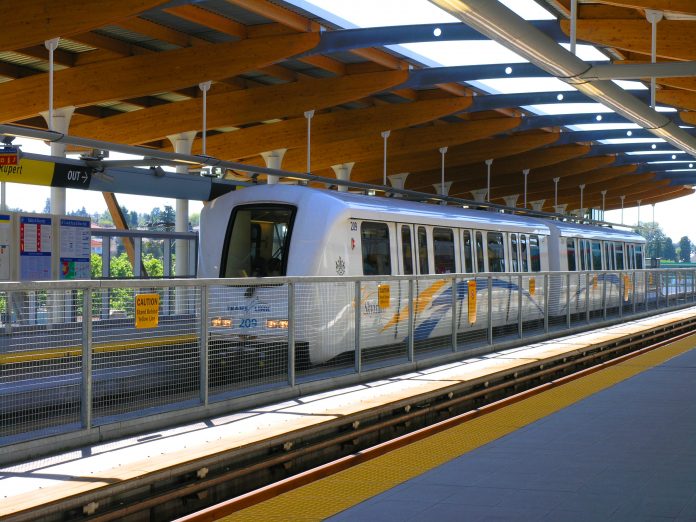
HUMOUR: The seven least popular funding alternatives to consider, now that Metro Vancouver voted “No” to the transit plebiscite
7. Have a gluten-free, vegan bake sale.
6. Rob a bank.
5. Raise fares to $1 million per zone travelled.
4. Put tolls — on schools.
3. Spend money on ads saying TransLink needs more money
2. Hire another CEO to help sort out TransLink’s finances
1. Have a transit plebiscite
HUMOUR: Guadalupe to wrap things up later this month, make way for Taco Bell
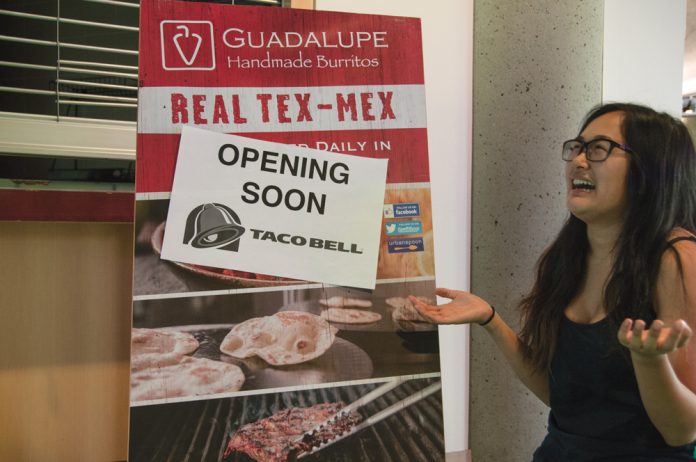
The battle for total corporate domination at SFU Burnaby has claimed another victim: last week, beloved food kiosk Guadalupe Handmade Burritos made an announcement that after a short but illustrious run, they will be packing in their beans, guacamole, and assorted heated sauces. Students now have only three weeks to get their fill of the most delicious burritos and tacos to ever grace the university’s campus.
Guadalupe’s seemingly sudden announcement has left many students feeling confused, sad, and suspicious that this might finally be the sign they’ve been looking for that God doesn’t really exist. A petition has already begun circulating the Internet, with over 10,000 signatures amassed as of July 12.
Criminology major and burrito addict Lindsey Cho, a regular at Guadalupe, told The Peak she is fearful for her mental stability after this unexpected revelation: “This can’t be happening. Every time I go to grab some food there, the line’s 10 people deep. It’s always buzzing with customers. Now how am I supposed to get my fix? I’m going to be burrito-tweaking hard by Friday.”
As it turns out, Guadalupe’s closure has nothing to do with a lack of lucrative earnings; the now-former owner of the food stand confided in The Peak that the closure was due to politics and competition from a well-known rival company.
“Not a lot of people know this, but we secured the lease shortly before Taco Bell was supposed to,” said the source. “They were pissed about it. They had plans to open up in the Ladle’s previous location. However, they were threatened by our success and comparatively better product.
“It wasn’t an easy decision to make — given our success and the wonderful staff I have — but at the end of the day, it wasn’t just about the money. It was about a lot of money. I mean, not only can I pay off my mortgage now, but I have enough money for a boat or maybe two. Straight-up pimp daddy of the seas, thanks to Taco Bell.”
Guadalupe will soon share the same fate as Himalayan Peak and the Cornerstone branch of Renaissance Cafe — a shift that has many students theorizing the fate of other independent establishments on campus. Dean McClees, an economics professor at SFU, suggested to The Peak that the closures might be far from over.
“Himalayan Peak, the Renaissance by the upper bus loop, and now the popular student food destination Guadalupe. It’s an unsettling trend with foreboding notions for the food landscape at SFU Burnaby. I honestly wouldn’t be surprised if the Highland Pub was turned into a McDonald’s somewhere down the line. On the bright side, given the space they would have to work with, the PlayPlace would be epic.”
Coincidentally, McDonald’s is indeed scheduled to replace The Ladle in September 2015, still occupying the left portion of the front of Higher Grounds coffee.
Taco Bell is set to take over Guadalupe’s space before fall semester begins, meaning students should start mentally preparing themselves now for the unsatisfying and mediocres flavours they will soon be choosing to consume. Patrons are also being advised to cry on their orders to make them more edible, potentially diluting any unsavory notes the chemically injected ingredients will undoubtedly have.
On Friday July 31, Guadalupe’s will serve its last chicken stuffed pinto bean-filled mouth-watering Free Runner, capping off its righteous and drool-inducing run in the pantheon of SFU food stops. Editors of The Peak newspaper will be holding a candlelight vigil in memoriam of this sad event. All SFU students, staff, and faculty are welcome to attend.
Laugh Track: Shirley Gnome

Shirley Gnome is aware that comedy musicians have a slightly tarnished reputation. For every successful example like Weird Al or Flight of the Conchords, there are a dozen acts that flounder, either from poor songwriting, poor jokes, or some hellish combination of the two. But with a string of accolades to her name — including back-to-back Canadian Comedy Award nominations for Best Variety Act — and her signature bright pink cowboy hat in tow, Gnome has hit the perfect note. Read on to learn about how she first got involved with comedy, the live album she recorded earlier this year, and why country music and comedy can be a difficult hybrid to sell to an audience.
How would you describe your comedy to someone who’s never seen Shirley Gnome?
I sing country songs about the stuff that women talk about in living rooms when they’ve had too much wine. The comedy is about being honest about a lot of things involving love, sex, relationships, and desire. I would describe it as very X-rated, very explicit, super honest, sometimes very silly, sometimes thoughtful comedy. Honestly I usually just tell people they have to see it. The live show’s kind of an experience, so you have to see it to believe it.
Have any family members seen your show before?
Yeah, my parents, my brother, my grandma, they’ve all seen it. They all think it’s awesome. My parents are actually very strong supporters, they’ve helped me out a lot. My mom even came to the Montreal Fringe this year. She handed out flyers, helped me sell merch, and sometimes even carried my guitar. Everyone was calling her roadie mom. So yeah, they get the jokes, they get the cleverness. They think it’s funny.
Has music always been so interwoven into your comedy?
I consider myself a musician before I consider myself a comedian. I love all kinds of music and I didn’t even know there was a stand-up scene in Vancouver until somebody invited me to do it. It wasn’t something that was actively part of my life, but music always was. I don’t think I would do comedy without music.
When did you first get into comedy?
I mostly did music and burlesque shows for two or three years. It was just sort of a joke side project and then my friend, who was bartending at a restaurant that had a comedy night, asked me to come and play his favourite song. I was weary about it, but then he offered me free bourbon if I showed up, so I thought, “Worst comes to worst, I get a bunch of free bourbon.” I went down and that night there were a bunch of great comics and everyone asked me where I had been hiding and they told me about all of these other comedy rooms. From there, it just took off.
Country music especially seems really polarizing; people either love or hate it. What’s been your experience with that?
There are two things that work against me when it comes to getting on stage: country music is one, because people have an aversion to it, and the second thing is, unfortunately, musical comedy often has a bad rep. People have seen enough bad musical comedians that they assume you’re going to be bad. Ask any musical comedian, they have to fight the first five or 10 minutes because they have to prove to the audience they’re not going to make them feel shitty. It’s always this upward climb. Musical comedy’s hard because you have to be a good comedian and you have to be a good musician. Most people will assume one of the elements is going to be off and it’s not going to be enjoyable.
What can you tell me about your latest release, the live album Lady of the Night?
That one was a reflection of me, being a part of the comedy world. The last two releases were studio albums with full bands, and this one was the act that I’ve developed from being in the comedy scene, so it’s just me and a guitar and an audience — that’s what my show’s turned into, in a sense. That’s why I decided to do a live album. Plus I had all of these songs I hadn’t recorded. Basically I was like, “Oh shit, I need to get all of this recorded so I can make room for more stuff.”
You’ve already done one set of Fringe shows, and you’re slated for two more this year. What can you tell me about the show you’re performing?
Fringe audiences are amazing. They just sit there and watch and they’re quiet and you can do whatever you want and they’ll go with you wherever you go. So what I’ve done with my material is taken all of my songs and woven them into an arc of a story that I tell. I change up the first half of the show sometimes, changing what songs I play, depending on the crowd. Sometimes I’ll go on a random tangent. There’s usually a variation, and then the second half is set as a mini arc with some darker themes. I get to play with a few stage conventions, like lighting cues, in a way that I don’t get to do at comedy or music shows.
If someone was trying to break into the Vancouver comedy scene, what would be your advice to them?
Someone was just saying this to me, about how they always wanted to give comedy a shot. Honestly, there are so many cool little rooms where you can try and most of the audience will be comics anyways. You can just get up there and people are pretty supportive. It’s not hard to start, but the thing is you have to keep with it. That’s trickier than just starting; it’s not stopping. Sometimes it’s frustrating. You’ll bomb at the beginning and it’s not a nice feeling, so you have to persevere. Get advice from the pros. When they’re there, ask them for feedback. It’s a great city to be in to try out comedy, so take advantage of that.
This week in comics



Failure makes me who I am

What is failure, really?
Typically, it’s known to be the absence of achievement. It’s the state created by inability. Failure is a condition virtually everyone knows, and perspectives on it are constantly developing. The idea of failure alone is alluded to by various aspects of education, ranging from the precise moment you step foot into the classroom to the letter grade on each assignment. As a student, I see sfailure is a significant part of my education.
We tend to think of failure as a negative result to a situation, often leaving us helpless and bitter. If this is the case, then it should be avoided at all costs, right? My past experiences tell me otherwise.
I have never really been academically distinguished. My school grades are representative of my somewhat ineffective diligence for studying. The walls displaying my ‘academic prowess’ are instead tiled with nothing more than lackluster attendance awards and recognition for menial tasks accomplished with satisfactory behaviour. My collection of consolation prizes pale in comparison to those of my siblings and my friends. It’s like having frames and trophies acknowledging my scraped knees.
“This isn’t me,” I thought.
The readily acceptable excuse has always been my artistic aptitude, and my current university experience has been widely determined by this. Being very indecisive about my future career at the time, my amazing solution for applying to universities involved accommodating for everything I could possibly be. Expectedly, I was not accepted into all my choices, and I am now studying graphic design at SFU.
I am more inspired by someone accomplished who has countlessly failed, than a natural genius.
Personally, my failures were a symbol of shame. The standards I set for myself were insane. My grades told me I just wasn’t smart. I often feared that pursuing a career that didn’t guarantee a favorable salary was risky. Being creative was just bad luck to me, like I had fished up a boot in the lottery of society’s prosperous aptitudes.
“I hate this about me,” I would say.
To my surprise, I’ve enjoyed my time studying design and grown passionate for the field of work. I’ve excelled beyond my expectation, and have become more confident in my creative abilities. How did this turn out so well when the process was so painful? Reminiscing, I realized some valuable truths about failure. It often sucks to experience; it is, however, essential.
Failure is necessary for success. No one is as perfect as they want to be. For me to set an abysmally high standard for every goal I was interested in was naive. Failing is as necessary and sequential in this process as planting your foot on the next step is to climbing stairs. To me, mastering a skill involves knowing how to fail in every element of doing it.
Furthermore, failure isn’t shameful. In fact, I would be more inspired by someone accomplished who has failed countless times than a natural born genius. Failure is the very element of life that makes it authentic and human.
Implementing this perspective in my daily life is still a challenge. I won’t pretend to completely understand how to deal with failure. Even now, I still struggle with new experiences and fall victim to comparison. Despite this, my realization of what failure really is has made me a stronger, freer person. One day, I want to be able to look back at all the times I’ve scraped my knees and say with a smile “This is me.”
Metro Vancouver votes ‘no’ to transit tax
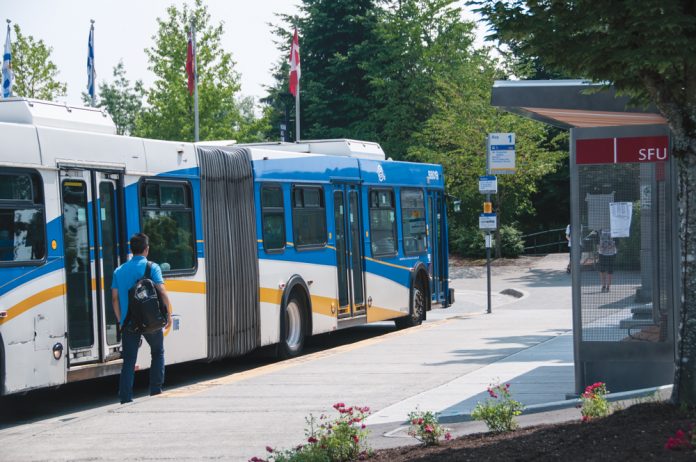
The results of the hotly debated Metro Vancouver Transportation and Transit Plebiscite were announced on July 2.
With a ‘no’ majority result, 68 per cent of voters voted against the 0.5 per cent PST increase to fund future public transit projects.
The tax would have contributed to increased bus services, maintenance of the Pattullo bridge, and many other transit projects. Critics of the proposal highlighted TransLink’s perceived history of mismanaging funds and also drew attention to TransLink CEO Ian Jarvis’ compensation, which totalled more than $400,000 for 2013.
Later on the day of the announcement, TransLink weighed in on the results, explaining in an online statement that they were “disappointed, but [they] respect the decision of voters.” The organization also admitted that voting for a tax increase was a “tough sell,” but that it would be a challenge for public transit to meet the growing needs of Vancouver without this extra funding.
“I think it was a mistake for them to hold the referendum.”
Megan Winters, SFU assistant professor of health sciences
The overall results were in stark contrast to a survey The Peak conducted in March, which showed 71 per cent of respondents were planning to vote in favour of the plebiscite. When it came time to vote, only three municipalities out of 23 voted ‘yes’: Bowen Island, the Village of Belcarra, and Metro Vancouver Electoral Area “A.” Maple Ridge had the lowest vote in favour of the tax, with only 23 per cent of voters voting ‘yes’. Altogether, forty nine per cent of eligible voters submitted a ballot, totalling 750,000.
However, the failure of the tax does not necessarily mean that transit will not be developed at all. Surrey mayor Linda Hepner explained to The Now that public transit is the biggest problem the city faces and that new sources of funding will be sought.
“I think it was an uphill battle,” said epidemiologist and SFU assistant professor of health sciences Meghan Winters, explaining that voters aren’t used to long-term policy planning. “We don’t vote on new bridges, we don’t vote [on] road investments, all of which have budgets even larger than the transit referendum.”
According to Winters, policy decisions like this one may be best “left to elected officials.” The last time British Columbians were asked to vote on a similar policy decision was in 2011, when voters rejected the Harmonized Sales Tax by a slight margin.
The media coverage of the vote is also believed to have been a factor in the results, and may have made the vote about something other than what was on the ballot. Winters explained “it’s not many people who are against public transit,” but the ‘no’ campaign focused on the shortcomings of the governance of TransLink, something that was not on the ballot.
When asked about potential reorganization of TransLink, Winters said, “Oh, something’s going to happen in TransLink, sure,” expressing a necessity to accommodate the growing Vancouver population’s need for public transit without any new sources of funding. “In the meantime, we won’t have dedicated long-term funding to strategic regional transportation and transit investment” she added.
Winters expressed her dissatisfaction with the process, saying, “I think it was a mistake for them to hold the referendum.”
In the coming years, Winters predicts that TransLink will have the considerable challenge of holding up to public scrutiny, while navigating a period of scarce funding and growing demand.
“No” victory will hit students the hardest
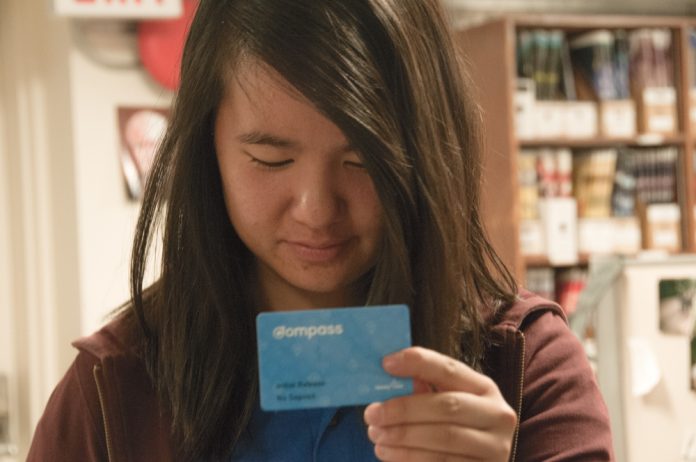
Like a lot transit riders who have kept up with the news these past few weeks, I’m disappointed, but I’m not surprised.
Metro Vancouver has voted “no” on a 0.5 per cent tax hike for increased transit services, including more bus service, a new Pattullo Bridge, 11 new B-lines, and better SkyTrain service. And it wasn’t even that close: 62 per cent of the area’s population voted against the proposed tax, versus 38 per cent in favour. Even Vancouver, where the effects of the planned tax would arguably have been the most pronounced, edged out a no vote, 51 per cent to 49.
We’re talking about a tax that would have costed the average Metro Vancouver household about $125 dollars per year — to put that in perspective, that’s about how much you probably spend on your annual Netflix subscription. In fact, most people reading this article would probably be paying even less, since the tax would have affected households based on annual income, which tends to be pretty low for starving college students.
Still, a “yes” win was always pretty unlikely. For starters, people are really unlikely to support raising taxes unless they’re given a convincing reason to do so, and the campaign run by the Mayor’s Council did little to focus voters’ attention away from the extra tax and towards the benefits they would reap from better transit service.
Furthermore, most similar referenda in the US, which the Mayor’s Council cited in their mission statement as successful examples, gave voters years to consider the questions they were answering, not months. Not to mention that distrust in both the spending practices and performance of TransLink — a system paradoxically admired nationally but despised locally — didn’t exactly get voters in the mood to give them more money.
BC students want better transit, and they’re willing to pay extra to make sure that they get it.
Given that the vote was a plebiscite and not actually a referendum, local governments and TransLink are essentially free to enact these changes anyway — they’re just likely to find the money elsewhere. Maybe from road tolls, or cutting wage, or reallocating government spending from other sectors? Those all seem like popular alternatives.
But let’s bring all of this back to SFU. I probably don’t need to tell you that this is a commuter school. With three main campuses and a diverse group of students from across the province and the world, almost 90 per cent of us take transit regularly, and those of us who do spend about twice as much time on buses as the average student in Canada does.
Given that most university students are low earners and fewer than ever are buying cars, we rely on transit a lot more than most Vancouverites — and, as anyone who has waited half an hour for a bus at Production Station or watched the third completely full 135 in a row drive by will tell you, there is definitely work to be done. But the results of this plebiscite mean that progress from here on out will be molasses slow, if there’s any progress at all.
And it’s only going to get worse. By 2041, roughly one million more people will live in Greater Vancouver, 700,000 more cars will be on our roads, and TransLink will contend with many, many more passengers on their already crowded buses and trains. You think the 135 is packed now? Just you wait.
In March of this year, The Peak polled almost 100 SFU students, 71 per cent of whom said that they intended to vote “yes” on the transit plebiscite. The reason? BC students want better transit, and they’re willing to pay extra to make sure that they get it.
By the same token, it’s students who will be hit hardest by the “no” vote, and it’s us who will be picking up the pieces in 2041.
A love letter to my beloved Renaissance at Cornerstone

[CUE THE DRAMATIC MUSIC]
My dearly beloved Renaissance at Cornerstone,
It saddens me to think that you’ve used the last of your coffee filters this past June 27; that you have shut your doors; that you are no longer. I gave you five to 10 minutes of my life (‘cause damn those lines can be long!) twice each week, in order to caress the rim of your styrofoam cup with my lips, and satisfy my salivary glands with your cheese bagels with cream cheese.
I greatly admire what you stood for. You stood to serve fresh, homemade delicacies, to bring a community of students together, and to brandish school pride with your SFU Burnaby origins.
Alas, it took a mere 10 years for your small, local business to be trampled upon, smothered, thwarted by an incredibly wealthy topless mermaid, who straightens her green crown, flips her flowing locks, and takes a duckface selfie before hauling her corporate ass through those doors.
And you have left me gut-wrenched, grief-stricken — a piece of my caffeinated soul lost forever.
I’ll be honest, your mochas taste a bit like burnt rubber, but it sickens me to envision hordes of students soon blindly feasting their tastebuds upon plastic croissants that conspire against our stomachs, or seductive tongues tickling our ear canals with lies of authentic ‘cuisine de France’ — all for five times the price.
You were local, you were fresh, you were honoured as part of the SFU community.
Tears now glisten down my now sunken, Renaissance-depriven cheeks!
Starbucks has undermined the inextricable values of small, independent business, and with it a sizeable portion of SFU pride. It’s brought further shame upon this campus by hiding under a visage of promises which include “creating community social space,” and “improving areas,” as the director of Ancillary Services Mark McLaughlin so justly stated.
I scoff! You, Renaissance, accommodated the same community social space. In fact, my beloved, you had no choice, for you housed the exact same number of square feet to offer our cranky, burgeoning academics. And believe me, my bruised hip-bones can attest to the fact that you were most definitely not short on table-space.
As for “improving areas,” allow me to be frank: what the hell does that mean?
Oh, the irony! What does this topless mermaid have that you do not? Ambiguity? Diabetes? High cholesterol? Boobs?
I understand that you still have two locations on our corporate-laden campus, and that these locations are only a three-minute saunter apart from each other, but put simply, losing you, Cornerstone, means losing one of three dear friends; one who makes me feel like the SFU student that I am, and who understands that my wallet is in tatters by cheaply medicating me with the lifeblood of pure, black, liquid gold.
And now we have no choice but to let this witless mermaid twerk an espresso shot into our sleepy mornings, contaminating our psyches with falsities of what defines valuable (and successful) business.
Sure, your mochas are shit, but the entity that is you, and your home made toasted cheese bagels with cream cheese, will remain in the hearts and minds of Cornerstone-going coffee addicts forever.
Goodbye, Renaissance at Cornerstone.
Your sorrowful sipper,
Adam
Through a Window

The main floor of SFU’s AQ building is a major thoroughfare. It’s busiest at peak class times, especially in the fall. It’s a transit hub, but also as a social space — perhaps the most social space at SFU’s Burnaby campus.
Found on this floor, across from the largest lecture halls in the school, are the SFU Galleries. This space stewards the Simon Fraser University Art Collection which includes in its holdings of over 5,500 works, significant regional and national works spanning the last century. One of those is Brady Cranfield’s Rhythmanalysis, marked on a bright poster outside of the SFU Gallery, which continues to illuminate this space at SFU. It is one of several personal rhythmanalysis studies conducted by SFU artists and writers near literal windows at the SFU campuses, and these posters are just one facet of a grand, three-part exhibition put on by SFU Galleries this summer, titled Through A Window.
Curated by Melanie O’Brian and Amy Kazymerchyk, Through A Window traces the history of art at SFU of the past 50 years. The inspiration behind the project stems from Henri Lefebvre’s book Rhythmanalysis (1992), particularly the chapter “Seen from the Window,” which allows us to consider three social, spatial, and material windows of SFU, and explore different rhythms since SFU’s inception in 1965.
Lefebvre’s method of rhythmanalysis begins with observing the rhythms of the body and how they are impacted by the natural and synthetic rhythms of the economies and cultures we live within, which in turn produces social practices and public spaces.
“It’s about making what has happened here known,” she emphasized. “It’s recuperative and celebratory.”
“It is such a big idea, and SFU is a portal,” explained Melanie O’Brian, the director of SFU Galleries. “Here we can look at those big and small rhythms in a meaningful way.”
The rhythmanalysis takes place in the framing of these different spaces, and is rooted in the concept of the ‘lens.’ We can first look through our lens at what’s going on ‘out there,’ on the other side of the window. We can also be introspective, and look at the rhythms within the walls of SFU and ourselves.
The exhibition is anchored at three SFU windows: SFU Gallery at the Burnaby campus (established 1970), the Teck Gallery at Harbour Centre in Vancouver (established 1989), and the Audain Gallery at the Goldcorp Centre for the Arts in Vancouver (established 2010).
Each space reflects its own unique history, psychology, community, and rhythms. Therefore, though the works one sees and the experiences one has are completely different, they still contribute to a whole cohesive and powerful narrative. O’Brian asks, “What is each without its context?” and stresses that each window “provides a space for social development.”
The SFU Gallery showcases intimate moments from our past, ranging from works of photography — my favourite is a grainy, oversized one of a professor throwing books from her office in the AQ — to video installation, such as an assignment in which a student records himself walking back and forth, over and over, in the space where the original SFU Pub was located.
Historically, our Burnaby mountain location has been slightly removed from the city’s rhythms, and so a unique situation of special freedom and ‘bird’s eye view’ thinking has manifested here. Featured are conceptual artists from the SFU community such as members of N.E. Thing Co., Christos Dikeakos, Ken Lum, Jeff Wall, and succeeding generations of SFU students and faculty, including Allyson Clay, Carol Sawyer, Reece Terris, Stephen Waddell, and Jin-me Yoon.
The Audain Gallery, located in the heart of Vancouver, is rooted in a more political performance, and uniquely takes up sound, activism, film, literature, photography, and performance as extensions of Lefebvre’s process of rhythmanalysis. It includes works by Lorna Brown, Rodney Graham, Tiziana La Melia, Elspeth Pratt, Judy Radul, and Althea Thauberger.
At Harbour Centre’s Teck Gallery, Sabine Bitter and Helmut Weber’s installation, The Templeton Five Affair, March 1967 (2010) features two opposing images: one of the exterior of the AQ with all people removed, leaving only white space, and the other of all those people without their surroundings. It investigates the struggle for academic freedom, as well as collective agency and the educational institution.
O’Brian acknowledged that the intention behind the exhibition is to lay the foundation for art history at SFU. “It’s about making what has happened here known,” she emphasized. “It’s recuperative and celebratory.”
Entering into the frames and rhythms of art and SFU, it’s clear that there have been huge transformations throughout the decades. Pointing out pieces by students, alumni, professors, and community collaborations, O’Brian explains how the societal consciousness and external rhythms are reflected internally through the artwork at SFU.
Looking back at work from Jeff Wall from 1977 reveals a process of relation rooted in conceptual art and photography. Moving into the 1980s, the shift of identity politics and feminism in the community is reflected through the change in teaching styles of art instructors at SFU, and subsequently the artists and art itself.
In the 1990s, through the age of the Internet, new media, and questions of gender, labour, and corporate versus individual identity, there was an increasing pull towards video and installation as the landscape of identity politics continued to change.
Through A Window is a dynamic and special exhibition. It signifies the first time that the art history of SFU has been collected, documented, and, of course, shared. It lays down the foundations of what our past has been, and sets us up to explore our future of possibilities.
We will be able to explore the rhythm of our history for some time longer — until July 31, 2015 at SFU Gallery in Burnaby, until August 1, 2015 at the Teck Gallery at Harbour Centre, and until April 30, 2016 at the Audain Gallery at Goldcorp Centre for the Arts.
The next time you find yourself power-walking to the Renaissance Cafe or your downtown location of choice, I encourage you to take a moment to stop by and feel the rhythm of our past 50 years. You won’t regret it.

