

By: Michelle Young, Co-Editor-in-Chief
Lost Chapters (or Los capítulos perdidos) is a quiet and tender documentary/fiction hybrid set in Caracas, Venezuela. The film follows Ena, who is searching for “forgotten writer” Rafael Bolívar Coronado across the city. Lost Chapters will be premiering at the Vancouver Latin American Film Festival on September 5. I had the wonderful opportunity to sit down with director Lorena Alvarado to learn more.
This interview has been condensed for concision and clarity.
Tell me about how your life influenced the film.
“I considered it sort of an auto-fiction film so it’s a mix of real things of my life and my childhood. The character of my sister is a hybrid of her and me, she’s kind of this character that’s playing herself but I’m also living vicariously through her in the film. So the film is very inspired by my life but the fiction component kind of carries the film.”
I found that the film has an overarching theme of memory and loss. There’s the loss of memory, lost books, lost business, and so on. Can you speak to what these themes mean to you and their importance in the film?
“The core of the film I would say is memory loss, and it’s explored in different ways through the characters. With Ena, it’s coming back home after being abroad for a long time and feeling this loss of when you leave and come back — that’s a very universal feeling of having these holes in what your life was and what you are now. She’s trying to reconnect with her sense of home and her family and coming to terms with the fact that things are different but they’re also kind of the same, so this bittersweet feeling of change.
“There’s the grandmother character who explores memory loss in a very literal way, like she has dementia, and she’s literally losing her memory.
“The third character, the bookseller father, he’s trying to safeguard the memory of a country that has had so much massive [emigration] and so many people have left, and libraries are left behind. His work as a bookseller has become to recover these books that people leave behind and he’s becoming a keeper of heritage of Venezuelan books. All of them are dealing with memory and trying to deal with memory, and trying to hold onto memory, even though it’s kind of a futile desire. Ultimately, we all die and we all lose the things we love so it’s this beautiful and futile endeavour that we all have as humans to hold onto the things that we love and care about but ultimately they get lost.”
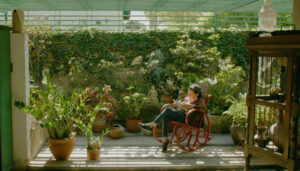
While the film is set in Caracas, and features small references to Venezuela’s current situation (such as the power outages and disputed election results), the main focus is on daily moments in life. Can you talk about your decision to keep Venezuela’s political and economic situation in the background?
“That was a big question I had throughout the entire process of making the film, how present I wanted the political and social crisis to be in the film — whether I wanted it to be at the forefront. And you know, most of the films I see in Venezuela are about the crisis and for me that was a little bit exhausting as a filmmaker and as a viewer — of only seeing the country through crisis. Just growing up, all my life I’ve heard of Venezuela in negative terms and always bad things. Despite it being a country that has gone through so much turmoil, I had a beautiful childhood. I wanted to reconnect with my childhood and my memories in a way that wasn’t mediated through politics. So that’s when I gave myself the agency to be like, ‘this is going to be a story about a family and not about the situation in Venezuela.’ I didn’t want the protagonist to be Venezuela.
“I wanted to make the film as subtle as possible. So there is mention of the things you said — the electricity shortages, people who have emigrated, the elections, but I wanted to present it in a very quiet whisper and not have it be smacked into people’s face.”
In the film, it’s this journey following this writer, Rafael Bolívar Coronado, who may have written on Venezuelan oil. I find that many people, when they think about Venezuela, they think about oil as being tied to our national identity. What was the reason you chose this author to lead the narrative?
“Even as Venezuelans, I think we see our national identity very connected to oil because it’s what’s caused so much richness and also the crisis we have now. I think oil is inextricable to the reality of Venezuela. But again, so many things I see about Venezuela are about oil and again, I was exhausted by that unidimensional exploration of the country. Like oil and the crisis. So I did want to mention it somewhere, but have it be this very soft whisper.
“Ena finds this postcard that mentions an author that actually wrote this book called Elvia, that is the first novel that mentions oil. The postcard suggests [the book] might be written by Bolívar Coronado, so it’s a possibility. So then Ena kind of embarks on this search to find the book to confirm if it might be written by this author.
“The search becomes about the book and also about him. So there’s this effort to learn more about Venezuelan history and dig into things that aren’t the first thing that people know about Venezuela.”
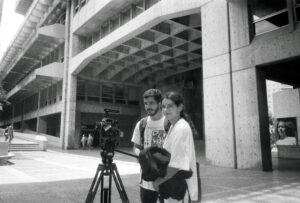
Tell me about the filmmaking process and your own cinematic influences.
“It’s a very small film. It was self-funded and most of it was shot by myself and with one other person. A very small part of the film — the scenes which were outside — was shot with a small crew. I think that intimacy shows through the film and you can see that it was filmed by very few people because there’s this sense of intimacy and tenderness that would have not been possible if it had been a big production. And also the actors aren’t professional actors, they’re real people.
“I love Matías Piñeiro, Nicolás Pereda, and Abbas Kiarostami. His films are just so tender and about universal human emotions. I read a book called Lessons with Kiarostami and it’s this collection of workshops that he did with filmmakers and I found it really inspiring. He talked a lot about seeing a film as a poem, rather than entertainment.
Is there anything else you would like to add?
“Stress the importance of seeing the film as a poem. We often aren’t used to seeing films that aren’t very clear cut or have a bad guy and a good guy, and a resolution and this film is very much not like that. So that’s why I see it as a poem: as something that moves you, and you might not necessarily know why. You might finish the film and not be able to pinpoint what it’s about. I love that feeling. I think art is the best when it makes you feel that way and it lingers with you.
“I see it as a poem: as something that moves you, and you might not necessarily know why.”
“There’s a poem in the film that’s at the core of the film and Ena is trying to get her grandmother to learn the poem by heart and she’s trying to recite it with her. I think for me, the closure of the film is when Ena realizes her grandmother won’t be able to learn it by heart and accepts that she’s losing her memory, so Ena starts learning the poem herself. That’s her way of keeping her grandmother inside of her. I wanted to stress how important poetry is for me in the film.”


