Home Blog Page 819

Former SFSS president publishes his side of “forced resignation” story

0
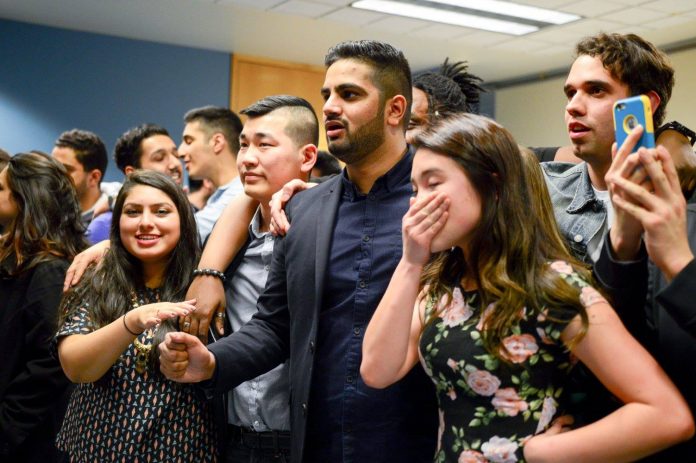
Sharma said he takes "full responsibility" for his resignation last semester.

Perhaps the biggest shock that the SFSS board of directors faced this year was when then-President Deepak Sharma resigned just over a month into his tenure as the President of the SFSS and Chair of the Board of Directors. It may now come as a bigger shock that Sharma claims the decision was forced.

If SFSS policy and bylaws had been concurrently practiced in the same manner they had been followed since at least 2008 onwards, I would [have] never been forced to resign as I still was an eligible member of the SFSS,” said Sharma in his first public mention of the matter, well over four months since resigning.

The Peak is currently investigating, but it appears that Sharma was not registered in a single class at the start of the summer semester, which he correlates during his statement as “[his] own choice of long delay in enrolment for the 2016 summer semester,” which then was flagged as an issue. Typically, candidates are warned of this before another check later on.

At the time of this check, Sharma was not registered a student, as he was under the impression that he would have until week six of the semester. This is just after the add/drop deadline for SFU classes, and the time this check routinely had been coming since 2008, which is what Sharma was referring to.

However, according to an anonymous source, Pierre Cassidy, Campaigns, Research, and Policy Coordinator for the SFSS, decided to push that time up, catching Sharma unprepared. For the record, it would appear that Sharma was a registered student by the time the check he was expecting came.   

From there, Sharma was supposed to be (and was) suspended from the Board, with a full check supposed to happen later on, and with Sharma given enough time to add classes to become eligible as per the the SFSS requirements.

However, Sharma instead took “temporary resignation,” which was taken as a complete resignation from board, and not a semester off as he intended, according to Sharma. While he was pressured earlier to be an enrolled student than he was expecting, he made the mistake of resigning from the board during his suspension period, which he acknowledged in his statement, while still maintaining the resignation was forced.

“Due to my own choice of long delay in enrolment for the 2016 summer semester all of this took place, which is why I can only hold myself accountable for all that has transpired,” he said. “As this is all my fault, I sincerely apologize to everyone that was compiled to deal with the outcome of my forced resignation.”

The Peak reached out to Cassidy for comment, but were told by VP university relations Arr Farah that he “does not have the authority to speak on behalf of the SFSS.”

The Peak is currently awaiting comment from the SFSS, and will update the story as it progresses.

For those interested, Sharma’s public Facebook post can be read here.

Never say oui to Ouija boards

0

[dropcap]I [/dropcap]wanted ghosts to be real. I wanted my fear of darkness be validated by the presence of otherworldly beings. Since the age of five, I would switch channels until I found a horror movie on the TV. I didn’t like horror that illustrated such grotesque monsters, but it validated me. This fed my interest in real ghosts; the ones that would make the air around me cold, the ones that would make me look around the room every five seconds, the ones that wouldn’t let me fall asleep the whole night.

I wanted to witness that kind of paranormal. I wanted to live it, so I went searching for that kind of presence. In boarding school, I easily fell into the trap the seniors set up for us: a hoax ritual, a sermon for the evil — all for a few laughs. So it was only natural that I nodded with alacrity when my friends in university asked me if I wanted to try out the Ouija board.

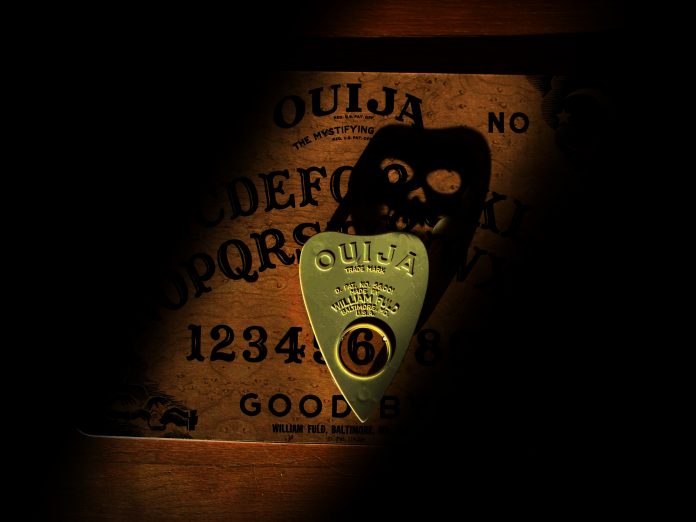
We picked a day, a time, and our favourite spot on SFU’s campus: the dugout. It was mid-spring and well under five degrees. We laid our Ouija board down on the ground and lit candles in a circle around us — you know, for the aesthetic.

We were all excited; excited for what might lay ahead of us, excited about the possibilities, excited because we thought this was silly.

Soon enough, the questions started to roll in: “Is anyone here?” “Is there someone around us?” “Can you hear us?” All of our fingers were placed on the planchette, and I giggled a little inside thinking that we all belonged in a cult.

Cults probably know the spirits they call upon. For us, this was just a way to spend our Thursday night. Someone suggested a different line of questioning, so my friend mouthed the words, “Is there a separate world for spirits?” The planchette pulled away from my fingers. It slowly dragged itself to “No.”

I looked around the dugout. It started to feel cold — maybe because there was a presence amongst us, or the lack of humour within us. The planchette was waiting for the next question as it moved back to the centre. We asked for the spirit’s name, and the planchette slithered to the letter “D” and across the letters to “N.” The only candle closest to the board flickered from the wind. I could hear my friend breathe as we all stared at the board.

We pressed further with another question: “Are you here?” I continued to gaze at the board in the little light we had, wondering if I was caught up in another trap by my friends. There was no movement of the planchette when my friend started to speak, “OK, guys, did anyone . . .” Her words faded away as she felt another movement. The planchette moved faster than before towards the corner of the board, towards me.

She no longer found the need to ask any questions. “Goodbye spirit. Goodbye.” She turned the planchette and the board upside down while instructing us to blow the candles out. I spilled the liquid wax onto my fingers and my coat; we didn’t realize how long we had waited for an unknown being to answer us. I saw my candle go out before I could put it out myself. What followed was darkness and silence.  

My friend finally spoke while we left the dugout. “When the planchette moves off the board, the spirit is trying to set itself free!” I thought something tugged at my hoodie. I cried while we sprinted for our life. Later that night, I was awake listening to every noise in my room — this was just another movie night in my life.

I can’t tell you if ghosts are real or not. My fear is real, though. That night confirmed that my fear might be well-justified.

The writing on the walls

0

[dropcap]B[/dropcap]efore I tell you about my experience with the paranormal, I want to stress that this is a true story. Not one made up to try and scare you, but instead one based on my best recollection of events that happened to me years ago.

Our story takes place at my old middle school. Being built in the early-’60s, it certainly had the elements of a school from another era. Strange old science equipment, dark and dusty untouched rooms, and some textbooks that had been left unopened for decades. Accompanying the age of our school always came the standard “ghost stories” of strange events and experiences.

The rumours were just as you would expect: books getting knocked off the shelf at night, the overnight custodian claiming they heard noises, that one kid who swears he saw some figure when he was alone in the school late after class.

However, there was never anything that I thought was really all that substantial. The kid who saw something was probably just exaggerating; the custodian was probably just trying to mess with the kids; and the books were probably knocked off by all the rats that were running around the place. Nothing to worry about. However, if there was one thing at my old school that made me uneasy, it would have to be the school basement — or as everyone called it, “The Dungeon.”

Anyone can recognize that basements are inherently creepy. Regardless of whether you believe in ghosts or not, once all the lights are turned off, you feel a certain sense of someone — or something — behind you, watching you, as you make your way up the stairs. My school’s basement was no different. I had never been to the dungeon, and that was a streak I wanted to maintain all the way through middle school. Unfortunately, that streak would come to an end when a teacher decided to send myself and a friend (let’s call him Adam) into the dungeon.

You see, it was near the end of the school year, and everyone had been allowed outside but Adam and I decided to stay inside and help our teacher clean out her classroom. She gave each of us a box of novels that needed to be put in the dungeon, and then gave Adam the keys to the basement door. She assured us that nothing bad was down there, nothing bad would happen to us, and that it was “just another storage room.”

She was a liar.

Reluctantly, we left her room and went to the dungeon, jokingly telling each other what kinds of terrible things were going to happen to us down there. When we got to the door, Adam used the key and we flicked on the lights that were right behind the door. Immediately in front of us was a flight of stairs, followed by a 180-degree turn to the right, and another flight of stairs leading to another corner and the main area.

We got to the bottom and took in the chamber. This place looked like a bomb shelter from the Cold War. No windows, all concrete, and spider webs that you would have to see to believe. The room was a bit smaller than your average classroom. Our school used this area to store the school’s textbooks, but it looked like it could have been used as a prison. The rectangular room was filled with bookshelves, all jam-packed with textbooks and novels. The lighting was bad, coming from two rectangular lights that hung in the center of the room. I certainly didn’t feel like Adam and I were the only ones inside the dungeon.  

“Does this place feel creepy to you?” Adam asked.

Regardless of whether you believe in ghosts or not, once all the lights are turned off in a basement, you feel a certain sense of someone — or something — behind you.

“Extremely,” I responded.

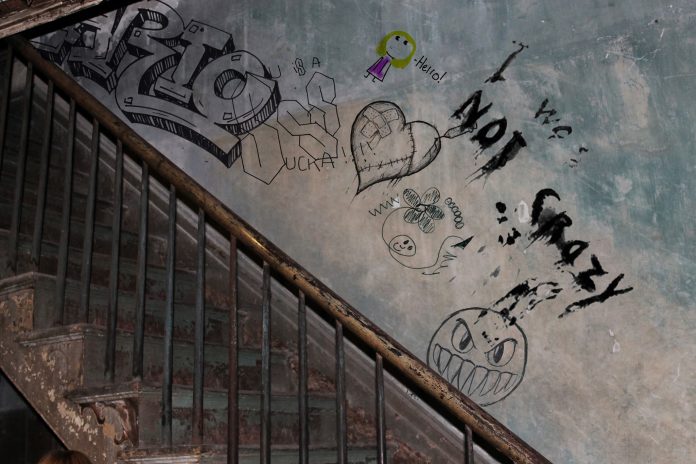
The walls were what caught my interest. I put my books down to examine them and the rest of the room. There was graffiti left by other students from previous years. Standard middle schooler doodles of smiley faces, their names and years, even that weird “S” people always used to draw. However, most of the ink was faded and very difficult to read. Adam wasn’t as interested in the writing on the walls, and he simply wanted to get back to the classroom. That wasn’t a surprise — the room wasn’t very pleasant.

We started looking around trying to figure out where to place the books, when something terrifying happened: we heard the door slam shut above us. Adam, without hesitation, dropped his box and ran to the stairs. As soon as he turned the corner to start going up the stairs, things got a lot darker. Literally darker. The lights turned off.

Shivers shot up my spine as a draft blew through the room. The chills of unease and concern were now overwhelming. I began hearing voices behind me. It sounded exactly like a classroom. Adam finally reached the lights and turned them back on. Looking around the room, something was different. Written over some of the older graffiti, standing out in clear, bold black ink, there were new words written on the wall. I didn’t have to read it before booking it back up the stairs into the hallway.

What freaked me out the most was the fact that the door closed before the lights turned off. The light was right behind the door; the only way it’s possible to close the door and then turn off the lights is to remain inside the room. Adam told me after that no one was at the lights when he got to them. Someone or something had turned off the lights and was in that basement with us. We just couldn’t see them.

So, the next time you’re going up the stairs, leaving your basement late at night, perhaps that unease you feel is more than just your imagination. Maybe it’s just something or someone saying goodbye, and watching you leave.

SFU hockey destroys Eastern Washington 10–1

0
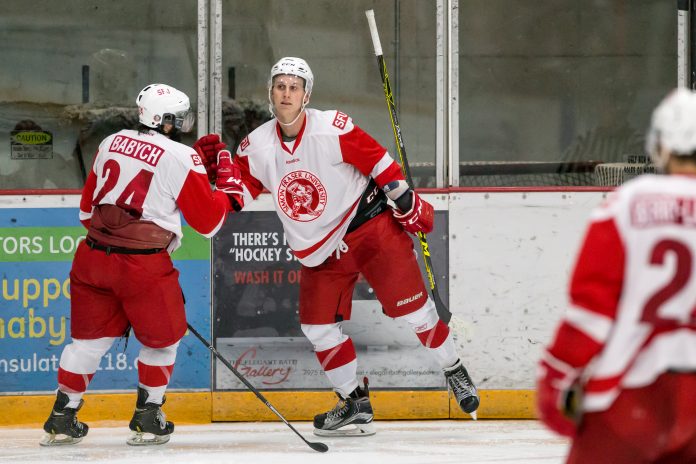
Mitch Crisanti (centre) scored three goals in the second period.

Coming into this one, it looked like the matchup against Eastern Washington could be the perfect tonic for an SFU team that lost in shocking fashion the week before. Eastern Washington had let in 20 goals through four games, and had lost every single one of those.

What resulted was a total domination of the Eagles; it was SFU’s biggest win since beating the University of Victoria on October 18, 2013 10–0, and the most the team has scored in a game since last February, when they scored 10 on Trinity Western.

“We were waiting for that for the last three years to be perfectly honest,” said head coach Mark Coletta after the game. “Tom [Spencer] and Jim [Camazzola] both mentioned it, we were waiting for a breakout performance. Ten goals is great, and I thought the boys in the first period really played well. There was a lot of jump, lot of energy, and I thought that was better than the 10 goals.”

SFU got off to a flying start, scoring five in the first period, and all from different goal scorers. The Clan also chased starter Tyler O’Donnell from the net, after he let in four goals on only nine shots.

“I think it was just the guys figuring it out,” said Coletta on the team’s quick start to the game. “Last week, we had a decent game, I guess until the end — it was just lacklustre. We had real progress in the Alaska games, and then we kind of tailed off. I felt we needed to find something to motivate us, and the loss did motivate us.”

The second period belonged to Mitch Crisanti. The second-year player from North Vancouver scored a hat trick in the period, and the only thing not making it a natural hat trick was a Darnel St. Pierre goal. Crisanti now has five goals this season; he only scored two all of last year.

“I just got lucky on the first one there, it kind of slipped through him,” said Crisanti on his hat trick. “From there, I just kind of felt good and they just seemed to go in.”

“We’ve been pushing for Mitch to be a goal scorer,” Coletta remarked. “That’s what he is, he was that in junior. He’s a big, great skating, free-wheeling kind of player. We just got to get him to do those little things defensively and the goals will take care of itself.”

As expected with a 9–1 lead after two, things got a bit physical. A total of four game misconducts were handed out in the final frame, most of them from a brawl that happened at the 10-minute mark. It was the second straight game with this sort of stuff in the third, and it’s something the team as a whole has to work on.

“I think we did manage it the best we could,” said Coletta on the emotions of his team. “I think there’s a couple of guys who have to make sure they manage it and we’ll address that internally. I don’t like to see that, [that] barbaric garbage stuff. A good hit and an isolated fight is sometimes involved but the little melees and the junk in front of the net, we’ll address it. Our guy was one of those guys and we’ll have to make sure he is held accountable because I don’t like it.”

With SFU set to face a stiffer test for the next three games, 10 goals will probably not be in the cards. However, it provides the Clan with a good shot of confidence heading into those contests.

Next up: SFU takes on the University of Victoria at home Saturday. It will be the first game against former NHLer Patrick Holland, a former draft pick of the Calgary Flames and who played five games for the Montreal Canadiens in the 2013–14 season. So far this season, he’s averaged a goal every game and has nine points.

“Just be tight,” said Coletta on how to shut down Holland. “I’m sure he’s a good hockey player, he didn’t get 100 points in the WHL [Western Hockey League] for nothing, but it’s no different than our guys. We just have to be able to match whatever he brings.”

Mistakes on offence drown out defensive progress in 57–0 loss

0
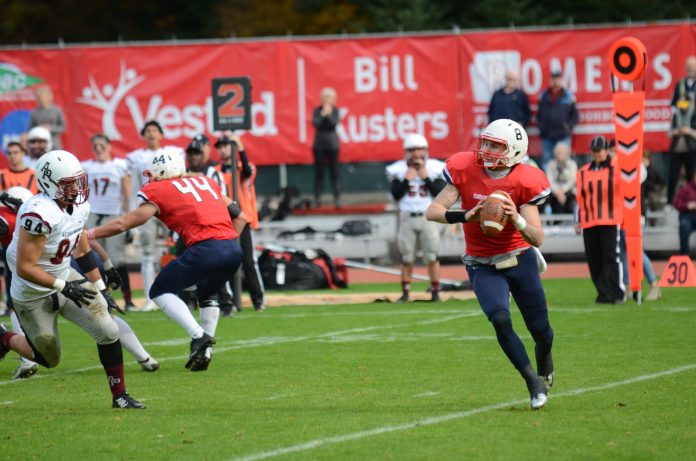
Miles Richardson (#8) went 14 of 25 for 95 yards passing and had four interceptions.

At halftime, the defence hadn’t allowed a single point.

Normally that would be a good thing, but on October 22, SFU’s football team was already down 28–0 to the Great Northwest Athletic Conference (GNAC) leading Azusa Pacific Cougars.

“Our defence was outstanding today,” said head coach Kelly Bates.

The defence was perfect on three opportunities against the Azusa charge in the first. So how did the team end up down 28–0?

Three pick-sixes thrown and a fumble return. It wasn’t the worst score SFU had been down after the first half, but it was probably the most deflating.

“Offensively, we spotted them 42 points basically, and that’s unheard of,” said Bates, also referring to later points scored against the team. “You have to be good on every play. We drove the ball at times very well, but we would end with a terrible mistake, and make no bones about it, it was mistakes whether it was bad throws or bad blocking. They weren’t physical mistakes that hurt us off the bat, [. . .] but the mental mistakes hurt us at the start and those are hard to overcome.”

SFU played two quarterbacks for much of the game, alternating most drives with starter Miles Richardson and backup Mihai Lapuste. Observing the game, it looked like it may have been a reaction to the three pick-sixes thrown by Richardson on misreads, but Bates stated that it was “game planned” from the start to alternate the two.

“Make no illusions, we were at 0–6 and we’re at 0–7 now,” he explained. “And you’re trying to gain experience for all your players at this point in time, and you understand that you are building for the future, and to build for the future, you need to give guys reps.”

It was neither quarterback’s finest hour, with Richardson throwing four interceptions, sacked four times, and responsible for a safety, while Lapuste’s fumble at the end of the half was returned for a touchdown.

However, it would be unfair to blame either quarterback solely for an offence that wasn’t just not scoring, but was bleeding points. Once again, there was little to no time for either quarterback to make decisions — it was get rid of the ball as fast as possible or be sacked.

“We’re just too small right now. We’re asking some guys right now that are young and really shouldn’t be put in that position yet to do some things, but that’s where we are right now,” explained Bates, saying that offensive and defensive linemen are key targets for recruiting. “We need to bring in some size and depth at those two key positions, because you’re only as good as your offensive and defensive line.”

Snaps were bad, and have been a recurring problem. On the safety charged against SFU to make it 50–0, though Richardson kicked the ball into the endzone causing the two-point penalty, he was making a quick decision on a high snap causing a fumble — his kick probably protected against a worse outcome.

The thing is, the offence was making some yardage when they weren’t giving up the ball. Though 15 first downs is no accomplishment, it shows there was some ball movement. Before a 68-yard pick-six on the first drive, SFU had gained two first downs.

The last drive of the game — when, again, the other team has probably packed it home — the offence put up its best effort of the game, moving 75 yards and possessing the ball for just over 10 minutes. But still, even making within seven yards, it was not enough to prevent the shutout.

“We drove the ball at times very well, but we would end with a terrible mistake.”

Gavin Cobb was perhaps one of the few bright spots on offence, putting up a great performance on special teams, returning 136 yards in kickoff returns.

“It’s been fun to watch Gavin. He’s a young kid obviously, right out of high school,” said Bates. “He’s special, you guys can see that. I look forward to watching him grow and becoming the student athlete we think he will become.”

While the offence lost more points than it put up, the defence once again put in a solid showing — a recurring theme, it seems.

Though the defence did end up allowing some points in the second half — one touchdown occurring after Azusa recovered a fumble by the SFU offence on the goal line — and was, to some extent, worn down, it was incredibly effective against the Cougars early on.

In the second quarter, SFU faced off against the Azusa offence on a long, laborious drive that lasted 8:54, not unlike the last one by the Clan. Though Azusa was able to make 94 yards, the SFU defence was able to prevent the touchdown at the two-yard line — yes, at the two-yard line — by forcing a fumble. SFU recovered (only to throw a pick-six, but I digress).

“Psychologically, it’s very tough. I believe our guys responded very well today though,” Bates reflected on the defence, which spent much of the first half watching mistakes on the other side of the ball. “Our defence, they played well all week and we’ve adjusted on defence. We’ve changed things to allow the ball to be thrown underneath and [that] makes offences have to be perfect, and that’s fine. They can nickel and dime down the field and we’ve shown the ability to stop them when we need to. And today we did do that.”

Perhaps we’re seeing the route that SFU may have to take to find success: a strong defensive team that makes its splashes in stopping the ball, rather than a high-octane offence.

However, in order to do that, the team still needs an offence that can not only score some points, but not add them in the opposite direction.

SATURDAY: SFU embarks on a road trip to Arcata, CA to take on the Humboldt State University Lumberjacks.

In their last matchup, an SFU home game on September 17, the Clan fell 56–24, after giving up 35 points in the first quarter. However, SFU saw a resurgence in the second half, tying the Lumberjacks in fourth quarter scoring 21–21. Jalen Jana put up 262 rushing yards in an elite performance.

Winning the GNAC title last year and being the first team in the GNAC to make the playoffs since 2009, the Lumberjacks were expected to do big things this season — they were picked to finish first in the GNAC. However, they have fallen short of expectations, currently sitting in third, tied with fourth-place Western Oregon for their conference record (2–4).

Before a 42–37 victory over Western Oregon on October 22, Humboldt was sitting alone in second to last, ahead of only SFU.

Part of the reason may lie with star running back Ja’Quan Gardner, who has been limited by injury, rushing for less than 80 yards in four of eight games. Gardner had 211 rushing yards and four touchdowns against SFU in their last matchup.

Statistically, Humboldt has one of the worst defences in the GNAC, allowing more yards per game than SFU (484.4 yards per game to SFU’s 438.7), and allowing 38.2 points per game (second-last to SFU’s 54.3).

But Humboldt is still an elite offensive team. The team leads the GNAC in both passing and rushing offence.

If there’s a team that SFU’s offence can find some sort of groove against, it might be the Lumberjacks, who supplied them their best performance so far. But the defence will have to keep up the level of play from the last two weeks — and may have to force some offence themselves.

Kickoff is at 6 p.m.

SFU’s men soccer puts five goals past Saint Martin’s

0
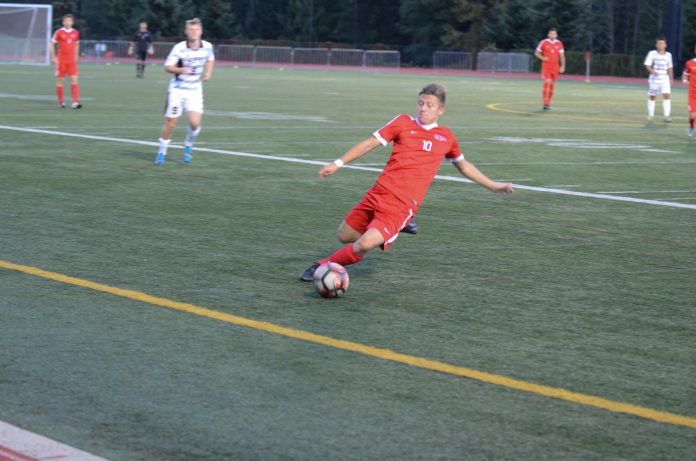
Adam Jones (#10) had two goals and two assists in the game.

The 2016–17 season has been a bright one for the SFU men’s soccer team so far.

The Clan blew up Saint Martin’s defence and showed goalkeeper Griffin Small no mercy. Five goals from Adam Jones, Mamadi Camara, and Magnus Kristensen sent SFU’s men’s soccer team on its way to a thumping victory after a recent draw against the Western Washington Vikings. The Clan, currently ranked first in the Great Northwest Athletic Conference (GNAC), was astonishing offensively.

Midfielder Jones had an incredible performance, netting two goals and two assists. Camara also notched two goals, while defender Kristensen scored the first goal of the contest.

Saint Martin’s University’s (SMU) nightmare started 17 minutes in, with Kristensen directing a high volley under an assist by Jones, and scoring his first goal of the season.

Coach Clint Schneider reflected on Kristensen’s performance: “For Magnus to get a goal, of course, it’s awesome. I’d love for him to get goals. We have an award in our change room called ‘The Grumpiest Man of the Year Award,’ and he’s [Kristensen] won that award [. . .] Hopefully, it’ll turn his frown upside down after that goal.”

Schneider also commented on goalkeeper Brandon Watson, who recently became GNAC’s all-time leader in shutouts. “What an incredible career,” said Schneider. “We’re pretty lucky to have a guy like that.”

Camara deployed his magic in the last minutes of the first half. Jones powered through the midfield, assisting Camara with a long lob pass. Camara cut past SMU’s defence and did not hesitate to fire the ball in the empty net.

Five minutes into the second half, captain Ryan Dhillon raced in the right flank before firing the ball to Jones, who deflected a perfect shot past Griffin Small. Jones scored his second goal less than a minute later. Thirty minutes before the final buzzer, Camara and Dhillon combined for a strong finish. Camara delivered a low ball just inside the right post.

Freshman Riley Pang, who’s scored three goals this season, was injured during the game’s performance. Schneider expects him to be able to play at the next game on October 27.

Schneider acknowledged his players’ explosive comeback. “We talked about making sure of a bounce-back. We are pleased as a coaching staff. We didn’t play to our ability against Western Washington. I’m glad that we came back. It’s all about commitment and I continue to trust them.

“At the end of the day, it’s just about wins,” said Schneider. “I am very pleased with the performance. That’s exactly what we’re trying to get out of the guys at this point,” he added.

The team is currently one of the four unbeaten teams in the NCAA Division II. The Clan will now take on the Montana State University Billings Yellowjackets on October 27 at 7 p.m.

Halloween is the best holiday, and you can’t tell me otherwise

0

When you were a kid, odds are you said Halloween was your favourite holiday. If you’re smart like me, it’s still your first choice in adulthood.

Nothing really changes about Halloween over the years, so why would our perception? Take a minute to think of all the things you loved about Halloween as a child, and see if any of them could still be relevant to your adult festivities.

For starters, consider the free candy — the most obvious choice. Even as adults, we encounter free sweets all around our most frequently visited locations: work, school, hairdressers, etc. No, you don’t get as much as you did for trick-or-treating, but you still don’t have to pay for it. Besides, your dentist will thank you for the downsize later.

The next best part of Halloween was the decorations. Fog machines were my main aesthetic before I even knew what an aesthetic was. I looked forward to admiring the decked-out houses all year, wishing that one day, my own home would look like that too. As an adult, I may not own a house, but I sure as shit own a lot of awesome Halloween decorations.

Don’t forget about the parties! Back in school, my class often had an entire afternoon off to throw ourselves a Halloween party. Looking back, it might seem hard to improve on those childhood gatherings, but those of us who enjoy a casual drink or 12 have perfected the art of the holiday party. Halloween bashes are even better for me now that my social anxiety disappears after a glass of beer. Thank you, alcohol!

Now, what is everyone’s least favourite part of holidays as an adult? Family obligations. These can be anything from having to spend money on gifts you don’t want to give, to making sure you’ve visited 37 different relatives over the course of five days. You know what holiday doesn’t involve family unless you want it to? Halloween.

Even as a kid, the most bonding time you generally got was during trick-or-treating, at the moment you emptied your full bag of candy into the empty plastic bag your mom brought as a backup. Family time is important, sure, but it’s nice to give yourself a break once in a while.

Yet ultimately, the part of Halloween which held the most significance for me was the costumes. See, when I was younger, I didn’t always feel super comfortable with who I was, so I always settled for who I thought I should be. A lot of the time, this meant acting and dressing in ways I didn’t really want to.

But even today, I find that my costumes serve as an exception to this: reflections of a version of myself that I wish I was. Halloween was the one day of the year I could wear whatever I wanted, act however I wanted, and just generally be myself.

If you only felt like yourself one day a year, you’d probably learn to love that day, too.

Don’t restrict me to “scary” Halloween costumes

0

Like many other holidays, Halloween has evolved from what it once was, barely holding onto its past roots. Once the night for everyone to dress up in their most monstrous attire, evolving gradually from its beginnings as a Celtic festival, it’s become a night of salacious Harley Quinn’s and cute yellow Minions; far from the supernatural day of rituals it once was.

Let’s be honest: what do we think of when we think of Halloween? Does the fact that Halloween is around the corner scare you? Are you afraid of how frightening everyone’s going to look? Me neither.

It’s said that people used to dress up in response to the wandering spirits of the night, either to hide from them or scare them off. Whatever the case may have been, that practical use has ended. Today, Halloween is about letting people indulge in things that society normally frowns upon: loads of chocolate and candy, dressing any way you like, and much more.

Your Halloween costumes don’t need to be monstrous. You can go for ugly, cute, or any number of other looks. There’s no reason to shy away from dressing as, say, a sexy nurse, or your favourite pop culture icon.

To be honest, I think the gradual shift of Halloween to a more “any costume goes” mindset is both better and more progressive. One day, the people of the future will look back and ask what the point of limiting yourself to “scary” costumes was, when we all knew that there wasn’t any point to it.

Halloween is only one night out of the year, and for many people, it’s developed into a chance to express their creativity and skills. Some dedicated fanatics spend hours putting on elaborate face and body makeup, or creating their own attire from scratch.

Changing our expectations of Halloween costumes might be seen as ruining tradition, spitting in the face of our forefathers — but it’s not like they never spat in the face of their forefathers.

Traditions change with the times. They’re fluid, and are based on those observing them. Their celebrators can share, change, and reject them as they see fit. Do you think that even today’s holiday traditions were the same 100 years ago? Instead of fighting change, let’s embrace it.

The changes in how we celebrate holidays persist whether you see them as progress or regression. Although your views about costume appropriateness on Halloween may differ from your neighbours’, it’s best to appreciate the holiday with an open mind and heart, putting aside your differences to enjoy this one-day event. After all, Santa takes over the very next day.

Stop guilt-tripping me over my trick-or-treating haul

0

Anyone who’s ever accompanied me for a dinner date knows my sugar addiction inside and out. If modern science could just harness my pure little sweet tooth’s power, we could scrap all our efforts to find clean and alternative energy sources right here and now.

Contrary to what I put out there in my daily life, I’m awfully self-conscious about my  glucose-loving heart. It’s no wonder, then, that I have so much love in my heart for a day where you’re theoretically free to chomp as much chocolate as you desire without reproach.

But there’s a gruesome Grinch in all of this who spoils the fun of drawing near the edge of spoiling your teeth. The devil of despair who shames you for willingly pumping yourself full of beautifully saccharine poison: the modern online dietitian.

As I scroll through the latest Halloween-themed hot takes on Google News, I’ll inevitably come across articles telling me which candies are the most unhealthy, or quizzing me on the calorie counts of each variety. They’re even scaring me with urban legends of drugged candy — which more often than not, turn out to be less a product of random lacings and more a result of, say, poisonings by family members or coincidences.

And honestly? Maybe this is an overreaction, but it’s all just so extra.

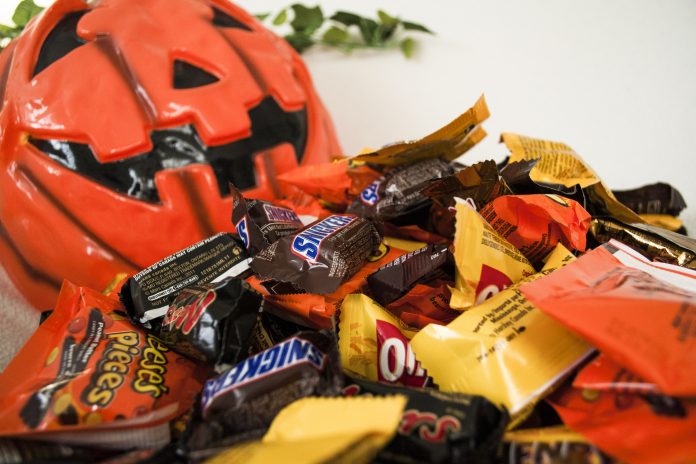
Candy isn’t good for you? Thanks, tips! Of course it’s not the healthiest — it’s not designed to be. I’m indulging by the bucketfuls on Halloween precisely because it’s a special occasion and I can afford to disregard the dangers for one day. Parents, children, teens, young adults — maybe we can’t memorize the nutritional information of a Snickers bar, but we all know that candy can be bad in excess.

As a result, when people write Halloween-based articles about the supposed dangers of excessive candy, it reads like a total waste of my time. You’re not telling me anything new; you’re just tarnishing my holiday to fill whatever quota you need to for your employer this week, or to satisfy whatever urge drives you to voice your opinions on everyone else’s health.

That is what my frustration really boils down to. I’m a grown-ass person, as is a good amount of the Earth’s population. Yet even outside of articles, there are so many people who feel the need to make snide comments about how other people eat.

I’ll freely admit that I personally invite it sometimes, too, because I acknowledge that I’m a big eater, and I’m able to laugh at myself for it and try to be mindful of not crossing a line with my health. But one person being able to deal with a behaviour doesn’t make it universally acceptable.

It’s great to want to encourage people to treat their bodies better, and many will thank you for it. But Halloween isn’t the day, and spoiling a candy-haul isn’t the method. I really, really don’t care if I hit “15 grams of carbohydrates” this year, and you shouldn’t be making others feel bad for doing so. Let me live out my sweetly pumpkin-y fantasies in peace.

Halloween is not an excuse to be a jackass

0

“Since 1983, at Spirit Halloween, we have offered a wide and balanced range of Halloween costumes that are inspired by, celebrate, and appreciate numerous cultures.”

This is the pithy excuse of a costume supplier defending its shittiest creations, including indigenous princess “Queen of the Tribe,” Caitlyn Jenner’s Vanity Fair cover, a Day of the Dead dress, a kid’s Geisha outfit — seriously, the list goes on. It’s like they tried to check off every racist, bigoted box they could.

What’s worse is that, when called out on their bigotry, Spirit Halloween dug in their heels. A group of activists in Regina put together a guerilla campaign to combat the selling of culturally insensitive costumes by putting warning labels on any costume labelled “Indian” or “indigenous.” Apart from pointing out the obvious racism, the warning labels also noted that there are upwards of 4,000 missing and murdered indigenous women and girls in Canada, and that an inquiry is currently underway.

Spirit Halloween shot back, lambasting the campaign for “defacing our products.”

There’s a special place in hell reserved for people who double down when called out on something they’ve done wrong (see: Donald Trump). And it’s clear that Spirit Halloween didn’t have to defend its products: just last week, UK costume supplier McCulloch’s Costume Co. pulled its “native” costumes off the shelves just 15 hours after consumers started a petition against them. “It was never our intention to offend anyone,” the owner said.

Change like this is almost always incremental, and it’s a credit to activists who spoke up to raise awareness and encourage businesses to think about the messages they’re sending. While this doesn’t defend McCulloch’s actions, at least they were willing to own up to their mistake and make amends. Spirit Halloween could learn a lot from their example.

At the end of the day, though, it’s as much the fault of those buying the costumes as it is of those supplying them. You could argue that “native” costumes aren’t as over-the-top as wearing blackface or buying a Hitler outfit, but thinking of racism in degrees is like saying it’s OK to have a little bit of cancer. It’s still going to kill you.

This criticism also applies to costumes that make light of abuses, like Bill Cosby costumes, or that costume of Donald Trump assaulting Melania.

Not only is it obviously a dick move, but it’s also super lazy. Can you really not think of a better costume? Is it too much to ask that you think of something that doesn’t make someone feel like crap, or like they don’t matter? That’s the logic of a bully, and rule number one of Halloween is that it’s all about being awesome, not being a jerk.

Anyone who thinks these costumes “celebrate and appreciate numerous cultures” needs to take a good, hard look in the mirror. Halloween is a great opportunity to be someone else for a day, but there are limits, and one of those limits is making sure you don’t take someone else’s experience and make a mockery of it.