Home Blog Page 764

How to gracefully deal with your mortality

0

You are going to die.

Yin and yang. Life and death.  You can’t have one without the other.  So, instead of bitching about it, here are a few tips to dealing with the concept of your inevitable death.

Forge ahead

Have a free moment? Trick question — you’re a student. You can’t sit there and contemplate the possibility of an afterlife; you’ve got a paper on communication below the threshold of awareness to write! If that doesn’t keep you busy, I’m sure staying up all night with your math textbook will be enough to keep your mind off it.  

Delegate

Why worry about these things at all?  You (probably) won’t have to deal with your death for at least another 50 years — why not simply put off the anxiety and delegate the responsibility to your future self?  Instead of worrying about lowering your lifeless body into the ground, simply wait and ponder these thoughts while you’re dealing with other pleasant questions like “what have I done with my life?” and “why doesn’t anybody love me?

Have a one-night-stand

Nothing like the adrenaline rush and thrill of a hook-up with a perfect stranger, or even someone you know for that matter.  Rather than thinking about the fact that next to nobody dies peacefully in their sleep, instead think about the many joys and pleasures of sex.  As you both fumble for protection, try not to fixate on terrifying statistics such as how 0.6% of all sudden deaths occur during sex.

Eat

What are questions of life and death when compared to a full box of Oreos? Worthless.  Science fiction writers used to imagine a gun that could erase memories. Had they known that they could accomplish the same thing with a box of pizza, they may have saved themselves some time. Instead of wondering why we bother to do anything at all if it’s all going to end anyway, think instead of the sweet, sweet taste of Charleston Chew.  


Ultimately, the only thing we can do to gracefully deal with mortality is to understand that mortality is inherently graceless. To finish, I’d like to leave you with a line from the BBC’s
Blackadder, which I believe has the whole thing right: “I am therefore leaving immediately for Nepal, where I intend to live as a goat.”


Werld News Headlines

0


South Korean president, Park Geun-hye, impeached

North Koreans: Wait, you can do that?!


Donald Trump’s advisors want Ivanka for government position in White House, while Trump wants her for reverse cowgirl position in White House bedroom.


Stoners panic over where to find weed in Vancouver as Richmond councillors reveal plans to block marijuana dispensaries.


Vancouver’s Night Nation Run described as “all night, outdoor EDM dance party” by organizers and as “the reason we’re moving to Coquitlam” by anyone living nearby.


Canadians torn over whether Kevin O’Leary running for Conservative leadership is a bad idea or awful idea


What your textbook says about you

0

Classes are in session, and students across all SFU campuses have been dishing out the big dollars to get their hands on textbooks that fit their lifestyles — and their courses. But what does your textbook say about who you are? Find out below!


ARCH — Archaeology

*Monkey noises*

Why are monkeys monkeys? Ponder this and many other butt-scratching questions by reading a textbook on archaeology — the groundbreaking study of old dry things. Just like other close relatives of australopithecus afarensis, you most likely use bipedal locomotion and are manually dexterous.


BUS — Business

“I
really want to be rich.”

Luckily for you, most business textbooks are well-written and designed, if a little pricey. You gotta spend money to make money, am I right? These textbooks showcase your wild entrepreneurial spirit. Except for the Practitioner’s Income Tax Act. It’s best to burn that book after use.


BPK — Biomedical Physiology and Kinesiology

“The only bottoms I own are sweatpants.”

Studying the body means that you know how to be nice to it, and one of the best ways to do that is to keep it comfy in sweats. Don’t worry, they don’t make your lumbo-pelvic hip complex look anteriorly rotated.


CMNS — Communication

“I’m probably kinda lazy.”

Some communication majors are exceptional students, eager to learn about media theory, political economy, and telecommunication. Then there’s the other 98% who want a degree and decent GPA, but also have other things they’d rather do with their time. Statistically speaking, you’re probably part of the latter.


CMPT — Computer Science

“Beep beep boop.”

You probably either spend most of your time on a computer because it’s your interest, or feel overwhelmed because all of your classmates are so tech-savvy. Remember that your textbook and online practice resources are your best friends, as most CMPT profs are about as experienced with teaching as a Vancouverite is with heavy snowfall.


CRIM — Criminology

“I don’t sleep at night.”

You probably watch gratuitously gruesome horror movies at the end of the day to wind down from all the fucked-up shit you learned about in class earlier. Don’t worry; you won’t get consumed in your research and go crazy yourself. . . probably.


ECON — Economics

“My hatred for graphs is steadily inclining.”

Sure, you get to do it with models and closely inspect their curves, but the demand of ECON courses is just too high. Kudos to Doug Allen for single-handedly keeping Voltaire’s Candide in print, but you should probably just the read the SparkNotes summary for those ECON 103 bonus questions.


ENGL — English

“I have lots of books.”

English classes provide you with the opportunity to carry around 25 books at a time for the first two weeks, only to give up by the third week and just lookup the summary on Wikipedia whenever a text is referenced. On the bright side, all those classics you have stockpiled at home are DIY interior decorating projects just waiting to happen.


IAT — Interactive Arts and Technology

“I literally shit aesthetic.”

IAT courses probably have some of the coolest, most beautiful textbooks out of all disciplines. Unfortunately, they’re so beautiful that you wouldn’t want to run the risk of damaging them by reading them. Find the information you need for class online and instead use your textbook as the statement piece on a coffee table to compliment your room’s chic minimalist look.


LANG — Language

“I already speak this language.”

If you’re taking a language class and don’t already know a fair amount about the language, you’re doing it wrong. These classes work best as GPA brownie points for people who are already fluent in that given language.


MATH — Mathematics

“I always differentiate myself.”

Taking Math is about as rational as pi. These poor textbooks always look sad because they have so many problems. You’re most likely the sort to go off on tangents, in the hopes of integrating yourself with others, when really, you’re differentiating. Just take care to ensure carrying that calculus book doesn’t give you scoliosis.


STAT — Statistics

“I’m a sexy masochist.”

Stats textbooks average about 80lbs each. Lugging those mammoths around all day ensures that you have stellar quads. You can usually buy a stats textbook for the price of all your savings, your soul, and your first-born child. All your axes are are probably mean or average — yeah, that’s right, we know your type.




Unfortunate might be in the title, but it’s no way to describe Netflix’s latest series

0
Malina Weissman (Violet), Presley Smith (Sunny), and Louis Hynes (Klaus) tackle the roles of the ill-fortuned Baudelaire orphans in Netflix’s latest original series.

By: Vincent Justin Mitra, Staff Writer

Based on the quirky and delightfully dark 1999 book series, Lemony Snicket’s A series of Unfortunate Events is the latest addition to Netflix’s growing library of original content.

Consisting of eight episodes which cover the first four books, the show carefully balances tragedy and comedy as it follows Violet, Klaus, and Sunny Baudelaire, who are orphaned after a fire consumes their home.

Many of the lead actors are relative unknowns, with the most recognizable names likely being those of Patrick Warburton and Neil Patrick Harris who play narrator Lemony Snicket and the dreaded Count Olaf, respectively. Both actors were met with skepticism when first announced, with fears that their comedic backgrounds would negatively impact the more severe aspects of the characters.

These fears have since been laid to rest as Warburton’s Snicket is able to summon a sadness in his eyes that suggests he has been truly affected by the tragic lives of the orphaned children, and Harris’ Olaf brings the right amount of theatricality to the sinister character, and the right amount of menace to the scenes that require it. They are joined by Malina Weissman as Violet, Louis Hynes as Klaus, and Presley Smith as Sunny.

This adaptation stays very faithful to the original material, with much of the dialogue taken directly from the books. Fans of the original will have their hands and commonplace books full from noticing all the little references and details that have made the transition from page to screen.

The visuals add to the feel of the show, with everything from the bright but muted colour palette, to the careful framing of the shots that give each scene a storybook-like quality. Many of the digital effects are also well done, except those relating to baby Sunny, who often looks rather unsettling when doing anything important or physical.

It is not a word-for-word adaptation, however. Some details of the plot have been changed, but most of these changes are for the better, a phrase which here means “streamlines the story and fixes parts that work better on paper rather than the audiovisual medium of streaming television.”

Something that is lost in the transition is the internal monologue and thought process of the Baudelaire children. As a result of no longer being within the minds of the siblings, some of the emotive moments don’t hit as strongly as they might otherwise, and their personality quirks are just that little bit harder to notice. However, the show is able to occasionally depart from the children and show events happening elsewhere in the story, expanding on events only mentioned in the books and helping the world feel larger and more alive.

This allows the other welcome change of having the mystery elements included earlier in the plot; something which did not originally appear until the second half of the thirteen book series. Establishing these elements early allows for these pieces of the puzzle to intertwine more deeply and believably, rather than their relatively sudden appearance in the books.

A second season of ten episodes, covering the fifth through ninth books, has already been announced. Daniel Handler (the author of the book series), who also serves on the writing team in addition to his role as executive producer, is already eager for a third season and hopes to “get the go-ahead” soon. Overall, Netflix’s A Series of Unfortunate Events is a dreadfully entertaining adaptation both for those unfamiliar with the books as well even the most visibly fervent devotee.

Two major issues could threaten to undermine the sexual violence policy

0
Little is known about the "Central Resource Office" - including what it will eventually be named - and the lack of information has become cause for concern.

Throughout the questions and comments raised at the feedback sessions for the Sexual Violence and Misconduct Prevention, Education and Support Policy draft, there were two issues that became a lightning rod for the Simon Fraser University community: the “Central Resource Office” and how a sexual violence report will be investigated and resolved.

The office, which at this point is no more than a concept, is “literally going to be an office that is central and have resources,” according to Dr. Jonathan Driver, former vice-president academic and provost for SFU at the town hall session last Tuesday.

Meanwhile, concerns have been raised that the University Board of Student Discipline, which the policy states will handles all the student misconduct cases. The board is composed of faculty, students, and staff at SFU.  

At both the town hall and the student feedback session last week, the resource office became one of the most discussed issues, with talks ranging from what it should be named to how it will be implemented physically to how it will be staffed, both with frontline resources and administrators running it.

Both Driver and the policy draft working groups respect that this is something that requires delicate care.

“I think we need to be very careful about what we name it, as a number of people commented. We need to be very careful about how we physically locate it,” said Driver.  

“We’re dealing with who say ‘It must be really obvious where you have to go,’ but other people who say ‘Look, if you make this a place that people go to when they’ve suffered from sexual misconduct, that people may be reluctant to go through the door.’”


One of the concerns that surprised was the insistence that the whatever it’s called, the resource office will be made up of experts on sexual violence and the other appropriate services it will offer.

“There’s also been concern expressed, and I must admit this surprises me, that we should staff the office with experts. Well, we staff all areas of the university with experts, we write job descriptions very carefully,” said Driver.

The difference between being an expert and believing you’re an expert is the main concern, as President of Academic Women at Simon Fraser University Elise Chenier pointed out when discussing the University Board of Student Discipline.

“The concern I expressed at the forum is that people already believe they have the expertise,” said Chenier. “This is not only hugely problematic because people who sit on that board as caring and as informed as they are have no expertise whatsoever in dealing with these cases. As I said at the forum, often think they can understand them based on quote unquote common sense knowledge.”

While the Central Resource Office could still take any shape (or shapes, if they decide to have one at every campus), it seems it will do so without actively seeking input from a group of students who have spent the last year and a half trying to build a similar resource on campus, as per comments made at the town hall.  

There has been a group on campus trying to build a Sexual Violence Prevention and Resource Centre, and while it has been said that there is a possibility of collaboration between the groups, as of yet they have not been consulted for what they know.

“It is striking that the policy group has not taken advantage of the opportunity to work with people who have already been actively researching this question. I don’t know why they did not take advantage of the opportunity, but that certainly seems to be an oversight on their part,” said Chenier.

This may be why concerns were raised over what experts look like, and why the Central Resource Office and the University Board of Student Discipline will be the most scrutinized issues going forward. As the crucial period of the edits comes up for the policy draft, it’ll be interesting to see how this will be dealt with. 

La La Land captures old school cinematic magic

0
Emma Stone and Ryan Gosling capture the magic of the classic Hollywood musical as Mia and Sebastian in La La Land.

The classic Hollywood musical gets an updated look while staying true to the genre with Golden Globe darling La La Land.

You know you’re in for a cinematic treat when the opening scene is a fully choreographed number set during one of Los Angeles’ infamous traffic jams. Everyone is listening to different music in their cars until one woman gets out of her car and starts singing. In a matter of seconds, more and more people join her until the sour mood has been turned upside down.

Other than the “Oh my God, it’s Ryan Gosling” moment that I had when he appeared on screen in the role of Sebastian, I was completely entranced by his character. Gosling and Emma Stone (Mia) poured their hearts into their characters and for a moment I forgot Mia and Sebastian weren’t real.

Set in contemporary Los Angeles, but with the streets mostly empty of cars and people, it almost feels like the 1940s again. The walls are covered with murals and music bars are on every block.

After Mia hears a lonesome piano while walking around after a party, she heads into one of these bars and finds Sebastian playing jazz. The rest of the world fades away and it’s just them.

Instead of placing a kiss scene in this moment, the story changes to focus on Sebastian and we learn these two are very similar: both are old school dreamers, she’s a struggling actress and he wants to open his own jazz bar.

In every romantic film, there’s a moment where everything is going a little too perfectly: Mia has written and will be performing in a one woman play and Sebastian is recording albums in a band whilst touring the country. However, burdened by the stress of her play, Mia lashes out at Sebastian for never coming home. After she performs her play to an audience of basically no one, she goes home to her parents’ house to rethink her life. Not all hope is lost, as she gets a once-in-a-lifetime audition for a movie.

However, this is not where the film ends. Director Damien Chazelle takes us five years into their futures to give viewers an epilogue filled with unexpected twists and turns. While some viewers might feel betrayed by the nature of this epilogue, the unexpected nature of it was a pleasant change from normal cinematic fare.

Even in musicals, never before has a soundtrack been so perfectly incorporated into the story. “City of Stars” is featured three times — for good reason — as it’s one of the most beautiful and timeless songs to ever be in a movie.

The plot, performances, cinematography, and soundtrack all work beautifully together to tell the old school romance of two dreamers who just want to make it in the entertainment industry. Whether you’re a fan of classic musicals or not, this movie will have you feeling the magic in no time.

Crucial period of sexual violence policy edits underway

1

Simon Fraser University was never going to write the perfect policy on their first attempt.

There was a lot going right for the Sexual Violence and Misconduct Prevention, Education and Support Policy (SVMPESP) after the first draft was released on January 4. For an initial draft, it was a very motivating beginning after months of work. The team behind the policy released all the feedback they had received online, showing what people wanted to see from it.

Members of the advisory committee were also open about the process that went into creating the SVMPESP, showing a great response to the demands for transparency from the original town hall meetings in May of last year.

However, at the town hall meetings this week, members of the SFU community came armed with copies of the draft that they had edited extensively, worried about the language, the process of disclosure, and the currently named “Central Resource Office.” They raised concerns and questions for the entirety of the two hour meeting, and likely could have kept going on.

And this is a trend many see as encouraging.

Concerns over the policy

“It is, in fact, a draft,” said Elise Chenier, president of Academic Women at Simon Fraser University. “That’s the process. They are following exactly the procedures and steps that are proper to a university environment so everything is on the up and up.”

Chenier attended the town hall at the Burnaby campus, and raised concerns about how some parts of the SMVPESP draft need to be reworked so that they don’t damage the policy as a whole, including the Central Resource Office.  

Read more: Two major issues threaten to undermine the sexual violence policy

“In my view, the entire project is really undermined by the fact that this new [Central Resource Office] will not provide counseling services. If we are to go by [former vice-president academic and provost, Dr. Jonathan] Driver’s explanation, it says that they will coordinate existing services, and that’s a problem,” she explained.

She also brought up the adjudication policy and off-campus incidents, among other concerns.

With all the demands and inquiries, the tone could easily be misread as tense, especially from those who were watching a livestream of the town hall or attending via conference call from the Vancouver or Surrey campuses. In fact, a source told The Peak that “SFU admins here are like beet red” during the discussion, and that “Tension is clear. They’re holding back their words.”

Policy makers were hopeful for this kind of response

However, advisory committee member Kathleen Yang (who attended and live-tweeted all the events) found was impressed with the sessions being held this week.

“Those who showed up definitely came prepared and it was really great to see folks who clearly had a lot of expertise,” she said. “It is critically important to have a range of folks participate in this process as their participation is going to be crucial to ensure the success of this policy.”

“We are a research institution. If we didn’t have folks who were willing to give us an extensive, critical analysis, I’d be worried.”

This sentiment is shared by Dr. Driver, who was the host of the town hall on Tuesday.

“The town hall session, I would say, probably reflected people who had read the policy very closely, and wanted to propose some changes to the policy,” said Driver. “A lot of people pointed out that we could be clearer, we could use language that was more direct, so I think there’ll probably be some changes made.”

He said that the working group and advisory group who were in charge of creating the SMVPESP draft felt that the draft policy that they had crafted for the beginning of January is really close to what the university needs, and anticipates the final draft being approved at the March Board of Governors meeting.

“Everything I’ve heard so far suggests that we have actually covered fairly well the issues and concerns that people have wanted to raise,” he said, adding that the Board of Governors meeting will be open so that anyone can see what the final wording of the proposed policy will be.

For Chenier, seeing exactly what those comments were and the people who raised them meant a lot to her, as it did for many others involved with the university.

“I was so appreciative of hearing all that input. It was an amazing experience. It was really beautiful to see how much thought, care, [and] attention people put into reading it and offering their feedback. It was really extraordinary.”

Stuff we like and don’t like

0
(Elena Hsu / The Peak)

Stuff We Like — Little Saigon in Yaletown

This is honestly my favourite restaurant. The Yaletown location is the most transit friendly of the three lower mainland locations, but the food is delicious at all of them. This place is a must try for anyone who loves Vietnamese food. One of the things I love about this place is that you can pick one of their favourites or build your own meal. There are gluten free and vegetarian options for every diner. My personal go to is their build your own vermicelli bowl with prawns and spring rolls. And of course there are the drinks. A personal recommendation: Little Saigon Ice Tea for all ages, Miss Saigon for those looking for an alcoholic option. – JP

Stuff We Like — Almond Milk at Starbucks

After the disappointment that was the introduction of coconut milk (a term that I’m going to use loosely since it was less coconut and more filler) Starbucks has finally brought another milk alternative to its menu — almond milk.

While it still contains added sugar and some additives to keep it from separating, the list of ingredients is significantly shorter than that of the coconut milk. And you can tell that based solely on the taste. Where their coconut milk always tasted a little fake — like someone added too much Coffee Mate to their beverage — the almond milk manages to strike a balance between alternative milk and regular milk in terms of taste.

If you’re looking for an alternative to soy, coconut, or dairy, give the almond milk a try, but remember it does have added sugar. So, if you want to skip a super sweet treat, ask for reduced syrup in your drink! – JW

Stuff We Like — The Ramen District

In Vancouver’s West End, there is about a three block area around Robson and Denman that has a disproportionate number of ramen restaurants. It’s fondly referred to as The Ramen District by some — myself included — and it’s probably one of my favourite food destinations in the city. I live in Surrey and on more than one occasion, I’ve transited the 90 minutes so I could then stand in line for an additional 30 minutes just so I could eat ramen. I’ve been called crazy for doing this, but when I end up craving ramen, I know that buying the instant kind from the grocery store isn’t going to cut it.

The nice thing about having so many of these restaurants so close together means that you can find something for everyone in your group. While most restaurants make the traditional pork bone broth, there are others that make their broths with chicken or with vegetables. So if you don’t eat pork or meat, you won’t miss out on the deliciousness that is non-instant ramen. – JW

Daniel Kelloway running out of time

0
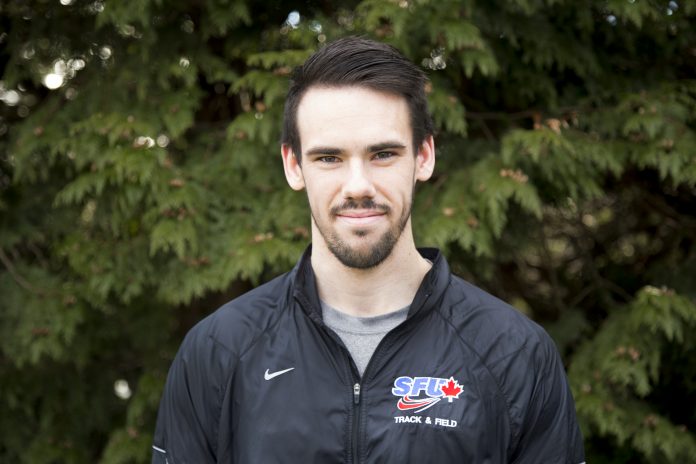
This season, Kelloway finished second at the UW Indoor Preview in the 400-metre.

Travelling over 7,000 kilometers is quite the distance, no matter what you’re travelling for. But that is what faced Daniel Kelloway in his decision to come to SFU. The native of Mount Pearl, Newfoundland, since coming to the west coast, has become one of the most dominant runners in the Great Northwest Athletic Conference (GNAC).

“Brit [Townsend] just kind of contacted me after a meet,” said Kelloway on the first steps to coming to SFU. “I did a year and a half at Memorial and the first summer after my freshman year, track was just going really well for me that season [. . .] She offered it up to me and said, ‘If you want to come out, [you can].’ I kind of just jumped on the opportunity.”

Initially, there was a bit
of hesitation.

“Coming out of high school, I only applied to Memorial University. I was very set on staying at home; I didn’t want to leave. It was kind of a very spontaneous decision. I was a little hesitant.
I don’t have any family out here. I didn’t know anyone at all.”

He credits the seniors at the time for showing him the ropes and helping him get comfortable.

“By the time I moved out, [residence] was actually full so [I] ended up moving in with some guys with the team. That actually ended up being super useful; they kind of helped me out quite a bit.

So how does it feel now that he’s one of the elder statesmen on the team?

“It’s pretty cool. It seemed like everything went by so quickly,” he explained. “I feel like I haven’t been out here that long. It’s kind of cool because the seniors back then gave me a lot of advice and I’d like to think that I am helping out the freshman the same way they helped me.”

Since this early adjustment period, Kelloway has become one of SFU’s most consistent and dominant runners. In his second season with the team, he was able to win the 2015 GNAC 400-metre title.

“I was more happy with the time than the title,” he elaborated. “It was a personal best for me at the time, and my first personal best since coming to SFU. I was really happy with that. Everything just seemed to come together that day. I was pretty pumped. I know all the coaches were pumped.”

After that, Kelloway repeated in 2016. And now, even though it’s not for a few months, Kelloway has his eyes for a three-peat in the 400-metre.

“You kind of have to taper your training a bit so that you peak at the right times,” said Kelloway on how he plans to prepare throughout the season. “So it’s just [about] picking the right races to run at the right times, so that you try not to burn out. And your training is kind of adjusted accordingly as well.
Kind of just higher intensity, less volume as you approach these bigger meets.”

“Everything just seemed to come together that day. I was pretty pumped.”

However, until then, there is still a lot of work to do, and a lot of meets to prepare for and compete in. Kelloway was able to train back home over the winter break indoors, but he and his teammates had to resort in some unorthodox training methods — namely running in the AQ.

“It’s kind of weird,” said Kelloway on the new training methods. “There’s not very many people there because it’s a Saturday morning, wbut people will be looking at you like ‘what are you guys doing.’ [But] it is the best we can do, and we’ve been making it work.”

So far, it’s seems to be working. In the team’s first meet of the 2017 season, Kelloway finished second in the 400-metre with a time of 48.46. Not only was it a personal best, it was the best time out of anyone from the GNAC at the meet.

In his last semester, and pursuing a degree in earth sciences, Kelloway at the moment is not sure what his future holds,
but has narrowed it down to
two options.

“I’ve been kind of debating recently whether to go back to grad school or take a year off and work a bit. So I have to decide that soon because it’s currently my last semester. Right now it’s one of the two.”

However this season ends, it will be the end of a spectacular and memorable time at SFU.

Fun Fact: Favourite place you’ve traveled with SFU?

“I really enjoyed San Francisco. It thought it was a really cool city; we got to sight see a little bit when we were down there.”

World News Beat

0

USA — Celebrities Cher, Robert Denero, Michael Moore, and Robert Di Niro head to anti-Trump rally

On the eve of president-elect Donald Trump’s inauguration, celebrities were among the many that engaged in anti-Trump protests across the USA. Among the thousands that joined in the protest that aimed to show unity across the states, celebrities such as singer Cher and actor Mark Ruffalo revved up the crowd with a rendition of “This Land Is Your Land,” while documentary filmmaker Michael Moore and actor Robert De Niro led speeches outside of the Trump International Hotel and Tower. The protests have been described as a possible indicator of further protests over the next four years with a Trump presidency.

With files from The New York Times

Italy — Over 25 people missing in hotel following an avalanche

On January 18, major earthquakes across Italy instigated a major avalanche which hit the Rigopiano hotel located in the Abruzzo region. Only two people were rescued, as they were outside of the hotel at the time the avalanche. Due to the severity of the avalanche, emergency response could only access the area on skis. Search and rescue teams have continued to search for the missing individuals though there is little sign of life.

With files from BBC News

Mexico — Drug Lord El Chapo extradited from Mexico to the US

El Chapo, a known drug lord whose cartel is possibly the largest illicit drug cartel, was extradited on Thursday, January 20. The drug lord has received charges of drug trafficking, kidnapping, murder, and money laundering. While his lawyer, Juan Pablo Badillo, has criticized this extradition as “not inside the law,” El Chapo arrived in New York and could face life in prison. He has previously escaped two high-security prisons in Mexico.

With files from BBC News and Global News

UK — Britain’s Prime Minister outlines the 12 priorities for Britain to exit the EU

Prime Minister Theresa May announced during a speech that Britain would take a “hard Brexit approach” when negotiating a deal to exit the European Union (EU). Among her top priorities, she mentioned that Britain must fully surrender its membership from the EU’s single market, while also placing more stringent controls on Britain’s borders. In regards to the future of Britain’s economy, May stressed the importance of building relationships with countries outside of the the EU in order to build a “global Britain.” While many pro-leave supporters praised the speech, including British foreign secretary Boris Johnson, many pro-remain supporters criticised the restrictions on immigration as a negative approach to improve the economy. The speech was also criticised that the new deal expressed many similarities to full EU membership.

With files from The Guardian