Home Blog Page 676

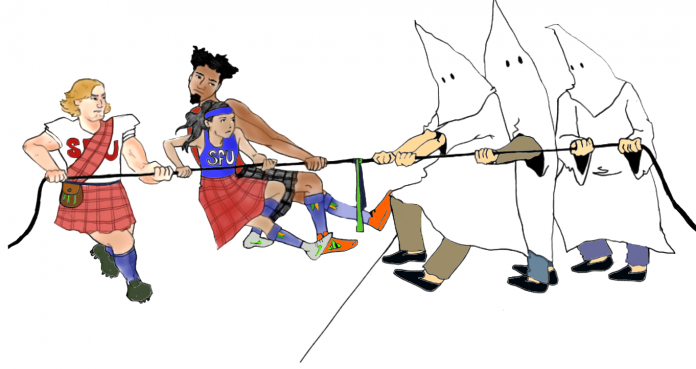
SFU needs to decide who we are and what we stand for

0

It’s not news that we cannot please everyone. However, we should always be open to the possibility of change, especially when that change might make us a better, more inclusive, and more socially aware campus. With the political tension just south of the border, individuals are getting offended by SFU’s sports team name.

You may or may not be aware of this, but SFU’s athletes compete under the name “the Clan.” Back in the day, it used to be “the Clansmen,” but it has since changed (probably to be more inclusive of the female athletes who compete shoulder-to-shoulder with the men). The name is in honour of the Fraser Clan and Scottish explorer Simon Fraser. Simon Fraser University has always had a proud line of Scottish tradition.

The first school newspaper at SFU was called The Tartan, and the current SFU mascot is a Scottish terrier named McFogg the Dog, after SFU’s inaugural president, Patrick McTaggart-Cowan. He earned the title “chief meteorologist” during World War II. The other aviators took to calling him “McFog” after a grueling period of poor weather (not unlike the weather we sometimes get at SFU.)

With all that Scottish history, it isn’t surprising that SFU feels strong ties with our heritage. However, it is always important to question history and tradition, especially due to the current state of socio-political affairs.

Recently, professor Holly Andersen took initiative and started a petition demanding that we change the name “Clan.” This wouldn’t be the first time that we, at SFU, have been under scrutiny for holding onto our roots and traditions. This petition is being held on change.org and, at the time of writing, has just over 200 supporters.

“The word ‘Clan’, which sounds the same spelled with a K or a C, has a century or more of horrible history in the United States, one which continues very visibly in hate rallies and acts of terror in the South,” the petition argues. “This is not a history we can just wish away by saying, ‘but that’s not what WE mean by it!’ We don’t get to decide all by ourselves what words mean.”

As Canada’s only NCAA team, our sports teams compete predominantly against American teams. Would it not come off wrong for us to compete against Black American athletes under the name “the Clan”? Does it not, then, make sense to change the name out of respect and good sportsmanship?

Though it pains me to say this, as an SFU student athlete, this is a convincing argument. Mallory Velte, a student athlete on the SFU women’s wrestling team, says, “It makes sense changing the name because some people think it’s the Klu Klux Klan.”

Just as “the Clan” comes from Scottish tradition, so does some of the most terrible and racist actions of the Ku Klux Klan (KKK). The KKK have burned crosses in the yards of African Americans. The act of lighting crosses began in Scotland, as a declaration of war. In the War of 1812, it called forth the Scottish clans to defend their lands from the other clans.

For some students, the name is not that relevant. SFU’s Tyler McLean says he isn’t affected by it. “I don’t know, it’s not what I think about when I think of SFU. I barely even think about how we’re called ‘the Clan.’ That being said, I wouldn’t be opposed to the change. It would just have to be a name that makes sense and truly represents what we’re all about here at SFU.” McLean is part of the men’s wrestling team.

SFU student Yvomil Gosselin was more of the opinion that it was “social justice warriors” taking offence for no reason. “It doesn’t really matter at the end of the day, there’s always going to be something someone can take offence to. We can’t cater to everybody and forget our school’s Scottish history.”

I myself am split on the decision. I understand why the change is necessary. However, if the change is to happen, there needs to be a strong consensus for the new name, as it will be the name that SFU’s sports teams rally behind when it comes time for competitions this season. I am personally not digging the suggestion of “the Highlanders.”  

Andersen has already sat down with SFU’s athletic director, Theresa Hanson, to discuss the possibility of SFU changing the name of our sports teams. Hanson says that the athletic department was aware of the issues “the Clan” raises for competitors south of the border and that they are “exploring [a] strategy.”

A meeting is scheduled for the third week of September to discuss the petition with SFU president, Andrew Petter.


Puddles, a problem small enough to ignore

0

The walkway along the West Mall Centre (WMC) parkade leading to the residence buildings is the main walkway students who live on campus use to get to class. It’s covered by a series of glass panels that were originally intended to protect you from the rain. . . except many of the glass panels cover only half of the walkway. Admittedly, this is an improvement that was made in 2014. When I began my degree in the fall of 2013, many panels were missing altogether.

I don’t think SFU realizes that its students live in the Vancouver area. I don’t know of anything more entrenched in the perception of Vancouver than rain, yet SFU still has trouble dealing with it.

An important part of any school in Vancouver is architecture that is capable of handling rainfall. In some ways, SFU is actually above-average in this field — architect Arthur Erickson’s original design of Burnaby campus was greatly favoured because it allowed students to get almost anywhere on campus while avoiding the rain. However, some issues such as water drainage have been left to fester, either because they were unaccounted for from the start or because the school has failed to maintain solutions.

Rainy days litter Burnaby campus with puddles: some small enough to miss, others big enough to rival the Academic Quadrangle (AQ) pond. From the bottom of the stairs to Convo Mall below the Rotunda to the north entrance of the AQ’s second floor, water regularly pools into cross-campus problems for students to deal with.

The inadequacy of that WMC walkway has been a problem for over four years, yet it still goes ignored. Since the beginning of 2013, a total of 12 large-scale construction projects at SFU based on campus renewal have been completed, with budgets totalling over $30,000,000. Yet, a handful of glass panels are still only half the appropriate size.

SFU consistently works on repairs and renovations, yet this issue continues to persist — and it doesn’t stop at puddles or students getting caught in drizzles. In 2013, The Tyee covered the damages and calls for repair that SFU’s aging campus had then brought upon itself, including “leaky pipes, mould infested classrooms and offices, crumbling stairs, and cracking foundations.”

Big, obvious problems linger because they’re too big to fix easily. Small, easy-to-fix problems linger because they’re small enough to ignore. But any student who has walked to class from residence knows how bothersome that walkway can become; finishing it would likely have just as much, if not more, of an impact on students as many of the large-scale construction projects currently underway. Either SFU is entirely unaware of this problem, or they are simply ignoring it. Neither are good excuses.

SFU’s image is said to be depressing. With the grey concrete and the overcast skies, it’s not hard to imagine why. When students have to constantly avoid puddles in many of the major walkways, the image of despair and disrepair only gets stronger. The persistence of these problems shows that SFU is either out of touch with what affects students on a day-to-day basis, or willfully ignoring an issue they know to be a problem. Either way, plenty of work needs to be done.

Secret SFU campus found beneath Burnaby Mountain exclusively for left-handed students

2
Photo Illustration by Janis McMath, Photo Credits to BP22Heber and arkalyk via Adobe Stock

Construction workers were shocked late last week when they accidentally uncovered a hidden subterranean campus exclusively for left-handed students.

This campus, named the SFU South campus according to signage, is reportedly home to several left-handed advancements and conveniences that would be unimaginable at the more public SFU branches. Some of these amenities include moving walkways, a trampoline gym, free valet parking, and left-handed two-for-one vending machines.

A team of students who chose to explore the hidden campus reported that the walls were decorated with fine art and sculptures “like some museum,” and that the air smelled of peppermint “like Santa’s armpits.”

Further exploration revealed that the secret campus had a wider food selection — even including a private McDonald’s with a full all-day breakfast menu, year-round McRibs and other seasonal items, and boxes upon boxes of that Happy Meal toy you always wanted as a kid but was always out of stock.

The layout of the underground campus was reportedly very similar to that of the aboveground campus but “like, much nicer.”

“It was nuts,” said one explorer. “It was like I was where I was, but I wasn’t.”

The classrooms, for example, were furnished with soft padded seats that would charge your phone as you sat, and there were left-handed tables with cup holders. Rather than whiteboards or chalkboards, large panes of glass “like the ones in those cop shows” were suspended from the ceiling on gossamer thread and were written on with left-handed markers that never dried out.

Other notable differences reported by the explorers included additional services and amenities like room-to-room food delivery, a functional pub, left-handed people who operated club tables without running up to you and making things super awkward, and hanging televisions which did not display notices and info but instead played episodes of Game of Thrones a week in advance.

As the explorers ventured further they claimed that they started to feel a great discomfort within them “like needing to fart during a funeral.” They said that they knew they did not belong there, walking the gilded halls of a secret campus. They turned, despite not having been detected, and began walking back toward the right-handed ropes they climbed down on, though now with the added weight of shame “like someone who farted during a funeral.”

Before ascending to return to the comparatively grey and boring surface world, one explorer quickly reached out their right hand to a notice board and pulled off a flyer as a souvenir. It came off smoothly and without any tears or rips. The explorer folded the paper and placed it in their pocket.

When the explorer arrived at the top of the rope, they reached for the flyer and was relieved to find it had not vanished like the hole they had climbed out of only seconds ago. Unfolding the paper the explorer was surprised that it was not creased and looked as smooth as when it was pulled from the board. It was a notice, and bore both the TransLink logo and the secret sigil of SFU South at the top of the page. Further down, the notice simply read:

Gondola construction delayed again.


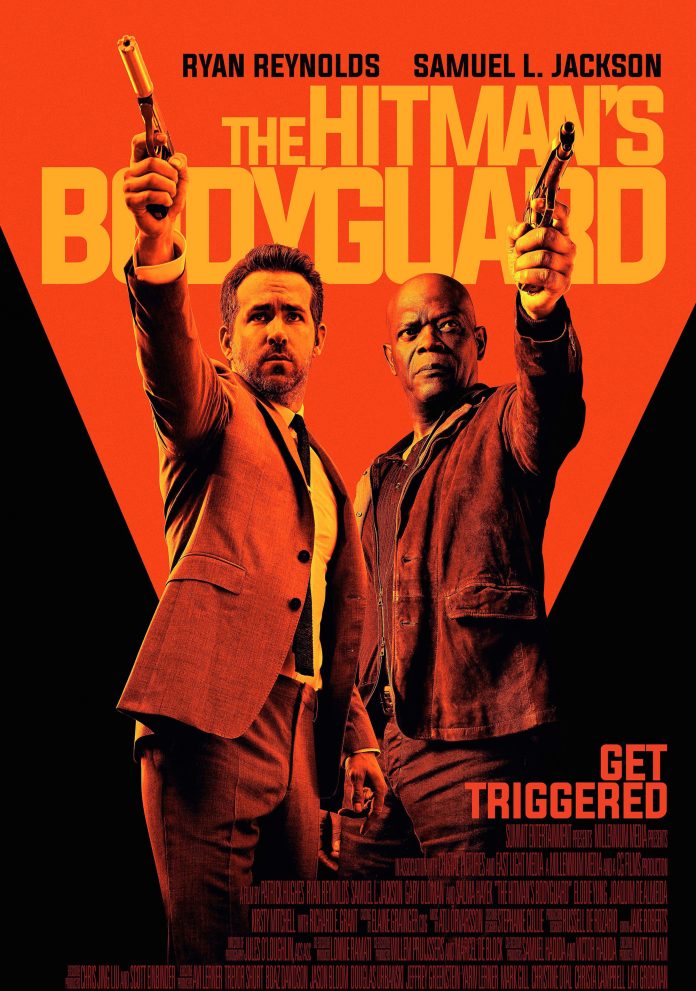
The Hitman’s Bodyguard: terrible plot, amazing actors

0
(Image Courtesy of Lionsgate Films)

The Hitman’s Bodyguard is pretty bad — it’s the kind of bad where you don’t want to admit you really, really enjoyed it because it’s embarrassing. Which is why I’m here in my nighties, eating a vegan microwavable chimichanga typing out my esteemed thoughts on how I — yikes — enjoyed it.

Critics are complaining their mouths off about the movie, saying all sorts of stuff about how it’s a repeat compilation of the cheesy action-comedies of the ‘90s. They also say that the only reason people are going to see it is because it stars Ryan Reynolds and Samuel L. Jackson, which is honestly the sole reason I went to see the movie.

Here’s what wasn’t great about the movie:  

  • The action scenes, specifically the hand-to-hand combat scenes were pathetic, but it was almost as though they did a bad job of it on purpose to make it funny.
  • The car chase scenes were better . . . not that much better, but still pretty cool. I dunno, I really love car chases.
  • The women in the movie were clearly badass but ended up playing the damsels in distress, swayed by love and acting as the motivation for a male character which was super disappointing.
  • Nothing was surprising. The writers threw out plot twists and I threw out the best acting of my life trying to pretend I was even remotely surprised.
  • The underlying politics and the commentary on terrorism in the movie kind of made me uncomfortable.

Here’s what was really great about the movie from start to finish, other than the fact that it was funny as hell:

  • Ryan Reynolds and Samuel L. Jackson were totally vibing onscreen and by that I mean their constant bickering and tolerate-hate relationship was gold. Pure. Gold.
  • It was more bloody and gory than I anticipated from a movie like this, but it kind of shocked me into believing that the action scenes weren’t that bad.
  • Ryan Reynolds playing the more “uptight” bodyguard role was hilarious. I loved that Samuel L. Jackson was the one constantly fucking around and Ryan Reynolds was super unimpressed for 99% of the movie.

Although I have many more bad points than good points, I definitely think it’s worth a watch, especially if you’re down for some light comedy, or because you want to laugh your way through a horrible date. I laughed harder at this movie than I had during any movie since 21 Jump Street. So yeah, I think that if you go in expecting more comedy than action you won’t regret it.


Spotlight: The Switch

0

The Switch is a show that tells the stories of transgender people through humour

WHAT GRINDS OUR GEARS: The boredom of Burnaby campus

0

Has anyone from the Burnaby campus not been to the Surrey campus? Go! It’s like a city resort, shopping underneath, glass and beautiful wood finishing everywhere, lecture halls that look like theatres, a Skytrain station next to campus, and, get this . . . escalators and a gaming room.

All this for “over 7500 students”? Excuse me, Burnaby easily has more students and we get none of those luxuries. Every day we struggle up the Saywell staircase huffing and puffing while Surrey students ride escalators like kings. We pile into the overcrowded 145 while Surrey kids stroll leisurely to the Surrey Central Station, sipping Blenz coffee (forget Renaissance.) Don’t get me started about the games room; they have better equipment than what I have at home.

Is Burnaby, the heart of SFU, forgotten? We deserve better. If Surrey has a Skytrain, I demand a cable car to Production. If Surrey has escalators, I demand a travelator so I can feel like I’m in the airport when going around the AQ. If they get a games room, I want an arcade.

Come on, SFU, step up your game for Burnaby kids. We deserve more than a . . . wait . . . “Student Union Building”?

Metro Vancouver holds vigils for overdose awareness

0
Photo via CBC News

The Greater Vancouver region took part in International Overdose Awareness Day events honouring victims and fighting stigma along with other cities around the world on August 31.

With an estimated minimum of 190,000 deaths due to opioid overdoses worldwide each year, the problem is demanding more immediate attention and action in many municipalities.

In 2016, Vancouver saw a new level of overdoses recorded by emergency services, with nearly 6,800 overdoses that year in Vancouver alone. With fentanyl climbing the ladder of the deadliest drug, Greater Vancouver is expecting to see record-breaking numbers of fatal overdoses continuing in 2017.

There were three events held in greater Vancouver this year to commemorate International Overdose Awareness Day, including a downtown event called the Commemorative Canvas and a rally at the Vancouver Art Gallery, according to the event website.

Many of them followed an agenda of speakers and testimonies, as well as a moment of silence in a sombre remembrance. Some of those in attendance also called for government action on the issue.  

“As a federal plan there is no strategy for monitoring or tracking — without having any understanding of what the problem is, it is very difficult to take action,” said Sasha Woo, head organizer of the New Westminster vigil held at Hyack Square.

Woo recommended that recovery houses and separate emergency services for mental health and addiction be prioritized.

Although filming was taking place at Hyack Square during the vigil, the organizers led the attendees and speakers over to the street space in front of Anvil Centre to continue the event.

“We know that around the world there are vigils just like the one we have here today. We know that the death toll and the number of victims are increasing. So today is a time to remember and a time to act — we must stop what is becoming a catastrophe,” said Peter Julian, MP of the New Westminster-Burnaby region.

“Addiction is not a moral failing,” said New Westminster MLA and minister for Mental Health and Addictions Judy Darcy in a written statement on the BC NDP website. “It is a complex health condition, often resulting from deep psychological pain or acute physical pain.”

The event in New Westminster concluded with two drum circles to give blessings to victims and their families, and a lot of teary eyes as speakers shared their stories of loved ones lost.

“I think the stigma is what killed him. The fear of being looked down on made him want to do everything on his own and when he was finally willing to reach out for help, he found that the resources weren’t as accessible as he thought,” said Lizzy O’Sullivan from Moms Stop the Harm of her son.

How SFU fencing is making the jump from unknown to national competitors

1
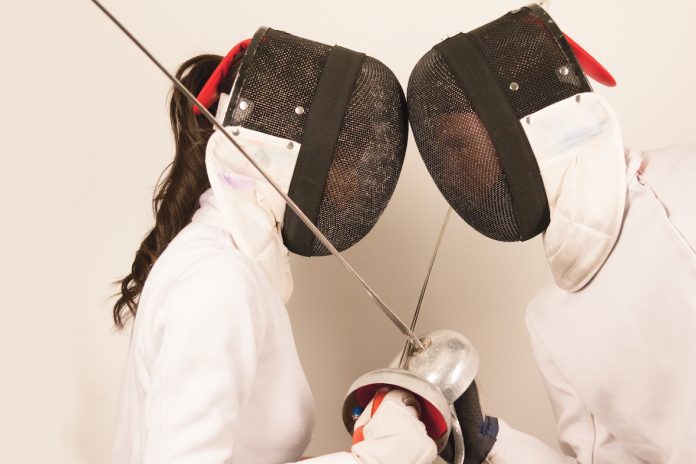
Marie-Rose Bruskiewicz has gone from never having fenced before, to being one of the best in the country during her university life. Photo by: Alexa Tarrayo.

As the fall semester begins, and Simon Fraser athletics starts to pick up with volleyball, soccer, and football, sport clubs such as SFU fencing seem to be forgotten. This, however, does not need to be the case. By speaking with co-president’s Marie-Rose Bruskiewicz (SFU fencer) and Jonathan Hutchinson (head coach), SFU fencing is ready to take the national stage by storm.

This, of course, comes after the success that they’ve already had, even if it has not been acknowledged by the university. After Bruskiewicz and teammate Isaac Velestuk both finished with bronze medals at the 2016 Canadian Fencing Federation’s National Championships in the University Division, a tremendous accomplishment, they were not praised by the school they represented.

“We both came out with bronze medals, and we represented SFU, but SFU had no idea,” said Bruskiewicz.

It wasn’t until the athletes and their coach reached out to The Peak that their story was known, and things have been progressing ever since. “The first article paved the way for us to get the ball rolling,” said Hutchinson. From being forced to train in empty classrooms, or the Forum Chambers at 7 a.m. and 9 p.m., and never between those hours, this exposure allowed them to be recognized as an SFU sports club.

While this is a nice step forward, it only marks the beginning for what Bruskiewicz and Hutchinson hope to accomplish at Simon Fraser. While SFU fencing is now acknowledged within the school itself, they hope to expand this to across British Columbia, and even make a nation-wide impact.

According to both, there is elite talent for fencing in British Columbia, but nowhere to go for those that want to stay in Canada and represent a university. Many Canadian fencers have to make the decision between being able to compete in the Olympics or going to a Canadian university, with many opting to compete for NCAA schools in the United States if the opportunity presents itself. Since many athletes don’t begin to hit their stride until 18 or 19, however, as Hutchinson noted, they miss the opportunity to compete for NCAA schools. “To see this wealth of talent not being explored, it really bugged me,” said Hutchinson.

Bruskiewicz serves as an extreme example of how an athlete can hit their stride late. After having never fenced before, Hutchinson (her boyfriend and coach) introduced her to the sport in her first year at Simon Fraser in 2013. In merely three years she went from having never fenced before to medaling on the national stage. As Hutchinson explains, however, this is no fluke. Five of six students he began coaching when they were 12 years old had medaled on the national level and become provincial champions in the span of three years. One of them just finished second at the world championships. “What it shows is, that in the span of a university undergraduate life, you can go from having never done something before, to being very proficient . . . to being one of the best in the country,” said Hutchinson.

When these athletes are picking how (and if) they will be pursuing fencing post high school, Hutchinson hopes that they will pick Simon Fraser. The foundation is being built, with just under 10 competitive athletes involved in SFU fencing, three of which have competed nationally before. Those who have yet to compete at the national level still have an important role on the team, however, as they are elevating the level of the competitive athletes through training until it is their time to shine.

“I’ve seen the most success in the shortest amount of time when people work together and try to build each other, and everybody leaves their egos [aside] and everybody tries to unite underneath the concept of chasing perfection and getting better,” said Hutchinson.

This foundation will help SFU fencing continue to expand in the upcoming years, with the goal of becoming internationally respected. “One day I’m hoping to have tournaments here. One day I’m hoping to bring . . . American schools and other countries here [to SFU],” said Hutchinson, “In order to achieve that, we need to win a few national championships, which will not be a problem.”

For now, it is important to appreciate how far SFU fencing has come in just a few years. They now have scheduled practices on Mondays and Tuesdays from 5:30 p.m.–7:30 p.m. in either the east or central gym. From Bruskiewicz competing nationally for SFU without it being known to the school (with her coach having to speak to her through Facetime on her aunt’s phone), to having a club in place and a convenient place to practice, things are looking up.

“I am . . . excited that if somebody is looking on Club[s] Day[s] for fencing, we are going to be there, and we are going to be able to give them that opportunity that I didn’t have,” said Bruskiewicz.

For those interested in being a part of the SFU fencing club, or just want more information, they will be present at Burnaby campus’ Clubs Days from 10:30 a.m.–3 p.m. They will be hosting tryouts the following week on September 18 in either the central or east gym from 5:30 p.m.–7:30 p.m. Both Bruskiewicz and Hutchinson encourage anybody to try it, as it is more a skill assessment test than anything. For true beginners that would like be a part of the SFU fencing club, the SFU fencing recreational program will work as a feeder program to the competitive team.

We need to preserve both safe spaces and academic freedom

0

The right to free speech flirts with human progress the way peanut butter jives with strawberry jelly — they’re the “it couple.” At SFU, we all benefit from free speech; it’s a key component of higher learning. But I don’t support misusing it to spread hate on university campuses.

The scripted battle between ‘safe space’ and ‘academic freedom’ has been short, messy, and ongoing. Many authors have worried that the safe space is restricting academic discourse, and changing university education into something unrecognizably useless.

The origins of ‘safe space’ are diversely attributed: 60s–70s gay bars and women’s movements, psychologist Kurt Lewin’s sensitivity training for American corporate execs, even anti-military recruitment spaces. The common themes are resisting oppression and freedom to discuss controversy. Harvard University draws a dichotomy of “emotional safety” vs. “[safety in taking] intellectual risks and [exploring] any line of thought.”

However, the two can — must — work together. We can have a ‘safe’ university without impairing education. The argument against safe space frames it as political mob mentality, coddling and isolating its membership from intellectual challenge. It’s variably dismissed as “[quarantining] oneself” and “de facto cultural segregation,” But this view is incredibly narrow.

Yes, attending university implies agreeing to challenge your beliefs. If nobody challenges others’ ideologies, social progress becomes nigh impossible. So it’s preferable that people be open to argument, risking some emotional and intellectual discomfort.

That doesn’t mean we must debate at all hours of the day. Freedom of speech is the choice of how and what to express. That includes the choice not to speak, not to express, not to engage. Discrete safe spaces are temporary reprieves from stressors, and forums to discuss inequalities uninterrupted.

Regardless, these safe spaces aren’t what whole universities should be. ‘Safe’ universities don’t censor everything we dislike. They protect students from being treated as less-than for their identities.

One person might disagree with something they learn in a gender studies course, and debate it in good faith. Another person scrawls “this is utter shit” on their queer theory textbook, writing the entire field off, while their friends see using proper pronouns for non-binary classmates as beneath them.

This is the difference between intellectual challenge and bigotry. You are allowed to challenge my liberal views, even if I don’t agree with you. What you can’t do is completely deny a person’s identity and direct micro- and macro-aggressive hate at them.

You think safe spaces interfere with academic freedom? Lacking them does that a hundred times over. Without precautions to avoid a person’s ideas being discredited based on ad hominem prejudice, without measures to give the less privileged a platform to speak, without protecting people from having their lives destroyed before they ever get the chance to contribute to the world, there will never be full academic discourse.

American vice-president Mike Pence, a starkly anti-LGBTQ+ politician, spoke at the University of Notre Dame’s May 2017 commencement ceremony about the evils of “administration-sanctioned political correctness.” Many students elected to walk out and host their own ‘alternative’ ceremony in protest.

Student protest against controversial guest speakers is accused of stifling free speech. But defending speakers like Pence ignores what public demonstration and lecture actually does. It isn’t just to ‘educate,’ or to promote debate (a silly notion, actually: as this Huffington Post article points out, the organization of most commencement ceremonies and guest lectures doesn’t allow for actual debate).

These public figures are brought in as a symbol of their ideas — ideas that may advocate for incredibly harmful practices. (In case you’ve forgotten, Pence happens to believe that electroshock therapy is a proper ‘solution’ to non-heterosexuality.) When these ideas actively endanger others, validating them is a problem.

Another supposed barrier to academia is trigger warnings, notes about potentially sensitive content in a work designed to let trauma victims know in advance. They’re not about “[shielding students] from words and ideas that make [them] uncomfortable,” or “extraordinary fragility of the collegiate psyche,” as an article titled “The Coddling of the American Mind” puts it.

Think of it this way: you don’t require trigger warnings, your idea of ‘getting triggered’ is based on your experience of what it’s like to face an idea with which you disagree. That experience isn’t comparable to an actual panic- or anxiety-induced episode rooted in the recollection of a trauma.

That’s not to suggest that all sensitive material ever should be censored. For instance, Harvard law professors can’t exactly avoid teaching students about sexual assault law, and that there should be dedicated processes in place for addressing potential triggering. But those extreme cases are extremes, not reasons to eschew the trigger warning totally.

Growing up, we’re taught: “Sticks and stones can break your bones, but words will never hurt you.” In Psychology Today, Boston College professor Peter Gray says that students don’t know how “to be called bad names by others and . . . respond without adult intervention.” Spiked editor Joanna Williams says we learn that we are “too vulnerable” and “too easily led.”

If I am told I don’t belong, addressed with slurs and disrespect, it doesn’t hurt. It doesn’t dig into my flesh and burn me, my synapses don’t snap under some psychic pressure, and I have no reason to have my feelings hurt.

But your words incite legislation against me. Your words incite violence against me. Your words stoke the flame of an institutional inequality that punishes people like me every day of our lives.

Don’t pretend like academia is some sterile vacuum, detached from real life. We’re frequently commanded to separate ‘the personal’ from ‘the political.’ One Spiked article mocks how university student now learn that “words and images are powerful and can hurt or corrupt” — except that’s. . . very obviously exactly the case.

Words relegated many Canadians to ‘second-class’ under Bill C-24, a bill fueled by Islamophobic thought. Words spoken by the American president from the start of his campaign to now encouraged a massive jump in hate crimes following his election. Words spoken by a police officer in Georgia to console a white woman this week, “we only kill black people,” are a terrifying reminder of how little the lives of minorities have come to matter to the dominant regime.

People like UCLA law professor Eugene Volokh say that “we have no right to be safe from [ideas and statements],” It’s increasingly obvious that we do.

Someday, years from now, perhaps your children or your grandchildren will be part of some minority or social movement whose systemic oppression we can’t even conceive of or predict right now. They might be SFU students, like you are now.

Violent hate crime doesn’t come from nothing. It is fueled by ideology, and ideology spreads through words. Especially when you blindly protect all ideologies regardless of their content.

So, if some evil person punishes, or hurts, or murders your kids, because you placed the right to entertain damaging, wicked rhetoric in a classroom over the right to be alive — if, someday, you lose people precious to you because you cared too much about getting to slander whoever you like — will you then say that it was right for them to die for you?

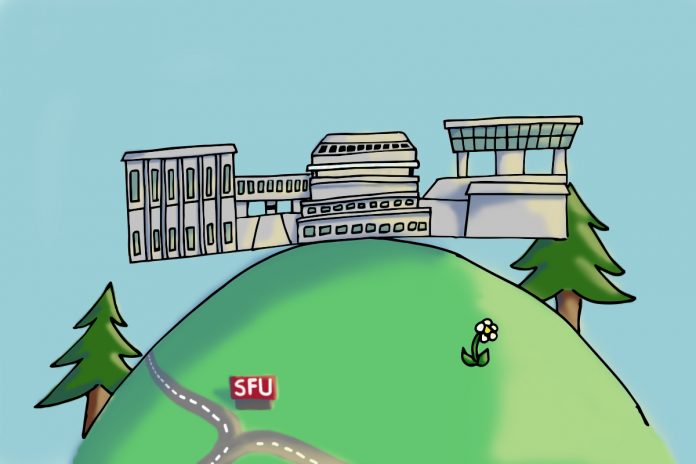
SFU Burnaby campus: A molehill made into a profitable mountain?

0
Illustration by Zach Chan

It has recently been discovered that the location of SFU’s Burnaby campus is not, as most believe, on top of Burnaby Mountain. What’s more, recent reports tell us that Burnaby Mountain doesn’t even exist! It turns out that Burnaby Mountain isn’t a mountain at all — instead, it is a tiny hill no more than 20 metres high.

The belief that Burnaby Hill is a mountain all results from a long ongoing social experiment started by the founders of SFU. Back in 1965 when SFU was created, the administration began spreading rumours that Burnaby Hill was not a hill, but rather, a mountain. The purpose of this experiment was to test whether social expectation could shift one’s perception of reality. The experiment was a rousing success, shifting the perceived realities of SFU students and Vancouverites for generations. Similar campaigns have been performed by many other notable companies. Perceived reality experiments are why Tim Hortons coffee is considered “good” rather than the garbage bitter water that it really is.

The motivations behind such an experiment on social expectations remain unknown. The most educated guess is that SFU founders hoped being on a mountain would be a novelty that no other university had. Students would gladly pay greater fees for a university that is in a semi-perpetual state of flood, with massive puddles forming in most major walkways. The next best guess is that SFU founders believed that being on top of a mountain would create both a feeling of isolation — which would inhibit students from forming long-term friendships — as well as a feeling of superiority coming from the fact that you literally look down on the peasants below you. They believed these factors, when combined, would result in SFU graduates being prepared for the long and depressing life that awaited them on the other side of graduation.

However, there are those among us who have broken through the perception created for us by the SFU founders. The first group is the stoners that wander Burnaby Mountain Park late at night. In their smoke-filled fugue, they open the doors of perception, and many have caught but the faintest glimpse of the true reality hidden from us. Unfortunately, these realizations come most often in the form of stereotypical stoner epiphanies. As these epiphanies often come a dime a dozen, they are rarely taken seriously. Although we all tend to laugh at and dismiss such stoners as Kyle (aged 24 and living in his mom’s basement), he glimpsed a truth many of us will never experience in all our lives when he looked out over the city lights with eyes red and mouth dry, and exclaimed, “Man . . . we’re all mountains.”

The other small group who has seen through this rift in reality are those who come from the far away lands of the prairies. As the illusion created by SFU founders comes from social expectation, those who are free from such social expectations and ignorant of Vancouverite propaganda remain unaffected. However, our prairie-born peers often don’t realize that SFU rests on merely a hill instead of a mountain. The bump that rises no more than 20 metres in the air is one of the highest points that any of them have ever seen, let alone been atop. When they hear the glory of the mountains in the far-off land of BC, this tiny bump is even greater than what they could have ever imagined.