Written in response to British Vogue’s “decision to mark 100 years since women were granted the vote,” involving a feature spread discussing seven women who have been instrumental in fighting for gender equality, this Guardian article caught my eye for raising a valid point: the continued erasure of people with disabilities, even from conversations about marginalization.
In Ryan’s words, “it says something about disabled women’s exclusion that we are somehow too marginal even for a conversation about the need to be included.” As important as topics like racism, sexism, homophobia, and transphobia are and will continue to be, we can’t let ourselves forget that ableism, too, can blind us to the existence of a veritable mass of wonderful individuals.
Privilege comes in degrees and variations. It’s not, nor will it ever be, easy to make sure that nobody is made to feel shoved to the side for their identity. But we can’t cherry pick our diversity.
Part of The Ubyssey’s Their Campus series, Yamanaka-Leclerc talks about his experience at Lancaster University in England. Being there, he realized something key about “fleeting friendships,” like the kind you make on exchange: they’re a chance to be whoever and whatever you want.
You might be questioning this choice of article to look at. It’s short, personal, and highly anecdotal; does it count as an argumentative article? Maybe, maybe not. What this article does do is express a worldview and message that’s incredibly important for university students.
Fleeting friendships aren’t just an exchange student phenomenon. They’re a life phenomenon, particularly for us at SFU, a school that we frequently criticize for its lack of long-lasting relationships. Remembering that there’s value in the friends you make along the way even if they don’t ride the whole route with you is big.
Goff’s piece talks about the stop-and-frisk practices of police officers in New York City, which are particularly biased against Black and Latinx people. I found myself drawn to Goff’s assessment of how we talk about the effects of certain police practices on a community.
“Crime has traditionally been the only outcome deemed important enough to measure,” Goff writes. “A recent National Academies of Sciences report on proactive policing lamented that compared with the research on how policing influences crime rates, ‘there is proportionally very little’ research on racial bias or the social consequences of police contact.”
We talk about how a practice affects the crime rate — and never in terms of the damage we do in the process of trying to change that crime rate. We measure the success or failure of a police force by their effect on crime, and that makes sense . . . if not for all the innocent, marginalized people that get hurt as an aside. Our way of thinking about law enforcement aims has to change.
Many movies fall into a certain niche category. Sometimes, it’s a whole genre: like thrillers, crime-dramas, or comedies. Other times, it’s a less conventional grouping: like whimsical rom-coms or movies that freak you out. However, not all movies fit a single category. In the case of Michael Gracey’s recent release, The Greatest Showman, this proves true. Though the movie lacks originality and is a movie-musical, its modernity, message, and glitz make it a film that people of different tastes can all enjoy.
The Greatest Showman follows the life of P.T. Barnum (Hugh Jackman), taking the viewer on a brief journey through his boyhood to his adult family life with his childhood sweetheart, Charity (Michelle Williams) and their two daughters. From there, the movie follows the rise and fall of Barnum as he becomes an entrepreneur in the entertainment world, buoyed by his ideas for his circus, his rampant imagination, and his personal quests. With a star-studded cast and music from Benj Pasek and Justin Paul (La La Land, Dear Evan Hansen), the movie musical aims high on all levels. The question is, with so much going for it, is the film as good as it should be?
In many ways, the answer is yes. To start, the movie benefits greatly from its cast. Jackman shines as Barnum, bringing to the character a boyish enthusiasm for his schemes and misadventures that is vital to the movie. The other characters are also portrayed well, some highlights including Williams’s modest playfulness as Mrs. Barnum, Rebecca Ferguson nailing the high-brow grace of opera singer Jenny Lind, and Keala Settle’s fantastic vocals in playing the Bearded Lady. In addition, the music and cinematography of the film are excellent; the soundtrack’s surging dynamism carries the movie’s emotional climaxes well, while the vibrance and color of the film gives The Greatest Showman a truly magical feel. Where the movie appears to gain the most criticism, however, is undoubtedly its weakest point — the plot.
To put it simply, The Greatest Showman feels like part origin story and part inspirational drama, all tied up into one bedazzled, slightly unoriginal present. The plot moves from a tidy backstory through to a predictable ending with some conflict in the middle, and a heavy dose of messaging that speaks of accepting yourself and following your inspiration. Change the movie’s moral or its setting, and this formula fits any number of feel-good films. Additionally, the movie’s portrayal of Barnum and some of its plot points aren’t totally accurate, as articles by Vanity Fair and Entertainment Weekly point out. If you’re looking for a credible, thought-provoking historical movie, The Greatest Showman is not it. However, perhaps that’s not the point.
The Greatest Showman doesn’t break boundaries or reinvent modern cinema, but it will dazzle you and make you feel as though the world could be yours if you only gave your dreams your best shot. So, perhaps it isn’t the best movie of the year, its flashiness tries to compensate for its flaws, and its message is something we’ve all heard before. Regardless, The Greatest Showman just might leave you with a smile on your face.
As SFU students, we stand in constant vigilance of anyone foolishly attempting to hand us things. While speed-walking from bus stops to lecture halls, our peripheral vision remains sharper than the NORAD defence line — ready to dodge and dive away from any flyer, brochure, or informational pamphlet directed our way. However, when it comes to Clubs Days, the plethora of free giveaways greatly outweighs the dangers of small talk. The freebies are just too enticing to ignore. To assist in maximizing efficiency and profit as you traverse the tables, here’s a compilation of the best and worst handouts SFU has to offer.
Pens and pencils A staple of student life, these classic writing utensils constitute a large per cent of giveaways. They offer great practical gain if you’re able to make instant snap judgements on their quality. No one needs another broken piece of plastic petrified in the layer of sediment at the bottom of their backpack, so noting if the pen nib is too small or the eraser is flimsily attached to the pencil before the volunteer even has time to push their mailing list is a crucial skill. Due to their prolificacy at SFU, you can afford to ditch the cheap ones.
Pins and stickers The unequivocal pinnacle of SFU’s free offerings. Pins and stickers are the holy grail of things to snatch off Clubs Days’ tables. Akin to pens and pencils, not all are created with the same level of creativity or quality. Approach prospects in the mindset of a honeybee, zeroing in on the shiny and the colourful. Don’t be afraid to wander over to unfamiliar majors or groups! You never know where you’ll find a treasure-trove of bright graphics declaring your political allegiance and personal values.
Condoms A truly versatile giveaway, promoting both safe sex and the opportunity for immature comic relief. Condoms and lube spread liberally across tables can be a novelty gag to drop in an unsuspecting friend’s bag or a useful pick-up for yourself. They are available all year round in the All Genders Resource Area in the Rotunda, so no need to panic if you get lucky after Clubs Days are over.
Candy The B+ finding of Clubs Days. A snack-size Kit Kat never disappoints, but candy is something you expect from anyone trying to lure you into their pre-scripted spiel. With a touch of sleight of hand, Clubs Days can turn into the unofficial Halloween of the New Year. There’s a fantastic variety of candy offered at Clubs Days, so even the pickiest of candy scavengers can come away a winner. Everyone can come out with a nice handful of treats stuffed away in their pockets for a quick pick-me-up when their blood sugar hits a low halfway through lecture. You can force yourself to stay awake with the reward of an Aero bar half melted in its packaging! However, danger lurks around candy . . . if any Club member plans on holding a single Werther’s Original hostage until you like their group’s page on Facebook, cut your losses right away — the next table will have something better.
Whether you follow through on your New Year’s resolution and join a sports team, or just show up to rake in the free goods, enjoy and forage for giveaways responsibly.
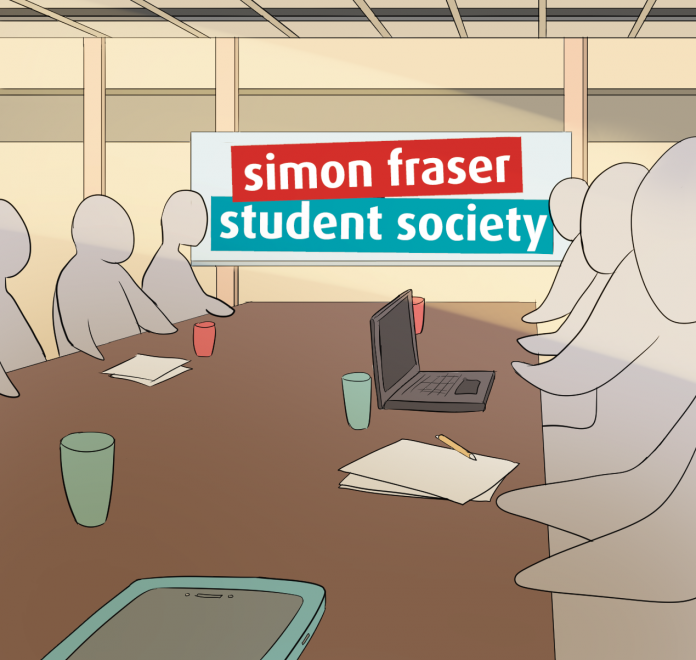
Last December, The Peak reported that student societies independent from the Simon Fraser Student Society (SFSS) may be in danger of losing their on-campus spaces due to a lack of space in the Student Union Building (SUB) and the upcoming expiration of their current leases in June 2018. These on-campus student societies include the Embark Sustainability Society, the Simon Fraser Campus Radio Society CJSF, and the Simon Fraser Public Interest Research Group (SFPIRG). The SFSS has responded that the decision stemmed from an overwhelming interest from clubs and student unions for space in the SUB, and that space was never formally promised to these groups in the first place. Putting aside technicalities and the story’s continuing development, an important part of understanding these societies’ situations includes understanding who they are, what they do, and what is at stake for them.
First off: what is a society?
In British Columbia, a society is an entity regulated by and in compliance with the Societies Act. Among other legal obligations, societies are non-profit organizations, oriented towards a particular goal that they have defined for themselves. A student society more specifically is defined in the University Actas a society “whose purpose is to represent the interests of the general undergraduate or graduate student body, or both . . .” Here at SFU, this is the SFSS’ role.
From each student’s tuition, the SFSS collects a membership fee (paying this fee is a requirement to qualify as a member in good standing of the SFSS), fees for services that it offers (e.g. the U-Pass), as well as fees on behalf of other independent societies on campus. In this sense, part of your tuition is like paying taxes for services and organizations that benefit the SFU community as a whole, allowing them to continue operating. You can find the exact financial breakdown on membership fees on the SFSS’ official website.
A society’s status as a legal entity is its main differentiation from a club or a student union. At SFU, clubs and student department unions are housed under the SFSS and are therefore subject to SFSS regulations. This also makes them reliant on the SFSS for funding, whereas independent student societies on campus receive funding from their membership consistently and independently from SFSS regulations.
Note: Although The Peak Publication Society is also an independent on-campus student society, The Peak has ceased to pursue office space in the SUB.
So: who are the independent student societies affected by the SUB’s construction?
CJSF has been in its current studio for more than 25 years. Photo courtesy of Chris Ho.
These are the voices you hear at 90.1 FM from 8:00 a.m. to 2:00 a.m. seven days a week, all the way from their studios in the Rotunda to Burnaby and the American border. No radio? No problem — you can listen to CJSF live online. Their full program guide can be found on their website, and they even take requests at (778)-782-CJSF (2573). CJSF has been around since 1974, though campus-community radio has been on the Burnaby campus since 1966 under different call letters, making CJSF only a year younger than the university itself. They have been in their current location for over 25 years.
A fleet of 200 volunteers and students part of the Work-Study program have a hand in running the station. Throughout their time at CJSF, volunteers gain free training and experience with writing, audio editing, and production, but they also contribute to the station’s strength and enable CJSF to achieve its mandate. As Jesse Wentzloff, CJSF’s public affairs and talk co-ordinator, tells us that part of the station’s mandate is to share the voices, perspectives, and cultures of groups that go unrepresented both on and off campus.
“We’re a place where the students can mix with and learn from diverse members of the community, all united by a passion for grassroots media, arts, and culture,” Wentzloff says. “Few student resources offer the opportunity to interact with both students and non-student community members on a daily basis [that] CJSF does . . .”
Despite this far reach, CJSF depends on their on-campus studio to gather and provide an easily accessed space for their volunteers, over half of whom are SFU students. This space currently includes meeting and work spaces, a music library boasting over 80,000 items, as well as the space for their servers and FM equipment.
Undeterred, Wentzloff goes on, “We fully intend on continuing to provide the unique and invaluable media exposure [and] experience to students as we have done for the past 50 years and this requires long term stability.” But the possibility of moving, and the costs and technical requisites that are entailed, are enormous and unsustainable for the society.
“In short, we would be a radio station without a station,” he says.
SFPIRG: Simon Fraser Public Interest Research Group
SFPIRG’s office is open to all students, even if it’s just for a nap… Photo courtesy of Chris Ho.
One of CJSF’s Rotunda neighbours, SFPIRG was established at SFU in 1981 as public interest research groups appeared in universities across Canada in the ‘70s and ‘80s. SFPIRG describes itself as a “student-funded and student-directed resource centre dedicated to social justice and environmental justice.” However, SFPIRG’s director of communications Craig Pavelich assures The Peak that SFPIRG isn’t just for students who identify themselves as activists. Everybody is welcome at SFPIRG, he says, “Even if it’s just to hang on the sofas …”
When asked about SFPIRG’s activities, Pavelich has a list the length of his arm. Among them, SFPIRG supports students trying to create a tumbler-share program with Renaissance Coffee, fighting the decline of wild salmon, promoting body-positivity, and conducting research for inmates through the program Letters for the Inside. They have resources and supplies on hand for SFU students involved in social or environmental action, a bike tool co-op, and they also help students facing financial troubles to access the Quest Food Exchange program.
“One of the greatest things we’ve seen happen over the last few years is a shift on campus at the institutional level, a growing awareness of the need to prioritize social justice and intersectional anti-oppression,” says Pavelich. “More and more, student organizations and SFU departments and programs have been coming to us for training and education.”
SFPIRG’s multifaceted interests and projects, all grounded in their dedication to student voices and the acknowledgement of social injustice, make them a unique resource. Pavelich admits: “We regularly hear from students that this is one of the only places on campus they feel safe talking about their experiences of injustice. Students need more than simply space — they need a wide array of programming and support.”
Embark operates The Learning Garden where students can grow their own food. Photo courtesy of Embark.
Currently housed in 2623 West Mall Centre, Embark offers and shares its vision of a future where all SFU students lead environmentally sustainable lifestyles and act as leaders in the field on and off campus.
Since its creation in 2003, Embark has advocated for sustainability initiatives and conducted assessments across campus. A referendum in 2010 made undergraduate students members and financial supporters of Embark. Though Embark is the youngest society on this list, their website nevertheless tallies 65 accomplished student projects such as the Food Rescue program and the Dining Services’ Monday veggie challenges. They have built a community garden on the Burnaby campus (students can rent plots in the Learning Garden) and secured seats to represent students on relevant SFU boards and committees, including the Senior Sustainability Council.
According to Embark’s communications and operations manager Jao Dantes, the threat of losing their space comes as Embark prepares to tackle its new strategic plan for 2017–20.
“We are planning more diverse programming addressing sustainability challenges in connection with multiple perspectives, values, and barriers,” he says. “A great example of this is how we’ve been connecting how food systems interact with cultural values in our monthly Community Kitchens.”
Unlike other societies, Embark may be able to continue leasing their space through the university according to SFU President Hangue Kim. However, as Embark grows, Dantes says that the society is feeling the need for more and more operational space to have a strong, accessible, visible presence on campus.
“While we do not face the same risks as the groups located in the [R]otunda, we do stand in solidarity with them,” Dantes concludes.
Embark, SFPIRG, and CJSF definitely seem to be sharing a sense of overlapping concern as the threat to lose their spaces also threatens their ability to fulfill their unique on-campus mandates.
“Whether or not SFPIRG loses space on campus, students should be paying attention to what’s happening on campus right now — SFPIRG is not the only organization under threat,” says Pavelich.
Simon Fraser University consults SFSS on its updated Code of Student Conduct
Dr. Tim Rahilly, vice-provost and associate vice-president, students and international, who is currently on leave, proposed at the Simon Fraser Student Society (SFSS) Board of Directors meeting on January 12 that the current SFU student conduct policy, the Code of Academic Integrity and Good Conduct, be split into two policies: one for academic conduct and one for non-academic conduct.
“Generally speaking, the academic piece will follow what we do now, [. . .] and with the non-academic piece, there are some major changes,” said Rahilly.
The revisions pertaining to the non-academic piece of the new policy were introduced in the context of SFU’s new policy GP 44, which addresses issues of sexual violence.
Currently, the procedure for investigating serious cases of misconduct may involve the case being presented to the University Board on Student Discipline, which involves a tribunal. As an SFU Student Services document outlining the proposed changes notes, “In recent years the use of tribunes for conduct has been identified as a barrier for those reporting misconduct such as sexual violence as the survivor/compliant must face the respondent/perpetrator at the tribunal and there is an expectation of cross examination.”
Accordingly, the use of a tribunal to handle sexual assault allegations will not be recommended in the proposed non-academic conduct policy.
In the most serious cases, an investigator would be assigned to look into an allegation. The investigator would submit a report to a university decision-maker, which could be Rahilly, who would then determine whether or not the Policy had been breached and disciplinary action may or may not be taken. Disciplinary action can range up to, but excludes, suspending a student from the university.
Suspension of a student is an action that can only be taken by the President of the University, as specified by the University Act of British Columbia.
Board approves social event for student unions and council
The Board of Directors approved the budgets for an upcoming event for student union and council members.
As part of its Governance Engagement Strategy, the event’s goal is to bolster the student society’s relationship with its student unions. The budget for the event is approximately $1,700, with the projected attendance to be 25–40 individuals.
According to Erwin Kwok, vice-president of university relations, the event will allow the SFSS Board of Directors to discuss with departmental student unions about their goals and concerns.
“We feel that [this event] is entirely justified given the fact that this could change the whole focus of how we’ve been approaching these groups, who are our strongest followers,” Kwok said.
The majority of the budget will be spent on prizes, as an incentive for club members to attend the event, according to Jeffrey Leung, applied sciences representative. The event is free of charge and it will help the student society learn more about how their services could be improved to better accommodate the student unions’ needs.
External company to help SFSS explore new options for its health and dental plan
The board has unanimously approved a motion to allow TRG Group Benefits and Pensions Inc. to administer its SFSS health and dental request for proposal (RFP).
The purpose of the RFP is to help the student society explore new options for its health and dental plan.
According to Jimmy Dhesa, vice-president of student services, TRG Group Benefits and Pensions Inc. is a reputable consultant company that has worked with the University of British Columbia’s Alma Mater Society in choosing their health provider.
“[TRG Group Benefits and Pensions Inc.] will help us market the RFP . . . to many vendors as possible and then review the submissions that come in. They’re [going to] help us negotiate to get the best possible deals and they’re going [to] identify and recommend the possible vendors to us,” stated Dhesa.
The cost for their service is approximately $15,000, but according to Dhesa, it is a small price compared to the current size of the costs for the student society’s health and dental plan.
“The value that this would derive is [probably going] to far exceed the cost. We’ll probably get a much better deal that will be valued at more than $15,000 [than] we are going to spend into this,” noted Dhesa.
In addition, Dhesa stated that this fund is coming out of the Health Reserve fund, which is currently around $1,065,000, and after this expenditure, it will decrease to $1,050,000. Dhesa emphasized that this is a one-time service between the SFSS and TRG Group Benefits and Pensions Inc.
“I think it’s money that’s well spent,” added chief executive officer Martin Wyant. Dhesa also commented that the last time the student society did a RPF was approximately eight years ago, so it is time for the student society to begin this process.
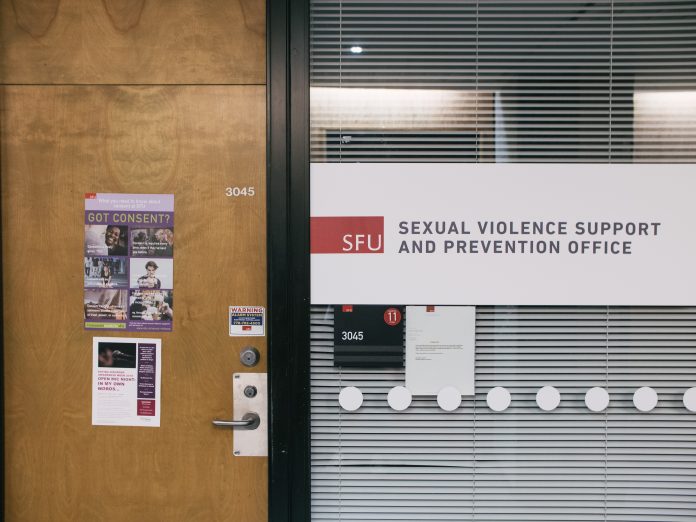
Starting February 2018, Simon Fraser University’s Sexual Violence Support and Prevention Office (SVSPO) will have an interim physical space for the university community to access its services.
Back in March 2017, the university implemented itssexual violence and misconduct policy as part of the provincial legislation and later that year, it welcomed CJ Rowe as theSVSPO’s first-ever director as part of its strategic plan to end sexual violence and misconduct across its three campuses.
Rowe, who uses the pronouns they/them/their, stated that this newly opened office will allow the SVSPO to have a physical presence that they have never had before.
“One of the strengths that [I] think [this] office can bring is our ability to meet with [sexual violence] survivors where it’s most comfortable for them to meet,” they said.
Moreover, Rowe explained that there was a delay in the opening of the SVSPO because they wanted to engage in a rigorous hiring process to ensure that there would be an appropriate staff to oversee the office and its operation.
However, Rowe emphasized that although the office didn’t have a physical space, SFU students, faculty, and staff still had access to similar support resources and services before the office opened.
The SVSPO is currently located in the Academic Quadrangle 3045 and it will occupy this space until the end of spring 2018. “Our hope is to move into a [permanent] space on May 1, 2018 and [we hope to make this] announcement in early-to-mid February,” said Rowe.
For students based in SFU Surrey or SFU Vancouver, Rowe noted that they can get in touch with the office via phone or email and the staff will come to them if needed.
As for the services that will be offered, Rowe noted that one of the SVSPO’s key components is to link people who are looking for education and support with services that already exists.
“If a student wants to come and say [this] is what’s happening to me . . . we can be here to listen to them, to hold space for them to share their experience and we will also provide them with links to appropriate support and resources, whether that’s here on campus or off campus or in [their] home community,” said Rowe.
Rowe also emphasized that they see the SVSPO as a hub for the campus community, recognizing that working towards ending sexual violence is something that the entire SFU community needs to be engaged with.
It is important to note that the SVSPO is the sole place on campus where a sexual violence survivor can make a report, according to Rowe. The office can also refer survivors to counselling and medical services, as well as self-care and provide assistance navigating resources.
Rowe emphasized that it takes all of the campus community to equip students, faculty, and staff the ability to support someone when they make a disclosure, to be able to step up to be an active bystander, and to move towards a culture that is centred on consent.
“We as a campus community have a lot of hard work in front of us. And what I’ve noticed in the last three months is there’s a willingness to engage in that hard work. And now that we’re close to having a full staff team, I’m [really looking] forward to digging in,” they concluded.
Put on by the Edmonds Seniors Society, Grandparents Film Festival is an event showcasing the experiences of our elders. In an interview with Burnaby Now, Shiraz Ramji, who has worked for SFU in the past and is the current president of the Edmonds Seniors Society said “In Canada, there are six million grandparents, and I can’t even find six movies with stories of elders…” The first screening of the festival will take place on Sunday, January 21 from 4–6 p.m. at the Edmonds Community Centre. Admission is free and the events are open to all ages. The film being shown on the 21st is called Shepherd’s Pie and Sushi, some shorter films will be shown in addition, and there are plans to continue screening movies on the third Sunday of each month “for as long as possible” according to Ramji.
Salish Singing and Drumming Workshops
Hosted at Goldcorp Centre for the Arts’ Djavad Mowafaghian World Art Centre, established composer/producer and traditional Lil’wat singer Russell Wallace will be teaching Salish singing, drumming and dancing. The first workshop will be taking place on Thursday, January 25. Additional workshops will be held on Feb 22, Mar 22, Apr 26, and May 24. All workshops are free, drop-in sessions for anyone who would like to attend. For more information visit the SFU Woodward’s website.
Mak Barden is one of six players that will be retiring from SFU hockey this year. (Photo courtesy of SFU hockey)
Returning home from a successful road sweep of the BC Intercollegiate Hockey League’s (BCIHL) Vancouver Island teams last weekend, the Simon Fraser University hockey team beat the Vancouver Island University (VIU) Mariners for the second time in two weeks on Friday night at Bill Copeland Sports Centre. Led by an offensive explosion courtesy of Brendan Lamont, Mac Colasimone, Jaret Babych, and Mak Barden that proved to be the difference, SFU won handily 5–1 with Colasimone scoring what would eventually be the game-winning goal late in the first period off a turnover at the side of the VIU net. The team has now won three straight games as they look forward to attempting to continue their winning streak in a meeting next week with their main rival, the Trinity Western Spartans.
SFU’s dominance began from the puck drop and held for a significant chunk of the first period. Lamont opened the scoring with a snipe from the top of the left circle at 4:55 of the first period. The goal was made possible by a solid break in and forecheck that had VIU hemmed in their zone for over a minute and a half straight. The goal gave Simon Fraser a 1–0 lead which they would add to before the period ended on an unassisted goal from Colasimone, his fourth of the season. With his two assists, he got his 15th, 16th, and 17th points of the season in only 11 games so far this campaign. Just before that, Jaret Babych, in Thomas Vanek-like fashion, made an outstanding no-look-behind-the-back pass that almost set up another SFU goal. Despite SFU having dominated for much of the first period, there were a couple defensive breakdowns that forced Lyndon Stanwood to be sharp with a few key saves throughout the period. The team carried its 2–0 lead out of the first and would proceed to open the game up in the second.
After VIU got within a goal toward the start of the second, Braxton Bilous smoothly released a quick snap shot from the point that found net to restore the two-goal SFU lead. With the assists, Lamont and Colasimone picked up multi-point games. The shot deficit widened further in the second as SFU’s offensive approach and clear advantage in time of possession in the VIU zone wore down their defence. The line made up of Babych, Lamont, and Colasimone was extremely effective in every period of the game, but especially the second, and was a major contributor to the win.
Of note was Tyler Basham picking up an assist late in the second and climbing into a tie for 50th in all-time BCIHL league scoring; that is the highest standing on the all-time list for any active SFU player. On the same note, Lamont had three points and pulled within one of joining Basham in the tie for 50th in all-time league scoring as both players continue to solidify their impressive BCIHL careers.
In the third period, SFU sealed the win with some strong defensive play and goaltending. The home team rode the 5–1 lead they established in the second to victory and continued to distance themselves from the fourth-place Mariners and cement the likelihood of their playoff position. The three stars of the game were unsurprisingly, Babych, Lamont, and Colasimone with Colasimone earning first-star accolades for his three-point night and energetic play. Having outshot VIU by an enormous margin of 44–25 by the end of the game, the offence was undoubtedly the story of the night.
In goal, Stanwood had a solid game with multiple key saves in tight for SFU, saving all but one of the shots that came his way. While the offensive outburst was the story of the night, Stanwood’s performance ensured the game was firmly in SFU’s grasp. This was his eighth win of the season and, with his goals against average continuing to fall, now into the mid 2.00s, he has quietly put together an impressive season that has helped the team remain firmly in a playoff spot despite some adversity in the first half.
When asked about his team’s performance, Stanwood pointed to the offensive outburst led by the line of Babych, Lamont, and Colasimone as a key factor in the win. “They showed some great chemistry out there tonight,” he said, adding that “the team as a whole put together a pretty consistent effort tonight” which has been a key to their recent success. The challenge now for SFU is to translate what, at times, has been dominance of the teams below them in the standings into winning efforts against Trinity and Selkirk, first and second in the league respectively, so that they can make up some ground in the race for home ice advantage in the first round of the playoffs. As far as Stanwood is concerned, the team has a good shot at catching one or both of the teams ahead of them as long as they can “maintain that consistency” and “find a way to keep putting together full 60-minute efforts.” With three wins in January, the team is showing their ability to do just that through the first few weeks of 2018.
With the victory on Friday, Simon Fraser are now firmly in third place in the BCIHL, with a 9–5–0 record. SFU looks to continue narrowing the gap in the standings between themselves and the top two teams in the league next week. They will head to the Langley events centre on Thursday for a 7 p.m. puck drop against the Spartans.
Sophie Swant is leading the women's basketball team with 13.3 points per game so far this season. (Photo courtesy of SFU Athletics)
Year: Junior
Major: Business
Hometown: North Vancouver
Sophie Swant, a third-year on the women’s basketball team, helped lead the team to a 73–49 win against University of Alaska on December 31 in their last game of 2017. In 2018, they are currently 2–1, claiming wins against Western Oregon and Saint Martin’s, and losing against Concordia (Ore.). Swant is currently the leading scorer on the team, averaging 13.4 points per game, and also leads the team with over one block per game. After a lot of turnover from the season before, Swant is seen as one of the leaders on a relatively young Clan team.
The Peak: Why did you choose to play basketball for SFU?
Sophie: There [were] a lot of reasons that contributed to me choosing SFU. I mean, yes, it is close to home, it (academically) is a prestigious school, [it has] a very competitive basketball team, and it’s in my home province of British Columbia, but [I] mostly [chose it] because of the tradition of excellence on the women’s basketball team here at SFU. Being coached by Bruce Langford is an amazing opportunity. He was one of the coaches that really [convinced] me to come here, so if he was willing to take a chance on me then I was willing to take a chance on him, too.
P: What are some of your favourite memories of playing for SFU?
S: So far? I’d say one of the big ones was last year when we beat Alaska Anchorage who was currently ranked as number two in the country, and that was a big upset. Leading up to that game there [were] online polls of people voting the probability of us winning or not winning, and most people said that we didn’t have a chance at all to even come close to winning. And when that final buzzer sounded, that was all the hard work we’d put in that season, and everything we’d wanted to accomplish that year seemed to come forward . . . Everyone really came together as a huge team, and that was really the first time. The celebration of it was just remarkable.
P: So would you say that the polls helped motivate you?
S: I would say yeah. It’s always nice to go into a game when other people are saying you can’t do it and having that extra fire and saying, “Just watch us, we can do it.”
P: What are some of your personal goals for upcoming seasons as well as team goals that you would like to conquer alongside teammates?
S: [For] personal goals, I would like to just be what the team needs me to be. If that means being a scorer one day, a passer one day, someone who needs to be on the bench maybe because everybody else is playing really well, that is what I’ll be. I just kind of want to have my role, whatever that might be for that day and help towards our team goal of winning and playing to our potential, and allowing us to flow on offence and take pride in our defence.
P: How did you get into basketball and what made you decide early on to keep playing?
S: So I actually picked up basketball later than I would say most people do. [I started] around grade seven, grade eight. It wasn’t really that competitive for me; I considered it something to do in the off-season of soccer. And it wasn’t until grade twelve that I chose to play basketball, or even really wanted to play basketball at the post-secondary level. So, a little bit more of a less traditional route, but I think I made the right decision because I always look forward to coming into practice, playing hard, getting better, helping our team get better, and to work towards our season goals.
P: Can the Clan witness a comeback to soccer down the line?
S: [chuckles] Well, if the soccer team, let’s say, had a bunch of people get injured and needed people, I’d definitely be there to help out a fellow team. But I’ll probably just stick to the intramural area of soccer. I mean, I do miss parts of soccer; I think it’s a great game, and I think it’s different in a lot of ways from basketball [but] it’s also the same. I do miss it on occasion, but basketball is definitely where my passion and my love is for sport.
P: This is more of a team question: do you as a team have any pregame traditions? Anything that you guys do to promote a good attitude on the court?
S: We all have our own little things that we like to do. For me personally, I like to be on the court an hour and a bit before the game actually starts and get my game shots up, or looks that I might have in the game that are the opposition-specific look. So, if we’re playing Alaska Anchorage you’re gonna have a lot more coming to lane post looks, whereas in other teams you might be more of a shooter, so just tethering your preparations to the team you’re going to be playing are things that I like to do. As a team, when we’re on the road we have a pregame meal together and we kinda all arrive at the gym at the same time, and we have our team warm up, so I guess that’s more of a tradition. But we don’t have songs that we listen to, or like a dance that we have, nothing that extreme. I think it’s a little bit more subtle than that.
P: How do you find balancing basketball and school?
S: It’s difficult sometimes, but at the same time you have so much support from your fellow teammates who are going through the exact same thing as you are. Your coaches, everyone upstairs in the SFU athletics department, Kelly Traynor, they’re all there to support you and help you achieve your academic goal as well as your sport goal. So it’s nice that there is still an emphasis on academics.
P: What are some of your favourite things that you’ve gotten to experience at SFU?
S: I think the people are a big part of it. The people in my faculty, and the people in athletics have added so much more to my experience maybe than if I’d gone somewhere else. Whether it be classmates, teammates, coaches, faculty, staff, everyone has enriched my [experience] here, which has really made it special for me.
P: If there was one piece of advice you’d give your past self (you as a first-year) what would it be?
S: Don’t sweat the small stuff as much. There’s going to be times where you’re not going to — in sport and in school — get the mark you want, or hit the shot you need to hit or feel like you need to hit. Moving on without carrying that on as dead weight in your life I think makes you a happier person, and I wish that I really believed that, as much as I do now, in my first-year.
P: Similarly, if you could ask a question to your future self what would it be?
S: I mean, jeez louise, I guess: “What are you up to now? Are you still playing basketball? Are your goals in line with where I see them right now, both sport-wise, academically, and career-wise?” I guess, yeah, all that. That’s a tough one. [chuckles].