
You walk excitedly into the basement party, nestled in the suburbs, surrounded
by university friends, more like acquaintances? whatevs, WE FINNA GET
FUCKED UP 2NITE! SHOTS! SHOTS! SHOTS! SHOTS! vodka, tequila,
and rum and all those fancy liquors you think you know from movies
and TV but they burn and taste like nail polish remover so you chug
soda pop. Is this what adults like to do? I should know I’m in uni now
bitches how much did you pay the boot you’re woozy and sloppy,
nervous laughter sneaking up from the back of the throat, aftertaste
of alcohol sneaking up, alcohol swimming through your blood
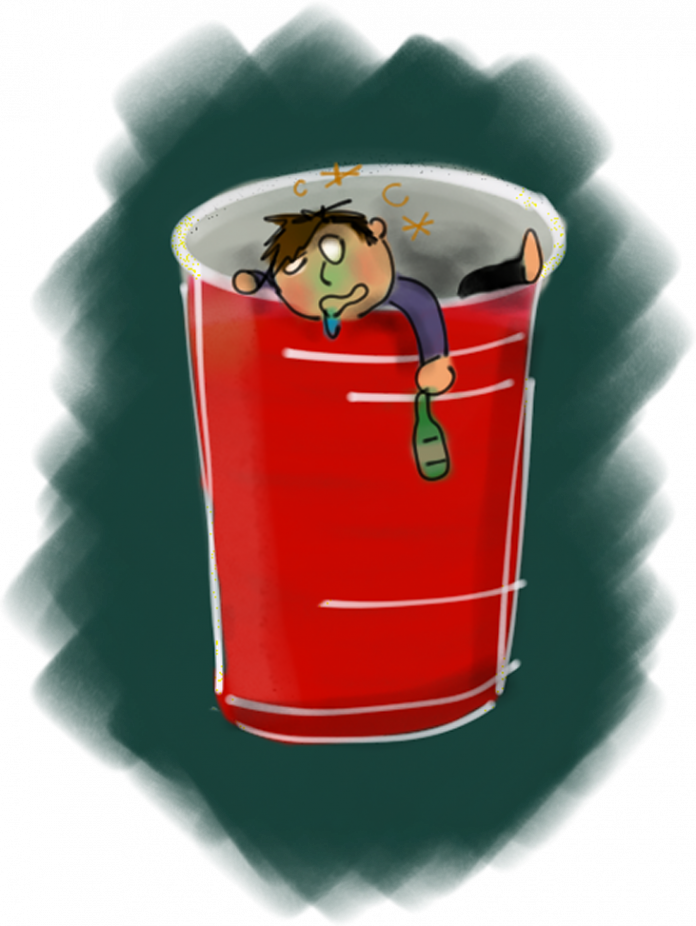
choked sitting on the basement couch red plastic cup
brimming with bad decisions, derision striking the back of
the throat oh wait no that’s vomit UUUUGHGHHGHGHGH
REGRET REGRET hands and knees towards the toilet the
rest of the night is spent staring into that bowl of pristine
porcelain so much cleaner than your soul right now. Bile
and regret in the toilet bowl, splitting headache nauseous
sensitivity to all light and sound you’re crying,
sobbing, bawling into the toilet bowl as your class
valedictorian babysits you from the corner of the
washroom making sure you don’t try to drown yourself
in your own pool of vomit and shame. One of your
stronger friends offers to carry you to bed but as an
independent woman you refuse inebriated but
stubborn stumbling with a plastic Walmart bag
held feebly under your chin in case you throw
up again and then you throw up again and the
Walmart logo is illuminated by vomit and you
mentally apologize to your liver I’m so sorry liver,
you’ve always been so good to me detoxifying my
blood and shit that’s what the liver does right?
You should have called Mom to pick you up
hours ago, where is she now? probably asleep,
you fall asleep blissful sleep while hugging
a trash can as a potential barf bowl
what a lovely learning experience
Comedic poetry: Getting drunk for the first time
Bringing cricket from India to SFU

Fast Facts
- Name: Ekamjot Singh Deol
- Pronouns: He / Him / His
- Department Affiliation: Criminology
- Birthplace: Punjab, India
- Fun Fact: Ekamjot’s favourite cricketer is Bhuveneshwar Kumar, because of his talent on the field, his caring and calm personality off of it, as well as all of his charitable work.
Cricket is a lesser known sport in North America. But after being spread widely over the world by the British monarchy, it is now played competitively and loved in over 125 countries. Under the International Cricket Council (ICC) stand nations and groups of islands, ranging from India to the West Indies.
At SFU, some know of this sport from back home, or have heard about it from friends who come from cricket-playing countries. But if anyone was interested to learn about and play the sport, they did not have an opportunity… until now!
Ekamjot Singh Deol brings SFU and its cricket enthusiasts one step closer to the sport by establishing the SFU Cricket Club. Registered as a sports interest club under the SFSS, the cricket club is here to cater to anyone with any interests related to cricket.
Ekamjot explains cricket for those who may be unfamiliar with it: “A contest between the bat and the ball, with two teams of 11, and the team scoring more runs wins.” If someone has ever explained it to you by saying it is similar to baseball, he warns you to not fall for this, as it “certainly is not!”
Ekamjot is a second-year international student from Punjab, India, studying criminology at SFU. Before coming to Canada as a student, Ekamjot played cricket professionally at a district level. (Cricket in India is played at various levels: district, state, playing for clubs or leagues, and national teams. Unfortunately, he didn’t get the opportunity to continue professionally in Canada. However, he has had the idea of launching a club dedicated to cricket ever since he got here, and the idea finally became a reality this semester.
“I have finally found a way to carry out my passion,” Ekamjot says, gleaming with excitement and hope for his new club.
His first memory of the sport is from the tender age of 5, when India played Australia in the 2003 ICC World Cup final. Though India lost the match, his intrigue and love for the sport grew, and has remained with him ever since. He is an ardent fan of the sport, and although he speaks about it extremely passionately, he has immense patience to explain the terminology and the rules of cricket to anyone interested.
Not only is Ekamjot passionate about the sport, but he is also full of insight on the most interesting and unknown trivia about many of the players. For example, did you know the reason why the world-renowned Sourav Ganguly is a left-handed batsman in the first place? Ekamjot tells me that it is because Ganguly’s older brother was left-handed, and he grew up practicing with his brother’s equipment. He went on to become a left-handed cricketer and a legend.
“I try and look for the small things that people don’t know to get my motivation from, because the next time I think ‘I’m in big trouble and this situation cannot be turned around,’ I think about Sourav Ganguly’s left-handedness and get my motivation,” he says.
Considering that he had been a student at SFU for two years, we were interested in finding out why he hadn’t started the club any earlier. Just like any student, he was busy juggling his undergraduate career and a part-time job, and had never thought that he could give a club enough time and attention. He was also unsure of whether or not he would be able to reach out to a large enough audience.
Now, Ekamjot recalls startling crowds gathered to watch cricket matches live-streamed by clubs, and spotting students playing cricket with makeshift bats and tennis balls near the residences.
“I realized that people do want to play, they just don’t have the platform to. Here, they may not have more people and equipment. This motivated me and I thought: let’s create a club for those 400 people that were there for the screening of the match one time in the year. If even 40 of them can come to our events all year round, we can be successful.”
His other concern was that the club-creating process would be rather demanding and complicated. But that wasn’t the case at all, he recalls: “The SFSS is so supportive, you don’t necessarily have to work a lot!”
All one needs to do is talk about the club idea with the SFSS and discuss the kinds of budgeting and finances you may need for upcoming events, do an online Canvas course on SFSS and how to run a club, and voilà — with the starting number of 10 undergraduate students, your club is official! More information can be found on the SFSS website, under the ‘Clubs and SUS’ tab.
Currently, though they have yet to advertise widely, the club already has over 30 members, including its three first executive officials: Ekamjot as president, Kanav Ahuja as executive secretary, and Dhawal Gupta as the club’s treasurer. They aim to include more people in the executive team as the club grows.
What Ekamjot hopes to see from this club is a higher intake of domestic and international students alike, who know cricket or are excited to learn about the sport. As president of the club, he seems to have his priorities figured out. He has four primary objectives for this club: to focus on those “who want to know more about the game, who want to talk about the game, [. . .] play the game, and watch the game.”
Ekamjot also insisted that: “an integral part of this club is raising awareness and making sure people know about the game.” In the near future, they plan to host a few social events to increase people’s knowledge about cricket and its technicalities.
Aside from serious, educative sessions like “Cricket 101” or ball-tampering crash courses, the creative club members are also planning to arrange games like “cric-tionary” and “cric-charades” to help club members learn and teach cricket terminology. They also aim to hold tournaments, but can only do so after signing a waiver with the SFSS. Nonetheless, this remains one of their more serious agendas to cover before summer ends, so cricket can be played outdoors. They aim to collaborate with the Indian Student Federation (ISF) to arrange, play, and hopefully screen future cricket matches.
Eventually, he would like for the club to become a sports club under SFU Recreations, and possibly, have a team that represents the university.
“That’s the dream!” Ekamjot says. “Hopefully, we will achieve it in my undergrad life. But even if [we do] not, as an SFU alumni, I’d be very happy to come and watch the SFU cricket club play, and have a sigh of happiness, seeing that it all started as a ‘sports interest’ club with only 10 people in it. That’s a long-term goal.”
Album versus album: Blink-182

Blink-182 (2003)
For Blink-182’s self-titled album, Mark Hoppus (vocals and bass), Tom DeLonge (vocals and guitar), and Travis Barker (drums extraordinaire) took the opportunity to deviate from their usual pioneering pop-punk sound to create a deeply personal experience that perfectly encapsulates the sadness, anger, angst, and volatility of teenagerdom. Most people might remember it by the timeless bops “Feeling This” (the music video looks like a horny teenager’s wet dream) and “I Miss You” (every emo kid’s anthem in the mid-2000s), but truth be told, every song on the album is an amazing listen.
The album opens with jangly guitars, tight drums, and anthemic lyrics on “Feeling This” before slamming into the angry distortion of “Obvious.” “I Miss You” introduces the slower, sadder tones on the album, while “Violence” is an avant-garde punk march that leads into a reading of a letter Hoppus’s grandfather sent to his wife during his service in WWII. While I could write for hours about each song (especially the dying astronaut who is the central subject of “Asthenia”), I’ll spare you by simply saying that every one of them has a story coupled with catchy instrumentation and raw emotion. The result? A tapestry of songs that come together to form nothing short of an artistic masterpiece.
Don’t fast-forward through any of them. A few are utterly fantastic, and some must-listen tracks include “Go,” “Down,” and “Here’s Your Letter.”
 California (2016)
When Tom DeLonge left the band for the second time in 2015 to focus on UFO research and play in his other band Angels & Airwaves, diehard Blink-182 fans went rogue on Twitter, proclaiming the incident blasphemous. In response to DeLonge’s departure, Barker and Hoppus inducted Matt Skiba of Alkaline Trio into their inner circle. The three of them made a baby called California.
The album showcases some of the weakest lyricism to date. A couple of examples are the pre-chorus on “She’s Out of Her Mind” of only the line “she’s a-a-a-antisocial, a-a-a-antisocial a-a-and she’s an angel, yeah” and the endless refrains of “na-na-na-na” on “Sober” and “No Future.” This shouldn’t have come as a surprise, considering John Feldmann, the king of “wo-ah” and “na-na”, produced the album. They even included a 16-second song — if you can even call it that — called “Built This Pool” smack-dab in the middle of the album.
It’s not that California is a bad album, it’s that there isn’t anything that I haven’t heard a million times before on other pop punk albums. I expected a veteran to the game to come out with an album that doesn’t sound like background music at an emo kid’s house party.
Despite all its shortcomings, the one thing that you can’t deny is that the band sounds like it’s having fun again. Really, they haven’t sounded so excited, happy, and immature since Take Off Your Pants and Jacket. That at least makes me hopeful for their future.
Highlights include “Home is Such a Lonely Place,” “Bored to Death,” and “Rabbit Hole.”
Verdict
Blink-182’s Blink-182 beats California by a mile. Everything — the lyricism, the instrumentals, the stories behind the songs — is better. If you’re going to listen to only one of their albums in your lifetime (huge mistake, but you do you), pick Blink-182. It is hands-down their greatest album.
Research Roundup – Investigating links

How the attractiveness of your server can affect the taste of your food
A study done by UBC and SFU students looked at how the attractiveness of a server affected the taste perceptions of male and female customers.
The procedure involved getting between two to 600 participants per segment of the study. The participants were asked what they looked for in a dining experience and were served two sets of select samples from either an attractive or unattractive (consisting of makeup to give the appearance of acne, bags under eyes, yellow teeth and a ponytail) person or photo of a person. The samples included a kind of fruit juice as the sweet item and a vegetable spread as the bitter item.
It was found that women were less influenced by the attractiveness of the server. But they did rate restaurant location, loudness, and taste of food as being more important than males did.
Men rated the juice as being more sweet and enjoyable and less bitter in the presence of attractive females and the opposite in the presence of unattractive females. However, the pattern was reversed for the vegetable spread. Unpleasant tasting food was more unpleasant in the presence of an attractive server.
The former (attractive people, pleasant food) is likely due to a spill-over in a positive stimuli affecting judgement. The latter (attractive food, unpleasant food) is likely due to a mismatch between stimuli making the food appear worse.
Community follow-up may not affect chances of rehospitalization for mentally-ill and homeless population
SFU Somer’s Research Group Conducted a study where they looked at data from 433 British Columbians who were homeless and mentally ill over a span of five years. The researchers found that community follow-ups had no noticeable impact on the chances of hospitalizations of mentally ill and homeless individuals.
Patients can end up costing taxpayers $60,000 per patient, mostly due to hospital readmissions.
The results showed that 53% of individuals were readmitted within one year, which indicated that medical staff require access to appropriate housing which may be used in planning discharges for the patients. This is significant as many prior studies indicated that community follow-ups tended to have a more substantial positive impact on patients.
According to Somers, “Follow-up care after someone is discharged from the hospital only helps reduce rehospitalization if the patient is housed or is working. If someone is homeless no amount of medical care will compensate for the fact that they are homeless.
“Taxpayers can invest in support programs like consumption sites or street outreach nurses, but it won’t put a dent in reducing the number of re-hospitalization visits.”
Rejection letter from the company you’re too unqualified for

Dear Mr. Just Graduated,
Thank you for your application for the position of Director of Human Resources. Unfortunately, we here at Way Too Out of Your League Inc. regret to inform you that you have been rejected for this position due to your lack of qualifications.
The resume you attached has zero relevant work experience. In fact, it lists no work experience at all. Instead, you included a “My Greatest Achievements” section containing useless feats such as “can speed-rap ‘Lose Yourself’ by Eminem” and “ate two hot dogs in under 30 seconds.” Perhaps you should be applying to be a contestant on some obscure game show with terrible ratings?
In the section about the fraternity you attended in college, we expected to find volunteer work and the community events you helped host, considering you won “Most Hours Worked” in 2017. To our shock and dismay, you described in great detail the time you relentlessly hit on a girl even though she refused your advances 18 times. We do not consider that to be an example of your “dedication to achieving your goals.” Was “How not to be a douchebag 101” no longer a mandatory class in high school? We also did not need to know that your nickname was “King of the Bros.”
Under “Skills and Qualifications,” you wrote down everything you do not know how to operate, such as “don’t know how to open, let alone use, Microsoft Word” and “still haven’t figured out MS Paint.” Furthermore, being able to finish Mario 64 in two hours is not a transferable skill.
Your cover letter was equally disappointing, because it could not even qualify as a letter. All you wrote was “ayyyye my dudes wass poppin?” I can only assume that you might have been smoking an illegal substance at the time of composure.
Enclosed with this letter is the flash drive with 0.10 BTC (Bitcoin) you sent with your application. We here at Way Too Out of Your League Inc. do not accept bribes of any sort. Especially not in the form of Bitcoin, because we know how little they will be worth in a year.
I wish you luck on your future endeavours. You’re going to need it.
Best regards,
Hiring manager of your dreams
Show versus Show: RuPaul’s Drag Race and Drag Race Thailand

Warning: this review contains spoilers for both shows!
RuPaul’s Drag Race (Season 10, 2018)
RuPaul’s Drag Race (RPDR) turns 10 and is back with finely orchestrated drama, bigger wigs, and even bigger personalities. RuPaul herself makes big promises about this season being more show-stopping than ever. She is ready to butt into these queens’ lives with sharp observations about their most personal and drag-related flaws, which brings us to the queens of this season.
RPDR is all about fleshed-out arcs, whether they’re real or not. The season is full of shade, laughs (may I interest anyone in a Miss Vanjie reference?), and underdog arcs. However, it’s queens like The Vixen and Eureka who bring fresh drama to the screens, the former igniting a long overdue discussion about racism amongst the drag community. That aside, many charming personalities make it to RPDR this season, getting the audience cheering for underdogs like Miz Cracker and Kameron Michaels who must face daunting and sometimes confusing challenges.
When the queens walk the runway this season, we’re witness to many glamorous and lavish looks, with fashion queens like Aquaria dominating the stage. At times RuPaul is a tad more adventurous than her usual gown, but nothing is too notable. As for lip syncs, this season includes a few lip sync assassins like Monet X Change and Kameron Michaels. Only a few queens rely on props to make their lip syncs legendary; most rely on their heart and many, many death drops.

Drag Race Thailand (Season 1, 2018)
Drag Race Thailand (DRT) may not include RuPaul herself, and the production of the show isn’t as stellar RPDR, but the show proves that Asian queens have just as much charisma, uniqueness, nerve, and talent as their American counterparts
All 12 queens, diverse in both Thai and other Asian languages, are also wildly diverse in body style, size, and looks. A big difference between DRT and RPDR is that two queens are hosting the show. The first is Art Arya, whose background is more grounded on design and style than drag. She’s more subdued that RuPaul and she isn’t bursting with catchphrases, but she’s still always ready with her sharp tongue. The other host, Pangina Heals, is younger, more charismatic, and a seasoned drag queen after winning Thailand’s first drag reality TV show T Battle.
In its first season, DRT does not pull back when challenging the girls. Their first maxi challenge is to create three-in-one looks, immediately raising the bar for RPDR. Looks this season vary wildly, with some queens going for cheap and glamourous and others attempting intricate and lavish. It’s refreshing to see traditional cultural pieces like Jaja’s baro’t saya, and to see even the judges going all out; one of my favourite outfits would be Pangina walking out as a sexy bowl of noodles (no, I am not exaggerating).
The lip syncs of the season, like the show’s production, vary wildly in quality. The Top 6 performance is a disorienting and messy dance sequence with too many pop ballads. It’s no surprise that Art Arya did a double save and elimination. In the “Dhoom Dhoom” lip sync, one queen, Natalia Pliacam, brought out a literal bag of props, which goes to show that heartfelt performances like Petchara never go out of style.
Verdict:
After almost a decade of RPDR, it’s clear that the show is struggling to top itself, raise its stakes, and keep the audience surprised. RPDR still showcases great personalities with strengths varying from pageant to comedy to looks. There’s more than enough drama to boot. But the drama has gotten contrived.
The stunts pulled, especially in the finale with a “surprise” three-person lip sync (made especially unbelievable with a song meant for three divas), were anything but surprising, and with more and more queens getting snubbed, the show is losing the same grip it had on audiences like me.
Drag Race Thailand, however, is a refreshing change of pace in terms of the contestant and judge aesthetics and the challenges themselves. The queens keep your attention with their shady one-liners (Meannie Minaj upon seeing another queen freak out over a win: “Are you that happy? Haven’t you been winning anything in life?”), but drama for the most part is toned down.
Both shows have their own charm, RPDR with its drama and DRT for its fascinating looks and challenges. But I’m an extra bitch at heart, so I’m inclined to say this season of RPDR with its flaws, shenanigans, charming-as-hell queens, and over the top drama, that, Chantay, you stay.
SFU Connect transitions to SFU Mail on August 18
“SFU Connect accounts will be accessible until March 2019.” SFU website / “The new platform will help better meet the current and future needs of the University.” SFU Website.
Students who are currently using SFU Connect will be transitioned to SFU’s new email account on August 18, 2018. The change was decided upon in 2017, due to the SFU Connect email system updates failing to meet standards.
The school website states that the goal behind the transition process is “to better meet the current and future needs of the University,” and that this decision was “guided by input from the SFU community.”
Communications officer Stephanie Stewart told The Peak that, following the decision to phase out SFU Connect, the decision to narrow the focus to a Microsoft email solution was because “Microsoft Outlook is already being used by many members of the University community as their preferred mail client.”
Stewart continued, “third-party applications and services outside of email and calendar systems are focusing their efforts on integrating only with mainstream email solutions such as Microsoft Exchange, and both Microsoft’s Outlook client and Exchange server are generally regarded as the industry standard solutions.”
The first part of the transition was initiated and completed for “staff, faculty, sponsored, and resource accounts” on April 28, 2018. The second part of the transition is aimed at all current students and retirees. More specifically, existing students (undergraduate or graduate) with no other active staff/faculty position at SFU, or retirees with no other active staff/faculty role at SFU, are going to undergo this transition in email system.
Once the new SFU Mail account is activated, all new emails are to be delivered to it, while the older SFU Connect account is slated to be accessible until March 2019.
Graduate student Isabella Thet Su Aung, whose account was switched in April, mentioned to The Peak that one of her main concerns was regarding moving the existing data from SFU Connect to the new email accounts.
SFU has announced that migration of data from SFU Connect into the related SFU Mail account will begin immediately on August 18. Within the first 48 to 72 hours, calendars, contacts, and tasks will be migrated to the new account, followed by the most recent 30 days of mail from each mail folder.
The initial migration period will be followed by an email stating, “Your initial set of data has been migrated to SFU Mail.” The email will also contain an estimate of how long it will take for the remaining mail data to be completely transferred. The migration process is supposed to continue until all the data has been exported from the older account to the new mail accounts. Upon completion, each student can expect to receive a message informing them that all their data has been migrated.
The process to completely phase out SFU Connect, powered by the Zimbra Collaboration Suite, and adopt Microsoft Exchange as the new email platform, is slated to be finished by 2019.
Stewart confirmed that students will be able to use third-party mail clients, such as Apple Mail and Thunderbird, “through protocols including IMAP and POP. If you currently use these clients, you will be able to continue using them after the transition to the new email solution.”
Further information regarding the transition can be found on the SFU Mail website.
Pro-tips from a self-declared wine snob

I know that you could never hope to be as sophisticated as me, myself being the wine connoisseur that I am. You have to have a certain palate to be an expert at it (like me). However, here are a few tips to help you impress your friends when tasting wine.
Firstly, begin by swirling it around in the glass and holding it up to your eye, just to make sure it is, indeed, wine. Then, smell it and discover that it certainly seems to be so. When you take a sip, you should slurp it through your teeth as dramatically as possible — this is very important and is something all the fanciest wine tasters do. It lets the wine stain your teeth and shows everyone that you are a sophisticated wine drinker like them (think of it like a calling card).
The actual tasting of the wine is much more difficult and something you must acquire over time, as I have. Here are a few of my latest reviews to help inspire you:
‘93 French Shiraz
This particular wine was too cheap for my sophisticated palate. Firstly, it is a ‘93, and as everyone knows, this means that there are 93 ingredients in this wine (much like the 67 on a bottle of Heinz ketchup) and that is far too many. The more ingredients, the cheaper the wine; this is why the ‘84 will cost more than the ‘93. Some people say they prefer a dry wine and this was definitely a wet wine — moist, even. The Cabernet tasted somewhat like grass (possibly one of the 93 ingredients?) with sour, grape-like notes. I added some ice cubes to it because they clearly hadn’t chilled it beforehand, and this helped slightly, but overall I was unimpressed.
Caraval Blended White (Sauvignon Blanc and Pinot Grigio)
This wine is a slightly higher-class white, as demonstrated by the fact that it is, in fact, two wines and not just one. The flavours of the Sauvignon Blanc (pronounced saving-yonk-blonk) blend wonderfully with those of the Pinot Grigio (pronounced peanut-grishoo) to create a decadent white wine.
Victoria White Zinfandel
I was surprised and appalled when the waiter poured me not a white wine, as I was expecting, but a pink one. I asked to speak to the manager and she told me that a white zinfandel was a rosé. I have never been so insulted! Do they think I am an idiot? An amateur wine taster? It says white right in the name! I left before tasting the lie.
Ricci Pink Sparkling
Often considered among the fanciest of wines, this champagne was certainly sophisticated. Make sure it is in a flute to properly aerate it. I made the mistake of using a clarinet instead of a flute, and the effect wasn’t nearly the same. I found the tastes to be slightly tangy, the same as if you were eating a lemon warhead, and the texture of the champagne to be very bubbly. Overall the Ricci Pink Sparkling wine was a fine champagne.
Are you SFU-ready? Version 1: Busting myths and spreading facts

Myths busted by: Jennifer Low
Facts provided by: Victoria Lopatka
As you stand at the bus loop, glancing up at Simon Fraser University and trembling before the foreboding concrete maze that awaits you, your mind is plagued by the many horror stories that you were told the moment you announced that “You Are SFU.”
Fear not, troubled and confused students. The Peak’s Declassified SFU Survival Guide is here to help you feel a little less troubled, and maybe a bit less confused. Simply put: most of those horror stories are just stories. But if the legends aren’t true, then what is? We’re here to put the rumours to rest once and for all by separating fact from fiction.
Myth #1: SFU used to be a prison
SFU was never used as a jail, and was never designed to resemble a prison at all. In fact, according to the Archives and Records Management website, its design was created for a competition in 1963 that was held by Dr. Gordon Shrum, who had recently assumed the position of chancellor of the university. You have Shrum to thank for never having to walk through the rain to get to class, and for having all your large lecture theatres in one place rather than dispersed about the entire campus, as these were included in his collection of informal guidelines for SFU’s design. The winning design was created by Arthur Erickson and Geoffrey Massy in a unanimous selection by the judges.
Besides, not everyone thinks SFU looks like a prison. Its design is based on the horizontal structure of the acropolis in Athens and has been featured in many TV shows and films . . . It has served as courtyards, streets, walkways, CIA/FBI Headquarters, government research facilities, alien worlds, hospitals, and a slew of other settings. – JL
Facts:
- Originally, Simon Fraser University’s proposed name was simply Fraser University, but Les Peterson, the minister in charge of the legislation setting the new university up, didn’t like that the abbreviation would be “FU,” so the name was changed.
- Arthur Charles Erickson, whose works include the Canadian Embassy in Washington, the Museum of Anthropology at UBC, the MacMillan Bloedel Building and the Vancouver Art Gallery, was the architect who worked on SFU. You may have heard that Erickson designed prisons (an extension of Myth #1), which is false.
- SFU was nicknamed the “instant university” due to its quick construction and opening. Over a span of roughly two years, the Burnaby Campus was built and ready to welcome its first class of students.
- In 1969, a heavy snowfall cracked the glass in the roof of Convocation Mall, so the school paid $70,000 to have all the panes replaced with reinforced glass.
- Many TV shows and movies have been filmed at SFU, including The Day the Earth Stood Still, Spy Game, Agent Cody Banks, The Sixth Day, Personal Effects, Antitrust, Fringe, Battlestar Galactica, Stargate SG-1, Millennium, and The X-Files.
- Do you know what SFU’s coat of arms looks like? Based on the arms of the Scottish Fraser of Lovat Clan, it includes blue and white quarters, white strawberry flowers, and red crowns. It bears some books, representing education. This coat of arms replaced a previous one bearing crosses, which led students to believe SFU was a private religious institution. Today, SFU is best known for a simple red box with white letters.
- Many students may not know the university’s official motto: “Nous sommes prêts,” which is a French phrase meaning “We are ready.” This is also inspired by the Frasers of Lovat. – VL
Myth #2: UBC is better than SFU
Ah, there is no greater rivalry than the one that is revealed in the UBC versus SFU debate. However, this myth can be debunked, as a quick Google search will ultimately reveal that SFU and UBC are both rated as among Canada’s top universities. For this reason, it is often more important to consider the options based on the program that you are interested in.
While UBC has a larger reputation, as it is about 57 years older than SFU, SFU is still well respected. In October 2017, for the ninth time in a span of 10 years, SFU was named one of the top universities in the Maclean’s Magazine University rankings in the comprehensive universities category. According to the article: SFU was ranked as “one of Canada’s top universities for producing research that makes an impact in the real world, and was lauded by Times Higher Education World University Rankings as one of four Canadian schools that excel in tech programs such as engineering.”
Not to mention, SFU (arguably) won the Great SFU vs UBC meme war of 2017. Even UBC had to admit defeat when facing the wrath of SFU’s superior meme skills. – JL
Facts:
- Of the 4,438 bachelor’s degrees that SFU awarded in 2008–09, the most popular majors were business, education, economics, psychology, communications, criminology, and english.
- In 1970, SFU became the first university in Canada to implement a computerized registration system.
- In 2008, the reflecting pond in the Academic Quadrangle was emptied by staff, revealing all the items that had been lost in it over the years. According to The Province, besides about 400 fish, they found “two pairs of glasses, three hockey pucks, a hearing aid, a ‘really boring’ diary, two cellphones, a five-pin bowling ball, some liquor bottles, and a sodden copy of the Thomas Hardy novel Tess Of The D’Urbervilles with an inscription that read: ‘She should have kicked him in the strawberries’.” Though it may not look like it, the large boulder in the reflecting pond in the AQ is actually six tons of Lillooet jade discovered in the Fraser Canyon. That mossy mass is the university’s founding stone. – VL
Myth #3: You’ll make all of your friends during the first few weeks.
In every cheesy rom-com with a college setting and every post-secondary romp flick, it always seems as though the first person the main character meets is destined to become their BFF or soulmate. For normal people like you and I, who reside in the real world and not some filtered TV-screen fantasy, this is not typically the case.
In university, the friends you make in many classes sometimes do not persist into the following semester, which is often when you no longer see one another due to lack of classes together. Having this expectation that you only have one chance to make friends can make you feel frustrated and lonely. Remember that the first day is not always the most important day. You can find friends any day of the year! Sometimes, you just don’t “click” with the first few people you meet. – JL
Facts:
- When SFU’s first ever pub opened in 1973, beer cost 45 cents and a cup of coffee was only 25 cents. The good ol’ days, huh?
- As more mothers started attending SFU, a demand for child-care on campus grew. In the summer of 1968, SFU administration “swiftly denied” the request for daycare services, so a group of mothers set up their own. Each mother volunteered four hours a week to watch the group of children in the AQ. – VL
Myth #4: Making friends at SFU is impossible because it’s a commuter campus
SFU is filled with diverse, talented and friendly people, but there is always the concern that SFU lacks opportunities to allow people to meet one another. While it is true that SFU does not have the same volume of students living or staying on campus as other universities, it is possible at any university to simply travel to and from class without engaging in any sort of socializing. It is truly up to you.
Making friends could be as easy as sitting next to someone in lecture, asking someone to be your partner for an in-class assignment, or just saying “hi.” The quality of one’s student experience at any university is dependent on the level of effort you are willing to put in. SFU has an abundance of social events, like the SFSS’s most well-known and anticipated event: the Fall Kickoff. One of the best ways for students to become engaged in their SFU community is by joining clubs. If you’re interested in a specific subject, developing your career, or want to become part of an activism, volunteer, spiritual, sport or hobby club, SFU has it all.
Clubs Day can often be a daunting time for a new SFU student, but the SFSS has got you covered with a fantastic directory of clubs that links students to short descriptions of the club as well as contact and website information. So whether you’re into League of Legends, public speaking, dance or even competitive dragon boating, SFU has a club for that. And if it doesn’t, you can always apply to start one. – JL
Facts:
- The SFSS oversees about 350 clubs and an additional 50 student unions.
- According to SFU, the university currently boasts 30 000 students divided amongst the three different campuses. Its alumni count is around 130 000 alums.
- SFU originally had two student newspapers, The Tartan and The SF View. Each published only a few articles before they merged into a single paper, The Peak, on October 6, 1965. Upon creation, there was no name for this new newspaper, so students were asked to pick and vote on a new name.
- Since a March 1966 referendum, where students voted overwhelmingly against having fraternities at SFU, frats haven’t been recognized by the SFSS as official SFU organizations.
- The first-ever protest at SFU was in 1966, over the construction of a Shell gas station on campus. It was coined the “Shift Shell’ rally. I haven’t seen a gas station on campus anywhere, so the thousand students who showed up must’ve made a convincing argument.– VL
Forum raises concern tank farm poses “catastrophic” risk
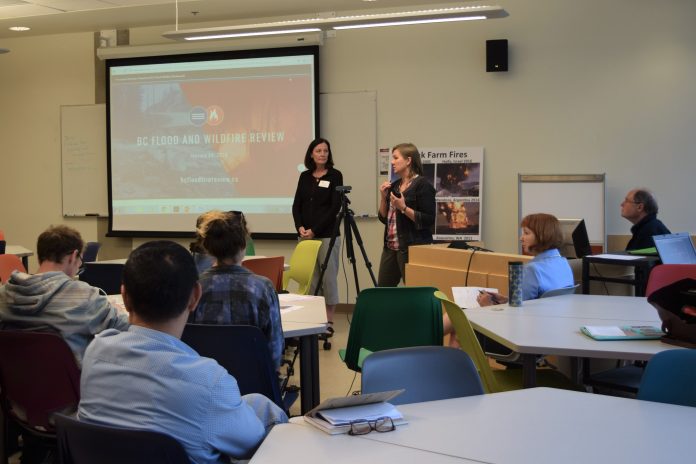
Dozens of concerned citizens gathered to discuss links between the potential for a devastating fire on Burnaby Mountain and the Kinder Morgan tank farm expansion at Simon Fraser University on June 28.
“The pipeline is proposed to be expanded and that increases the risk of fire on the mountain,” Tim Takaro, event organizer and associate dean in the faculty of health sciences, told The Peak.
Earlier, Takaro mentioned that the consequences of the expansion would also involve “increased catastrophic risk to the university and community.”
The Fire on Burnaby Mountain teach-in followed a university wildfire drill held earlier in the week. The drill among responders was the first time the university assessed its new emergency plans for evacuating and/or sheltering on campus.
“They have this drill about forest fires but are not connecting the dots to climate change, the pipeline, and the tank farm risk,” Takaro said of the impetus to hold the event.
Many speakers at the forum voiced fears that climate change increases the risk of forest fires while the expanded tank farm also raises the possibility that fire or toxic emissions could threaten the university campus and nearby communities.
SFU chief safety officer Mark Lalonde was in attendance to discuss the wildfire drill and concerns about safety issues stemming from the tank farm.
“This [drill] was an opportunity to test the new mass evacuation and shelter-in-place plan,” Lalonde told the audience. “We’re really happy with it; we know that there are some adjustments to make and that is in progress.”
Lalonde responded to a number of questions about steps taken by the university to address safety issues around the tank farm and how the institution would respond if a fire blocked the roads to campus.
“We’ve been repeating [our concerns] with government, all three levels of government, and the National Energy Board, and with Kinder Morgan,” he responded. “SFU remains opposed to anything that challenges the safety and security of our campus community.”
Lalonde noted that the university is only responsible for the campus and that the municipality oversees the roads and surrounding area. In the event that the roads became impassable, the recreational trails down the mountain would not be a viable route for evacuation, he added.
“[This] is why our plan is shelter-in-place and mass evacuation,” Lalonde said. “That would be the reality is that we’re going to have to stay here, absolute worst-case scenario.”
“This is one of a myriad of concerns I have about the campus here. This is certainly one of the more significant, it has the most catastrophic potential impact,” he concluded.
In 2016, a report commissioned by the university found that a fire at the facility “could envelop the university, and block access to and from SFU, thus making an evacuation difficult or impossible.”
Jaclyn Parks, a master’s student in health sciences who helped organize the event, noted that a lot of students are unaware of the risk and how to respond.
“[SFU should be] very concerned about the risk of a fire on Burnaby Mountain,” Parks said.
“I don’t think the students have any idea that all of this is happening,” she added. “I don’t even have an idea of what happens if there is an alarm.”
“If there is a giant explosion and a fire, how do we get out?” – Jaclyn Parks, SFU student
In response to audience questions, Lalonde explained that the university has communicated safety issues through its website and other media, but described educating the public as an “ongoing struggle.”
He advised that students, faculty, and staff download the SFU Snap app, which will enable emergency notifications to be sent to mobile devices.
The organizers hope that the event will spark conversation about a lesser known side of the controversy surrounding the Kinder Morgan tank farm and pipeline expansion.
“We know this forest burns, there are a lot of people on the trails, there is a lot of opportunity for accidental fires to start and we also have this enormous risk of the tank farm” Takaro said.
He hopes that people came away from the event with an understanding of the need to stop the pipeline expansion.
The Trans Mountain expansion project, intended to double the capacity of the tank farm and triple the capacity of the oil pipeline, was purchased by the federal government last month from Texas-based Kinder Morgan for the price of $4.5 billion.

