Home Blog Page 562

B.C. government launches campaign addressing sexual misconduct in post-secondary institutions

0
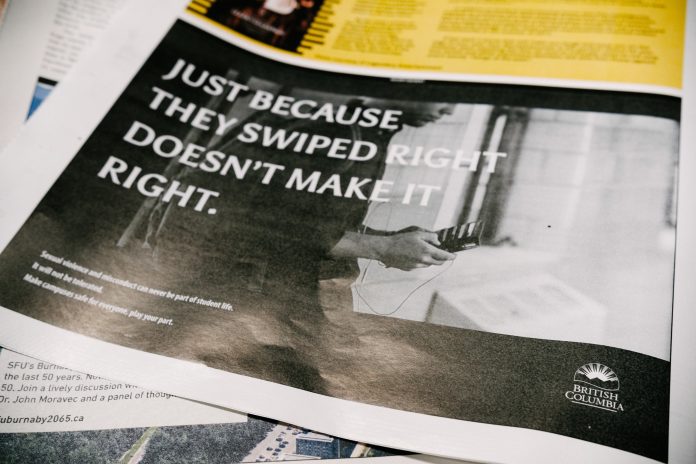
The campaign is based around poster dissemination and raising awareness on social media. (Chris Ho/The Peak)


A new campaign launched by the provincial government aims to address sexual violence and misconduct in post-secondary institutions. The campaign is based largely on social media and via posters which focus on male students while highlighting the message that “sexual violence and misconduct can never be part of student life.”

According to statistics prepared by the government, one in every five women will face sexual violence while attending a post-secondary institution. The new campaign includes all 25 universities and colleges in the province.

“Student life should never include any type of sexualized violence or misconduct,” said advance education minister Melanie Mark to Global News.

“We know that roughly two-thirds of sexual assaults on campus occur during the first eight weeks of school.” – Melanie Mark, advance education minister

On Aug 17, SFU’s Sexual Violence Support and Prevention Office (SVSPO) was contacted by Mark announcing the launch of the campaign. The campaign will take effect between August 27 and October 22, covering the first eight weeks of the present school year.

The campaign will involve dissemination of information through posters in student newspapers (including The Peak), around public spaces in campus, and in local bars. Social media channels like Facebook and Instagram are being used as promotional platforms as well.

CJ Rowe, director of SFU SVSPO, told The Peak that, as of September 11, they are still awaiting more material on the campaign from the provincial government. Once they receive the information required, the SVSPO will integrate elements of the campaign with their own support and services and publicize across all three SFU campuses. Additionally, the SVSPO will also begin its own “consent matters” campaign at the end of September, which will complement the government initiative.

Rowe mentioned to The Peak that they appreciated the new campaign efforts of the provincial government as one part of a larger frame of work that is required to tackle the issue. However, Rowe also stated, “When I look at the campaign it appears very student-focussed. But in reality sexual violence impacts us all.

“So my question to the government would be, is the campaign to remain solely student-focussed, or will it in the future recognize the reality of sexual violence on campuses, that is that it impacts all members of the campuses who live, work and study here?”

Information from the campaign has already appeared in The Peak in its September 4 issue.

Currently all universities and colleges in B.C. are legally required to put up policies on sexual assault.

The B.C. government has reportedly changed its policy on campus-based sexualized violence, and has dedicated five years funding of $5.5 million to tackle the issue. The provincial government aims to strengthen the backing for sexual assault crisis centres in post-secondary institutes and lead to a policy framework for the whole country based around the issue.

In a statement on sexual violence prevention and response policies, published in December, Mark had emphasized that “safety and security on post-secondary campuses is an important issue. We cannot be bystanders. Any form of sexual violence or misconduct simply will not be tolerated.”


With files from Global News.

Sports clubs spotted at clubs day

0
A minimalistic illustration. A few lines and colours are draped from the top of the image, reminiscent of ropes of flags. The center of the photo reads: “Simon Fraser Student Society” and “Clubs Days”
What better way to find people with similar interests to you? Illustration courtesy of the SFSS

SFU Cricket Club

SFU Cricket Club is a non-professional team sports interest club under the SFSS. They have four main objectives:

  1. Learning. Cricket isn’t a popular sport in North America, and the club focuses on allowing people to learn more about the game.
  2. Discussion. Cricket enthusiasts come together to discuss teams, players, and matches around the world.
  3. Watching games together. The club has events with livestreaming of cricket games and free food.
  4. Play. Club members come together to play cricket together. They aren’t allowed to support hardcore play, so they play with a soft ball instead of a leather ball.

Essentially, the club is a means for socialization, and they center cricket as an integral part of that.

SFSS Club Link: https://go.sfss.ca/clubs/789/info

Facebook: https://www.facebook.com/sfucricket/

Contact: [email protected]

SFU Badminton

A badminton team for all levels of expertise. They compete against other schools, but it’s a friendly environment, and anyone is welcome to join.

SFU Link: http://www.sfu.ca/students/recreation/active/sports/clubs/clubs/badminton.html

Facebook: https://www.facebook.com/sfuBadmintonclub/
Contact: b[email protected]

SFU Hip Hop

SFU HipHop club aims to educate its members about HipHop dance culture and everything that comes with it, from breakdancing to house. It offers students a way to meet new people with a love for the genre, and have fun while learning new skills.

SFSS Link: https://go.sfss.ca/clubs/286/info

Facebook: http://www.facebook.com/sfuhiphop/

Contact: [email protected]

SFU Ping Pong

SFU Ping Pong is an SFSS club that has events at different venues in Metro Vancouver, including the Greater Vancouver Tennis Association. They welcome people with different skill capacities, and they’re happy for more members to join the club.

SFSS Link: https://go.sfss.ca/clubs/502/info

Facebook: http://www.facebook.com/groups/pingpongsocialSFU/

Contact: [email protected]

SFU Field Hockey

SFU Field Hockey is a women’s team that plays in the Greater Vancouver Women’s League in Division 2. They have also partnered with Burnaby Bears, a club that has youth program with whom they volunteer, and a women’s team with whom they practice.

SFU Link: https://www.sfu.ca/students/recreation/active/sports/clubs/clubs/fieldhockey.html

Contact: [email protected]

SFU Quidditch

Quidditch is a growing collegiate sport, and one that allows students to make new friends while competing. We will be running an in depth story on them this week.

SFU Link: http://www.sfu.ca/students/recreation/active/sports/clubs/clubs/quidditch.html

Club website: http://quidditchsfu.wixsite.com/marauders

Contact: [email protected]

SFU Athletics Dance Team

SFU Athletics Dance Team is a team that trains in street jazz, contemporary, and other genres of dance. They perform at games at SFU (four times a game). While dance experience on the team varies, they’re looking for dancers willing to commit and learn. A new program they’ve started is the Training Team, an option for members who want a more relaxed dance opportunity. Auditions for the competitive team are once a year, but anyone is able to join the training team for a fee of $20.

SFU Link: http://www.sfu.ca/students/recreation/active/sports/clubs/clubs/dance.html

Facebook: https://www.facebook.com/sfuathleticsdanceteam/

Bonus Clubs:

SFU Board Game Club

A friendly, casual board game club that specializes in lighter social games and promotes companionship. SFU Board Game Club is here to have fun and make friends.

SFSS Club Link: http://sfssgo.net/clubs/75/info

Contact: [email protected]

SFU Altered Reality

Club members meet up, play board games, and run Dungeons and Dragons campaigns. They have meetings Tuesdays and Thursdays in the Rotunda, which run all day. People drop in and out all day long, play some board games, and have fun.

SFSS Club Link: https://go.sfss.ca/clubs/56/info

Facebook: https://www.facebook.com/groups/39506421514/

Twitter: https://twitter.com/sfuarc

Contact: [email protected]

Comedic Poetry: When I Have Fears that I May Cease to Drink

0
Illustrated by Cora Fu

It’s a long way home from here. But I tread

o’er the widesalk, arm linked with a stranger’s

and a light, bubbly air about the head.

I’m a little slort of sheep, but danger

disappears and up like a listless dream.

Metal bracelets chime; a voice like a bell,

but my mind drifts; I know not what it means.

I’m under a lovely blue and red spell.

What’s this? Do I know my rights? I’m confused

since I’ve studied law for seven years,

then I think I puke on the stranger’s shoes,

and his stern, mustachioed face appears.

          Then, we drive in quiet to the precinct,

          ‘till drink and shame to nothingness do sink.

What If: Office hours suddenly disappeared

0
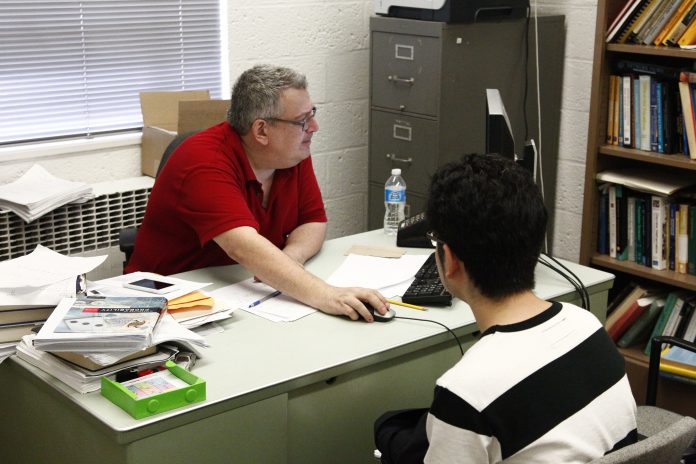
Photo by Leon Sankathumar / The John Hopkins News-Letter

Right out the gate, this would clear up a bunch of time out of our semester. We would no longer need to spend a large chunk of the first lecture specifying times and places for something that relatively few people will go to (to the point that many lecturers and TAs joke about the lack of people who come to see them).

For the students who need them though, it would become their responsibility to organize appointments. But as the main users of office hours are students in need of extra attention, or top students trying to improve further, this slight additional effort is probably reasonable.

That shift aside, the sudden disappearance of office hours likely would have different effects on professors than on TAs. The profs’ lives would be very pleasantly simplifed. Few students use office hours, and the utility the timeslot can provide is limited as it is. Most often, an email is enough for little questions, and larger questions can be asked during, after, and before their lecture.

TAs’ jobs might become significantly more difficult, though. Rather than having consistent schedules, they would be need to spread themselves out through the entire week regardless of how many students need to see them. If very few do, they still need to be on-call for all of this dead space. If students constantly need attention, they may be doing office hours every day of the week.

The sudden disappearance of office hours would certainly make things easier in a lot of respects, but not all parties would likely benefit. This fantasy is likely just more difficult and less effective than what we have now.

Funding uncertain for SFU’s Academic Summer Camp for Aboriginal Students

0
Earlier this summer, it was announced that the summer camp would be discontinued due to lack of funding. (Israrul Haque/The Peak)


Updated September 21, 2018: Dr. Veselin Jungic has reached out to The Peak to indicate that the paraphrase at the end of this article which indicated that “he is convinced the camp’s future on this campus will be secured” was inaccurate. The article has been edited to reflect his quote more accurately.  


After running for five consecutive years, concerns regarding the potential discontinuation of SFU’s Academic Summer Camp for Aboriginal Students were raised due to uncertain funding.

The camp has been held annually on the SFU Burnaby campus after being co-founded by the Pacific Institute for Mathematical Sciences (PIMS) and Dr. Veselin Jungic.

At the time that the SFU camp was founded, PIMS was running a similar initiative at UBC. The UBC camp was discontinued following the summer of 2014.

The SFU camp provides advanced mathematics and English support to Indigenous students in grades nine through 11. It is estimated that the camp has had over 125 participants, and according to Jungic in an email interview, “over the five years all students that were accepted to the camp also completed the program.”

“In general, I am very proud with what we have achieved with the camp over the last five years,” wrote Jungic. “For certain we have touched many lives in positive ways [. . .] I believe that by hosting such a camp, Simon Fraser University strengthened its relationship with the Indigenous community.”

Earlier this summer, Jungic announced that the camp would no longer continue in subsequent years due to lack of funding.

Jungic had originally received funding support for the camp from a PromoScience grant from the National Sciences and Engineering Research Council (NSERC) which would help fund the camp from 2014–17. Additional funding and support for the initiative was provided by the SFU Office for Aboriginal Peoples, SFU Faculty of Science, SFU Department of Mathematics, PIMS, and the IRMACs Centre.  

The camp was hosted in SFU’s IRMACs Centre, which has since been shut down. The Peak reached out to Felix Breden, former executive director of the centre,  regarding the situation surrounding the centre’s closure, but did not receive a response by the publication date of this article.

Jungic also identified that key support and funding from SFU’s Office for Aboriginal Peoples was missing.

In an interview with The Peak, Ron Johnston, pro-tem director for the Office for Aboriginal Peoples at SFU, stated that the Office for Aboriginal Peoples did not have a dedicated budget line to fund the camp. In previous years, funding from the office was provided from resources that were left over at year-end in the form of “soft” funding.

“I think that’s probably one of the big challenges with the Aboriginal programs in general is there’s often soft funding and there’s not core funding provided through it.” – Ron Johnston,  pro-tem direction for Office for Aboriginal Peoples

Johnston referred to the Walk With Us Report, written by SFU’s Aboriginal Reconciliation Council (ARC): “One of the things that the ARC has recognized is that soft funding isn’t sustainable funding. This is an example of where something was being soft funded.”  

Principle three in the report’s calls to actions states that “SFU needs to find ways to establish core funding for programs or services that have been funded using ‘soft’ or discretionary funds.”

Johnston maintained that the office may have funding remaining at the end of the fiscal year that could be contributed to the continuation of the camp, but that the office was unable to commit to that contribution at the moment.

When The Peak reached out for comment from SFU’s vice-president academic Peter Keller regarding the camp’s discontinuation, Keller stated that he was not aware that the camp was being discontinued.

“Over the years, it’s always been the challenge of somehow clobbering together enough money to run [the camp],” said Keller. “I know that, once again, we are looking for ways to clobber the money together [. . .] I’m working with the community to see how we can continue to fund it.”

“As far as I’m concerned, no decision has been made,” commented Keller.

The Peak reached out to Mary-Catherine Kropinski, chair of SFU’s Department of Mathematics, for comment on the summer camp’s closure. Kropinski indicated that the announcement of the camp’s closing was premature.

“I’m hopeful that something can be arranged to ensure the camp’s continuation,” she wrote.

Jungic has since changed his official comment on the situation of the camp’s discontinuation, stating that he is “convinced that Drs. Keller and Kropinski will do everything what is in their power to secure the continuation of the camp.”


SFU Pipe Band’s Tori Killoran is here to change your perspective on the bagpipes

1
Photo courtesy of Tori Killoran

Fast Facts
Name: Tori Killoran
Pronouns: She/Her/Hers
Department Affiliation: Criminology (fifth-year student)
Hometown: Pitt Meadows, B.C.
Hobbies: Playing the bagpipes, highland dancing, and going for bike rides
Fun Fact: She started dancing when she was two years old, so she’s been dancing for almost 20 years of her life.

This August, the SFU Pipe Band joined 8,000 other pipers and drummers in Glasgow, Scotland to perform at the World Pipe Band Championships. The band has now triumphed as world champions seven times since their official conception in 1981, finishing fifth this year and thereby maintaining last year’s position.

This is all very impressive, but how much of this did we actually know already? Did we know that SFU had a pipe band? Are we wondering why SFU is host to a pipe band when we’re over 6,000 kilometres away from Scotland?

Before we think too much of the band itself, we must remember our connection to Scotland. Simon Fraser, our university’s namesake, was born to Scottish immigrants in New York, 1776. Because of this, our university has adopted a Centre for Scottish Studies, the Clan name for its athletic groups, and, as we now know, a pipe band. While the band had a humble beginning, simply as a way for our school to have more character, it has now grown into a worldwide entity.

To put this entity into perspective, we sat down with pipe band member Tori Killoran, a fifth-year criminology student at SFU with a flair for bagpipes and highland dancing.

Before she entered the world of piping, Killoran began highland dancing, a solo Scottish dance. She describes highland dancing as “more of [an] athletic type rather than a balletic type of dancing” that involves a lot of jumping and complicated footwork. She explains that after she began highland dancing, the accompanying music of bagpipes really caught her attention and she was inspired to learn to play.

From there, Killoran joined the Kamloops Pipe Band and then moved into the youth pipe band at SFU, known as the Robert Malcolm Memorial Pipe Band. “From there, the SFU Pipe Band is kind of the final step,” Killoran says.

“I was really quite amused and astounded at everything the Pipe Band was doing. I just really loved their music and I thought, ‘That’s the band I want to play with’ because they sounded so good and I wanted to be part of it.”

I ask her if it’s a bit surreal to have a top-tier pipe band in Burnaby. “Yeah, there’s a lot of people who really are actually surprised that there’s a big Scottish culture in the Vancouver area because we are so far away from Scotland,” she said. “It’s cool to be so far away yet so connected.”

Despite the distance, this year SFU’s band once again made it to the championships, and Killoran explains that “the world championships were huge, again, just like every year.” 13 nations were represented by the 214 bands in attendance, and over two days, 30,000 attendees watched pipers from New Zealand to Zimbabwe perform. The event was also live-streamed, so anyone who couldn’t make it to Glasgow could still tune in.

But Killoran proves the most memorable moments happen within the SFU Pipe Band itself. “There was this one concert that we did in 2015 and it was a fundraiser [. . .] At the time, one of the members of the pipe band had just been diagnosed with cancer. Unfortunately, he has now passed away.”

As part of the fundraiser, members of the band shaved their heads. “In particular, there was this one guy who had a pretty big beard, and a lot of people liked it. So he raised, just by shaving off his beard, an extra $100 . . .”

Now having all this information with me, I can ask Killoran my burning question: how do the bagpipes even work?

From the blow pipe, air is filled into the bag. When the bag is squeezed enough, then sound comes through the “chanter,” which is where the piper makes the tune by covering different holes. The “drones” are three pipe-like things near the top of the bagpipes, which is for the “background music,” according to Killoran.

“It’s not that the instrument itself gets easier, but you get stronger as a player,” she explains.

Despite the glory the band receives and the instrument’s complexity, the bagpipes still get tons of flack. I ask Killoran what she thinks when people say they “hate the bagpipes.”

“They probably haven’t heard a really good bagpiper to be honest,” she says. “It isn’t really a nice instrument if the person is squeaking a lot [ . . . ] Once you become confident with the pipes and you can play tunes well, they’re quite a nice instrument.”

“Hearing a good bagpiper or a good pipe band can really change someone’s perspective of bagpipes.”

From that, I hope many at convocation are inspired by the mix of youth and older pipers from the SFU band who play there. You might assume the competitive nature of the pipe band would make them intimidating, but Killoran assures me that the piper community is tight-knit enough that new and seasoned players are happy to mingle and support each other, especially at events like convocation.

Of course, getting to that professional level takes a lot of work. “[Piping] is kind of a mix between [a] hobby and a job for several reasons,” Killoran explains. “It’s a hobby because it’s something that we all really enjoy doing [. . .] but also a job because it takes up a lot of time for us. [. . .] I guess another way to look at it is as an ‘intense hobby.’”

Killoran also comments that while balancing school and the pipes can be challenging, she finds that piping and dancing act as a sort of “brain break” from studying.

In her first year, Killoran moved from Kamloops to Vancouver in order to start her studies at SFU and try out for the SFU Pipe Band. For most of us, first year was daunting enough, but Killoran explains she had “to learn all of this music because the [band] had a concert in Glasgow that year.”

“There was all of the competition stuff [and] it was just pages and pages and hours [of] repertoire that I was to memorize for the year if I wanted to be in the band the next year.”

However, Killoran found that it wasn’t all stress. “It was really tough to balance it all, but I found that learning the tunes actually kind of increased my productivity of studying because it was like a break, but, again, not actually a break. [. . .] That following September, I was invited to actually be a full member.”

Nearing the end of our conversation, I ask Killoran if she has any general advice for someone who’s interested in learning the bagpipes or even highland dancing.

“I’d say honestly just go for it. Find an instructor or contact the SFU Pipe Band or the [Robert Malcolm Memorial] Pipe Band just to get yourself started,” she says. “It can be as competitive as you want or you can just do it recreationally, both dancing and [piping] as long as you just get started.

“I’m a little bit biased because I love both of the things that I do, but it’s just such a great community to be a part of, really small, close-knit. [. . .] I would say just go for it, don’t let anything stop you. [. . .] You’re never too old to get started.”

For those of you who still believe SFU is community-less, the pipe band is yet another family that you can find on campus and become a part of. The youth pipe band (ages 6 to 18) starts up again on September 15, and any inquiries about joining any of the SFU pipe bands can be sent to [email protected].

SFU Rugby lose season opener 34–7 to Surrey

0
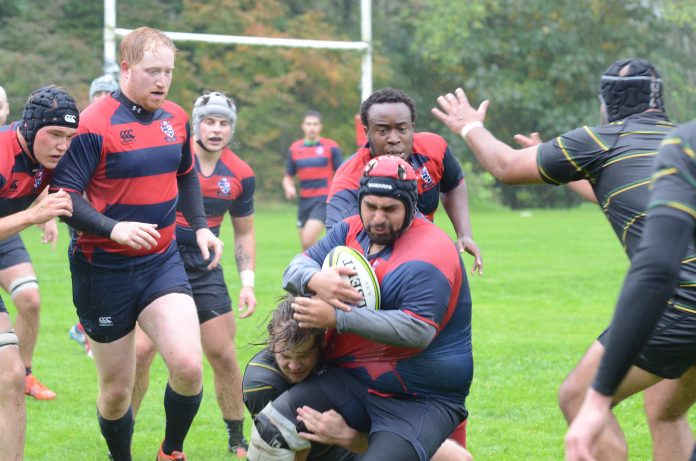
As stated by head coach Conan Cooper, this is a good platform for SFU Rugby's season. (Kelsey Nikl / The Peak)

On Saturday, September 15, the SFU Rugby team opened their season with a home game against Surrey. The team played a tight game, but a few mistakes made the difference in what would end up being a 27-point loss. The score, however, is not representative of how the game was played.

This is what head coach Conan Cooper had to say on the topic in a post game interview with The Peak:

“Early in the season a little bit of indecision and just making the wrong call at the wrong time because [there’s] a group of new guys back together again. We made three or four decisions that gave them the ball. One of them they ran back in and three of them they kicked penalties off,” before adding, “For sure that score did not match the play, the play was very even.”

Penalties certainly hurt the team, and Surrey was able to capitalize. In early season play, however, this can be expected as the team is still not in the full swing of things. As the season continues on, expect to see the amount of mistakes, and their severity, decrease.   

“We’ve had a lot of good practices, it’s been focused a lot on fitness and just getting new guys in. So what I’m seeing now already is some of our attack phases that we haven’t even practiced [are being brought back from last season] and there’s a better gel than I saw at the start of last season,” said Cooper.

While starting out the season with a loss is rarely a positive thing, it sets a base for the team to work on heading forward.

“This is actually a very good platform for us, because the new guys have now been let in and they’ve seen the system live. It’s one thing to practice it but to actually play it out with these guys live – now there’s a bit of bonding that’s happened, a little more understanding of how our structure goes as we play.”

The lone try of the game for SFU Rugby was scored by Matt Herbert.

Peak player of the game: Tachara “Magic” Makanza

It’s only right to give the player of the game to Magic, who returned to the rugby field after spending over two years out battling injuries. He seems sure to be a force on the field for the team all season. This is what he had to say on his return, via message:

“It had been over two years since my last ‘dance,’ and I was beginning to lose the feeling [of playing], so one can imagine how anxious and apprehensive I felt when I had finally gotten the opportunity to dance again amid my recovery from torn ligaments. Thankfully, fueled by passion and trust in my new family [with the Clan], within the first 10 seconds of play all [negative] thoughts fled my conscience and freed me from constraint. I’m more than happy to say it felt like home. Excited for the future.”  

Board Shorts

0
Irene Lo / The Peak


Board increases budget for website redevelopment

In the latest Simon Fraser Student Society (SFSS) board of directors meeting, the board passed a motion to increase the Web Site and Tech Support budget by $9,000. The funds for this budget increase were obtained from the unrestricted operating surplus.

The board also approved $7,500 plus tax to appoint Ballistic Arts Media Studio Inc. as the vendor for the website redevelopment.

The motion was carried, with the abstention of applied sciences representative Kia Mirsalehi.


Board recaps meeting with Beech’s office in response to SOCA complaint

Vice-president external relations Jasdeep Gill provided the context of the meeting, which was prompted by an email the board had received from Burnaby North MP Terry Beech’s office. The email was sent in regards to a complaint sent by the SFU Students of Caribbean and African Ancestry (SOCA) to Ahmed Hussen, the Minister of Immigration, Refugees, and Citizenship of Canada.

Gill summarized that board representatives had an “informational meeting” with Beech in which the shared-space model being proposed for the Student Union Building (SUB) was discussed.

“The meeting was great, and then they did understand where the SFSS was coming from as the shared space model,” said Gill.

She stated that the board has since received an email from Beech’s office stating that the Department of Immigration had been forwarded the details of the meeting, and that “there’s no further action that they’re taking at this moment.

“As of now, they’re not requesting anything of the society, and the initial correspondence has been sent back,” said Gill.

SOCA president Giovanni Hosang stated that SOCA “also reached out.”

“We will be hearing additional information from the Department of Immigration as well,” he said.


Board holds discussion regarding SUB space with representatives from rotunda groups

Representatives from the organizations currently operating within the rotunda were invited to the board meeting to discuss SUB space. Further details regarding this discussion from The Peak will follow.


Board forms sexual violence and prevention working group

Gill began this discussion by stating that the SFSS is not currently covered under GP 44, SFU’s Sexual Violence and Misconduct Prevention, Education and Support policy.

“The recent events have [ . . . ] made this policy an absolute priority this year,” said Gill. She stated that the SFSS was looking to collaborate with the Women’s Centre, Out on Campus, and SFU’s Sexual Violence and Prevention Office to develop the policy.

“I’d also love the board’s support on this so future incidents of sexual harassment that do take place in the board can be handled at light speed,” she said.


Board approves motion to submit collective letter for AGM report

Gill brought this motion forward. She stated that, as president Jas Randhawa had missed the September 5 deadline to submit a president’s letter for the Annual General Meeting (AGM) package, the board had drafted a collective letter to be added to the report.

“I just assumed that it would be better to have the message come collectively since I wasn’t able to get my agenda items onto the AGM,” commented Randhawa in response.

The motion was carried with the abstention of Randhawa.


Board approves posting of impeachment press release document on official SFSS channels

Rihani commented that the document had already been distributed via the board members’ personal social media channels. He stated that the purpose of posting the impeachment press release on the SFSS’s website was to “show people that this is the general voice of the board that’s been decided on together.”

Randhawa commented that he wanted to motion to add his own document drafted in response to the impeachment press release onto the SFSS website as well to “share my perspective on the channels.”

Rihani responded that the board could not address Randhawa’s motion in the current board meeting as it had not been officially added to the meeting’s agenda.

The motion was carried with the absention of Randhawa.


Board decreases budget for SCC Barbecue Social event

The budget, which was approved to be up to $2,100 in the previous Board of Directors meeting, was decreased to $1,100.

Gill explained that the board had approved the previous amount in the case that the Mechatronics Systems Engineering Student Society (MSESS) was unable to get a grant approved for the event. As the MSESS was successful in obtaining the grant, the SFSS could reduce their investment in the event.

The motion was carried.

Eighth Grade is a brutal yet loving confrontation on adolescent misery

0
Photo courtesy of A24

This review contains no spoilers!

It’s perhaps the biggest cliché to say grade eight sucks. But unlike so few works of art, Bo Burnham’s breakout film not only chooses to not only deconstruct its unique pain, but also dares to make others experience it all over again.

      Eighth Grade follows 13-year-old Kayla Day as she maneuvers her last week in junior high,  dealing with anxiety, insecurity, and an intense desperation to belong. What results is a generous dose of skin-crawling second-hand embarrassment scene after scene as the film forces the audience to relive the most awkward, feverishly-repressed memories puberty entails. My commitment to avoiding spoilers withholds me from describing such events in the story, but you have my word: they are agonizing.

     As a devout critic of cringe humour, I am amazed by how Burnham uses it in this film. Cringe humour is often used to create a two-dimensional punchline to elicit an easy laugh, but here, the cringe is not cynical or cheap, but empathetic and raw. By making Kayla such a well-rounded character, the embarrassment we experience with her becomes an extension of our own adolescent identity: our skin crawls not because we despise her, but because we are her. Unlike cringing at Michael Scott’s idiocy, we shy away from her actions out of an intense connection to what she feels. The choice to provoke discomfort is the basis of the film’s emotional core: it is brutal and uncompromising, yet compassionate and kind. This achievement lies with the movie’s heart and soul, actress Elsie Fisher. Fisher beautifully portrays a girl exhausted with her world, but who remains unwaveringly kind. While the intimate relationship the audience builds with Kayla makes it painful to see her experience her turmoil with school, it also makes Kayla experiencing her joys an even more rewarding experience to watch.

     Social media is an inevitable aspect of any modern portrayal of eighth grade. As Kayla diligently scrolls through today’s various media platforms, trying to break out of her shell on her own terms, it brings up a really interesting dynamic between performing online and anxiety. More specifically, the double consciousness most teens bear through heavy social media use: are these platforms a tool, or a detriment for shy teens? Eighth Grade understands that kids can be desperate to express themselves even though they have no idea who their own “self” may be — and portraying this inherent contradiction in social media with such nuance, and such care, helps make Eighth Grade’s script so effective.

     For fans of Burnham’s work, it’s a remarkable thing to watch him extend his trademark self-awareness past his own consciousness, and apply it to this remarkable protagonist. Despite the film’s aforementioned challenges to to the human condition — or perhaps because of it — Eighth Grade is a hilarious delight. The film is a soul-healing gem among the barrage of summer blockbusters. It encourages you to feel, to empathize, and forgive your 13-year-old self for trying so desperately to be a human being.


The Americans of SFU want political engagement to surpass geography

0
Image courtesy of New America Media

3 to 6 million American citizens are living outside of the United States, for a variety of reasons. And as it turns out, Metro Vancouver appears to be a hotspot for American expats living in Canada. Among them: 183,155 eligible U.S. voters as of 2016, which is more than the population of Abbotsford to give you an idea. It is the largest number of any major city outside the United States.

A group of them at SFU have nicknamed themselves “Americans of SFU,” and are committed to “getting out the vote” despite the distance.

If you were wandering around Convocation Mall on Thursday, September 6, you might have missed their stand in the midst of fire pits and enormous lines for free food, but they were there. Their table was decorated with a red tablecloth and two American flags, and covered with information packets, business cards outlining the process to get registered, and even registration packs.

“I always felt that with what’s going on with politics in the states right now, it’s really important to be engaged sort of in the democratic process,” said James Smith, a dual citizen and staff member at SFU who took a vacation day to man the booth. “Basically I just started to reach out to anybody I could on campus that [ . . . ] was an American citizen and to see if we could get something going in terms of voter registration or anything like that,”

Smith made connections with like-minded grad students and faculty members. They also checked in to see if an undergraduate club had been formed by SFU undergraduates, in the same way that the Chinese Students Association or the Students of Caribbean and African Ancestry are active on campus, but found nothing. Right now, their core group is only four or five members, but the club is only a few months old. They’re hoping to expand their activities through social media and actual acts of presence on campus, such as their Week of Welcome stand.

For the Week of Welcome, their main goal was to register voters abroad for voting in the midterm elections.  

“[Midterm elections] happen every two years, and every two years every member of the lower house of Congress, the House of Representatives, is up for election. And a senate term is six years long, so about every two years about a third of senators are up for election,” Smith noted for Canadian students who may not be used to the United States’ multi-election system.

“That’s the entire sort of legislative branch of the American government that is basically there to hold the other branch accountable,” he said. “It’s very important to be engaged, especially in the current political climate, to be involved in all federal elections whether it’s a presidential election or not.”

The vice-consul of the United States Consulate in Vancouver, Weldon Montgommery, was also present at the event. The U.S. Consulate is a resource to support American citizens in the city, regardless of whether they find themselves in Vancouver for work, travel, or schooling. Assistance with passports, registering to vote, keeping tabs on where American citizens are in case of a natural disaster or emergency abroad — all these sorts of things are covered by the Consulate and other branches around the world.

While not everyone has to worry about knowing where the nearest consulate is on a day-to-day basis, according to SFU, around 20% of the university’s undergraduate population are international students. In fall 2017, 28.3% of graduate students were international students and 27% of them had earned their bachelor’s degree outside of Canada. While it’s not clear how many of these students are American, according to the University’s headcount, the percentage of international students is growing.

For the Americans of SFU, getting in touch with the student body is crucial since they represent the largest segment of the SFU community. Furthermore, the 18–29 year old demographic (AKA the age of most students) is also notorious for low voter turnout. In the last presidential election in 2016, only about half of 18–29 year old Americans eligible to vote actually cast a ballot. And the problem isn’t just American: in 2015, 57% of Canadian 18-24 voters voted, which was in itself a huge leap from 2011.

“If you’re an American citizen you can vote from anywhere,” Smith noted. “But it can feel sometimes like just voting isn’t enough engagement with the democratic process in the States.”

Smith also mentions that students should feel welcome and comfortable to reach out to other organizations, since American expats are far from being alone in Vancouver. As an example, Smithx offers the Vancouver chapter of Democrats Abroad.

“Even if you are not in the States you can volunteer to do things like phone banking, or candidates within the States are doing texting campaigns and that kind of thing. You can donate to campaigns in the States if you’re a U.S. Citizen . . . ”

Bottom line: there’s a lot of different ways to get involved, and Americans of SFU are also getting their hands dirty and digging into other sides of the issue. Another member of the small group, Dr Melek Ortabasi, noted in an email to The Peak that: “We’ll also be organizing some phone banking parties in the coming weeks. We’ll be calling in support of Democrats Abroad, or your candidate/campaign of choice. Anyone can do it!”

To make the time fly even more quickly, the Americans of SFU will be booking rooms on the Burnaby campus in the evenings to call together. Ortabasi also provided the link to a Doodle, to which she encourages volunteers to sign up.

“If you haven’t phone banked before, it’s easy,” said Dr Ortabasi in an email statement. “We’ll be using the CallHub software platform, which basically supplies you with ready-made scripts and makes all the calls for you, for free! All you need to bring is a laptop, some earphones/buds, and a positive attitude (well, OK, some snacks would be good too).”

While this event is definitely more partisan, Ortabasi is clear that the Americans of SFU are not necessarily a partisan organization as a whole. Smith also emphasizes this facet of their group.

“The reason that we discussed this initiative to be non-partisan and to be able to get the support of, for example, the consulate here in Vancouver . . . to get the support of the university as well,” Smith says. It’s a question of putting political engagement at any level over partisan engagement at any level.

Eager to see Americans of SFU grow, Smith mentions that students can reach out to him at [email protected] should they want to get involved. A lot of the voter registration onlines are only in October, according to Smith, so there is still plenty of time to get involved.

“If American citizens in Vancouver or in British Columbia want more information about voting overseas, they can email the consulate at [email protected],” Montgommery tells us as well.

For Canadian students who need only turn up at a local elementary school or library to vote, looking at the lengths to which expats can go to stay in touch with politics back home can also be thought-provoking. The Americans of SFU offer some interesting food for thought as Canada gears up for its next federal election in 2019, and Burnaby South prepares for a by-election even sooner.