Home Blog Page 554

Competition gives undergraduates opportunity to present research to the SFU community

0
(Nathaniel Tok / The Peak)

rWritten by: Nathaniel Tok, Peak Associate


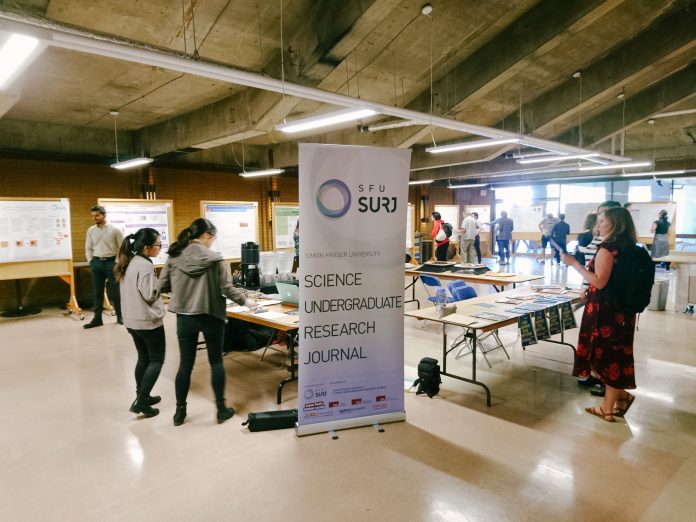
Undergraduate students presented their original research findings to colleagues, graduate students, faculty members, and other members of the SFU community during the second annual poster competition of the SFU Science Undergraduate Research Journal (SURJ). Around 21 groups set up posters describing their research in the James Douglas Safe Study Area for the event.

SFU SURJ is a publication run by undergraduate students, and it is currently in its third volume. It aims to give other undergraduates the chance to undergo peer review with experts and professors and publish their research. SFU SURJ’s online blog also provides opportunities for students to publish more informal opinion pieces.

This year, their poster competition had entries from all over SFU. Students from the biological sciences, molecular biology and biochemistry (MBB), statistics, chemistry, physics, and health sciences departments competed.

Competitors set up their posters in the James Douglas Safe Study Area and were judged by a panel of graduate students and faculty members who walked around looking at the poster layouts. The judges listened to the students’ presentations and asked questions to establish how much the presenter knew about their topic.

Olivia Tsai, a fourth-year MBB student and one of SURJ’s senior editors, hailed this year’s poster competition as a success.

“The location had a lot of traffic,” said Tsai, who was one of the event’s organizers. “We saw a lot of students come [ . . . ] the presenters had a good time showcasing their research.”

Tsai thought the contest helped the students “reflect on their work,” work on their presentation skills, and see the wide variety of undergraduate research going on in SFU.

Participants echoed Tsai’s assessment. Dasha Iskakova, a fourth-year MBB student, noted that “it was really interesting seeing everyone’s else research.” Iskakova found the competition to be a good source of experience in presenting research in a formal setting.

Cassandra Mah and Tess Marusyk, health sciences students, presented on the effects of opening a new greenway in Vancouver. They added that beyond the experience, it was satisfying to show their research to people whom it would affect.

Nicole Whittle, a second-year kinesiology student, found that her research and presentation was in line with her goal of becoming an occupational therapist. Although she found the research process difficult at times, she noted that it was also rewarding. Whittle hopes that her work helps her lab’s next undergraduate researcher plan clinical trials.

Kristen Bystrom and Zhi Yuh Ou Yang, statistics majors who presented on using classification models to study weather data, also enjoyed the process. The two remarked that “we did this research for fun and we wanted to showcase it.”

“It gave us a great opportunity to work with real data [ . . . ] to use the math and statistics we learned in school in an applied sense.” – Kristen Bystrom and Zhi Yuh Ou Yang, SURJ poster competition participants 

“It gave us a great opportunity to work with real data [ . . . ] to use the math and statistics we learned in school in an applied sense,” they noted.

Tsai encouraged students from various disciplines, such as psychology, mathematics, the physical sciences, life sciences, computing science, engineering, and others to publish their work with the SURJ and to participate in future poster competitions.

Tsai hopes that the poster competitions continue, but she acknowledges that it could be hard to recruit judges, as graduate students and faculty members are often busy with their own projects. She also looks forward to doing more to increase SURJ’s outreach to SFU students. Tsai is presently looking to continue recruiting students who are interested in research and in connecting with experts across Canada to become editors for the journal.

 

Seth Rogen’s deleted transit announcements

0
Illustrated by Marissa Ouyang

Unless you’re one of those people that drives to school every day (yes, I said those people) you’ve probably heard one of Seth Rogen’s marginally humourous transit-etiquette announcements. Love them or hate them, you may be surprised that many more didn’t make the cut, some of which might have provided a somewhat different feel to the campaign.

“Hey Vancouver, it’s Seth. If a person asks you if the current train is for Production Way or King George, tell the truth. Let’s be honest, anyone who still hasn’t figured out the Expo Line at this point probably isn’t a great problem-solver, and will likely end up having to live at whatever station you send them to.”

“Hey Vancouver, it’s Seth. If you lose something in transit, don’t panic. Just talk to the nearest TransLink employee or call the TransLink help line. Unless you left weed on the Canada Line. In that case, I can assure you that I have it, and you will not be getting it back.”

“Hey Vancouver, it’s Seth. Make sure you’re aware that the last SkyTrains leave between 12:30 and 1:30 a.m. Why is that you ask? Because TransLink hates you and doesn’t want you to have any fun, that’s why.”

“Hey Vancouver, it’s Seth. Remember that some SkyTrains have extra seats at either end of the car that fold down. Not only does that mean you can give up your seat if it’s reserved for those who need it, but you can also look like a total badass to your friend from out of town.”

“Hey Vancouver, it’s Seth. Does anyone here remember that the SeaBus is a thing? Weird, eh?”

“Hey Vancouver, it’s Seth. This one’s for all you bus drivers out there. I know you guys do really great work, but my voice is annoying enough as it is; please kindly only play my message once. Trust me, your passengers will thank you for it.”

*sniffles* “Hey Vancouver, it’s Seth,” *sobs* “A reminder that even after cannabis is legal in Canada, it will be still be prohibited to smoke on transit property.” *bursts into tears*

“Hey Vancouver, it’s Seth. Above all the other advice I’ve given you, remember the golden rule of transit: if you’re sitting in a SkyTrain that has a “driver” seat, and there’s a kid anywhere near you, you give that kid your seat. Just because the world has stripped you of your childhood wonder doesn’t give you the right to do the same to others. Asshole.”

“[30 seconds of Seth Rogen laughing as you go through a tunnel]”

What grinds our gears: Bus bunching

0
Photo by Stephen Rees / Flickr

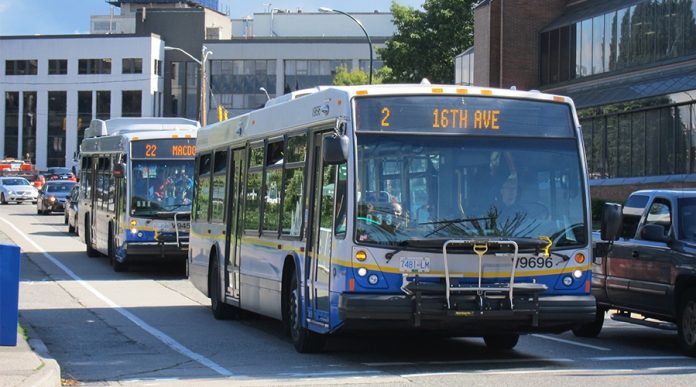
As university students, most of us spend a lot of time taking buses, and a lot of time waiting for them to arrive. Much  of the wait time can be attributed to bus bunching, which is when buses on the same route clump together in traffic. Many people may not have heard the term before, but most of us have experienced it through infrequent buses that are either early or late (I’m looking at you, 95 B-line).

Mathematically, some degree of bus bunching is unavoidable, especially during high traffic times. However, the level it has gotten to in Vancouver is ridiculous. After I have waited for 45 minutes for a bus, I’m already pretty pissed. Then all of a sudden, three show up at the same time. Between these three, the one that pulls up to the stop is packed full, forcing me to physically fight my way on just to make it home.

Meanwhile, the bus with a haven of leg room passes right by, trying to jump ahead towards what’s probably a less populated stop. I could always gamble on whether the vacuous bus is kind enough to let me in for once, but if a bus sees a crowd, the driver sometimes just thinks “eh, they’re probably fine” and it’s too often a losing bet.

All I want is a little more predictability in my trip home. Is that too much to ask?

Two SFU students injured during campus incident

1
(Anderson Wang / The Peak)


Note: Due to new information regarding the subject of this article coming to light, The Peak is currently looking deeper into the matter and will be posting an update to this story.

An incident involving a student in Robert C. Brown Hall left two other SFU students with minor injuries on Wednesday, October 3.

According to SFU Chief Safety Officer Mark Lalonde, SFU campus security arrived within three minutes, and the student was removed from campus by the RCMP.

SFU Campus Security did not disclose further information regarding the nature of the incident.

Lalonde noted that SFU Health and Counselling Services was notified and began providing support to all individuals involved in the incident the following morning.

“Other students in the class who were witness to the event are encouraged to reach out to Campus Security for support if they would like,” wrote Lalonde.


Justin Traviss is taking political science from the classroom to city hall

1
Photo courtesy of Justin Traviss

Name: Justin Traviss

Pronouns: He/him/his

Hometown: Port Coquitlam, B.C.

Major: Political science

Fun fact: He loves Dungeons and Dragons


Port Coquitlam is one of those Vancouver-adjacent cities you don’t think about much if you’re not from there. But it has its charm — just like its residents, particularly those of us who attend SFU.

As a PoCo-raised boy myself, it was a pleasure to chat with Justin Traviss, a fourth-year political science student aiming to be elected as one of Port Coquitlam’s six city councillors on October 20. Perched at a patio table at the Waves Coffee on Shaughnessy Street, we talked about his campaign, what it’s like to be running for a government job while still a student at SFU, and what motivated him to dive into the contention.

“I had no real idea how to get my foot in the door — how to get into politics,” Traviss says. “But after I did some research . . . it takes time and effort, but it’s time I’m very willing to put in. It’s been a very great time just these last few months; I’ve learned so much more than I would reading about it or anything like that.”

It’s Traviss’ first time dipping into a city election, and he’s running on a platform of bringing better transit and more reasonably priced housing to Port Coquitlam. He wants to preserve the diverse and amiable atmosphere of the town where he grew up. At the same time, he hopes to represent his up-and-coming generation of PoCo residents, as a candidate open to brand-new ideas and perspectives. Notably, Traviss is visibly the youngest candidate in the election, at only 23 years old.

“I’ve had a few detractors saying, ‘oh, this person doesn’t have any life experience,’” Traviss confides when I ask him about the issue of age. He hasn’t let it get to him though: “Life experience does have a part to play, but it’s not the whole picture. There’s other things in life. I want to be able to bring that fresh voice.”

Though you won’t find many people who’ve run in a municipal election while still in school, Traviss doesn’t believe himself to be particularly unique. He asserts that the key reason most people don’t involve themselves in city politics, Port Coquitlam or otherwise, is lack of information about what happens there. Who handles the water infrastructure? Who pays for new roads? These are the sorts of questions Traviss believes go unanswered for many, especially in our young-adult age demographic.

“A lot of people our age don’t understand how important the city is to their daily life,” says Traviss. “We’re getting into real estate, we’re getting into the market, we’re getting into the economy. Our city — we’re going to be interacting with that more so than the other two levels of government.”

Traviss notes that putting political theory into practice is something he’s been excited about, although that’s not just because of his background as a political science major. In fact, he admits that most of the political science course material is “bigger picture,” and that he only knows three or four political science professors at SFU who are experts in municipal politics. He sends up a shoutout to professors Patrick Smith and Aude-Claire Fourot.

Traviss admits, a little bashfully, that he’s not particularly involved in SFU’s campus life.

“It’s just . . . it seems so detached from your life,” he says of SFU’s student club scene and student politics. “It’s a little bit contained in a bubble. [ . . . ] You don’t see the fruits of your labour when you do things up there. That’s why I’m much more interested in doing things down on the ground.”

Regardless, Justin certainly seems to have the needs of students in mind as he campaigns in his city. I ask him what the biggest motivation is for SFU students from Port Coquitlam to come out and vote.

“If you are living in PoCo, it’s an affordable city; it’s still affordable. I want to keep it that way. You, as a student, probably want to keep it that way too,” Traviss tells me.

“Even if you’re living in your parent’s house [and] you’re not going to move out in [the next] five years, in five years, things can get more expensive. [ . . . ] We want to stem that as much as possible. We want to make sure you have a place to live.”

If Traviss were to be elected, he’d still be just one member of the council. With that in mind, we talk a little about the politics of the city council, and how much ability Traviss would have to bring his campaign visions to fruition. He explains that the council differs from some other levels of government in that there are no party politics: “Every vote is technically independent,” he explains.

“It’s more about your character. If you’re able to present yourself as a character that can actually get things done, other people are more likely to follow you. [ . . . ] If you have facts and stats to back up your points, you’re much more likely to get other councillors on board with your ideas.”

Traviss thinks it would be excellent to see more younger candidates campaign in elections and otherwise get involved in their cities. That said, there are plenty of opportunities to get involved in the community outside of election season, he emphasizes to me. He suggests looking for volunteer opportunities with the cities, or speaking to your local MP or MLA about ways to engage.

As we wrap up, he encourages SFU students — regardless of where they live — to keep an eye on their local politics, figure out who they align with, and go out and vote.

SFU partners with Fraser Health to open world-class medical imaging facility

0
(Nathaniel Tok / The Peak)


SFU and the Fraser Health Authority have partnered to open a brand-new medical imaging facility at the Surrey Memorial Hospital. The facility, named ImageTech, went public on September 18, and is hailed by a SFU media release to be the “first-of-its-kind in Western Canada.”

ImageTech combines many advanced imaging technologies, such as magnetic resonance imaging (MRI), magnetoencephalography (MEG), and various computing platforms.

This combination of equipment lets researchers use medical imaging to “watch the brain in action” in real time, looking at brain function and structure. These images grant insight that allows researchers to evaluate, diagnose, monitor, and improve treatments for brain-related disorders and conditions such as Down syndrome, dementia, and depression.

In an email interview with The Peak, Ryan D’Arcy, SFU engineering and computing science professor, Surrey Memorial Hospital Foundation BC Leadership Chair in Multimodal Technology for Healthcare Innovations, and one of the researchers in the lab, medical imaging enables “rapid, safe, powerful insights deep into our bodies’ structures and functions.”

“[Medical imaging] creates disruptive breakthroughs in medicine and science around the world, at dizzying rates.” – Ryan D’Arcy, ImageTech researcher and SFU engineering and computing science professor 

D’Arcy believes that access to an advanced medical imaging facility like ImageTech will augment SFU researchers’ capabilities.

“Few other breakthroughs have been more impactful to individual healthcare, more rapidly, than those in medical imaging,” wrote D’Arcy.

The idea of creating ImageTech first emerged in 2012 as a joint venture between the Fraser Health Authority and SFU to develop the Health and Technology District in Surrey, a hub of research and innovation striving to make advancements in health care outcomes and experiences. Funding came from a variety of sources such as Western Economic Diversification Canada, Canada Foundation for Innovation, the B.C. Knowledge Development Fund, Philips Canada CTF MEG, and others.

ImageTech itself stands within the Health and Technology District so as to make its advanced medical imaging capabilities available for SFU and Fraser Health Authority experts to use.

The facility is a multi-user regional healthcare asset. Scientists from SFU, BC Children’s Hospital, Fraser Health Neurology, and Fraser Health Radiology are currently active in the facility.

Navdeep Bains, minister of innovation, science and economic development in the House of Commons, and the minister responsible for Western Economic Diversification Canada, praised the ImageTech Lab as a milestone for Surrey and SFU. He noted that the facility created room for “partnerships between researchers, entrepreneurs, and healthcare professionals.”

SFU’s vice-president, research and international Joy Johnson echoed those statements, calling the lab “a testament to the power of collaboration and partnerships.”

The lab already has a multi-disciplinary team in place from various organizations apart from SFU and the Fraser Health Authority, such as UBC, the BC Children’s Hospital, the BC Cancer Agency, and more.

Beyond its research capabilities, the lab will also contribute to the healthcare needs of the region. In the SFU media release, Dr. Victoria Lee, vice-president, population health and chief medical health officer for Fraser Health, commented that the lab will help researchers better understand diseases and their impact on people’s lives. Lee commented that the research facilitated by ImageTech will help “influence the innovation and advancement of health care.”

SFU president Andrew Petter was quoted in the press release, summarizing ImageTech’s role in SFU as a force multiplier for the university’s health technology capabilities and a contributor to community health as SFU grows in its role as Canada’s engaged university.

The importance of the Indigenous Sport Gallery

0
The Indigenous Sport Gallery is open from 10 a.m - 5 p.m at BC Place. (The Peak / Youeal Abera)

Vancouver’s BC Place is currently hosting a monumental exhibit that celebrates and honours our province’s Indigenous athletes. As a part of the BC Sports Hall of Fame, the Indigenous Sport Gallery acknowledges the contributions of athletic excellence which B.C.’s Indigenous communities have brought to the world of sports. Exhibiting a wide array of sport leagues and organizations, ranging from hockey and basketball to canoe-racing and horseback riding, the Indigenous Sport Gallery highlights a demographic often disregarded in discourses surrounding sports.

As you first walk into the exhibit, you are instantly greeted with rich information on Indigenous cultures and how they’ve impacted sports. Not only does the exhibit display the impressive accomplishments of Indigenous athletes, but it also teaches about the vital sports leagues and organizations entrenched within our province’s Indigenous communities.

For instance, the gallery sheds light on the North American Indigenous Games (NAIG), which is an event that hosts thousands of North America’s Indigenous coaches and athletes for a multi-sport affair. The exhibit informs its attendees that Team BC, a team of over 500 Indigenous coaches and athletes from our province, has won more medals and taken first place more times than any other province or territory in the history of the NAIG.  

The hall of fame’s recent addition also articulates the significance of the Indigenous Sport, Physical Activity and Recreation Council (ISPARC). With the hope of maintaining healthy Indigenous communities in B.C., the ISPARC’s main goal is to increase the accessibility of recreational and athletic activities to all Indigenous individuals.

The Indigenous Sports Gallery also spotlights the amazing Indigenous athletes who have come from British Columbia. One section of the exhibit is dedicated to the legacy of Dawn Murphy, also known as Delta Dawn. Known for her impeccable strength and skill within the world of wrestling, Murphy travelled B.C. with an All-Star wrestling team while also competing for Japanese professional wrestling organizations. Dan Cloutier, a former star goalie of the Vancouver Canucks, was also celebrated in the exhibit. From 2001–04, Cloutier garnered three consecutive seasons with over 30 wins.

Terry Fox, in addition to being cherished for his philanthropic and athletic achievements, is also celebrated through the exhibit’s account of his Indigenous ancestry. In one portion of the exhibit, it’s revealed that, although he was unaware of it growing up, Fox and his family shared Métis heritage.

Moreover, although the Indigenous Sport Gallery provides an excellent account of many of B.C.’s Indigenous athletes, the most salient part of the exhibit is that it truly acknowledges how integral the Indigenous peoples of British Columbia have been to the development of sports in Canada. BC Place’s decision to replace the exhibit on the British Commonwealth games with the Indigenous Sports Gallery is indicative of what needs to commence in Canadian society. Through the BC Hall of Fame’s celebration of Indigenous athleticism, some of our province’s most skilled and iconic athletes are finally beginning to receive the widespread acknowledgement they deserve.

Green Party convention wraps up after three days in downtown Vancouver

0
(The Canadian Press/Chad Hipolito)


The Green Party of Canada held its biennial national meeting from September 28 to 30 at the Westin Bayshore in downtown Vancouver. The three-day event comes with less than thirteen months until the 2019 federal election, where Greens are hoping to ride a wave of recent provincial victories to increase their federal seat count in Ottawa.

Frequent refrains throughout the weekend included an emphasis on Indigenous reconciliation and engagement as well as giving a voice to those who traditionally have had difficulty being heard in government, such as youth and independent businesses.

“This isn’t about gaining power, it’s about empowerment,” said Green Party leader Elizabeth May during her keynote address to Saturday’s convention crowd. “It’s time for the truth about corporate rule, the truth about electoral reform, the truth about reconciliation, and the truth about the climate crisis.”

In an interview with The Peak, national youth coordinator Isabella Robinson emphasized the importance of the under-30 demographic for the Green’s 2019 federal campaign and how the party has made room for youth voices through its Young Greens council.

“The Young Greens council is now a governance body within the party which makes decisions and advises the party on the strategic direction. Since moving to this model the Young Greens have seen a growth in their membership base,” noted Robinson.

Robinson says Green policy proposals such as free tuition and electoral reform in particular have been resonating with students. “The Green Party would like to erase student debt and offer free post-secondary education to all Canadians. We also believe in banning unpaid internships as we all deserve to be paid for our work.”

When it comes to jobs for new university graduates, Robinson said the Greens plan to tackle this issue through investment in certain industries. “We believe in creating jobs through investing in healthcare, education, and renewable energy.”

Proposals for the Greens’ 2019 election platform also came to a vote at the convention, including a pitch for government divestment from fossil fuels, forcing polluters to be accountable for clean-up costs, and constitutional recognition for Indigenous and treaty rights. These policies passed the convention vote and will now be put to the general membership for a final ratification vote.

The Green line-up of speakers included many from both the scientific and activist community. The convention’s opening night featured an address from Grand Chief Stewart Phillip, president of the Union of BC Indian Chiefs, and Dr. Thomas Homer-Dixon, professor in the Centre for Environment and Business.

Homer-Dixon stressed the need to engage the public through a meaningful focus on scientific facts and a realistic assessment of the path forward, particularly when it comes to climate change issues.

Although he did not speak, environmentalist David Suzuki was also present. “You know you have a great lineup of speakers when you have David Suzuki here and all he wants is to be in the audience,” quipped May.

Green politicians currently hold one seat federally, and nine seats in provincial governments. The next federal election takes place on October 21, 2019.


With files from Global News.

Selkirk dominate SFU in BCIHL season opener

0
Not an ideal start to the season for the Clan. (Photo courtesy of SFU Hockey)

The Simon Fraser University hockey team lost to the Selkirk Saints on the opening night of the 2018–19 BCIHL season by a score of 7–1. The Saints’ offensive explosion began early with two goals in the first period from Dylan Heppler and Nolan Percival, and the Saints never looked back. The Clan are now 0–1 on the season.

Taking the 2–0 lead into the second period, the Saints promptly doubled their lead to 4–0 with goals from Parker Wakaruk and Edward Lindsay. SFU was held off the scoresheet until late in the third period despite outshooting the Saints.

In the third, the Saints sealed the win and chased Clan goaltender Michael Lenko from the game with three more tallies early in the frame. The home team rode the 7–1 lead to victory, making an unquestionable opening-night statement against one of their main rivals.

The three stars of the game were unsurprisingly all Saints. One silver lining for the Clan was having outshot the Saints by a margin of 40–28 by the end of the game despite the dominance displayed by the Saints on the score sheet. The team will need to carry positives such as this into the second game of the weekend if they hope to earn a split on their Castlegar road trip.

In goal, newly recruited netminder Michael Lenko allowed seven goals on 22 shots before being pulled early in the third period and replaced by goaltender Ryan Sandrin, who stopped all six shots he faced in the remainder of the game.

Asked for an assessment of what the team needs to improve in order to win their next game, Sandrin feels that “the most important thing for us will be staying cohesive as a unit. We have a lot of skill and the chances will come when we are patient and stick to our systems. It’s really a matter of us going back to basics for [Saturday].”

With the loss on Friday, Simon Fraser are now left with one more chance this season to earn a win in the Saints’ challenging home arena as the teams complete the first two of their five-game season series. The remaining three matchups are all to be played at Bill Copeland Sports Centre in Burnaby.

Following the second game in Castlegar on Saturday night, the team will head home to prepare for their home opener the following weekend against the defending league champions, the Trinity Western University Spartans, on Saturday, October 13.

World News Beat

0


HIV-AIDS infection rates on the rise in China

HIV-AIDS rates have increased around 14% in China since last year. Over 820,000 people were reported to have HIV or AIDS in June in the country. This marks an increase of around 100,000 cases since 2017 with almost 40,000 new cases in the second quarter of 2018 alone.

Since 2003, China has granted wide-ranging access to HIV treatment under universal health care to fight the disease.

The previous main method of transmission of HIV in rural parts of China was via infected blood transfusion. Government officials now report that this method of disease transmission has fallen to zero, meaning most of the new cases have been transmitted sexually.

With files from BBC News and Al Jazeera.


Attack on Facebook leaves information of users at risk

Around the end of September, Facebook announced that its servers had been attacked. The breach, exploiting a weakness in Facebook’s software code, left the information and the accounts of almost 50 million users at risk.

Facebook states it has since resolved the software vulnerabilities that led to the attack. But the firm still does not know the source or scale of the attack. Facebook is integrating programmers responsible for software security with its product team in the company to make product development more secure.

The American government has called for more congressional oversight of Facebook in response to the attack.

With files from The New York Times.


India’s supreme court rules in favour of biometric system use

India’s highest court has decided that the use of the nation’s biometric identity system, called Aadhaar, is not unconstitutional.

The system which contains information about the user’s face, iris and fingerprints, was mired with concerns over privacy violations in the use of Aadhaar. But the court stressed the usefulness of Aadhaar, stating that it helped the poor by providing access to welfare and social services. However, the court blocked government attempts to make Aadhaar compulsory for banking, and school or mobile registration.

Up to a billion people are already registered in Aadhaar since it began in 2010.

With files from BBC News and Reuters.


Mexican military detains Acapulco police

The Mexican military has disarmed the Acapulco police force in the southern state of Guerrero and detained around three of its high-ranking members on suspected ties to crimes, homicide, and for carrying unlicensed weapons. The police force itself is also currently under investigation. The state security ministry will take over policing duties in the city.

The city of Acapulco in the southern state of Guerrero has one of the highest murder rates in the world due to its drug networks and fighting between drug cartels.

With files from Reuters and Al Jazeera.