Home Blog Page 478

Campus Community Shuttle extends its service for one more year

0
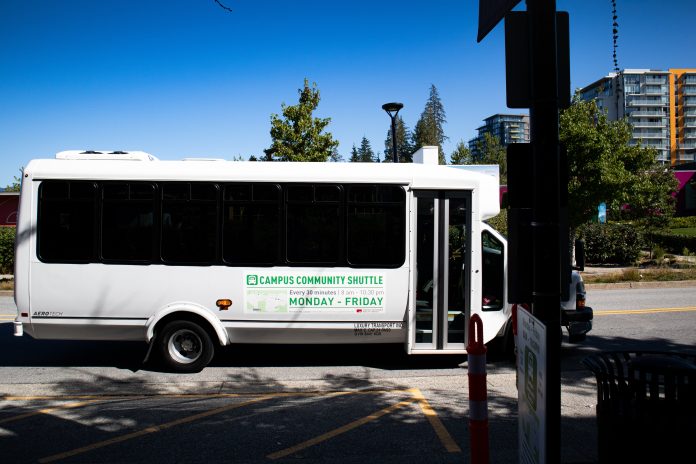
The shuttle stop located at UniverCity by Cornerstone // Photo by Zeh Daruwalla

It took 523 signatures but the student’s collective voice has been heard — SFU’s campus shuttle lives on. Due to a petition on the website change.org started by student Robyn Jacques in June (which The Peak previously reported on), the Campus Community Shuttle service has now been extended for one more year and will run until August 2020. 

SFU’s Parking & Sustainable Mobility released a statement saying, “As a response to your overwhelmingly positive feedback and thanks to a collaboration with [Fraser International College], we will be extending the current Campus Community Shuttle Pilot Project.” 

Jacques started the petition as a way to prioritize student safety on campus. Her incentive for starting the petition was because she “realiz[ed] how unsafe the campus has become in recent months.” 

“There are so many vulnerable populations on campus that are at a higher risk of getting assaulted or robbed, and I strongly believe that the shuttle has helped keep those same populations safe,” Jacques said in an email interview with The Peak. 

The safety and well-being of students is one of Jacque’s priorities after dealing with her own experiences of sexual harassment and walking home at night on campus. Jacques said, “Before the shuttle, I was terrified about walking home late at night, and I felt that I was completely restricted to my dorm once it was dark out. Once the shuttle was implemented, I knew that I no longer had to fear going up to Cornerstone at night, because I knew I had a safe ride home.”

There were a plethora of comments on the online petition from students in support of keeping the shuttle due to having work, classes or social activities until late in the night on campus. Recent reports of sexual assaults on campus may have increased the desire for safety measures such as this.  One signatory, Tanzina Islam, wrote, “It is very convenient for the residence community and especially for FIC students . . . I remember the struggles of walking alone to FIC scared especially at night and not to forget [the] days of winter. Talking to my FIC friends, this bus shuttle has been the best thing for them in the past months [ . . . ]”

The petition was started in June and was largely directed by Jacques. “I am not a member of the SFSS, I do not have close ties with board members or deans, so I did not know what power I would have over the shuttle staying or not.” She reflected on her efforts and added, “For over a month, I had put all of my energy into this campaign . . . it finally felt like I had made a difference, and knowing that I did it on my own made it even better.”

Jacques still feels that there is more to be done, however — including additional security and better lighting around campus in the night time. She notes that “the walkway by the observatory [is] pitch black” and “the areas surrounding Shell House Residence and McTaggart-Cowan Hall are relatively dark.” Jacques also mentions that “SFU needs to put more money into light fixtures around campus, and at no point during the night [should] they be turned off.” 

The free shuttle will run until August 2020, Monday through Friday from 8:30 a.m.-10:30 p.m. every thirty minutes. It will be stopping at Discovery 1, High Street in UniverCity, and the Dining Hall by student residency. 

Several students have raised issues about accessibility related to the shuttle. The Peak will be reporting on this in a follow-up story in the near future.

Political Corner: Greta Thunberg isn’t the only answer to climate change

0
We can’t look at Thunberg as the only Supergirl of environmentalism. Photo: Anders Hellberg / Wikimedia Commons

August had no shortage of devastating climate change news. The Amazon Rainforest burned, creating an unprecedented level of damage across the region. Alaska’s July temperatures broke records, leading scientists from the International Panel on Climate Change to publish a report stating that they had underestimated the pace of climate change. But despite all of the environmental doomsday news, there was one bright spot sailing across the Atlantic. 

Sixteen-year-old Swedish vegan and Nobel Peace Prize nominee Greta Thunberg set sail on August 14 from London to New York in a carbon neutral yacht. The trip lasted 15 days. In New York, she will speak to the United Nations before moving on to various other speaking engagements across South America in an effort to promote action on climate change. 

Thunberg began protesting against climate change in August of 2018 by demanding that the Swedish government begin to take radical actions. However, what’s important to remember is that she is bigger than the choices that have made her a name across the globe. She represents a growing movement within younger generations — a movement that is largely born out of frustration towards government officials’ inaction. This frustration was demonstrated during the March 15 global wave of student walkouts to push for new climate change policies. 

Yet, walkouts every few months will not be enough. Thunberg has been successful due to her unrelenting resolve to continue until there are results. We have to embody that resolve rather than simply cheering her on and hoping that she will save us. In order to see the change she advocates, we need to remain vocal and make adjustments in our lives to prove that we are not just words. 

SFU has been making the effort to promote green changes in accordance with the growing climate-consciousness as exemplified by Thunberg. The creation of sustainable spaces, and the soon-to-be implemented single-use plastics ban are good starts. But in order to have SFU continue this trend, students need to actively participate and continue to support the implementation of greener changes across campus. Changes towards a greener lifestyle prove that we are serious about climate change and, like Thunberg, need to be taken seriously.

SFU’s decision to phase out single-use plastics is a good one

0
SFU is among the many institutions pledging to eliminate plastic straws, among other plastics. Photo: Agency France-Presse

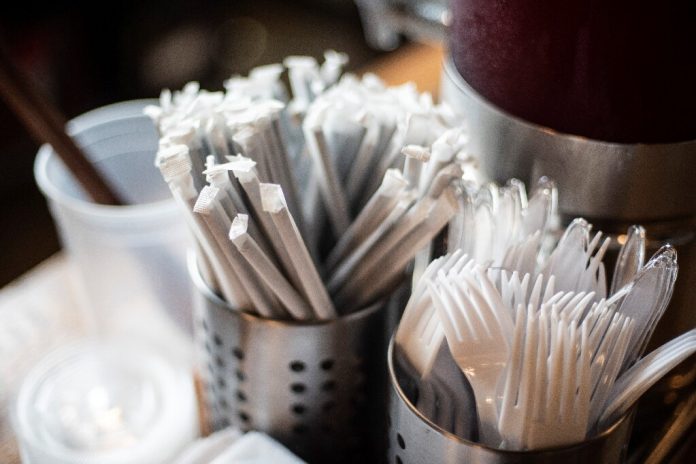
This September, SFU is acting in support of a ban on plastic straws. Led by a task force including the Simon Fraser Student Society (SFSS), the university is set to eliminate single-use plastics from its campuses. Their action plan includes two phases: Phase 1 (starting this September) involves removing plastic straws and replacing plastic utensils with metal ones; Phase 2, which is scheduled for 2020, addresses single-use beverage cups, plastic bottles, and coffee pods. SFU’s action plan is notable as it not only includes a plan to reduce plastic waste, but it also has a plan for implementing programs to reduce container waste at Mackenzie Café. 

Importantly, SFU will still take into account people with disabilities — bendable plastic straws will still be available if required for accessibility.

As a student, I fully support SFU’s decision to reduce single-use plastics. It makes me happy to know that I attend a university where meaningful actions are being taken to help save the environment. Knowing that SFU considers people with disabilities further demonstrates that their plan is considerate of everyones’ unique situations. Their decision to be more sustainable sends a great message that shows dedication to climate crisis changes. 

Although banning plastic straws may seem like a minuscule step to resolving the current climate crisis, the benefits are impactful when examined on a larger scale. In Canada alone over 3 million tonnes of difficult to recycle, single-use plastics are thrown away annually. This translates to millions of injured or dying wildlife through ingestion or entanglement when these plastics inevitably end up in our waterways. By reducing plastic waste, not only are we prioritizing animal life, but our oceans and beaches will be cleaner as well.  

The current climate situation is slowly being seen as a priority by businesses under increased pressure from climate activists. Through their activism, young people have increasingly shown that they value putting the climate first. This has resulted in companies, such as Starbucks, opting to pledge their commitment to save the environment by phasing out plastic straws. It’s gratifying to know that our university, having similar environmentally-conscious ambitions, is taking a step in the right direction in accordance with these companies.

Responsible and positive change towards addressing the state of the environment has to begin somewhere. We are currently seeing the shift from concern to action in the policies and commitments of more and more institutions and governments. Hopefully, SFU’s action plan will also promote and instil sustainable habits in the students who graduate from this university.


SFU’s negligence at the Transportation Centre is putting commuting students at risk

0
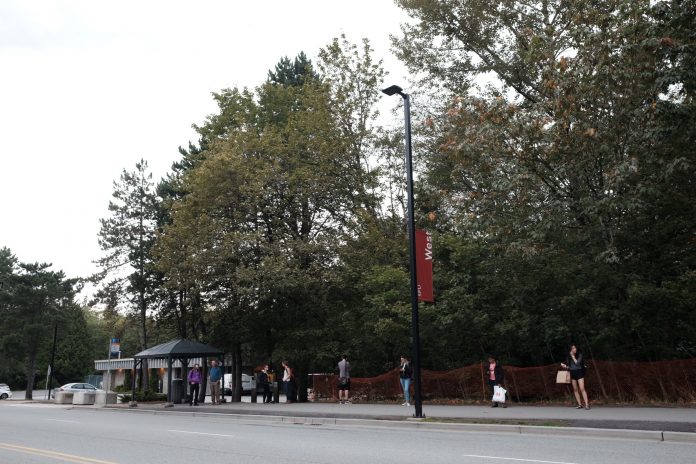
Dimly lit, forested bus stops far from campus buildings create unsafe situations for students. Photo: Chris Ho / The Peak

Last spring, I found myself commuting home late on a Friday night, which isn’t unusual for me. The Peak’s publication days are on Friday, and they stretch out. On this particular Friday I was with two male coworkers/friends. We locked up the office, made our way through the Maggie Benston Centre’s parkade, and down to the Transportation Centre. But as most students know, this lower bus loop isn’t in use at the moment — so we crossed University Drive West and stood at the temporary stop that has been set up. 

At first sight I told my friends that somebody was going to get hurt here.  

For those who don’t spend time at the Burnaby campus, when you’re waiting for the bus at this temporary stop you’re standing on the sidewalk across the street from West Mall Centre, with a looming forest stretching out behind you. There is a lamp post lighting the area, but it feels more creepy than actually illuminating and secure — probably because you’re quite far from any buildings, in a part of campus that’s quiet to begin with. There’s a gazebo if it rains, but there are no blue SFU Security phones nearby. Also, there’s a sign warning commuters about wildlife — although, to be frank, bears weren’t the predator I had in mind. 

So when the news broke in July that a female student had been stalked and assaulted near University Drive West and West Campus Road? I was mad. I’d seen this coming, as had many other women students — which isn’t to say that this set-up is safe for men and non-binary students either. The area just doesn’t feel safe, period.

The Friday after that story broke, I stood at that same stupid bus stop again and nothing had changed, despite the fact that someone had been attacked a stone’s throw away. When I looked around, there was no extra lighting to keep the area better-lit, nothing separating students from the woods that someone had nearly been pulled into, no way to call for help if something happened, and no hint at all that this was a safe place for students to stand as we tried to leave our unsafe campus. 

After seeing that? I was livid, because someone had nearly gotten hurt and because the university had continued to allow this unsafe situation to exist by not taking additional steps to adapt the infrastructure its students were using. A full month later, as I finish writing this piece in the office, this is the same bus stop I’ll use to get home — thankfully, in broad daylight. 

I’m happy and thankful that this student’s story didn’t have a worse ending, but the fact that this attack happened at all is unacceptable. I started this piece by talking about my work with The Peak, and so I’ll circle back to that now to express how concerned I am by the increasing number of reports regarding violence and dangerous situations on our campus that I have read, seen, and heard of. This is a complicated issue, but there are simple things that I as a student want to see to feel safe on campus — my university providing safe infrastructure is one.   

The concept that university campuses can be unsafe places (for women in particular) isn’t news, but it leaves SFU with an institutional responsibility to be mindful of its students and to protect us. The Transportation Centre’s redesign has always struck me as unsafe, but now that violence on campus is escalating it feels purely negligent. If something else happens on University Drive — while I dare hope that nothing will — our university shares the blame.

If you’re new to campus, you should know about the following resources:


Universities need to rethink their finances in the interest of equity

0

Back in July the Vancouver Sun published a list of the top 10 highest paid public executives in B.C., along with a detailed breakdown of their compensation packages. Of the ten, four were university executives, with the president of UBC, Santa Ono, predictably pulling in one of the highest incomes ($601,772). SFU president Andrew Petter also made the list, with a total compensation package for the 2018–19 year of $439,910. This was only slightly higher than UVIC president James Cassels, who saw a total compensation of $432,979 for the same year.

Students who remember the controversy surrounding SFU’s 2019–20 budget decisions may be disgruntled by these figures. In March, the school’s Board of Governors voted to increase tuition across the board, with international students being hit the hardest. Increases of 12–20%, depending on academic program, will be levied against incoming international students starting this semester, while domestic students will see their tuition rise by the maximum 2%. 

A six-figure income is something I can only dream about at present. My current income just barely covers my tuition every semester, and certainly doesn’t cover my living expenses. It is widely acknowledged that Vancouver is the most expensive city in Canada to live in, and yet, when looking to balance the university’s budget, money is squeezed from those who make the least, rather than those who make the most. 

Am I alone in thinking that this is a backwards way to do things? Has the image of the “starving student” become so accepted that we don’t think twice about laying on yet more financial burden? Reports of students unable to afford Vancouver’s rising rents being forced to sleep in classrooms are more than just campus rumours, as a recent story in The Globe and Mail reported.

If the argument being made in favour of the current income of SFU’s president is that it is required in order to draw and maintain a talented administrator, then let me also make the following counterargument: if tuition rates become prohibitively expensive, the university also risks driving away the student talent that fuels a university’s credentials. This is particularly true of international students who are already looking outside of their domestic academic landscape for potential universities, and may choose a more affordable option outside of SFU — or even Canada for that matter. 

It is unconscionable for university administrators to make such obscene amounts of money while at the same time increasing the tuition of students who are just barely scraping by. If there is enough money in the SFU budget to pay our president over $400,000, then there is enough room in the budget to pay for talented faculty and building upgrades without raising student tuition to such a drastic degree.


Caring that isn’t impossible: An SFYou with Mission Possible’s CEO, Matthew Smedley

0
Photo Courtesy of Mission Possible

Name: Matthew Smedley

Pronouns: He/him/his

Profession: Executive Director & CEO at Mission Possible

Education: Simon Fraser University (graduate certificate in Community Economic Development), Regent College (course work in theology and sociology), and Cairn University (bachelor of science, field of theology, biblical studies and sociology). 

Fun fact: Smedley says that the least known fact about him is that he is an ordained minister

An office, a window, and a tremendous capacity to care for Vancouver’s Downtown Eastside community — three things I quickly learn that SFU alum, Matthew Smedley, currently has. 

After several rescheduled emails, we finally sit down for an interview, both in our respective offices, linked by our cell phone lines. I, in a cramped space tucked away in SFU Burnaby’s Maggie Benston Centre, and Matthew, in his office somewhere in the Downtown Eastside. 

Amidst the awkward fumbling of recording devices, Smedley’s voice is clear and strong through the static of my iPhone. I begin by asking him to describe his role at Mission Possible (MP), a community organisation dedicated to helping the Downtown Eastside homeless population.

“I get to essentially support and help manage a team who are doing amazing work which is busy impacting lives of people who are experiencing poverty,” he says. “We’re creating impact ultimately through employment opportunities that lead to empowerment for individuals are experiencing isolation and marginalisation.”

In the morning haze, I do not put two and two together that Smedley, being the Chief Empowerment Officer, is also the company’s CEO. It’s safe to say that Smedley is familiar with the Downtown Eastside, as he has been with Mission Possible for a little over 11 years, being the CEO for almost five of them. 

Smedley starts by telling me that the Downtown Eastside is a neighbourhood. 

“Well, not a neighbourhood. It’s actually five neighbourhoods,” he later amends himself, “but it’s a community of 20,000 people. And of that 20,000 people, half of them are living in poverty. So the per capita rate of poverty is extremely high.” Throughout the interview, I notice something about Smedley: not once does he use the term “homeless people,” and opts for calling them as they are, people. 

“People often just assume that people don’t have the ability or motivation to work, or those kinds of things, but it’s really the opportunity, they need just the right opportunity,” he emphasizes. 

“You know, one of our individuals who was running our MP Neighbours program started out volunteering with our organisation,” he offers eagerly, sharing the story of an individual who came through Mission Possible’s program only to end up working in it permanently. “Someone who was going through recovery, and was volunteering, and then he was referred to come work with us.” Smedley doesn’t waste a moment before praising the individual’s hard work. “He walked in [the] shoes [of a homeless person], and just that lived experience is so powerful.”

“My goal is that anytime we have positions where we can hire people, we always look for those who have come through our program,” Smedley explains,  “Those who have experienced what we do, and those people are going to have the biggest impact in supporting those who come after them.”

But how does one get into this line of work? For Smedley it was simple. Roughly 13 years ago, Smedley was working at a church. It was through there that he found Mission Possible.

 “I started volunteering serving some meals, and then I was able to start working part time,” he shares. “And this was before we had our social enterprises, and our employment readiness program.” 

When I ask Smedley whether or not his background as a pastor impacted his choice of current career, he agrees with an almost casual, “Yeah,” as if a life of social work from religious ministry was something most would do on their average weekday. 

“I would say that the connection was what helped me come in, but the work, really — as a pastor and training that I had — was what inspired and gave me the drive to really want to care for people who I feel like otherwise would not have the opportunities that they have,” he says. As Smedley continues talking about the marginalisation, it faintly occurs to me that Smedley has talked about his community more than himself throughout the interview — a testament to his selfless character. 

When I ask what Smedley finds most rewarding about his work, I’m not surprised with his answer. “It’s the people that motivate me,” he says, “It’s the team I get to work with, I just work with a fantastic group of people [ . . . ] But it’s also those we get to build relationships with and get to know who walk in our doors and get to see lives changed through the work that we’re doing.”

As he’s an SFU alum, I ask Smedley if his time at SFU helped to prepare him for his current career. Smedley states “it was a program that I did actually right before moving into the Executive Director role, and it was one that opened my eyes to the amazing work that’s being done across our province and across the country.” 

The program Smedley speaks of is Community Economic Development (CED) program, which aims to empower and equip its students with skills that will allow them to help strengthen communities. On the CED website, SFU calls their program a leader in CED across Canada, [with content that] is both progressive and unique compared to peer institutions.”

When it comes to Smedley’s fondest memories of his time at SFU, he doesn’t hesitate to describe the connections with other people that have made his work fulfilling and memorable. Given that the CED program is located in downtown Vancouver, Smedley mentions how fortunate he feels to still be working with some of the other members of his program. They all may not be in the same organization, but the connection is there.  “I’m just so thankful for the connections that have been made through that time at SFU.” he says. 

For any aspiring SFU students interested in learning how to make a difference, Smedley offers two ways to get involved with Mission Possible. 

“One is we currently have a co-op student working with us, and that has been fantastic [ . . . ] we have summer opportunities and things like that for short term, temporary work. We’re always looking to recruit great people.” 

Those interested in permanent positions can find them on the Mission Possible website as well on SFU’s job posting lists. 

Smedley emphasizes that he hopes to provide opportunities of all kinds, regardless of one’s major, whether it’s for communications or business students. “Anything from communications and marketing, you know — there’s fundraising roles, there’s sales roles, there’s training roles, doing employment training, [and] coaching.” 

Smedley suggests that the small size of the organization, roughly 23–25 employees, make the jobs at Mission Possible multifaceted. 

“We would love to give opportunities to students who are coming out with education, maybe in social services field, but even if not, there’s opportunities,” he says. “We’re running social enterprises, we’re running businesses, and so, I think there’s opportunity in a whole bunch of different areas that people may not expect when they think of a nonprofit.”

Even long after I ended the interview with Smedley, I am still in awe of his character. It gave me hope for humanity whenever he opted to say “we” rather than “I.” Inspired, and the slightest bit self-reflective, I look up Mission Possible’s next date for volunteering (it’s every Saturday, with a call time of 8:30 a.m.!). Smedley began his career serving the Downtown Eastside by serving meals, so I see no reason why I can’t do the same. 

For more information about Mission Possible, see www.mission-possible.ca. For further information on volunteering opportunities, Mission Possible’s Power Breakfast and Coffee House Volunteers meet every Saturday morning, and can email [email protected]. 

 

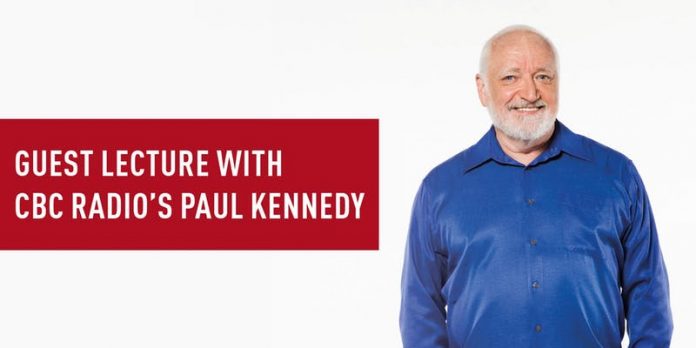
Paul Kennedy presents guest lecture to CMPT 320: “What would Marshall McLuhan say?”

0
Photo Courtesy of SFU

Paul Kennedy, broadcast journalist and former host of CBC’s “IDEAS,” presented a guest lecture to the CMPT320 students and additional guests at SFU’s Burnaby campus. Winner of the ACTRA award for best Canadian radio documentary, Kennedy spoke at length about his feats and challenges in academia and, later, at CBC. One of Kennedy’s main focuses centered on the works of Marshall McLuhan, a Canadian philosopher and media theorist with whom Kennedy worked with in academia and briefly in broadcasting.

“McLuhan was one of the most fertile minds that has ever lived . . . I learned a lot from [him],” said Kennedy.

McLuhan, who coined the saying “the medium is the message”, gathered a lot of his inspiration from his colleague and mentor Harold Innis, a Canadian political economist who opened up dialogue about the works and influence of media. 

“Nothing I have ever written or will ever write is more than a footnote to the work of Harold Innis’,” paraphrased Kennedy, referring to McLuhan’s introduction to the 1964 edition of Innis’ book The Bias of Communication. 

Kennedy went on to speak about the emergence of digitization and technological changes. While describing the tedious process of being a freelancer in the early days of his career, including carrying around a reel-to-reel machine for recording interviews, Kennedy admitted that he originally resisted the change in computers and technology. Near the end of the lecture, he emphasized the influence of technological changes and their less than positive effects on society.

“I have a daughter [who] loses her phone every three weeks, and every time she does, she loses her contacts and she doesn’t remember them anyway,” Kennedy stated. “I think there are cognitive changes happening in society because of digitization.”

The lecture concluded by opening up the discussion to the audience, in which students had the chance to come down and pose questions for Kennedy himself. 

Burnaby Mountain roads need to be reassessed to keep all travellers safe

0
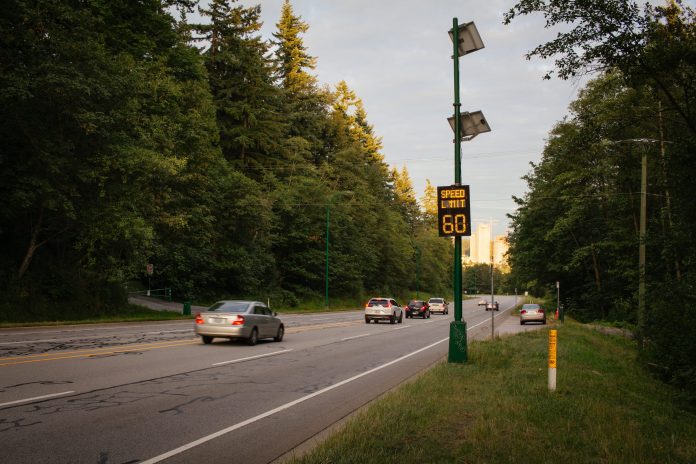
Current speed limits feel more like a suggestion than a law. Photo: Andres Chavarriaga /The Peak

Having a university on a mountain has its perks: nice views, nearby hiking trails, and beautiful natural surroundings. Campuses located in busy cities may not have these privileges. But this picturesque mountain comes with downsides as well, one of the major ones being the commute.

Because of SFU’s location and distance from most students’ living situations, many students find themselves bussing or driving to get to their classes. Any Burnaby Mountain commuter knows that the 60 km/hr speed limit going up and down the mountain has felt like more of a suggestion than a requirement — many vehicles go at least 80 km/hr and frequently even faster on the way down.

This has created a driving environment in which drivers feel pressured to go faster. Whether it be to avoid “riding their brakes” all the way down, or for fear of being honked at, from my experience, drivers going down Burnaby Mountain have been going much faster than they should.

Unfortunately, this reckless driving has resulted in several accidents, the victims of which include pedestrians, cyclists, and motorcyclists. Accidents such as these are almost always fatal due to the speed the cars are traveling. Yet even death isn’t enough to warn people to drive safe, as a recent heart-wrenching Vancouver is Awesome article describes the dangerous driving on Burnaby Mountain in the aftermath of a fatal accident.

Better understanding of road sharing between cyclists and motor vehicles, stronger reinforcement of speed limits, and significant penalties for negligence and breaking the law are good first steps toward making the roads around SFU safer for our community. But with motor vehicle collisions being the single largest contributor to accidental death in B.C., extra precautions must be taken to ensure the safety of everyone, especially those at higher risk of death or injury, such as cyclists and pedestrians.

Looking at how the roads entering and exiting SFU are designed can also be key to reducing accidents. Consider roundabouts, of which there are two at major SFU intersections. While these may be more convenient for drivers compared to stop signs as cars often aren’t required to come to a full stop, this convenience comes at the expense of pedestrians and cyclists who may be confused by how they should navigate the road space. Replacing SFU’s existing roundabouts with four-way stops may prevent this confusion. Placing additional traffic calming infrastructure such as medians along the roads leading to SFU may also reduce the problem of speed. 

On Burnaby Mountain, stronger enforcement needs to be placed on safe driving. A greater  police presence is needed to check drivers’ speeds, and hold reckless drivers accountable before an accident occurs.

Eventually, SFU would benefit from a protected and wider bike lane to both encourage biking and protect cyclists from automobile traffic. Although this may not benefit everyone, as long as changes made make road conditions safer, we are going in the right direction.

As for the rest of our community who commute by car, please remember: it is better to get to class late than to not get there at all!


SFU Construction Watch: Week 13

0
Andres Chavarriaga/ The Peak

SFU Construction Watch: the segment where we aim to provide accurate and up-to-date information about construction happening around our campuses.

SFU Burnaby

Greenspace on Residence: According to the SFU Residence and Housing website, the Greenspace project will “create a paved, accessible pathway running from the front entrance of Shell House down to McTaggart.” 

The project will also include improved drainage and pathway lighting, greenspace landscaping and amenities for gathering spaces. It is expected to be completed in Spring 2021.

Phase 2: Student Housing and Services: This new residence office will be located at the former Madge Hogarth House Location. According to the SFU Residence and Housing website, it will “provide space for programming to promote and welcome students, provide lively, public spaces for all students, [and] rooms for socializing.” 

The building will also include short-term accommodations for visitors to campus. Construction is slated to start by Fall 2019 with an estimated completion date of Fall 2022.

Dining Hall South Patio: Located at the south side of the Dining Hall, this project will be the “new outdoor seating area equipped with gas hook-ups for bbqs and supplementary heating,” according to the Residence and Housing website.

According to the website, the new patio will be a space where students can dine and socialize.  It will also serve as additional seating during the expansion of the Dining Hall.

The project is set to be completed in Fall 2019.

SFU Harbour Centre

All information provided by Matt Cocuzzi, Manager of Facilities Services at the Vancouver Campus

HC 1700 Labatt Theatre Renovations: After months of consultation with students, faculty, and staff, the 110-person lecture theatre is undergoing renovations. According to Cocuzzi, the renovations will include improved the theatre’s aesthetic and acoustics and completely upgrade its audiovisuals, while also being mindful of accessibility.

The project is set to be completed by Fall 2019.

HC 2200 & 2250 Learning Spaces: The two learning spaces are being refreshed with new furniture, lighting and AV equipment.

The project is set to be completed by Fall 2019.

HC 2500 Washrooms: The washrooms on the second floor are currently being modernized. Once complete, the washrooms will be designated all-gender washrooms. 

The project is set to be completed by Fall 2019.

SFU Goldcorp Centre for the Arts

All information provided by James Brenmer, Project Manager for SFU Goldcorp Centre for the Arts. 

Fei and Milton Wong Experimental Theatre: In his response, Brenmer wrote, “A new retractable seating system allowing  for a faster turnaround between events has been completed and is currently in use.”

New Marquee Digital Signage: This project aims to improve way-finding and programming signage. It is expected to be completed by the start of the fall semester.

External Signage Upgrades: This project’s goal is to provide SFU Goldcorp Centre for the Arts with “inviting and improved” entrances at the Hastings and Cordova courtyard. It is expected to be completed by the start of the fall semester.

Ground Floor Lobby: The space is currently undergoing renovations to allow for “more flexible seating [ . . . ] that will enable the space to be better utilized.” It will also provide a gathering space for students and the public.

It is expected to be completed by the start of the fall semester.


Second assault reported at SFU within two weeks

1
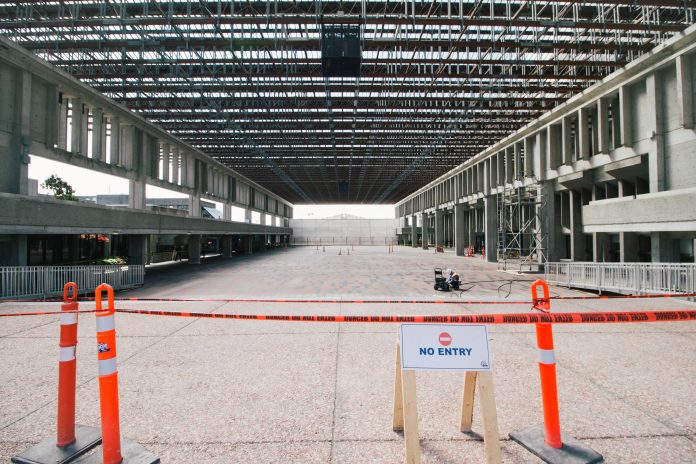
Photo: ITC Construction Group

For the second time in two weeks, a safety alert was sent out by security on Burnaby campus warning students that an assault had been reported. 

According to an alert issued by Burnaby RCMP, on the morning of July 26 around 4:30 a.m., a woman was walking along Highland Court and University Crescent near the Cornerstone Market. She was approached by a man, who physically assaulted her before attempting to sexually assault her, and then quickly fled the scene. 

Burnaby RCMP described the suspect as a black male in his late 20s, about six feet tall with a medium build, and a short, bushy curly beard with a moustache. He was wearing a black hoodie, black sweatpants, and a black baseball cap with a New York Yankees logo on it.

RCMP asked that anyone who may have been in the area of Highland Court, University Crescent, or University High Street around 4:30 a.m. on July 26 and seen anything suspicious contact them at 604-646-9999 or Crimestoppers at either 1-800-222-TIPS or www.solvecrime.ca.

Reactions from the SFU Community

Later on the day of the incident, SFU News issued a release stating that there is currently “nothing to suggest that this incident is connected to a previous assault that took place on a trail near SFU on July 14, 2019.” In light of both of these incidents, SFU has increased security presence on campus.

However the two assaults have left some students shaken, and concerned about their safety on campus. “[I am] worried about being on campus late at night because both alerts [were] during evening/night time,” said communications student Stephanie Chiakwelu, adding that she felt she needed to make sure not to be out on campus late at night. “I didn’t want any harm to come to me. I honestly felt scared.”

She noted that she thinks students, particularly female students, will feel a sense of fear when moving about campus. “They won’t know what to expect at evening times anymore. I can’t even imagine how sexual assault victims must feel now on campus. I can only hope they’re getting all the support they need. Security needs to be beefed up at the mountain, so that dangerous people will understand that we’re onto them and we don’t tolerate abuse up at our campus.”

“How much security does SFU have up at nighttime that trespassers feel comfortable lurking around campus?” asked Chiakwelu.

Resources for students 

In the event of an emergency situation on campus, SFU recommends calling 911, and/or the campus security emergency line at 778-782-4500. If the phone call is made from one of the direct-line security phones or blue emergency phones located around campus, security will be able to immediately know the caller’s location.

SFU also currently provides a 24/7 service called Safe Walk, where students can be accompanied by campus security to their destination anywhere on Burnaby campus, within a two-block radius of Vancouver campus, or to nearby bus stops on Surrey campus. To request a Safe Walk escort, call the Campus Security non-emergency number at 778-782-7991

Students who wish to access counselling and support services can call SFU’s Women’s Centre at 778-782-3870, SFU’s Health & Counselling Centre at 778-782-5781, or SFU’s Sexual Violence Support and Prevention Office at 778-782-7233.