Home Blog Page 477

SFU Construction Watch

0

With all the construction happening around campus, it might be a bit confusing for new (and returning) students to find their way around campus. Here is a breakdown of construction projects happening on campus and what students have to look forward to in the upcoming months. 

SFU Surrey:

Surrey Sustainable Energy and Engineering Building (SE3P)

With a budget of $116 million, this is one of the largest construction projects at SFU in recent years. The building is open and hosting classes as of September 2019.  Built to LEED Gold Environmental standards, the building will be the host to mechatronics labs and a new Sustainable Energy and Environmental Engineering program in Surrey. According to the construction project page on SFU’s website, “the City of Surrey supported an accelerated construction schedule and sees the building as a key player in the City Centre revitalization and expansion.”

SFU Burnaby:

Two New Residence Buildings 

Phase 1:

Two new seven story residence towers for first year students will be built at the former Louis Riel Residence site. It will have 482 single rooms and is expected to be opened for the spring, 2021 term. This project is estimated to cost $43 million. 

This also includes the development of a new greenspace, which will include an accessible pathway from the front entrance of Shell House down to McTaggart. The SFU Residence and Housing website states that it will also include “drainage improvements, pathway lighting, greenspace landscaping and planting (mix of lawn, grasses, groundcover and shrubs) and gathering spaces with amenities (tables, benches, basketball hoops).”

Phase 2: 

This will include the building of a centrally located office suite for the Residence and Housing staff. According to the SFU Residence and Housing website, “Phase 2 will play a significant role in community engagement, student citizenship, and student academic success.” The site for this office suite will be where the Madge Hogarth House is currently located.

Student Union Building (SUB) 

The long-awaited SUB is finally almost upon us, although its construction has meant the much-beloved rotunda groups are still without space on campus once the SUB opens. Funded by a longstanding building levy, the SUB will have many different facilities that will appeal to students. Some of these, as outlined on the SFU Construction Project Website, include “a napping room, a community kitchen, an online gaming lounge, music rooms and a live performance stage.” This is part of a $65 million dollar project that is meant to reinvent the campus experience at SFU that also includes the building of the stadium. You can read more about this on the SUB Building Design and Development Report or on the Student Society page. This project is expected to be completed in Fall 2019, but the completion date has been pushed back before with the video stating a “Fall 2018” completion date. 

Here’s a link to a computer-generated flythrough of what the SUB is going to look like:

Link to “Fly Through the SUB”: https://www.youtube.com/watch?v=Bb5k3tPWi8E&feature=youtu.be

Lorne Davies Complex Stadium construction

SFU is getting its own stadium, which is expected to finish in Summer 2020. The new stadium will be able to host more than 1800 people and includes “new individual bleacher seats and informal seating for up to 300 on the surrounding landscaped berm (a path or grass strip beside a road)” says the SFU Construction Project Website. This project is in collaboration with the SFSS and the University, and will cost $15 million dollars with an additional $10 million from SFSS. 

“Guests will come together to enjoy sports and entertainment in a comfortable campus facility overlooking the Lower Mainland, with covered, theatre-style seating close to the field for an enhanced spectator experience” says the SFU Athletics website. “As Canada’s only university competing in the National Collegiate Athletic Association (NCAA), the stadium will play an instrumental role in supporting SFU student athletes and raising the profile of the University.”

Plaza Renewal

The public plaza from Starbucks Plaza to AQ Plaza will be replaced along with the subsurface waterproofing. Phase 1 is set to be completed by Fall, 2019 and Phase 2 by Fall, 2020. 

Residence Dining Hall:

The Dining Hall is getting an expansion. This $24 million renovation will triple the size of the current dining hall and, according to the SFU Construction Project page, will add 700 seats — including a patio addition. This is said to be completed by Fall, 2020. 

Education Building Renovation

The Education Building is receiving a $26 million renovation, which will include window, door, and skylight replacements. This is set to be completed Fall, 2019.

Comix Biomass:

The Burnaby Mountain District Energy Utility Project is an addition to the already established district energy utility that provides energy for heating and hot water to UniverCity. The UniverCity website says that “the utility will decrease associated greenhouse gas emissions on Burnaby Mountain by approximately 85 per cent at full buildout.”


Seven things SFU was WRONG to welcome back to campus

0
  1. That guy who types too loudly in lecture

His typing is obnoxiously loud. But he’s not actually typing any notes . . . Instead, he’s using his keyboard to tap out the Morse code for “I own a MacBook, so I’m above you pieces of filth.” It’s especially obvious because he starts doing it before the professor has even started talking.

  1. The professor that keeps getting your name wrong

Lorenzo . . . After five semesters together, I thought we had something special. Then you go off on your hot girl summer and don’t even remember who I am anymore. What happened to all the times I sat in silence as you begged us to participate, because I was scared? All the times I didn’t visit you in office hours, because I was scared? All the times I made accidental eye contact with you and then ran out of the classroom, because I was, you guessed it, scared? Well, SFU might want you back . . . but I certainly don’t. 

  1. That one group of people walking who take up the whole hallway

How did you manage to make so many friends in the first place? How much did they cost? Is this the skill that got you accepted here? My best friend on campus is Oscar the trash-sorting AI. He’s the one person in my life to NEVER mistake me for garbage. He clearly stated I was compostable.

  1. The quarter-ply toilet paper

You’re lactose intolerant. You know you’re lactose intolerant. And you still chose to eat the creamiest, most dairy-filled pasta of your life. You have only one thing to clean yourself up with: the thinnest sheet of toilet paper since 12 BCE. Just like my ex-girlfriend, it’s barely even there for me. Whoever invented SFU’s quarter-ply made a serious breakthrough, if you know what I mean. 

  1. Saywell Hall stairs

This staircase serves as a very unwanted reminder of how unfit I am. The smug, ever-present bane of my existence. I’ll keep a long story short: these stairs just seem . . .  to ruin my day.

  1. SFUNET-SECURE, the slowest Wi-Fi in history

Disgusting that SFU keeps bringing you back. How am I supposed to watch The Office during lecture if the screen takes five years to load? At least I can climb the Saywell stairs faster than the Wi-Fi ever could.

  1. Me

Why am I here?


Man celebrated as an ally for saying gay guys can blow during beer pong, too

0

VANCOUVER, B.C. — Last Thursday evening, a local straight man intervened in a beer pong dispute, telling all four participants that a gay male guest was fully entitled to blow into the cup to get the thrown ping-pong ball out and stop the other team from scoring.

The straight man in question was Hunter Blaine, 22, a lifelong resident of the Metro Vancouver area. Blaine was attending a housewarming party in Langley, a city known for its population of one straight white man and one straight white woman run through a photocopier 13,000 times each. When he arrived with a Corona in hand, the critical beer pong round was already underway on the house’s patio.

“When Addison [Editor’s note: the one gay man in attendance] blew into the cup, I know I was being kinda fucked up — I was one of the guys yelling, ‘Only girls can blow!’” one anonymous guest confided to The Peak. “But Hunter, man! My boy stepped up and declared it a legal move. He was like, ‘It’s 2019, buddy — ANYONE can blow.’”

Blaine’s novel gesture of kindness to the gay community was met with a clamorous round of applause, generated partially by the rapid-fire high-fives he received from his boys.

Though the blower in question, Addison Leung, appreciated the gesture, he told The Peak that he felt the impressed partygoers’ cheers were somewhat premature.

“What they all failed to realize is that when that happened, Blaine was only one Corona deep,” Leung explained. Apparently, once the heterosexual man was two Coronas deep, the situation quickly deteriorated.

Responding to fellow partygoer Carter Chester’s repeated midnight cries of “TARPS OFF,” a drunken Blaine joined the other guests in ripping off his enormous cutoff shirt. Skin now fully exposed, his allyship simply evaporated off his sweat-stained body into the stale, boozy wind. 

Reportedly, Blaine spent the rest of the night doing two things: questioning various women at the party on whether the cop show Brooklyn Nine-Nine “really needed” a gay protagonist, and questioning various women at the party on whether they, themselves, “really needed” to be gay.

First-years deprived of icebreakers after climate change melts all remaining ice

1
What SFU looked like, on the emotional plane, before the tragedy of social warming.

This Tuesday, countless TAs discovered to their horror that it might not be possible to hold icebreaker activities for their students this fall. If SFU’s foremost environmental science professors are correct, global warming has advanced to the point that there’s actually no ice at SFU left to break.

“The melting of the world’s glaciers, now that was easy enough for people to understand — or to choose not to understand, if you’re from Alberta,” explains Dr. Callie Plantain, a geography and environmental science professor. “But global warming has moved past the physical plane of reality. It’s actually started to melt away the emotional, spiritual coldness that divides us from one another.”

“It’s an abomination, is what it is.”

Curiously, Plantain elaborates, nowhere is this “social warming” effect more pronounced than within SFU’s own walls. No longer will TAs make a difference in their students’ lives by asking friendly questions about their names, majors, or how many cats they own. In a post-warming era where the ice is long gone, these questions have been left powerless and purposeless.

But while social warming has left the icebreaker obsolete, the melting of the ice doesn’t actually seem to have changed much about student-to-student relationships. Plantain referred The Peak to Maria Hail, a second-year communications student, who spoke about her experience in a socially warmed classroom. 

“Before, we all thought it was the ice that was dividing us,” Hail explains. “But today, we learned the biggest lesson of all: we don’t ignore our classmates because of the ice, we ignore them because we just hate them.”

Sure enough, social warming seemed to have little effect on the students’ interpersonal relationships at all. As another example, Plantain laid out her findings from a Tuesday morning CMNS 110 tutorial. The tutorial’s first year students, as usual, made little effort to remember each other’s names, relate to each other on any personal level, or be at all interesting to talk to. 

Plantain believes that this might be a clue that icebreakers, in fact, never accomplished much at all. 

The complete lack of change to the status quo has also opened the door for social warming skeptics to speak out against SFU’s findings.

“There is no social warming emergency at SFU,” stressed Maxie Garnier, a second-year majoring in political science. “No reason to panic or be anxious. No consensus supporting the melting of the metaphysical ice. No justification for SFU to be spending our tuition dollars on researching such an ambiguous, ephemeral concept.”

However, Garnier capped off his statements by saying that as someone who wasn’t a part of the Faculty of Environment, he had “no opinion” on the topic of climate change, “in any sense of the term.”

Your weekly SFU horoscopes: September 2–8

0
An illustration of a girl with long flowing hair. Astrological signs and stars shine around her.
ILLUSTRATION: Marissa Ouyang / The Peak

Aries — March 21–April 19

This week you’ll be tested emotionally. You’ll meet your professors and know instantly that they all bluffed their way through grad school. Trust your gut instincts. Just set fire to their lecture halls. You won’t go to jail for arson, because SFU Security will ignore the loud, loud alarm, thinking it’s another fire drill. 

Taurus — April 20–May 20

There’s no point in writing you a horoscope. Thanks to your severe emotional inertia, nothing I could possibly tell you will change your stubborn, unproductive behaviour. Just skip ahead to planting yourself within the earth of the Student Union Building construction site. Good things come to those who wait. Like asphyxiation.

Gemini — May 21–June 20

You’re hated by all. Have been since 2015. So drop out of SFU, buy a fake passport, and fly your ass to Vanuatu. You won’t have a degree. But what you will have is 276,000 fresh people to confuse using your two dreamy personalities: McLovin’ and McCut-A-Bitch. It’s called self-care. 

Cancer — June 21–July 22

You messed up this week. No need to tell you what you did wrong. Your inner parking security officers — ahem, demons — are doing it for me. Just accept that you don’t deserve the forgiveness or salvation you so crave, and that the only appropriate atonement is for you to leave your soon-to-come rough case of pubic lice untreated. 

Leo — July 23–August 22

You’ll be the hottest one at The Study this week. And you won’t even be at The Study. But focus on friends this week. Breeze through SFU’s three campuses and collect a perfect squad of “besties.” Choose these hapless worshippers based on how well they obscure and offset your sunny borderline sociopathy.

Virgo — August 23–September 22

Everyone wants your advice this week. Give it to them. Tell Lincoln that running a depressing memes page online is 100% a personality. Tell Marina that skipping all her tutorials will prove to the TA that she’s independent and clearly too well-read to need review. Tell Hester that she can get her friends to spend time with her again by manipulating them all into dumping their partners. 

Libra — September 23–October 22

This week, remind a classmate that they matter to you. Then, balance the scales by reminding a different classmate that they mean nothing to you. Now that you feel like a total bitch, escape your current sadistic identity by redesigning your bedroom with more succulents in mind. (I say “now” . . . but you won’t get around to self-reinvention until Sunday.)

Scorpio — October 23–November 21

You’ll be late a lot this week. Don’t answer your favourite TA’s concerned questions about “what’s gotten into you this semester,” though. Just smile sadly, hold up your iPhone, and play for the class i think you think too much of me by EDEN. The album will last the whole hour, even if your teacher’s patience doesn’t.

Sagittarius — November 22–December 21

Your friends? Dramatic little hoes this week. Don’t hold a grudge. They’re trying. But they’re also trying your patience. So be diplomatic here. Identify the problem person and expose their embarrassing Taiwanese Chicken Nugget feeding fetish to the rest of your friends. Sacrifice the evil to save the squad. Then you can all ride to The Pint together with no regrets.

Capricorn — December 22–January 19

The student body doesn’t hate you this week, nor do you hate yourself. Shit. But you can fix that in two easy steps. First, be a diligent student and strategically highlight your course readings. Then, tell all your friends about your strategic highlighting. It’s like telling all your friends about your strategic voting in the federal elections, except even more insufferable.

Aquarius — January 20–February 18

You’ll be really tempted to stave off SFU’s obvious aura of loneliness and loserdom by starting a cult. You’d do amazing at it, babe — but don’t do it. It sounds all fun and fraternal de jure, but de facto, the SFSS is never going to get your cult’s room booking right. 

Pisces — February 19–March 20

You have so many different personal fantasies on the go that you really don’t have a sense of identity or self-awareness anymore. And I can’t help you with that. So go back and read the horoscopes I wrote for everyone else. Soak in those sloppy seconds, like you always do. You’ll identify with all 11 horoscopes, confusing you further. But at least you’ll have something nice, for once.

CONFESSIONALS: All along, I was the closeted capitalist

0
Illustration of a closed envelope, with the text, “Confessionals”
ILLUSTRATION: Marissa Ouyang /The Peak

Hey, SFU. I’m going to start by saying that this is really hard for me to talk about. It’s something I’ve struggled with my entire life. But I’ve realized that you can’t just run away from your authentic self. Not even by running five different Instagrams, putting two of them on private, and filling the three others with a mix of resume-friendly content and intensely shirtless pics of your summer camping trip to Squamish.

So — nothing for it. I’m just going to say it.

I’m the closeted capitalist.

Wow, that feels good. Real good. Fuck. I feel liberated — something the rest of you suckers at this Hollywood cash cow of a university, sadly, will never understand. Not as long as you remain subjugated by our current, beautiful economic model.

It’s been hard to keep this under wraps. I lie awake at night, sweating at the chance that a roommate might find the copies of Wall Street Journal under my bed. When my friends see me hiking up Burnaby Mountain in full Patagonia gear, I claim I’m just ace at thrifting. I tell my classmates the vial of fluid on my gold chain necklace is something I bought at Granville Island to support local artists, but actually, it’s full of toxic chemical runoff from Silicon Valley’s ruthless tech production cycle.

But I’ve done it. I’ve fooled them all . . . My friends look into my eyes, and they miss the fantasies I entertain about employing them all to work several tiers below me at a fraudulent student-populated summer painting company. They follow me on Instagram accounts #2 and #4, but they don’t know about #1, the bio of which I just updated to “ENTREPRENEUR | FASHION | DM FOR BUSINESS INQUIRIES.”

The Mughal emperor, Shah Jahan, built his dead wife the Taj Mahal. I do it better; I build my ladies pyramid schemes. And I’ve gotten so good at it that I think I might, like . . . be 1% Egyptian or something. I’ve considered using ancestry.com to find out, but then the government might get my DNA, and I can only bribe the government so much to go harass other, poorer capitalists about their business instead of harassing me about mine.

So SFU . . . I’m sorry . . . but I just can’t relate to any of your struggles. I’m hotter, richer, and simply more beloved by God than you. And since capitalism’s inevitable, horrifying collapse isn’t coming any time within the next couple of years, it’s going to stay that way for as long as I’m stuck sitting beside you all in these oppressive liberal arts classes. I’ll be busy pretending to cry over our professor’s lecture on boring 16th-century British peasants who lost their farmlands to feudal lords and enclosures, when in truth, I shed my tears for your lack of faith in the gospel of the all-encompassing Kardashian empire.

Written by Zach Siddiqui, Humour Editor

Nurturing Resilience at the Women’s Centre

0
The Women's Centre at the Rotunda // Photo by Zeh Daruwalla

“One in five women experience sexual violence while attending a post-secondary Institution,” said Erica Van Driel, a Registered Clinical Counsellor at SFU Health & Counselling. She is also the Program Facilitator of Nurturing Resilience, a weekly support group for “SFU students of all genders who have experienced any form of sexualized violence at any time in their life.”

“Due to this overwhelming identification of students experiencing sexualized violence on campuses across the country, support groups such as Nurturing Resilience are often part of a larger network of support put in place for students. Support groups play a critical role in helping survivors heal, cope, and move forward,” said Van Driel.

The support group is organized in partnership with the SFSS Women’s Centre and the SFU Sexual Violence & Support Prevention Office (SVSPO). Van Driel describes a regular session as “beginning with an opportunity to connect and check-in over light refreshments and snacks, followed by a predetermined topic for discussion, such as self-care, identifying values, boundary-setting, healthy relationships, communication, dealing with triggers, and coping strategies.” 

Van Driel’s hope is that “students will feel less alone with their experiences and build resilience through learning skills such as mindfulness, self-compassion, and identifying values, strengths, and boundary-setting [. . .] by making connections with others.” 

According to a report from the Canadian Federation of Students-Ontario, “women are less likely to report sexual assault and other forms of violence because of the stigma associated with being an individual who experienced sexual violence.” Van Driel notes that students who attend the group can share as much or as little as they are comfortable with. “The intention for this group is for it to become a supportive environment where safety and community are built through self-care, respect, skill development, and self-compassion,” she adds. 

The Nurturing Resilience support group will be meeting every every Tuesday from 2:00 p.m. – 4:00 p.m. at the Women’s Centre TC 3014. The first meeting of the Fall will be held on Tuesday, September 17.

For more information about joining the group, please contact Erica Van Driel, Counsellor, at [email protected]

Students who wish to access other counselling and support services can call SFU’s Women’s Centre at 778-782-3870, SFU’s Health & Counselling Centre at 778-782-5781, or SFU’s Sexual Violence Support and Prevention Office at 778-782-7233. 

Here’s all this summer’s gondola gab

1
Courtesy of Tri-City News

Dreamy, postcard-like panoramic vistas of the horizon over Burnaby Mountain are one step closer to fruition. The SFU Gondola Project received notable approval and endorsements this summer that could indicate the project is finally getting off the ground.

The proposed gondola would transport people from the area near Production Way or Lake City Way SkyTrain stations up to Burnaby Mountain, though the precise route is still under negotiation. This project is being touted as a solution to congested transit routes between SFU and the rest of the Lower Mainland, though it has faced a number of roadblocks in recent years, lacking approval from governments. Recent support from the Burnaby City Council in May and the Metro Vancouver Mayor’s Council in July has meant that TransLink can begin public consultation and other project development. 

Gondola project moves forward to public consultation

The Metro Vancouver Mayor’s Council met on July 25 and approved the next major step in the SFU Gondola project. TransLink will now begin the official public consultation phase of the project, seeking input from members of the public, including the SFU Campus Community, Burnaby residents, and other stakeholders.

Three possible routes have been identified for the SFU Gondola, the most efficient of which only taking six minutes to travel from Production Way to SFU campus; this route, however, would pass directly over homes in Burnaby. As has been reported in other media outlets, this may be a concerning prospect for some of those residents. The second route would avoid traveling above residents by following a similar route to existing SFU bus routes, going up Gagliardi Way. The third option begins at Lake City Way SkyTrain station, rather than Production Way, passing over Burnaby Mountain Golf Course. 

Funding for the project is still being sought by TransLink from the federal government. According to TransLink, operation of the gondola would cost roughly the same amount as existing bus service to and from Burnaby Mountain.

SFU receives gondola endorsement from GSS

At their council meeting in August, the Graduate Student Society (GSS) voted to endorse the SFU gondola project. The motion for endorsement succeeded following a series of meetings between SFU and GSS councillors over the past few months.

The GSS was first approached in March by Andrew Petter, SFU president, and Joanne Curry, SFU’s Vice-President of External Relations. Petter and Curry provided GSS councillors with an information package about the gondola project that included an SFU brochure, summaries of relevant TransLink studies, news articles, and a map of proposed routes. According to Curry, “We would love to have the GSS, a very important part of our student body … support this project.” 

On July 11, Curry and Navjot Sanghera, SFU’s External Relations Coordinator, met with the GSS Council about the gondola project, presenting the university’s responses to various questions the GSS had previously posed in June; this was done as a prerequisite to gaining their endorsement. The questions covered a range of topics, including altered transit routes, safety concerns, and accessibility needs (see sidebar). The GSS required that both SFU and TransLink respond to the questions before their members would vote on a possible endorsement.

The approved motion for endorsement includes writing a letter of support, distributing information about the gondola project on the GSS’s online platforms and in their lounge, and mandating that their Director of External Relations advocate for the project to government officials and other officials.

Fast Facts about SFU’s Gondola

The below information comes from SFU’s responses to questions about the gondola posed by the GSS. 

Accessibility:

  • 3S gondola systems are known to be accessible forms of transit. TransLink cited the fact that they slow down at the stations for boarding and aligning with door levels to the ground as proof of this.                                                
  • TransLink has expressed interest in using smart glass or switchable window film/ gradient window film. This would help minimize the anxiety of riders who have fears of heights.

Construction:

  • SFU stated that the gondola has an 18-month construction window and “can be implemented quickly with little disruptions.”                                              
  • Five towers will be needed for the gondola, but they will be located next to existing roads and rights-of-way to limit disruptions to the conservation area and local residents. Trees will not be removed between the gondola towers.    
  •  SFU stated that the bus route 145 would be discontinued, and other bus routes would be unaffected, citing TransLink’s Burnaby Mountain Gondola Transit feasibility study. However, they added that the confirmation of affected routes would depend on consultation with the community by TransLink.

Costs:

  • Subject to the SFU Board of Governors approval, SFU is willing to consider contributing land and limited funding toward the project. SFU stated that the plan thus far includes using some existing resources to assist with public education and encouraging people to participate in the TransLink consultation.                                                                                              
  • Gondola fares would be included in TransLink’s fare network.

Consultation:

  • SFU External Relations, alongside SFU Camps Planning and the Office for Aboriginal Peoples, hosted a “campus masterplan discussion” with representatives from Squamish Nation, Tsleil-Waututh and Kwikwetlem Nations present. SFU also presented to Chief and Council of Squamish Nation. Both meetings yielded positive feedback.                                          
  • A community consultation process handled by TransLink will listen to concerns raised by commuters and Burnaby residents.

Safety: 

  • 3S gondolas can survive 240 km/h winds and extremely cold weather, and have backup systems in case of a power failure. Aside from the presence of emergency intercoms, the gondola will have an attendant at each end who would be able to stop it in case of emergencies. TransLink will also develop safety and emergency evacuation plans.

Hong Kong students need to have a safe platform to express their views

0
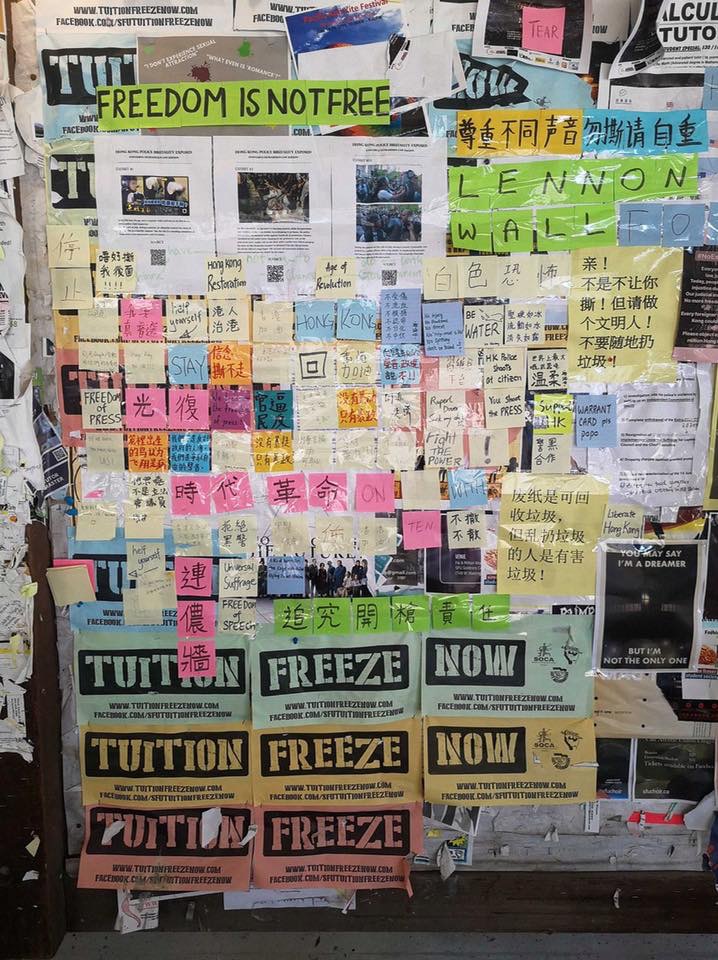
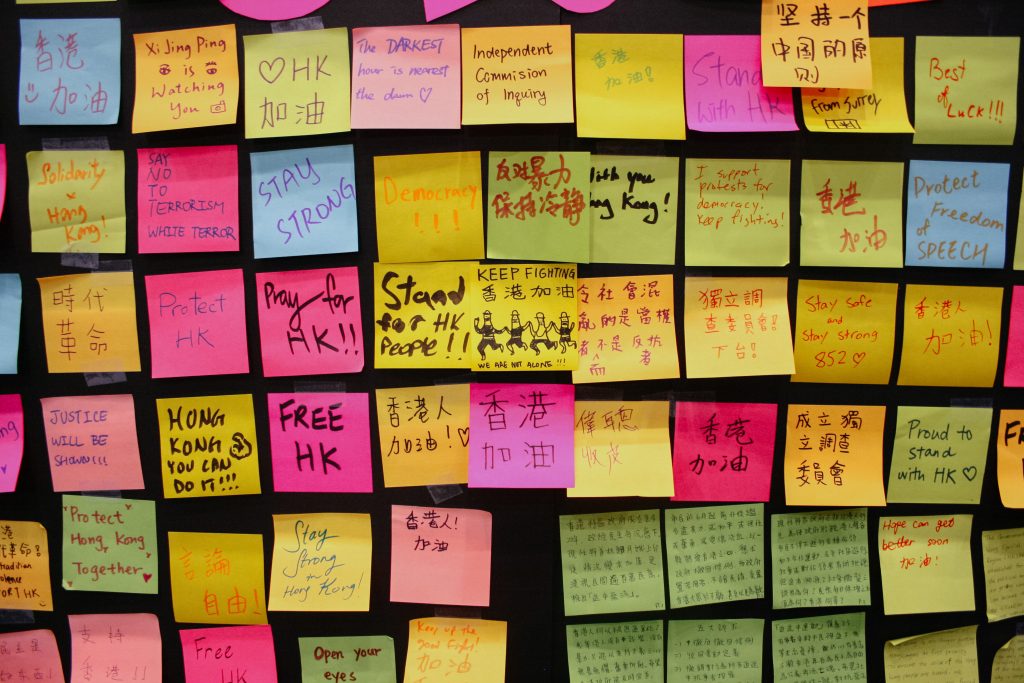
The Lennon Wall represents a place of solidarity and support for democracy in Hong Kong. Photo by: Zeh Daruwalla / The Peak

Where can we, Hongkongers, speak?

In early August, a group of Hong Kong students created a “Lennon Wall” of solidarity on the message board outside of the Bennett Library. They hoped to provide a platform for others to share their support and thoughts with the protestors in Hong Kong who are protesting against the amendments of the Fugitive Offenders Ordinance. However, messages on the board were repeatedly vandalized and ripped up until the SFSS erected a new wall outside of their offices where it could be protected. 

Similar incidents happened at the University of Queensland, Australia, ending with a violent altercation between pro-Hong Kong students and pro-China students. 

White terror (a feeling of fear produced by anonymous acts of political repression) and state terror make it more difficult day by day for people in Hong Kong to speak out for their democracy. It is important for Hong Kong students studying in Canada to have a place to peacefully protest on behalf of their homes.

China is able to exert its hegemony and oppression over people, even across oceans. The state seeks to generate blind Chinese ultranationalism and disinformation in order to manipulate its citizens and their emotions against people with different opinions. This traps Chinese expats in an ideological fantasy that embodies the oppressive policies of their government, abroad.

China also induces white terror through economic means that force corporations to obey the regime. Cathay Pacific and the Hong Kong and Shanghai Banking Corporation are recent examples of how transnational firms surrender to the demands of the Chinese government due to their business relations with China. Executives and employees are being fired or have resigned because of actions carried out during time-off or because of things said on personal social media. This subsequently triggers a massive personnel change that moves pro-government, pro-China employees into these positions, and signals to locals and expats alike that their livelihoods are on the line — should they speak out.

The Hong Kong government is, of course, just as culpable as they try to shut our mouths by generating state terror through the use of force and police brutality. Police have labeled protesters as cockroaches, have treated apprehended individuals in an inhumane manner, and have carelessly deployed tear gas, pepper balls, and bean bag rounds. These instances have resulted in multiple injuries, including the loss of an eye suffered by one woman who was shot point blank in the face by a bean bag. And this does not even begin to address the rumours of torture carried out by the Hong Kong police behind closed doors — rumours strengthened by the fact that the police have a history of this kind of behaviour.

As we Hongkongers struggle to speak, the Hong Kong government has given up trying to communicate back by disregarding the multiple appeals of protestors despite two months of protests. Perhaps the government is trying to create an illusion that they are an ineffective one, providing a seemingly lawful excuse for the Chinese government to intervene. 

There is clearly no easy way out. However we can, as students, make the effort to understand the situation a little better. We could take a look or even share our thoughts on the new Lennon Wall at the Maggie Benston Centre. It is a symbolic gesture, one meant to reflect on a place where the freedom to speak a diversity of opinions is shrinking, bit by bit.         


How post-it walls sparked protests: What you missed with the SFSS, Lennon Walls, and students supporting Hong Kong

0
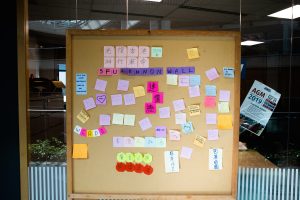
The first iteration of the SFU Lennon Wall outside W.A.C. Bennett Library, made by SFU collective/ Photo: Anonymous SFU Student

On Friday, August 2, the SFSS uploaded a Facebook post announcing their decision to host a Lennon Wall in Maggie Benston Centre in support of SFU students voicing their solidarity with Hong Kong protesters. 

Yet, students may have missed previous post-it walls that went up earlier this summer outside of W.A.C. Bennett Library, and in the AQ Hallway — many were ripped and torn down. 

The first iteration of the SFU Lennon Wall outside W.A.C. Bennett Library, made by SFU collective/ Photo: Anonymous SFU Student

“Last week, several members of the Hong Kong community wrote encouraging messages of political and emotional support on a poster wall,” said Jeffrey Leung, a fifth-year computing science student and former SFSS director, in a Messenger interview with The Peak. The phenomenon of “Lennon Walls” at SFU were inspired by a local activist organization, Vancouver Hong Kong Political Activists. According to an email sent by an SFU student, who wished to remain anonymous, the Lennon Walls were made to feature supportive messages and stand in support of Hong Kong protesters. The Lennon Walls outside of W.A.C. Bennett Library and in the Academic Quadrangle were considered the first iteration of the SFU Lennon Walls. 

“Soon after, [anti-protesters] tore down the messages to prevent the freedom of speech of the Hong Kong community, saying that Hong Kong should submit to China’s control,” alleged Leung. SFSS Vice-President of University Relations, Shina Kaur, corroborated Leung’s reports of vandalism in an email interview with The Peak. 

“There were then successful attempts to tear down the posters and defame the sticky notes three nights in a row,” Kaur wrote. 

Remnants of the first iteration of the SFU Lennon Wall / Photo: Gudrun Wai-Gunnarsson / The Peak

“I believe this happened because of the anonymity that is available with the bulletin board, since it is tucked away [sic] people are aware there are no consequences for writing something negative or tearing down posters,” she said. 

Screenshots provided to The Peak by the aforementioned anonymous SFU student show a WeChat group chat entitled “SFU选课+找友+二手. . .” which contains over 400+ users. Hostile messages are shown in the screenshots which show several users speaking urging others to tear down Lennon Wall posters and signs. 

Following the tearing down of the  Lennon Walls at both locations, various SFU students sprung into action. 

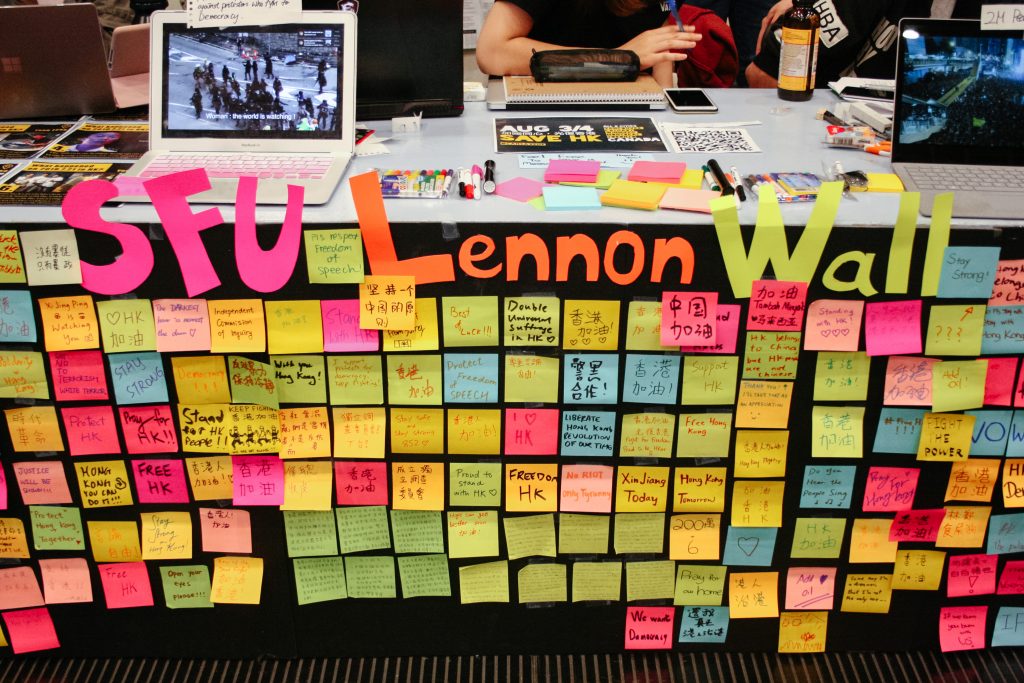
The second iteration of the Lennon Wall was created on Wednesday, August 31, 2019 by a group of Hong Kong students, who were not affiliated with an official group. Located in the AQ, students set up a booth, laptops, and signs with information about the Hong Kong protests. More notably, there stood a mini-wall of colourful post-its, many voicing support for the protesters, both in English and Cantonese.

The second iteration of the SFU Lennon Wall inside the Academic Quadrangle hall, table comprised of Hong Kong students / Photo: Gudrun Wai-Gunnarsson / The Peak

According to one of the students manning the booth, who asked to be anonymous, the group’s efforts all began with a Telegram group chat — Telegram being a popular Asian messaging app. 

The student asserted that their main goal for this table was to not only provide support for Hong Kong students, but also to raise awareness on the Hong Kong protests. The students coaxed students of all backgrounds to write something for their Lennon Wall. 

“Just be respectful, I encourage you to post anything onto the wall,” they said.

In an interview with The Peak, the aforementioned student wanted to emphasize that their motives for making the Lennon Wall were not political in any way. 

“The purpose we are here not to raise a political stance because we come out after the Yuen Long attack,” they began. The Yuen Long Attack was a July 2019 incident wherein masked men attacked Hong Kong train-goers. 

This photo was taken on
the second day of the Hong Kong students’ tabling / Photo: Gudrun Wai-Gunnarsson / The Peak

“I don’t want some of the people, from mainland China or different country, they are saying that we are doing [this] for the Hong Kong independence, that [is] totally false,” they continued. “We are not doing [this] for any political issue, or even [the] independence of Hong Kong, just for the human moral.” 

Another student who acted in reaction to the first Lennon Wall’s defacement was fourth-year communications major Kayli Jamieson. She approached various SFSS members about installing a Lennon Wall at SFU. 

“I added Giovanni [HoSang], Shina Kaur, Jessica Nguyen, and Christina Loutsik to a group chat on Facebook and sent them a very long paragraph [. . .] presenting the background of the issue as well as the proposal for the idea of having a designated official wall provided by the SFSS that can’t be torn down,” Jamieson wrote in a Messenger interview with The Peak. 

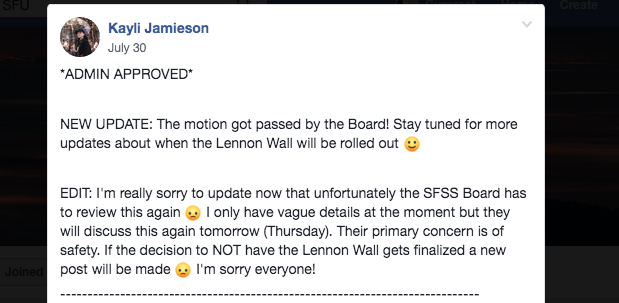
However, the motion to approve the board was brought to a halt when concerns about safety were raised by staff who would be monitoring the rolling board. A board development session on August 1 then turned into an emergency board meeting to address the Lennon Wall immediately. This meeting occurred despite an earlier announcement on the Facebook group “Must Know Courses at SFU” by Jamieson stipulated the board’s approval.

Screenshot via Facebook courtesy of Winona Young

“After hearing [safety concerns], the SFSS decided it was best to put the project on hold until we had conversations with Campus Public Safety and the rest of the tenants in the Maggie Benston Center,” Kaur told The Peak.

“We wanted to ensure this was implemented with safety in mind for everyone involved. During that time we were also able to convene a board meeting and get an official stance of the society supporting freedom of expression.”

On the afternoon of August 1, Leung even made a brief appearance at the impromptu board meeting, and spoke on the Lennon Wall’s importance. 

“[The SFU Lennon Wall] is a place of support and community which was attacked,” Leung said. “Bringing it back shows that freedom of speech cannot be suppressed, and shows China that the world is watching.”

The third iteration of the SFU Lennon Wall created by the SFSS, still available outside the SFSS Office in Maggie Benson Centre / Photo: Zeh Daruwalla / The Peak

Soon after, the SFSS announced via Facebook that the Lennon Wall would be unveiled that Friday, August 1. 

Kaur told The Peak the SFSS strives to support SFU students’ right to express their views safely and their condemnation of threats against supporters. These reasons were what swayed the board to approve the Lennon Wall. 

“This Lennon Wall is a way to protect the right of free speech and political debate without intimidation,” Kaur said. 

“We hope to continue an ongoing sense of comfort for the SFU student population to approach The SFSS with their concerns and allow us to support in the ways we are able.”