Home Blog Page 467

What students need to know about the possible TransLink strike

0
Photo courtesy of Vancouver Sun

UPDATE, 10/31/2019: The first phase of the Metro Vancouver transit strike is set to begin Friday, November 1 as a partial strike—with workers refusing to wear uniforms or work overtime.  

Have you ever watched bikers, joggers, or hikers make their way up Burnaby Mountain and thought, “wow, I can’t believe people actually do that”? 

Spoiler alert: that might be all of us as the potential of a TransLink strike looms over Vancouver, as the Coast Mountain Bus Company and Unifor butt heads. 

The contract covering over 5000 TransLink workers expired on March 31 and workers were left without a contract for months as their union and employer negotiated. Negotiations to produce a contract broke off on October 9, and on October 10 workers voted 99% in favour of giving their union a strike mandate, which has set the city abuzz.  

The last time Vancouver’s transit workers striked was in 2001, leading to a 123-day strike that broke provincial records. While a repeat just in time for midterms isn’t on any student’s wishlist, understanding the key issues at stake for TransLink workers is crucial to understanding just how important this possible strike is. 

The union representing over 5000 transit operators, Seabus workers, and maintenance staff is Unifor (locals 111 and 2200, respectively). According to the union’s website, they are “Canada’s largest private sector union, with more than 315,000 members across the country, working in every major sector of the Canadian economy.” It emerged in 2013 through a merger of other unions. Other TransLink workers are represented by other unions — meaning that a strike wouldn’t impact all of TransLink. In 2001, for example, SkyTrains remained open. 

The good news for the student peasantry is that if negotiations truly fail between TransLink and Unifor, workers have to give 72 hours’ notice before striking  — giving everyone a hefty heads up. Labour negotiations are called collective bargaining.

The other important thing to remember is that a strike mandate only means that a strike could happen, not that it will happen. Think of a strike mandate as a permission slip given to a union by its members to openly discuss, plan for, and leverage a strike. In 2016, for example, 98% of workers voted in favour of a strike — but a new contract was negotiated and accepted before the strike actually took place.   

Even in the event of a strike, a full walkout isn’t the only possible outcome or action that the union could take. Also worth noting is that there are different types of strikes — workers could opt for a partial walkout, a slowdown strike . . . 

Furthermore, TransLink workers are aware of the potential impact this strike may have. Students and low-wage workers are cited as particularly impacted demographics by Balbir Mann, president of Unifor Local 111.  As Local 2200 President Mike Smith said in one of Unifor’s official statement:“Our members know that the public relies on them and it is our sincere hope that Coast Mountain comes back with a serious offer to avoid strike action and inconvenience to transit riders, but we are determined to obtain a fair deal for the workers.” 

And what are the issues that workers want to see? 

One of them is safety: increased ridership places more stress on drivers and affects their working conditions. Workers are hoping to see more and longer break times. As the Western Regional Director of Unifor, Garvin McCarrigle, told Global News, drivers’ breaks are measured in minutes between routes. Aside from being exhausting and unpleasant, this leads to overworked workers which is a safety issue. As a side note, while we’re on the issue of safety, according to a Unifor statement from July, WorkSafe BC claims involving assaulted transit workers are routinely denied. 

The union is also looking to secure wages competitive with those other Canadian transit operators, hire more drivers to support TransLink’s expanding infrastructure, and reduce overcrowding on buses. 

While overcrowding and congestion may seem like petty annoyances to riders, for transit workers they create further work and safety concerns. Unions report that overcrowded buses increased by 36% between 2016 and 2018 alone. Back in May, Unifor encouraged its members to take part of the #CureCongestion campaign to address overcrowding — showing how long these issues have plagued workers for. 

The fact that TransLink is in the midst of an expansion at the moment is exasperating the concerns of Unifor members, according to the union, and making these negotiations unique and particularly impactful.  

Union representatives have reported that preliminary negotiations are going well. As the Western Regional Director of Unifor Gavin McGarrigle told CityNews, “We’re starting to make some progress, although it’s slow at this stage.” Given upcoming negotiations scheduled for October 24, 25, and 28; McGarrigle estimates that any strike announcement would come after October 28. 

Personally, if there is a complete walkout that paralyses our public transit, I’ll be doing my best to keep in mind that while it’s an inconvenience to me, not having a contract, proper compensation, or safe working conditions is a bigger inconvenience for TransLink employees.

New U.N. study reveals that only sustainable source of protein is eating the rich

0

In view of soy fields eroding soil worldwide, eggs violating poultry rights, and tofu being too moist for comfort, the World Health Organization (WHO) has determined that the only truly sustainable source of protein is eating the rich. 

Their recent report has been endorsed by the world’s leading nutrition and labour studies experts, including acclaimed Hungryan sociologist Dr. Pooria Ündurfedd. The Peak spoke to Dr. Ündurfedd via Skype to learn more.

“We wouldn’t be in this mess if everyone could just keep eating red meat without worrying about cow flatulence, or if millennials weren’t forced into veganism to desperately attempt warding off a Mad Max: Fury Road apocalypse scenario,” Ündurfedd said. “But here we are, in a climate crisis, scrambling for meat alternatives. My team figured that if corporate greed and environmentally negligent industry has gotten us here, maybe they’d be the solution. 

“Like poetic justice, but culinary.” 

The United Nations admitted in their final report that they were concerned about the socioeconomic consequences of their findings, and waves have definitely been felt worldwide. 

Multi-billionaire Zark Mukerberg attempted to hide out in the underground bunker he had prepared for the upcoming nuclear apocalypse, the construction of which was facilitated by his award-winning social media platform. However, as the CBC (Comrade Broadcasting Company) recently reported, his team of manservants turned on him and devoured his flesh after lightly seasoning it with olive oil and smoked paprika. 

More locally, Gill Bates was recently found in Vancouver, feigning poverty by living in a basement suite and shopping at Walmart. He was identified after asking a customer service associate in which aisle the caviar was kept. Bates was not destined for the delicacy he craved; instead, an angry mob of overwhelmed parents, extreme couponing enthusiasts, and university students turned Bates himself into a delicacy.

As a result, governments across the globe are crashing; lobbyists are no longer funding their operations. Only one government remains: the Simon Fraser Student Society (SFSS), which reports a dramatic decrease in the use of its emergency food bank.  

“For the first time, I feel full,” said fifth-year English student Annie Belle Lecter, who had been subsiding on a diet of instant oatmeal and soda crackers since moving out of residences in second year. “I’d worry about the price my immortal soul would eventually pay for cannibalism, but since it’s endorsed by the U.N., I think I’ll worry about midterms instead. It’s so much easier to study on a full stomach.” 

Another student, Virginia Jameston of the Beedie School of the Culinary Arts, similarly welcomed the report. 

“At first I was a little bit unclear about the legality, but since my student union has turned into a hunting party, it would have been irresponsible of me not to join in. I was the treasurer up until the dollar was abolished.” 

Health Canada, which is now staffed entirely by former minimum wage fast food workers, has announced plans to re-review its food guide to ensure that Canadians incorporate adequate quantities of Beff Jezos in their diets. 


SFSS, GSS host federal election debate at SFU

1
From left to right: Svend Robinson (NDP), Terry Beech (Liberals), Amita Kuttner (Green) appear at SFU for the debate

SFU Burnaby campus hosted a federal election debate for the Burnaby North-Seymour riding on October 7, 2019. Candidates in attendance were Svend Robinson (NDP), Terry Beech (Liberals), and Amita Kuttner (Green Party). Heather Leung (Conservatives) was not in attendance, despite repeated invitations from organizers. Leung’s candidacy was terminated by the Conservative Party the day after the debate due to a history of homophobic comments.

A crucial theme of the evening was equity for marginalized groups across Canada, with the three candidates speaking about Canada’s current and historical shortcomings in terms of diversity. These issues were particularly personal for Robinson, who, back in 1988, became the first openly gay MP in Canadian history, and Kuttner, a nonbinary trans person of colour. During the debate, Kuttner noted that the Conservative party’s platform would erase their rights altogether, especially with candidates like Leung being allowed to represent the party. When approached by The Peak, Kuttner urged to voters that “getting involved in the political process and [at minimum] voting is the real way that we can create the world that we want. I say vote Green because I’m going to overhaul the whole system and talk about things that have never been addressed like intersectionality and institutionalized racism. . . I have experience in those areas.”

This theme resonated with the students in attendance too. The Peak spoke to Bella Aung, an attendee of the event, who said “even though one of the main topics that they are debating about is climate change, I think what is happening to our planet is actually deeply intertwined with systems of oppression, colonization, patriarchy, and exploitation of Indigenous people and people of colour in Canada. I would like the candidates to be aware of that and include the marginalized voices.”

At the mention of representation within the different federal parties, Robinson criticized the Green Party and specifically highlighted the lack of diversity in their MPs. In their rebuttal, Kuttner noted that, “diversity statistics are not the same as inclusivity. Quotas do not mean the same thing as a welcoming community. Every single party is racist. We all have our problems. We can’t hide behind the numbers to deal with the true issues.”

When asked what more the federal government should be doing to combat climate change, all candidates had ideas. 

Beech began by stating that his government has done more for the environment than any in Canada’s history, which he described as a “down-payment” for the future. He named some of the government’s achievements, such as amendments to the Ocean Act and other wildlife endeavours. Notably, Beech initially did not mention the controversial purchase of the pipeline expansion by his government, despite it being a point of controversy in the Burnaby North-Seymour riding particularly. 

For Robinson, however, the Liberal government is doing nowhere near enough. He demanded a new Green Deal that immediately ends the expansion of the pipeline and eradicates fossil fuel distribution that negatively affects the environment. Kuttner said that the Greens are the only party that has a plan to reduce carbon emissions by 60%. According to Kuttner, this is what the Paris Agreement targets demand for the reversal of the climate crisis.

A discussion followed about reconciliation for missing and murdered Indigenous women. Following this, each participant spoke on the government’s shortcomings and what should follow.

In addition, each candidate said that all recommendations of the National Inquiry into the Missing and Murdered Indigenous Women Report must be implemented.

“I think it really highlights the lack of equity we have in our country both in terms of racial discrimination and racism, as well as in terms of gender,” Kuttner said. They stated there is a need to admit Canada’s history of genocide and a need for introspection by the government.

Beech said that an untraditional form of empowerment is necessary. He believes this should entail “the security of the person and that ability to invest in yourself before you can be successful.” According to Beech, many Indigenous people are living in third-world conditions, rural areas unrecognizable as parts of Canada. Beech added that the Liberal government has already invested a “historic” amount into Indigenous communities and hopes to do more with another Liberal government in the next cycle.

The evening also covered electoral reform, foreign affairs, and more localized concerns like the cost of tuition for post-secondary institutions. Kuttner and Robinson agreed that free tuition lends itself back into the community so that funds can be distributed elsewhere. Beech argued that this would hinder the quality of education offered for students.

“This is a world-class education. You do well at Simon Fraser University, you are prepared for the world,” Beech said. He argued that free tuition does not solve all the issues of students and the idea of implementing a free post-secondary experience should be reconsidered.

Robinson countered that free tuition’s viability is a matter of the federal government’s priorities. “There are resources available. . . it is not going to happen overnight, but it is an absolutely critical objective. Robinson adds that progressive taxation would help to address the issue of funding for things such as free tuition. “For example, capital gains taxes: the top one percent of the population gets 88% of the benefit of capital gains taxes. Let’s put some of that into post-secondary education, as well.”

All of the candidates had similar comments on the importance of participating in democracy. Beech said “if you take [ . . . ] all the 20-year-olds, all the 30-year-olds, even all the 40-year-olds, if all of them got together as a block and picked their candidate, they could have a majority government, focused on their issues entirely. If you think your vote doesn’t matter, you’re wrong.”

Robinson also commented about why he believes it’s important for students to vote. “I think it’s the most important election in our history, and if you’re concerned about the future of the planet, the climate crisis, if you’re concerned about affordable housing, if you’re concerned about student debt, tuition fee increases and so on, this is the place to be. . . I think it’s great that SFU is hosting this event.”

Near the end of the night, an audience poll was taken of whether the event helped attendees decide their vote. To this question, asked near the end of the event, the majority of the crowd had voted yes.

Voters can register at the Elections Canada website. Election Day is October 21, 2019.


Election resources for the new voter

0
Vector Images

With Election Day coming up on October 21, many of us are preparing to vote for our first federal election. And while that’s pretty exciting, it’s also really nerve-wracking. We’re making decisions that will uphold our democracy, and eyes are on us to show up at the polls. 

Global News recently reported that Millennials — which they defined as people born between 1980 and 2000 —  will “make up the biggest voting bloc in the federal election.” Igor Korbaciz of Abacus Data, which provided the data on the potential impact of millennial voters this election, says, “I do feel comfortable saying there is nothing I see in the data today that suggests that they will be as motivated to do so as they were in 2015.” 

So where do we start? The Peak has published a cheat sheet for useful voting information that I encourage you to check out. This article gives you a basic rundown of how our elections work and how you can register to vote, as well as some more useful resources to help you make your decision.

What Party Are You Interested In?

Vote Compass

As mentioned at the bottom of the cheat sheet, if you’re not too clear about where you align politically, CBC has an assessment to help you decide.

Vote Projections for Each Riding (AKA: Who’s Who in My Riding?)

This website provides an interactive map and legend for what the projected vote looks like in each riding. The rest of the website also predicts the odds of what party will win the most seats and updates quite regularly. It can definitely be helpful to know how your community might vote. I live in the Coquitlam-Port Coquitlam riding, and Port Coquitlam historically favours NDP candidates (though the North side of Coquitlam tends to vote in favour of the Conservative party). Because of that, I’d be more likely to check out Christina Gower’s platform as she is the NDP candidate for the riding.

What are the Parties’ Platforms?
There are five official parties in Canada: the Liberals, Conservatives, the NDP, the Green Party of Canada, the Bloc Québécois and. . . the People’s Party of Canada. The respective platforms of the parties will give you a good sense of what they are committing to.

If you’d like to compare all the parties’ takes on issues that you care about, CBC and Maclean’s have listed the official parties’ platforms by the way they’ve addressed key voting issues. These can be sorted by ones that are relevant to you, like by education and jobs, for example.


Get to Know Your Party Leader!

The Federal Leaders’ Debate on October 8 (English)/ The Federal Leaders’ Debate on October 10 (French, with English Subtitles)

I would suggest watching the Federal Leaders’ Debate if you haven’t checked it out — it’s still available on YouTube. While speaking ability and charisma isn’t a determining factor in your vote, it’s useful to watch the debates to see how the leaders respond to the debate prompts based on key voting issues. This will help give you a sense of which party leader you resonate with. 

Leader Meter

Leader Meter measures the approval ratings of the five official party leaders, taking statistics over time. It’s frequently updated, so if you’re wondering about what kind of support a leader is getting after a debate, check it out.

Fact Check
Though this can be generally directed to the parties rather than their leaders, this section of CBC is focused on giving quick run-down on whether the leaders are making sound claims. If you think a candidate said something fishy, it doesn’t hurt to check here.

Neat Guides to Follow Along During Election Season

All the Canadian Politics!

I’ve been following this blog for years, and I highly recommend browsing it this election season. This is a left-leaning politics account that frequently updates in newsletter-style posts. The author, Tynan Phillips, is quick to answer questions and direct people to resources if they would like to find out more. 

The Globe and Mail Canadian Federal Election Guide

This is an organized guide that gives quick summaries of the official party leaders, where to watch the debates, and frequently updates with the latest campaign news.

Election Podcasts

If you don’t think you have enough time to follow the election, then it’s a good idea to check out some podcasts that are discussing the election. The website recommends five podcasts to help you get caught up on election news.


Lastly, If You Need to Check Anything At All

Elections Canada

Elections Canada runs the federal elections and is your best bet for any remaining questions you have about voting procedures. If you’re not sure of where you’re voting, whether you’re registered, or what your riding is, please check the Elections Canada website. 

Your weekly SFU horoscopes: October 14–20

0
An illustration of a girl with long flowing hair. Astrological signs and stars shine around her.
ILLUSTRATION: Marissa Ouyang / The Peak

Aries — March 21–April 19

Victory will be yours this week. No matter the cost. You might end up in some conflicts because of that. But if your friends can’t handle how trash they are at Catan, the fault isn’t yours. It’s SFU Board Games Club’s.

Taurus — April 20–May 20

Damn, babe . . . you look good this week. If this were 1873, farmers on the Fraser River would lobby the provincial government to carve out an expensive and very inefficient trail connecting Lillooet and North Vancouver, all just for you. 

Gemini — May 21–June 20

You might be uncertain about how many different personalities to compartmentalize yourself into this week. This is another week where you’ll want to keep it to an even TWO. Be the you who you describe in your resume and the you who lied about your leadership skills on your resume. 

Cancer — June 21–July 22

Looking for another emotional experience you and your partner can explore together? Make an appointment with a discourse analyst. When she mentions to your lover that you are a “highly effective storyteller,” don’t panic. Ton cher is unlikely to get suspicious about your salacious past at Nesters Market, not this far into the relationship.

Leo — July 23–August 22

Don’t commit to any party invites this week. A Halloween party thrown on the third weekend of October is not a Halloween party. It’s just socially accepted LARPing. And you can do better for escapism — after all, you’ve done so for years.

Virgo — August 23–September 22

Lying comes a little too comfortably these days. Take a step back. Remind yourself that just because you can manipulate people into thinking Galiano Island is a United Nations fabrication, it doesn’t mean you should. 

Libra — September 23–October 22

Elevators are a danger this week. Take one and you may find yourself trapped in a small metal box with an elderly person who demands to know what language you speak. And your Broca’s area will start to melt once they inevitably begin to argue with you about your answer.

Scorpio — October 23–November 21

You might spend this week . . . vibing? With other living organisms? It’s quite shocking. You already get along OK with slime moulds and mushrooms (only in your pasta though); now you might smile at a patch of moss on a rock. With any luck, you might go so far as to expel from your mouth a friendly syllable for a puppy therapy dog.

Sagittarius — November 22–December 21

Accept his apology? Never. His excuses are so half-baked that you could find them on a dinner menu in a hotel in Calgary, ridden with malignant e. coli. And as soon as you find yourself relating to the Albertans, you’ve already lost. 

Capricorn — December 22–January 19

Go to office hours this week. Your need to clear up a few things from the course readings with the prof. It won’t do if he keeps getting the facts wrong in his lectures.

Aquarius — January 20–February 18

Drop your current flirtationship. It’s getting too high maintenance. A relationship with this bae would be like dating the Coquihalla Highway: rocky, uncomfortably long, and demanding your full attention. And there are too many other things you care about more, like other, cuter Bumble matches or voting. 

Pisces — February 19–March 20

Skip 23andme.com this week. The truth will deep-fry you. You don’t need to know that you’re distantly descended from one of the spoiled slabs of tuna sold in myriad Canadian markets during the 1985 Tunagate scandal.

A cheeky deBRIEF on wasting your best undies on a boring day

0

Victoria’s Secret is out: today, my high hopes were crushed by an overwhelming sense of mediocrity. The day was so bland that I know — or rather, I should have known — that some granny panties would have done the trick. 

If this day were an actor, it would be Nicolas Cage. If this day were a meal, it would be a fine selection of day-old white bread dipped in lukewarm water. But the worst part of it? I wore, and therefore wasted, my Favourite Pair™ of underwear on it.

This undergarment decision was not even for validation from some “here for a good time, not a long time” bio-wielding Tinder hook-up that I chose out of mixed self-hatred and boredom. Panties like these are for my own self-confidence, my own pleasure when I remember that under these Old Navy jeans resides a brand of bad bitchery that I rock for myself. 

Lace is not for the faint of heart. It is not for that Tuesday when you have the same leftover pasta for lunch and dinner — except that the pasta isn’t quite microwaved right, resulting in a texture reminiscent of the eraser on a pencil’s rear. Lace sets expectations that, if let down, result in utter, complete, overwhelming devastation.

If my body is a temple, then this sweet lace is the gold embellishments of the inner shrine.

According to the Daily Mail, our base chakra lies just where our underwear sits on our bodies. This piece of cotton, more than an article of clothing, is a symbol of success, a harbinger of the energy for the proceedings of the day, a silent anthem muted beneath pants. 

Black, grey, and white undies fail the vibe check. That cheeky aqua pair, though . . . that may just do the trick to get over an ex. Polka-dots? Iconic. Floral patterns? Swoon. Tie-dye? M . . . maybe. 

Whatever your poison, we all have our favourite pair that has been there for us when nobody else was. The wild paradox of covering up our bums, that unifying moment when fabric meets skin, becomes like an intimate, liberating contract with the self. To dedicate such a perfect pair of underwear to this particular day raises my spirits. It gives me more hope than Trudeau did when he first graced us with his charismatic smile and dreams for Canada back in 2015. It sets me up to be let down harder than I let down my team for a group project.

The belief that today will be exciting enough for hot pink panties to grace the scene leaves me devastated when the world does not follow suit. I mean, I will get over it. But only after laundry days: that is, laundry day plus the many days where the pile of freshly laundered items sits on my chair instead of in my dresser. I’m talking weeks of my life stunted by a day of plainness, of the boring, the underwhelming, the bland. Such a day left my favourite pair tapped out for a time. 

If this is my punishment for being the least bit idealistic, holding onto some shred of optimism to glimmer from inside my typical shrewd cynicism, then shame on me. Shame on me and my underwear. 

What a shame, indeed.

How to break up with a classmate

0

So you’ve decided you’re done. His constant gaming and chronic lack of hygiene are just too much for you. You need your freedom. You deserve to be happy. But there’s one tricky little thing getting in the way of it: he’s in all of your classes.

You thought it would be nice to share a schedule. You’d go on cute coffee dates to work on homework together; you’d make a new group of friends in your department; you’d shit-talk your professors while catching up on Stranger Things . . . But you never went on those coffee dates, and people avoided you because you were a couple, and, for whatever reason, he actually kind of liked your professors. And now you need out. 

Fortunately for you, this isn’t the first time something like this has happened. The collective pool of undergraduate knowledge has solutions for this. Here are four easy and effective strategies you can use to break things off with a classmate:

1. Ghost him

A classic. Act as if he quite literally. does. not. exist. When he comes to sit with you in lecture, pay no mind to his hey, babe or his got any snacks? Keep taking notes. Change seats if you’d like. Look past him as you scan the room for nothing in particular. He will get the idea eventually. Ideally, he may even break up with you. After all, problems do go away if you ignore them hard enough. 

2. Destroy his reputation

As Sun Tzu once wrote, one must work smart, not hard. Instead of confronting your partner head-on and risking total emotional injury, the intelligent play would be to ruin his reputation among your classmates, thereby rendering him unable to attend class. This may be achieved in a number of ways, including telling the professor your beau is currently working on a wonderfully disparaging Rate My Professors review of them; notifying the girls of the class that they may soon be immortalized in doll form (he just can’t help himself sometimes); openly discussing the time you caught him eating out of the garbage in the W.A.C. Bennett Library. Before long, he will be too embarrassed to show his face around you. 

3. Frame him for plagiarism

Your soon-to-be ex can’t bother you at school if he no longer attends the institution. What you’re going to want to do is take one of his assignments — preferably, an essay — and insert material borrowed from relevant professional sources. Adding it to the middle is usually best, so he doesn’t notice. But realistically, he isn’t even going to proofread his work, so feel free to use your own discretion and throw it in wherever you like. Make it big enough for the ensuing penalty to, at the very least, result in removal from the course. Expulsion, of course, is the true goal. Do this as many times as necessary. 

4. Talk it out

The boring option. In this scenario, psychiatrists or whatever would probably tell you that the healthiest thing to do when separating from a partner is to clearly outline what went wrong, why you feel dissatisfied with your relationship, and how you plan to move forward independently. They’d probably tell you, too, that this is the “most responsible option” or that “everyone deserves closure” or something. Again, boring. 

Break-ups are hard — there’s simply no way around it. But they don’t have to be that hard. The next time you find yourself fretting over having to end with a classmate, just remember these four totally moral, totally fuss-free methods. He’ll never know what hit him.

SFYOU: Alumna Yvonne Hanson takes her environmental and humanitarian activism to the federal campaign

0
Photo: Yvonne Hanson

Name: Yvonne Hanson 

Pronouns: She/her/hers

Department Affiliation: BA, Political Science

Hometown: Squamish, BC 

Occupation: NDP candidate for Vancouver-Granville, portrait photographer, customer service worker at a garden store. 

Only one year after graduating with her bachelor’s degree from SFU, Yvonne Hanson became Vancouver-Granville’s NDP candidate. If elected this October, Hanson would be the youngest female MP in Ottawa. When Hanson walked across the convocation stage, she had no idea she was going to be running for office this October. Although she had been involved in previous campaigns as a volunteer, she had intended to gain more experience working on campaigns and with the city before considering a run of her own. 

I went to visit Yvonne at her campaign office on 1067 West Broadway and had a chance to interview her before we went out canvassing around the neighbourhood with her and several other volunteers. Yvonne led me to her office, which, at the time, was cluttered with campaign supplies. She expressed glee over the fact that they had finally acquired a proper desk. 

Hanson attributes her experience at SFU as one of the key factors in her feeling completely equipped and prepared for this election campaign. Involvement with the SFU NDP Club helped her keep up with changes within the party while allowing her to form connections with people who are now supporting her campaign. 

“You know,” Hanson said, “before [my education] I had a loose idea of what I believed in, but I didn’t really understand how multiple different issues kind of intersected with each other.”

One of those values that became evident as we talked was climate change — which shines through in her platform and decision to run. 

“Given the gravity and immediacy of the climate crisis I figured we don’t really have another 10 or 12 years for me to wait until the perfect moment to start running. So that’s why I’m here now, doing it so soon,” Hanson expressed with a determined look on her face. 

Between graduation and the time she decided to submit her candidacy, Hanson was busy pursuing activism in a big way. Much of this included climate change activism, but she was also involved in the Voice of Ituri project, which aimed to facilitate independent journalism in the midst of the humanitarian crisis occurring in the Democratic Republic of Congo.

“Right now, the news outlets are all government-run or otherwise corrupted by misinformation. So the project basically helps journalists get in and give information, as well as helping to disseminate technology to help raise awareness of the crisis in the outside world,” Hanson explained passionately. 

Outside of SFU, it is through her work in activism that she learned the most about her beliefs and how they translate into politics and leadership. It was, coincidentally, during an activist meeting, that she discovered there would potentially be no NDP candidate in Vancouver-Granville. 

“My core fundamentals have been shaped by my place in the activist movement and seeing [things] like how the lack of housing justice in our city affects people firsthand,” Hanson said.

“Talking to people being evicted down in Oppenheimer Park and hearing these stories about being in shelters, being shoveled around SROs [single room occupancy units], and treated like animals instead of people, like problems instead of people [ . . . ] that has definitely galvanized my will to fight really hard and not compromise on things that I believe in.” 

These convictions solidified through her experiences in both environmental and humanitarian activism, and they have given Hanson drive throughout the campaign. Hanson registered her name on the ballot to become the NDP’s candidate over the summer, and this was only the beginning. She has been canvassing and putting in campaign hours, both in and out of office, six days a week with her team of volunteers ever since. 

Hanson recalls how she felt in the moment when she found out she was officially running in the riding, which was a surreal experience for her.

“I remember the moment after I was vetted and the other person who was considering running in this riding had a conversation with me and then pulled out, I was like wow, okay — I’m in.” Hanson said.  “It’s sink or swim now, there’s no turning back.”

“I didn’t anticipate the broad spectrum of people who are inspired by the messages that our campaign and the NDP is putting out,” explained Hanson. “Particularly, things like the wealth tax and the Green New Deal are very appealing to a broad range of people.”

Hanson’s boldness has been compared to Alexandria Ocasio-Cortez by other press and associates. Observers point out that they both bring transparency and a streak of hope to the dire political scene.

“You can’t go halfway with justice and have it still be justice,” declared Hanson boldly. “I’m here to challenge the status quo and I’m very excited about that and, hopefully, I can make (AOC) proud.” 

After canvassing with Hanson for a few hours, I couldn’t help but feel utterly inspired by how she put on a blazer and a brave face, even when doors would slam in our faces. She would smile and move on to the next door without missing a beat. 

Once all the work was done, the campaign crew and volunteers climbed up to the rooftop of the campaign office and had a drink to celebrate a good day’s work and, of course, Hanson’s potential. Equipped with her extraordinary ambition, passion, and political knowledge, Hanson is ready to take the issues that mean the most to her, and the people, all the way to Ottawa.

Election rundown: Which party leaders participated in the climate strikes and why does it matter?

0
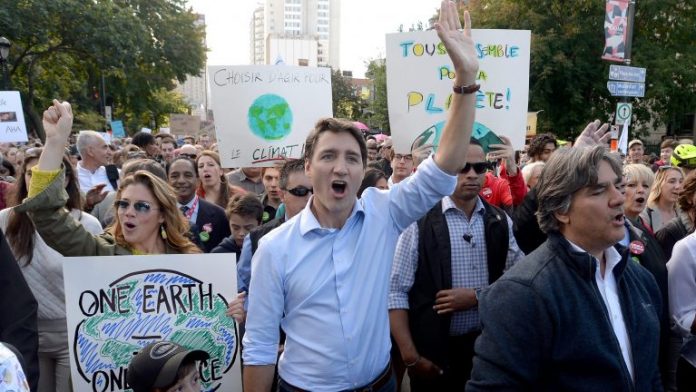
Justin Trudeau’s trouble climate history isn’t mitigated by his attendance at the climate strike. Photo: /CBC

On September 27, climate strikes were held across Canada as part of the larger global movement inspired by Greta Thunberg. Environmental policy has also become increasingly central in the Canadian federal election campaigns. Because of this, it is important to not just look at the platforms of the parties, but also the actions that they have taken prior to the election — including their participation in the climate strikes.

Elizabeth May of the Green Party attended the Montreal climate strike, publicly calling on the other major leaders to work together to develop a bipartisan response to the crisis. This went hand-in-hand with her party’s platform which discusses utilizing all government branches  to transition into a greener economy — including intergovernmental agreements to allow for new, greener jobs.

Justin Trudeau also attended the Montreal strikes after meeting privately with Greta Thunberg. Thunberg later spoke at a press conference saying that Trudeau’s government was “not doing enough.” Her disappointment rings true in light of the Liberal failure on climate change since 2015, which has seen Trudeau going back on many campaign promises and buying the Trans-Mountain Pipeline. While the 2019 platform lists climate change as one of their top issues, the lack of adherence to these principles after 2015 should be remembered going forward.

Jagmeet Singh, leader of the NDP party, attended the Victoria climate strike. Singh choose to walk through the crowds, speak one-on-one with the students, and keep the focus on them. He also discussed protecting our coasts, fitting with the NDP’s platform message.

Andrew Scheer chose not to attend any climate strike, despite being in Vancouver during the city’s 100,000 person event. Aside from opening himself to criticism by not joining in, Scheer’s absence has also raised new questions from voters and non-Party MPs alike about the supposed Conservative commitment to reversing climate change. 

Considering the fact that Scheer could be the next prime minister, it is important to know where he stands on such a critical issue. Climate change is going to be one of the biggest issues going forward. The Conservatives already have a small environmental platform, so having a leader who ignores public outcry on this issue is only hurting the party further. As we get closer to the election, important decisions like this could be enough to not only determine who becomes prime minister, but also how parties find themselves represented in the House of Commons. 

With a minority government appearing more and more likely, both the Liberal and Conservative parties may be looking to the NDP and Green party to allow them to create majority coalitions. Choices like avoiding the climate strike may cause both Singh and May to think twice before choosing what party to align with.