Home Blog Page 43

Vancouver mayor Ken Sim freezes construction of supportive housing

0
A sign outside on display of a caricature illustration of Vancouver mayor Ken Sim holding an apartment building upside down and dumping people out of it.
PHOTO: Gudrun Wai-Gunnarsson / The Peak

By: Lucaiah Smith-Miodownik, News Writer

Content warning: Mentions of racism, Indigenous displacement, and substance use.

On February 26, Vancouver City Council voted “yes” on mayor Ken Sim’s motion to freeze the construction of new supportive housing units in the city. As per the motion, supportive housing is designed for “individuals experiencing or at risk of homelessness and with severe mental health challenges and/or substance use disorders, including 24/7 on-site support services.” The motion, according to Sim, could help “encourage a mix of housing, businesses, and services” to come to Vancouver’s Downtown Eastside (DTES).

Specifically, the plan states that Vancouver will freeze any aid for new supportive housing, be it money or land, “until progress is made in increasing the supply of homelessness response supportive housing across the region.” This pause excludes fixing current single room occupancy and temporary modular housing housing. The Peak spoke with Fiona York, a longtime advocate for unhoused individuals, and Kaylee from Stop the Sweeps about this decision and its effects. Kaylee doesn’t share her last name for privacy reasons.

While the motion specifies that current single-room buildings in need of repair or replacement will be attended to, York said “there is no clarity” regarding where the residents can live during construction. “Some repairs can take many months or even years. And sometimes people [whose buildings are being repaired] are moved into other buildings or units, meaning those units are then unavailable for others who are in need of housing,” she continued. Such is the current nature of things for those unhoused — options are sparse. “For decades, corporate-driven bylaws, capitalism, and colonial courts have prevented unhoused people from legally sheltering in any public or privately-owned spaces,” reads a press release by former CRAB Park advocates.

Both York and Sim recognize Vancouver’s historical legacy of unhoused populations, particularly in the DTES. The Council members’ motion states that “despite representing only 25% of the regional population, Vancouver is home to over 77% of the region’s supportive housing and more than 67% of its shelter spaces.” For York, a significant percentage of unhoused people along with no new housing yields a simple answer: “dire vulnerability that leads to harm and even death.”

“A massive gap in knowledge and empathy between those in power and the general public, especially those with less power, and those who are struggling and vulnerable.” — Fiona York, advocate for unhoused individuals

Kaylee echoed a similar sentiment: “Not only is the motion itself a death sentence for unhoused residents, it is yet another signal from Ken Sim and the ABC party that they do not care about low-income and marginalized populations.” The ABC party is a municipal political party led by Sim.

For mayor Sim, the numbers referenced in the motion draw a different conclusion. That is, while the city intends to create a “comprehensive response plan for the DTES, including investments in mental health and addiction recovery services,” other communities outside Vancouver need to increase their own supportive housing efforts to fill that gap. The Council’s motion stated that this “would allow individuals experiencing homelessness to access stable housing in their own communities, closer to family, cultural connections, and local services, rather than being displaced in Vancouver.” Doing so would allow the city to “ensure that those suffering the most receive the safe, stable housing they desperately need,” according to the Council.

York doesn’t believe this motion will encourage other areas to start tackling the issue. “There is no co-relation between cutting back on housing and assuming other cities will increase housing,” she said. “So the net result could be that no housing is built, and people have nowhere to go.” Additionally, “unhoused people are not going to necessarily travel to another region with fewer services to try to access housing.” York explained that “many services are located in Vancouver, and many people who are unhoused have family, friends, and relatives in the area and stay near their community or family and services that they access.”

Kaylee also mentioned a leaked proposal that The Globe and Mail reported on, which aims to “send Indigenous residents of the DTES to their home communities in service of reconciliation,” she explained. Kaylee suggested this proposal aims to remove Indigenous individuals without properly addressing systemic issues like racism and poverty in Vancouver. She said the proposal is “the most barefaced, racist attempt to launder Indigenous displacement I have personally ever seen.” 

Overall, for York, the decision “indicates a disdain for truth and reality,” as well as “a massive gap in knowledge and empathy between those in power and the general public, especially those with less power, and those who are struggling and vulnerable.”

Leaked audio files reveal controversial comments by an SFU lecturer last semester

0
A closeup of a line of computers in a computer lab on campus.
PHOTO: Victoria Lo / The Peak

By: Mason Mattu, News Writer

Content warning: Mentions and descriptions of anti-semitism, Islamophobia, and hate speech, mention of suicide.

In a recent post published to r/simonfraser, a Redditor posted leaked audio files of SFU computer science lecturer Steven Pearce making several threatening statements. These files were allegedly recorded on October 30, 2024 during a CMPT 276: Introduction to Software Engineering class. His statements in class regarded his support for a well-known Islamophobe and skepticism around climate change.   

“When I go to England in January [ . . . ] I’ll be detained as a domestic terrorist because I supplied money to Tommy Robinson. I’ll let you all know about it — you can go out there and tell the administration that I’m a far-right Nazi, go on,” Pearce can be heard saying in the recording. According to the Georgetown University’s Bridge research initiative, Tommy Robinson is a British “anti-Muslim and anti-immigration activist” who is currently jailed. The Bridge Initiative also notes Robinson “believes Islam is a ‘disease’ and Muslims are invading Europe.” Pearce added, “I’m as moderate as I possibly can be. I am the most moderate pro-feminist, pro-woman, beotch.” 

Pearce also questioned the current “understandings” surrounding climate change and climate models. When a student attempted to challenge Pearce, he asked if the student learned their information from their “Marxist professors” or CNN

“If anybody puts me on social media, I will go after you legally and destroy your future.” — Steven Pearce, lecturer, SFU

“If anybody puts me on social media, I will go after you legally and destroy your future,” said Pearce. “I have an armada protecting me now.As an armada is a “large group of warships,” Pearce might have been indicating he believes some sort of protection is bestowed upon him. 

Alongside these audio files, the same Reddit user later posted a screenshot and short clip of Pearce holding a gun to his head during a Zoom lecture when COVID-19 forced classes online. The Peak reached out to the user for comment, but did not receive a response by the publication deadline and was unable to confirm the user’s identity. Another user in the comment section who allegedly attended the lecture said, “[If I recall correctly] it was a fake gun and he was talking about how he’s gonna end it cause he hated teaching online lectures so much.”

Last year, Pearce sent out an email to his students in CMPT 320 with the subject line, “My Statement on the Insanit [sic] of the Transgender Marxist Divide-and-Conquer Cultural Weapon.” In his message, he “urged students to ‘be brave and tell the truth’ in the face of ‘impending lies from the establishment, the Marxists, and their radicalized Red Army of naïve students who know virtually nothing about the world.’” Burnaby Now reported that the statement featured anti-trans and anti-feminist rhetoric. Pearce’s class was covered by a substitute during the university’s investigation. He will be teaching two classes this summer.

The Peak reached out to Pearce for a statement, but did not recieive a response by the publication deadline. The Peak also reached out to SFU for a statement. They were unable to provide information on the matter, citing “SFU is required to uphold the privacy protections set out in Freedom of Information and Protection of Privacy Act.”

Cars I hate to drive behind: a review

0
Tesla Cybertruck driving in the rain.
PHOTO: Luke Miller / Pexels

By: Kaja Antic, Sports Writer

As a seasoned driver in the Lower Mainland, I have spent many hours stuck behind a variety of vehicles. Whether it’s on the slow crawl up Burnaby Mountain or navigating the increasingly ridiculous Fraser Highway construction, certain cars piss me off to no extent when they pull in front of me. 

Teslas. All of ‘em

This one should be obvious, but in case I have to spell it out for you, it’s like driving a Volkswagen in the early ‘40s. You probably bought it before the Tesla CEO started saluting, but I’m still judging. That car would have its namesake, Nikola Tesla, rolling in his grave. The “smart car” makes all its operators worse drivers. Oh also, exploding batteries.

Tesla drivers are so bad that even on autopilot, the car veers to hit pedestrians. The cars are also just unpredictable to drive behind due to their very sensitive brake and not-gas pedal controls. Also, most of them are plain ugly, especially if they have a wrap. Any matte wrap? Right to jail, right away

Special note to Cybertrucks, you exceptionally suck. Your “truck” looks like an unfinished project in a Woodworking 9 class. I’ve seen less blocky Minecraft worlds than this shit. Also would like to send a particular fuck you to the Cybertruck that resides near 232nd and 56th; you have cut me off multiple times over the past few months, and for that I hate you specifically.

Special note to Cybertrucks, you exceptionally suck. Your “truck” looks like an unfinished project in a Woodworking 9 class. I’ve seen less blocky Minecraft worlds than this shit. 

Kia Souls

I do not respect you. How do you respect yourselves? You drive hamster cars. Fellow members of the Kia Soul Hate Clan rise up. I know y’all are out there.

Lifted pick-up trucks

I spend most of my time driving in Langley and, unfortunately, find myself in between lifted pickup trucks quite often. Whoever is driving these, I can assure you you do not need a lifted truck. You live in suburban Aldergrove, not Tumbler Ridge. Knock your wheels down a peg; you’re doing way too much honey! No one can see past you and your “Fuck Trudeau” stickers, it’s unsafe!

Transport trucks with questionable cargo

I’ve never actually seen any of the Final Destination movies, but I do have an anxiety disorder. Driving behind any trucks with a math-question amount of cargo from logs to propane tanks is automatically setting off alarms in my brain. Zoloft can only do so much! Even driving within a 10-metre radius of these vehicles gets my heart rate up. This hater entry is mainly due to worrying for my and my emotional support water bottle’s safety!

Cars that drive without THEIR LIGHTS ON

This one is illegal, I’m pretty sure, but I see it EVERY TIME it rains, or when it gets dark early. MAKE! SURE! YOUR! LIGHTS! ARE! FULLY! ON! Headlights: turned up all the way. Rearlights: only turn on when step one is complete. It’s like you’re asking to be rear-ended, no one can see you if it’s dark or foggy or Vancouver has its weather on default rain. Getting a surprise in front of me when I see sudden brake lights is not fun!

It’s not sufficient for alerting drivers behind you that you exist on the road ahead of them, especially on the highway. If it gets dark at 4:00 p.m., turn your lights on. If it’s foggier than the twohour slot in The Hunger Games: Catching Fire game arena, turn your lights on. If Highway One is throwing 2024 Sao Paulo Grand Prix levels of rain spray up, turn your damn lights on! If you intentionally drive with your headlights or taillights only semi-turned on or not turned on at all, I hope you hit all the potholes that exist on both sides of the Fraser <3.

Personal and communal stories behind Ramadan

0
Five hanging Ramadan decorations and lanterns.
ILLUSTRATION: Winnie Shen / The Peak

By: Yildiz Subuk, Staff Writer and Yasmin Hassan, Staff Writer

The impact of Ramadan beyond the religious practices — Yildiz Subuk 

Ramadan, the ninth month in the Islamic calendar, is the most important time for Muslim communities. It’s a time when many connect with religion, culture, and their loved ones. For me, it’s a time for my family and I to sit together at the dinner table as we start and end our fast. It is also a time of compassion. While Muslims encompass a deep connection to Ramadan for many reasons, such as it being the month that the Qur’ān (the Islamic holy text) was introduced, it is also a time when Muslims increase their support for marginalized groups around the world. To put it simply, Ramadan is more than a customary religious practice, but also a time to embrace gratitude and find ways to support others in need.

Ramadan is a time for many members of the Muslim community to engage with humanitarian efforts. Nearly 70% of American Muslims give to charities during Ramadan, as it is a time of heightened compassion. A topic of discussion during iftar (meal to break our fast after sunset) for my family has to do with gratitude. When we engage in gratitude we also reflect on the world around us, especially those who are less fortunate. We spend time reflecting on our privilege and luck. 

The older I get, the more I realize that fasting extends beyond discipline. While Muslims don’t eat from sunrise to sunset, there are many other customs we engage in. Fasting is not just discipline, but also a lesson in patience. Through patience we understand compassion, and once compassion is deep within our daily lives, we begin to understand that the next step is action. Zakat is one of the five pillars of Islam. It encourages us to donate 2.5% of our savings (if feasible) to charity. Zakat is a reminder of how our wealth is a privilege. 

Zakat, as well as the communal acknowledgement of action to those who are in need, signifies the vital influence of Ramadan outside pure spirituality. This is a time for many members of the community to mobilize support for struggling nations across the world. This year specifically sees the need to support Palestinians who are suffering under the brutal Israeli occupation. Through Zakat, many Muslims donate through charities like Islamic Relief to aid the people suffering. 

For the past year, Ramadan has been filled with grief. Many Muslims are filled with sorrow about the devastating situation in Palestine. We acknowledge the hurt and suffering of the communities across the globe, as many people in Gaza take part in Ramadan without proper access to food or water, as the Israeli Occupation Forces block humanitarian aid. Now more than ever, Ramadan has become a vessel for the Muslim community to channel our efforts, not only to exercise compassion, but find ways to take action. 

“Through patience, we understand compassion, and once compassion is deep within our daily lives, we begin to understand that the next step is action.

Think fast! What are you eating at iftar? — Yasmin Hassan

The religious significance of dates in Islam comes from the tradition of Prophet Muhammad (peace be upon him) who is reported to have broken his fast with this fruit. This practice is based on hadith — sayings and actions of the Prophet — and is widely followed by Muslims around the world during Ramadan. When fasting, and especially during the first few days of Ramadan, it’s easy to fall into the habit of overeating when it’s time for iftar — the first meal eaten after fasting for the day. However, dates are packed with fibre, sugar, minerals, and a bit of protein and fat, making them perfect for satiating the pang of hunger and providing a quick source of energy after a long day.

There are many different kinds of dates, each with unique flavours and textures. Some popular varieties include Medjool, known for its large size and soft, caramel-like taste; Deglet Noor, which are smaller and slightly drier with a firm texture; and Ajwa, a highly-prized variety in Islamic tradition with a slightly wrinkled appearance and rich flavour, grown exclusively in Medina, Saudi Arabia. 

When I was a kid, the few times I tried fasting, I always looked forward to drinking and eating the dates soaked in milk that my dad had set aside in the fridge the night before. Imagine the best part of eating your favourite cereal — the sugary, caramel-infused milk left at the bottom of the bowl. I loved breaking fast with my family because, for once, we all had a shared moment over food. On most days, we ate at different times, but during Ramadan, dinner was sacred, uniting us at the table. It was especially fun for me as a kid staying up later than my bedtime, as my parents were eating their suhoor — the meal eaten before fasting, just before sunrise — before calling it a night.

Recently, I’ve been reinventing ways to eat dates, like making walnut date squares with date filling between two layers of buttery crumb cookie and topped with hazelnuts or walnuts for extra crunch. Another easy recipe I love to make even beyond Ramadan is chocolate-dipped dates stuffed with some sort of nut (preferably walnuts), which tastes especially good with dark chocolate and paired with a black tea. There’s obviously the well-known sticky toffee pudding that is made with a moist, date-infused sponge cake and toffee sauce, but I haven’t made that yet. More than baked goods and desserts, I’ve started to add them into smoothies for added fibre and as a natural sweetener, something that I fervently look forward to downing after tiring volleyball games. Their versatility never ceases to surprise me.

Brighter Side: Art books

0
this is a photo of a spread from The Art and Making of Arcane, an illustrated art book about the making of the League of Legends show.
PHOTO: Abbey Perley / The Peak

By: Abbey Perley, Production & Design Editor

There’s nothing more endearing than the sketches and notes in an art book. Stuffed with lost designs, art books are where artists behind well-loved video games and animated shows release their inspirations and process. Interwoven with notes from creative directors and developers, they show the behind-the-scenes of complex media creation and inspire me endlessly.

I love how they look on my desk with their spines shining by lamplight. I can glance over and see the titles of media I have so many memories with, branded by each of their distinctive colours. My favourite and newest is The Art and Making of Arcane, which goes in-depth into the multi-year production of the animated series Arcane spanning across decades. At any moment I can pick it up and crack open the pages. Maybe I’ll learn something new about a character I never got to meet, since they never made it to the final cut, or discover a new detail about a character I already love. In every case, my heart fills more as I peer into the artists’ heads and try to understand their intentions. 

Reading art books reminds me why I’m in a design major: to create with beauty and meaning. They’re a beautiful, messy, passionate visualization of the amount of work going into everything we play with and watch. Without artists, how happy would we really be? 

I was shook and lived to tell the tale

0
Man looking shocked. He is wearing a red t-shirt, and black-framed glasses. He has his hands on his face and his mouth wide open. He has big eyes.
PHOTO: Andrea Piacquadio / Pexels

By: C Icart, Humour Editor

The earth shook. We all experienced it. Within minutes there was a megathread about it on r/vancouver and people were on Twitter asking, “Did anyone else feel that?” On February 21, we learned something very important about our community: no one knows what to do in the event of an earthquake. And then the earth shook again ten days later but we were sleeping so we weren’t as dramatic about it. 

Personally, for the first quake I was in a virtual meeting, so I just kept working. Because that makes sense right? Under capitalism, when in doubt, just keep working. Apparently (“I’ve never been on live television before” — so sorry, I had to. Just ignore me), you need to go under a table? Come to think of it, I definitely saw Cat Valentine do that on an episode of Victorious once. 

You know how being asked what you’d do in a zombie apocalypse is like a thing on dating apps? And how most people just write that they’d simply pass away? (Maybe I’m just attracted to people with no survival instincts). Well that really got me thinking . . . about how if there’s any mention of a zombie apocalypse on your Hinge profile we’re probably not compatible because I don’t even own a flashlight. I’ve never been camping. I’m what the French call “a city gurl” (don’t question it). 

If I made an emergency kit (because apparently responsible people do that), I’d ignore the instruction to put non-perishable food in it and I’d pack it with croissants. Because (stay with me here) I was watching a TikTok about pandas having poor survival skills (I’m very selfabsorbed; I like to watch content of living beings who are just like me for real), and someone commented that pandas have the survival instinct of a croissant. That made me crave the beautifully layered French pastry. So basically, when the Big One hits, I’ll be under my poorly assembled IKEA furniture munching on a stale croissant.

Film and literature tell the story of The Nickel Boys from different angles

0
The book cover for The Nickel Boys (left), which shows two boys standing against a red splotch on a white background, beside the film poster for Nickel Boys (right) depicting two boys standing side-by-side and looking up at the camera.
IMAGE: Courtesy of Doubleday Canada, Amazon MGM Studios

By: Yildiz Subuk, Staff Writer

Content warning: this piece talks in-depth about slavery and racial segregation. 

Colson Whitehead’s novel The Nickel Boys tells the story of two boys doing time in a reform school. Elwood Curtis, who is falsely accused of a crime he didn’t commit, sees all his ambitions stripped from him when he is sent to Nickel Academy. He meets Turner, who has lost hope in any chance of freedom. They’re both victims of systemic racism, as the story unfolds during the Jim Crow era, when racial segregation was common. The two characters have different viewpoints of life, but are confined to a space that has reduced their futures to becoming subservient to an oppressive system.

The novel dissects how Elwood, who refuses to give up his pursuit of freedom by resonating with the importance of the civil rights movement, is paralleled by Turner, who has seen what a place like Nickel can do to people. The novel is straightforward. It tells the story through a third-person point of view without any stylistic diversion. This makes the progression of the story even more shocking. Readers know there is some level of tragedy awaiting, but the way it unfolds is not only unexpected, but leads readers to review the context of the previous events leading up to the end. 

Whitehead’s novel is based on the true story of the Dozier reform school in Florida, which committed multiple accounts of abuse, and was responsible for the death of attendees. The subject matter is heavy, yet Whitehead handles the story with so much compassion that it feels wrong to avoid it. While The Nickel Boys came out in 2019, it has recently been adapted into a film by director RaMell Ross. The film, which takes the word “the” away from the book’s title, follows the exact same plot as the book, but presents the story in a completely new light. To reduce the film as an adaptation completely detracts from how ambitious it truly is. Nickel Boys is shot from a first-person point of view. Unlike the book, which tells the story in a way where we see it unfold from the outside, the film lets us peer into the lives of Elwood and Turner. 

Shot in a 4:3 aspect ratio, condensing the projection to present us with a square look, the film confines us in the viewpoint of the two characters. While it mainly focuses on seeing what Elwood sees, it occasionally shifts to Turner’s point of view as well, giving us a glimpse into what Elwood looks like on the outside. These perspectives play out the same scenes but from two different angles, giving viewers more context. 

“The subject matter is heavy, yet Whitehead handles the story with so much compassion that it feels wrong to avoid it.”

Despite the film’s composition making it seem like we are walking in the shoes of the characters, the cinematography is powerful. The shots often focus on an entire frame, then slowly bring it out of focus to show smaller details. There are shots that have similar elements, but take place at different parts of the film, allowing them to take on new context. One example of this has to do with Elwood’s point of view. As a child, he sits under a tree, observing little details in front of him. Later, Elwood appears under an orange tree, during his time in Nickel. The shot is almost identical, but this time he is picking the oranges, practically coerced into slavery as he serves his time. 

Seeing this book adapted to film has shown how different contextual lenses can create an immersive understanding of history. The Nickel Boys’ devastating narrative becomes even more poignant when viewed in two different mediums.

Nickel Boys is streaming on Prime Video. Those interested in borrowing the book can place a hold at the VPL.

A map of Indigenous history, scenic surroundings, and unmatched eateries

0
A side view of a map with multiple different coloured thumbtacks pushed in.
PHOTO: delfi de la Rua / Unsplash

By: Izzy Cheung, Arts & Culture Editor

The Lower Mainland’s nature and cultural scenes are some of the best in the world. Not everyone can take a quick bus and be able to enjoy a yummy dosa while listening to the beautiful melody of churning waves. This spring and summer, spend some time outdoors, learn about some of the history behind the best scenic spots, and test out some of so-called Vancouver’s food scene all in one go. 

City views from Ch’etl’am and Swaywi 

PHOTO: Mason Mattu / The Peak

Let’s start at Ch’etl’am (John Lawson Park) and Swaywi (Ambleside Park), located along the North Shore. The Skwxwú7mesh (Squamish) People primarily lived in this area, having made their way over to West Vancouver from across səl̓ilw̓ət (Burrard Inlet, pronounced suh-ley-l-wut) in the late 19th and early 20th centuries. This community’s income came predominantly from logging at the time, but later changed due to the introduction of big malls such as Park Royal after the Town Planning Act of 1926 was established. Ch’etl’am is the Sḵwx̱wú7mesh word for “mix-up,” and serves as a “warning” to those nearby for the area’s churning waters. Swaywi was not only a place used by the Sḵwx̱wú7mesh to catch seafood, but it also housed “the first Squamish Shaker Church.” Stippled along this stretch of waterfront land is a host of eateries with easily portable foods. At MANI, you can grab a beef or chicken burger from $10 to $17. Thai Pudpong is home to $14 lunch specials ranging from chicken cashew to phad gra prow (chicken, pork, or beef with vegetables and rice). For a quick bite, you can stop by ABURI Market for a large selection of rolls, soft sashimi, and creamy oshi

Stories of the sea from Steveston 

PHOTO: Jeff Hitchhock / Flickr

Arguably one of the most popular places to host a picnic outside of Metro Vancouver is Steveston, which has “possessed at least two settlements” — qʷeyaʔχʷ and qʷɬeyəm. As this area evolved into canneries, the Indigenous communities that resided here were forced to relocate. These canneries eventually began hosting Chinese labourers who came to work on the railway. Soon enough, Japanese settlers moved to this spot, helping foster the community through the growth of their own businesses. However, due to the events of World War II, many of these residents were removed from the land and forced into internment camps. Fish is king at Steveston, so be prepared to try a variety of fresh seafood from The Crab King Fish Port Seafood Bistro, Timmy Kitchen, Mega Sushi, and more. 

The underground tunnels of Deer Lake 

PHOTO: Yulissa Huamani / The Peak

For a mix of greenery and lake life, stop by Deer Lake. Sḵwx̱wú7mesh stories, such as Legends of Vancouver by Tekahionwake (Pauline Johnson), detail how Deer Lake was once thought to be linked to Sen̓áḵw (False Creek, pronounced Snawk) through underground tunnels. This story explains the connection between these two bodies of water through the journey of a seal king that was discovered by the first Chief Capilano. Johnson was told this story a century after it occurred by another Chief Capilano, Chief Joe S7ápelek, who was a steadfast advocate for Indigenous rights in the early 1900s. Home to various stretches of green lawns and lakebound lily pads, Deer Lake is only a 600m walk from one of the smallest yet most diverse sets of eateries in Burnaby. Within five storefronts of one-another are Chettinad Dosa Palace, Deer Lake Wonton Restaurant, Viva Sue Pizza, and Safari Snack House and Grill

A large loop in kʷikʷəƛ̓əm

PHOTO: Robert Ashworth / Flickr

The Traboulay Trail in kʷikʷəƛ̓əm (Kwikwetlem) stretches an intimidating 25.3km. Whether you decide to walk the entire route, or stop by for only part of the way, you’re sure to stumble across crops of to-go eateries located near picture-perfect parks. Kʷikʷəƛ̓əm itself is large, encompassing the colonially known areas of “Coquitlam, Port Coquitlam, Port Moody, Pitt Meadows, Burnaby, Surrey, New Westminster, Anmore, and sections of the Provincial Agricultural Land Reserve.” The trail itself, however, is located predominantly in Port Coquitlam. Dominion Park, situated along qʼʷa:n̓ ƛʼən̓ (Pitt River, pronounced Kwantlen), hosts playgrounds and picnic tables surrounded by shrubbery. 450m away is Cachito Mio, a quick stop for chilaquiles (corn tortilla chips with salsa, sour cream, and a variety of toppings) and burritos. Right next door is Emilio Finatti Pizzeria, where you can build your own pizza for as low as $12 or choose from their preset toppings. If you end up on the other side of this trail, which traces skʷƛ̓əma:ɬ stál̕əw̓ (Coquitlam River), you can also test out $13 koobideh and $15 joojeh at The Kebob House, or souvlaki and meat platters at Pita Pan Donair.

To boo, or not to boo?

0
The inside of a sports arena with the Canadian flag displayed on the jumbotron.
PHOTO: Courtesy of @nhl / Instagram

By: Yasmin Hassan, Staff Writer & Phone Min Thant, Staff Writer

Politics have become a huge topic in sports communities recently, particularly hockey, as the NHL’s 4 Nations Face-Off was littered with dialogue around the annexation of Canada. This stemmed from Canadian hockey fans booing the American national anthem as a means of protest against the harmful annexation rhetoric being spread by the Trump administration. While many offer their support of the booing, some have also argued this action is disrespectful. In your opinion, is booing the national anthem justified? 

Yasmin:
Though I’m no patriot, I completely understand how people in Canada may feel compelled to express their discontent in the form of booing the American national anthem during the game. With the rise of stark right-wing conservatism in the US, that orange-coloured felon they call president, and the absolute ridiculousness of his executive team members, it seems the US has put a target on its back and walks around freely touting it in other countries’ faces. What makes no sense to me is how, despite being our closest neighbour and longtime ally, they have chosen to pick a fight with Canada and threaten to expel its existence as an independent country. Regardless of all the geopolitical nonsense that seems to multiply every hour, I don’t agree with the actions Canadian fans have taken in choosing to boo the American anthem and players. You can hate the players for reasons independent of politics, such as not playing up to standard, for their character, or playing dirty. But to boo the singers, musicians, and players who are uninvolved in President Trump’s proposals feels unfair. Canadian patriotism is at an all time high at the moment, and I get it, but we should be showing people respect and hospitality regardless of the decisions of fascist leaders as fellow athletes, sports fans, and humans living in arduous times.

Phone: I believe booing the national anthem is justified when sports are being used to spread interstate hatred by the Trump administration. When a simple question about hockey is answered by referencing Canada as the “soon-to-be 51st state,” you know sports are no longer about sports. You can argue that ordinary citizens and players should not have to suffer for what the government does but wait, what about those memes and taunts before the game? When sports are inherently associated with a negative view of another country, then responding to it similarly is acceptable as long as it is non-violent. Plus, sports and national anthems have had a history of protest. In 2016, Colin Kaepernick, a NFL player, kneeled in protest against police brutality and discrimination. In supporting this and to also protest against Trump’s sexism, former co-captain of the US women’s soccer team, Megan Rapinoe also refused to sing the national anthem or put a hand over her heart. Booing the US national anthem is a form of expression and protest, not to criticize the sports or players, but to bring attention to US hockey fans (and the wider population) that this narrative of belittling Canada is unacceptable. Let’s also not forget that Americans have started booing O Canada in sports events following the 4 Nations Face-Off.

Yasmin: You raise an interesting point about sports being used as a tool for political messaging and interstate tensions. While I agree that national anthems and sports have been historically sites of protest, it’s worth considering whether booing an anthem is the most effective way to make a statement. Yes, sports rivalries can sometimes spill over into nationalism, and the Trump administration certainly encourages divisive rhetoric. However, if the goal is to challenge harmful narratives and foster respect, responding in kind booing an anthem risks reinforcing the very cycle of antagonism that fuels these tensions. It might make US fans more defensive rather than prompting them to reconsider the way sports is being used to belittle Canada. That said, I agree that sports aren’t always “just sports,” and political dynamics inevitably seep into the culture surrounding them. But, maybe the better response isn’t to mirror the antagonism, but to reframe the conversation in a way that calls attention to the issue without escalating hostility?

Phone: Definitely. As much as I support the protest aspects of the booing, I also don’t like how this might be turning into a vicious cycle of adversity between the two nations. As seen by the conversation between President Zelensky and Trump last week, the Trump administration is going to be more assertive and childish when dealing with the rest of the world. In this unfortunate case, I think it would be better for Canadians to be the bigger people and protest through other channels. One method that seems to be working is the boycotting of US products by Canadian consumers and businesses. These kinds of protests hit the US where it hurts, spreading a message of resistance while maintaining a face of maturity. I am glad we are both on the same page about sports becoming more political these days. Sadly, things have changed much since people referred to sports as a unifying factor that transcends borders and nationalities. We have a lot of work ahead of us as people living in Canada and the US to bring back sports that can bring solidarity between each other. In the meantime, I’ll support any initiative that pushes back against Trump’s anti-Canada rhetoric, if not anthem booing, then boycotts and social media protests.

Never have I ever: Public transit edition

0
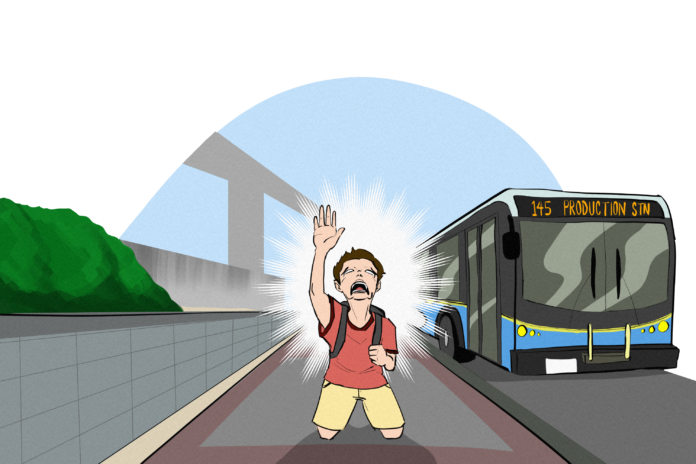
Student wearing a grey jacket and a blue backpack running after a 145 bus that is speeding away from the bus stop.
ILLUSTRATION: Yan Ting Leung / The Peak

By: Osna Hadef, SFU Student

Is it just me, or has Metro Vancouver’s public transit system gone to the dogs lately? All while the fares are expected to keep rising? The sheer audacity, man! 

Before diving into more complaining, I acknowledge that we have a functioning public transport system. We can get anywhere around Metro Vancouver, as long as you’re not afraid of three or more transfers between different modes of transportation and 20 minutes of walking. 

That being said, we are a world behind transit systems like Japan’s — not only are the buses and trains spotless and high-tech, but the operators literally apologize publicly to passengers for slight inconveniences. I, too, demand a formal apology, a deep bow, and perhaps a small compensatory snack whenever my bus is late, and especially if it has departed early

Let’s play Never have I ever and see how many of these issues you poor beings have also experienced as riders.

Never have I ever . . . run late because the bus/SkyTrain was not on time 
Classic one. You left early, planned ahead, and still made it late because the ride was late or was cancelled entirely! Maybe it’s some “fashionably late” trend among the drivers and operators that we’re unaware of. 

Never have I ever . . . had a bus driver ignore me at the bus stop
You waited 10 minutes for a bus, stood up ready for it, only to — WHOOSH! — zoom past you like your mom didn’t give birth to you, and you do not exist. 

Never have I ever . . .  not been able to catch a bus because it left minutes early
Life happens. Sometimes, a bus leaving two minutes early will cost you half the wage you work that day. I had to Uber to work, not once but TWICE! The bus I had to switch to left earlier than scheduled leaving me stranded for the next 30 minutes. 

Never have I ever . . . not been able to get on a bus/SkyTrain because people by the doors refused to move 
There is space right there in the back and the middle, but these cold-hearted people, instead of moving there to make space, just . . . leave you hanging outside in the cold with teary eyes. 

Never have I ever . . . been blocked by people who did not let the passengers get off first
You are so excited to finally reach your stop and be home soon. You try to exit, but a wall of impatient humans pushing you back has other plans for you — they want you to get off at the next stop.

Never have I ever . . . almost missed my stop because no one made way for me to get off
Exiting the bus or SkyTrain during rush hour feels like a scene out of an action movie that keeps you on edge. To reach the exit, the main character must unleash their superpowers — shoving, squeezing, and pushing past a sea of relentless antagonists. 

Never have I ever . . . ignored an older person to keep your seat
You look anywhere but towards them, pretending you haven’t seen them because you’re so absorbed in the magnificent view — of traffic. Do you relate? Tsk tsk. If so, you’re so cringe

Never have I ever . . . seen someone sneak onto the bus without paying and pretend nothing happened 
They so nonchalantly get in and pick themselves a seat by the window to enjoy the free tour in their $500k vehicle with a private chauffeur. 

Never have I ever . . . experienced the entire transit system become non-functioning after 2 centimetres of snow 
Every single year! A light dusting of snow, and suddenly, it’s the apocalypse. 

Never have I ever . . . stepped on a mystery pool of spilled liquid on the floor of the bus/SkyTrain
You tell yourself it is a spilled coffee or some type of drink. You hope it’s just spilled coffee or some type of drink.

Never have I ever . . . been hit by a fellow passenger’s backpack 
It is rush hour and the bus/train is packed. Someone still refuses to take off their giant backpack — Bang! Bang! smacking everyone around.

Results
If you have experienced 0–3, lucky you, you seem to have rarely used transit. If you got 4–7 I haves, you know the struggle is real. And if you got 8–11 I haves, I have good news — our transit system sucks!