As Dr. Galicken’s PSYC 392 course started this week, he was infuriated to see half of the Zoom call participants turn off their cameras and the other half visibly roll their eyes when he asked them to open the course’s textbook.
“Come on, people. Is this really how you want to start the new semester?” Galicken sighed, adjusting the pink cat-ear-endowed gaming headset he had to borrow from his daughter.
“I sent an email regarding all the required materials for this course. It would do you good to check your email once in a while,” he grumbled, flapping his arms out of habit of teaching large crowds in the Images Theatre. This habit inspired his nickname “Chickalicken,” coined by a previous PSYC 100 course during a discussion on short-term memory.
The senior professor’s interpretive dance cut off as a message reflected in his rage-filled eyes.
“ya ok but u emailed us the syllabus at like 11pm last night,” a student had typed into the Zoom call’s chat.
Galicken slowly raised his fingers to his temples, taking a moment to collect himself before responding. He was so used to students fearing speaking up in person that he only expected looks of disoriented fear from his lectures. That had all changed with this online stuff and the new chat box option. There was discussion? During his three hour lecture?
“Listen, you had time to make arrangements. School preparation really needs to be your top priority,” he said finally to his students trying to live through a global pandemic.
Despite the entire class being muted, a collective sigh was heard from the 8:30 a.m. class.
“I tried to buy it but the bookstore was sold out 🙁“ typed another student, mostly annoyed that this was the course she was stuck with thanks to SFU hating third-years. A late enrolment date stuck her with this professor who wasn’t accommodating at all and has at least 94 Funko Pop figurines visible in the background of his video.
Galicken glanced at the chat and huffed.
“In my old age, I shouldn’t be the one who has to tell you this, but there are these things called ebooks here in the modern age!” Galicken sneered, a wave of nostalgia hitting him from the old days of publicly shaming any student who did dare to ask a question.
Another message popped up in the chat saying, “Bro you made us get this weird exclusive edition with supplementary stuff at the end. Only the physical book has that.”
“Who are you to call me ‘bro?!’ Listen, everyone, I already have my degrees. This is about you. Make all the excuses you want, but at the end of the day, you are the one in charge of your education. You need to work in my course,” said Galicken, cursing under his breath as his iPhone 4 charger got caught in his chair’s wheels.
At this point, 27 students signed off the call and in a bout of self-care, dropped the class immediately.
With no textbook or positive outlook for the class in sight, Dr. Galicken flapped his arms once again and decided to continue lecturing, only to be stopped by failing to know how to share his screen.
SFU Alumnus Ravi Bansal-Beech, the cofounder of Valley Acrylic Bath, has been working on sinks and bathtubs that fight viral transmission. This is made possible by using innovative materials such as acrylic, that provides a coat which prevents the spread of bacteria. When asked about the objective of her company in an interview, Bansal-Beech said she aimed to create “an environmentally-friendly engineering company.”
Valley Acrylic Bath is a “company started in 2007, that is 100% female owned,” Bansal-Beech claimed. Based in Mission, British Columbia, Bansal-Beech noted all the molding of their products take place in Canada. According to Bansal-Beech, Valley Acrylic Bath “created an oxymoron for bathtubs, because [the bathtubs] save water and energy.”
The whole industry was in panic mode during the pandemic, which motivated Valley Acrylic Bath’s to refocus their vision. “The scariest thing for our industry was when they noticed that the virus lives on stainless steel [as] most of our hospitals are full of stainless steel,” she explained.
Their research resulted in the use of acrylic. The material is insulated which retains energy, is easy to clean, lightweight, and repairable. It offered the coating that would prevent the spread viruses. “Our plumbing industry is the first defense for healthcare [ . . . ] because without proper plumbing and sanitation we don’t have modern medicine,” Bansal-Beech said.
As Bansal-Beech explained, “Short term we can use hand sanitizers but I think that’ll become another problem,” In accordance with this, she stated that Valley Acrylic Bath “are creating portable hand-washing stations that can be put anywhere.” She also talked about how she wants her company to simultaneously educate and promote environmental sustainability and proper sanitation for all Canadians. “For me it’s always been important that the business lines up with my values [ . . . ] sustainability, healthy living, and proper sanitation should be for everybody.”
In regards to the plumbing industry, Bansal-Beech said that it wasn’t easy being a women-owned company in a male-dominated field. “[We’re] at the table, but the table was never created for [us].” She concluded by urging youth to use their entrepreneurial skills to promote proper values.
The one piece of advice she has: “advocacy is one thing, getting shit done is another thing.”
The SFU library has adapted to remote and limited in-person services to comply with safety recommendations. The Peak received a joint email statement on the library’s fall services from Karen Munro, Associate Dean of Libraries, Learning & Research Services, and Chloe Riley, Library Communications Officer.
There is an extensive digital collection accessible through the library’s website, which includes “articles, ebooks, and databases.” Students can also request virtual scans for a “digital delivery” of scanned print book chapters. For those who are seeking in-person guidance, they can access AskAway, the “online chat service that connects to live research advising seven days a week during the academic term,” said Munro. Further, students will be able to email a liaison librarian, a specialized university department official, to set up an appointment for assistance with research.
Students will also be able to request paper books from the library with a contactless pick-up routine that will not have students entering the building. According to Munro, “Staff will be on hand to assist you and provide instructions on how to safely collect your hold.”
SFU students, faculty, and staff can download the W.A.C. Bennett Library lab’s computer software to their personal computers. The software grants students access to the lab computer’s technology, files, and apps from home.
The Student Learning Commons is offering remote workshops and online consultation sessions, such as the “Getting Ready for Academic Success program.” This week-long program offers undergraduates the opportunity to develop time management skills, practice writing university-level research papers, and connect with a panel of SFU professors. The Research Commons, which aims to aid graduate students, also offers support for citations and writing through the Research Commons website.
The library is also considering offering “some study and computing space to SFU students on the third floor of Bennett Library, for limited hours, during fall semester.” While this would not include full access to library books or other areas of the building, it would provide students a “safe place to study and use computers and printers.” Regarding COVID-19 protocols, Munro noted that the library “[anticipates] that SFU staff would be on hand to remind students about the need for physical distancing, and cleaning supplies would be provided for any shared equipment [ . . . ] SFU [recommends] everyone to wear masks in public indoor areas.”
While unsure if it is feasible to open the library during the pandemic’s restrictions, Munro stated that “the library’s buildings may be closed, [but the] staff are still here to help you start the year.”
For up to date information on the library’s available services, students can refer to the library’s website.
A new social data analytics (SDA) minor will be catered to students in the faculty of arts and social sciences. According to the SDA website, the program is the first in Canada to teach students how to harness the concepts of big data through the social sciences.
There are no prerequisites or minimum GPA necessary for program application or entry. The program emphasizes big data and its components of “communications, ethics, [and] statistics.” Applications to the program are open to anyone, but are based on grades and coursework, a statement of interest, and whether the SDA minor can enhance students’ field of study.
In addition to SDA courses, students will take statistics, and data science courses. Beyond these disciplines, students can take courses from a variety of departments and faculties across SFU, including gender, sexuality, and women’s studies, geography, economics, political science, English, linguistics, philosophy, and communication to count as electives towards the minor. In total, students will complete a minimum of 27 credits for the minor. The program will culminate with a final capstone course.
Steven Weldon, director of the minor program stated at the SDA minor launch: “I think all of us understand and recognize how much data is out there, how much data is probably being collected about us as individuals.” The program will focus on looking at issues such as, “Social, cultural, political, and economic challenges” in data.
Students who finish the program will have the skills to analyze and evaluate big data concerning human behaviour. Weldon noted at the information session that “one of the reasons that we created this program is [because] data alone is not knowledge.” Beyond the analysis process, students will also learn how to communicate their findings to decision makers such as policymakers or the public. The program emphasizes respecting the privacy and ethical concerns of using data that comes from humans.
To get into the first intake of the SDA minor for Spring 2021, interested students should submit their application by September 30, 2020here.
The Simon Fraser Clan name has officially been resigned. The decision came after pressure from students and alumni at SFU to change the name due its negative connotations, since “clan” was often associated with white-supermacy group, the Klu Klux Klan. Former SFU President Andrew Petter announced, “The single most important factor influencing my decision is the views of student-athletes on this matter.”
In explaining the initial name choice, Petter explained: “The Gaelic word for a family was chosen to honour friendship, loyalty and connection, commitments that remain deeply ingrained at SFU.” The petitionagainst the nameargued that “the worrisome part about this [name] is it puts SFU’s NCAA Athletes at risk when in the [United States] but it also undermines North American Black history regarding lynching, the KKK, segregation, and more.” The petition received over 13,000 signatures.
The process of investigating the name change began in January 2020, according to Petter. Student-athletes were the leaders of the discussion, as they voiced their concerns for the team name. A survey conducted in the Summer of 2019 by the students athletes’ advisory committee on the name showed that a majority of the students supported the change.
Former men’s basketball student-athlete Othniel Spence was one of the advocates for the name change. “Contrary to intent, this name was seen and experienced as triggering and traumatizing by those who played for the school; especially so for black athletes and athletes of colour,” he told The Peak in an email statement. “This population of athletes alongside allies saw this name for its negative connotation or experienced it first-hand when travelling to the states.”
According to the 2019 petition, many student-athletes vouched that this name had caused uncomfortable conversations with family down South, and had even further possibly dangerous implications. “This new name will also not require athletes to explain the intent behind it to fans, peers, and recruits like how the retired name previously did,” Spence says. He believes that this signals a more diverse athletic community and that he fully expects it to be reflected in the athletic teams’ demographics in the coming years.
Theresa Hanson, Senior Director for Athletics & Recreation, credits the name change to the approach taken by the student-athletes. “Their respectful approach to the nickname dialogue was both helpful and influential, and greatly contributed to the decision process” she explained in an email statement. Hanson added, “It takes a community to make positive change, and I am very grateful to our student-athletes, coaches, staff and athletic alumni who passionately advanced this issue.”
Spence said, “this will create a new avenue for Black recruits to feel welcomed by Simon Fraser University; thus, increasing the likelihood of signing more Black student-athletes in the upcoming years and creating a space for Black and POC Athletes.”
“Key groups within the university community will be involved in the process, and our student-athletes, coaches and staff will help inform our new team name” Hanson concluded. The new name is aimed to be announced by the end of 2020.
Indigenous people from the Grassy Narrows First Nation in northern Ontario protest the long-term health effects of mercury contamination in their waterways. Toronto Star.
On June 19, CBC published an article investigating allegations of a “game” being played in the emergency room where health officials would guess the blood alcohol level of Indigenous patients. While these are allegations, they point to a deeper problem of discrimination in health care. This is far from the first instance where Indigenous peoples have been treated differently because of racial prejudice, and it makes sense that many Indigenous peoples report that they aren’t surprised by this game.
The racism in health care that affects Black and Indigenous peoples (BIPOC) is a systemic problem, not just the individual actions of racist health professionals that they may encounter. As currently constructed, the health care system for BIPOC is not built to serve their needs.
The primary objective of this article is to break down what factors prevent BIPOC from accessing health care compared to the rest of the Canadian population. This article is divided into the history and circumstances that have created systemic barriers for BIPOC, and how these circumstances now lead to BIPOC facing racial prejudice when they need medical help. A final section will be dedicated to educational resources to learn more about this topic, and organizations that alleviate BIPOC health barriers in BC by giving financial support to mental health organizations and vulnerable communities.
As a disclaimer, I am writing this as a Chinese immigrant and I recognize that my voice may not be the most appropriate one to frame these issues. I don’t claim to be an expert on this topic because I have not been affected by it like BIPOC have. However, I also feel that it is important that I use my privilege and platform to do the work in discussing structural racism that hurt BIPOC, which doesn’t just exist in criminal justice, but in institutions like health care.
Contextualizing medical racism as a structural problem
The racism that is being discussed in this article is not just interpersonal, but systemic: this means that it is not exclusive to BIPOC experiencing discrimination in their daily lives within the health care system. Systemic racism in health care is how legacies of colonial trauma continue to affect BIPOC because they experience socioeconomic barriers, better known as social determinants, to accessing health care.
Statistics Canada notes that Indigenous peoples have problems with accessing health care facilities as they live in remote areas. For example, most of the Inuit people (73%) live in Inuit Nunangat, where many of the communities are only accessible by air. As a result, 82% of the Inuit living in Inuit Nunangat report that they don’t have a family doctor. Even for Indigenous peoples living closer to or within populations, Statistics Canada reports that nearly one in five Indigenous peoples living off reserve and 16% of Métis people do not have a family doctor.
In the same report, Statistics Canada notes that as many as 18.3% in 2016 of the Indigenous population lived in “unsuitable” housing, which refers to the house not having enough rooms for the size of the household. According to the report, the low-quality housing leads the peoples of Inuit Nunangat to experience poor respiratory health and overcrowding, which lead to higher rates of tuberculosis (TB) infection compared to the rest of the Canadian population.
Statistics Canada also found that high levels of the Indigenous population have pre-existing health conditions: 36% of Indigenous peoples 50 and older that live off reserve have high blood pressure, and 20% of them report having diabetes. Comparatively, 33% of all Canadians that are 50 and older have high blood pressure and 14% report having diabetes.
These are social determinants that have strong, long-term impacts on Indigenous peoples, and similar ones exist to enforce health inequities for Black people in Canada. Black Health Alliance (BHA), a community-led charity that works to improve Black health in Canada, finds that Black Canadians are overrepresented in the Canadian prison population (9.4%), while representing only 2.5% of the Canadian population.
BHA also finds that 24% of Black Ontarians are “low income,” compared to 14.4% of the general Ontario population. 18% of Black Canadians live in poverty, though they make up less than 3% of the population. These social determinants have a direct impact on the chronic illnesses that Black people inherit. BHA states that while diseases like sickle cell disease may be inherited at greater rates in some ethnicities, many chronic illnesses are a result of not having strong access to education, support networks, and stress.
A distinctive lack of race-specific research data in health care can also lead to misdiagnosing fatal illnesses, or missing symptoms that are race-specific. In a paper published in the Journal of Health Care for the Poor and Undeserved, researchers Onye Nnorom, Nicole Findlay, Nakia K Lee-Foon, Ankur A Jain, Carolyn P Ziegler, Fran E Scott, Patricia Rodney, and Aisha K Lofters write that Black Canadian women are under-screened for breast and cervical cancer, despite evidence from the United States suggesting that Black women may be predisposed to increased risks or worse outcomes from these diseases.
While I used statistics for Black and Indigenous peoples here, I would like to stress that my intention is to compare how they fare in accessing health care compared to the rest of the Canadian population, not to pit them against each other. Racism is embedded in multiple institutions, including denying equal health care to BIPOC. In order to fully alleviate the playing field in the health and welfare of BIPOC, we must first look at how to take care of these social determinants.
How structural racism manifests today
The effects of these social determinants trickle down into more than just an issue of individuals in health care, although that does contribute to the general tension between BIPOC and the medical system.
In this next section, I have asked BIPOC from the SFU community to give their input on their experiences with inadequate health care. Two people responded, one of which chose to remain anonymous. The commonality in both of their responses is that they feel they were either ignored or had their symptoms dismissed.
In 2016, Amelia Boissoneau, an SFU student, was sick with what she knew wasn’t a normal flu. She went to a clinic to get it checked out, and saw that it was completely empty. “I approached the receptionist and handed her my ID [ . . . ] one was my status card. I was in pretty rough shape, and asked to be squeezed in to see the doctor.” Boissoneau was promptly dismissed at the receptionist desk, and told that she would recover in a few days. “I knew I had more than the flu. I tried to explain to her how I knew it was not just a flu. But she refused to listen to me and sent me off.”
Days later, an intense pain started to develop from her ear canal into her jaw. Boissoneau cited this as some of the worst pain that she had ever felt. “I ended up developing a horrible ear infection that was so painful it had me bedridden. My hearing was so sensitive [that] any sound hurt my ears. This all happened because the receptionist wouldn’t let me see the doctor when I knew they had no patients at the moment.”
Boissoneau’s story echoes what many Indigenous peoples experience when they seek health care — they are ignored. The report maintains that racism is prevalent from 39 to 78% in multiple Indigenous survey studies across geographic settings in health care. Indigenous peoples also have to be wary about the racist assumptions of their health care providers. This may lead to them not seeking medical help until it is urgent because of their distrust in health care.
In an article investigating Indigenous access to health care, Moira Wyton writes that because Indigenous peoples may not seek health care until it is urgent, they are often redirected to emergency rooms. Emergency rooms are not equipped to handle chronic illness because it’s not a one-time fix, nor are they necessarily aware of how to properly handle the cultural weight of treating them.
Additionally, the CDC found that in the United States, Black women were 4 to 5 times more likely to die from pregnancy-related causes compared to White women. An anonymous student wrote that in their experience, people in health care did not believe the pain of Black people, leading to delayed treatment, or worse, none whatsoever..
“Anti-Black racism in medicine has [gotten] to the point where if a doctor refuses to treat my friends, they ask for the doctor to note refusal to treat them in their medical record. Then [suddenly,] the doctor backtracks, changes their mind, and decides to treat them because they fear consequences. It’s sad that doctors are more afraid of being perceived as racist than actually perpetuating racism.”
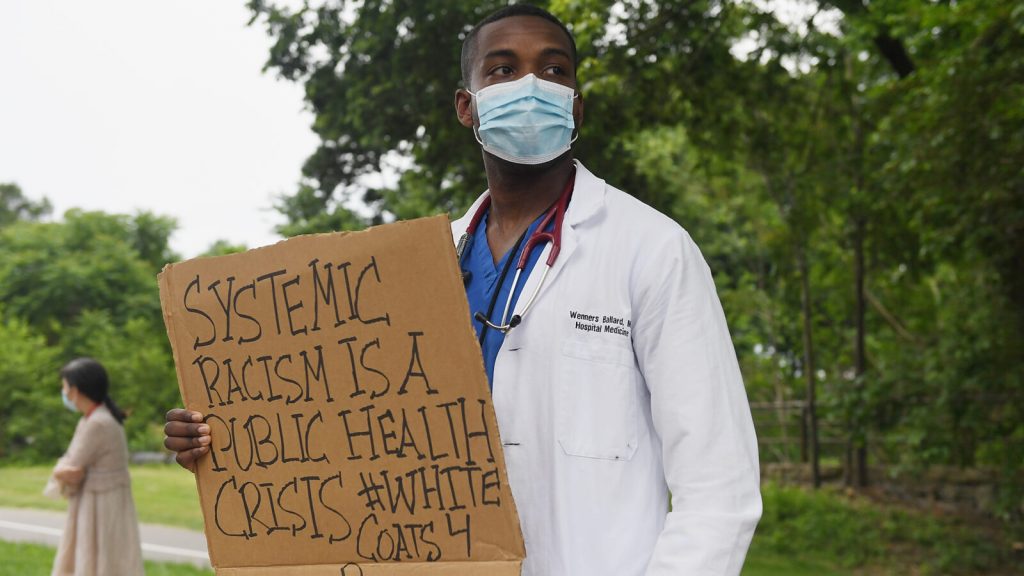
Doctors, nurses, and medical professionals have joined countless others across the country to protest against police brutality and the killing of George Floyd. Michael B. Thomas/Getty Images.
Not having enough BIPOC represented in health care is also what leads to doctors not understanding how systemic racism affects BIPOC. This is especially prevalent in mental care. “As a Black and Muslim student, I find counselling services at SFU inaccessible because of the lack of cultural competency to understand the context of my experiences and how I must navigate the world. I constantly have to go through the emotional and triggering burden of giving a “Racism 101” or “Islam 101 lesson” before even going into the medical reason I’m there, which is typically for mental health support, which is intertwined with facing anti-Black racism anyways,” the student writes.
“When SOCA was being evicted, and safe Black space was at threat of not existing on campus[,] I, as well as other students that rely on SOCA, faced heightened anxiety as Black students had to explain basics of structural racism while facing racist backlash. People failed courses or withdrew from semesters, all while SFU was complicit in the refusal to protect Black students. I speak from anecdotal experience and witnessing other’s experiences, but unfortunately there is not even race-based data to show what I’m talking about because SFU does not collect it, to the detriment of Black students.”
To increase the level of trust for BIPOC in health care, we do not just need more health care training in how to handle implicit bias and BIPOC issues, but also BIPOC in health care positions. They understand how systemic racism impacts their patients, and this will help in alleviating some of the inequalities in the medical system..
We also need to push for more ethnocultural data to better support BIPOC with chronic illnesses. In June, BC Human Rights Commissioner, Kasri Govender, joined human rights commissioners across Canada in calling for the collection of such data. More recently, she agreed to provide advice to the B.C. government about the human rights implications of disaggregated data collection and recommendations for action.
Simply put, we need to educate, fund, and uplift more BIPOC voices in health care. I have attached some resources here that you can learn about and support. While not all of these are strictly related to health care, they help alleviate the factors that affect healthcare distribution to BIPOC communities.
Black Therapy and Advocacy Fund, which have been working to connect licensed therapists in the Lower Mainland to recipients during their intake period. This fund was created in recognition of the need for Black therapy resources that are accessible to the Black community in Vancouver.
Black Health Alliance, which I referenced earlier as an organization that works to improve Black communities. They also provide resources for learning about Black social inequity in Canada. In 2018, they secured one million dollars towards Black Youth Mental Health with CAMH, TAIBU, Wellesley Institute, and East Metro Youth Services.
Black in BC Community Support Fund for COVID-19. They’ve been providing one-time, non-refundable $150 payments to Black people who reside mainly in Vancouver, but in BC, Canada, more broadly.
Black and Indigenous Care Fund, seeking to give funds for self care and body work to Black and Indigenous (First Nations, Métis and Inuit) peoples on the frontlines. To access or ask questions about these funds, please email [email protected].
Indigenous Community Fund, which is funded by the Government of Canada at $380 million. It should support vulnerable community members, help alleviate food insecurity, provide mental health assistance, and educational support for children, and more. To find more information, contact regional officers.
Determinants of Indigenous Peoples’ Health in Canada. This book is edited by Margo Greenwood, Sarah de Leeuw, Nicole Marie Lindsay, and Charlotte Reading about the health disparities that affect Indigenous people in Canada.
Medicine Unbundled: A Journey through the Minefields of Indigenous Health Care. This book is written by Gary Geddes, where Songhees elder Joan Morris first relates the story of her mother’s seventeen year institutionalization as well as her own experiences of racism in the health system. It also navigates other Indigenous elders’ experiences with contemporary Canadian medicine.
From Enforcers to Guardians. This book is written by Hannah L. F. Cooper, and Mindy Thompson Fullilove. It examines how the way police violence targets Black communities through a public health lens to see how far its suffering is extended to. Assessing
Differential Impacts of COVID-19 on Black Communities. Conducted by Gregoria A. Millett, Austin T. Jones, David Benkeser, and many other researchers, this study shows how COVID-19 has disproportionately affected Black communities in the United States.
Originally scheduled for completion in August 2020, the SFU Stadium Project on Burnaby campus is now anticipated to be completed in November 2020. In an email interview, Theresa Hanson, senior director of Athletics & Recreation, spoke with The Peak on the current status of the project.
The SFU Stadium Project is a student-led initiative that will provide SFU students and athletes with a home stadium on campus, as well as a space for Canada’s NCAA teams. The anticipated Stadium will include sightlines, 1,800 seats, and a canopy roof. Other amenities will also be featured, including accessible concourse, washroom facilities, broadcasting and media spaces, an integrated sound system, a fully accessible VIP box, and booths for coaches.
Hanson explained, “COVID-19 has impacted the construction schedule in several ways, including off-site fabrication delays, supplier delays as well as restrictions to the overall work capacity to meet provincial health guidelines.”
The project is being led through COVID-19 by Chandos Construction. In compliance with maintaining a healthy environment, the construction company’s safety measures have included mandatory masks, reduced workers for social-distancing protocols, and site inspections. Hanson added that a full safety plan by Chandos Construction is publicly available on their website.
“At this time, all varsity athletic competitions have been suspended through to November 30, and the NCAA Division II has cancelled all fall championships [ . . . ] [so] the delay in the stadium has not impacted the athletics schedule,” Hanson explained.
“We have been really pleased to see the progress of the stadium construction [ . . . ] we look forward to the completion of the project, and to a bright future where we can celebrate in person and welcome the SFU community back to campus and our new stadium.”
To communicate updates to the SFU community on the construction of the stadium, Athletics & Recreation has two informative sites. According to Hanson, the next update is expected in the next couple weeks.
There is also a live webcam that shows the Terry Fox Field and the construction site of the new SFU Stadium, which is updated every 15 seconds for 30 minutes.
Image Courtesy of Simon Fraser University via Facebook
SFU’s Vice-President Academic and Provost pro tem Dr. Jonathan Driver announced on September 3 via email that the university anticipates the continuous use of remote instruction for the upcoming spring semester. Select in-person components for courses that require “research and experiential learning” will also continue during the spring. Students in programs that require on-hands learning “will hear directly from their faculties with ample time to make arrangements.”
The email addressed to SFU students, faculty, and staff explained that on-campus activities plan to be expanded. This could include certain academic events, such as thesis defences, and select on-campus services, like the W.A.C. Bennett Library and Health & Counselling Services. Expanding in-person activities will require an approved Safety Plan for services and events, and the guidance of public health officials.
At this time, international travel will only be permitted for “essential university-sanctioned travel and in accordance with approved guidance for exceptions.”
There is also potential for some graduate classes to move towards in-person instruction, as they’re typically smaller in size, according to Driver. The announcement noted that more details on the approval process for in-person classes will be communicated at a later date.
Driver concluded by stating that SFU “[continues] to work with public health authorities to ensure the health and wellbeing of students, faculty and staff.”
VANCOUVER, BC — This morning, an SFU student woke up completely emotionally stable. He had fallen asleep on top of his bed covers at 2:37 a.m., still dressed in his T-shirt, shorts, and favourite pair of American Eagle boxers.
“I don’t really ‘choose’ when I sleep,” said Snow Rinking, a fourth year communication student with a philosophy minor. “I just use my bed as a multipurpose workstation, dining table, and rec room until the desire possesses me like in Jennifer’s Body.”
Rinking reports an incredibly deep, good sleep in which he had no feelings or awareness of anyone or anything, including his own personhood. He was especially proud of himself for not rolling over unconsciously and snapping his open Macbook Air in half.
“I’m like super at peace now,” the communication student explained. “The extra few hours in this outfit have allowed my internalized feelings of alienation and paranoia to finally drain fully into my unethically sourced textiles. Usually it just happens a little bit each day.” Today, reportedly, Rinking has not once stormed away from an innocuous Messenger missive to entertain his misplaced beliefs about what his texting partner is really thinking.
His nicest memory of the experience is waking up at 5:30 am thanks to the chilly open window, and then changing into pyjamas to sleep for another half-hour. He cannot wait to intersperse the other four hours of required sleep throughout his day.
“It’s really exciting. I’m going to be so productive,” he sighed. “Now that this one thing has gone right, I’ll be able to completely revolutionize my life today. I don’t need long-term, sustainable personal growth. I need lots of kiwis for my fridge and to go file my taxes.”
At press time, it was 2 a.m. again. Sadly, a lot can happen in one day and all of Rinking’s emotional progress has been undone!
VANCOUVER, BC — An SFU student has been sighted in the downtown core playing hide-and-go-seek. When asked who was “it,” he explained that he was trying and failing to track down his memories of the times in his life where he’s allegedly been wrong.
“It’s real weird,” Bob Nockschuss, the student in question, told The Peak. “I just can never figure out where they’re hiding! I hate it, I haven’t won a game in years. People say I haven’t won an argument in all that time, either, but I just don’t know how that could be true.”
Despite the latest round of hide-and-go-seek starting several minutes ago, Nockschuss has yet to uncover his eyes and start looking.
“It’s not time yet, I’ve been personally counting. Numbers don’t lie,” he insisted, pausing from his repeated mantra of “98.”
Many of his friends, enemies, and unfortunate seatmates on buses have tried to offer him helpful hints on where to find his missing memories, to no avail.
“I remember he once tried to convince me that mail-in voter fraud was the biggest threat to the American people and that we couldn’t let it take root in Canada,” says Polly Ticklyware, who then sent articles explaining that Canada already has mail-in voting and that fraudulent voter mail barely ever happens in the US.
“He does seem to have changed now, even if he denies that it ever happened. But later, when I told him he’d probably find the memories hiding somewhere in our last few texts, his eye rolled back and he started yelling ‘ready or not, here I . . .’ over and over until I walked away.”
“Basically, at this point, the idea that I’ve ever even been wrong in the first place is something I’m expected to just believe people about,” Nockschuss concluded. “And I do not know where I could possibly find out for myself, especially not now that most of my social interactions are publicly recorded in date-marked Tweets and comments online.