Home Blog Page 413

U-Pass reinstated for fall 2020 semester

0
PHOTO: Gudrun Wai-Gunnarsson / The Peak

The Simon Fraser Student Society (SFSS) voted to reinstate the U-Pass for the Fall 2020 semester. The U-Pass BC program was suspended over the summer due to COVID-19, but according to the SFSS website, they “worked with TransLink, and other post-secondary institutions and student associations in Metro Vancouver” to reinstate the program as of September 1. 

The U-Pass program affords students a compass card to ride the bus, SkyTrain, and SeaBus for a cost of a $170 student fee payable to their university every semester. It also includes a discount for the West Coast Express. This rate of $42.50 a month for discounted transit saves students from “paying anywhere from $98–$117/month,” according to Samad Raza, the VP External Relations at the SFSS, in an email statement to The Peak. 

Raza said that “through a survey, [the SFSS realized that the] majority of students are in favour of U-Pass” because they “depend on [it] for necessary travels to jobs, grocery stores and other personal trips.” 

Some students are exempt from the student fee for reasons such as residing outside of Metro Vancouver or if they are enrolled in less than three units. Otherwise, all students are required to pay the student fee. While the SFSS isn’t involved in the exemption requirements, Raza stated that they “are looking into more ways to help [the] students who are under financial burden.” In an email statement to The Peak, Jillian Drews, a representative for TransLink, stated that “TransLink administers the program but does not set eligibility criteria” and suggested that students with questions or concerns be directed to “their school or student association.”

A petition by an SFU student calls for an exemption from the student fee during COVID-19 and currently has over 300 signatures. Some students are against the mandatory student fee as classes have been moved to remote learning, but others maintain that the U-Pass program is only available because of the number of students paying for it. 

For full eligibility and exemption rules, information can be found on the SFU website.
Wildfire extinguished on Burnaby Mountain

0
PHOTO: Jonathan Wong

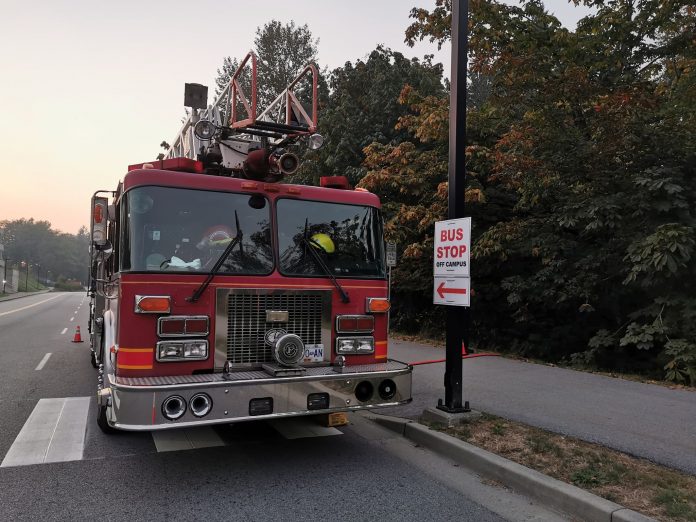
On Friday, September 11 a fire burned on the northern side of Burnaby Mountain. The Burnaby Fire Department was called at 12:20 p.m. for a fire that was “500 to 600 feet across,” according to assistant fire chief Dave Younger on Burnaby Now. The fire was located around “the site of the old Shell gas station, north of University Drive.” 

Around 5 p.m., Burnaby Fire stated on Twitter, that the “fire [was] extinguished quickly by a strong initial response and highly coordinated field operations.” 

Younger said that a helicopter with a fire crew was called in from Chilliwack to aid with the wildfire. It took the crew nearly an hour to locate the source, and they believe it “started below a tree fort.” The cause is currently unknown. 

The Peak spoke with assistant fire chief Stew Colbourne, who stated that the fire was “difficult to get to” due to the location of the fire, which was down a cliff. Crew came in “from the bottom [of the mountain] looking up and from the top looking down” to find the source. Colbourne added that setting up hoselines in a remote area was also difficult. 

Fire crews were on Burnaby Mountain “shortly after noon [ . . . ] til darkness on [September 11] and then they went back [on] the second day to check that everything was out.”

Chief Safety Officer Mark LaLonde said in an email statement to The Peak that Campus Public Safety “took direction from [the Burnaby Fire Department]” and that “at no time was there a threat to the SFU community.” 

In regards to fire safety, Colbourne said “to always be safe when you’re out in the outside environments in the trails and the bushes because it’s the end of the summer and we haven’t had significant rain for sometime and any sort of ignition sources [ . . . ] could cause forest fires or fires in the bushes.”

This is a developing story that will be updated for more information as frequently as possible. If you, or someone you know, knows more information regarding this story, we’d like to hear from you. You may remain anonymous. Please reach out to [email protected] with any further information you are comfortable sharing.

SFU to introduce its own virtual private network

0
PHOTO: Erick Cerritos / Unsplash

SFU has prepared a new Virtual Private Network (VPN) service ready to launch in September. This will allow students to connect directly to SFU servers and enables them to send and receive data that they could only access by being at SFU.

The VPN is being introduced because of the shift to remote learning. Chief Information Officer Mark Roman explained in an interview with The Peak, “Some of the things folks wanted to do with our existing services, they couldn’t do.” For instance, “if [students] have a laptop that requires updates, [they] would’ve had to be on campus,” Roman said. SFU is preparing an announcement for students, which will have a thorough explanation of how to use it. 

The university is preparing for a remote fall semester, which may mean a busy time for support staff. In preparation for this rise in traffic, there will be “more staff at the service desk, and longer hours at the service desk as well,” Roman explained. 

IT services will also be adding multi-factor authentication (MFA) to the VPN. Roman explained that MFA is an added precaution during login, which is seen all over the web. It will require your user ID and password and something additional, which you would likely get from a device — such as a phone through a text. In the situation where a “password is phished or compromised, it would prevent a [hacker] to use [your] system.

“Our strategy at SFU for IT is what we call ‘the one IS vision,’ where all of our systems should work together in a seamless fashion, and all the people that support those systems should work together in a seamless fashion,” Roman said. 

The introduction of VPN is a first in a series of new advancements that the IT department at SFU is unveiling for the future. “One of the big things that [we’re] introducing [is] Microsoft teams. [It] will provide us with the capability to improve collaboration,” Roman added. This will allow them to use OneDrive which will give the ability to “concurrently update and work on documents together as groups.”

Roman also said that they are planning to “introduce a research administration system for the whole university that will reduce the administrative burden for researchers at the university [and] improve workflows and help improve the overall efficiency of how we administer research at the university.”

Roman concluded, “IT has been absolutely central to keeping everything going [ . . . ] There’s over 400 IT people at this university who have been working really hard day and night to keep all these services going. A big thanks to everybody in it, who’s kept the university running.”

Dialogue, not debate, is needed for democracy

0
PHOTO: Christina / Unsplash

I really couldn’t pinpoint when social media became such a tiring vortex of people just screaming their opinions, hoping that others will scream back. This kind of chaos is also so prevalent in the realm of politics, with heated, daily attacks now being common from politicians on all sides. Not to mention how seemingly structured formal debates that occur around election seasons only result in insult and injury. We can’t continue to express our opinions in this cyclical black hole of unproductiveness. Introducing dialogue, the idea of productive conversation, is necessary to ensure the survival of healthy democratic practice.

Having a conversation focused on dialogue means that you are openly listening and exploring, with the goal of learning and understanding other perspectives and experiences. With debates, the end goal is to “win,” to get some sort of prize, recognition, or just the satisfaction that you bested the other person. If a goal in a conversation is only to be the best, then what is the point of having the conversation? Dialogue not only provides space for open discussion, meaning that no one is on a particular “side,” but it also allows for error and for someone to not be faulted if they get something wrong or stumble. It also doesn’t see any opinion as “wrong” or of a lesser quality, just because it is different from the prevailing thought.

Debates do have the ability to provide structure and clarity to a conversation, however they can also be restricting in their format. Dialogue allows for a flexibility and openness that can’t be explored in a structured back-and-forth debate. This has the potential to create deeper understanding and empathy between conversants. 

The idea of dialogue isn’t a new phenomenon, either. I won’t lecture on the importance of the public sphere, I’ll save that for communication professors. Though, the idea of a place where people are dedicated to taking time to converse with the intent to foster change dates back to — in the eurocentric world — the 18th century. A more recent example of this is SFU’s Morris J. Wosk Centre for Dialogue, which has been engaging with the idea since 2000. Now, this concept just needs to be more broadly engaged with by the general public.

In action, greater consideration of dialogue over debate would look like engaging with empathy and understanding. Imagine elections where candidates aim to understand each other’s points of view rather than diminishing them, and a social media sphere filled with substantive comments that add to continuing conversations about important social issues. Simply, a democratic ideal where all voices are heard and considered equally. This absolutely does not mean that prejudiced beliefs like white supremacy should now be considered. But, in general, that conversation should be held where people can understand instead of hastily shutting down any opinion that they don’t also hold.

Implementing greater practice of dialogue won’t magically solve our problems, but it puts us on the path to a better understanding of them, our own opinions, and how to deal with them. Next time you have a burning thought, consider speaking, not shouting. Who knows, maybe someone will even speak with instead of at you. 

Watch the-peak.ca for a recurring, web-exclusive Opinions in Dialogue segment where SFU students engage in casual dialogue about various topics concerning SFU and the world. 

Millionaire returns from isolated Caribbean retreat, complains about forced isolation in the real world

0

I just returned from a peaceful silent retreat from an island in the Caribbean, the name of which is not important for true soul-searchers like me. To my dismay, I returned to a dastardly state of affairs where self-isolation is the norm. 

I thought initially that physical distancing referred to my children or taxes. You can imagine my disappointment when I discovered it entailed quite the opposite. 

I am now confined to my luxury villa in Vancouver for two weeks where my neighbours are but a few measly acres away. It is cruel, really, how I have to suffer alone in quarantine. I can’t even make use of my $50,000 parking spot in Yaletown.

To make this quarantine worse, my tenants are refusing to pay rent and I apparently no longer have the right to evict them. This is what happens when a special snowflake, big government, communist authoritarian like Justin Trudeau has power. You cannot even kick people out on the street anymore! These people just sit at home and get addicted to government handouts. Pathetic.

It is not just because I, as a white man, can not empathize with any individual who has experienced hardships. It is because I can not empathize with anyone at all.  

Thankfully, this glorious free market awarded hard workers like myself $500 per tenant because I work for my money as a landlord. People do not understand how tough it is managing property that I do not know the address of.

People may not see it now, but this pandemic is an opportunity for people to really make something of themselves. Take a coding bootcamp, read a self-help book, manifest your destiny by taking what is rightfully yours and definitely did not belong to anyone before you. There are so many ample opportunities for everyone.

I have done this work, I cashed out my trust fund. Do I get any recognition? Of course not. I did the hard work of being my father’s son and some people just do not have the capacity to accomplish that.

It is shocking that I am being treated with such disrespect. What crime did I commit? The crime of inheriting an amount of wealth that could never be spent during my lifetime? Sue me! (But as a fair warning, my lawyers could eat your lawyer for breakfast, buddy.)

In all honesty, I regret ever stepping out of my private jet, into my Tesla, and re-entering such an authoritarian regime.

A Zoom love story: How I fell in love within the confines of a 4x5cm box

0
Photo by Chris Montgomery / Unsplash

Oh how the utter bliss from classes seems to have faded since the transition online!

No, I’m not talking about the increased difficulty in communication, nor am I talking about the increased workloads and expectations piled on by my professors in the wake of a global pandemic. I’m not even talking about the constant devitalizing anxiety plaguing me day after day that this may be our new reality for the indefinite future.

I’m just left yearning for the joy brought on by finding love at first sight within Saywell’s walls. 

No longer do I feel the thrill of meeting eyes with the hottest member of my class, hopelessly pining after the mysterious, unattainable scholar despite not knowing the first thing about them. Why do I even bother looking good for class anymore? My love life is as hopeless as the prospect of having an eventful 2020. 

Or so I thought. Then, it happened. On the first day of my class, I locked eyes with them. 

I could hardly believe my luck! How was it possible for someone to be that perfect? I urgently click off of gallery mode and fill my screen with their face carved by the Zoom gods. I have no hope focusing on my prof’s words at a time like this.

And I just know they feel the same way.

I can feel our heartbeats synchronize as our eyes meet pixel by pixel. I can feel it through each breath they take, through each nod of acknowledgment to the lecture material neither of us care about, each adjustment to their AirPods. I watch obsessively each time they turn a page, each time their adorable nose scrunches up at a tricky topic. I drink it all up like a nitro cold brew before an 8:30 lecture. 

I sigh wistfully each time we end a lecture, longing to see my Zoom muse once more.

I pine endlessly for them. I get ready each morning for them. Each smile and each bat of the eyelash I dedicate solely to them. 

Today, however, I search for their beautiful face in gallery mode and come up empty. 

I wail! I cry! How ever will I find true love now?

Oh.I turn on my webcam, and there I am in all my glory. I admire my jawline, each perfected curl, and I smile. My true love.

A name change is not enough to hide SFU’s institutional whiteness

0
Courtesy of SFU Athletics

Former SFU President Andrew Petter released a statement on his decision to change the name of SFU Athletics’ varsity teams after an “an extensive stakeholder engagement process.” Petter’s statement, which does not recognize any Black student organizing, activism, or petitioning, seriously undermines the physical and emotional labour of student activists and disregards Black trauma and oppression.

Black students and Black athletes mobilized and pushed for this name change. Not acknowledging these efforts is an insidious way of disarming and suppressing Black power while also minimizing the impact and importance of student activism. Othniel Spence, a Black student-athlete who fought for the name change, expressed that he was “brought back [into the discussion] by Petter’s lack of acknowledgement for the students that were involved in this name change; especially students of colour that placed themselves in vulnerable positions.” Even from the beginning, radical student activism has played a key role at SFU, and choosing not to acknowledge student organizers, like Spence, downplays the ability of their activism to change systems of oppression.

In addition, although SFU has made strides with Indigenous reconciliation — such as with the construction of the First Peoples’ Gathering House — Petter’s statement appears to completely disregard indigeneity by using the university’s Scottish and colonial heritage in defence of the original name. Marie Haddad, a student who also fought for the name change, voiced that “there was a greater priority to recognize Scottish heritage and hold its legacy at SFU than it was to equally speak on the North American POC/Black history behind ‘The Clan’ name.” Colonization is not an acceptable excuse to keep a sports team name, and certainly goes against the university’s apparent commitment to reconciliation.

This leniency towards whiteness and white privilege in academia is not a new issue. Petter’s response hints at disturbing institutionalized systems of racism and colonialism embedded in the university and within the community. According to the SFU 2019 Diversity Meter, Black-identifying employees, who are underrepresented in faculty, reported lower feelings of  inclusion compared to other racialized groups. This shows that there may be a gap related to diversity and equity perceived by Black-identifying employees working at SFU.

Instead of performative lip service, the university and its leaders need to begin proper reconciliation. As Spence stated, Petter’s response “didn’t acknowledge the trauma and pain this name caused for black student-athletes.” A good way to start doing this would be by recognizing the efforts of Black SFU student organizers and allocating mental health resources specifically for Black, Indigenous, and POC student athletes.

Entertaining that a name change is enough is “specifically harmful and compliant to the racist systems that are embedded in our educational institutions,” as Haddad expressed. More work needs to be done by SFU to recognize institutional structures on inequity, and the student labour done against them. Although changing a name is a good start to making amends, recognizing historical marginalization and the significant efforts of Black student activism would be even better.

SFU students and alumni create program to aid ESL learning

0
PHOTO: Annie Spratt / Unsplash

SFU students and alumni teamed up to create CommuniCreate, a program that supports immigrant and refugee youth aged 10–17 learn English, become involved in the community, and exercise life skills in a safe space under the guidance of SFU student mentors. Their curriculum was ready to launch as the COVID-19 pandemic forced British Columbia’s communities into lockdown. The program was adapted to virtual learning by student leaders and some of the founders of CommuniCreate, Saba Fatemi, Rufiada Kheraj, and Eunbee Baik. 

CommuniCreate’s bi-weekly meetings are now held on Zoom where an equal number of SFU student mentors and newcomer youth interact with each other. These meetings include roleplaying real life scenarios, interactive videos and worksheets, games, and one-on-one connection with a mentor. 

In an email statement given to The Peak, Eunbee Baik, Co-Founder and Program Coordinator, noted the “greatest benefit of this program is having the students work one-on-one with a volunteer.” Saba Fatemi agreed, stating that it “gives them a sense of community amidst [ . . . ] the disconnection of the world right now.” According to Fatemi, persevering through British Columbia’s pandemic restrictions was challenging, but they “couldn’t have done it without [the TD Community Engagement Centre].”

The program was created when Trisha Dulku, the Community Engagement Associate and partner in the CommuniCreate program, noted that “especially in Surrey, there’s a need for more English language learning services and programs that are fun [ . . . ] for youth specifically in that teen age range.” There were students arriving at welcome centres in Surrey, looking for free English learning support, but it was not readily available, according to Fatemi. She told The Peak that her, Kheraj, and Baik “recognized the value of having a free resource led by other people [their] own age.”

Dulku told The Peak that everything “was flipped on its head” and “there were discussions around delaying the launch of the program until it [could] be in person.” She also noted that it was due to the team’s eagerness that the program was able to begin this summer; they found that “every [obstacle] leads you to a new path and new potential.”

CommuniCreate will continue in the fall and welcome a new group of youth. In an email statement to The Peak, Rufiada Kheraj, a Co-Founder and Program Coordinator of CommuniCreate, said “I feel like my experiences with this program has given me the gift of true empathy for English language learners [ . . . ] we all need to make an effort and appreciate people who are learning.” Dulku noted that the program’s goal is to “remove any preconceived barriers or moments of stress that English language learners are often facing.” 

Volunteer applications for SFU student mentors to engage in this opportunity are planned to open soon. For more information on getting involved, students are encouraged to seek out the CommuniCreate website. 

Increasing tuition does nothing to support students

1
PHOTO: Pxfuel

As initially determined at the Board of Governors meeting on March 19, SFU has approved a 2% tuition fee hike (4% for international students, and upwards of 20% for specialized programs) for the 2020–21 Budget and Financial plan. Concerns by students circulated around the decision, and the SFSS even responded in a letter to the Department of Finance opposing the move.

But, these concerns — as prevalent as they are — arose in the spring, before the pandemic. There has been some discussion of the student body going on strike, but so far there has been little organized action surrounding it. With rising concerns over virtual education’s quality, students who are financially struggling are also now expected to jump through hoops just to pay for a less-than-ideal version of their studies. Considering these circumstances, a tuition increase is the last thing students need.

Being able to afford post-secondary education is without a doubt already a huge financial burden for many students. The stress of applying for student loans, scholarships, bursaries, and any other form of financial aid is on its own a headache. Let alone other financial requirements like purchasing textbooks, supplies, adequate technology, and the latest software to go with it. Alongside other financial tolls that students and young people face (e.g. housing and food security), I’m sure most students would agree that being a student is just so darn expensive. Even without the financial and economic insecurities students may be facing due to COVID-19, the continuous tuition increases alone bring on an inequitable studying barrier for lower-income students. 

It’s been clear that in non-pandemic circumstances that the SFU administration has not entirely considered the financial capabilities of their student body. Now that COVID-19 has been added to the mix, students are experiencing additional hardships brought on by circumstances like job insecurity or decreased income. On top of that, online learning for some requires additional costs to properly participate in classes, which can mean investing in a stronger internet connection and an adequate at-home workspace. Ultimately, the administration should consider that such costs would be avoidable if classes were not remote, but unfortunately this is not the case. 

I understand that the continuation of remote learning means that professors and TAs still need to be paid, campuses need to continue to be looked after, and that construction projects still need my tuition money. However, I also understand what it’s like to be an SFU student, who is not receiving the expected level of education that they enrolled in. Specifically, a now lacklustre education that will make me go into debt. Frankly, I am frustrated that in times like these, I feel not only unsupported by SFU, but as if my tuition money is more important than my mental and financial well-being.

Students need SFU to step up and provide more support right now, and a hefty tuition increase completely overlooks the needs of students who have been financially struggling and who are also feeling impacts of the pandemic. That being said, if there are students who choose to go on strike over the tuition hike, to say the least, I would not be surprised at all.

How SFU’s A-listers are managing without the limelight (and potato wedges) during the pandemic

0

Providing its readers with the latest scoops on SFU’s most notable, The Peak reached out to three different raccoons on the Burnaby campus to get a sense of how they’re coping with being away from their adoring fans on the mountain.

One prominent raccoon, who wished to keep her name private but is famously known on campus as “Tailless Boi,” noted with relief that the insufferable years as an A-lister have finally ceased. 

“So the other night, I go to the AQ garbage bin to grab a bite ’cause, you know, Mama’s gotta eat, but I was worried I’d run into all the students with their stupid cameras trying to pet me for the ‘gram. But once I got there? No one! Not a single person! I still haven’t gotten used to it.” 

She noted that, as a single mother, it’s difficult to deal with always being in the limelight. 

“You know, it’s hard enough to keep a strong face in front of your kids sometimes when people are always in your face yelling, ‘IT’S DAT BOI!’ like I’m some type of animal. Honestly, this whole quarantine thing has been just rejuvenating.” 

That feeling of gratitude, however, was far from universal for other SFU inhabitants. 

Another anonymous raccoon with which I spoke, who I’ll call Lindsay for the sake of this interview, seemed to be having a difficult time adjusting to this newfound freedom. Sporting dark circles under her eyes, brassy bleached highlights and a brutalist, deconstructed take on choppy bangs, Lindsay disclosed that she had recently gotten in trouble with the other raccoons over possession of a dangerous substance: pearls from Bubble World. 

“They keep trying to force us to be the little cutie patooties the students want us to be, but why should they care?” Lindsay began. “What is it to them if the boba pearls could get stuck in my throat? I’m sick of having to be whatever they want me to be. Their precious students aren’t here so I should finally get a chance to eat trash and live fast. They can all BACK OFF.” 

Another anonymous raccoon I’ll call Norma, whose presence at SFU has been a staple for years, also seemed to be struggling despite her brave, camera-ready face. 

When asked if she had any worries about being forgotten by students, she fluffed up her tail and wrapped it around her neck like a feather boa. 

“What, no . . .  Of COURSE not. Sure, it’s been a bit difficult for all of us, hearing silence from the Dining Hall where there used to be cheering mobs at all hours of the day, and we no longer have a constant supply of potato wedges. We’re still big, though. It’s just the campus that got small.

“I do, of course, still get my admirers,” Norma continued. “The construction workers who have come in and out of that shiny new box they’ve been building for generations of raccoons have always been so kind to me and my family. So long as we get love from them, we will get love from the people of Simon Fraser University.” 

I pointed out that the structure, the Student Union Building, was finally completed, and the construction workers would likely appear there no longer. 

“WHAT?!” Norma wailed, dropping the twig she was pretending to smoke. “They’ve been here for five goddamn years and even THEY’RE leaving? No. They can’t! We’re STARS! No one ever leaves a star!” 

Norma then began hissing and foaming at the mouth, so it seemed best to conclude the interviews for the day. 

Be sure to think of your friendly neighbourhood raccoons in isolation this fall. They are certainly thinking of you.