Home Blog Page 401

SFU hosts Fall 2020 virtual convocation for graduates

0
Image Courtesy of Simon Fraser University

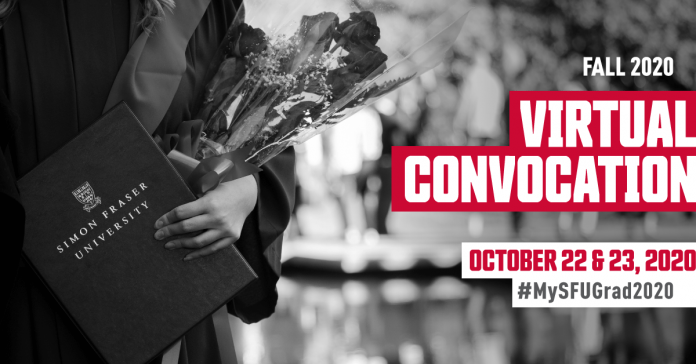
The SFU Fall 2020 Virtual Convocation took place on October 22 and 23 for recent graduates. This is SFU’s second virtual convocation due to COVID-19, following the one that took place last June. 

In an email statement to The Peak, Director of Ceremonies and Events Gloria Chu explained the planning process and changes to the event. An established committee was in charge of the virtual convocation, with representatives from each of the services: Communications & Marketing, Student Services, IT Services, Meeting, Event, and Conference Services, and Facilities Management.

“The group looked closely at the June virtual convocation graduate survey results, met with a focus group from the Fall graduating class, consulted with faculty and departmental contacts and deans, and reached out to other Canadian universities to create the plan,” Chu said. 

The main objective of the group was to try their best to replicate the real-life experience of a convocation ceremony in the virtual format. Graduates were given a chance to sing in a national anthem montage, and a hashtag (#MySFUGrad2020) was created for students to share their celebrations. Students Danaan Cordoni-Jordan, Alicia Fahrner, Davina Anthea Gounden, Margaret Kapitany, Michael Koziura, Madeline Lauener, Sumreen Kaur Rattan, and Nuvprit (Preet) Saini also featured to give speeches.

Each faculty organized interactive grad celebrations and a “Convocation Box” which includes parchment, a cap and tassel, an SFU Alumni Pin, the print program listing all grad names, and an item from their faculty. A range of virtual celebration tools was also provided to graduates, such as print-at-home signs, Zoom virtual backgrounds, and an Instagram filter. 

The changes that were implemented for these ceremonies included individually reading out names, degrees, displaying pictures, and a short message from every graduating student during the ceremony. In the spring, the convocation consisted of about 5,000 graduate students, hence the arrangement of four virtual ceremonies to allow for the name to be called. 

Chu said that the next convocation’s planning depends on upcoming advice from health authorities. They want to “assure the 2021 grads that the Planning Committee will do [their] best to make Convocation as engaging and meaningful as [they] can for them.”

Being an international student during the pandemic — to stay or to not stay?

0
Photo courtesy of SFU C19 Coalition.

On March 12, 2020, four group members and I spent Thursday night discussing our projects over shared tuna stacks at Cactus Club Cafe. That night was the last time we got to see each other in-person, as none of us could have imagined that on March 17, the university would physically shut down. 

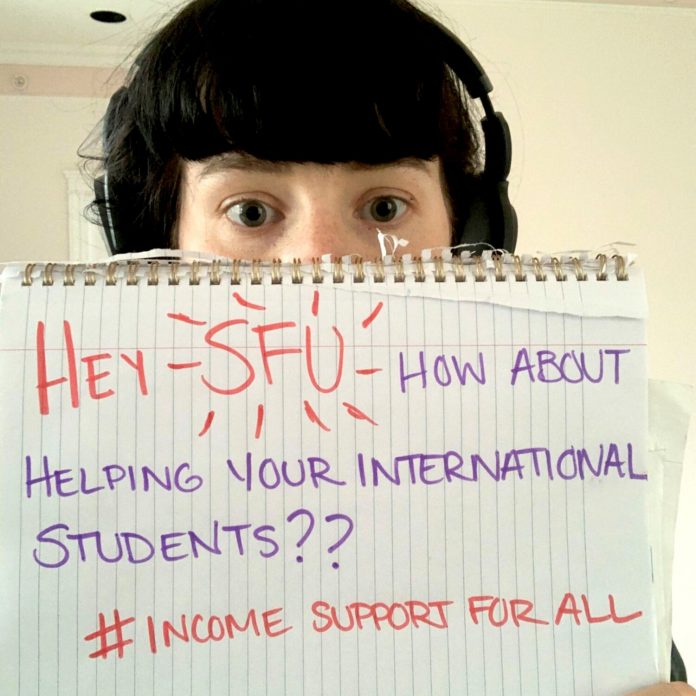
Of the many questions I’ve asked myself since the onset of the COVID-19 pandemic, one lingers. Should I be in Vietnam, where my family is, or should I be here, in Canada, where I can continue my studies and maintain student status? 

Being an international student is not easy to begin with, especially during the pandemic  — and it’s compounded by the fact that the university we attend doesn’t support us. 

I came to Canada when I was 17 and have been living alone for nearly 10 years. With no one to rely on, I am pretty much an expert in taking care of myself, even in the most difficult of times. I cautiously prepared myself for the pandemic. I stocked my shelves with rice, dried foods, and toilet paper; equipped myself with rubbing alcohol; and cleaned my doorknobs, shoes, and clothes after I came home. I was ready for the long quarantine — or so I thought I was.

Everything around me was eerily quiet. The construction noises I had hated so much had stopped. The streets were empty. The sounds of music and of laughter from people barbecuing during the weekends disappeared. If not for the weekly class on Zoom, I would have thought I was living in a post-apocalyptic world.

Not too long ago, my mom urged me to sign up for the Vietnamese government’s rescue plan to go home as soon as possible. Before hanging up, she told me, “At least at home you have me to take care of you.”

That’s when it began. I missed my mom’s wonderful dishes; her chicken mushroom recipe that she always cooks for me when I came home during Christmas, the soft but chewy texture of the chicken, the aromatic smell of mushroom that had been cooked for hours, and the richness of the soup that can be eaten with either bread or rice.

“Home” tugged at me, shattering the independent self that I had been building for years. I wanted to be with my family. I wanted to taste my mom’s dishes again, hear her nagging about my messiness, and I wanted to start stupid fights with my brothers. 

Unfortunately, there was no guarantee that I would see my family anytime soon. It made me feel more alone than ever.

It would have been nice, going back to Vietnam. Businesses there gradually reopened throughout the summer. I would’ve spent my time driving to the beach, soaking myself in the warm ocean, collecting seashells, and enjoying the finest and freshest seafood.

Despite that, I made the decision to stay in Canada to keep my student status.

I still have some savings to rely on for daily needs, which takes some financial burden off my shoulders. But other international students do not have it as easy; they must deal with the emotional toll from being away from their families and that of worrying about paying their bills — and if they’ve lost their jobs due to COVID-19, how to compete for new ones.

Most international students don’t qualify for the Canada Emergency Response Benefit, given many don’t work during the school year. Also, we do not have access to the Canada Emergency Student Benefit. For all those reasons, I wished international students like myself could receive more financial support from SFU.

Other universities have taken measures to support their students during the pandemic. For instance, Douglas College negotiated a U-Pass exemption with TransLink. Thompson Rivers University cut its student activity fees by 25%, even with having its facilities opened. 

SFU, instead, raised tuition fees as scheduled by 4% for international students, doubled the domestic students’ fees, left U-Pass fees as is, and kept student activity fees, despite the fact that most of those activities are not taking place. 

SFU prides itself on being unconventional, compassionate, and “ready”. We need SFU to demonstrate its compassion, its readiness to act, and that they care about all their students.

Many other international students will have returned to their home countries under circumstances different than mine. Deciding whether or not to stay in Canada is undoubtedly one of the most difficult choices that an international student makes during what can be lonely and uncertain times. 

I hope that my story brings attention to some of the many struggles international students experience and helps them understand that they are not alone.

#OURDecisionSFU calls upon the university to acknowledge the real reason behind the “Clan” name change

0
Illustration courtesy of the SFSS.

SFU has an extensive history of participating in institutional racism against Black students, faculty, and staff. The hesitancy to acknowledge and address the SFU athletics team name of the ‘Clan’ continues to be one of SFU’s most blatant displays of racism against Black students in particular. 

Black student activists put years of physical and emotional labour behind a collective goal to change the name due to its associations with the Ku Klux Klan and white supremacy, and the harm the association has caused Black athletes. Because of the association, there were multiple incidents as a result of the name that student athletes and coaches had to endure due to SFU’s inaction.

After years of labour and undue burden, the work of Black students and allies came to fruition as a name change was announced. Former SFU president Andrew Petter announced the name change in a problematic statement which completely ignored the work of Black students, the negative connotations of the previous name, and the harm his years of inaction caused. 

“We were truly relieved that the community actively supported Black athletes’ calls for SFU to drop the triggering team name. However, we were disappointed – but unsurprised – by the blatant systemic racism at play on SFU’s part throughout the whole name-change process,” said Balqees (she/her/hers), a member of the BIPOC committee, in an interview with The Peak.

In response to Petter’s statement, the Simon Fraser Student Society’s (SFSS) BIPOC committee created an email campaign called #OURDecisionSFU. 

The campaign “list[s] a few concerns regarding the statement pertaining to the SFU Athletics team name, followed by calls to action for SFU to rectify the situation by: 

  1. Publicly stating that SFU is dropping the ‘Clan’ name due to its racist connotation with the Ku Klux Klan [ . . . ] 
  2. Publicly, and specifically, acknowledging the harm inflicted and unpaid labour forced on Black students and athletes [ . . . ] crediting those who spent countless hours advocating and organizing for the name change [ . . . ]
  3. Upholding the health values of the Okanagan Charter [ . . . ]
  4. Supporting Black students with specific resources for Black athletes.”

Balqees continued, “The BIPOC Committee launched #OURDecisionSFU to continue supporting the name-change movement that Black athletes and students started years ago. We want to make sure that the process of the name-change is done with honour and respect to BIPOC, and that SFU adequately supports our Black student athletes and POC allies who faced the burden and trauma at the forefront of this advocacy.”

Othniel (he/him/his), the student athlete who created the petition for the name change, stated, “Although from what I’ve seen from SFU’s action for the name change is acknowledgeable. I don’t believe it’s enough.

“First, the lack of recognition of those that spearheaded this change is just saddening. Second, the truth behind my involvement during the petition for the name change was to ensure that people understood how the team name has a racist connotation, thus easily traumatizing and creating a discomforted space for student-athletes of colour that have to wear it every day. However, that wasn’t fully addressed in the statement.”

Marie (she/her/hers), a member of the BIPOC committee, spoke to the deception of Petter’s statement. 

“Andrew Petter disingenuously deemed the name change as his own decision in his statement on the athletics name-change,” said Marie.

“It is unjust for SFU to claim this decision as purely the University’s choice, especially after years of systemically overlooking and gaslighting Black Athletes’ concerns, when we know it was our collective community pressure that forced the institution to act.

She continued, “During the summer of 2020, BIPOC organizers put in 20-30 hours of weekly unpaid labour all the while experiencing reliving the emotional trauma caused by the issue. 

“The goal of these organized efforts were to usher in a movement in hopes of pressuring and cornering the University to listen to the calls of Black Athletes suffering. To say the athletics name-change was SFU’s decision is deceiving – this was our decision.”

The campaign outlines their demands, concerns, background on the issue, and provides an email template to demonstrate support for the initiative. In their demands, #OURDecisionSFU also calls on President Joy Johnson, who has stated on multiple occasions that equity, diversity, and inclusion, is one of her top priorities.

“[T]he BIPOC Committee invited President Joy Johnson to our regularly scheduled meeting to discuss the campaign’s calls to action, along with anti-racism initiatives at SFU as a whole,” said Balqees. 

“On October 19th, we were joined by Joy and AVP Rummana Khan Hemani, who oversees student services at SFU. While we are grateful for having productive conversation, we have yet to see enough action to redress the harms of the former team name.

“We’re glad to hear that Joy committed to releasing a public statement from the Office of the President regarding the athletics team name change, though we were disappointed that we did not receive a commitment to a specific date when we asked for a timeline,” expressed Balqees.

In terms of what’s next for the #OURDecisionSFU campaign, Marie stated the following:

“It’s essential that we continue to amplify BIPOC voices. The SFSS will continue to hold the institution accountable and demand that SFU allocate much needed resources to BIPOC Athletes suffering trauma due to their former team name. As an ally, I have taken a commitment in fighting and amplifying for Athlete’s – I will do so until the harms of the former team name are redressed and the athletes are provided with the adequate resources they deserve.”

The campaign to date has resulted in 204 emails sent of their goal of 500. To learn more about #OURDecisionSFU visit https://sfss.ca/ourdecsionsfu/

The Peak staff reveal their best worst childhood costumes

1
PHOTO: Emma Jean / The Peak

By: Juztin Bello, Emma Jean, Dhivya Manohar, and Paige Riding

By Juztin

PHOTO: Juztin Bello / The Peak

I wasn’t big on creative costumes when I was a kid — evident by the fact I have no photos to submit before the age of 19. Once I got into that age where Halloween was less about trick-or-treatin’ and more about keg stands-or-pongin’, my perspective on Halloween changed. 

Here you can see one of my favourite costumes in which I’m Barnacle Boy from Spongebob Squarepants. The best part about this outfit was the equal levels of nostalgia and comfort; because if I’ve learned anything about going out on Halloween, you want to ride that line of comfortable and cute extremely delicately. I don’t remember much else from this night that I spent as the sidekick to the Champion of the Deep, but that sound of a whole room chanting for Barnacle Boy as I did a keg stand will never be forgotten. To this day, still have no clue where we parked the Invisible Boatmobile.

By Emma

PHOTO: Emma Jean / The Peak

In grade four, my deliberation reached a very 2010 crossroads: do I go as Justin Bieber — whose fashion choices and haircut had an uncanny resemblance to my own — or as a strip of bacon, a costume I found online on our boxy PC? Consultations with classmates, teachers and friendly adults revealed bacon as the unanimous answer. After the longest three weeks of my life, the parcel finally came and I paired it with my best bacon-flavoured lip balm. I wore it trick-or-treating and to a family friend’s party where I struck this Burt Reynolds-like pose beside my dad. 

In a twist of irony, the dawning of my self-awareness and worldview would soon have me begging my parents to let me become a vegetarian until they let me permanently convert. As far as costumes go, this one smoked the competition.

By Dhiv

PHOTO: Dhivya Manohar / The Peak

This was a very abrupt decision from Halloween 2011. I thought I wasn’t going to celebrate Halloween anymore, but all my friends were still going to dress up, so I gave in to peer pressure. The night before Halloween, I pulled out a white jacket, black and white t-shirt, black yoga pants, and socks and made this. It was impulsive but hands-down the best costume I ever had.

By Paige

PHOTO: Paige Riding / The Peak

This is me at the ripe old age of two, when the only problems I had were “will mom place me in front of the TV when Elmo is on” and “wait the human brain can’t recall memories from before the age of three did I even exist back then?” Y2K may have warned about the end of the world, but at least I could pay homage to my world, Elmo, before the end. Not much else to say but “when did I change from an innocent little Elmo on the kitchen floor to a depressed blue-haired socialist?”

S. Laurel Weldon inducted into the Royal Society of Canada

0

SFU political science Professor S. Laurel Weldon has been inducted into the Royal Society of Canada (RSC), which honours researchers for their achievements in their respective fields. Professor Weldon’s research specializes in the role of social movements in influencing public policy, violence against women, and gender equality policies around the world. 

When asked about her induction into the RSC in an interview with The Peak, she said, “It’s a labour of love [ . . . ] it feels like a lot of recognition of that hard work.” Weldon added that academics “do a lot of work on the weekend” such as “a lot of work in evenings [getting up early and] a lot of travelling.” 

The state of women’s rights and equality during her formative years catalyzed her interest in researching this field. Weldon stated that she had high expectations for equality in Canada; however, Weldon found it shocking “how recent some of the changes were and [ . . . ] the inequalities that persisted.” She added that she was particularly surprised about violence against women. 

One of the main takeaways Weldon highlighted is that “protest is an important avenue of influence for people who are otherwise excluded from power in various ways.” She also noted that, “We need people to have a passion for their issues and to be bringing new ideas and perspectives to our political life in order to have a robust and inclusive society.”

Weldon believes that what separates her method of research from others, is that she “like[s] to ask big questions, big theoretical questions, and [compile her own] datasets.” Building on this discussion, Weldon offered this comparison about her work about how she collects data: “I think being a social scientist, it’s like a detective, right? You’ve gotta take all the evidence that you have.”

One of her research projects focuses on gathering large datasets that are related to women’s rights. Weldon also studies inequality in family law — the legal aspect of family matters that directly affect women. Factors like feminist movements, women in government, and the presence of democracy in different countries are factors she looks at. 

Professor Weldon was a distinguished professor at Purdue University in Indiana for 18 years, followed by a two-year tenure as a Vice Provost there as well. She had started a couple of research centers there, including one on diversity inclusion and public policy research. 

Additionally, Weldon has written several books, the most recent one titled The Logic of Gender Justice co-authored with Mala Htun from the University of New Mexico. The book won an award from the International Studies Association for the best book on human rights in 2019. 

SFSS hosts 2020 Annual General Meeting

3
Photo Courtesy of the SFSS via Twitter

The Simon Fraser Student Society (SFSS) held their Annual General Meeting (AGM) for its members — all SFU undergraduates — on Monday, October 26, 2020 via Zoom. The meeting included several by-law proposals and an official condemnation directed towards SFU for the recent tuition hikes. 

One of the proposals entailed discussion by members voicing their concerns on the Council. The proposal was set to give the Council — which consists of departmental student union (DSU) representatives —  a voice when working with the Board. This ongoing issue stemmed from problems with the 2018/19 SFSS Board and showed that the student government didn’t have the opportunity to adequately represent the students — specifically, marginalized groups. 

During the discussion, one member expressed their support for the proposal saying, “There’s a difference between welcoming someone into a space and actually creating and designing that space with their needs in mind. Changing the actual system to allow these marginalized populations to have an equal seat at the decision-making table and have their voices heard on an equal level, represents the creation of a space. Representation is key and I really believe that the new organization of the SFSS governing body is the way to achieve it.” 

Conversely, a council member for the Bachelors of Environment Student Union expressed that they are against the motion saying, “We don’t really get to hear the student group that we’re representing nearly as much as we’d like to, so therefore, representing and having more power on council doesn’t necessarily mean more student power.” They also added, “The council stipends are not high enough to encourage actual time commitment from us as counselors.” The proposal passed with 86% in favour and 14% against.

The tuition hikes condemnation was also a headline topic, where students expressed their outrage on the issue. VP University Relations Gabe Liosis responded to a student’s comment on SFU’s operation as a business by saying, “The university operates like a business and you’re 100% right. And what businesses try to do is [try] to make the most money [from] buying their services and are buying their goods. And that really is not how a university should run. Universities should not be a source for exploitation of students.” The vote would mean that the SFSS would be condemning and speaking on behalf of students, to answer why they would raise prices, specifically during a pandemic. The discussion was cut short, and a vote was motioned in which it passed with 98%.  

By-law proposal two was directed towards clarifying the vagueness of the executive portfolios in the by-laws and instead of making it clear as to what each position entails. The new list of positions includes President, VP Internal and Organizational Development, VP Finance and Services, VP University and Academic Affairs, VP External and Community Affairs, VP Equity and Sustainability, and VP Events and Student Affairs. 

The third by-law proposal sought to clarify the definitions of student groups, which include student unions and constituency groups. For example, there will now be one representative from each Affiliated Student Group, to be elected by their respective Affiliated Student Group in the Council. Constituency groups, which represent and serve their members who share an experience or condition of oppression and systemic discrimination, are now included in the by-laws and may be recognized officially by the board if they meet the requirements. This proposal was passed with 97% of members in favour. 

SFSS President Osob Mohamed, who chaired the meeting, expressed her gratitude for the attendance and student response to the event. Mohamed said on Twitter, “600+ attendees at our first ever online AGM, new bylaws passed, and @SFU will need to answer to the students’ condemnation of tuition increases. Thank you to our membership for trusting me to chair such a legendary meeting. This is student power!” This is the largest turnout at an SFSS AGM since 2006.

SFU C19 Coalition condemns tuition hikes

0
Photo Courtesy of SFU C19 Coalition via Facebook

The SFU C19 Coalition is asking SFU Senior Administration to formally defer tuition and withdraw fee increases for the 2020–21 academic year. The Coalition is a grassroots organization of students and staff at SFU fighting for the Senior Administration to prioritize “equity, justice, and redistribution of resources” during the pandemic, according to co-organizer Balqees Jama.

Their demands include increasing transparency on SFU’s COVID-19 responses, recognizing that there has been a decrease in quality of education for students and an increase in workload for instructors, as well as implementing a tuition deferment. 

The organization is demanding action from SFU as well as the federal and provincial governments to see more clarity, democracy, and respect for the challenges that students are facing amidst the pandemic. 

As noted by Jama in an email statement to The Peak, “the C19 Coalition will increase pressure and campaigns if the university is not responsive to students’ and workers’ concerns.” This will be ongoing work, and they will continue to campaign for “the health and financial interests” of all. 

Currently, the Simon Fraser Student Society (SFSS), the Graduate Student Society (GSS), the Teaching Support Staff Union (TSSU), and Tuition Freeze Now have all endorsed the Coalition. 

The support of the TSSU “ensures there is solidarity between students and teaching support staff during this pandemic.” The Coalition is not pushing the rhetoric of teachers against students, as they recognize that staff at SFU are also experiencing tuition burdens, an increased workload, and mental health challenges, according to Jama. She also noted that the support of their union is “a good resource because of its long history of organizing students and workers on campus.”

The Coalition sought student body opinions during many opportunities such as the SFSS COVID-19 Survey and the C19 Coalition Town Hall. They stated that they will continue to engage with students and represent their needs to the administration. 

Jama noted that it’s “important for students and workers to be able to afford an education and survive without sacrificing their health or academic studies.” 

The C19 Coalition is currently running a petition that has over 1,400 signatures. Students can sign-up to be an organizer here. They also encourage students to contact local representatives, their respective academic departments, SFU’s administration, or to sign the GSS Letter to BC’s Health Minister and the Migrant Student United! petition. 

An SFU Halloween choose your own adventure

0
PHOTO: Gudrun Wai-Gunnarsson / The Peak

INTRO:

It’s Halloween! And you, being the procrastinating piece of shit you are, left a major project due tonight until this morning. With someone in your house dressed as a bootleg Coraline wearing a blue mop head blaring the same three seconds of a Melanie Martinez song for a ~spooky~ TikTok, you opt to work on campus. It’s a Friday night during remote learning. You thought you were alone.

START:

Suddenly, a bang sounds from RCB. You snap your head up as your 450 out of 1,000 words scream at you to not look away. Do you:

A) Continue working. It was probably a psychology TA banging their head against the brick wall. Mood  — but also, not my business. (Go to 5)

B) Go and see what the noise was. What’s procrastinating but a staple of my personality at this point? (Go to 6)

─────────────────────────────────────────────────────────────────

  1. You hurry to the parking lot, heart racing. As you head outside, a dense fog hinders your sight and you stumble. You feel a presence. Just as you remember that you didn’t drive here at all, a haunting wail sounds behind you. You turn around and . . . 

It’s your classmate, Steve.

“I didn’t hand in my assignment in time!” he wailed. You check your phone. It’s 12:01 a.m. and you didn’t finish it, either. (End)

~

  1. You turn back to your laptop and try to refocus. As you type, the discomfort of being watched grows unbearable. You dare to turn back to look down the hallway at the figure . . . but it’s gone.

“Hey there,” a voice whispers suddenly behind you. You yelp and whip your head toward the voice.

“. . . Sorry to bug you, but can you put your mask over your mouth and nose?” asks a security guard with an ill-fitting jacket on. You slide your mask up as your life expectancy from that scare goes down. (End)

~

  1. You turn left and head down the hallway. Illuminated by the full moon is a large, menacing silhouette. You dare to walk closer until . . .

“Sorry if this wheeled whiteboard thing was loud when it fell over. I’m exhausted. I’ve been doing research all damn week,” a tired TA mumbles to you behind it. Honestly, you just wish you could say the same. (End)

~

  1. You stand up and slowly head towards the figure. When you get close enough, you’re stopped dead in your tracks.

“Happy Halloween! Sorry, I was waiting for you to leave so I wouldn’t have to be seen in this,” says someone wearing a grimy McFogg the Dog costume. Halloween truly is when the dead come out to play. (End)

~

  1. You keep typing. As you bullshit another contradictory point, you suddenly get the feeling of being watched. Jesus Joy Johnson. You swear you see someone — something — almost humanoid but disfigured standing in the unlit hallway to your right. Do you:

A) Ignore whoever or whatever it is and work; the only thing scarier than creepy things in a small space is my paradoxical lazy perfectionism. (Go to 2)

 B) Get a closer look. What’ll it do, kill me? Oh no, no assignment to do! :(( (Go to 4) 

~

  1. Packing up, you head towards RCB and the noise. It’s bizarre seeing it so dark and empty. You start chuckling to yourself about your cranium also being dark and empty when you’re interrupted by a piercing scratch against the bricks in a hallway to your immediate left. Do you:

A) Turn around and go the fuck home. That’s no TA I want to talk to. Mind you, I don’t even talk to my own TAs when I need help with assignments, so . . . (Go to 1)

B) Examine the source. The only thing I fear is computer science, and that department isn’t even in RCB. (Go to 3)

Board Shorts — October 16, 2020

0
Image: Irene Lo


Embark Storage Room Allocation 

The Board made a decision regarding a storage room previously allocated for Embark Sustainability in the Student Union Building. Embark expressed that they do not need the room, which resulted in the decision to remove the room from their space allocation. 

Discussion on Black and Indigenous advocacy at SFU

Some time was allocated towards discussion and concerns regarding BIPOC advocacy at SFU.  

VP Student Services Matthew Provost noted the support they received in response to the First Nations Student Association’s (FNSA) call to action letter. Provost stated, “It’s nice to see the amount of allyship that has been shown from students and the amount of momentum that the letter and calls to action have been getting.” Provost added that it’s “very draining and it’s shameful for students to take on this work while being in school and having other obligations and doing this.”

It was also mentioned that the BIPOC committee will be holding a meeting calling for a direct response to the FNSA’s letter and to advocate for BIPOC allyship. The Board invited SFU President Joy Johnson to join. 

SFU Sustainability office presents the Strategic Sustainability Plan 2025

Kayla Block, Associate Director of the Sustainability Office, presented the Sustainability Plan 2025 to the Board. The three main goals of the plan are: “Developing and applying innovation and climate change mitigation to all of our decisions, operational decisions and practices.” Secondly, “to create a space for researchers, faculty, and staff to all work together and develop into climate solutions.” Lastly, “increasing the visibility of climate action leaders at SFU, providing them training and support, and then also providing training and support.”  

There are two groups that have been formed to implement these goals, the first being an advisory council, which is the governance aspect of the plan. “This is a diverse group of stakeholders who will kind of oversee the plan. They will view action plans, they will provide advice on strategies to achieve the targets and they’ll review any final reports before they go to the VPs and the president,” Block stated. The second implementation is the target working groups, for 16 different targets (shifting to renewable energy, reducing food waste, increasing plant-based food items). Each working group will be tasked to meet their target, provide data, and report to the community on their progress.

More information on the plan can be found on the SFU website. 

The next SFSS Board meeting is planned for October 30 at 1 p.m. 

Top Ten 2020 Halloween Costumes

0
Very calm, very cool. Nothing wrong here. Illustration: Siloam Yeung / The Peak
  1. The debate fly

As the breakout star of the VP Debate, this meme-turned-costume is kind of filthy, relevant to current events, and at the exPence of a shitty politician — perfectly encapsulating 2020. While you could just dress up like Michael Pencil with a fly in his hair, that would be uninventive and very telling of your morals. I mean, just think about it: why would you dress up like an insignificant, weak, dirty, spineless maggot, when you could dress up as a fly?

2. Carole Baskin’s dead husband

Remember that phase of quarantine when Tiger King was a thing during 2020’s five-year-long March? Who could forget the m̶u̶r̶d̶e̶r̶ tiger Queen herself, miss Carole Baskin, and the mystery behind her ex-husband Don Lewis’ “disappearance?” Now, as someone who seldom trusts a white woman in a flower crown, I know that this giant-pussy-lovin’ activist definitely murdered her ex-husband. So why not pay homage to Mr. Tiger-grub himself and go as him for Halloween! All the cool cats and kittens will love your pop-culture phantom fit so much you’ll be Baskin in the attention you crave — except, unlike Carole, you won’t have to kill a man to get it. 

3. A Notes app apology

“Hey guys, I never thought I’d be doing this, but I just want to be completely transparent with you all . . .” blah blah blah. If you’ve seen a celebrity post this type of discourse on social media, then you’ve unfortunately witnessed the most empty attempt of owning up to mistakes out there. Dressing up like a Notes app apology is easy, given that these apologies themselves are basically just glorified disguises manipulative people use to hide their ignorance and lack of social awareness. You could literally just stick a piece of paper on you that says “I’m sorry I guess,” since that’s about as much effort people put into these apologies.

4. The diversity character for a Netflix original

As a year that has seen the rise of performative activism and virtue signalling, a perfect 2020 costume would be a character thrown into a Netflix TV show/movie that solely exists to hit a diversity quota. This costume is pretty easy if you’re already a minority; you just have to go somewhere with a bunch of privileged-looking people, stand in the background, and not say anything. And middle-class, able-bodied, cisgender, heterosexual white person reading this, I know what you’re thinking — but no, this costume is not for you. 

5. Trump’s tax debt

While the obvious choice would be dressing as Trump himself, this writer feels that, much like Trump’s “tan”, this costume seems a little overdone. The next best thing would be something that Trump himself finds horrifying, gets people talking, and is completely unexpectedly expected: that’s right, why not go as the taxes Trump failed to pay? You think the rich find monsters and try-hard pun costumes terrifying? No, of course not! Instead, confront them with accountability and the reality that they aren’t above the working class. That’ll get them screaming. 

6. An impostor

This Halloween, take this opportunity to dress up like one of those sus, cylindrical little bitches and find out which of your neighbours is the impostor. Is it your stiff, old neighbour who glares at you and your dog on your walks to make sure neither of you shit on his lawn? Is it the meathead down the road who drives 70 down your residential street and yelled at your friend for puking in front of their house before the Uber came? Or is it actually just you, who continues to uphold the image that you’re perfectly collected and unaffected by the numerous tasks you’ve yet to do that will probably kill you if you attempt completing all of them?

7. C a k e (???)

2020 has been a year of questioning, and one of the biggest questions on everyone’s mind has to do with one thing: cake. In spite of numerous 2020 atrocities, the questioning of whether things are actually cake tops this year’s list for “Why and how is this a thing?” Why not play into this confusion? Put some crumbs in your pocket and leave them in your path to really play up your cakiness. Or, if you want to play the “laying it on thick” game, you could cover your naked body in icing; that’ll really have your friends questioning whether or not you’re actually cake. But then again . . . how do you know you’re not made of cake? . . .

8. A shit ton of moths

Mothpocalypse really swarmed BC this year. Arriving during the height of the forest fire smoke, their timing was almost as good as SFU’s tuition increase during a pandemic — the biggest difference, of course, being that the moths didn’t make any excuses for their sudden appearance. And while one might oppose dressing up like the butterfly’s ugly twin, in truth, moths depict exactly what everyone is trying to do this year: searching for the goddamn light. 

9. Elon Musk’s child, X AE A-XII

I’ll be honest, Elon Musk absolutely terrifies me. And knowing that this man has offspring is possibly the next scariest thing. When word came out about Elon’s child with a literal formula for a name, people were rightfully amused. But rest assured, we shant be laughing for long, for once this all-powerful being becomes old enough to take over Elon’s empire, we’re all doomed. This child has access to all of the secrets of the universe and the inheritance to do whatever he wants with said information. Now is the time we must begin paying respect to our future ruler by honouring him through costume and hailing his name. No being, human or extraterrestrial, shall surpass the future energy conservation king. A L L H A I L X AE A-XII. 

10. 2020 itself

Naturally, the only thing that could round out this list would be dressing up like the entirety of the shitshow that is 2020. There are plenty of ways you can replicate this year’s landmark disasters: dressing up like a tree and setting yourself on fire, wearing a hazmat suit that’s also on fire, or literally just setting yourself on fire with no costume because, let’s be real, that’s actually how 2020 feels. I could humour the idea of dressing up as a (white) cop who hasn’t faced consequences for his actions, someone who refuses to wear a mask in the middle of a pandemic, a Republican, or something on a similar, utterly thoughtless wavelength, but something tells me the only people who would wear these “costumes” wouldn’t really be dressing up at all.