Home Blog Page 376

A minimum voter threshold for SFSS elections should be required

1
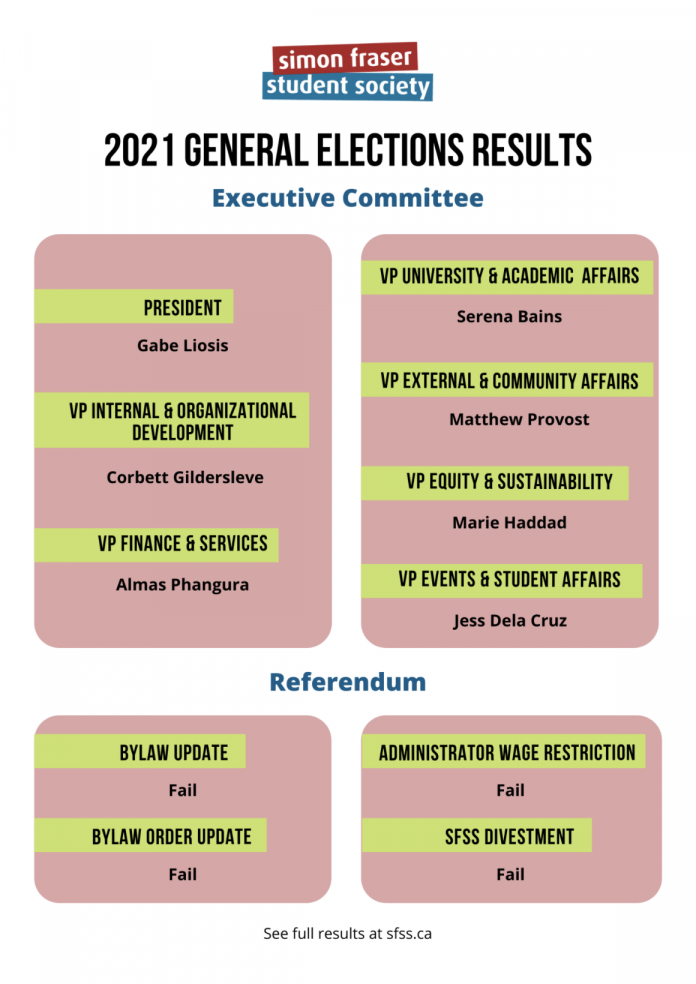
This year’s Board was elected with no more than 650 “yes” votes per position. Image courtesy of Simon Fraser Student Society via Facebook

Another round of SFSS elections is complete, and I congratulate all of the successful candidates, but something about the results isn’t right. 

The 2021 election results had an average of 891 total votes per position, with most candidates being elected with between 500 to 650 votes. With over 29,000 undergraduate students currently enrolled at SFU, it is astonishing that the highest total vote count of 953 for the president position represents a mere 3.29% of the population. The SFSS cannot advocate for and provide resources and services meant to represent the entire student body with such disproportionate percentages.

All SFSS executive positions should reach a minimum percentage of “yes” votes — 8% in proportion to the total student population — in order to be elected to the Board of Directors. A minimum voter threshold would prioritize member outreach activities to both ensure a larger voter turnout and that candidates properly connect with students, hear their concerns, and address the issues important to them. 8% would be a reasonable goal for the SFSS as it is a significant increase in engagement while still being cognizant of the reality of previous years’ voter turnout.

In the 2020 election, most VP positions were elected with 700 to 1,000 votes in favour. Even still, this is a staggeringly low proportion of the total student population. This goes to show the trend in weak voter turnout didn’t start this year, but has been a long-standing trend.

The SFSS is one of the most powerful representations of undergraduate students at SFU. They make decisions about students on a regular basis concerning academic, financial, social, and health-related matters. In fact, as of last spring, the SFSS was managing more than $4.3 million in their general fund alone. This fiscal responsibility must be rooted in oversight measures, student trust in the union, and transparency to the student body. This cannot effectively be achieved without a minimum percentage of students casting their votes for the representatives directly involved in this financial management.

The Independent Electoral Commission (IEC) is tasked with coordinating and running student election engagement initiatives to increase voter turnout — on top of running the election itself. However, the SFSS Elections and Referenda Policies state they are to plan classroom visits, student union meeting visits, club meeting visits, and other such activities “if possible.” This loophole is contradictory to its purpose. The IEC ensures that each candidate’s platform is broadcasted to the student body in a number of ways to make it easier for voters to make informed decisions. The phrase “if possible” negates this purpose, has no place in the written standards for how elections are conducted, and should be amended to aid in increasing the total percentage of voters.

Additionally, all four of the referendum questions on this year’s ballot required a quorum of a two-thirds majority for passing. If we can have a threshold for the referendum questions, why not for the executive team? While reaching an 8% minimum turnout may not be possible, and new rules would have to be created to deal with that possibility, there should still at least be an attempt to obtain greater engagement from the student body.

While the pandemic made facilitating this year’s election more challenging, the general trend of weak voter turnout still needs to be fixed. Our elections should be principled on the fair and accurate representation of student views and should be mirrored by the written election rules and procedures. It’s time for the SFSS elections to implement a minimum voter threshold of 8% of the student population to achieve this.

Four things I’m spending my student bursary on

0
PHOTO: visuals / Unsplash

Well, we got our bursaries, I guess. And if you’re anything like most of the student populace, your tuition was paid long ago, or you’re still in the process of selling your spleen and/or your soul, but you just can’t seem to find a buyer. Apparently they upped our tuition so they could increase financial aid this semester, because tuition freezes wouldn’t stop the problem before it became a bigger problem . . .

Well, have no fear: here are four excellent uses for the money they upped your tuition to provide after said tuition was way past due. Don’t think about it too much.

  1. Finally becoming a vinyl collector

Remember in 2012 when everyone started collecting vinyls and talking about how they just “sounded better” than digital streaming? Yeah, I do. And while hipsters are kind of extinct — seriously, has anyone seen a hipster in the past few years? (Except our Editor-in-Chief and the horde of glasses-endowed Wallows fans just like him found for the low price of one iced coffee at your local coffee shop.) You can finally embody the jackass at your local music shop. And no, you don’t even need a record player. As I’m sure you know, the secret to keeping vinyls in good condition is never using them.

2. A splurge on Amazon clothes you’ll literally never wear 

Ah Amazon. The online shopping icon that, yes, is still treating its workers like garbage. But you want to buy stuff anyway just to feel that thrill of purchasing something and waiting for it to arrive, huh? You just ordered it, bud. Stop looking out your window for the delivery guy. Look what you’ve done to this poor student: they’re buying a new air freshener just to feel something. Thanks a lot, capitalism.

3. Buying something from your family member’s “local business” so they’ll leave you alone 

Are you going to actually use your Aunt Marie’s janky homemade pottery? Will you ever wear your second cousin’s bizarre personalized wool sweaters with what could be a llama, or a dog, or even a self-portrait, stitched on for a design? Do you really have room in your house (or heart) for your cousin’s niece’s Harry Potter-themed resin plates? No, no you don’t. But if you buy their stuff, they’ll probably stop sending you their store link and prodding at you to “support local businesses,” so in that way it’s worth it. 

4. Invest in Squishmallows 

Squishmallows. Is it safe to say that they’re the modern Beanie Baby? I see them everywhere, except, ironically, in the stores that sell them, because they’re always sold out. And if people aren’t hoarding them like squeezable diamonds, then they’re reselling them for ridiculous prices. If you can get your hands on some of the Sanrio ones, you’re basically already nobility. They came out this year, and already, they’re the price of a new video game. You just know those costs are going to age like fine wine, so invest now.

SFU needs to take greater measures to protect our data

2
The school continues to let its community down with its inability to protect personal data. PHOTO: Penn State / Flickr

SFU prides itself on keeping its community safe from harm, yet its cybersecurity (or the lack thereof) paints a different image. 

SFU’s servers were hacked on February 3, exposing the personally identifiable data of over 200,000 past and current students and staff. This wasn’t the first time something like this has happened either; SFU also had data exposures in 2016 and 2020. SFU’s lack of support for their IT department and options for those whose data was exposed reveal the school’s inability to keep up with modern cybersecurity demands. The school should reflect on the shortfalls that lead to this breach, and take concrete measures now to prevent another breach in the future.  

Email addresses, student numbers, and transcripts are among the long list of information that was exposed in the breach. Although more secure information like banking details and social insurance numbers were not exposed, the fact that data breaches like these can happen on a semi-regular basis is a serious cause for concern. At a time when classes are virtual and both staff and students rely on safe online support from SFU, this data breach is a major let down for the community. How are staff and students expected to be productive when the threat of their personal information being revealed hangs in the background? 

What makes the data exposure worse is that there is no way for the community to take back the personal data floating out on the Internet. It is now someone else’s free real estate, and there is no way to know what the consequences will be until it’s too late. This risk speaks volumes to the school’s outdated cybersecurity systems. Especially since modern online privacy methods prioritize user transparency and control over one’s own data — something that SFU should prioritize as well.

Investing more in the maintenance of the SFU data servers and in supporting their IT personnel would have helped to prevent an exposure in the first place. The maintenance of IT platforms was even amongst SFU’s top reasons for the annual tuition hike during the pandemic. If SFU had taken more appropriate preventative measures, it would have saved the community a lot of grief. Yet here we are, trying to cope with the fallout of a data breach even though we have already (literally) paid our dues.

Additionally, it’s odd that alumni information is kept on SFU’s servers. What would be the purpose of keeping the information from people who have moved on from SFU? While there may be a good reason for keeping their data, it is not worth bearing the higher risks associated with it. SFU deleting irrelevant or unused data after a certain period of time would be a small step towards ensuring a safer online presence for the whole community. 

IT Services recommends that the community set up multi-factor authentication (MFA) and to use SFU’s virtual private network to aid in data breach prevention — the latter of which is only available for staff and faculty. MFA will be mandatory for all staff and students by December 2021 and provide a safer log-in experience, but it does not address the core problems that started this whole mess. These suggestions also put the onus on the community to take action on preventative measures that should have been implemented on SFU’s end from the start. 

SFU’s recommendations are only temporary bandaids that do not solve the issue of the school’s vulnerability to data breaches. SFU needs to step up and be a leader in ensuring the online safety of its community, beginning with investing in its cybersecurity infrastructure and personnel, being more transparent with the data it collects, and giving more control to those who own said data. Students and staff deserve more than an email that offers no solid solutions for future exposures.

Western Canada Marine Response Corporation responds to fuel spill on Tsleil-Waututh territory

0
PHOTO: Ruth Hartnup / Flickr

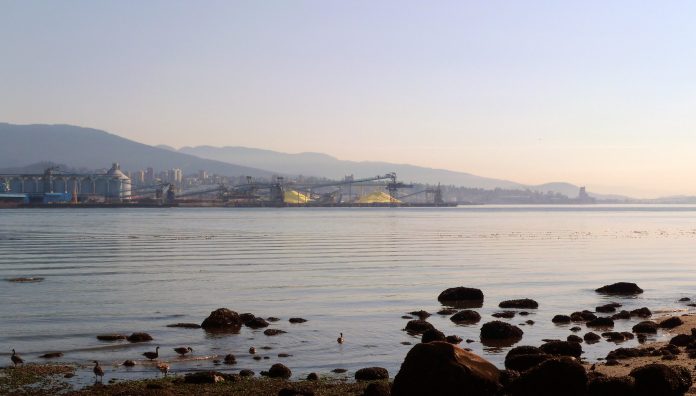
On February 22, the Western Canada Marine Response Corporation (WCMRC), who work to clean marine spills, responded to a fuel spill on the Burrard Inlet caused by an oil tanker. The spill took place on the Tsleil-Waututh Nation’s territory and resulted in a litre of fuel spilling into the water. 

The Peak had the chance to interview Communication Manager Michael Lowry from WCMRC regarding the response team’s call. 

Lowry explained that the WCMRC gets called when a marine spill occurs by either the source of the spill or by the Canadian Coast Guard. He said by law, “all large vessels of a certain size must have a membership with the response organization” and if an incident occurs, they are required to contact the WCMRC. 

“During that refilling operation, there was a burp of the fuel,” said Lowry, adding that it was bunker fuel that spilled. He said about three litres of fuel spilled onto the deck, from which approximately a litre leaned down the sides of the boat and got into the water. 

He confirmed that while there was no investigation, the WCMRC anticipates no environmental damage. 

When asked about preventative measures for these sorts of incidents, Lowry explained the nature of their role takes place “within the windows” of when spills occur. However, he added that other than responding to spills, they also create “response plans to help mitigate the impacts” of their calls. 

“We’ve done some mapping work of the entire Vancouver Harbour [ . . . ] so that mapping work involves pre-identifying sensitive areas on the coast and so that could be an environmental sensitivity like an eelgrass bed or it could be a cultural First Nation sensitivity.” 

He explained, the WCMRC “work[s] with nations along the coast, including the Tsleil-Waututh, to identify areas that are of concern to them and then we pre-develop protection strategies called geographic response strategies for those areas.

“So certainly, if there had been a threat to any of those sensitivities from that spill already or future spills, we would also have been deploying protection strategies in that area.” 

The Tsleil-Waututh Nation responded to the incident on Twitter saying, “Regardless of size of spill, these spills occur regularly, and cumulatively pose significant negative impacts to our home waters, shorelines, and ecosystem.

This is yet another reminder that oil spills are inevitable and why [Tsleil-Waututh Nation] cannot consent to the Trans Mountain Expansion.”

The Peak reached out to the Tsleil-Waututh Nation for more information but did not receive a response by the publication deadline. 

A surprise revisit from 2006

1
PHOTO: Adam Valstar / Unsplash

I’ve been feeling funny lately. Could it be the annual spring fever? It’s already March and the midterm season is in full blast. Maybe I’m just stressed. 

I’m tossing and turning half asleep. I open my eyes to check the time and almost fall out of my bed as a wild STARLY appeared! It’s sitting right in the middle of my old childhood bedroom with me!

Wait. There’s no Starly in the most recent Pokédex (nor in-person, not until Pokémon GO inevitably becomes the new reality). Panic strikes as I check my surroundings. Troy Bolton sporting that Disney star smile and a Wildcats uniform from my pillowcase? Rubbing my eyes in disbelief, the Starly disappeared, but I’m still stuck in my High School Musical-themed bedroom. 

Scrambling for my iPhone, all I can find is a Motorola Razr laying on the bedside table, which among other things, also features a Nintendo DS and an assortment of CDs and game cards. Oh, Nintendogs! I flip the phone open. Time and date: 6:59 a.m. March 10, 2006. Before I can fathom a clear thought, the alarm goes off blasting Nickelback’s “Rockstar.” 

While struggling to operate the flimsy flip phone, a knock on the door is followed by a Karen poking her head in to remind me to get ready for school. Wait. Karen is actually my mom with the asymmetric haircut that she rocked in the early 2000s.  

I swing my legs out from under the red bed sheets, just to find myself dressed in a matching Wildcats PJ set. I had almost forgotten about this pre-teen phase of mine. The Twilight aesthetic that hit me like a train in 2008 had a much longer-lasting impact on my general taste. I still listen to “Roslyn” on repeat, come at me. I’m planning which Disney princess lip gloss to put on for school that day when . . .

Suddenly, I startle awake and find myself feeling stiff as a board at my desk. My half-written midterm essay is glaring at me from my laptop. The date reads March 2021.

I wish my 2006 throwback had lasted a little longer. I didn’t even get to play Pokémon Pearl or check on my Nintendogs. I wonder how my golden retriever Daisy is doing. Did I give her enough water to last 15 years?

Bummed, I close down the various tabs on my computer. That’s when I come across the article I must have read before dozing off. “2006 is making a comeback! For its 15-year anniversary, Pokémon is remaking Brilliant Diamond and Shining Pearl for the Switch.” 

I quickly drop my summer courses, cancel my apartment lease, and phone my mom to tell her I will be back home for the summer. I’ve got Pokémon to catch, and High School Musical to rewatch.

A sourdough horror show

0
PHOTO: Simona Sergi / Unsplash

I just couldn’t eat Cadbury Mini Eggs for dinner again.

I was looking for some kind of microwaveable food that I wouldn’t have to wash down with a bottle of ginger pills to stomach. I shoved a box of Clif bars—so expired Prince Philip doesn’t look old in comparison—to the side. There really were just slim pickings in here.

Leaning sideways into the cabinet, I suddenly felt my hand hit something gooey, and a high-pitched peep escaped. What the hell? Have my Goldfish had enough of smiling back? Is this the end?

“Leave me ALONE!” the small voice said. What was in those Cadbury Mini Eggs? I cleared my throat, looking around to make sure no one was around to mock me for talking back. 

“Who are you?” I asked, just far enough down the rabbit hole to engage.

“Oh, you know DAMN well who I am.” Slugging noises, not unlike the sounds a jar of grape jelly makes when a kid sticks their hand in it, echoed off my near-empty pantry. I reached out for a can of soup for self-defense, then decided against it. That was the last gourmet meal here. I couldn’t waste it.

What peered out from behind my cabinet door made me squirm. A gooey, Flubber-meets-Pillsbury-Dough-Boy monstrosity kicked aside a pasta box and slid forward, with a haunting, distraught face made out of divots in the dough. 

“Oh, God!” I cried. Behind it was a vacant empty mason slapped with a piece of masking tape labeled “sourdough starter.” 

“Yeah!” the creature squeaked, a doughy point outstretched angrily at me. “Remember me? Remember how you CREATED me?” 

During the first weeks of COVID-19 lockdown, I had decided to make sourdough in a moment of normie weakness. I couldn’t remember what I had done with it. I looked at the angry blob. How much yeast did I put in that thing?

“Are you my sourdough starter?” 

The blob scoffed, “Now, look who’s keeping up!” 

“And you can talk?” 

“Do you not hear me right now, jagweed? Yeast is a living thing; of course it’s gonna live and talk and grow.” 

A wave of guilt and panic washed over me. 

“How long have you been living like this?” 

“You tell me, jagweed,” the sourdough creature gestured to the label on the mason jar. “The day you brought me into this cursed existence is written right there.” 

I reached into the cabinet to grab the jar, and examined it closely. “It’s been a year. I made you one year ago today.” I looked over at the creature with its furrowed dough brows and I felt my guilt mix with sadness and an odd affection. “Happy birthday.” 

The creature looked up at me with an inexplicable expression. “The fuck is a birthday?” 

I looked around, trying to think of something I could do to demonstrate. I grabbed a paper towel, drew a cartoon with a little Shrek face, and tied it around the creature’s gooey neck.

“Listen, I’m sorry that I created this cursed life for you and abandoned you for your first year of life. Can I at least try to make things better for you?” In a truce offering, I stretched out my arms to my doughy, sticky yeast child. 

The creature stared in awe. “Are you fucking kidding me?” the creature asked, shaking its head and storming back into the cabinet.  “You left me to rot for a year and you expect me to come crawling back to you? Not a chance, jagweed.”

“Where are you getting these insults?”

“I heard all those days you spent watching 30 Rock, too.” The creature slapped its arm to the cabinet door once it was nestled inside and pulled it back, closing the door shut. I stared at the floor, heartbroken.

“Can we try this again another time?” I attempted, squeezing my eyes closed with regret. The silence filled the room.

“Get me some nice buns as company, and I’ll think about it.”

Disability Day of Mourning remembers those killed by their family and caretakers

0
Photo courtesy of Autistics United Canada

Content warning: discussion of ableism and violence against those with disabilities. 

Autistics United Canada and disabled community members hosted the Disability Day of Mourning last week to commemorate disabled lives lost at the hands of caretakers and family members. The event, hosted over Zoom and live-streamed on YouTube, was attended by people across Canada. In the last five years, over 700 people with disabilities have been murdered by parents, relatives, or caretakers. 

The vigil remembered those murdered by sharing their names (if known), and information about their lives. Event organizer Allie, quoted disability advocate Gabrielle Peters, “Their lives have ended, but their humanity will not be erased from history.”

“Ableism is relevant and connected [to] every social issue [ . . . ] yet continues to be overlooked by many, including in spaces that strive for social justice and liberation,” said speaker Tami Starlight.

The event called to “actively [fight] against hierarchies of oppression and systems of supremacy,” and to recognize the value of “all bodies, brains, minds, and senses.” 

Bridget Liang added that disabled people often hear their lives are not valued, and other marginalized groups of people share similar struggles. Disabled people should have the right to possess self-determination, said Liang. 

The speakers explained that disabled self advocates have faced the belief that disabled lives are not worth living. Stories about the victims of ableist violence may sympathize with the perpetrators, sending ableist messages about whose lives are valued and promoting “an association of disability with suffering and death.” 

Later, Bill McArthur shared his experiences at the Woodlands School, where he and other residents suffered abuse. He asserted disabled people belong “out in the community to participate to the best of their abilities.” 

Several speakers, including McArthur and Peters, spoke in opposition to Bill C-7 — which aims to ease restrictions on disabled people’s access to medical assistance in dying. The bill would counter funding support systems and make euthanasia easier to access, instead of focusing on accessible care to disabled people. Speakers explained that the bill threatens disabled lives and continues a long history of eugenics. 

The event closed with disability activist Laura Hershey’s poem, “You Get Proud by Practicing.” 

It reads: “Remember, you weren’t the one / Who made you ashamed, / But you are the one / Who can make you proud. / Just practice, / Practice until you get proud, and once you are proud, / Keep practicing so you won’t forget. / You get proud / By practicing.”

BC NDP’s misleading policy regarding the protection of old-growth forests

2
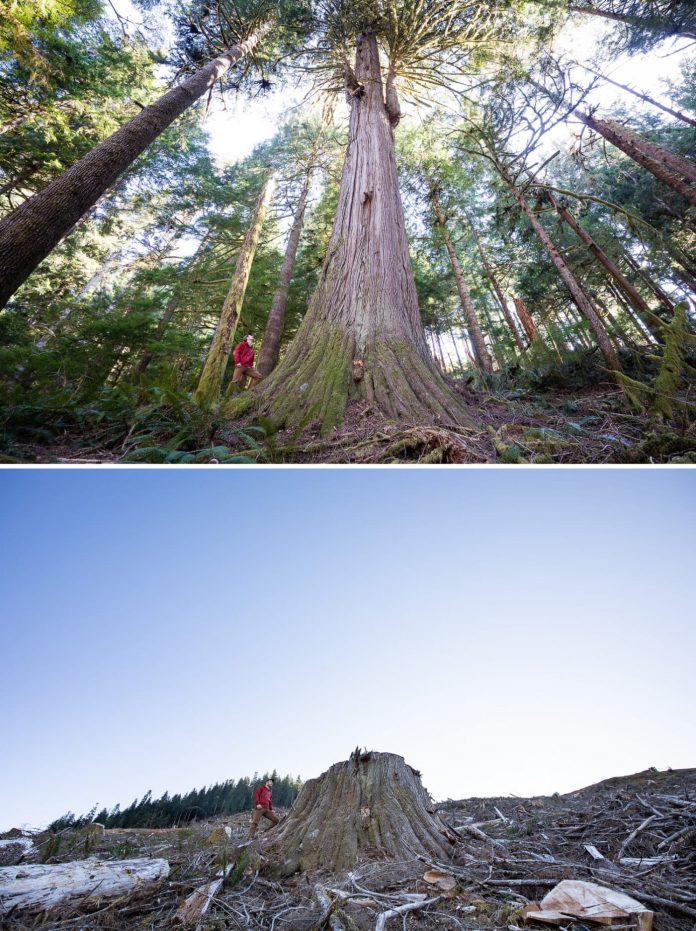
PHOTO: Before and after of old-growth in Caycuse watershed. TJ Watt / The Narwhal.

One of the most significant ecological challenges in BC has been the conservation of old-growth forests — BC’s ancient forests. Their conservation is synonymous with protecting biodiversity, and the cultural practices and ways of life for many BC First Nations. However, just as important is how these forests act as reservoirs of carbon — carbon that increases global temperatures if released into the atmosphere. 

The conservation of old-growth forests is essentially to protect humans from themselves. 

In September 2020, the BC NDP government embarked on a new approach to old-growth forests with a policy that sanctioned the deferral of old-growth logging in nine areas throughout the province, equalling 352,739 hectares (approximately 260,000 hectares from the Clayoquot Sound). However, these deferrals are temporary protections and are set to expire after two years. 

The provincial government’s promises to conserve nearly 353,000 hectares of old-growth forests are factually incorrect and misleading, according to a report by The Narwhal. There are environmental, spatial, and cultural consequences to this pressing issue and the lack of a meaningful policy response by the BC NDP government.

Additionally, according to Tzeporah Berman, international program director of stand.earth, the deferrals were for areas that “weren’t even threatened by logging or made up of big trees.”

Not to mention, mapping by geographic information systems (GIS) mapper Dave Leversee and conservation organizations found that approximately 137,000 of protected hectares in the Clayoquot Sound “were already under some form of protection” and on the government’s map of protections in the area, much of approximate 260,000 acres include non-forested areas such as rocks, mountain peaks, swamps, etc.  

The reason the provincial government was able to get away with claiming their policy will conserve nearly 353,000 hectares of old-growth forest is that the definition is highly contested. Some define “old-growth” by the age of trees while others define it through physical characteristics or ecological functions. 

When The Narwhal asked the province’s Ministry of Forests to clarify their definition of old-growth, they directed the publication to a strategic review titled, “A New Future for Old Forests.” In that review, old-growth was described as “a generic term to describe forests with old trees” and more specifically (for management purposes), forests which are “250 years [old] on the coast and 140 years [old] in the interior” of BC.

The Narwhal’s report explains that of the near 353,000 conserved hectares, only approximately 196,000 hectares are actually considered old-growth forest according to this definition. The remaining approximately 157,000 hectares are considered second-growth forest, which is open to the logging industry. 

Second-growth refers to native forests that have regrown after being cleared due to human (or natural causes) but the differences between these forests and old-growth go much further than this. Old-growth forests are structurally different in that that they have multiple-layered canopies with gaps. This means that the trees are of diverse ages and heights, and that sunlight can permeate through to create understories that are richer in biodiversity than second-growth forests.

This retroactive clarification raises concerns that the current protections in place for old-growth forests are inadequate.

The 196,000 hectares of protected old-growth is even more inconsequential when the differences between high-productivity and low-productivity forests are considered. High-productivity forests are critical to the conservation of biodiversity in BC as they are much more biodiverse than low-productivity forests. The largest trees are found in high-productivity forests, and endangered species such as mountain caribou, northern goshawk, fisher, and marbled murrelet call these forests home.

Of the 196,000 hectares that the provincial government marked for protection, a team of independent scientists analyzed that only an estimated 3,800 hectares of BC’s remaining high-productivity old-growth were included. A mere 1.94% of high-productivity old-growth is included in this policy’s protections, a far cry from what the BC NDP government is presenting themselves as doing. This policy is incredibly misleading and fails to contextualize its supposed protections within the productivity of the forests they planned to conserve.

This failure by the provincial government to conserve old-growth forests in BC will have consequences that will contribute to the ongoing climate crisis. A research study comparing the carbon stocks of old-growth and second-growth forests in central BC concluded that “harvesting of old-growth forests in sub-boreal [BC] lowers total [carbon] stocks by 54–41%.” 

Through analyzing BC provincial government data, Sierra Club BC reported that while the forests of BC acted as a carbon sink between 1990–2002, they had become a net carbon source by 2003. This means they have gone from keeping in more carbon than they were releasing to storing as much carbon as they were releasing. In the years since 2003, they have been emitting more than they have sequestered (stored). The factors that have contributed to this include the increasing rate of forest fires and the mountain pine beetle outbreak that killed a large number of trees. 

Where old-growth forests come into this equation is that these trees have developed adaptations that make them more resistant to burning — they absorb water and retain moisture, essentially regulating the climate within a forest. The fire resistant capabilities of second-growth forests do not match those of old-growth, but because of widespread old-growth harvesting, it’s second-growth trees that dominate the landscape of BC today.

BC’s ongoing transition from a forest landscape comprised of old-growth forests to second-growth forests will likely continue to contribute to the rising rate of forest fires and the decreasing capabilities of their forests to sequester carbon.

Additionally, incorporating the voices of Indigenous peoples in decision making, especially regarding issues that are affecting them directly, will be paramount to BC protecting themselves from their own action (and inaction). Of the forestland in BC, 95% is Crown land, most of which has been stolen from the many First Nations in the province (198 bands, over 200,000 individuals) who are forest-dependent peoples.

When conserving old-growth forests, as well as addressing the broader issue of the climate crisis, “supporting the capacity of Indigenous governance and management is likely to have multiple benefits [ . . . ] including avoiding over-exploitation, achieving effective ecosystem-based management, and enabling local monitoring for climate impacts.”

A spokesperson from the Ministry of Forests told The Narwhal that engaging with Indigenous nations is a priority for the ministry. However, their policy of conserving only 1.94% of BC’s high-productivity old-growth forests is contradictory to that statement as these forests are important for how First Nations sustain themselves, as outlined on the Government of British Columbia’s website. 

Stating that “the diverse ecosystems of old-growth forests provide water habitat for the fish, wildlife, and ecosystems that are vital to many Indigenous communities” and that they are “important to Indigenous cultural practices that have been passed down for generations” must go along with policies that reflect those acknowledgments.

The very report the provincial government referenced for their definition of old-growth forests discussed the importance of engaging with local Indigenous leaders and creating an “entire system grounded with a Provincial-Indigenous government-to-government framework.” This would represent “a new governance approach that relies upon cooperation rather than regulation for situation-specific problems.”

For forestry management, this intergovernmental system would entail adapting to how different BC First Nations have developed their own ways to monitor forest health and climate impacts. More specific adaptations include increasing the age of rotation ages (waiting longer to harvest from one part of a forest to another) as the rate of cut for logging companies is too high to be sustainable, and selective logging instead of clearcutting to minimize soil erosion.

 However, a counterargument to this would be that not all First Nations in BC share the same ideas regarding old-growth forests. Indigenous peoples have been deprived of economic opportunities due to settler-colonial practices that still persist today. These practices include racism and discrimination in many areas, such as healthcare, the environment, and more, as well as the ongoing issue of missing and murdered Indigenous women. 

As a result, many Indigenous people seek revenue and employment opportunities where available. Since old-growth forests often overlap with First Nations territory, logging old-growth forests is one of the most accessible opportunities. 

However, First Nations who are in favour of protecting their ancient forests are working with conservation groups “on solutions that strengthen First Nations’ governance and provide financial support for sustainable economic alternatives for First Nations, such as cultural and eco-tourism, non-timber forest products harvesting (e.g. wild mushrooms and berries), sustainable seafood harvesting, renewable energy projects, and value-added second-growth forestry [that incorporates Indigenous values].” 

There is a dichotomy that exists within the different First Nations in BC regarding this issue, and it underlies the dialogue surrounding land use in the province. 

Nonetheless, it is a fact that this policy is not going to accomplish what it is being presented to accomplish.

The BC NDP government’s misleading and factually incorrect policy was either gross disingenuousness or accidental. Regardless, the 353,000 number is what first registers from headlines, not that:

  • Of the supposed 353,000 protected old-growth hectares, only approximately 196,000 of the hectares is actually old-growth
  • Only 1.94% (3,800) of that 196,000 was high-productivity old-growth
  • The deferrals areas didn’t contain big trees and hence, weren’t threatened by logging
  • 137,000 hectares of protected areas in the Clayoquot Sound were already under some form of protection
  • Of the 260,000 protected hectares in the Clayoquot Sound, much of them included non-forest area

This policy will not be effective in conserving old-growth forests and the provincial government should make the necessary changes to reflect its supposed commitment to the environment and Indigenous peoples. The necessary changes should be implemented together with Indigenous leaders, beginning with implementing Indigenous frameworks of forestry management to BC’s forestry management system. 

Regarding this specific policy, the necessary changes include increasing the number of hectares protected in high-productivity old-growth forests, which will conserve the province’s biodiversity, resistance to forest fires, and the ways of life for BC First Nations. 

It will be a step in the right direction in conserving BC’s environment.

SFU celebrates Black womanhood through art

0
Photo of un/settled art installation at night on the Belzberg Library's windows. Photo courtesy of SFU.ca

Since November of 2020, Vancouverites have been consuming the resilience, energy, and beauty of Black womanhood through visual art in the form of a 240 foot photo-poetic art installation un/settled. The piece, which resides at the intersection of West Hastings and Richards Street occupying SFU Belzberg Library’s large windows, embodies Blackness and everything that celebrates Black creativity. 

The artwork features stunning poetry written by writer and academic Dr. Otoniya J. Okot Bitek, and portrait imagery of artist-educator Chantal Gibson. On February 10, both Black creatives, along with SFU Belzberg head librarian Ebony Magnus, shared dialogue for upholding Black voices through art in an enticing panel that aimed to unpack the presence of Black bodies in urban public spaces. 

un/settled encompasses overlapping significances: from Black women representation, to challenging notions of visible blackness in public spaces, and encouraging solidarity between communities. The atwork exhibits poetry excerpts from Dr. Okot Bitek’s 100 Days which were written in response to the horrors of the Rwandan genocide in 1994:

Some of us fell between words

& some of us onto the

sharp edges

at the end of sentences

& as if we’re not impaled

we’re still falling

through

stories that don’t make sense

In discussion, Dr. Okot Bitek emphasized the use of the word “we” (which is bolded in text as a part of the installation) to symbolize solidarity. Although un/settled was created in the light of Black womanhood, the artwork is for everyone to indulge and cultivate narratives for solidarity and unity. 

It’s important to recognize the urgency of solidarity in the scope of racial justice, and that standing in solidarity for Black lives is a communal effort, that requires an ongoing willingness to support and attain equality. Moreover, unsettled means to be disturbed by what is happening around us, to question, and object to the humanity behind discriminatory enforcement.

“I want us to continue to be unsettled by the horrors [ . . . ] what will it take for us to be unsettled?” asks Dr. Okot Bitek after she recites the excerpt to the audience. 

As simply as she put it, this statement proposed so much more dimension to the artwork in the sense that even Dr. Okot Bitek, one of the artists behind this work, questions the extent of its impact on society. Similarly to when people chant “Black Lives Matter” in a protest, one’s intent is determined and confident; but simultaneously, there is that doubt of whether or not that pain and anger is valid enough to spark systemic change — what will it take? This uncertainty exemplifies what it means to feel unsettled: the dread of not knowing if things will be different, and the frustration of stagnancy. 

Another interesting angle introduced by un/settled is that the installation is presented as a temporary piece, hence, unsettled in its placement. Where un/settled is mounted up in Vancouver, there happens to be an abundance of permanently “settled” art pieces surrounding it, be it inside the SFU campus or in nearby areas. The temporary nature of un/settled plays on the lack of Black art within Vancouver. 

This juxtaposition speaks to the current decolonizing moment in history, where we allow people to be uncomfortable about the realities of racial inequalities. As a result, we are able to shift those emotions into learning items to actively dismantle and restructure systems that derive from, and uphold white supremacy. In any event, to see Black culture on this scale is indeed a valuable step towards acknowledging this restructuring. 

Having been closed since the pandemic, Magnus brings up the fact the SFU Belzberg Library as a social construct has always been closed for some, alluding to the exclusion of institutions built upon white supremacy. 

That being said, un/settled is so much more than a 12 foot tall Black body at a busy intersection Black womanhood is depicted in the artwork through the strands of braids, representing her crown, her history, her heritage, her protection, and her identity, all the while acknowledging her inner void through the dark, empty space on the inside of this art. The installation reminds us that Black bodies are allowed to occupy space, in a world where they are so confined. 

Mounted onto the library building, the presence of un/settled  holistically speaks to the absence of representation and Black voices within SFU as an academic institution, as well as within urban spaces in the city of Vancouver. The real estate that un/settled takes up engages the community in a special way, embracing solidarity through art.

SFU physics professor Eundeok Mun appointed one of Canada’s Research Chairs

0
Photo courtesy of Simon Fraser University

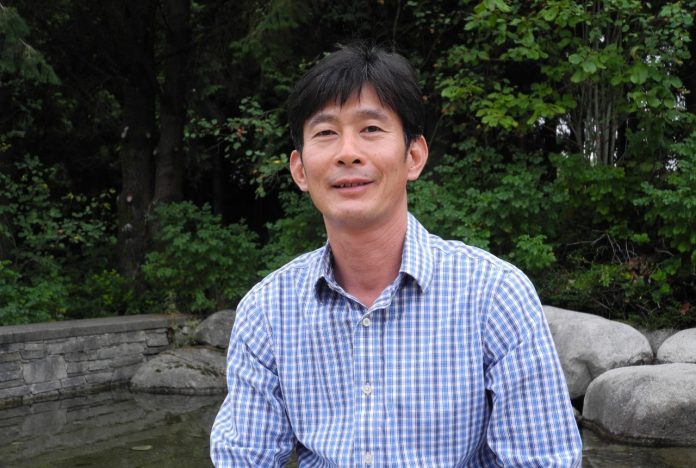
Assistant professor Eundeok Mun, a member of SFU’s physics department, has been awarded as one of Canada’s Tier 2 Research Chairs. Appointed for his work on material physics, the award grants him $100,000 in research funding annually for five years. 

The funding from the program will go towards Mun’s continued work leading the Emerging Materials Lab, which aims to create new materials that could aid in future technological advancements. Alongside Mun are several graduate students who work towards the same advancements.

“I am designing new materials to discover new phenomenons, new physics or new science, while also considering the application,” he told The Peak. He focuses on frost-treated magnetism, and freezes it to the lowest possible temperature to understand its properties. 

To contextualize the nature of his work, Mun discussed the lab’s current study, which seeks to find a room temperature superconductor which can conduct electricity without resistance, even in freezing temperatures. 

“There is some optimism,” he explained. “Based on my past five years, I am seeing some clues that I can make a connection between a superconductor and magnetism. This is a tiny clue but I have to seek the further, big picture.” 

This would be a significant tool in creating a room-temperature superconductor, Mun said.

This is the second time Mun has been granted the Tier Two award, having been first awarded it in 2015. Its renewal comes along with 150 other Research Chairs across Canada, each with a specific area of study. 

The Canada Research Chairs program is an initiative that funds post-secondary research across the country, and aims to draw international researchers to Canadian institutions. It provides $295 million in funding for researchers each year.

For Mun, the program is what brought him to SFU after previously studying at Iowa State University in the United States, as well as Sungkyunkwan University in South Korea. He has been working to find material breakthroughs for nearly 25 years. 

“I’m putting in a lot of labour to find proper, really good material. Then, with the Canada Research Chair, I have a big plan, but who knows. With people doing my research, rolling the dice, there may be some success or maybe all fail, but who knows! I just keep working. This is the reality.”