Home Blog Page 1184

Addicted: Nymphomaniac Vol.1 and 2

0

seligman

It’s a room reminiscent of Freud’s set-up: a woman is reclined, a light from behind setting a glow on her, the makeshift patient.

Joe (played by Charlotte Gainsbourg and whose younger self is played by Stacy Martin) wound up in this strange bedroom convalescing under Seligman’s (Stellan Skarsgård) wing after he found her in a wet brick and mortar alley. We might have called it chance if it weren’t for the over-saturation of coincidence in the film. At certain hallmark moments the too-precious serendipity is exhausting, and we don’t offer von Trier the leeway we might for a less seasoned screenwriter.

Joe sets out on a life-long, four-hour recollection of her nymphomaniac condition. Seligman is too eager, moving in careful intervals, scratching his chin; his fascination with this detailed montage of her sexcapades is in medias res, as though he had the bed made and the tea boiling before he found her.

Seligman’s openness is like that of a priest on the other side of the confessional: getting high on this unprecedented access but responding as though asexual. Speaking of priests, the film inevitably challenges us with the choice of whether or not to moralize. Joe is puzzled at Seligman’s very clinical (pedantic, rather) responses to her monologues, and for the viewer it feels measured as we realize that each chapter reveals something more difficult to bear.

She is not a woman with desire and control, rather she is a person succumbing to an appointed vocation — eating for survival and not for pleasure.

Young Joe in Vol. 1 is played by an utterly bored-looking Martin, a young first time model-cum-actress. It’s hard to feel anything for what she gets up to, whether playfully teenage or pregnant and under-stimulated, as present-day Joe narrates the exploits. She is not a woman with desire and control, rather she is a person succumbing to an appointed vocation — eating for survival and not for pleasure.

Joe speaks about the condition methodically, outlining the monotonous routine she managed to find herself in with a full-time job and 10 different fucks per day. Is there even a way to schedule ten partners in a day without a fairly dedicated administrative sense? She loses sensation, and then her husband (Shia Labeouf), and then eventually total hope for her future.

Joe and Seligman realize the sun is coming up and notice a tiny splash of sunlight on the outside of the building directly across from his window. Seligman mentions that he’s never been able to identify what series of reflecting surfaces makes it possible, and there’s a soft feeling of rarity and buoyancy in the mysterious source of light.

Von Trier, it first seems, has attempted to suggest Joe’s nymphomania as a counter-cultural condition — an exercise in chest-puffery where women are capable of living on the man’s side of the double standard, a place where tallying sexual partners at least exists for the other 50 per cent of the world.

But the attempt inevitably folds over on itself. The languorous, digressive nature of the film comes to a sharp head in a series of very slight interactions between these two new friends. The room’s tone changes, some sudden action and then — we exhale, but the relief is only momentary, impulsive. Von Trier brings us to the edge of this sexual capacity from a woman’s perspective and, with the finale, snaps the whole thing back, leaving us with a bleak shadow of what he perhaps lays out as his forecast for female sexuality.

The Straight Medicinal Dope

0

If you’ve been following the news, or have a Google Alert for the words “medical marijuana,” you’ve probably been hearing a lot about medical marijuana recently. Apparently, the rules surrounding it are changing or something; it might be illegal, I don’t know. The point is you need to get informed about it and learn the cold hard facts about medicinal dope. So here it is, everything you NEED TO KNOW about medicinal marijuana.

Conditions Treated with Medical Marijuana

Contrary to what you may have heard, medical marijuana isn’t just for people suffering from “not being high” and is in fact prescribed to reduce pain for a number of real ailments.

piechart

Dispensaries

Dispensaries are the name for medical marijuana stores. They sell a range of differently-named forms of marijuana, all with their own unique benefits much like you will find when purchasing antibiotics. They also sell terrible-tasting cookies and brownies. No one knows why, it’s just tradition!

Side Effects

Unfortunately, medical marijuana-use isn’t all fun and games like Xanax or Methadone. There are 3 known side-effects to frequent medical marijuana use.

1. Memory Loss

2. Poor Counting Skills

Slang Terms

Medical marijuana goes by a lot of different names out on the street, here’s a few you should learn.

1. Medical Weed

2. Medical Pot

3. Medical Reefer

4. Medical Chronic

5. Medical Dope

6. Medical BC Bud

7. Medical Ganja

8. Medical Puff

9. Medical Mary Jane

10. Medical Cannabis

Types of Medical Marijuana Plants

Sativa

Recognizable as a tall and slender leaf, sativa medical marijuana has more THC (Total Highness Concentration) and gives patients the energy and inspiration to finally finish that 3-D puzzle they’ve been putting off.

Indica

Indica is shorter and fatter in appearance than a sativa plant. It also has more CBD (Chill Baked Degree) which makes patients mellow enough to enjoy the movie “Here Comes the Boom” but also makes them so sleepy that they miss the last half-hour.

Maple

Although it is the most commonly found form of medical marijuana in Canada, Maple Leaves have been proven to be almost entirely ineffective as a medicinal product despite countless reports from 12 year olds who “totally got stoned” off of them.

Grad Gab

0

Results from the GSS Elections

The results are in for the Graduate Student Society elections, which were held from March 25 to 27. The positions up for grabs were Academic and Internal Relations Officer (AIRC), Coordinating and External Relations Officer (CERO), and Member and Community Relations Officer (MCRO).

Of the three positions, only that of MCRO was contested. The MCRO is responsible for “overseeing the public communications of the Society.” The final count was 88 votes for candidate Melissa MacAskill to Brieanne Olibris’ 85 votes. There were also 41 abstentions.

Although there were originally two candidates for AIRO, Mengliu Zhao withdrew her candidacy. Therefore, the GSS will proceed with the acclamation process for both the AIRO and CERO positions at the upcoming GSS Council meeting on April 16.

Volunteer Appreciation Gala

The GSS hosted their third annual Volunteer Appreciation Gala at the Vancouver Aquarium on April 4. The event honoured volunteers from this past year who have made contributions to the GSS.

In addition to enjoying live music and a free photo booth, some volunteers received fun prizes such as “Best Caucus Minutes” and “Best Councillor,” among others. This year even afforded those in attendance the opportunity to dine with the belugas.

Said current GSS Member and Community Relations Officer, Eleonora Joensuu, “We hope this event shows our members how important and appreciated their dedication is to their student society and just generally, a big thank you!”

Tippy Top Ten: Spring Sendoff

0

Here are the Tippy Top Ten Biggest Surprises from the SFSS Spring Sendoff …


10. One of the performers had a pronounceable name

9. The beat was only dropped once and it was an accident

8. 3LAU did an entirely acoustic EDM set

7. Tupac hologram refused to perform after not receiving payment

6. MOIEZ’s brother Peter filled in for him without anyone realizing it

5. A few attendants retained their sense of hearing

4. The exact same song was played over six times

3. FKYA turned out to be a juggling act

2. Concert was briefly hijacked by the Putty Patrol

1. The mother died and Ted started dating Robin

West Coast separatist movement grows

8

cascadiaflag
PRINCE GEORGE — There is a separatist movement building slowly in the Pacific Northwest; its speed reflects the pace of the people outside of its metropolitan centers.

It is not your typical movement based on the right and left spectrum, nor is it necessarily about protecting a certain culture. More so, it is about creating one, building off the foundation of what already goes on in the westernmost bioregion.

It is about decentralizing two governments that seem to disregard what the population wants on the West Coast. The movement calls for a new sovereign state: Cascadia.

The map is not perfect yet. For some it stretches from northern California to the Alaskan Panhandle. For Cathasaigh Ó Corcráin, co-editor of underground journal Autonomy Cascadia: A Journal of Bioregional Decolonization, Cascadia’s borders would reflect the fact that it is based largely on ecological designs rather than current political boundaries.

Corcráin, following Dr. David McCloskey’s influence, says that watersheds should dictate Cascadia’s region. For example, he uses the Alsek River in Alaska and Yukon as the northernmost border, and the Klamath River as the southernmost. He also points to the importance of sharing the Salish Sea.

Flowing from that, Corcráin also sees the focus of bioregionalism as challenging the current way we associate ourselves with the land. Bioregionalism, as defined by Brandon Letsinger, founder of the Cascadian Independence Project and manager of Cascadia Now’s web presence, is “a way to reframe and rethink a lot of the boundaries and borders on this region to better represent economic, political, social and environmental realities.”

Corcráin, who traveled around theoretical Cascadia when filming Occupied Cascadia, says that he also noticed many similarities to communities around the region that shared similar relationships with natural resources and surroundings. For example, a logging community in rural Washington likely shares many cultural characteristics with a logging community in rural northern British Columbia.

Furthermore, Corcráin points to that fact that Cascadia is a very wild place, and the wilderness is rugged and “in your face, hard to ignore.” Letsinger said that Cascadia is the birthplace of the idea of bioregionalism. What’s more, Cascadia has many of its ecological systems still intact relative to the rest of North America. He says Cascadians are further united by love of a shared place.

In 2011, the “Republic of Cascadia” made it onto a Time Magazine list of the Top 10 Aspiring Nations, which may be just the beginning, despite the author’s throw-in that Cascadia has “little chance of ever becoming a reality.”

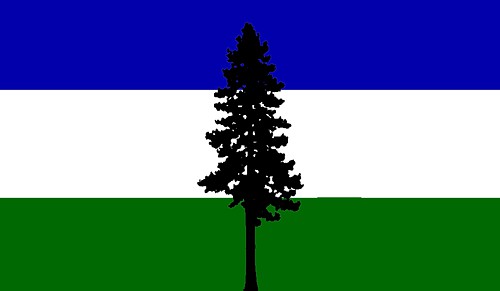
Many British Columbians have probably seen Cascadia’s flag, amicably nicknamed the “Doug Flag,” as it has made its way onto the packaging of one of Victoria’s most popular brews, Blue Buck. The Doug Flag depicts a Douglas Fir over a typical horizontal tri-colour flag.

The three colours — blue, white, and green — represent the bioregion of Cascadia. The blue is for the ocean, lakes, rivers and other bodies of water; the white for the snow-capped mountain ranges and glaciers; and the green for our lush forests.

Letsinger sees growing support for Cascadia. He points to lack of other alternatives and general unhappiness when it comes to the Canadian and American federal governments. He sees this as largely due to the fact that Cascadia focuses on positives and a new, untainted prospect.

According to Letsinger, Cascadia Now is in direct communication with around 15,000 people and acknowledges the many social media groups with thousands of followers which support Cascadia. Corcráin agrees, saying that he has seen the buzz around Cascadia grow since he first became involved. Only time will give clear definition to Cascadia.

Fun in the sun #2

0

Questionable Information: Mt. Rushmore

0

The majority of the United States’ federal debt is the result of a top-secret project to add Lincoln’s top hat to Mt. Rushmore.

”Fossil Fools” Day organizers have the last laugh

0

WEB-fossil fuels-Leah Bjornson
Sorry fossil fuel companies, but it looks like the joke is on you — at least, so says environmental justice club SFU 350.

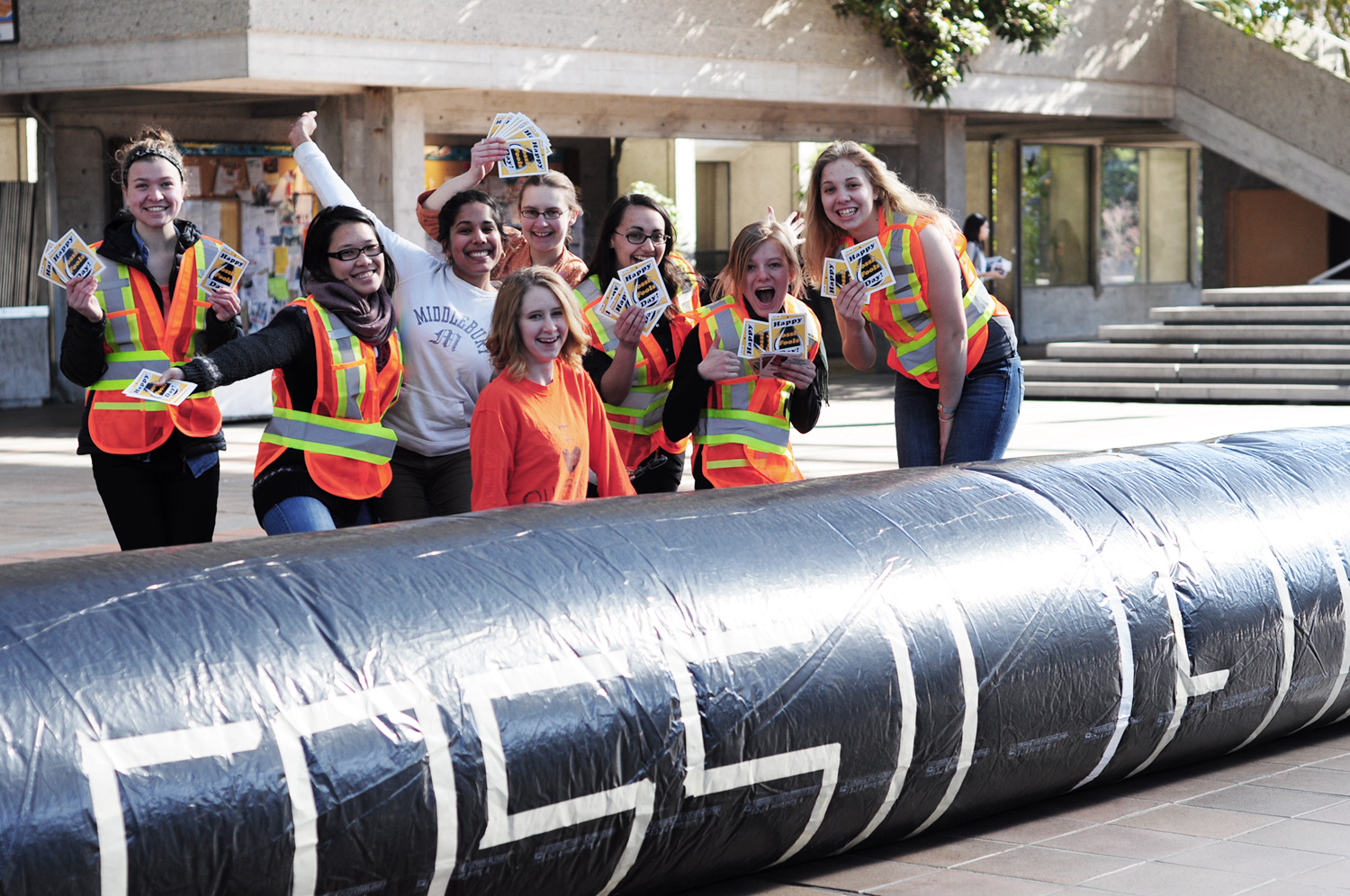
This April Fool’s day, the club held a “Fossil Fools” event in Convocation Mall to raise student awareness on the consequences of building the proposed Kinder Morgan pipeline.

“Fossil Fools” Day is a nationwide movement, in which several university student groups across Canada participated, advocating an end to the country’s reliance on fossil fuels as an energy resource and a greater investment in more sustainable energy alternatives. The aim of the initiative is to tackle the hard-hitting reality of climate change which SFU 350 holds will only be worsened by the release of fossil fuels into the air.

The Kinder Morgan pipeline project hits close to home, as it would carry crude bitumen from Alberta’s oilsands to the Burrard Inlet here in BC. The project has sparked outrage from several members of the community with regards to the potentially catastrophic damages it could cause through oil spills.

To emphasize the disruption that this structure would cause in the environment, students got creative and built their own inflatable pipeline that ran through Convocation Mall — a silly yet striking reminder of the proximity of the environmental consequences that the pipeline might create.

SFU 350 is a student-run organization — its goal is to advocate for climate justice on campus. The group’s name is based on the measurement of 350 parts per million (ppm), which is the optimum amount of carbon dioxide that should be in the atmosphere in order to have a stable climate. The club, while only formed last September, is already a prominent advocate for climate justice on campus.

The club, founded in September, aimed to create awareness about the environmental future.

With the fun filled and student centered celebration, the club aimed to create awareness about the environmental future. SFU 350 secretary Jesse Willows said of the cause, “There is often a ton of negative connotations associated with climate justice groups, and we wanted to be a more accessible [resource for] people. Our goal is to engage in dialogue that can be tricky because it can be perceived as political.”

SFU 350 is also a participant in the Divest SFU initiative, members of which recently made a case for fossil fuel divestment to the SFU Board of Governors. The campaign has garnered support from the Simon Fraser Student Society, the Simon Fraser Graduate Student Society, as well as the departments of Urban Studies and Resource and Environmental Management.

SFU 350 president Andhra Azevedo was one of two representatives who petitioned the board on March 27 to end investment in fossil fuel companies in order to reduce the university’s contribution to climate change risk.

In addition to the initiatives that they support on campus, the group also supports the march to be held by Burnaby Residents Opposing the Kinder Morgan Pipeline Expansion (BROKE) on Saturday, April 12. They share values with the community organization centre not only in regards to the potential effects of the pipeline on climate change, but also the rights of First Nations peoples, the lack of democracy demonstrated in the building of this structure, and the impacts of potential oil spills on the water and air quality of Burnaby Mountain.

While “Fossil Fools” Day was meant as a light-hearted glimpse into the problems with non-renewable energy and climate change, the group isn’t joking around. Willows concluded, “We wanted to raise awareness about the foolishness of fossil companies. We are trying to protect our future.”

Does Not Compute

0

web-robot loverIllustration by Eleanor Qu

Brave New World

For most of us, the word cyborg likely conjures images of RoboCop or the Bionic Woman. We envision bodies where limbs are replaced by machines, enhancing one’s way of life: Darth Vader, whose helmet hides a face obscured by burns and scars; Star Trek’s Borg, whose coldly calculated plans of assimilation make them a force to be reckoned with; and Steve Austin, who would be a penny short of a Six Million Dollar Man without his bionic eye, arm, and legs.

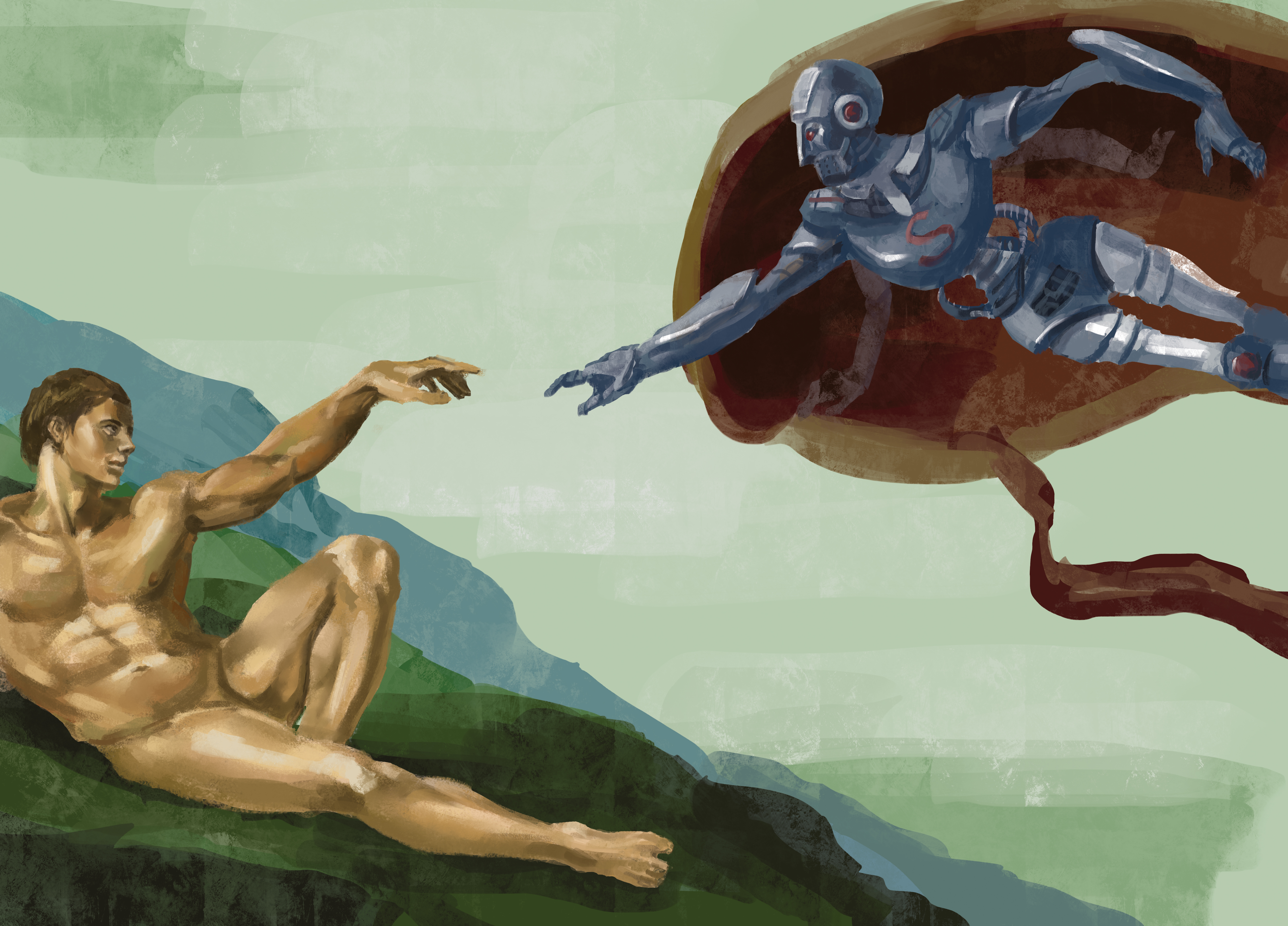
Our current pop culture narratives depict cyborgs as human bodies integrated with high-tech gadgetry, electronically empowering the mind and body. The typical science fiction story often portrays the human part of the body as dependent upon the machine part to survive, and this dependence never comes without super-human benefits.

Our concept of distance has been minimized by our access to technology.

But consider this: are these tales still futuristic fantasies, or do they finally reflect a real-life rewiring of our human hard drive?

Technology has advanced to the point where it is fair to argue that many of us depend upon it to survive. Cell phones, the Internet and other digital technologies are a must-have for communication in a global, business-savvy world where now is always preferable to soon. Such technology provides us with more convenient ways to complete tasks, store information, and do something we once deemed possible only in fictional worlds: bend time and space.

Does that not sound superhuman to you? Maybe not — most of us are so accustomed to this way of life, we don’t take the time to question it.

The word cyborg refers to a person whose abilities and senses are enhanced by technology beyond the capacities of a regular human being. Without the help of our digital technologies, we would not have the ability to communicate instantly with millions of people, or to bend space and time. Compared to the way people lived a century ago, we may as well be superhumans.

Modern Cyborgs

Donna Haraway, a professor at the University of California, states in her 1985 essay “A Cyborg Manifesto” that “we are all cyborgs now.” Every time we click, scroll, dial or type, we essentially become electronically-augmented people.

It’s in our nature as humans to want to augment our abilities and extend our reach — as Marshall McLuhan states in The Medium is the Massage, “All media are extensions of some human faculty, psychic or physical.” In our increasingly tech-mediated world, cyborgs have gone from fantasy to everyday reality.

Such are the concepts that scholar Amber Case has dedicated her life’s work to. She explores these concepts as part of a rapidly emerging academic discipline: cyborg anthropology.

As in every anthropological discipline, cyborg anthropology is concerned with the study of humankind and how we relate to the world around us. Case’s fascination with our high-tech world has inspired her to pen ethnographies focusing on our relationship with — and reliance on — technology. She studies how we interact with technology, and the positive and negative effects of its increasing influence on our lives.

Ultimately, much of her work is devoted to examining how our brains have begun to work in the same way as the machines we carry around with us. The line between humans and machines has become increasingly indistinguishable: machines behave more like us, and we behave more like them.

The human race has always been trying to enhance its own potential. Neanderthals constantly strived to discover new ways to hit harder, move faster, and kill more efficiently. More recently, industrialisation was inspired by the necessity of business and war — we look to make our lives easier and more manageable through the invention of tools to extend our abilities. In the modern age, we’ve become equally concerned with increasing our mental faculties as well as our physical ones.

Case sums up her research brilliantly in a recent TED talk, in which she describes her ideas and those of cyborg anthropology at large. She views a personal device, like a laptop or cell phone, as a kind of “Mary Poppins technology” that never becomes physically heavier, no matter how much technology it stores.

If we were to print out every piece of information we own, we’d never be able to store it all — it would pile up to mountainous levels. To earlier generations, this would seem like magic.

The idea of teleportation, which seems even more fantastic, also appears in Case’s work. Stories of characters traveling immeasurable distances in a matter of seconds have been around for hundreds of years: Douglas Adams describes the process in The Hitchhiker’s Guide to the Galaxy as “not quite as fun as a good solid kick to the head.”

Having to maintain our identities and images online has led us each to create another version of ourselves.

You might be surprised to realise that teleportation is hardly fiction anymore. While we may not be able to physically transport ourselves from point A to point B, we are now mentally able to do so. As Case says, we can “whisper something on one side of the world and be heard on the other,” all through the wormhole technology that we carry in our pockets.

A quick visit to Google Maps and you can digitally walk through the streets of Paris or the jungles of Brazil. Our concept of distance has been minimized by our access to technology.

The Second Self

But perhaps one of Case’s most fascinating ideas is the notion that we have become two separate people because of the technology we use. Having to maintain our identities and images online has led us each to create another version of ourselves, or what Case calls “the second self.”

Whether we like it or not, it is inevitable that each of us has appeared on the Internet in some form. Once our names, faces, or any information about us has surfaced online, that second self has been created, and it’s our job (or at least our inclination) to make it reflect our physical selves in whatever way we deem appropriate.

For many of us, the second self has a different personality, or presence, than our actual selves — most real life people are never as funny as their Twitter accounts or as impeccably dressed as their Facebook profile pictures.

This dichotomization of the self has been a cause of much social anxiety among adolescents. Teens today not only have to deal with the awkwardness of puberty and social interaction; they’re now equally burdened with the grueling task of maintaining a second image online.

This second self is also constantly accessible. We’re able to be contacted and viewed at any time, and once we’re on the web, we never really disappear. With this in mind, do our electronic selves really have any privacy? While the actual self has the option to hide away in a small, dark and dingy corner concealed from any contact with the world, the online self does not have this luxury. We are always available, always open, never alone.

Case’s research delves into psychasthenia, a psychological disorder characterized by phobias, obsessions, compulsions and anxiety. Because of the unprecedented control we have over time, the constant access to a world of people in our pockets, and perpetual need to maintain our online images, Case believes many of us have developed these feelings.

Many have become seriously anxious about what the world of online identities is up to, even if they have been logged off for only an hour — experts have coined the term “fear of missing out,” or FOMO, to describe this phenomenon. We think of ourselves as belonging to two worlds: one physical, one electronic, both equally important.

Such anxiety leads to what is called ambient intimacy: we are now constantly intimate with ourselves, engaged in a neverending conversation between me, myself, and I.

Think of our online identities as sculptures of ourselves that we are constantly moulding. Every day we find parts we decide don’t make us appear exactly the way we want to, so we continue to cut and shape and press to no end. Maybe our noses are actually a little too large, or our foreheads jut out too much. We are compulsively indecisive artists, constantly reinventing ourselves in order to represent our best selves. It’s a lie that we tell ourselves and others, and with the advent of new technologies, it becomes a harder one to maintain.

“We are all cyborgs now.” – Donna Haraway, University of California professor

As a cyborg anthropologist, Case is very concerned with these notions, believing a continuous sculpt is mentally dangerous, especially for youth. She describes how young people today are not spending enough time self-reflecting because they are too immersed in the competition to establish the best online identity possible. “When there is no external input, no technology,” she argues, “we can actually create ourselves, do long-term planning, and figure out who we really are as real-life people.”

Case feels that once we unplug and discover who we truly are in the physical world, we can then make the move to maintain our second selves in a legitimate way that is reflective of who we actually are.

Children and youth today have lost the privilege of having downtime: our instantaneous, button-clicking culture hinders our ability to develop a good sense of real-world presentation, and develop truly comfortable, real life relationships with others.

A Brighter Future?

However, cyborg anthropologists also cite the positive effects of our high tech world. Case argues that our gadgets can actually help us to enhance our humanity, rather than marginalize it. We are naturally social beings who are biologically wired to live together, communicate and, inevitably, form relationships with one another. Our machines help many of us to connect with others more easily. The most successful technologies help us to increase and improve our interactions with other humans, rather than solely with ourselves.

In my opinion, cyborg anthropology should be considered as a new discipline to be offered at Simon Fraser University. While we do offer a wide variety of media and technology classes, our increasingly tech-centric world is too often ignored in lectures and course materials. Amber Case’s work could be a starting point, introducing the concepts and theories of cyborg anthropology to students and faculty alike.

Think about it: we cyborgs should have the chance to learn about our superhuman abilities and how they are truly influencing our selves and our lives. Doing so in an academic setting may allow us to strike a greater balance between our real and digitally sculpted selves, and to make the most of our cybernetic brains.

After all, it’s not easy being digitally enhanced.

SFU hires new defensive coordinator

0

Simon Fraser University falls 3-1 to FC Edmonton in Men's Soccer

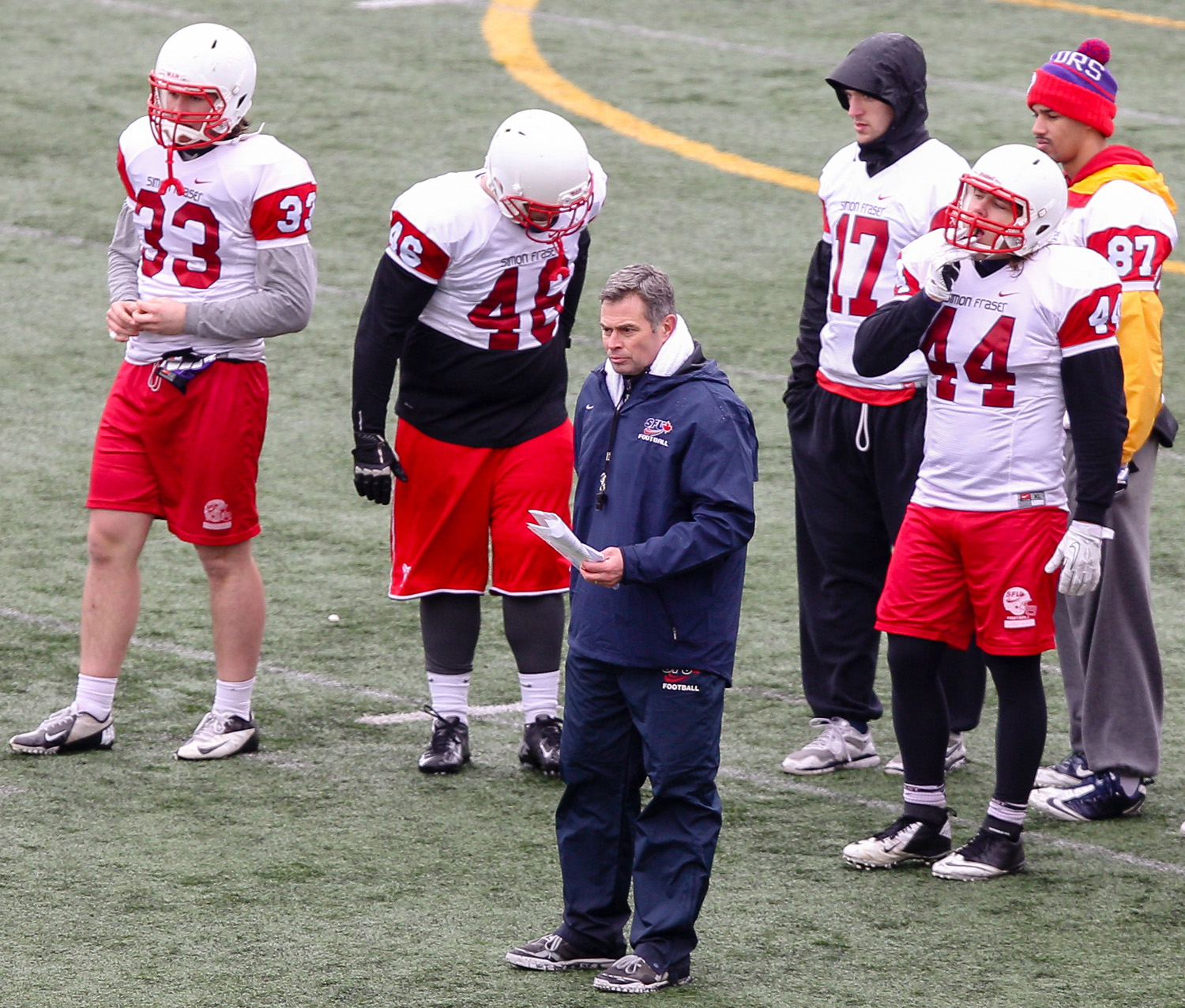
After SFU hired former BC Lions offensive coordinator Jacques Chapdelaine as the football team’s new head coach, scoring points was no longer going to be a concern.

Stopping the other team from doing so? That’s something the Clan haven’t been able to do since entering the NCAA. But with the brand new hiring of Abe Elimimian as defensive coordinator, things may finally turn around.

Elimimian comes to SFU from Div. I’s Washington State, where he served as the cornerbacks coach. Last season, his Cougars ranked fourth in the PAC-12 against the pass, against the likes of Oregon State’s Brandin Cooks — a first-round receiver prospect in this year’s NFL draft — and Oregon quarterback Marcus Matiota, who’s projected to go first overall next year.

“We were looking for someone who was going to be able to come in and be a good teacher, who was going to have a great way to communicate with the young people at the college level,” said Chapdelaine of his new colleague.

“From that point of view, Abe was the ideal candidate in a sense that he’s had experience coaching at the college level and he brings a great deal of understanding and relevance, not only from his NFL playing experience but also from the college coaching staffs he has worked with.”

Elimimian, a University of Hawaii alumni, signed with the San Diego Chargers in 2005 and the Chicago Bears in 2006. He also has some NFL coaching experience, working as an intern with the Green Bay Packers as a defensive assistant.

“The opportunity to work at a wonderful university and for an excellent head coach in Jacques Chapdelaine is outstanding,” said Elimimian. “From when we first spoke on the phone, I could tell he was a man of high character and high integrity and a man who knows how to win. Once I came here I found the people were outstanding, very smart and the atmosphere very welcoming.”

He takes over a program that has been dismal defensively since joining the GNAC, but Chapdelaine sees progress already.

“So far his communication skills with the players have proven to be very efficient and our student athletes are finding themselves in a scheme where they can perform freely and aggressively,” said the head coach.

And, after four years of struggle, any signs of progress are welcome.