Home Blog Page 1182

My Semester in Lecture Notes

0

Week 1

WEB-humour3-Anderson Wang

I took notes on every single word all my professors said with my best penmanship. Sure, none of it was important but still, I think this is going to be my best semester ever!

Week 2

WEB-humour4-Anderson Wang

My notes aren’t quite as neat as last week, but I’m still really staying on top of things. I even wrote down all the TAs’ emails and office hours. Maybe I’ll actually go to them this year!

Week 3

WEB-humour5-Anderson Wang

I drew a cat.

Week 4

WEB-humour9-Anderson Wang

No notes taken.

Week 5

WEB-humour7-Anderson Wang

I wrote down all the main Friends characters names and ranked them from most to least essential.

Reading Week

WEB-humour10-Anderson Wang

No notes taken.

Week 6

WEB-humour9-Anderson Wang

No notes taken.

Week 7

WEB-humour1-Anderson Wang

Switched to taking notes on my laptop. It’s a lot easier but I keep getting distracted with all the cool websites that are out there!

Week 8

WEB-humour11-Anderson Wang

My computer started coming up with all these crazy pop-ups and then just shut down for no reason. Oh well, back to the old pen and paper!

Week 9

WEB-humour6-Anderson Wang

I added sunglass to my cat drawing.

Week 10

WEB-humour9-Anderson Wang

No notes taken.

Week 11

WEB-humour9-Anderson Wang

No notes taken.

Week 12

WEB -humour8-Anderson Wang

My profs did their reviews of their courses this week. I tried to get it all down but they moved through it so fast! How the hell do they expect us to remember all this stuff?!?!

Week 13

WEB-humour2-Anderson Wang

My computer started working again. (No notes taken.)

Finals (Projected)

WEB-humour12-Anderson Wang

I’m screwed, I’m not prepared for any of my exams at all! I’m going to fail all my History, English, Biology and Dog Illustration classes!!! These professors are AWFUL!

Reflecting on photography

0

I’ve spent the last five years at SFU photographing people. Hundreds of faces have looked into my camera: students, student-athletes, student-politicians, professors, board members. A large cross-section of the SFU body populates my archives, digitized in JPEG format.

As this is my eighth and final semester as the photo editor for The Peak, and as with any ending position, reflection comes naturally.

I could discuss, in length, the amazing people I’ve met, the friendships I’ve made, and the opportunities I’ve had. However, I’d much rather keep those stories between myself and those who I’ve come to love so much.

Instead, I’d like to share a few things I’ve come to learn about self-image, a result of showing hundreds of people photographs of themselves.

People take to being photographed differently. On any given shoot, a person will sit down in front of me and act in a variety of ways. Where some are confident and comfortable, others are timid and unsure. Some people sit quietly, watching me with suspicion as I set up gear.

Our eyes are drawn to the thing we don’t like about ourselves.

It’s a profound thing to have your photograph taken and one that many people don’t take lightly. It takes a certain amount of trust and if that trust isn’t there, the person will likely decline to be photographed. I think a lot of this mistrust stems from the fact that everyone has things about their physical appearance that they wish were different.

After a shoot, I’ll go through the images with the subject so that they can help me choose the images to be used for publication. As we go through the pictures the first thing I always hear is a negative remark on certain facial features or imperfections. The most common concerns include different sized eyes, blemishes, red or blotchy skin, and wrinkles.

Our eyes are drawn to the things we don’t like about ourselves. These are the features we think others will see and judge us for. They are the features we’ll hide altogether with blown-out highlights and sepia-toned filters.

It’s a sad observation and I wish people could focus on what they like about themselves, and embrace the “flaws” as unique and defining features. One of the reasons I love portraiture is the variety I see from face to face. (You wouldn’t believe how many different types of noses there are.)

I want to emphasize the fact that nearly everyone I photograph behaves this way. I do so because it raises this one simple question: If we’re all worrying about the same things, shouldn’t there be nothing to worry about?

University Briefs

0


WEB-briefs-Shane Murphy

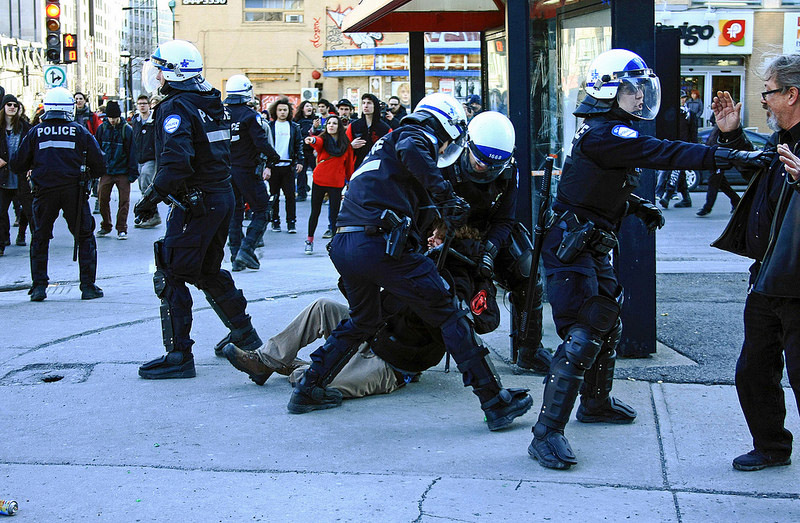
Police break up student protest in Montreal

Thousands gathered in the streets of Montreal last Thursday, April 3 to protest austerity in Quebec’s economic policies. The demonstration had been declared illegal by Service de police de la ville de Montréal (SPVM) before it even began. The march proceeded for three hours before the authorities intervened.

The Association pour une solidarité syndicale étudiante (ASSÉ) is a student union at McGill which was key in mobilizing the student protest of 2012 and organized this most recent demonstration after approximately 60,000 students voted in favour of it.

The SPVM broke up the march with a charge and used tear gas and rubber bullets as a means of dispersing the crowd. At least two people were injured and six arrests were made.

With files from The McGill Daily


Can employers friend you before hiring you?


Marketing agencies and the Office of the Information and Privacy Commissioner of Ontario recently spoke to students at Ryerson University regarding whether employers are legally permitted to ask for social media account names in job applications.


In the past few years, more and more employers are requiring candidates to include their social media account information. However, since students have a right to informational privacy, the legality of this depends on whether the hiring company is a public or private organization.


Public organizations are allowed to do background checks when they are authorized and necessary to the hiring process, but private companies can only do background checks with the candidate’s consent.


Still, district manager at Launch! marketing agency Kyle Tettman encourages students to “be mindful” of what they post online, since “doing a keg stand isn’t illegal, but it doesn’t look great as your display picture either.”


With files from The Ryersonian


International students work under the table

As tuition rises at George Brown College, under the table “cash jobs” are gaining popularity. These illegal jobs appeal particularly to international students, who are trying to support themselves financially in Toronto.

Examples of cash jobs include, “[t]utoring, editing classmates’ work, dog walking, working in repairs, [and] being a handyman.” These types of jobs do not require students to provide work permits or social insurance numbers, making them an attractive option for students from outside of the country.

The problem with cash jobs is that students may end up being paid less than minimum wage or working longer than the legally acceptable number of hours. Furthermore, students are sometimes not paid on time, or even paid at all; however, with so many restrictions on work permits, and the high price of living, it’s a risk some are willing to take.

With files from The Monologue

Harper: the new leader of the free world

1

Since the dawn of the Cold War, the President of the United States has been colloquially referred to as the “Leader of the Free World,” a title that the rest of the free world has generally accepted because of America’s powerhouse status. The ongoing Ukrainian crisis has started to show that a new leader may be stepping onto the scene: our very own Stephen Harper.

If this situation’s narrative could be compared to the annexation of the Sudetenland by Hitler’s Germany in 1938, Harper has cast himself as Winston Churchill, calling for a hard-line against Russian aggression. Conversely, Obama seems to be more of a Neville Chamberlain, continually stuck in negotiations with a foreign leader who doesn’t seem to care about the world’s opinion, so long as he gets what he wants.

And make no mistake, Putin is getting what he wants. While he has removed any objections over an Organization for Security and Cooperation in Europe (OSCE) mission to Ukraine, this mission will not visit Crimea, an act that Russia is interpreting as tacit recognition of is annexation Crimea. Russian Foreign Ministry was quoted as saying that the mission will not enter Crimea because this “became part of Russia.”

While Obama has negotiated with few results, Harper has acted. His was the first, and to date the only, G7 leader to make the journey to Kiev to meet with the interim government and show his support in person, even pledging to restart talks on a trade agreement. He has spoken his mind, stating that Putin, “has not desired to be a partner. He has desired to be a rival.”

As other G7 nations have considered upping sanctions only in response to Russia making further land grabs, Harper has been fighting to increase the sanctions until Russia withdraws from its illegal occupation of the Crimean peninsula. He says, “we simply . . . cannot afford the risk of Europe going back to being a continent . . . where bigger military powers are prepared to invade their neighbours or carve off pieces.”

To merely maintain sanctions now would be to effectively surrender Crimea to Russia, which only serves to enforce Putin’s attitude that he can continue to take parts of former Soviet republics and reintegrate them into the Russian Federation as he wants.

Harper is also calling for the permanent ejection of the Russian Federation from the G8, in line with Russia being excluded from the group’s current meetings.

Canada’s role in all this has not gone unnoticed, with one of Russia’s top parliamentarians singling out our nation for its tough line toward Moscow and support for the new Ukrainian government. Russia has even gone to the length of imposing travel bans on 13 Canadians, including politicians from all three major parties and the head of the Ukrainian-Canadian Congress.

Though many critics have accused both Harper and Foreign Affairs Minister John Baird of abandoning diplomacy, the two men are choosing to uphold Canadian values, rather than stand on the sidelines.

As the crisis continues, talks between the United States and Russia continue to show few results. Diplomacy is not working. The West needs to start following the new “Leader of the Free World,” and crack down on Russia economically until Putin is forced to withdraw.

FaceFries app sparks life in virtual communication

0

FaceFries_LilyLi
Step aside, Snapchat: A new social media phenomenon is on the horizon. The recently launched app, FaceFries, developed by SFU professor Steve DiPaola and UBC professor Liane Gabora, allows you to share not just photos, but a 3D talking animation of your face — or your favourite celebrity, for that matter.

The start-up company, FaceCo, developed out of DiPaola’s artificial intelligence and human expression research, conducted at iVizLab with the SFU Surrey Cognitive Sciences and Interactive Art and Technology programs. The company’s first project, FaceFries, was recently picked up by Apple. Launched last week, the app is already in the Top 60 entertainment app downloads in the Apple App store.

“A lot of what you see on Facebook, or Tumblr, or these kinds of social media is still based on text chat — we were hoping to do something more social, with thinking, breathing, animated humans,” DiPaola said. “We’re interested in bringing the spark of life back into computer systems.”

The technology detects where your face is and allows you to record commentary using the iPhone or iPad microphone. It also allows you to combine multiple faces to create a large ensemble of animated friends, family members or characters who can talk and sing. According to DiPaola, the app gives colour and creativity to digital mediums, allowing human expression to take centre stage.

The animations can be shared through Facebook and other social networks from anywhere around the world. “Two sisters in two different places could put their faces together and sing happy birthday to their mom,” DiPaola explained.

Currently, you can experiment with your avatar’s personas in a number of different ways, with the option of turning yourself or someone else’s photo into a zombie, clown, tattooed person, or an older version of the character.

“[People] hit the ‘re-fry’ button a few times and they see another version of themselves.” DiPaola explained that the app is a sort of social commentary and can be used to experiment with ideas of identity. “I’m interested in gender politics, seeing yourself over, and seeing yourself in different ways.”

Self-awareness and awareness of others is the real driving force behind the app, according to DiPaola. “Our long-term goal is to play with this essence of selfness, so you can understand people by talking through them. It’s an entertainment app at the moment, but that’s the direction we want to go.”

Are you Proud of your government?

0

Proud - Craig Erickson, Emmelia Gordon & Andrew Wheeler image Emily Cooper

Whether or not you’re proud of the current federal government, if you’re interested in politics, Michael Healy’s Proud will be an enjoyable show.

“I would hope people of all political stripes come to the show,” said director and Firehall Arts Centre producer Donna Spencer. She believes the show will really appeal to political science students, political writers, and anybody with an interest in the subject.

Written around the time of the 2011 election, Healy’s Prime Minister is clearly Mr. Harper, although the name only comes up once during the play and the character is referred to as “the Prime Minister” throughout.

The Conservative Party is mentioned during the play which is written from the perspective of a young female member of parliament who has very little political experience. Her perspective aligns with the audience’s as she tries to navigate her way through her new political world. She feels that she has been wronged by the Prime Minister and wants to get revenge.

“She gets bitten by the political bug,” said Spencer, “and she introduces a bill. She sees it as a way to gain greater profile and get back at the Prime Minister.”

When writing a play about a public figure, one has to be very careful about libel, but Spencer said that she doesn’t think the play is in any way libellous. “It’s not particularly controversial but it was treated that way at first,” she said.

At the time the play was written, a number of arts groups in Toronto had been losing funding and there was speculation about government interference. It’s understandable that they didn’t want to produce a play that could have cost them what little funding they had. Regardless, Proud was first produced in 2012 at the Berkeley Street Theatre in Toronto.

“In a way it reveals how government functions […] I don’t think a lot of people know how that works.”

Donna Spencer, director

Spencer has always been interested in politics and had her eye on this play since it was first produced. “For me it was something that really resonated, and it has a couple of really great parts for actors,” she said. Andrew Wheeler plays the Prime Minister, and the whole cast has been working hard to be up to speed on politics and history.

“It’s fascinating in rehearsal how the research informs the work,” said Spencer. She learned a lot about Conservatives’ rise to majority in 2011 and their strategic plan to re-engage disaffected voters. “It’s really interesting to do research and consider how the playwright built the play.”

So much of the play’s humour comes from the fact that it’s based in reality; it’s an intelligent satirical critique of the institution of government. “The humour unfolds from that,” said Spencer. “We try to hit the realism.”

Spencer was also interested in the informative aspect of the play. “In a way it reveals how government functions,” she said, “I don’t think a lot of people know how that works.”

The play may not show the Prime Minister in the most flattering light, but Spencer explained that in some ways it makes his personal self sympathetic. But not his professional self, she clarified.

Spencer said that she doesn’t think there’s anything the Conservatives should be scared of in this play, or the other parties for that matter. “It’s about a political process. We need to think about how we want government to function,” she said. She hopes that the show can spark some political interest in audience members. “I’m actually hoping they’ll get re-engaged about political responsibility,” she said.

Showing that there are many benefits to minority governments and that a majority can erode and erase laws, the play has an all too familiar feel. The story also involves putting forward a bill to create a diversion while other things slip by. “We should be aware and try to get involved,” said Spencer. “Michael Healy felt compelled to write the play for a reason.”

Proud will be presented at The Firehall Arts Centre from April 5 to 26. For more information, visit firehallartscentre.ca.

Cougar hunting

0

WEB-RGB-Lax option 2

It was a game of efficiency and execution as the Clan hosted in-conference opponent Washington State Cougars on Terry Fox Field. The Clan controlled the entire game, treating the visiting Cougars to a constant onslaught of high-powered offence and rock-solid defence, dominating them 30–2.

Before the beatdown, it was an emotional day for the Clan. As it was Senior’s Day, the Clan brought the crowd’s attention to the graduating players and their parents and acknowledged their contributions and efforts over their years at SFU.

The Clan honoured five players before the game who will be graduating at the end of this season: long-stick middle (LSM) Riley Wanzer, defenceman Mark Hilker, goaltender Darren Zwack, and midfielders Brendan Ferrell and Travis Hayes.

The Clan also honoured Lt. Col Paul Paone, father of freshmen LSM Ian Paone, who returned from nine months in Afghanistan and was attending his first SFU Clan lacrosse game.

But after the ceremony, it was no holds barred.

The Clan owned every aspect of the game, going 19 for 30 on faceoffs, collecting an astounding 99 ground balls, and maintaining the ball offensively for a large majority of the game. All but three players recorded a ground ball in the game, and five different players recorded five each.

Seven Clan players had multi-point games, led by Ward Spencer who had a career-high 14-point game with nine goals and five assists. Clan leading scorer Tyler Kirkby had 10 (seven goals, three assists), followed by Lyndon Knuttila (three goals, two assists), Sam Clare (three goals, one assist), Iain Vickers (one goal, three assists), Jordan Lasher (one goal, two assists), and Hayes (two goals).

Meanwhile, a stifling Clan defence kept the Cougars away from goaltender Zwack, who faced only six shots the entire game.

The Clan’s home season is over, and they have just two more road trips to play #14 Texas and conference opponent Montana. The Clan’s record now sits at 6–0 in the conference and 10–2 on the season, boosting them up to #9 in the rankings. The Clan are looking to finish their season on a high note and carry their success into the Pacific Northwest Collegiate Lacrosse League finals, beginning May 2.

Erotica, eh?

0

WEB-girl mountie-deviant art-hawkstone

Last month, the Canadian Radio-television & Telecommunications Commission (CRTC) issued several warnings to Toronto-based adult television channels AOV Adult Movie Channel, XXX Action Clips, and Maleflixxx, as they were failing to meet the required 35 per cent Canadian content threshold. This apparent non-compliance may mean suspension or loss of license for these three adult TV channels.

Since releasing these warnings, the CRTC has received a great deal of criticism for pursuing a seemingly trivial issue. However, these violations should be taken seriously as Canadian content has proven to be beneficial.

Some are of the opinion that Canadian content regulations, as laid out by the Broadcasting Act, should not apply to certain varieties of television, such as pornography. This mentality is often backed by the assumption that the Internet has made porn a borderless industry.

Canadian porn is irrefutably beneficial to the Canadian economy.

While the web has doubtlessly expanded the industry, all televised programs should still adhere to the rules of Canadian broadcasting, as these rules were established for legitimate reasons. Airing Canadian-made programs that reflect our attitudes, values, and creativity allows us to display Canadian talent in entertainment, employ local resources, and distinguish ourselves from American programming.

While it may be hard for some to imagine how Canadian porn can be culturally beneficial, it is irrefutably beneficial to the Canadian economy. Hiring Canadians to shoot, act, edit, and write porn keeps jobs in Canada. Upholding the 35 per cent threshold is important to anyone in film, radio, or television.

Before the act was created, the majority of content on television and the radio was of either British or American origin. At first many stations were hesitant to accept the Broadcasting Act, wanting to “play the hits” rather than find unknown Canadian talent.

By pressuring companies to seek out Canadian content, Canada was able to create an industry that became profitable to us. Since the establishment of the Broadcasting Act, channels such as CBC have flourished.

Some say that there is not enough interest in Canadian porn for a real industry to exist, but this is simply not true. Last year, Northern Peaks, an Edmonton-based company, went above and beyond as 50 per cent of their scheduled programming was Canadian-made pornography. This year it was reported that the Québécois porn industry was thriving and beginning to rival those of LA and Amsterdam. Why neglect a growing industry?

While having the US so geographically close can be great for weekend excursions, it’s important we don’t let Canadian culture succumb to American influence. Instead of mimicking American programs, Canadians should try to differentiate themselves from their southern neighbours. Who’s to say that porno can’t take place at a sugar shack in Quebec or in a lighthouse in Nova Scotia?

The CRTC was created to enforce the regulations surrounding broadcasting and Canadian content. These rules reaffirm more than just Canadian identity; they help support jobs and industry in Canada, as well as prevent the total domination of American media that would otherwise occur.

While Canadian porn seems odd and insignificant, the CRTC’s prosecution of their non-compliances is valid. We as Canadians should pride ourselves on homegrown talent and creativity.

Satellite Signals

0

surrey

Surrey

Last week was election season for the Surrey Campus Committee (SCC), a branch of the SFSS based out of SFU’s Surrey campus. An online vote was held April 1 and 2. The following candidates were elected for a term from May 1, 2014, to April 30, 2015. Taylor Theodore, Chief Officer; Sukhman Thind, Surrey Affairs Officer; Aman Taggar, Promotions and Outreach Officer; and Jessica Leung, Campus Life Officer. Joanne Yoon, Jaskirat Aujla, Juzer Antria, Hitesh Advani, Jessica Thandi, and Dhruv Arora were elected as General Officers.


WEB-woodward

Woodward’s

SFU’s Centre for the Contemporary Arts has named Howard R. Jang as its new cultural unit director. Jang is currently the executive director of Vancouver’s Arts Club Theatre Company, and has participated in The Canada Council for the Arts as a board member since 2012. He plans to use his background as an artist and administrator to both inspire innovative thinking and build community-driven partnerships on behalf of SFU.


vancouver

Harbour Centre

On Wednesday, April 2, George Nicholas put on a presentation that questioned the ethics of research practices used to gather information about the heritage of indigenous peoples. The discussion around who “owns” or has the right to benefit from Indigenous heritage is a hot topic at local, national, and international levels. Nicholas proposed that collaborative research models where the community is directly involved in deciding the direction of the research must be implemented immediately, if protection of Indigenous heritage is to be effective.


SFU inducts 2014 Athletics Hall of Fame class

0

At the Diamond Alumni Centre last Monday, SFU Athletics named six athletes, one coach, one builder, and one team to the Athletics Hall of Fame.

Eugene Gyorfi (swimming and diving), Jim Jardine (football), Sara Maglio (soccer), Andrea Schnider (basketball), Ed Sernoski (wrestling), and Harold Willers (track and field) were the athletes inducted.

Former men’s basketball coach Stan Stewardson, trainer Jack Taunton, and the 2001-02 women’s basketball team were also inducted.

Gyorfi, already an established swimmer before joining the Clan in 1981, led SFU to the 1983 NAIA team championship, while earning three individual titles of his own that year. In 1984, he earned another three, making him one of SFU’s most decorated swimmers ever.

Jardine was with SFU’s football team at its inception, recruited by the Clan’s founding athletic director, Lorne Davies, who was on hand at the ceremony as well. Despite being brought in as quarterback, Jardine switched to defensiveback where he’d anchor the Clan’s secondary throughout his college career. The Clan’s original Minister of Defence became a BC provincial court judge after graduation.

Sara Maglio, named an NAIA All-American four times, was a star in her time with the Clan. She won a national title in 1996 while leading the team in scoring. Maglio would join the Canadian national team, playing in the 1999 FIFA Women’s World Cup.

Schnider, who played for renowned head coach Alison McNeil from 1988 to 1992, was a two-time All-American from 1991 to 1992. She was also on the first Clan squad to qualify for the NAIA Championships, and is still the NAIA all-time assists leader with 926.

Ed Sernoski won two NAIA wrestling titles in 1986 and 1988 at 150 lbs. He also earned a team championship in 1988, a year for which he holds the Clan single-season win-loss record, with a dominant 73–3 season. He went on to become the Canadian champion at 74 kg, and represented Canada in the 1989 World Championships.

From 1978 to 1980, Willers was a three-time NAIA champion in the hammer throw, and continued his collegiate success after graduating, winning four Canadian Championships in the event from 1981 to 1984.

Coach Stewardson led the SFU men’s basketball program for nine seasons, from 1975 to 1979 and again from 1984 to 1989. He groomed some of Canada’s best talent, including Terry Fox and Jay Triano, two other Clan Hall of Famers. He is also a recipient of the Metro Vancouver Basketball Foundation’s Lifetime Achievement Award and has been inducted into the Basketball BC Hall of Fame as well.

Dr. Jack Taunton began his sports medicine career at SFU, serving on the Clan’s medical staff. Since then, his career has grown immensely and he served as Chief Medical Officer for the Vancouver 2010 Winter Olympic and Paralympic Games. With Taunton at the helm, the event was named by the IOC as the best sport medicine platform in Olympic history.

The 2001-02 women’s basketball team were SFU’s first Canadian Interuniversity Sport Champions. The Clan racked up 35 wins on the year, and went the full season without a single loss. The team was named the Basketball BC and Sport BC Team of the Year that season and was later elected into the Burnaby Sports Hall of Fame.

Meanwhile, the late Tim Jones became the first inductee of  the Terry Fox Honorary Inductee category since Fox himself. Jones died suddenly in January of this year, but was the volunteer team leader of North Shore Rescue (NSR), a Vancouver-based search and rescue operation, and was also the paramedic in charge with the BC Ambulance Service. Jones raised over $1 million for NSR, and served with NSR and BC Ambulance Service for over 30 years. His son Curtis accepted the award on his behalf.