Home Blog Page 1148

A 12-Step Cure For Insomnia

0

1. Find a quiet space with minimal noise and distractions

2. Lie down and keep your entire body still

3. Empty your mind of all thoughts

4. Take deep breaths

5. Go to your medicine cabinet

6. Get a package of Tylenol 3 with Codeine and a bottle of Benadryl

7. Put them in a container

8. Use a blender and mix in a litre of any liquor you have lying around

9. Go to your computer

10.Search “health risks of mixing tylenol 3, benadryl and liquor”

11. Read through every post on the subject

12. Fall asleep from boredom

Fun in the Sun: Facebook

0

Satellite Signals

0

vancouverVancouver

From July 15 to 20, SFU co-hosted Mathematics Education at the Edge, which brought together participants from 48 countries to discuss the future of mathematics education research.

Some of the topics included the relationship between gestures, language, and diagrams for bilingual math learners, the ‘flipped classroom’-style of teaching in undergraduate calculus classes, and emphasizing thinking classrooms.


Djavad Mowafaghian

A conference titled The Frankfurt School: The Critique of Capitalist Culture, posed questions on July 17 to 19 about the capacity of Frankfurt Critical Theory to explain the cultural landscape of contemporary capitalism.

SFU’s Institute for Humanities worked in conjunction with Douglas College, UBC, and SFU’s Vancity Office of Community Engagement to explore the helpfulness of the concept of the “Culture Industry” in the context of global neo-liberal order.


University Briefs

0

Judge overturns decision in favour of soup thieves

Three University of Saskatchewan cafeteria workers were fired in March, 2012 for reportedly pilfering soup on the job and smuggling gravy and expired fruit cups home with them.

The majority of the university board later decided that the firing was an “excessive disciplinary response,” due to the fact that dismissal of thieves was not outlined in their policy.

A Saskatchewan judge has just overturned the new decision, citing it as, “unreasonable and outside the range of acceptable outcomes.” He sided with the minority of the board in thinking that the three were “involved in a series of deliberate thefts,” this being made worse by the fact that they initially denied the charges.

With files from National Post


U of A research looks to artificial movement

University of Alberta professor Jaynie Yang has been researching the possibility of returning mobility through the use of fully functioning robotic exoskeletons. Her research has been enabled by a four-month lease of the ReWalk, the first robotic exoskeleton in Canada.

The ReWalk was initially designed to aid in the rehabilitation of people with spinal cord injuries. Yang’s team hopes to conduct a 12-week study of people with various spinal cord injuries and capabilities to find out what the technology is capable of.

“We want to know what’s possible with this exoskeleton, because people can walk in it for extended periods, and that’s what’s needed to provoke changes in your nervous system,” Yang said.

With files from The Gateway


Upright MRI helps UBC researchers treat osteoarthritis

Using an upright open magnetic resonance imaging (MRI) machine, UBC researchers hope to make advancements in the treatment of osteoarthritis: the machine found at the Vancouver Coast Health Research Institute’s Centre for Hip Health and Mobility is the only one of its kind in Canada.

These machines have advantages over the traditional closed machine that requires the patient to lie still on a flat surface. Their unique design allows for the imaging of joints in their full range of motion, the significance being that imaging the joint under stress could help doctors provide more targeted treatment for their patients.

With files from The Vancouver Sun


UBC students climb mountains for charity

A group of University of British Columbia students from the school’s Tanzania Hearts Babies Project spent several days trekking up to the bases of both Mount Everest and Mount Kala Pattar for charity. The students recently released a montage of their trip, which took place in May.

With their climbing, the students aimed to bring awareness to the problems of heart defects among Tanzanian children. The group initially intended to merely climb the mountains, but the idea rapidly grew into a humanitarian effort through Tanzania Hearts Babies Project.

With files fromThe Ubyssey

What would Shakespeare do?

0

web-Equivocation

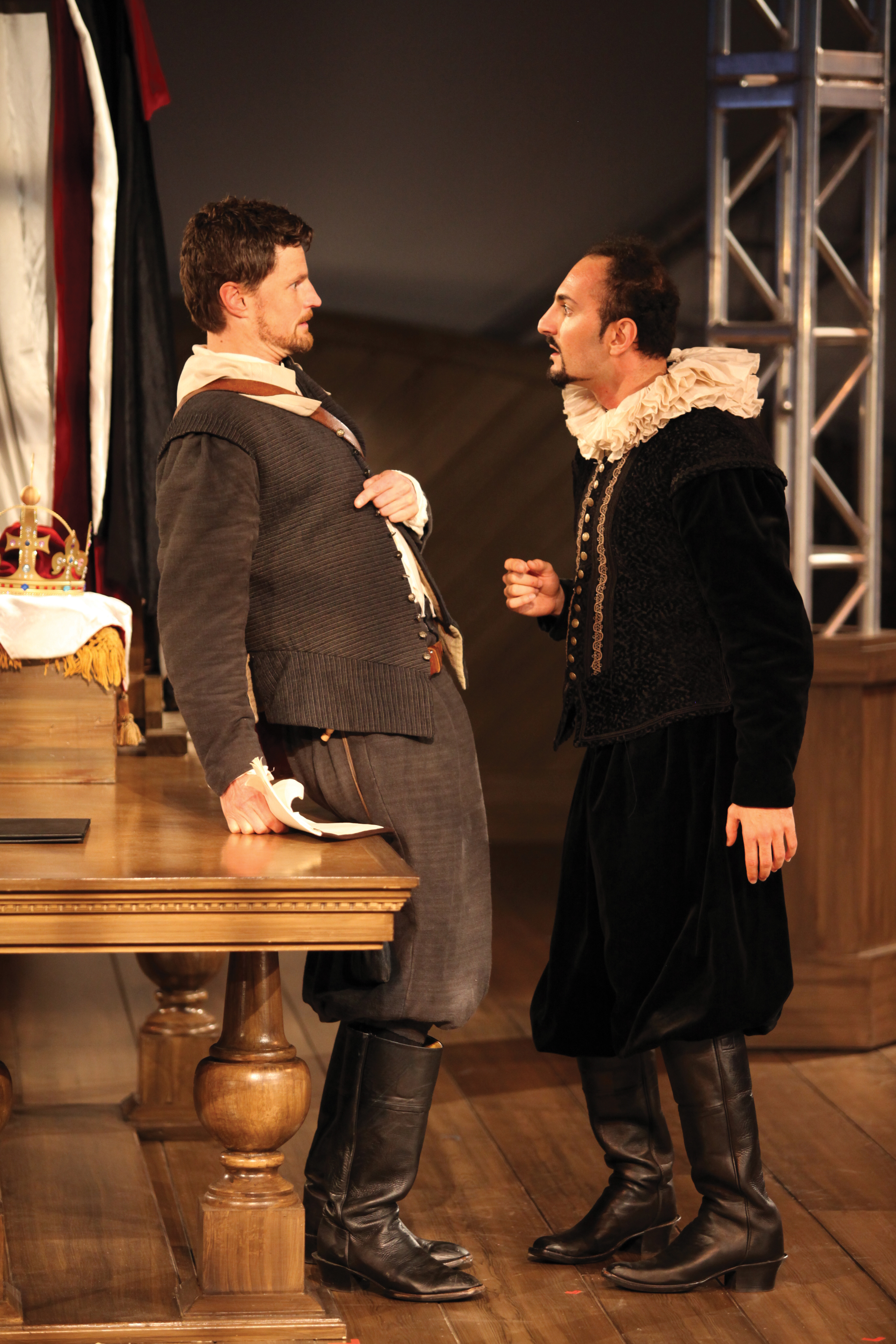
Bard on the Beach almost never presents plays that are not written by the Bard himself, but when they do, it is for good reason. Bill Cain’s tale of art and politics is a masterpiece of suspense and humour played by a cast of six talented actors. It is presented in partnership with the Belfry Theatre in Victoria, where it premiered this spring.

The story is set in Jacobean England in 1606 as Robert Cecil (Anousha Alamian), King James’ Prime Minister implores Shagspeare (Bob Frazer) to write a play titled The True Historie of the Gunpowder Plot. Shagspeare explains that he writes histories and plays based on events that happened in the past, but he does not do current events. 

The gunpowder plot was a terrorist plot led by Guy Fawkes to assassinate King James I and blow up Parliament, and Cecil is adamant that Shagspeare be the playwright to bring the story to life at the King’s request. Shagspeare has no choice but to agree and accepts Cecil’s payment. 

Under the direction of Richard Burbage (Gerry Mackay), Shagspeare and his Globe Theatre company (Anousha Alamian, Anton Lipovetsky, Shawn Macdonald) attempt to translate the story to the stage. As they delve further into the plot, they realize that the King’s version of the story might not be true, and they are forced to decide whether they can perform a story that they know to be false and damage their artistic integrity, or risk their lives by revealing the truth.

Bob Frazer is outstanding in the starring role of Shagspeare, and the relationship he has with his daughter Judith (Rachel Cairns) is so poignant. Judith has a beautiful soliloquy in which she laments about her disdain for soliloquies and plays in general, and I loved the moment when Shagspeare can finally look at Judith without grieving the loss of her twin, Hamnet. 

Anton Lipovetsky as a young King James, with his high-pitched voice as he called for his “Beagle” (Robert Cecil), was hilarious. Lipovetsky also played Sharpe, one of Shag’s actors who needs plenty of encouragement. Alamian as Cecil was also very impressive as he immediately switched from the limping, humpbacked Prime Minister to his other role as one of the actors.

Directed by Michael Shamata, Equivocation is full of references to the bard’s plays and humorous lines from Cecil about his work lasting at least 50 years. He also remarks that Shagspeare has the unique ability to make fun of a group of people during his plays, but have them laughing by the end. The construction of the play’s scenes is quite complex as they are interwoven and involve many quick character changes for the actors, but this cast seemed to pulled it off with ease and it was not difficult to follow. 

At its core, Equivocation is about posterity and how to tell the truth in difficult times, and it tackles these themes with intelligence, humour, and plenty of intrigue. According to Shagspeare, “We are all fools, we are all noble, we are all royal.” He tells his company of actors that they can play any role because they have it inside of them already. It was wonderful to get this glimpse of what it might have been like as Shakespeare directed his actors and dealt with the realities of being under the rule of the King. 

Equivocation runs from July 2 to September 19 at Bard on the Beach in Vanier Park. For more information, visit bardonthebeach.org.

Cymbeline is a modern drama

0

CMYK-Cymbeline

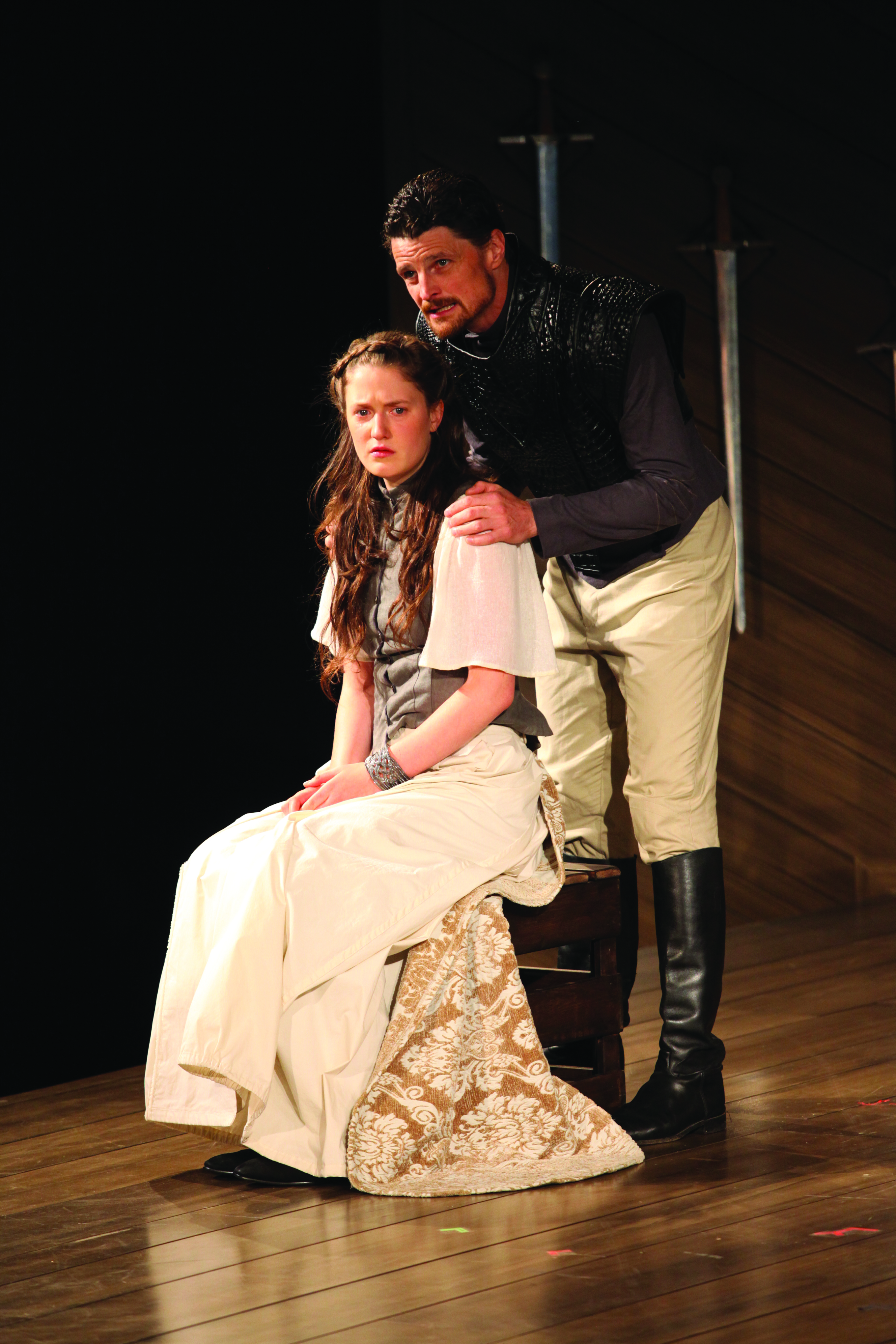
Late in his life, Shakespeare seemed to get a bit sentimental, writing plays that don’t fit neatly into one of his usual categories. Cymbeline is not exactly a tragedy, although it involves war; it’s not exactly a comedy, although it ends happily, and it’s not exactly a history, although it is about a king. The play is really a modern drama with elements of each and a happy Hollywood ending. 

Director Anita Rochon makes her Bard on the Beach debut with this small cast of seven who play multiple roles. The setting is ancient Britain where King Cymbeline (Gerry Mackay) is being threatened by the Romans. To Cymbeline’s dismay, his daughter, Imogen (Rachel Cairns), has married Posthumus (Anton Lipovetsky). Cymbeline had ordered her to marry his new wife’s son, Cloten (Lipovetsky), and he banishes Posthumus to Rome. In Rome, Posthumus meets the manipulative Iachimo (Bob Frazer), who makes a bet that he can seduce Imogen. 

Imogen is one of Shakespeare’s best female leads, and Cairns plays her with subtlety and elegance. Iachimo fails to seduce Imogen with his charms and resorts to hiding in a trunk to gain entry to her bedroom. Bob Frazer was perfectly cunning in this scene as he slinked out of the trunk and around Imogen’s bed. He takes a bracelet from her wrist that serves as evidence of Imogen’s infidelity, and Posthumus orders his servant, Pisanio (Anousha Alamian), to kill her. 

Pisanio leads Imogen into the mountains, but doesn’t plan to carry out his orders. Instead he tells her to go in search of Posthumus disguised as a boy named Fidele. She meets Belarius, a banished lord who has also disguised himself, and his two sons who are the King’s kidnapped sons. These three cave dwellers provide much of the comedy as they sing and go about their work.

Cloten, doting on Imogen and offended by her witty remarks, also provides many laughs. He disguises himself as Posthumus in order to try to win her affections, and seeing that Lipovetsky also played Posthumus, it was quite the feat to keep everything straight and make sure the audience wasn’t confused.

Along with Benjamin Elliott, Lipovetsky also played one of the King’s sons, and I lost track of how many times they ran across the stage to quickly throw on a costume piece and instantly assume their other identity. These rapid-fire costume and character changes added another level of humour that Cymbeline wouldn’t normally have.

Another added element to this production was the music by Benjamin Elliott. With a few instruments and relatively simple vocal harmonies all performed by the actors, this was the perfect final touch. 

Dealing with themes of forgiveness, hope, love, and the power to change, Cymbeline is a well-rounded story played by a small, talented cast. Although it is a lesser-known work of Shakespeare’s, I think it is among his best and deserves to be seen more often.     

Cymbeline runs from July 4 to September 17 at Bard on the Beach in Vanier Park. For more information, visit bardonthebeach.org.

SFU looks to the future with aboriginal academic summer camp

0

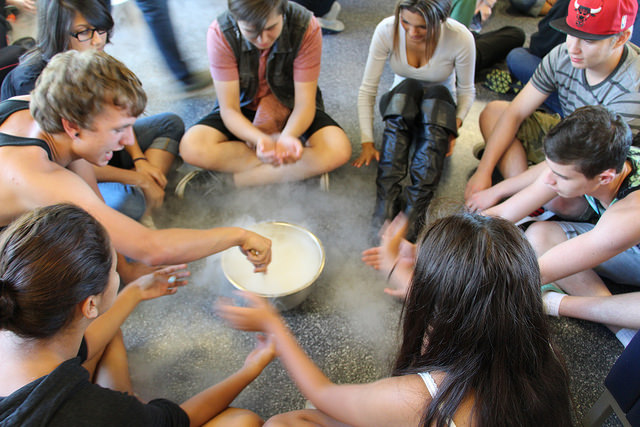
14604507894_1dcf82afce_zThis summer, SFU is offering its inaugural Academic Camp for Aboriginal Students from July 2to 31 at the Burnaby campus.

The camp’s attendees are aboriginal students from the Greater Vancouver area in grades eight to 11. The focus of the day-long sessions is math and english training, but they also expose the students to recreational activities, such as archery, as well as cultural activities that are organized by the Office for Aboriginal Peoples at SFU.

Some of the activities include meeting with elders, learning from Squamish performers how to dance and sing, and making dream catchers.

Veselin Jungic, an adjunct professor and associate chair in the math department, explained, “The purpose of the camp is to help aboriginal high school students in mathematics and English and to also introduce them to the academic environment [. . .] Most of the students are struggling with mathematics and they need another push to get the level of mathematics that will hopefully lead them to post-secondary education.”

Although the students are comprised of a mixture of different aboriginal ethnic backgrounds Jungic makes it clear that these differences do not affect the teaching method. He stated, “The students have an aboriginal background that we need to recognize and we need to support, but when it comes down to it, a math class is a math class and an English class is an English class.”

In BC, the aboriginal population represents 5.4 per cent of the total population. However, Jungic pointed out that at SFU, the aboriginal population represents just one per cent of the Faculty of Sciences and 0.8 per cent of the Faculty of Applied Sciences. This under representation of aboriginal students in applied sciences and sciences is one of many factors that led to the creation of this camp.

Jungic and the rest of the organizers of the Academic Camp for Aboriginal Students say their aim is not only to strengthen students’ understanding in math and English, but also to ignite a new interest in the students that will encourage them to continue into post-secondary education.

Jungic pointed out, “In my view it is not that aboriginal students should be enrolled in science, and applied science to be proportionately represented. It is a fact of life that without science and without applied science, you cannot become a doctor and you cannot become an accountant and you cannot become a lawyer, and that is why mathematics is so important.

“If the community is going to get these people involved in these careers than mathematics must be done.”


Apply!

0

fat-joe-money

Do you enjoy writing, getting your facts straight, and asking the hard questions? Or do you veer more towards graphic design, and creating beautiful layouts? How about creating high quality videos or photos?

Most importantly, would you like to be  paid to do those awesome things?

We’re currently accepting applicants for all of our Fall 2014 positions! The positions we’re hiring are:

To apply for a position, please send your resume and a cover letter to [email protected]. Please make clear in your cover letter which position(s) you are applying for. Inquiries about the positions and their qualifications can be sent to the same address.

The deadline to apply is August 1st.


Experimental Edge of Dance

0

MD The Three Cornered Hat photo Chris Randle

Another crop of contemporary dance works have graced Vancouver during the 26th annual Dancing on the Edge festival’s ten-day span. This year saw over 30 works, a strong partnership with the Scotiabank Dance Centre, many outdoor and site specific performances, and even a Family Dinner where the audiences were the guests at the table.

The mixed programs at Dancing on the Edge allow for a variety of choreographic styles in one evening, and the site specific works add another element of scenery, integrating the space into the work, but I opted to attend five of the full programs this year to see some full-length works by developed and emerging artists.

Ottawa Dance Directive presented three vastly different pieces and showed off a lot more than their choreographic skills. Their first piece, Fracture by Yvonne Coutts, was very funny and broke down the fourth wall before we even realized it. Riley Sims casually walked onstage eating a bag of nuts while talking directly to the audience and explaining nonchalantly that at first he wasn’t supposed to be in the piece, but then they were able to get more funding so he was included.

Sims spends much of the piece observing Jasmine Inns and Marilou Lepine dancing as he seems left out and eager to join them. The dynamic of the two girls dancing with Sims as an added afterthought worked well and Sims contributed plenty of humorous commentary. Out of the three works they presented, this was the most enjoyable.

Their second piece, Trembleherd Bells by Ted Robinson, had five dancers all in white garments and there were large bells placed around the stage. One of the dancers had a book and, at first, seemed to be in a position of authority as the others moved around in a trance, shaking and ringing the bells off and on. When all of the dancers picked up the bells and rang them vigorously, it felt like the whole theatre was one giant bell and we were the clapper swinging from side to side. It was quite the experience and left a lot to be interpreted.

For the final piece of the night, Noam Gagnon’s sho me wut u gut began with the same five dancers in sharp business attire as they romped around the stage and imitated a sort of animalistic need for sexual pleasure. They grabbed each other, rolled around, and generally got frisky. If you are uncomfortable watching other people be intimate, it probably would’ve been the least of your worries. They progressed to removing their clothes and continued to push and pull each other around the stage. There were some beautifully tender moments, but overall this piece wasn’t very pleasant.

Vanessa Goodman’s company, The Contingency Plan, presented What Belongs to You at the Scotiabank Dance Centre. The five dancers in this show are athletic and powerful, and they are full of subtle emotion that comes across through their movements. This work used balloons to create various costuming and scenic effects that I thought were very clever.

The dancers began with balloons covering their bodies as the music grew in volume and intensity and the dim lighting rose to reveal them. As they moved, the balloons slowly fell off one by one. The balloons were central to the work as fans blew them into a whirlwind centre stage and one of the dancers slowly moved in the middle of this balloon tornado. The work is described as being motivated by human desire and led by the senses, and I think that came across well as the dancers were propelled by one another’s energy and performed impressive lifts and moved in unison.

Mascall Dance’s The Three Cornered Hat was my first experience at the eclectic Chapel Arts venue. A few rows of chairs were arranged around a low stage, and this work immersed the audience in a few ways. Piles of red notebooks dominated the stage and served as many things throughout the show. There was a mop that had an open notebook as its base, a notebook on a fishing rod that they dropped onto a few laps to recite journal entries, and notebooks with lights instead of pages.

Before the show, Jennifer Mascall said that the show is like a book club where everyone is sharing their own story. With such a richly visualized concept and the wonderful use of these red notebooks, I loved the humour and intelligence of this piece.

That same evening at Chapel Arts Edmond Kilpatrick, another experienced choreographer, presented Four Intimate Pieces. Along with Ziyian Kwan and Anne Cooper he shared vulnerable moments of his life through narration and they translated these experiences into movement. One intense scene had Kilpatrick and Kwan in a heated couple’s argument followed by a physical exchange that was loving but coloured with anger. Allowing raw emotions to guide their movements, this sparse work took a while for me to get into. I think the opening section could have been shortened or benefited from some more narration to guide the audience.

The final night of Dancing on the Edge was Karen Jamieson’s. Her project, solo|soul, was the culmination of three years of research and danced conversations with other Vancouver dance artists. Through this work Jamieson wanted to explore the relationship between the inner meditative body and the outward focused, performative body that is used in dance.

The work felt as though I was observing one long meditation, and for an audience, it is difficult to feel as invested when the performer is not focused on their outward, performative side. Jamieson danced in the centre of a circle of lights, in front of blurry video projections adapted from her creative process with other dancers, and with John Korsrud playing trumpet around the outside of the circle. I think for the audience it was hard to grasp the concept that Jamieson was after, but it was a unique experience to watch a performer who is so connected to their inner world while on stage.

Celebrating 30 years of her company at this year’s festival, Karen Jamieson’s work was a fitting way to end a festival that supports emerging and established artists alike and allows for collaboration, diversity, and a forum for choreographers to show their works each year.