Home Blog Page 1139

Solo Cup of lukewarm tap water declared most powerful sanitizing agent in the world

2
All other cleaning methods leading to this have simply been foreplay.

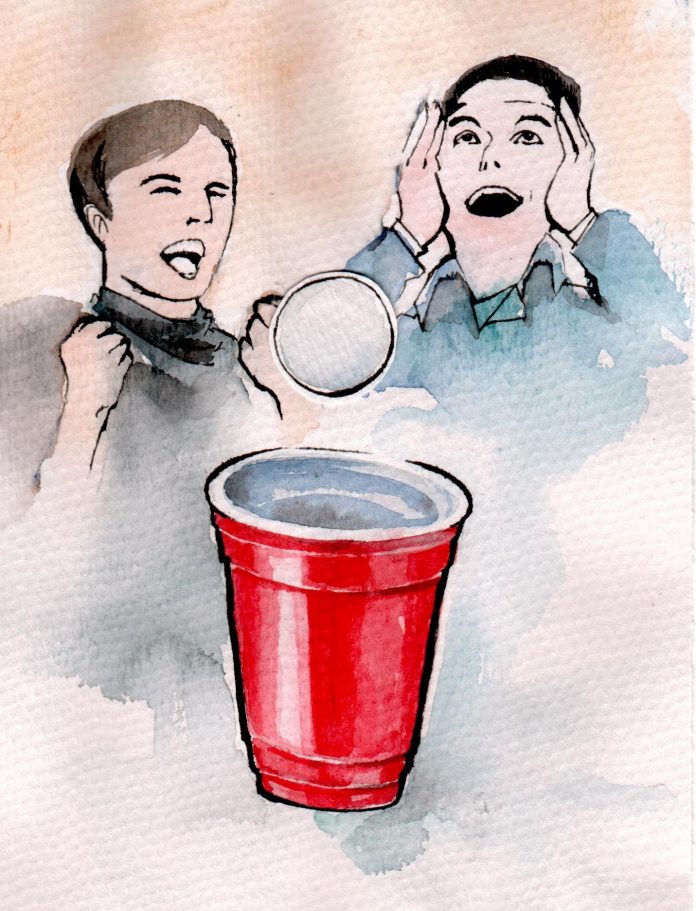
In a move that could very well change the way in which humans deal with sanitation and sterilization, attendees of a Tight and Bright party last week have discovered the most efficient, fast-acting way of killing nearly every trace of bacteria on a surface: a red Solo Cup filled with lukewarm water from the tap.

“We were setting up cups for a game of beer pong when someone asked for an extra one,” Tiffany Marsh said, recounting the extraordinary events leading up to the discovery. “He said he wanted to use a rinse cup for the ball, since the table was pretty gnarly from the game before us. Also, I think someone had puked on it earlier.”

Once the game was officially underway, the pingpong ball repeatedly bounced off the table onto the beer-crusted floor underneath, and even into a nearby fern plant. Marsh was sure the ball would never be fit to be sank into cups of beer again.

“Each time one of us missed the table, I thought to myself, ‘That’s it. That ball is done for.’”

However, just when all hope was lost and several party attendees had written the ball off as a dirt-covered germ orgy, the mysterious newcomer dropped it into the Solo Cup, dunked it a few times, and then haphazardly wiped the ball off on his shirt. Though no actual test was conducted to see how effective or thorough the ball had been cleaned, attendees agreed that the Solo Cup had rid it of all previous contaminants.

“Now I know how Thomas Edison must have felt after inventing the lightbulb,” Marsh said, though likely downplaying the moment’s importance.

While the discovery’s scope is limited at this time, it’s possible that Solo Cups of water will have a dramatic impact on the way hospitals sterilize tools and environments; the food hospitality industry is also speculated to undergo changes in how sanitation standards are upheld. Even the recent Ebola epidemic — the largest in history — could become a testing ground for the new disinfecting method.

“It’s unclear at this time what effect this new super sanitizing agent might have in the current outbreak,” said Tim Riggins, spokesperson for the World Health Organization, “but one thing is for certain: whoever’s bright idea it was to use a cup full of water to supposedly clean off a pingpong ball while playing a drinking game, deserves a medal. Reeeeeally good job on that one.”

Living with acid reflux

0

Each time I ingest food, I am plagued afterward by a burning sensation, as if a fiery creature has burst through my stomach, clawed up my esophagus, and into my throat. I wince in pain and massage my chest as bile enters my mouth. I have what is called Gastroesophageal Reflux Disease (GERD), a chronic condition that impacts my lifestyle choices more significantly than one would think.

For those of you who are unsure, acid reflux occurs when contents in the stomach back up into the esophagus midway through digestion. The pain is caused when the stomach acid hits the esophageal lining, which does not have the protection from acidity that the stomach does. This would explain the searing discomfort I feel when I awake in the middle of the night to unbearable pain and half-digested food in my throat. If not controlled, chronic heartburn can erode the esophageal lining completely, and even cause cancer.

The surprising truth is that GERD is becoming increasingly common in younger demographics. Some researchers blame this fact on the degrading quality of the North American diet. Others look at environmental factors, such as air quality and pollution.

But what saddens me is that many people who don’t have GERD tend to view my condition as petty and insignificant. When compared with fatal diseases, I’ve had people scoff at my condition for being easy to maintain or avoid. Most doctors I’ve seen simply say, “Avoid brown drinks and take a Tums before you go to bed. Your heartburn will clear up soon.” The reality is that GERD has tormented me for nearly a decade, and has caused me to significantly alter my lifestyle — the foods I eat, the positions in which I sleep, even my clothing choices.

GERD is becoming increasingly common in younger demographics.

A few years ago, though, I came to find a silver lining in my condition. I once told a friend in annoyance that to control my reflux I’d have to eat foods without spices, fruit and vegetables without preservatives, lean meat, no sugar, and drink lots of water, all while maintaining portion-control and refraining from food a few hours before bedtime. To which he replied, “That’s kind of a nice disease to have!”

I then realized I’d essentially outlined a healthy diet plan, one that would make Jenny Craig nod her head and smile. I further realized that my GERD had provided me with an opportunity that not many people have — an opportunity to, perhaps, eat in a way that would save me from not only acid reflux, but from a plethora of other health-related problems.

After finally seeing a physician who recognized the longevity of my condition and strongly affirmed this proper heartburn-free diet, I’ve been trying the best I can to live a healthy lifestyle. After all, if I don’t, it hurts!

Of course, there are times when I shamelessly pop a Tums and inhale a cheeseburger, and while I’ve cut back significantly on my coffee intake, giving it up entirely is out of the question! But indulgence once in a while is mostly pain-free, and I’m certainly fine with that.

All in all, I think it’s important to recognize the problems we may have, and to think of the benefits that could arise from these. Life is easier when we take our disadvantages and turn them into something that could benefit us, no matter how difficult these advantages may be to find. While eating has not been all that kind to me, I feel somewhat privileged to have a stomach that literally tells me when something is not good for me. Here’s to being my own personal nutritionist!

To read, or not to read

0

How do the words of a dead man affect you? In Shakespeare’s case, the ways could be countless. This year marked the Bard’s 450th birthday, and consequently raised the following question: are his works still relevant today?

The answer is simple — yes. Shakespeare’s literature is every bit as relevant to our modern society as it was to the average bloke of Elizabethan England. Through prose and plot he established timeless themes, coined new words and sparked centuries of adaptations.

Some argue that Shakespeare’s works are outdated, as they fail to mirror modern life. This simply isn’t true. Every year, authors release adaptations of his iconic dramas and comedies, transforming messengers from the Renaissance age into smartphones, and daggers into guns.

Every summer Bard on the Beach, a Shakespeare festival here in Vancouver, presents both traditional and modern re-enactments of plays that bring to life truisms of our society. Modern adaptations also allow for new generations to connect to the characters and stories in a different way, and bring about new interpretations.

To those who claim we can ignore Shakespeare, or write him off as a relic of literary past, I say that an understanding of his works is needed if you wish to fully understand many stories from the 20th and 21st centuries. There are countless authors and filmmakers who have included references to the Bard’s work in their own, and who have built their plots as a branch from his.

The argument that Shakespeare is just too tough to read is nothing more than laziness.

Aldous Huxley used the title Brave New World for his acclaimed novel, in reference to Shakespeare’s The Tempest. The Lion King, a well-known and loved children’s movie, is based off the iconic play Hamlet. To enrich the modern experience, one must read and study Shakespeare to pick up on references other great authors have made.

From a purely linguistic point of view, Shakespeare remains indispensable to the English language. He coined new phrases, words, and grammatical concepts in all of his works. If you’ve ever been told “the world is your oyster” or “neither a borrower nor a lender be,” then you’re hearing people reiterate just a few of the phrases Shakespeare crafted in his scripts. We must examine these scripts if we wish to understand how modern English was developed.

Some argue that Shakespeare’s writing is antiquated and difficult to read, and should therefore be abandoned — but that just isn’t a good enough reason to rob our society of his literature. There are certainly sections where the words and grammar are difficult to follow, but do we really want to tell the next generation of readers not to bother because it’s too hard?

The argument that Shakespeare is just too tough to read is nothing more than laziness. We should push ourselves to understand Shakespeare’s early modern style; otherwise we are suggesting that if something seems difficult, it’s not worth pursuing.

Storytelling is a structure that borrows the best blocks of the past to build a more fantastic and entertaining literary future. If you cut a row of blocks from the bottom, you risk the collapse of enlightened literary possibilities. Shakespeare laid the groundwork for English literature that would follow centuries after his death. The lively plots, variety of characters, and hilarious wit make it so everyone can find a part of the story to relate too. So take the time to read, appreciate, and reflect on Shakespeare’s works. I promise you won’t regret it.

Main street Massacre is a work of art

0

A recent online video game entitled “Main Street Massacre” has sparked a furious commotion from Vancouver’s public transit system, Translink, over the last couple of weeks. The violent game, which depicts an angry construction worker as he guns down pedestrians at a station labelled Main Street, has had Translink’s lawyers on the prowl, and the media clawing at any information they can get their hands on.

But amidst the accusations that the game will provoke violence at Skytrain stations, and that it infringes on Translink’s intellectual property, what the public seems to overlook is that the game is, first and foremost, an item of artistic expression.

Colin Palmer, the game’s creator, remains rooted in his intentions, telling CBC that “it’s a work of art,” a “political statement,” and that it was designed to be “provocative.” I have no trouble in seeing this game as exactly that.

In light of the game’s media coverage, many Skytrain-goers have expressed anxiety over their safety while taking public transit. The Province recently interviewed commuters on the subject, many of which claimed the game is “too close to home” and will incite violence in Vancouver’s public spaces. Palmer, however, quickly removed Translink’s logo from the game to cut its ties with Vancouver, and to avoid clash with copyright law.

The game’s setting resembles just about any other subway station there is; players shouldn’t give the setting a second thought and should only see the game as a general protest of public transit. If the public feels that its safety is threatened, this is due to the media’s over-saturation of the story as a ‘game that promotes violence at Skytrain stations,’ and not the actual game itself.

Palmer’s game is a provocative and reasonable statement on public transit.

It’s an artistic piece — Palmer felt the need to be creative in expressing his frustrations. He mirrors his video game’s character, as they are both construction workers, managing stressful jobs that have them under physical and mental strain throughout the day. To have public transit break down after this busy workday only adds to Palmer’s (and his character’s) stress.

Main Street Massacre allowed Palmer to release his frustrations in a safe and harmless manner, while also making a political statement about the quality of public transit. If anything, the game should act as a jolt of realization for Translink to clean up its act and to start brainstorming strategies that will make its transit system run smoothly.

What also bothers me about this situation is that the hype surrounding the game seems to have arisen, at least in part, from the type of medium in which this form of expression is presented. If the same narrative were told on a poster, or through a song, would the news still buzz with excitement on the issue? Would Translink be as furious as it is now? Would lawyers be as adamant to remove it from the internet?

Thankfully, I am not one to see an issue with Main Street Massacre. With the countless other violent video games plaguing the internet, I do not feel my safety is any more at risk than it normally would be while taking the Skytrain. Palmer’s game is a provocative and reasonable statement on public transit, and is expressed with creativity. It’s a move that more people should really take the time to consider.

It’s time to stand with Israel

0

Toward the end of the summer, newsfeeds throughout the world were dominated by yet another conflict in Israel, as the terrorist group Hamas began indiscriminately firing rockets at Israeli cities. Despite multiple attempted cease-fires, the conflict continues, and there does not appear to be an end in sight. Incredibly, this overseas conflict, in a country with less land mass than Vancouver Island, is having an effect on our own nation.

At the provincial level, Premier Christy Clark came under fire for a letter written to The Centre for Israel and Jewish Affairs, demonstrating her support for Israel in the conflict.

Though the letter itself did not contain anything incredibly offensive or inflammatory, it was called outrageous by Hanna Kawas, the chairman of the Canada Palestine Association, who claimed that it was “ignorant of facts on the ground” and that Clark “should not be speaking on behalf of British Columbians on the matter.” Kawas’ statement is, in itself, ignorant of the fact that as the democratically elected leader of the province, speaking on behalf of British Columbians is part of Clark’s job.

Kawas was not the only one upset by statements made by politicians regarding the crisis in Israel. The usual critics have emerged from the woodwork to criticize the government’s pro-Israel stance.

Sana Hassainia, MP for Verchères Les Patriotes, recently quit the NDP in protest of the party’s stance on the conflict in Gaza. The worst thing about critics like Hassainia is the incredibly shaky ground they stand on, as the statements they criticize seem to hone in on only part of the story.

There is every indication that Israel is doing what it can to avoid civilian deaths.

Hassainia singled out the first NDP press release, which simply stated that “Israel has the right to defend itself against terrorist attacks by Hamas.” This statement caused her to label the NDP a blatantly “pro-Israel party,” despite the fact that leader Tom Mulcair recently shifted his opinions, with statements surrounding the deaths of innocent civilians killed in the line of fire. Mulcair’s full statement was that “Israel has the right to defend its citizens from these attacks, while doing its utmost to protect civilians.”

Truth be told, the pro-Israel position is one that’s been widely adopted by the Canadian political establishment, though with varying degrees of concern for the deaths of civilians. Even Liberal Party leader Justin Trudeau has condemned Hamas’ attacks and “commended [Israel] for having accepted the ceasefire proposals, demonstrating its commitment to peace.”

Alongside that of Mulcair, Trudeau’s statement echoes those made by Prime Minister Harper, forming a rare occurrence in Canadian politics: all three parties actually agree on something.

To be honest, it’s difficult to disagree with the statement “we support a country’s right to defend itself against terrorist attacks.” While civilian deaths are tragic, there is every indication that Israel is doing what it can to avoid these deaths, including calling intended targets in advance to warn civilians to evacuate, and sometimes dropping non-lethal sound bombs to announce an impending attack.

Perhaps we shouldn’t judge this conflict at all, but when one examines the stories behind the headlines, one sees that the true story is not as black and white, as many like to believe. When the Liberals, the NDP, and the Conservatives all agree on something, there must be merit to this agreement. Perhaps it is time to truly stand with Israel.

Community involvement at SFU is invaluable

0

Congratulations on making it in, or making it back to SFU! As an SFU student, you have amazing extra-curricular options available to you, and your time here will be greatly improved if you capitalize on the many opportunities to get involved outside of the classroom.

In the short term, extra-curricular involvement at SFU will benefit you greatly. You will have the satisfaction of contributing positively to the community, and shaping the environment of your school. You will make friends with people you would never have met in class, learn about various social events, and gain experience that may make you eligible for various community service based scholarships and awards.

In the future, your involvement will be a great asset in a competitive, diverse world where having a rewarding professional life may require more than a university degree. Extra-curricular involvement is a fantastic way to learn and master organizational, time management, and leadership skills, and you will likely gain valuable practical experience in teamwork, delegation, decision making, budget management, public speaking, and networking. 

The involvement opportunities at SFU suit a diverse range of interests, skills, and time availabilities. If you are interested in student government, you can get involved with the Simon Fraser Student Society (SFSS) or the Graduate Student Society (GSS). You can also become involved in your departmental student union (DSU), your faculty student union (FSU), and SFU’s senate or board of governors.

The involvement opportunities at SFU suit a diverse range of interests, skills, and time availabilities.

If you’re interested in social justice, be sure to check out the Rotunda groups. If you’re interested in social activities or have a specific hobby, consider joining an SFSS club. If you’re interested in writing, consider contributing to The Peak. This list is by no means exhaustive and is just a small sample of the plethora of opportunities that are available to you. 

It is normal to feel overwhelmed with all the opportunities and acronyms, and to be confused by how to get involved. Finding your ‘involvement niche’ takes some exploration, experimentation, and time. Do not worry about creating a formal extra-curricular activities plan. You will likely have more success in simply trying new things whenever you can.

Once you get involved, you may experience the ‘involvement snowball effect.’ This is where, due to confidence and experience, you are willing and able to become involved in even more roles and initiatives. Once you’ve found your ‘involvement niche,’ do not be afraid to take your time; an extra year, or even an extra semester, may allow you to capitalize on more opportunities, build important connections, and may provide you with practical experience that you would not have been able to obtain otherwise. 

It is important to acknowledge that many students have circumstances in their lives that make it more difficult for them to become involved. Employment, long commutes, heavy academic pressures, child-care requirements, and taking classes that are spread across multiple campuses can make it particularly challenging to get involved outside the classroom. Take on only what you can, and do not feel pressured to be ultra-involved if it is beyond your capacity.

It is never too early or too late to start taking advantage of the many extra-curricular opportunities that being an SFU student provides. You have worked hard to get here and are now uniquely positioned to have a fantastic university experience where you can contribute to the community, and graduate with a host of skills, experience, and connections. These will help you succeed professionally, so make sure you get involved in the SFU community!

Point/Counterpoint: Does Greek life belong at SFU?

2

No, it doesn’t!

By Katrina Trask

Pranks, panty raids, hazing, and parties are the first images that come to mind when one mentions Greek life at a university. These images have been around since fraternities and sororities were introduced in 1824. And while Greek life at Vancouver institutions, such as UBC, dates back to 1921, the always-radical SFU has yet to establish any form of Greek life on campus.

Should SFU follow the crowd and incorporate these campus clubs? I don’t think so. People who support Greek life have argued that fraternities and sororities offer opportunities to network, become involved in volunteer work and fundraising, and make friends. Yet what supporters of Greek life often fail to realize is that, statistically, these clubs seem to value social life more than academic life, can be hubs of exclusivity and discrimination, and can be physically dangerous to students.

To be a member of a fraternity requires a large time investment due to a plethora of events, such as parties, formals, rush week, fundraisers, and volunteering. All these activities leave little time to study or do homework. So little time, in fact, that a study carried out by Bloomberg View, earlier this year, found that fraternity members have lower grades and underperform in cognitive tests compared to their non-membered peers.

Greek life puts students’ health at risk, as hazing rituals can be dangerous both physically and mentally.

Furthermore, exclusivity found in Greek life appears to be income-based. The average female in a UBC sorority commits to spending $900 to $1,400 in dues for four years, with new members paying anywhere from $1,000 to $1,400. A study at Princeton University also concluded that 70 per cent of Greek life members at Princeton come from families that make more than $150,000 a year. These payment requirements exclude students from low income families.

The same Princeton study found that racial discrimination was prominent, as 88 per cent of Greek life members at the institution are white. Also, the University of Alabama has seen cases where women have been denied sorority membership because of their race.

Finally, Greek life puts students’ health at risk, as hazing rituals can be dangerous both physically and mentally. According to Hank Nuwer, a professor at Franklin College in Indiana, there have been 104 deaths related to hazing in the US, since 1970.

These deaths have occurred from both alcohol consumption and physical violence, as there are high rates of binge drinking and sexual assault within fraternity houses. The Bloomberg study states that 90 per cent of fraternity residents engage in binge drinking, compared with 45 per cent of non-members. Furthermore, ‘frat boys’ are more likely to commit sexual assault than their non-member peers.

The justification for introducing Greek life to SFU is flawed. The exclusivity, anti-intellectualism, and dangers associated with Greek life have overshadowed any benefits, as hazing deaths, sexual assaults, and numerous forms of discrimination have made the news too often to count. Fortunately, there are other ways to be involved in community service, network, and make valuable friendships without being discriminatory or sacrificing one’s academic career and health. Thankfully, Simon Fraser University has replaced Greek life with an abundance of student clubs, events, and centres on campus, which help to do just that.

Yes, it does!

By Arjan Mundy

Belonging at SFU is an ill-defined concept. SFU Confessions is filled with posts about people who simply commute to and from campus; people who seem to believe that they do not belong on campus after their classes end. Because of so many similar stories, many of us start to actually believe the commuter campus myth that has become an infamous part of SFU’s culture.

Community at our university is not as prevalent as it should, and could, be. Let’s be clear, we have the potential to be much more than a commuter campus. Within smaller, more tightly knit communities people can feel a sense of belonging, and our university can truly develop the sturdy cords of community it needs. This is exactly what Greek life provides.

For example, the SFU-related fraternity Tau Kappa Epsilon, has allowed me opportunities that I would have never imagined when the colony was first founded. When establishing TKE, the idea was simple: to make the university experience as inclusive for as many people as possible.

So TKE began hosting a variety of events to accommodate different groups of people on campus. It has accomplished everything from philanthropic events, to tailgates, to handing out cards that simply say “Smile, you’re awesome.” Our minds are set on trying to make the majority of the student population believe: “I belong at SFU.”

The media would rather sensationalize hazing scandals than cover the many hours of community service fraternities and sororities worldwide engage in.

Despite the many positive attributes Greek life has, there are many points against it; points that seem completely valid if you accept some of the more antiquated notions that surround fraternities and sororities. For example, many will look at some of the hazing scandals and assume they are a staple in the Greek lifestyle.

To counter this point, I could talk about the strict rules and regulations that many fraternities have around hazing, but at the base of this discussion is the fact that hazing makes headlines. Being a communications student has forced me to take a critical look at the media, and a resurfacing trend is how well the audience reacts to negative news, as opposed to its positive counterpart.

So the media would rather sensationalize hazing scandals than cover the many hours of philanthropic work and community service fraternities and sororities worldwide engage in. TKE has raised more than $300,000 towards a cancer research facility, and that’s just one organization out of many.

Yes, Greek life does have its problems. I, myself, struggle with archaic traditions around gender. However, it also produces students that are committed to reaching out to one another and contributing to their communities. These students are progressive enough to not buy into obsolete traditions, and passionate enough to really bring about change; not only within their organizations and for their members, but for the entire student population.

Minimizing or banning Greek communities is not the answer. Things are never black and white. We have to be willing to continue opening this space for discussion, and be ready to engage and create solutions that are nuanced — that make space for the good, while working to mitigate the not-so-good. That being said, Greek life could be an amazing addition to campus life, and belongs at SFU.

The SFU survival guide

0

Alison Roach, Editor-in-Chief of The Peak

alison

Q. What do you wish you had known as a new student at SFU?

When I was first starting, I wish that I had known that it was okay to not know exactly what I was doing. A lot of my high school friends went to university with a strict four- or five-year plan ending in the degree of their dreams, and all of their course decisions and scheduling was based around that. I came to SFU as an undeclared arts major, and I remember the anxiety to figure out what I wanted to do as soon as possible.

I wish I’d let go of that anxiety and seen my first two years as a time to explore. I was 17! I didn’t know what I was doing! I spent those two years exploring anyways, and tried lots of different things: world literature, communications, humanities, linguistics, geography, psychology, philosophy . . . you get the gist. And I took something valuable from every course I took. It wasn’t until the end of my second year that I landed on my major, and I’ll be graduating soon with hardly an extra credit. So if I could go back and take 17-year old Alison by the shoulders and tell her something, it would be this: don’t be afraid to not know what you’re doing. Your degree is built to give you lots of room to experiment and to figure it out. Take advantage of it.

Q. What’s the best way to get involved in SFU’s student community?

The way that I got involved at SFU was by being on campus. It’s easy as a commuter to come to school, go to class, and leave immediately. I was lucky to live in residence my first year, which instantaneously gave me a great network of friends from all over. If you’re looking to get involved in groups and clubs and find people with common interests, my advice would be to sign up for absolutely everything. Go to Clubs Days, wander around, put down your email, repeat. Try things that aren’t necessarily in your wheelhouse. I still get emails from the SFU Photography Club (I’m sorry I never came to the meet ups!) and the first thing I applied for with The Peak was multimedia editor, a position I was insanely unqualified for. I didn’t get the job.

But applying got me in the door, and three years later I have an amazing job on campus doing something I’m passionate about with a group of people I love.

Q. What other advice would you share with new students?

Take the time to do the things that you want to do. As someone staring down the barrel of graduation, I know that I might never again be in an environment as free, exciting, and stimulating as academia. Take advantage of the things this place can offer you. University is going to take up a huge amount of your time and your money, so make sure that what you’re getting from it is worth that enormous personal investment. If you realized in your fourth year that your major isn’t right for you, change it. If you really want to take on that extra co-op term, take it. If you want to take time off, take time off. Most of the best courses I’ve taken and the best things that I’ve done during my degree have been unexpected. Don’t shy away from doing things here because they’re not what you expected of yourself.

Chardaye Bueckert, President of the Simon Fraser Student Society (SFSS)

chardaye

Q. What mistakes did you make as a new student that you’d caution others to avoid?

I didn’t get involved in clubs and student government in my first year. I made friends through orientation, classes, and living in residence, but I didn’t really feel like part of the community until my second year when I got involved in the SFU Debate Society and the Society of Arts and Social Sciences (SASS). I also didn’t utilize the various academic resources that SFU makes available for students, such as academic advising and the Learning Commons.

Q. What’s the best way to get involved in SFU’s student community?

I have found that the best way to meet people, make friends, and to get involved is to pursue the things that you are interested in. Get involved in the events and committees of the SFSS that look interesting to you. Consider joining several of the 300 clubs on campus, as this will help you meet people with similar hobbies. Attending meetings of your departmental student union and/or faculty student union is another great way to meet people with similar academic interests who can give you advice about classes, professors, etc. Check out the Rotunda groups and Sustainable SFU if you are interested in social issues, sustainability, and activism. If you look into the things that interest you and have the courage to attend meetings and/or events, you are sure to find friendly and like-minded people.

Q. What other advice would you share with new students?

Get involved in extracurricular activities, as it will make your experience at SFU much more enjoyable.

Be sure to vote in the Simon Fraser Student Society (SFSS) elections in March, as the people who get elected are meant to be representing your interests. Try out as many different things as you can, as you will have so many once in a lifetime opportunities while you are at SFU. Go see your professors in office hours, as they are generally all very nice people who want to help you.  Don’t be afraid to explore a variety of different courses in your first year as it will help you complete your breadth requirements and will help you get to know what you’re interested in.

Make sure you take the time to explore SFU, including the archives, the Surrey and Vancouver campuses, and the trails around the Burnaby campus. SFU has a very unique and interesting history which is definitely worth reading about (the book Radical Campus by Hugh Johnston is an excellent resource in that regard).

Craig Pavelich, Director of Administration at Simon Fraser Public Interest Research Group (SFPIRG)

Craig

Q. What would you go back and tell yourself as a new student?

I would tell my younger self that it’s okay to meet new people, to put yourself out there and to say hello. I was unsure of myself and didn’t know how amazing and welcoming folks are on campus. It can be intimidating at first, breaking through the barriers we set up for ourselves, but it can be so rewarding. During my first two semesters, I would drop in at Out On Campus (SFU’s LGBTQ+ centre) looking for a friend of mine, but never see them there. It wasn’t until March of my first Spring semester that I finally ran into them, and actually stuck around in the lounge and started to make a whole slew of new friends. Looking back, if I had actually stuck around and said hello when I first visited, I would have had a much more fun and exciting first year at SFU! Don’t listen to anyone who says there’s no community or no fun at SFU — there is so much community and life on campus, you just have to look up from your textbooks to see it.

Q. What’s the best way to get involved in SFU’s student community?

The best way to get involved in the SFU community is to follow your passions. Do you care about the environment? Do you fight for social justice? Do you play an instrument, or a sport? Are you a loud and proud gamer? Do politics excite you? Are you a writer or a DJ? There are many, many, many organizations, clubs and teams on campus, all looking for students to get involved. From Sustainable SFU to the SFU Women’s Centre, from CJSF (SFU’s radio station) to the SFSS and the GSS, from SFPIRG to the Altered Reality Club, there is no shortage of ways to immerse yourself in campus community. Listen to your heart and your passions and find exciting ways to explore them. And if you aren’t sure about where to start, check out Club Days at the beginning of each semester — it’s a great chance to find out what’s happening right now at SFU.

Q. What other advice would you share with new students?

If my first two responses weren’t enough of an indication, my advice is to get out of the classroom and into the community. Your education and experience at SFU is about so much more than your GPA, and there is so much more to ‘breadth requirements’ than simply completing your Writing, Quantitative and Breadth credits. Volunteer with groups on (or off) campus, take part in a rally, go to a film screening, sit on a committee of your student society, get dressed up in cosplay for Anime Evolution — the list can go on and on. There’s no point in rushing through your degree if it means missing out on all of the life experience (and fun!) you can get on campus. And part of all this also means maintaining a social life of some sort and taking care of yourself and those you care about — your personal well-being is not worth sacrificing for a grade. Take the time you need to be happy and to be well, whatever that looks like for you.

Mike Soron, Executive Director of Sustainable SFU

Mike

Q. What do you wish you had known as a new student at SFU?

Take advantage of being at a research university like SFU. Every day, there are lunch time lectures, international guests, forums, panels, and discussions taking place on campus.  These events are almost always free (and sometimes there is food, too). Sign up for updates from organizations like SFU Carbon Talks, Public Square, the Centre for Dialogue, or student groups like Sustainable SFU to hear about these events. They are great opportunities to meet fellow students, faculty, alumni, and other community members outside of the classroom. Your next scholarship, project idea, or job could come from an interaction at a campus event — and you might learn something new and useful, too. I often felt too busy to attend, but now that I’m out and working, I wish I had taken advantage of these opportunities when my time was more flexible as a student.

Q. What’s the best way to get involved in SFU’s student community?

Get involved early with a student leadership organization, like the SFSS or Sustainable SFU. It’s a fun and rewarding way to meet new people, make a difference on campus, and develop skills and experience that will help you in your professional life ahead. While some positions are elected, there are many opportunities to get involved with committees or as a volunteer as a new student. Think about the kind of people you want to meet and skills you want to learn [and] find an opportunity to match. If the right opportunity doesn’t exist, find an existing student leader and figure out how to create it.

Q. What other advice would you share with new SFU students?

Take care of your mind and body. It’s easy to fall into habits of poor eating, sleeping, and exercise while studying. Since I was a new student here, SFU and student groups on campus have created many new programs and services to help you care for your mind and body. Pay attention to your health and ask for help when you need it from the many resources on campus. Eat fresh, whole food and take time to prepare healthy meals with friends. All-nighters are always a bad idea so do what you can to avoid them, however tempting.

Melissa MacAskill, Member and Community Relations Officer of the Graduate Student Society

Melissa

Q. What would you go back and tell yourself as a new student at SFU?

During my first semester at SFU I thought I knew everything! If I could talk to my younger self, I would encourage her to take advantage of the information sessions and workshops that are designed to help students make a successful transition. I always felt like I didn’t have time to participate, but in the end a few tips and tricks could have really helped.

Q. What’s the best way to get involved in SFU’s student community?

I think the best way to get involved in the SFU community is to hang around your student society, and really take advantage of what they have to offer. Just being present in the lounge will expose you to other students and help you stay aware of what’s happening on campus.

Q. What other advice would you share with new students?

When you begin studying, you begin your academic career. But you also become a part of the university community. My best advice would be to try and embrace that in some capacity. Campus is somewhere you can work and study, but it is also somewhere you can socialize, explore hobbies, or relax.

Woodward’s is SFU’s arts and culture hub

0

Welcome to Woodward’s Watch, a new column dedicated to bringing you the latest news from SFU’s arts and culture hub. I’m a fourth year student in the dance program at SFU, and I’ll be introducing you to the Woodward’s building, one of our main Vancouver campuses along with a cluster of other buildings downtown, including Harbour Centre.

Since the building’s redevelopment, the location has become an integral part of the local arts scene in downtown Vancouver.  The building is designed for dance, theatre, music, film, visual art, and art and culture studies, and while the majority of spaces were made for a specific discipline, it was also designed with the flexibility to accommodate a variety of works and collaborative processes.

As the heart of the School for the Contemporary Arts (SCA), students devote their time to studying their respective arts and spend a vast majority of this time at the Woodward’s building. Each week, students will dedicate long hours to a single course, and will often spend extra hours in rehearsals, in editing suites, or gaining hands-on experience elsewhere. It is therefore not an exaggeration to state that Woodward’s is indeed a ‘home away from home’ for many of our contemporary arts students.

Alongside the SCA is the other resident organization of Woodward’s, the SFU Cultural Unit, and together the two bring forth a series of events and performances to the Woodwards campus throughout the year. During the year there are student mainstage shows, film screenings, black box shows, and works by the faculty. Events brought from the outside community often include the Vancouver Latin American Film Festival (VLAFF), the Vancouver International Film Festival (VIFF), and the PUSH festival in the spring, to name a few.

To give a brief preview, the upcoming VLAF Festival “celebrates the distinct Latin American style and artistic approach to cinema.” It brings together films that have been “recognised internationally for a curatorial vision” and honours both established and emerging Latin American filmmakers. The festival runs from August 28 to September 7, and more information can be found on their website, www.vlaff.org.

Another upcoming show is Dancers Dancing’s 20.20.20, developed by Judith Garay, a professor of dance at SFU. The work “looks at 20 intersections in the city to set 20 dancers in motion.” The movements are inspired by the city and seek to bring the intricacies, the architecture, elevations, and dynamics of the people and the animals into a dance. The performance will run from September 24 to 27 in Studio T of the Woodward’s building. More information can be found on their website, www.dancersdancing.com.

Stay tuned for more exciting news about upcoming events and performances at SFU Woodwards!

Suspense is the driving force in Night Moves

0

The latest from acclaimed director Kelly Reichardt (Meek’s Cutoff, Wendy & Lucy), Night Moves, proves to be as tense as it is intriguing. It follows the dramatic story of three environmentalists who plan and then execute the explosion of a hydroelectric dam. What follows is a result they couldn’t have seen coming, and they end up unsure of how to move forward, or if to even move forward at all.

Jesse Eisenberg (The Social Network) plays Josh, an organic farmer, with Dakota Fanning (War of the Worlds, Twilight Saga) and Peter Sarsgaard (Orphan). This slow, dramatic film aims to make the viewers think about the ways in which we treat our planet, and the lengths to which people feel they need to go to get people to pay attention to our environmental issues.

Near the start of the film, a narrator of an environmental documentary the characters are watching states, “We are a culture hooked on profit, production, and perpetual growth. But, at what cost?” This theme carries throughout the film, as the characters all grapple with how far they were willing to go to make a point, and whether or not they meant to go as far as they eventually do.

They meant to make a statement, to stand up against the corporations who force us to stand back and watch as we lose the natural beauty that once surrounded us. They see fish killed for hydroelectric dams, and clear cut forests, and they don’t like what they see. They set out to make a statement, to get peoples’ attention, but again the question is raised, how far will they go to get this attention?

The film sugar coats nothing. With slow, silent stretches and idealistic views of nature, the tone for the entire duration of the film is set. It’s unsettling, and it’s depressing. It’s not a feel good film, and not something expected to leave viewers with an uplifted view after the closing credits. Therein lies its power.

The director paints a vivid, startling portrait of how our environmental landscape is viewed both by the general public, and by these eco-terrorists, or fighters for environmental freedom, depending on how you view their actions. The film is left completely open to the viewers’ interpretation. The viewer is left searching through the prolonged, grappling with the idea of what constitutes going too far, and at what point you can no longer turn back.

Night Moves is playing August 28 and Sept 6 at the Vancity Theatre. For more information, visit viff.org.