Home Blog Page 1128

Clan split Alaskan series

0
Outside hitter Kelsey Robinson making a desperate move to save the rally.

On Tuesday, the Clan won their GNAC opener against the University of Alaska Fairbanks by way of a sweep. The next night, though, the tables turned, as SFU was swept by another Alaskan team, the University of Alaska Anchorage Seawolves.

Although a sweep usually indicates a sizable loss, for the first two sets the Clan were neck and neck with the Seawolves, able to keep up but often unable to keep a lead.

SFU setter Brooklynn Gould-Bradbury, who led the team with 18 assists and provided eight digs, opened up the game with the first serve, although the Seawolves would score the first point. The Clan, though, would jump out to a sizable lead, reaching a peak of seven points at 10-3.

The Seawolves, however, got right back into the game, eventually tying things up at 16-16, helped in part by SFU giving up five straight points. UAA would then seize the lead, which they would not surrender for the rest of the set, winning it 29-27.

The second set would tell a similar story. This time, though, it was the Seawolves who got off to the early lead, taking the score to 9-5. In a role reversal, the Clan rallied back with a six point streak to take the lead at 11-9, which they would hold for most of the set.

When the Clan were leading 21-19, UAA started their push back, scoring three points to once again take the lead. SFU could only muster one more point before losing the set 25-22.

Although the first two sets were rather close battles, the third marked a serious collapse for the Clan.

The Seawolves rushed out of the gate after the intermission to a score of 13-2, aided by a remarkable eight straight points. Unlike the prior two sets, SFU was unable to fight back before losing handily 25-10.

Libero Alison McKay, who had 13 digs, was happy with her team’s performance in sets one and two: “I’m really proud of the way we played in the first two sets; I thought we fought really hard, we covered the ball, [we had] good hustle, we really kept up with them.”

She stated that the third set collapse provided a learning opportunity, acknowledging that frustration after the first two sets may have played a part in the Clan’s meltdown. “It’s always a bit frustrating, but now we have something to work on and push through.

“I think we can learn from it, to play consistent the whole way through,” she added.

Clan lose two in a row

0
SFU were often unable to convert.

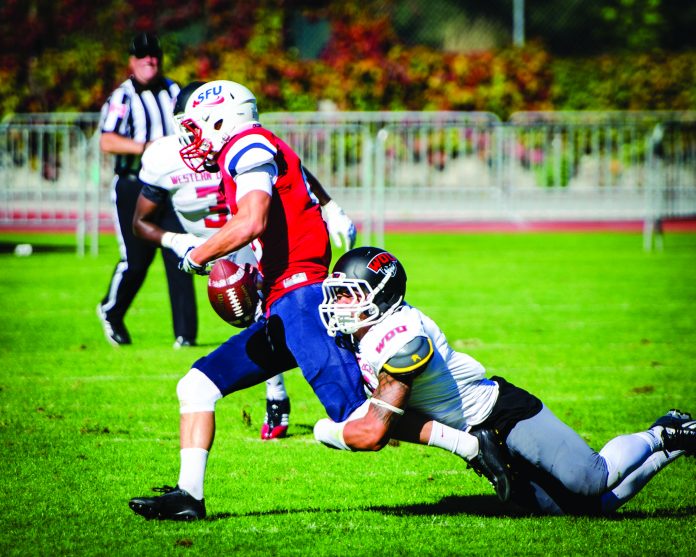
SFU has now dropped the first two games of the season, losing to the Western Oregon Wolves on September 13 by a score of 38-14. This marked their first game against a GNAC opponent, although it did not count in GNAC standings.

The first quarter was marked by little offence, with neither team putting points on the board, perhaps aided by the astronomical number of penalties against SFU. Although the flags did not contribute to the Wolves’ point total, they did serve to slow down the game and removeany Clan momentum.

In the first quarter, SFU went four of six on third down conversions, which is a good total, but it also speaks to the Clan’s inability to achieve first downs, and ultimately convert.

A bright spot for SFU’s offence appeared during a 5:45-long drive in which the Clan made it to the Wolves’ six-yard line, in part thanks to a 20-yard pass from quarterback Ryan Stanford to newly minted starter Sam Swerhone.

This forward progress was immediately interrupted by an interception in the end zone by Western Oregon with 1:34 left in the quarter. This would be one of SFU’s many missed opportunities and a sign of things to come.

Within two minutes of the second quarter, Wolves running back Joe Harris, who plagued the Clan all afternoon, ran the ball in for a touchdown, opening up the scoring.

SFU returned the favour quickly, however, when Chris Tolbert rushed five yards, tying up the scoreboard. However, Tolbert’s game has been inconsistent to say the least, with one fumble this game and two in the previous match.

SFU was forced to re-kick the ball twice after kicker Tiernan Docherty kicked out of bounds. Things would turn from bad to worse, as the Clan allowed a 62-yard pass to Wolves receiver Tyrell Williams for a second touchdown, returning the lead to the Wolves.

Turnovers would become the main story for the Clan; they ended up with four in the final tally, resulting in each of Western Oregon’s next scoring opportunities. The Wolves would score both a touchdown and a field goal off of turnovers, taking the score to 24-7.

SFU kept themselves in the game with a touchdown with only 12.4 seconds left in the half with a nine-yard reception by third-string running back Cole Tudor.

When the second half begun, however, any good will that the Clan built quickly evaporated when the Wolves scored another touchdown 1:42 in, and another just under half-way through the quarter, bringing the game to its final score of 38-14.

The Clan were unable to put any more points on the board and Western Oregon seemed content killing the clock.

Before the end of the game, head coach Jacques Chapdelaine took Stanford out, concerned that the team around him had given up on the game, particularly in the third quarter collapse.

“Our team just did not seem to have the energy to fight through adversity,” commented Chapdelaine. “That’s concerning to me, I don’t like to see that.”

With most of SFU’s problems being self-inflicted — mainly turnovers and penalties — he added, “We just seem to look for ways to hurt ourselves.”

However, not all was negative. Before being pulled, Stanford threw for 387 yards, while in the absence of wide receiver Lemar Durant, who was out with illness, much of the team stepped up. Bobby Pospischil’s 145 receiving yards were a game highlight, while Jamal Kett, Kyle Kawamoto and Swerhone each had over 50 yards. Linebacker Jordan Herdman led the team in tackles for the second week in a row with nine.

There were a lot of good things out there,” concluded the coach. “The elements are all there, we’ve just got to keep pushing on in the same direction.”

Battle for the Border

0

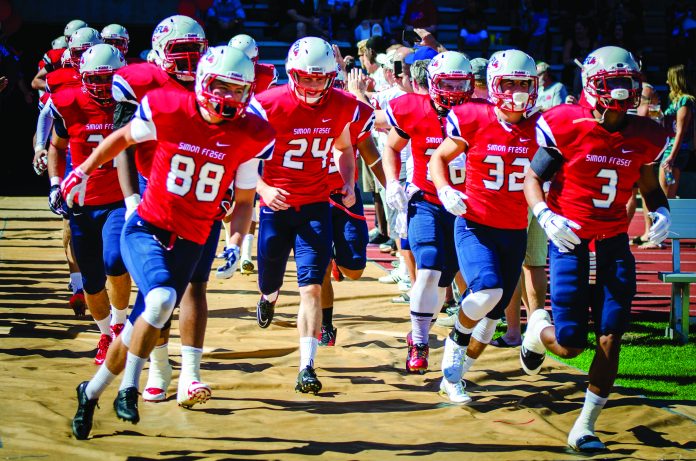
For $20, students can catch a ride to Bothell, WA to watch the Clan face the Central Washington Wildcats this Saturday, September 27.

The buses will leave from both the Burnaby and the Surrey campuses at 2:30 p.m. in order to get to the 6:00 p.m. game located in Bothell, just north of Seattle. The Facebook event posted by the SFSS estimates the drive to take two hours and 17 minutes.

The ‘Battle for the Border’ will see SFU face their closest GNAC rival — and their only opponent in Washington, in fact. SFSS at-large representative Jeremy Pearce explains the two teams are developing a rivalry, especially in the absence of the Shrum Bowl, and that they already compete for recruitment. “A lot of the time we’ll have the same recruits that we’re trying to get [as CWU],” he explained.

Pearce hopes that taking students to the game in Washington, which is a first, will help foster this rivalry.

Pearce, an SFU football veteran, also hopes to expose SFU students to NCAA football culture in a place where the whole community, not just the university, rallies around the team.

“It’s providing this unique opportunity. It’s an amazing atmosphere down there [in Bothell]. I’ve played on the football team for four years myself; it’s amazing down there,” he said.

“They have anywhere from 5,000 to 7,000 people at the game. I want students to experience that atmosphere and then eventually I’d love that atmosphere to carry over up here [at SFU].”

Students can buy tickets at the SFSS general office. The $20 will cover transportation and the cost of the ticket. Students will be returned to their respective campuses at around midnight.

Note: Students will be required to bring their passports or necessary visas in order to cross the border.

SFU loses home field advantage

1
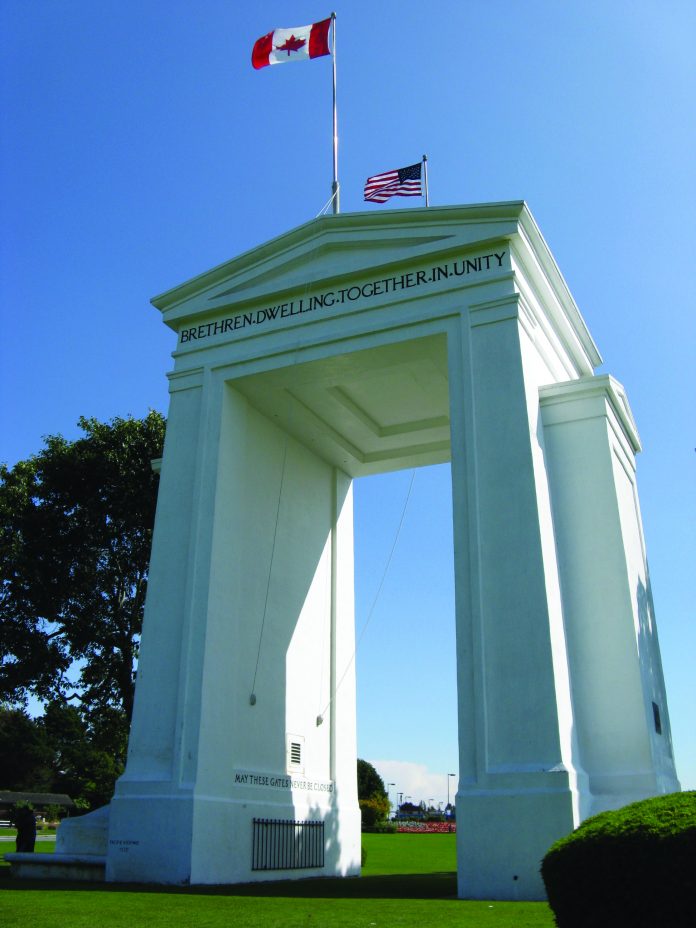
Playing at the Peach Arch could remove the need for passports.

If you’re a Clan fan like me, you may recall that after a hard-fought first season as a full member of the NCAA, SFU’s men’s soccer team ended the season ranked number one in the West Region. Which means — according to NCAA regulations SFU was granted home field advantage.

However, many of the American schools complained that some of their players and personnel don’t have passports to travel to Canada for the play-offs. Unfortunately, the American schools won, stripping SFU of their much deserved home field advantage.

As a die-hard Clan fan, this was something extremely upsetting to me. So, I began to look for solutions. That’s when I came across this special place within driving distance from SFU — Peace Arch International Park.

For those of you who don’t know, Peace Arch International Park is a park situated at the US-Canada border, half in BC and half in Washington. And what makes this park special is that visitors from either side can walk into the park both in BC and Washington without passports, provided they don’t wander further.

After some rough measurements, I’ve identified an area at the park with potential, roughly as large as Terry Fox Field without the track. SFU and the NCAA could simply set a temporary pitch using large pieces of artificial turf, plait the grid, and install temporary bleachers both on the Washington side and on the BC side and problem solved.

This solution, though not as optimal as allowing the Clan to deservingly host the play-off matches on Terry Fox Field or in Swangard Stadium, will render the “we don’t have passports” argument completely useless since passports would not be required.

More importantly, many Clan fans could actually attend the play-off games as the park is within driving distance of SFU.

Even though I still strongly believe that SFU should not suffer the consequences of the NCAA being unprepared, I hope that the universities will stop complaining and start preparing their passports in case the Clan,  once again, win the right to host the play-offs.

I hope the decision makers in Indianapolis will finally treat SFU like the full-fledged member of the NCAA it is, and stop stripping our rights like we don’t belong. We are part of the NCAA and should be treated as such.

At least for now, I may have found us a solution.

Meet the Clan: Callum Whittaker

0
New division I transfer, Callum Whittaker hopes to help the men’s soccer team to a national championship.

Screen Shot 2014-11-26 at 5.10.27 PMTo compete at the highest levels of the world’s most popular sport, a young athlete must overcome many obstacles and sacrifice certain comforts in life. Academics also provides struggles of its own, and demands a great deal of focus and consistency in order to succeed.

What these two worlds have in common is the demand for mental strength and perseverance; for Callum Whittaker, these things come naturally.

A native of London, England, Whittaker brings an unmatched wealth of playing experience to the SFU men’s soccer team. The defender saw action with the youth teams of Chelsea, Ipswich Town, and Southend United in England before being named the captain of Northern Ireland’s U-18 and U-19 international squads. Not bad for a player who tried out the sport just for fun at age six.

Whittaker recalls, “My dad always played football as a kid, he was a part of Arsenal’s group as a youngster. But he never pushed it upon me and wanted me to find out what I wanted to do in life. It was random how I ended up doing it; one of my friends had a flyer for a local team and didn’t want to go alone. He left after the first session and I stayed on and pretty much went from there.”

Just three years later, Whittaker would be picked up by Leyton Orient FC and would sign his first contract lasting until age 16. Chelsea eventually paid the buy-out clause in the player’s contract at age 12.

“Chelsea is based out of Surrey, which was two hours away so it became quite strenuous on family to get me there three to four times a week. From there, at age 14, I went to Ipswich Town until I was 16. After, I began a sort of apprenticeship to live at Southend United’s hotel and trained with the first team as a 16-year old.”

Three years later, Whittaker’s playing career came to an end with Southend, but he was given the opportunity to take his game to North America and The University of San Diego, an NCAA division I school.

“I wanted initially to go to other clubs, but my mom said it would be best to get an education for free through scholarships. Moving away from home is tough, but leaving at 16 to go live in a hotel was a stepping stone that helped ease me into it. Probably the hardest thing was acclimatizing to the California heat when I’m used to rainy England.”

Now in his senior year, the communications major has landed in beautiful (rainy) BC as a new transfer to don the kit of SFU’s Clan. Alongside another Southend youth product, Robert Hyams, the Englishman immediately broke into the highly competitive starting 11, and made his defensive presence felt from preseason onward.

“I’m a big communicator, I like to because that keeps me focused. If I go quiet I can lose concentration, so if I talk it means I’m thinking about everything more and more,” said the defender. “I think I’m fairly tenacious in the tackle, I like to get stuck in, I don’t mind pulling up my sleeves and getting dirty when [I] need to. Besides that, I am comfortable on the ball and can pass it around to get things ticking.”

It is fitting that the outspoken defender has chosen communications as his field of study, but his hard work and grit show that actions can speak louder than words on the pitch. The English style of play is reflected in his aggressiveness and determination — traits that Whittaker admired in Manchester United’s legendary midfielder, Roy Keane.

“He was my idol, I loved his tenacious ability, his attitude was spot on everyday and I try to model myself after that. He is aggressive because it’s the winning attitude inside of him; it’s always football first.”

Screen Shot 2014-11-26 at 5.11.15 PMWhittaker started his play in the same position as the Red Devil at centre midfield, and displayed his versatility in the centre back and fullback positions.

Even when thinking of a career outside of professional soccer, Whittaker’s love for the game shines through — he suggests an interest in a career in media relations, saying, “I wouldn’t mind going into the media side of football, I could talk about the sport for the rest of my life.”

For now, though, his goal for this season is an historic one: to help SFU become the first Canadian NCAA champions. “As an athlete that would be a defining moment of a career. There’s always a bit of hatred at us, so it’s a burning fuel to go out and do it.”

Dance House brings Wayne McGregor back to Vancouver

0

With a computerized pin board of 3,200 LED lights serving as the backdrop to Wayne McGregor’s latest work, Far, this acclaimed UK choreographer is playing with ideas of cognition and enlightenment. McGregor was last in Vancouver with Entity in 2012, and Dance House producer Jim Smith said that Far has a different tone.

“Far is a darker piece musically. The sound is a darker journey of trying to get to enlightenment, and there’s an ambient feeling.” McGregor deals with large ideas allowing the audience to make big abstractions based on the concrete questions that he’s asking about the brain and creativity.

“It’s very much about ideas,” said Smith. “McGregor spent a fair bit of time thinking about neuroscience and creativity and the brain.” He is also very interested in technology, explaining the light board which can be seen as representing the synapses of the brain.

Smith can see where the notion of enlightenment comes from in this work, and he said that it points to the growth and dissemination of information. “It’s about adding information to a larger body of work, the expansion of information. It’s the opposite of a dark age where there is a loss of information from society.

“In Entity there were large contraptions on the stage,” explained Smith, saying that “the set very much defines a lot of [McGregor’s] work.” In Far, the light board “fills the space and commands a lot of attention.” Although this might seem like it could overwhelm the stage, Smith said that they strike the right balance between the set and the movement itself. The large set pieces are also counterbalanced by the minimalist costuming which reveals the body so that the movement can be the focus. “The costumes are very pedestrian — they show the body in a natural way,” explained Smith.

McGregor has a distinctive style that is marked by fast paced, athletic movement. Smith explained that unlike much of the more conceptual work being created these days, McGregor dancers are athletes and the work is very physically demanding. “It’s very inventive movement; he’s establishing a signature,” said Smith. McGregor has choreographed for films such as Harry Potter and the Goblet of Fire and worked on a music video for Radiohead. He is able to strike a rare balance, excelling in both the world of contemporary dance and popular culture.

Dance House brings contemporary choreographers from around the world to present their work in Vancouver, and Smith explained that McGregor is part of the avant-garde in contemporary dance. “There’s a certain fascination of a generation and movement of choreographers that includes Crystal Pite and Hofesh Shector. They’re of a similar age and stage in their careers, and they’re on the cutting edge of contemporary dance in the world right now.” By bringing McGregor back to town, Smith said that Dance House aims to shed light on the current state of contemporary dance.

“Speaking of Dance,” a public lecture on this work, will be held at SFU Woodward’s on September 23. Far by Wayne McGregor’s Random Dance will be presented by Dance House September 26 and 27 at the Vancouver Playhouse. For more information visit, dancehouse.ca.


Every hipster will find something to watch at VIFF

0

Do you want to become a real hipster, not just someone who plays the persona in floral clothes from Value Village? Want to be cultured and informed about issues plaguing all corners of the globe? Or, do you just want to be able to say you liked something before it was cool?

If you answered affirmative to any of the above questions, then the 33rd annual Vancouver International Film Festival, which runs September 25 to October 10, will likely tickle your fancy. The event features almost 350 films from more than 70 countries, and this year’s festival is a strong meld of genre films, non-fiction documentaries, and undiluted short films, from established auteurs to up-and-coming filmmakers.

According to SFU alumnus Curtis Woloschuk, the festival’s program logistics coordinator, Canadian images shorts programmer, and above all, bona fide hipster, it’s “one of the strongest line-ups in recent years.”

Which films will different kinds of hipsters enjoy at this year’s VIFF? Read on.

Genre Films: For the phony hipster who likes to think he’s artsy, but goes to a film festival to see something accessible

The Rio Theatre has the bonkers genre films which play every Friday and Saturday night during VIFF (among other times). “I’m really happy with the genre line-up,” Woloschuk exclaimed, later saying that a film called Housebound is a “fantastic New Zealand horror-comedy that manages to subvert most expectations” and that two Canadian films playing late night at the Rio, The Editor and Bloody Knuckles are also “fantastic.”

Non-fiction documentaries: For the hipster who cares about social justice, environmental, and personal issues . . . or at least pretends to

Cinephiles can catch docs such as South Africa’s Khalo Matabane’s personal, Nelson Mandela, The Myth and Me, which delves into the director’s conflicted feelings towards the iconic and celebrated figure. Another, Gabe Polsky’s Red Army, looks at the relationship between the USSR’s hockey team and their national identity.

Woloschuk also noted a particular trend of non-fiction films which happens to have its own independent section called Arts & Letters — a component devoted to narrative and documentary filmmaking which centres on music. A Glen Campbell documentary, Glen Campbell: I’ll be Mine, explores the filmmakers Alzheimer’s diagnosis and attempts to reduce the impact of the disease with music.

Another noted film is The Possibilities are Endless: Edwin Collins, the frontman for Orange Juice and a solo artist, had two massive strokes and must learn to play music again.

Short Films: For the hipster who can’t go 10 minutes without adding a new selfie to their Instagram. Don’t worry there’s a little break between these!

Woloschuk said, “I think one of the great things about the short films is that you get to see people operate [. . .] within budgetary constrictions that doesn’t necessarily impact the story they want to tell. I think you can see people who really get to realize their vision and tell that 10-minute story without needing to be beholden to other forces like funding agencies.”

Additionally, he proclaimed that the “two films by UBC students, one called Light, one called Hard Card are fantastic short films.” He continued, “When you see that many films from one talent pool, it’s kind of remarkable the quality of the work and how strong it is overall.”

Canadian films and directors: For the patriotic Canadian hipster who thinks that negotiating their independence is way cooler than fighting for it.

“We have a good number of Canadian films who have really established themselves and now have American casts,” Woloschuk stated. Among them is Jean Marc-Vallee’s Wild (starring Reese Witherspoon on a soul searching journey in the wild) and David Cronenberg’s latest, Maps to the Stars.

Perhaps the most intriguing among the Canadian filmmakers featured at VIFF is the young and prolific Xavier Dolan. His new film Mommy experiments with an oddball 1:1 aspect ratio.

Established auteurs: For the hipster who dismisses “pretentious” films by saying “you just don’t get it.”

“Mike Leigh has a new film this year [Mr. Turner] that certainly stands out,” Woloschuk said before explaining that the Cannes Palme D’or winner, Winter’s Sleep, will also be in the line-up. However, the one that is bound to raise the most eyebrows is the influential French new-wave director Jean-Luc Godard’s Goodbye to Language 3D. Yes, you read that correctly: Godard in the 3D. It sounds bonkers.

Some hipsters, like some films, defy categorization. Some of the unclassifiable films are Damien Cazelle’s Sundance Jury Prize winning, Whiplash, which follows a jazz drummer as he’s pushed to the limit by his teacher, and Bennett Miller’s Foxcatcher, which took home Best Director from Cannes.

One could talk about the diverse selection at this year’s VIFF forever, but there is a universal element which is bound to affect more than just the hipsters. Woloschuk described this when he said, “People look for different things in cinema, the late night screenings kind of feed into this. You can watch a scary movie at home but when you watch it with several hundred other people, it’s a very different experience. We’re just trying to find different ways of making the festival experience be an experience for people, and that kind of goes beyond watching a film.”

The Maze Runner is predictable and dull

0

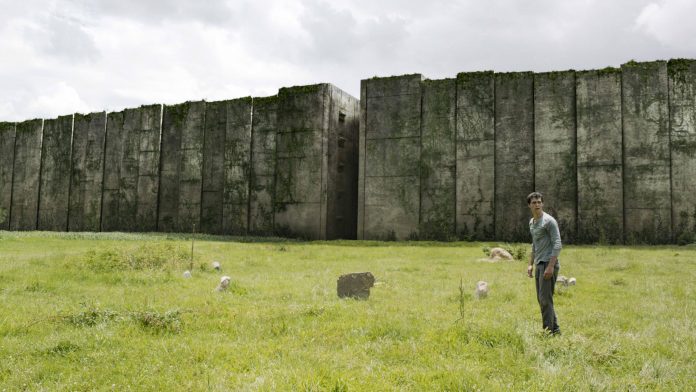
Wes Ball’s The Maze Runner (adapted from a young adult novel of the same name) begins with an elevator rushing to a bright light at the top of a dark shaft. A teenager awakens surprised and afraid as the cabin thunderously rushes to the top. He doesn’t remember his name, background, or hometown.  When the elevator reaches the top he realizes he is trapped in a small community surrounded by enormous concrete walls. The little town is inhabited by teenage boys who have all experienced the same thing. They arrive with no memories or understanding of where or why they are trapped.

Behind the concrete walls is a maze that opens every morning and closes that same night. The boys in the community send skilled ‘runners’ to map out the maze and attempt to find a way out. However, they must make it back before nightfall because inside the labyrinth the maze grievers, mechanical killer spiders, awaken to prey on any runners left inside. We are told no one has ever lasted overnight in the maze.

This concept, a cross between Lord of the Flies and Dark City, had me intrigued with many questions and awaiting an equally intriguing conclusion. Now I am still waiting. The film builds to a revelation, but is let down by a resolution that explains the essentials in a predictable expository speech that doesn’t even make sense of some of the smaller clues presented.

Paradoxically, we understand what is going on but are in the dark as to the significance and the connection between all the clues. More disappointingly, however, is that in the end, the reason for the entire fiasco was the first thought that came to my mind. My point is not that I’m smart, but that this movie is that shallow.

At times, the film hints at higher realms of science fiction by using the story to examine male nature or community break down; however, it eventually ignores this potential second layer to weave its charade of a plot.

The Maze Runner is science fiction with no subtext, a mystery without a satisfying resolution, and an action movie which utilizes the same tropes over and over (every ‘tense’ situation is either contrived from the closing walls and the characters needing to make it to the other side in time or a pop out scare with deafening sound design). It all seems like something you don’t want to see, but when it is evaluated in context alongside its peers, it doesn’t stoop to having schmaltzy pop songs thundering over make-out montages. There is no love story or developed characters that are later exploited for sentimentality’s sake — although one instance in the climax comes close — which is to say that Wes Ball could have made a worse movie.

Watching The Maze Runner is like paying to enter a corn maze where signs are posted showing you the exit, except that you must endure nearly two dull hours before escaping.

Ideas worth spreading in Vancouver

1

This year’s TEDxVancouver will take place on Saturday, October 18 at the Queen Elizabeth Theatre. An independent event affiliated with the TED Talks, this is the sixth year that TEDx will be held in Vancouver.

Presenting on the theme of turning your dreams into reality, the first three speakers announced for the event are Victor Chan, Treana Peake, and Jay DeMerit — three individuals from the diverse fields of fashion, sport, spirituality, and philanthropy. With different backgrounds and experiences from opposite ends of the world, they each bring their unique stories with them to the inspiring TEDxVancouver this fall. Although they are speaking on diverse subject areas, they have one thing in common: they are all excited and honoured to be using this unique platform to share their “ideas worth spreading.”

Jay Demerit attributes much of his success as a professional soccer player to his strong family support system, helping him each step of the way. In fact, he is now in the process of creating the Rise and Shine Retreat, where he can support aspiring sports stars of the next generation. Rather than just a sports camp, he and his wife envisioned a place where “not only can they get a soccer education, they get a life education as well.” An overwhelming goal for the camp is to “create good people.”

Demerit is one who can attest to this year’s theme of turning your dreams into reality since that is exactly what he has done in his career. After not making a professional team in the US, he took all his money and his determination to Europe where he was signed to semi-professional Northwood and then to Watford where he played in the Championship and Premier leagues. From there, he created a legacy for himself as the first American-born captain in his team’s history. He continued this legacy by playing every minute of FIFA 2010, and as the Vancouver Whitecaps Captain until this year.

As someone who has triumphed over challenges, Demerit hopes that those who hear him speak will be able to apply his experiences to their own lives. When this happens, Demerit says he will have done his job at TEDxVancouver.

Treana Peake is a fashion designer who takes a unique approach to the fashion industry and its far reaching influence. Though it is quite an achievement to see her Obakki pieces on red carpet celebrities, some of the brand’s biggest accomplishments have been through the philanthropic efforts of the Obakki Foundation.

As someone who had been involved in philanthropy all of her life, Peake recognized the opportunity to incorporate the two different aspects under one brand. As she said, “there was a platform to be used, for good.” With these philanthropic endeavors, she not only created a foundation that funds orphanages, schools, and focuses on bringing clean water to areas that wouldn’t otherwise have access to it, she also created a new fundraising model.

Rather than the typical organization with overhead costs that cut into philanthropic goals and accomplishments, the Obakki clothing line absorbs any and all fees incurred by the foundation. Donor money does not pay for a cent of the line’s operating costs, which allows the foundation to focus on its goals, including building hundreds of water wells. “So many things expand from water,” says Peake, and with her time at TEDxVancouver, she hopes she can inspire the audience with all that a new take on a classic charitable idea can do.

When Victor Chan looks back at all that has happened leading to this present moment — being kidnapped by three rifle-wielding men in Afghanistan in the 70s, and adventuring with a fellow escapee to meet the Dalai Lama — he asserts that without these events, we would not be speaking to him nor hearing him speak.

Chan never set out to meet the Dalai Lama, nor did he predict he would become a co-author with and friend of His Holiness. However, he realizes what a privilege it has been to learn from someone “who has such moral authority,” and today, the two of them travel together promoting their two co-authored books.

Victor previously spoke at TEDxArgentina, and attended TEDxOxford. He is looking forward to speaking at the Vancouver event, spreading the ideas of living in a holistic and balanced way, a way that strongly values the worth of a “warm heart.”

His experience is a stark reminder of how the paths we take in life can change us. The overall message Chan has received from the Dalai Lama, and wishes to reiterate in his writing and his speaking, is one of compassion. He says, “We all want to be happy. The surest way to attain sustainable happiness is through compassion.”

Each of these speakers will present inspiring stories and speak about their unique ideas and experiences when they visit Vancouver in October. Most importantly, they all have ideas worth spreading.

Our Town: as much as things change, they always stay the same

0

Sitting at a picnic table beside the main stage tent at Bard on the Beach, Bob Frazer explains that Thornton Wilder and Shakespeare have one very important thing in common: they wrote plays about human emotions. “One of the great things about Shakespeare, and why I firmly believe he gets done over and over again, is that he doesn’t deal with his time period, he doesn’t deal with what’s going on, he deals with human emotions. Our Town may take place between 1901 and 1913, but that’s not the point. The point is that it deals with human emotions and human truth.”

As his summer acting in Equivocation and Cymbeline at Bard on the Beach comes to a close, Frazer’s company, Osimous Theatre, has started rehearsing their production of Our Town. The play has been around since 1938 and is still so popular that it is staged daily somewhere in the world. It hasn’t been done professionally in Vancouver in over 20 years, and Frazer said he thinks this has to do with the play’s unfortunate reputation as a play reserved for high school drama class or community theatre.

“It’s unfortunate because the core of the story is something you can’t really understand when you’re in grade 10 or 11. There’s a reputation that goes with the play that it’s hokey and sentimental,” said Frazer, “but it’s much deeper than that. It’s one of the most beautiful plays ever written. It’s sad because if you do it with people who understand that life is slipping away from them, it’s going to have more resonance — and that resonance is going to carry over into an audience.”

Osimous Theatre will immerse the audience in this play in a unique way, as they plan to perform it in a church with flexible seating arrangements. “The audience isn’t seated in normal seats. In fact, they come to the show and we say ‘hey where do you want to sit. What do you want to sit on — do you want to sit on that couch? Ok let’s move it over here.’” They will arrange the seating based on where audience members want to sit, and the seven-member cast playing multiple characters will play through, among, and in between them, allowing for a new perspective on a traditional play.

Audience members will also have a chance to say a line or two in the play. As people enter, explained Frazer, they will choose a few audience members and ask them if they’re willing to say a line. “There’s a couple of lines from the audience in the play, and just at the moment they’re supposed to say it we’ll just shove them a cue card and they’ll say the line. They don’t know what they’re saying until they read it.”

The two intermissions will also provide some unexpected changes to the traditional theatre experience. “We’re moving the sets throughout the intermission, so when you come back your seat won’t be in the same place.” Suddenly you’ll be looking a different way and have a different perspective. “It will be fun, I hope people can find their seats again,” laughed Frazer.

Depending on where they’re seated, audience members may be so immersed in the action that they essentially become part of the set. “At the end, the audience may find themselves sitting in a place they were sitting the whole time and realize that it actually becomes a set piece. What we are trying to do is just allow people to fall into the play without forcing them into the play.”

In a similar way, the unassuming plot, or lack of plot, draws people in before they realize it. “The funny thing about this play is that there’s no real conflict, no real story arc. The first act is called ‘A Day in the Life,’ and it’s just these people, and yet within these people who are complicated and complex, you recognize your life.” This is the beauty of what Wilder is doing in Our Town. “He’s showing us life, and then all of a sudden by the end of it you find yourself involved in these characters — and it’s not that you’re involved in their life — but what you find is that your life has suddenly become intertwined with their lives.”

A major theme of the play is time slipping away, as well as the idea that our lives are very similar in terms of the everyday things we all experience. “One of the things Thornton Wilder talks a lot about is numbers. He uses the words millions, hundreds, thousands, etc, and he’s trying to show you that our lives are always the same. You’ve done the same things that I’ve done and our ancestors have done and the next generations will do the exact same things. They’ll all get married, they’ll all live and die, they’ll all go through love and hate — it’s the same thing. They’ll cook breakfast; they’ll eat lunch, see the sun set, and he says that’s ok; that’s what life is. Don’t expect it to be anything more than that.” He is trying to illustrate that while your life is unique, it has been done millions of times before.

This theme resonates with people of any generation, and as Frazer explained, we all go through a period of distraction where we’re not seeing those everyday moments and not really noticing our lives as they pass by. “Back in the 80s when I was a teenager, it was all about hair bands, and partying, and ACDC, and it was just a frivolous time. And you realized, wow I wasted so much time doing that. Today everyone’s texting everybody — they don’t look up and see the world — but we were on our walkmans; we were playing Atari. It was totally the same, yet so different. It’s not relevant to any one time because it’s relevant to all time.”

It’s relevant to all time, and also relevant to all places. The play is set in the fictional town of Grover’s Corners with many references to Massachusetts and the provinces above New York, but Frazer explained that there was no need to set the play in Vancouver or change these references. “It’s a universal play. It’s profound in the sense that it’s about life, and that life exists anywhere. It doesn’t just exist in Massachusetts or Grover’s Corners or New York; it exists here as well. The only updates to the play are things like the pocket watch that is now an iphone and their modern clothing.

Our Town will likely make you look at the theatre and the world around you in a new way. One of the most famous lines in the play occurs when the protagonist Emily asks the stage manager, “Do human beings ever really realize life while they live it, every, every minute?” He replies, “No, maybe the poets and saints, but no, nobody does.”

“I think that’s what the audience gets from it — they fall in love with people they recognize or themselves and then they walk away going ‘am I seeing life?,’” explained Frazer. Perhaps audiences will pay more attention to life’s little moments that Wilder is talking about. “He’s talking about the everyday things — the smell of bacon, or the sound of your mother’s voice, or your dad’s smell — his aftershave, whatever that is. That’s what Thornton Wilder is saying that we miss all the time, and that’s why it’s profound because once you understand that you start to see the world differently.”

As he’s working with his company to mount this play, Frazer said that one line from Wilder’s prologue has stuck with him: “All you need for the climax of Our Town is five square feet of boarding and the passion to know what life means to us.”

Our Town will be presented by Osimous Theatre September 30 to October 18 at the First Christian Reformed Church. For more information, visit osimous.com.