Home Blog Page 111

We must destigmatize social housing

0
A large winding high rise building as seen from below
PHOTO: Aria Amirmoini / The Peak

Owning a home is a dream for many in today’s society. Yet, have we ever paused to consider when the pursuit of home ownership becomes less about affording a house and more about owning land? Who benefits from that, and who is left with the short end of the stick? The reality is that corporate greed and the commodification of housing have made it incredibly difficult for many to afford a home in this economy. There are more affordable housing options, such as housing co-ops or government-subsidized housing. However, stigma about alternative housing options reinforces stereotypes about marginalized groups — and ends up harming everyone who struggles with housing costs. 

Housing co-operatives, also known as co-ops, differ from owning or renting. Co-ops provide housing to their members, who buy into a share of the cooperative as a whole but don’t own their units. They’re either run by private entities or subsidized by the government, such as through BC Housing. The Canadian government used to invest more money in social housing, but cut back its investments after the recession in the ‘80s. Nowadays, people often associate these affordable housing options with low-income families and marginalized groups. 

Many people are against social housing developments due to the assumption that they attract people with complex mental health and substance use issues. This August, some Richmond community members protested a “supportive housing project,” claiming the area would start to resemble Chinatown and lead to criminal activity. People from low-income families are actually more likely to be victims of violent crime, and separating individuals based on marginalization only exacerbates inequality. 

The growing opposition to new affordable housing developments goes against the self-interests of middle class folks as well.

How does this stigma relate to the reality of social housing? While it’s true that Canada has prioritized providing housing to vulnerable populations, it’s also important to note just how scarce these co-ops and subsidized housing options are. Only 3.5% of Canada’s housing stock is considered social housing, meaning there’s a high demand for such limited space. This leaves many people, including low-income and other marginalized folks, unable to access affordable housing. But the stigma that we as a society have built around social housing also impacts people such as students and others who would be considered middle-income. According to a survey by Ipsos, 80% of Canadians “believe that owning a home in Canada is now only for the rich.”

The growing housing crisis in Canada is evident in a report from the National Bank of Canada, which said “housing affordability nearly hit its worst levels since the 1980s [recession] in the fourth quarter of 2023.” The lack of available and affordable housing options normalizes the problem while pinning the blame on those who rely most on it. 

Trying to tackle this stigma requires coming up with solutions for the housing crisis — which includes embracing alternative options to renting and home ownership. According to Global News, “nearly a third of Canadians are considering buying a home with others, renting out a secondary unit and other ‘non-traditional’ paths to ownership.” The fact of the matter is that people are influenced by the idealization of home ownership. But if social housing were more available and normalized for the general population, it would alleviate many financial struggles and reduce strain on the private housing market.  

The negative impacts of looking down on affordable housing not only reach society as a whole, but also affect the SFU community. Many students find it difficult to afford housing, and as we have witnessed lately the increasing number of students sleeping on campus, it’s safe to say the situation is only getting worse. The idea of traditional home ownership is becoming less and less of a possibility now for the upcoming generations. This is why it’s important to break down stereotypes surrounding social housing. It’s time to rethink our society’s obsession with home ownership, and consider whether stigma is preventing us from exploring better alternatives. 
SFU increases car allowance perk for executives amid summer layoffs

0
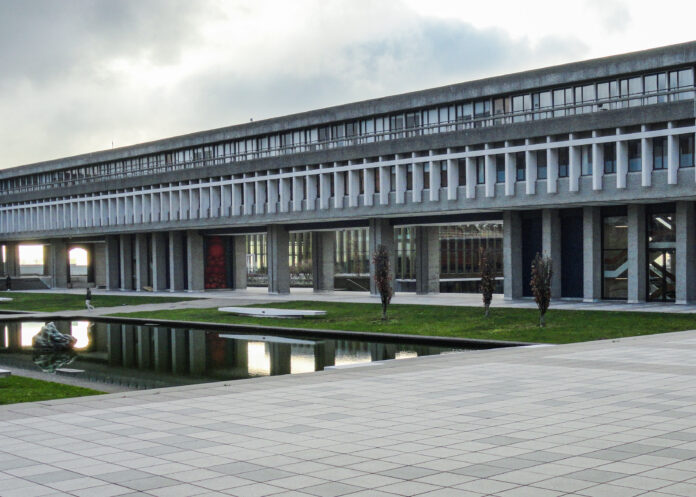
This is a photo of the outside of the Academic Quadrangle at SFU on a cloudy day.
PHOTO: Puneet Aulakh / The Peak

In July, The Peak received word from the Teaching Support Staff Union (TSSU) that SFU decided to increase the vehicle allowance perk for SFU executives by about $75,000. A vehicle allowance is a payment made by an employer to cover an employee’s vehicle expenses. A freedom of information (FOI) request indicated the perk increased amid SFU’s layoffs of nearly 100 staff, “including instructors, administrative support staff, and custodial workers” this summer.

SFU has been facing an estimated $49.9 million deficit in its latest fiscal year, citing “declining international student enrollment” as the main factor. Specifically, SFU saw a 15% decline in international student enrollment from 2019/20 to 2023/24. According to the Simon Fraser Student Society (SFSS), SFU laid off nearly 100 staff in “essential [student] services” in response, such as Health & Counselling, Academic Advising, and Co-op Support. The layoffs also extended to the athletics and recreation department, instructors, and custodial workers. 

Despite the deficit, TSSU chief steward Kayla Hilstob and member representative Derek Sahota found that SFU decided to increase the vehicle allowance perk via a FOI request to SFU. The Freedom of Information and Protection of Privacy Act outlines how the public can request and access BC government records. Sahota told The Peak he and Hilstob made the FOI request to better understand SFU vice president contracts and how much they make, as this information isn’t largely made public. “Gross misuse of public funds is something I see time and time again at SFU, and that’s why we use these FOIs to start to look and dig into what’s going on — and it’s very troubling,” said Sahota. 

Sahota and Hilstob found that SFU increased the vehicle allowance perk to $1,000 a month for SFU executives — a $5,000 increase per person per year. The FOI request indicates most vice presidents and some associate vice presidents received the increase, along with SFU president Joy Johnson and other executives. They also noted that SFU’s increase of this perk coincided with the layoffs. Specifically, Sahota said SFU was “designing” the layoffs in the “exact same time frame” as their decision to increase this perk. “That process has remained completely opaque to the community, and questions the TSSU has asked about it have gone completely unanswered from the senior administration,” he said. Hilstob found SFU’s planning “egregious.”

“Gross misuse of public funds is something I see time and time again at SFU, and that’s why we use these FOIs to start to look and dig into what’s going on — and it’s very troubling.” — Derek Sahota, TSSU member representative

In a statement to The Peak, SFU confirmed the increase in car allowances. They stated that last year, the Treasury Board of Canada “approved new vehicle lease and allowance rates” for BC Public Service deputy ministers. SFU said the ministers’ vehicle allowance increased from $580 to $1,000 as the “rates had not been increased since 2007 and did not adequately reflect current costs.” SFU stated they were advised they could “adjust vehicle lease or allowance rates to be in line with the BC Public Service policy for executives who have this commitment in their compensation package.” They added that BC employers “subject to the Public Sector Employers Act” were advised the same.

While it’s not uncommon for a vehicle allowance to be $1,000 a month in Canada, the increase creates an additional annual expense of about $75,000 for the university. Sahota pointed out that the additional money to pay for this expense “could have gone instead to saving jobs.” The Administrative and Professional Staff Association (APSA) previously told The Peak that some of the workers laid off this summer “were either on some sort of medical leave and/or maternity leave” or had recently returned from medical leave “within the last year.” APSA is an “independent association” that advocates for administrative staff. Women made up 77% of these layoffs, with those “over the age of 55 or a visible minority” making up “between 30–40% of the layoffs.” Lakshmi Gosyne, APSA associate director, previously told The Peak how dehumanizing the layoffs felt for these workers, as many of them had “been working for SFU for 10, 15, or 20+ years.”

Given these layoffs and cuts to student services, Hilstob said, for “those of us who do the work on campus and those of us who are here studying, our needs are not prioritized.” The new allowance was built “into the new employment contract template for senior leaders as something that can be offered as well,” indicating the annual expense could go above $75,000 in the future.

But how else is SFU managing the estimated deficit? The Peak also received word from an anonymous source that at a recent event, SFU president Joy Johnson allegedly stated “everything is on the table” in terms of budget cuts and seemed to think the tuition cap was too low. The Peak was unable to verify this claim but spoke to SFSS president Emmanuel Adegboyega, who was at the event. Adegboyega said the event referenced was a Greater Vancouver Board of Trade event where president Johnson spoke about “SFU’s approach to partnerships.” He stated that the SFSS continues to “urge the university to find several ways to reach their operational costs that do not rely fully on students having to compensate.” He said the SFSS advocates for a limit on tuition increases and continues to push SFU to prioritize services and activities “that students really care about” in their budgets. These especially include mental health services and the Centre for Accessible Learning. 

The SFSS president noted that SFU has official processes to receive feedback from the student body and student leaders, but could not speak to what was done with the feedback.

Sahota said he was concerned about SFU’s vice presidents being less present “at the table” to take on the work compared to the vice presidents at McMaster University, where he previously studied. He said that since 2020, he’s noticed a “huge growth in the budget” to almost a billion dollars a year. “Whether there is a projection of a deficit or not, there is enough money around here to deliver what is needed for the people who do the work,” said Sahota.

“Something seemed to go awry beyond difficulties with international student enrollment.” — Andrew Boden, APSA executive director

The Peak also corresponded with Andrew Boden, the Administrative and Professional Staff Association’s (APSA) executive director, for more information on SFU’s budget decisions. Boden said he had “a lot of questions about how SFU’s budget process in fiscal year 2023/2024 was handled.

“Something seemed to go awry beyond difficulties with international student enrollment,” he said. Boden also noted that most APSA members “find SFU’s senior administration aloof from the reality of the working rank and file at SFU.”

Sahota stated SFU “needs to be for the public good” and “actually keep people in jobs.” While the SFU community hasn’t hesitated to speak out about the layoffs this summer and the simultaneous increase in car allowances, Sahota said the Board of Governors is yet to take accountability and be transparent about these decisions. “We shouldn’t have to FOI this data. We shouldn’t have to be searching for this,” he said. “There needs to be accountability for what’s happened, and we need to set a new direction for this campus to survive now and into the future.”

This is a story The Peak will continue to cover.

Out on Campus holds Transgender Day of Remembrance event

0
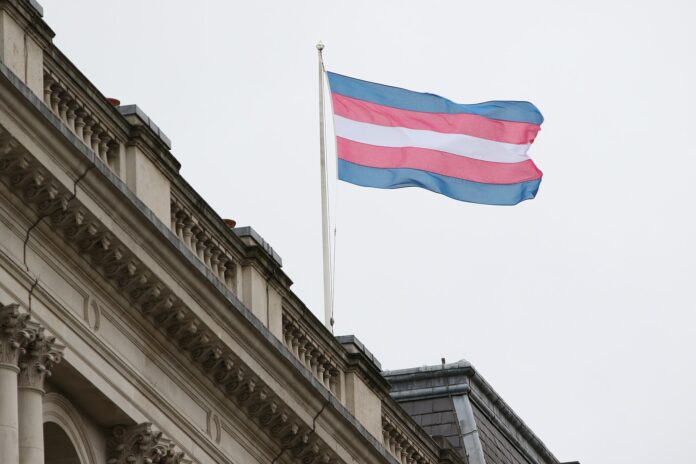
This is a photo of a large transgender flag waving in the air.
PHOTO: Foreign and Commonwealth Office / Wikimedia Commons

Content warning: mentions of violence, transphobia, and suicide. 

November 20 marked Transgender Day of Remembrance (TDOR). This year, Out On Campus (OOC) hosted a TDOR event in the Student Union Building ballroom. OOC “is a department of the Simon Fraser Student Society (SFSS) dedicated to supporting SFU’s 2SLGBTQIA+ students and allies.” The event was designed “to sincerely remember the trans people around the world we have lost to transphobic, transmisogynistic, and racist violence.” 

Transgender Day of Remembrance began as a response to the 1998 unsolved murder of Rita Hester, a Black trans woman. The media response to this homicide was minimal, with some media outlets misgendering Hester in their reports. This demonstrated “the disproportionate ways in which the death[s] of Black, queer, and trans people are taken up in public discourse,” according to the United Food and Commercial Workers union. Based on data collected from 2017 to 2018 through the National Crime Victimization Survey, the University of California Los Angeles Williams Institute reported that “transgender people are over four times more likely than cisgender people to experience violent victimization.”

The lack of attention towards Hester’s case led to an outcry from the trans community and allies, from which TDOR was born. Today, it is an internationally recognized day of mourning and a reminder of the harsh realities that many trans people face. TDOR is also an occasion to “recognize the need to disrupt the violence and oppression that trans people continue to face.” 

From October 1, 2023 to September 30 this year, 427 trans people have lost their lives globally — mostly to violence. Since data for TDOR started being collected, the majority of deaths have come from Brazil and have been due to violence. The Peak attended OOC’s event and spoke with SFSS accessibility coordinator Brianna Price and OOC coordinator Jude Mah about their roles in planning the TDOR event and what the day meant to them.

The program was centred around the reading of names of trans individuals who died this past year around the world. “The names are especially hard,” said Mah. “Monday evening to [Tuesday], there was already another name added to the list.” Detailing the intensive emotional labour the event requires, Mah explained how there would be relief if the responsibility for planning the event fell on cisgender people. That said, they recognized a certain importance in TDOR coming from the trans community. The event also included poetry reading, an opportunity for drawing and collaging, and a few moments of reflection using breathing exercises for anxiety led by SFU counsellor Alex Vanderveen. 

Price said the most important part of TDOR, which “helps make it feel not hopeless, is seeing the ways in which people in the community come together.” Specifically, she said coming together is “to share in the moment, to care for each other, to find light, and life, and connection out of the pain of the oppression that the trans community faces every day. 

“There’s love in every part of this,” she added.

Both Mah and Price were critical of SFU’s response to trans violence locally and on the international level. For one, Mah stated SFU administration likes to “tout that they care for marginalized communities, but they don’t actually step up and show that.” 

In 2019, the school faced criticism for an event they hosted called “How Media Bias Shapes the Gender Identity Debate.” In particular, backlash revolved around one of the speakers, Meghan Murphy — an SFU alum who called the trans rights movement “regressive and sexist” and spoke “against a bill that amended Canada’s rights act to prohibit discrimination on the basis of gender expression and identity.” In response to the backlash, SFU previously stated, “Universities operate on the principle that freedom of expression is a core component of intellectual inquiry and central to the pursuit of knowledge.”

Price detailed another incident that occurred last year in which an SFU lecturer went on an “aggressive, transphobic rant” to his students. She said the professor was subsequently “given one semester of paid leave and is now back to teaching.” The Peak was unable to independently verify this claim as SFU said they couldn’t comment on “individual employee matters.” “It’s an awareness of bigotry that happens and refusing to act on that,” said Price, regarding the school’s response. 

Price also mentioned SFU president Joy Johnson’s statement from September 9 this year, in which she said that SFU “must refrain from taking public positions on topics unrelated to the business of the university, including partisan matters and world events.” This decision was “heavily criticized by a lot of the trans faculty” at SFU, stated Price.

“When it comes to disciplining people for aggressive transphobia [ . . . ] the message many students are sent is that as a trans person, this university will not act to make your life easier,” she elaborated.

In a statement to The Peak, SFU stated they are “committed to creating a diverse, equitable, and inclusive community where all feel welcome, safe, accepted, and appreciated.” They said, “This commitment is reflected in our values and supported by our policies and procedures,” citing they “made gender-affirming care benefits available to all SFU employees” since this summer.

Price concluded by speaking to the support within the trans community at SFU: “Trans students at the school talk and make sure to protect themselves and know whose classes are a concern.”

For those seeking support, Mah and Price are available at [email protected] and [email protected] respectively.

Vancouver Art Gallery demonstration marks the International Day to End Impunity for Crimes Against Journalists

0
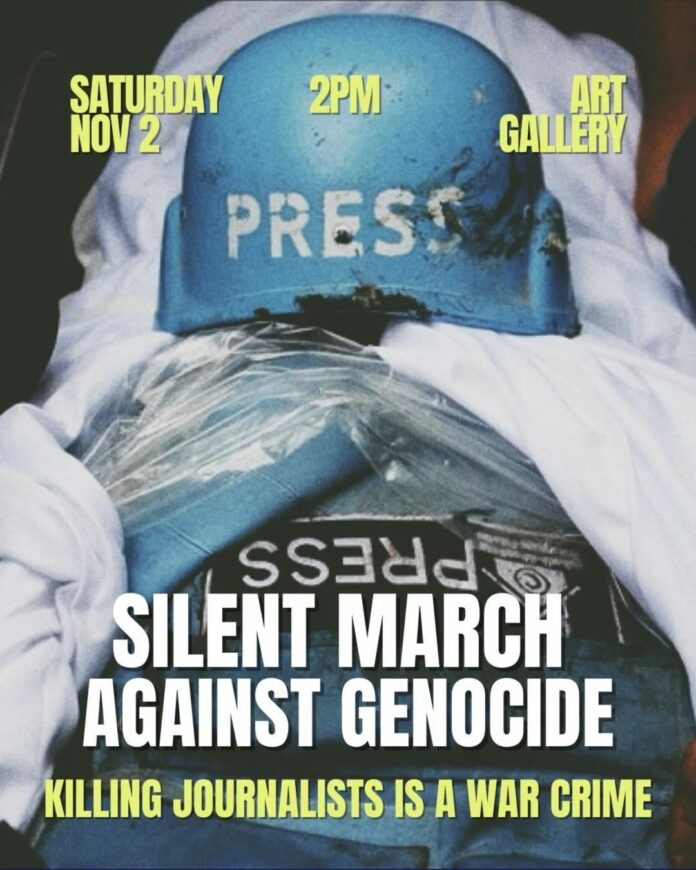
This is a social media graphic reading SILENT MARCH AGAINST GENOCIDE showing a blue press jacket and helmet.
PHOTO: @freepalestinebc / Instagram

Content warning: mentions of genocide. 

November 2 marked the International Day to End Impunity for Crimes Against Journalists. Protestors gathered at the Vancouver Art Gallery to mourn and oppose the mounting death toll of journalists at the hands of the Israeli military. 

As of November 26, “At least 137 journalists and media workers were among the more than tens of thousands killed in Gaza, the West Bank, Israel, and Lebanon” since October 7, according to the Committee to Protect Journalists (CPJ). Such a number marks “the deadliest period for journalists since CPJ began gathering data in 1992.” CPJ is a non-profit focused on protecting freedom of the press as well as the safety of journalists worldwide. Al Jazeera reported that critics say “Israel — which banned foreign reporters from entering Gaza — targets journalists in the Palestinian territory to obscure the truth about its war crimes there.”

Protestors waved Palestinian flags and donned blue as a tribute to the blue press jackets and helmets commonly worn by journalists reporting in war zones. Some brought out large bundles of cloth with red paint splatters meant to represent killed Palestinian journalists. The event featured several speakers, some of whom did not disclose their full names. 

The last speaker at the demonstration was Adel Iskandar, a global communications associate professor at SFU. The Peak spoke with Iskandar and Tamer Abu-Ramadan, a local Palestinian rights activist who was also present at the event, for more information.

Iskandar and Abu-Ramadan came to protest the Israeli military’s killing of Palestinian journalists, but also to fight against the Canadian press’ lack of sophisticated coverage on this. Both wanted to “call out journalists” in Canada “for failing to stand up for their colleagues.” 

“It is quite remarkable that journalists of all people are not covering the story,” said Abu-Ramadan.

“If you don’t see the fate of Palestinian journalists as patently unjust, then it raises questions about your own humanity as a journalist.” — Adel Iskandar, associate professor of global communications, SFU

“If you don’t see the fate of Palestinian journalists as patently unjust, then it raises questions about your own humanity as a journalist,” said Iskandar. “In the name of objectivity in the west, we have effectively stopped caring about Palestinians irrespective of who they are,” he added. Iskandar explained that western media’s coverage relies on racist tropes and stereotypes rather than providing a deeper context and history. Palestinians have been subjected to dehumanization and misrepresentation in western media for decades. To provide more nuanced, contextual coverage would be to challenge “built-in assumptions” about “who is good or bad, or right or wrong,” said Iskandar. 

At the recent protest, Iskandar described how a Global TV journalist came to report on the event. Iskandar alleged that the reporter knew the demonstration was about “the attack on the press,” but was unaware of its focus on the murders of Palestinian journalists. When the reporter saw Palestinian flags and keffiyehs, he allegedly explained he didn’t realize the event was “anti-Israeli,” ultimately leaving without covering the story. “If it was any other place, they probably would have stayed,” said Iskandar.

For Abu-Ramadan, the reporter’s choice to leave was all but surprising. He referenced an exposé written by ex-CBC producer, who goes under the pseudonym Molly Schumann, detailing the network’s staunch unwillingness to name, much less cover, the Palestinian genocide. He also explained the press’ tendency to pick and choose when to cover journalist deaths. Abu-Ramadan cited the Russian invasion of Ukraine as an example of when these deaths were covered.

Poll data suggests that Canadians’ sympathy for Palestine has increased. However, whether the media reflects this change in perception is less certain according to Iskandar. “We are now beginning to witness the first true test of whether or not our media system actually speaks to public opinion on this issue,” he said. Abu-Ramadan expressed a similar attitude, saying, “The media is not reflective of the public sentiment [ . . . ] but it is reflective of what the government wants.” He noted that Schumann’s exposé revealed the media’s top-down approach to manipulating coverage so it’s “more favourable towards Israel” on the topic of the Palestinian genocide.

“What I’d like to see is an honest public media that takes seriously human stories irrespective of where they’re coming from,” said Iskandar. “Journalism should help us empathize, not make us cold to one another.”

SFU Women in Computing Science have been transforming the program for the past 20 years

0
An illustration of a laptop open with a pink pop-up window that says WiCS. The background is purple with sparkles.
ILLUSTRATION: Abbey Perley / The Peak

Editor’s note: Denise Siu is an executive member of SFU WiCS. 

The SFU Women in Computing Science (WiCS) is an organization that deserves more recognition. Our organization is inclusive of nonbinary, transgender, and gender non-conforming individuals. 

Over the past few years, our growth has been nothing short of inspiring to watch. SFU WiCS advocates for its members through the vibrant community it has created — running as many as  30 initiatives per semester, made possible by hardworking student volunteers. These include everything: from networking opportunities and office tours to social events, technical workshops, high school outreach, grad events, a mentorship program, lunch with professors, and more. 

Since the early 2000s and continuing through 2015, UBC undergraduate enrollment data shows that men have made up about 70% of the students enrolled in computing science undergraduate programs. Individuals who do not identify as men often find themselves in the minority, which can be an isolating experience. The community that WiCS has built, the support system it provides, and the opportunities it brings highlights the importance and need for this organization. Former SFU WiCS executive member, Harpreet Dubb said, “Being a part of WiCS has been one of the most rewarding experiences of my university journey. When I first joined, I was looking for a supportive community where I could connect with others in computer science, and WiCS provided exactly that.”

Earlier this year, SFU WiCS celebrated its 20th anniversary, a significant milestone for its generations of members. At the reunion event some of the organization’s founders, Dr. Angelica Lim and Dr. Parmit Chilana — both now faculty at SFU — gave inspiring speeches sharing the beginnings and journey of SFU WiCS over the years. With everyone reflecting on their respective experiences with SFU WiCS, decades of stories were shared by the alum who came out to celebrate. It was uplifting to meet so many of these individuals, to see where they ended up, and how SFU WiCS shaped their paths, making a positive impact in their lives.

“With the continued gender disparity in computing science, events like these are crucial and it truly amazes me what this student-led group is capable of.”

SFU WiCS also works to engage with the next generation of technologists. Try/CATCH, the Computing and Technology Conference for Her, is one of the significant events that WiCS organizes every year for high school outreach. This event has brought over 1,400 students to the SFU Burnaby campus since 2009 for a day of learning about computing. The students listen to a keynote speaker, choose from a variety of technical workshops to attend, and interact with a panel of current university students. The purpose of this event is to generate interest in these young students and empower them to explore and potentially pursue computing. 

Gahee K., the now co-president of WiCS, recalled, “I attended Try/CATCH when I was in grade 11. There I learned about the different sectors within the technology industry and was inspired by the people hosting the event. They gave me guidance on the [Software Systems] (SoSy) program at SFU and shared insights about university life. Once I started attending school at SFU, I jumped at the opportunity to help organize Try/CATCH and to inspire the next generation.” This event not only represents so much of what WiCS stands for, but also bridges a gap between high school and university students. 

One of the most impactful annual events for current WiCS members is Networking Night in collaboration with SFU Women in Engineering. Planning for this event starts as early as five months before the day itself. The organizing team uses their extra time, on top of coursework and jobs, to gather sponsors, reach out to industry mentors and panelists, and organize logistics to make an unforgettable night for their community members. This year, the event had 22 panelists and mentors from various companies and a strong turnout of student attendees from both computing science and engineering majors who came out to network and gained first-hand insights into their potential future careers. Students got to enjoy a catered dinner while doing speed dating style networking sessions in small groups. 

I have been an active member of the Women in Computing Science community for the past four years and it has been the best thing to ever happen to me. I have made lifelong friends, learned so much about the industry and different career paths, and developed indispensable leadership experience which has helped me through my university journey. Although WiCS is only for individuals in computing science at SFU, I hope that everyone can find their own version of WiCS because everyone deserves a community like this one. 

Discovery of four-gene signature helps predict neonatal sepsis

0
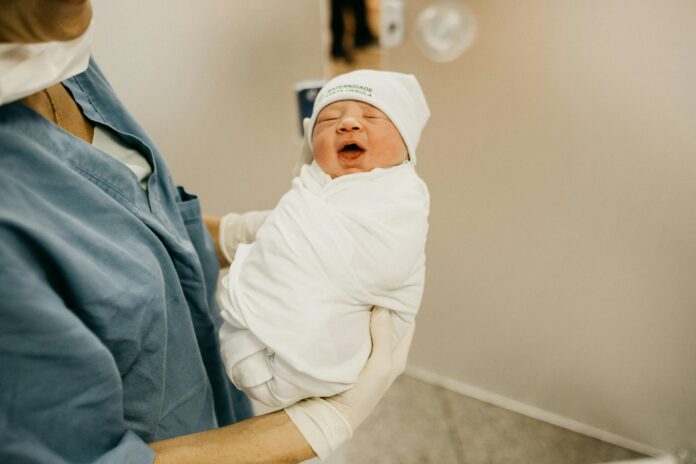
photo of a newborn baby
PHOTO: Jonathan Borba / Unsplash

Content warning: mentions of fatal infection.

Neonatal sepsis (NS) is a deadly condition for newborn babies within the first 28 days of life. As the body cannot properly respond to infections caused by common bacteria like “E. coli, Listeria, and Group B streptococcus,” as well as “viruses, fungi, and parasites,” infants can develop NS. The condition leads to “an estimated 200,000 deaths worldwide each year, with the highest rates in lower- and middle-income countries.” 

Early-onset sepsis, occurring in the baby’s first three to seven days of life, is generally caused by perinatal risk factors. Perinatal refers to the period of time a birth parent first becomes pregnant and “up to a year after giving birth.” Perinatal risk factors include “infection in the placenta and amniotic fluid,” a birthing parent’s water breaking early, or bacteria that have “colonized” in the internal reproductive system during pregnancy. Late-onset sepsis, found after three to seven days, is often caused by bacteria in a hospital setting, transmitted through “medical equipment such as catheters, IVs, and tubes.” However, signifiers of NS, such as irritability or feeding issues for the newborn, are “often non-specific” and “can also be associated with non-infectious causes,” making the condition difficult to diagnose.

Until recently, most studies regarding NS have focused on the infection after diagnosis. However, a new discovery from a group of UBC and SFU researchers, along with Medical Research Council Unit The Gambia, could change that. “Critically, our prospective study provided the unique opportunity to identify gene expression biomarkers that could predict, at birth, which healthy-appearing neonates will develop sepsis, and to follow these neonates during sepsis,” reported the team.

“Knowing that sepsis is impending would also allow physicians more time to determine the appropriate treatment to use.” — Dr. Bob Hancock, professor of microbiology and immunology at UBC

The team mapped “the expression of genes active at birth” in 720 apparently healthy newborns in the country of The Gambia. When they mapped them, they discovered “four genes that, when combined in a ‘signature,’ could accurately predict sepsis in newborns nine times out of 10,” as described by SFU assistant professor of molecular biology and biochemistry, as well as co-senior author of the study Dr. Amy Lee. This signature was identified through RNA sequencing (RNA-seq) on blood samples. RNA-seq is a technique used to help understand “gene expression levels,” which provide information on how cells function.

The ability to detect NS before diagnosis “is vital for infants’ survival,” Dr. Beate Kampmann, professor of pediatric infection and immunity at the London School of Hygiene and Tropical Medicine, told SFU. “Knowing that sepsis is impending would also allow physicians more time to determine the appropriate treatment to use,” UBC professor of microbiology and immunology Dr. Bob Hancock also told SFU. “Providing an early diagnosis to assist and guide physicians could save lives,” he said. Infants with NS are commonly treated with antibiotics, but “the uncertainty can delay urgent treatment.”

The next steps for the team include “a large prospective study” with other populations. The team hopes the signature can be integrated into hospitals and point-of-care testing. This refers to tests that can be run “at, or near, the site of a patient,” and don’t need to be sent off to a laboratory for results.

For more information, see the published study linked in the online article.

Stix: The burnt out candle

0
COMIC: Yildiz Subuk / The Peak

It’s Messi out here: the MLS’ costly conundrum

0
A black jersey with pink writing reads “Messi 10” on the back. In the background, a soccer field can be seen.
PHOTO: Courtesy of @intermiamifc / Instagram

“DON’T BE PLASTIC! SUPPORT YOUR LOCAL CLUB!” a banner read, draped over a supporter’s section in Yankee Stadium. It was September 21, 2024, and New York City FC was playing host to Inter Miami, the star-studded team captained by soccer legend Lionel Messi.

Messi joined Inter Miami in July 2023, skyrocketing the club’s popularity in Major League Soccer (MLS) and worldwide. Many of his superstar former teammates joined in the week following his announcement, including Sergio Busquets and Jordi Alba. Luis Suárez joined for the 2024 season later on. Messi’s former manager at both FC Barcelona and the Argentinian national team, Gerardo “Tata” Martino, also joined Inter Miami shortly before the star’s pen hit Miami’s paper. 

Since Messi and his star-studded entourage strutted onto the eastern Florida panhandle, the profile of Inter Miami and MLS as a whole has risen — arguably to the detriment of everyday fans. Miami’s ticket prices for the 2023 season rose by five times the previous amount to $161 (USD) each after the Messi announcement — a price that is 64% above the league average for gameday prices. 

When Inter Miami plays away games, stands are packed not just with the home team’s supporters, but also with Miami’s pink and black, with a smattering of Argentinian kits — typically bearing Messi’s number ten on the back. The prices to be in these stands have also risen substantially, as many saw this past May when Miami visited BC Place for their first matchup against the Vancouver Whitecaps on the 25th. When news broke that Messi, Busquets, and Suárez would be completely absent from the Saturday match, all hell broke loose.

This wasn’t the only match where a Messi no-show caused an uproar. Inter Miami had a planned international tour during the 2024 preseason, with two matches each in Saudi Arabia and the US, and one match each in El Salvador, Hong Kong, and Japan. While Messi physically attended the match in Hong Kong, he did not play, as he instead sat on the substitute bench after gaining an injury during his previous matches. Outrage struck as a result, from fans destroying Messi cardboard cutouts, to the booing of Inter Miami co-owner David Beckham after the match had concluded. Messi reappeared in Tokyo just days later, playing 30 minutes in the match there, sparking theories that his Hong Kong no-show was “politically motivated.” 

The World Cup-winning Argentinian national team had two scheduled “friendly” matches that were supposed to take place on mainland China in March, though both the match against Nigeria in Hangzhou and against Ivory Coast in Beijing were cancelled following Messi’s no-show in Hong Kong. The Chinese Football Association also cancelled its partnership with the Argentine Football Association in the wake of this controversy.

The 2024 regular season was a record-breaking one for Inter Miami, as they won the MLS regular season championship with the Supporters’ Shield — and set a points-scoring record in the process. Despite this, the team were eliminated from the MLS Cup Playoffs in a major upset against eighth-seed Atlanta United. 

“Lionel Messi is one of the best, arguably if not the best, soccer player of all time. Still, the star is slowly fading as injuries pile up after a lifetime on the pitch.”

Messi is one of the best, arguably if not the best, soccer player of all time. Still, the star is slowly fading as injuries pile up after a lifetime on the pitch.

Much of the MLS marketing tactics since the 37-year-old’s arrival have centered around him. I cannot begin to estimate the amount of times I’ve seen the ad of a dyed pink goat while watching the MLS Season Pass. Nearly half of the first page of jerseys on the MLS Store website are Messi- or Miami-related. Even the MLS email newsletter touts itself as “the Messi insider.” 

The league is banking on a player bringing them into a new era, when the player himself won’t even be there.

The MLS is facing an era where they are “the Messi league” — despite the fact that Messi only played 19 games of Miami’s 34-game MLS season. His current contract runs to the end of the upcoming 2025 MLS season, and the prolific forward has stated that Miami will be the last club he plays for in his storied career. 

Inter Miami have also gained a spot in FIFA’s upcoming Club World Cup — despite not technically winning their league after being eliminated in the playoffs. This has also caused controversy, as some have claimed that the club’s inclusion is only due to their captain’s starpower, and the cashflow his appearance can generate. 

I’m not saying that high ticket prices and tricky geopolitical situations are Lionel Messi’s personal fault, as I personally think he deserves the “GOAT” moniker — in men’s soccer, that is. The MLS has just walked itself into an impossible scenario with no foresight. With the high likelihood of the league losing their highest moneymaker within the next few years, they seem to lack a contingency plan in carrying on this attention past the final whistle of the 2025 season. 

With the next season starting late next February, only time will tell what Messi’s potential last club season will look like — along with how the MLS will recover from his impending departure. Until then, I guess MLS fans across North America should buckle up for another year of fighting for a place in their home stadiums whenever soccer’s golden boy touches the pitch (or doesn’t).

Professor’s feedback on “responsible investments”

0
SFU admin is throwing money at a globe. There are pumpjacks on the globe that represent fossil fuel extraction.
ILLUSTRATION: Sonya Janeshewski / The Peak

By: Professor No Nonsense

Dear Simon, 

Thank you for submitting your assignment about your investment approach. In my most recent therapy session, my therapist encouraged me to start practicing radical honesty. So, I’m starting right now. Your submission is bad . . . no, terrible. At multiple points while reading it, I took a break to mourn the time I was losing. For an assignment you avoided since last fall, you’re lucky to be getting feedback. Here is an in-depth breakdown of everything wrong with it. Regardless of whether or not you read this (I know you won’t), it was incredibly cathartic to write. 

1. No understanding of the topicThis assignment is about “responsible investments,” but it includes no definition of this concept. Could this be because you don’t know what it means? You claim to be a signatory to the United Nations Principles for Responsible Investment because you support incorporating environmental, social, and corporate governance considerations into your investment decisions, but you proceed to make up every excuse under the sun to avoid being held accountable. Were you unaware that signing would force you to reveal to the world what you believe is or is not an important environmental or social cause? Seems like a lack of foresight to me. . . 2. Bad analysis and even worse argumentation

You claim that divesting from fossil fuels has yielded “mixed results.” What led you to this asinine conclusion? To continue, you write “divestment can have financial implications” blablabla . . . At the university level, I expect much more sophisticated and thoughtful work. What made you believe that making a deeply obvious statement that could only be outdone by announcing that the sky is blue and the earth is round could possibly lead to a passing grade? 

And then, (I know this section is long, it’s just that you submitted incredibly subpar work) you say, “divestment from specific causes may conflict with our responsibility under the University Act to remain ‘non-sectarian and non-political in principle.’” This isn’t a starving artist’s screenplay, it doesn’t need a plot twist. Why after hundreds of words of you rambling about your values would you then reveal that you’re not allowed to have any?  

3. If you weren’t going to give me clarity, you could’ve at least given me concision 

I saw online that it’s hip now to write tl;drs because the youth “ain’t reading all that” and I truly believe this is a phenomenal tool you should incorporate in your future work. In order to clarify what I mean, an example of a good tl;dr for this submission would be: “I want to continue to virtue signalling and calling myself a leader in yet another made-up sector while making unethical investment decisions because it is profitable without anyone calling me out on it because it is deeply annoying to me.” 

Normally, this would be the point where I would encourage you to come to my office hours, but I fear you may be too far gone. When the environment and people’s lives are on the line, taking your sweet time to schedule community consultations is irresponsible. 

Don’t ask me to regrade your work. 
Professor No Nonsense

Food for thought: Momos

0
Five circular dumplings with pinched tops sit on a black plate garnished with green sprouts.
PHOTO: Momo King / Pexels

Dumplings, potstickers, perogies, gyozas, mandu . . . there are many variations of a filling stuffed in a dough wrapper. Each culture has its own spin on this type of dish, and the Nepali dish, momos, are no exception. 

A staple in Nepali households, momos are best enjoyed in the winter months. The filling of these delicious delicacies differs for each person. However, its base is usually some type of ground meat with onions, ginger, vegetable oil, salt, garlic, and Nepali seasonings all wrapped in a flour dough wrapper. What differentiates this from other dumplings around the world is the chutney it is paired with. Once again varying per person, the chutney is usually tomato based, filled with red chillies, salt, sugar, and garlic. The spice from the sauce adds a kick to the taste of the momo, creating the perfect balance of savoury, spicy, and sweet goodness in your mouth.

There are multiple stories as to how momos emerged. One consistent component is the involvement of Tibetan people. Some say Newari merchants brought the dish to Nepal while travelling from Tibet; however, others believe that a “Nepalese princess, who was married to a Tibetan king,” brought the dish from her country to his. 

Though its origin is up in the air, the feelings momos create for Nepali people are straightforward. Momos foster nostalgia, familiarity, and love. Since they take so much work to make, families usually gather around a table, with everyone participating in its production. Gossip is shared, funny stories are narrated, and memories are created. What makes this so special is that the momos are usually made and eaten simultaneously. You finish making one batch, eat it, then repeat. I can’t tell you why or how, but for some reason this process makes the momos taste so much better than if they were prepared all at once. Perhaps it’s the time being spent with your family that enhances the flavour, or the distance in time between eating so your stomach has time to digest the food. Either way, this process makes the momos taste that much better!

Momos are greatly loved in Nepal for reasons beyond their taste and the feelings they create. These flavorful, bite-sized delights are extremely versatile. They can be steamed, pan-fried, deep-fried, served in soup, and more. A reason for its versatility is how they’re stored. Because they take so much work to make, momos are made in big batches, and then stored in the freezer for the future. This prevents them from going bad and gives people time to decide how they want this dish to be prepared.

The idea of momos relates to a feeling of nostalgia for me. As a kid coming home from my after-school programs on a dreadful rainy day, I would be hit in the face with the fog from the steamers cooking the momos, wafting in the garlic-filled air. My mom would always make these delicacies on days that were cold and gloomy, almost like she was trying to lift up our spirits through these flavour-filled goodies.

I think it’s beautiful how different cultures have their own take on a dish, and how they can differ so drastically both aesthetically and tastewise! It’s through food that we realize how much more similar we are than we originally thought.