Home Blog Page 110

The commercialisation and politicisation of Diwali, Bandi Chhor Divas, and other South Asian festivals

0
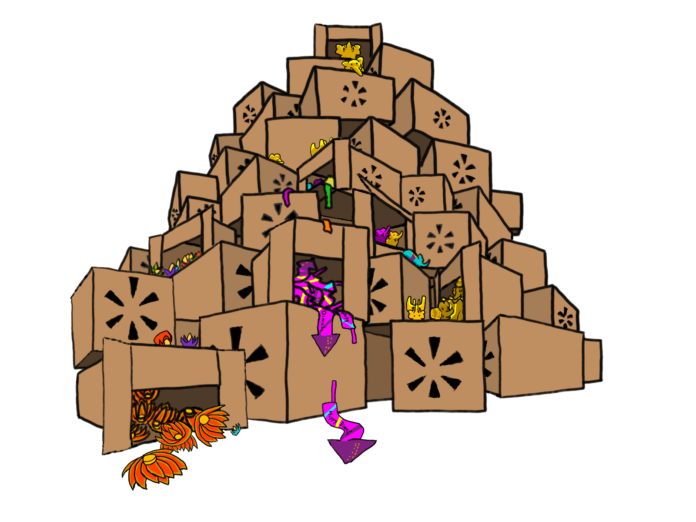
A pile of boxes containing different Diwali-related objects such as flowers, and colored animals.
ILLUSTRATION: Yan Ting Leung / The Peak

If you were wondering why there were so many fireworks on October 31 and November 1, it’s because South Asians celebrated Diwali and Bandi Chhor Divas on those days respectively. Diwali is the celebration of “light over darkness, of good over evil.” It is celebrated across a variety of South Asian religions and cultures. Bandi Chhor Divas is celebrated by those who follow Sikhi or Sikhism, and celebrates the day when Guru Hargobind Sahib Ji was freed from wrongful imprisonment. With him, he brought 52 prisoners who were also wrongly accused of crimes by the Mughals. In my family, we celebrate Bandi Chhor Divas by lighting divas, visiting the Gurdwara (a place of gathering and worship where all are welcome to respect the teachings of Sikhi) and listening to kirtan (singing the shabads in the Guru Granth Sahib Ji, our holy scripture). Part of the celebrations also include having big family feasts and enjoying firework shows. The beautiful thing about our festivities is that everyone is welcome to participate as long as they do so respectfully. While people usually don’t undermine our cultural values, corporations do. 

With a growing South Asian diaspora in North America, it’s inspiring to see Diwali and Bandi Chhor Divas recognized and celebrated by many different people. I’m proud to be Canadian and share my cultural background. However, there has been a recent rise in South Asian holidays being used for commercial and political gain — merging them into one rather than honouring their unique significance. 

In western countries, it has become more common for non-South Asian businesses to use Diwali and Bandi Chhor Divas as a means to increase profits. These are festivals that, at their core, are meant to promote a stronger connection to religion and spirituality — not fuel corporate greed, spending habits, or performative marketing. In doing so, corporations erase the beautiful distinctions of Diwali and Bandi Chhor Divas, blending them into a single, market-oriented holiday aimed at gaining the business of South Asian individuals.

One North American corporation which has most prominently sought out a profit on the basis of South Asian festivals is Walmart. The grocery giant recently announced that its so-called “Diwali footprint” has “increased more than 20% since last year and is now in more than half of [their] stores.” Note how multiple holidays have been grouped under the umbrella term of “Diwali.” I’ve even noticed Walmart using Diwali discount codes. New customers are attracted by performative marketing and are given a corporate-washed, all-in-one reductive approach to South Asian festivities. I have nothing against marketing towards a particular demographic. However, cultural celebrations are one thing that ought to stay out of the hands of corporations — especially given the fact that corporations such as Walmart exploit workers and use child labour while promoting “diversity.” This doesn’t sound like the values of Diwali and Bandi Chhor Divas to me.

While one might assume Walmart has taken positive steps in their approach by working with Indian distributors to stock up their stores, their ultimate goal remains to profit off consumers allured by their offerings. These Indian corporations who supply goods to Walmart are enthralled in a quest for capital gains at their own exploitation. They’re supporting Walmart’s goal of commercialising and capitalizing on South Asian festivals to transform them into commodities.

Turning Diwali and Bandi Chhor Divas into a “broader holiday ritual” will only allow for our culture to be lost at the hands of corporations.

Walmart has employed marketing and public relations strategies to celebrate Diwali, attempting to convince consumers that they are culturally inclusive. For example, they hosted a variety of in-store Diwali celebrations throughout the country. A pre-advertised Diwali celebration in Cambridge, Ontario went viral on TikTok recently, with the video including workers beating dhols and singing. While these are great initiatives on the surface, they expose a deep issue with corporations exploiting cultural symbols and traditions for profit.

In an interview with BBC, professor Nirmalya Kumar from Singapore Management University argued that due to “its timing,” Diwali could “end up becoming part of a broader fall-winter holiday ritual,” and fade into just “another holiday party.” The South Asian population comprises 7.1% of the total Canadian population, out of which 44.3% are Indian. Corporations are using this population to their advantage, watering down the diversity of South Asian cultural celebrations by shoving them under the broad umbrella of Diwali. Turning Diwali and Bandi Chhor Divas into a “broader holiday ritual” will only further dilute our cultures at the hands of corporate greed. Thus, we must ignore corporations who are promoting culture as a way to meet a new market.

Commercialisation of culture is not the only thing that South Asians have been experiencing. Political campaigns now use festivities as an excuse to promote or expand their platforms. Last year at the Vaisakhi parade in Surrey, I remember seeing the Conservative Party touting their policy to put a direct flight between the city of Amritsar  and Canada. This was in the middle of a festival that celebrates the creation of the Khalsa Order. This is a wildly inappropriate ploy to try to get votes from the Sikh community and other people who are welcome to attend religious parades and festivals. There is also a general increase in meddling by politicians into our religious spaces when it’s not festival season. When federal election campaigns come around, I can fully expect to see a political candidate in my local Gurdwara trying to siphon votes from the Sikh community. This is once again an indicator of how politicized our cultural values have become at the hands of politicians.

If we continue on our path of politicizing and commodifying cultural celebrations, what will be left to celebrate? Our diversity needs to be celebrated and appreciated by the broader society without the dilution of the distinctions that make it beautiful. In accordance with this principle, why not do more to celebrate Diwali and Bandi Chhor Divas in our schools? Or why not educate ourselves on the distinction between the two festivals, rather than combining them into one and disregarding their diversity? Social washing — strategies used by corporations to seem more socially responsible — has risen to become a dangerous trend. This could destroy individuality and cultural identity over time.

Corporations are misguided when promoting “diverse” cultural events such as Diwali and Bandi Chhor Divas. This is not OK. If we want to promote cultural celebrations from any faith, it is important that we take an organic lens and spread awareness of the different holidays through our education systems, and create long lasting change to how we view corporations and the role of capitalism in the commodification of traditional holidays. 

“Where football belongs:” Grey Cup Festival illuminates BC football

0
A wall of orange lights and helmets that form a snowflake-like shape. In the middle is a logo that reads “Grey Cup Festival Vancouver 2024.”
PHOTO: Izzy Cheung / The Peak

Although the BC Lions encountered an early exit in the CFL playoffs this year, Vancouver still got to enjoy the energy of playoff football. From November 10 to 17, Vancouver hosted the Grey Cup Festival, highlighted by the CFL’s championship game on the 17. This year’s matchup pitted east-division champion Toronto Argonauts (Argos) against west-division champion Winnipeg Blue Bombers. 

The last time Vancouver hosted the Grey Cup was in 2014, with the Calgary Stampeders fighting off the Hamilton Tiger-Cats in a close 20–16 game. Vancouver was the first to host the Grey Cup in western Canada and has hosted 17 Grey Cups in total. The Lions won their first Grey Cup in 1964, beating the Hamilton Tiger-Cats 34–24. The last time BC took part in the Grey Cup at their home stadium was in 2011, when they beat the Winnipeg Blue Bombers 34–23 to win their sixth and most recent CFL championship.

The Grey Cup was commissioned in 1909 by then-Governor General of Canada, Lord Earl Grey. The trophy was meant to be for the senior amateur hockey championship, though the Allan Cup had taken that place, so Grey decided to instead donate the Cup to the Canadian amateur rugby football championship. The Toronto Varsity Blues from the University of Toronto won the first Grey Cup in 1909. The first western team to win was the Winnipeg ‘Pegs — an early rendition of the modern day Blue Bombers — when they defeated the Hamilton Tigers 18–12 in 1935.

Here’s our breakdown of Grey Cup week in Vancouver. 

A rainy media day 

“It still feels a little like home,” Argos defensive coordinator Will Fields told The Peak of being back in Vancouver. Fields started as a scout with the BC Lions in 2013, before taking a position within SFU’s football department in 2014. He returned to the Lions in 2015, acting as a defensive back coach. With drops of rain thumping against the building on media day, the defensive coordinator joked that “the rain made it feel more familiar.

“I had a great time at SFU. It’s a beautiful school,” Fields said. “I even thought about having my son attend.

“We actually won a few games when I was there,” he chuckled, poking fun at the high-intensity competition that the team faced as part of the NCAA. “But I did enjoy my time and it was a good  experience.” He added that he “wouldn’t take it back for anything.” 

Also making his return to Vancouver was Winnipeg Blue Bombers wide receiver Lucky Whitehead, who played with the BC Lions from 2021 to the end of the 2023 season. He was named the team’s most outstanding player in 2021, and earned himself spots on the West Division and CFL All-Star teams. With three years’ worth of memories, Whitehead had a lot to reflect on from his time in BC.

“We used to always prep and plan touchdown celebrations, and just ways to have fun with football,” he reminisced. Whitehead also recalled his trademark game-day entrances, noting that his favourite was when he “came in on the horse.” 

Whitehead wasn’t shy to express how nice it was to be back in Vancouver, as well as how nice it was to see his teammates’ reactions to the city he once called home. 

“It’s funny just to hear my teammates rave about it,” he added. “I’ve seen it before. So I’m glad, I want y’all to enjoy it.

“It’s a special week and a special moment, especially for the young guys at this time, and for me, my career being 32,” Whitehead said, thinking about the significance of competing for the Grey Cup. Thinking back to his time in BC, formerly as a Lion and now as a Blue Bomber with his eyes set on a championship, he made one more statement of thanks to BC fans. 

“For the constant cheers and the love that I received — and just the memories,” he said. “It was a lot of ups, a lot of downs, a lot of injuries, but they always accepted me for me, and with complete open arms. So I just want to say thank you and see y’all on Sunday.” 

BC’s award winners 

The CFL Awards took place on November 14 at the Vancouver Convention Centre, with BC Lions owner Amar Doman receiving the Commissioner’s Award and Carolyn Cody being awarded the Jane Mawby Tribute Award. The Commissioner’s Award is given to an individual who has had a profound impact on the league, as named by CFL commissioner Randy Ambrosie. The Jane Mawby Tribute Award recognizes the efforts of the CFL’s unsung employees. 

Doman purchased the Lions in 2021, and has since elevated the team’s presence within the city. In Doman’s time as owner, the Lions have welcomed artists such as OneRepublic, LL Cool J, and 50 Cent for their annual Concert Kickoff games to start their home campaign. This year, the Jonas Brothers headlined the Grey Cup halftime show at BC Place, adding to the hype surrounding the championship game. 

“The CFL is about community, it’s about sport, it’s about people, and it’s about athletics,” Doman said, his newly-earned trophy beside him. “We really believe that we’re stewards of this franchise for the next couple of decades.” 

Cody, the vice president of Marketing and Business Operations for the Lions, won the second award for the Lions. Her tenure with the Lions dates back to 2013. Since then, she’s helped spearhead the team’s growth in corporate and social fields. 

“This weekend is such a great example of how we’re trying to do things differently,” she noted in a press conference post award-victory. “We’re making strides with integrating Punjabi radio broadcasts to every single one of our games. We’re bringing new Canadians to all of our games.”  

A quick game recap 

The matchup between Toronto and Winnipeg swung heavily in the latter’s favour. In their semifinal matchup against the top-of-the-league Alouettes, the Argos lost starting quarterback Chad Kelly to a leg injury. As a result, backup quarterback Nick Arbuckle slotted into the position. On the other side of the field, Blue Bombers fans got to see veteran quarterback and three time Grey Cup-winning Zach Collaros.  

Toronto revved up the offence with a field goal to put the Argos up 3–0 a little short of eight minutes into the first quarter. The Blue Bombers fired back with a touchdown late in the first, giving them a 7–3 lead. A Winnipeg field goal brought their lead up to 10, showing promise for an eventual Grey Cup victory. Two more field goals by Toronto brought the point margins closer and closer. 

Scoring was somewhat even throughout the bulk of the game, as the Argos trailed 10–9 going into halftime. After a touchdown and a couple field goals, it was Winnipeg’s turn to chase a lead, as they were down 17–16 by the final 10 minutes of the game. After that, Toronto’s offence exploded, racking up a grand total of 24 points in five minutes of game time. The Blue Bombers’ inability to make up for the influx of offence came due to an injury to Collaros, which he sustained towards the end of the third quarter. Winnipeg scored one more touchdown with less than a minute left before the game concluded in a 41–24 victory for the Argos. 

Speaking on SFU football 

We can’t wrap this up without addressing the fact that we’re writing about football to students of a school that currently doesn’t have a football program. The cancellation of the program was wildly unpopular, not just for students, but for alumni, staff, and the community as a whole. 

“I was pretty upset about it as well, even though I only spent the year there,” Argos coach Fields expressed. “I felt so bad for the players.” Despite the cancellation happening over a year ago, he hopes that the players can “get that piece of themselves that they need.  

“I always say this — if you love football enough, you can go seek it out. There are a million other places to play football, and you should want to be where you’re wanted.” 

Lions owner Amar Doman, who has been “very vocal” about his support for the program, addressed the issue after winning the Commissioner’s Award. 

“We’re not going to go away on that file whatsoever,” Doman pressed. “It’s another storied franchise [ . . . ] that we want to help.” He also noted that, while there hasn’t been much talk of a solution recently, Doman is still trying his best to get the program back. 

“I just know that I’m going to roll it over as far as I can to make that happen, whether it’s financially, or whatever it is, to get football back out at SFU where it belongs.”

Vancouver Christmas Market tickets offer the privilege of being able to spend even more money

0
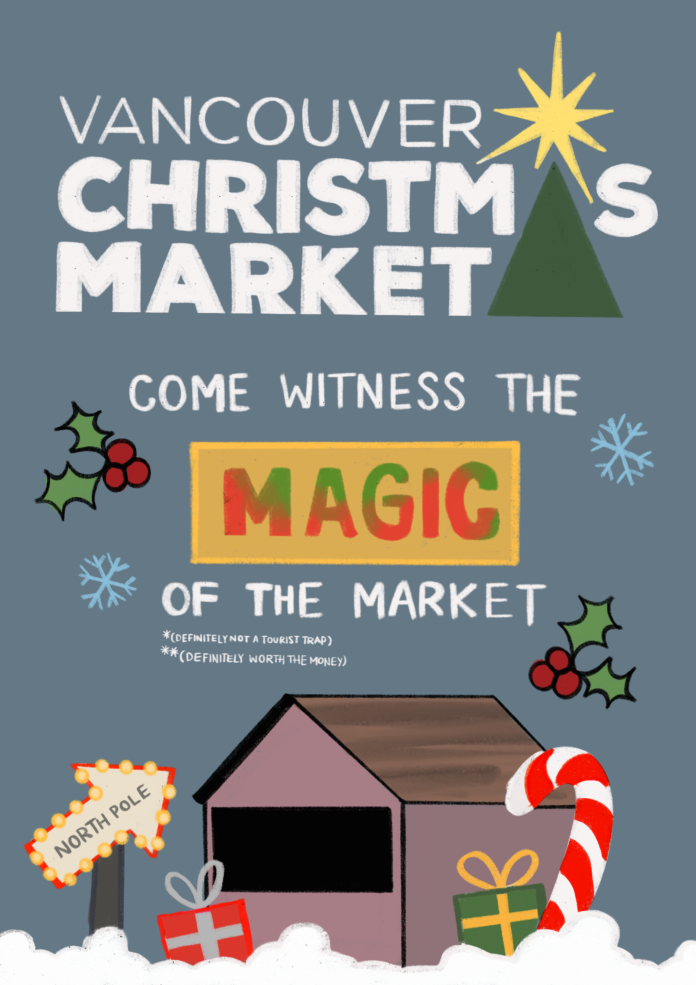
Poster advertising the Vancouver Christmas Market. It says “Come witness the magic of the market! (Definitely not a tourist trap) (Definitely worth the money).”
ILLUSTRATION: Victoria Lo / The Peak

It’s everyone’s favourite month of the year: the month where we pretend there’s snow on the ground and climate change isn’t real so we can get into the Christmas spirit. And what says “Christmas” more than spending money just to spend even more money? At least, that’s what the Vancouver Christmas Market’s marketing team tells me. They’re selling their tickets using the most effective methods we all fall for — consumerism and a desire to have friends.

This year, thousands of people are spending money to enter an event where they’ll spend even more money buying things like wax candles, essential oils, and mulled wine, which are arguably more important than having money for rent. So this holiday season is the perfect way for companies to say, “buy these priced-up goods just because they’re Christmas themed, and you want to celebrate Christmas like a normal person, right?” Although the $20 poutine tastes exactly the same as the $6 poutine I got at the Surrey Central food court, this is at a Christmas Market, which should objectively make it better.

There are some people that think the Vancouver Christmas Market is a tourist trap, but those non-believers don’t know what the true meaning of friendship is. Their marketing team is telling me that I need to pay for their outrageous ticket or else I’ll lose all my friends. I’m tempted to believe this. After all, I went to the Richmond Night Market last summer just because I wanted to hang out with my friends. As adults, none of us have a lot of free time, so our favorite activities involve spending a ton of money very quickly. We’re spending so much money just to hang out, which is a little counterintuitive considering we’re all broke college students barely getting by. Paying off student loans is overrated anyway. 

The Peak’s staff picks for album of the year

0
A thin outline of a pair of black headphones against a black background.
PHOTO: Jason Leung / Unsplash


Never Better and Better Now by Wild Rivers 
Hailey Miller, Staff Writer

Toronto indie-rock trio Wild Rivers — comprised of Khalid Yassein, Devan Glover, and Andrew Oliver — released two back-to-back sister albums this year, followed by a world tour. Never Better was the first out of the gate, released on July 26. The albums house a fresh dose of folk and harmonies that serenade, alongside raw guitar riffs and tangible lyrics with no need for over-production.

As the title track, “Never Better” sets the tone with Wild Rivers’ signature folky sound, complete with groovy rhythms and honey-soaked three-part harmonies. “Hardly Ever” is my favourite song off the record with its catchy guitar riffs, effortless vocals, and beats that’ll have you dancing on your feet. 

The band stated that they had countless songs written from the sessions that birthed Never Better, and they couldn’t bear to part with any of the tracks that would have otherwise been cut. Then came Better Now, released on October 18. 

This album is more timid, exploring different, more melancholic perspectives compared to the previous record. “Freezing” depicts Glover’s time moving from Toronto to LA and missing the cold. The acoustic masterpiece and narrative lyrics display that of yearning for what’s lost. In contrast, “I Want Everything” is more lively with heavy-hitting guitar chords that complement the harmonies.

With Wild Rivers’ signature sound and elements of flawless vocals, guitar, groovy rhythms, and whimsical vibes full of emotion, their 2024 albums highlighted exactly who the band has set out to be as they’ve evolved artistically over the years.

Orquídeas by Kali Uchis 
Izzy Cheung, Arts & Culture Editor

I’d consider myself to be a casual Kali Uchis fan, having gravitated towards some of her hits off of Por Vida, Sin Miedo (del Amor y Otros Demonios), and Red Moon in Venus. Her newest release, Orquídeas (Orchids), caters to any and all of the moods you could be feeling at any given moment, during any season, and for any situations you may encounter. Uchis’ harmonious, lip-gloss-smeared vocals compliment both the album’s funky, club-like beats as well as the more nostalgic, vocals-centred ballads. 

The album begins with “¿Cómo Así?” (How Come?), which transports you into the soundtrack of a vintage arcade videogame. The arcadecore aesthetic it conjures is created by the virtual-sounding backing similar to the thrum of a rapidly beating heart. “Pensamientos Intrusivos” (Intrusive Thoughts) is an instant play for getting ready with friends before a night out, swaying with a drink in hand at an upscale bar, and rolling the windows of your Uber down on the way back home. This lively track, despite the party-girl mood it sets, echoes the unyielding strength of the speaker’s love in the face of frequent heartbreak. Only two songs after this comes the slower, syrupy “Te Mata” (Kills You). It’s a track that transports you to a vibrant Latin town, where you’re dancing under a single streetlight as this song plays in the background. It’s a fantastic track that emphasizes Uchis’s voice with the sensual strums and richly-raw belting of bolero music. 

Verbathim by Nemahsis 
Petra Chase, Editor-in-Chief

Nemah Hasan cleverly coined Verbathim to represent being misinterpreted. A refreshing blend of art pop, R&B, and electronic, her debut album is brimming with evocative wordplay. Deeply introspective and inspired by the word “nemesis,” Nemahsis at times, becomes her own. “Dead giveway” feels like it was written for fleeing a crime scene. In “delusion,” she reveals twisted truths about herself alongside riddles like “gas in a Tesla, I’d fill it just to see what happens” singing “lalala, delusion hallucination, reality could never.” You unveil new dimensions every time you listen to the album, whether it’s how computer-crisp synthesized vocals are woven into electronic hooks, or unpacking theatrical epithets and terms-and-conditions speak. All 12 tracks bring surprises; as a whole, a full range of emotions are felt. 

“I borrow happiness from tomorrow” laments about being in a happiness shortage. In “You wore it better,” Hasan belts over artsy piano about comparison, a theme also explored in “coloured concrete;” metaphorically, of not looking at her neighbour’s swimming pool unless making sure it’s not dried out. All this is done while displaying incredible vocal range and control. Sprinkled within her vulnerability, there is also clarity. Maybe it’s the gentle strumming or yodel effect of her pretty vocal flipping, but “miss construed” sounds suited to be sung by a pond. It’s about art being misinterpreted by those who won’t even try to understand, and it’s written as if to a self with less experience, warning “not to be eager.” The album itself is a testament to letting go of having to please everyone and losing the “fight” — her label dropped her for being “sellable” to them as a Palestinian Canadian. It’s proof being true to herself and her art is what resonates.

The everlasting power of community in It Takes A Village

0
A close-up of two black men wearing black and sitting on the steps of a school.
PHOTO: Courtesy of Christopher Cho

The Vancouver Asian Film Festival was memorable, bringing community members together through a collective love of storytelling. The power of community is sometimes overlooked for stigmatized communities like East Hastings. It Takes A Village: An East Van Story explores the tales of David and Jon Mubanda, their surroundings, and the personal and larger-scale impacts of community. 

After leaving Uganda’s violent military regime, the Mubanda family settled in East Vancouver. The documentary focuses on the brothers’ extra-curricular activities and the adults that fostered these types of opportunities. This film destigmatizes what’s often labelled a “rough part of town” by showing us the bonds, collective projects, and history behind progression in sports and acting. 

“I grew up in that world too. I grew up in East Van. I went to Van Tech. [Jon] went to Templeton,” Director Chris Cho told The Peak. “I’m very ingrained in that world because all of them are [my] friends and family.” 

It was through this community connection that Cho was gifted the task of directing the film. A self-taught filmmaker, Cho built up his experience by creating YouTube vlogs and short films, which is how he first met Jon. 

The documentary’s home-video footage of the past is a treasure. There’s a nostalgic charm in the grainy and handheld 2000s footage captured. The film is reflective and influential, as community members emphasize the importance of giving back and creating a space for the next generation to thrive. As someone who also comes from an immigrant background, seeing the two brothers develop themselves through sports and acting is something that resonated with me. Exploring new things can initially be a way to escaping struggles, but may also have the long-term effect of setting young adults on a positive path. This was especially true for me, as I spent time after school hanging out at a community centre near my high school playing sports or making skits.

“I wanted to tell a love story of the neighbourhood I grew up in, regardless of all its challenges, ups, and downs.” — Jonathan Mubanda, actor and youth worker

One of the fondest things that Mubanda shared about his love for East Van was the connection of various communities and cultures, all stacked together in one neighbourhood. “It was so multicultural — it was a melting pot,” he described. “For me, that’s why I love East Van. You get to know about each other’s cultures. You get to know about each other’s backgrounds.”

Mubanda told The Peak that “regardless of all its challenges, ups, and downs,” he “wanted to tell a love story of the neighbourhood.”   

From playing in an underdog basketball team that ended up succeeding at a provincial level, to auditioning for his first roles as a youth with the help of his old drama teacher, Mubanda outlined positive experiences from his upbringing. It all boiled down to “having trustworthy adults” in his life as well as anyone that can be a “listening ear.” The ecosystem of healthy role models for a child is vital, as they provide them with opportunities, but also give them a safe space to express themselves — which is what East Van provided Mubanda with. 

“For us, we had our coach, we had our principal, we had our drama teacher,” Mubanda added. “I had a good mom and dad. It’s definitely an asset.”

Towards the end of the interview, Mubanda expressed gratitude for his high school coach, who helped him get employed early on in his career with the school board. “She not only took care of me in high school, but she took care of me after high school. Just by an opportunity,” he expressed. Now, he has become a role model and trustworthy adult within his community. 

As I reflected on the impact of It Takes A Village, I realized the reason this story was particularly striking was because of its authenticity. Mubanda and Cho didn’t want to tell a story about overcoming barriers within their childhood, but instead wanted to give back. Their focus was continuing the tradition of building a community where the youth can thrive.

The past, present, and future of Transgender Day of Remembrance

0
A group of people holding the trans flag and candles with messages of support for the trans community.
PHOTO: Cindy Wang / The Peak

Content warning: mentions of transphobia, violence, and murder. 

Honouring the past
Though November 20 — Transgender Day of Remembrance — will have passed by the time this article comes out, the weight of the day has not. In 1998 Rita Hester, a Black trans woman from Massachusetts, was murdered in her own apartment; Hester’s case remains unsolved to this day. This horrific tragedy gave rise to the day of vigil for those who lost their lives to anti-trans violence and homicide. Anti-trans hate persists. Earlier this year, Nex Benedict, a 16-year-old non-binary youth from Oklahoma lost their life at the hands of targeted bullying from other students. This kind of hatred is “peddled by State Superintendent Ryan Walters, Chaya Raichik (Libs of TikTok) and extremist state legislators.” This year, as of the writing of this article, “350 trans and gender diverse people were reported murdered,” an increase from last year’s total of 321, as reported in the Trans Murder Monitoring project by Trans Europe and Central Asia (TGEU). 

Canada and BC aren’t free from anti-trans violence. Back in 2003 Shelby Tracy Tom, a trans sex worker and graduate from SFU, was murdered in North Vancouver. While advocates classified her case as a hate crime, BC Supreme Court Justice Patrick Dohm ruled against the designation in 2005. Sadly, Tom hasn’t been the only trans individual murdered in BC’s recent history. In 2012, 26-year-old BC resident January Marie Lapuz was murdered over “an argument over payment for a sexual encounter.” Lapuz “lost her job due to her gender transition” and was in an extremely vulnerable state, engaging in sex work to pay for basic necessities like food and clothing. Her death is tragically one of many. Trans folks, especially trans women, are often left with few viable career options due to systemic, institutional, and interpersonal discrimination, leading many towards sex work — a profession that TGEU reports as being “the most targeted group of all known occupations.” Anti-trans violence has, and continues to be, underreported in the media and in education, which obscures the alarming rate of harm done to the community and its members. Moreover, trans folks are subject to losing their jobs and housing just for coming out. Advocating for basic rights in a society that still presents structural challenges, prejudices, and real danger is a kind that cannot be overlooked or brushed aside. 

To Rita Hester, Shelby Tracy Tom, January Marie Lapuz, Nex Benedict, and all those whose lives have been lost to violence, the named and the unnamed, those whose stories remind us of the urgent need for change. We honour you and remember you. Your resilience, courage, and humanity will not only not be forgotten, but will fuel the fight for present and future generations.

Celebrating the present
Despite the challenges that trans folks face to live authentically, 2SLGBTQIA+ communities in so-called Vancouver and Canada continue to thrive through the hard work of activists, artists, creatives, and organizations committed to promoting inclusion. Ivan Coyote, raised in Whitehorse, Yukon, is a storyteller and award-winning author who has done an immense amount of work for the queer community by advocating for their rights and sharing personal experiences of their own through art. With various books, films, and stageshows, they continue to create art that explores themes of gender, identity, and social justice. SFU had the privilege of having Coyote as the English department’s writer-in-residence for 2018–2019, and they currently work as Specialist in Inclusion and Creative Expression at Yukon University. 

Meanwhile, on the island, the University of Victoria (UVic) houses the world’s largest archive of transgender materials — spanning nearly 1.5 football fields long and containing items from around the world, some dating back over 120 years. This awe-inspiring feat of a collection was founded by PhD Aaron Devor, the world’s first chair in transgender studies at UVic and historian for the World Professional Association for Transgender Health. Dr. Devor has won awards such as the Virginia Prince Pioneer Award, a Canadian Association of University Teachers Equity Award as well awards from UVic “for outstanding community outreach and for advocacy and activism in equity and diversity.” Devor is also the founder and host of the international Moving Trans History Forward conferences that aim to address trans history and important issues that exist today. What sets these conferences apart is their focus on inclusivity beyond academia — many different groups, from the general public, to artists, family members, allies, and more can share their experiences, learn from others, and grow with awareness and motivation for a better future. Meanwhile, here at SFU, we have our own student society that supports the 2SLGBTQIA+ community: Out On Campus. They offer resources for learning about 2SLGBTQIA+ history and culture, as well as support for physical, mental, and sexual health. 

“We must ensure history stops repeating itself — losing lives because of someone’s gender or identity is unacceptable, especially in a country that prides itself on inclusivity and diversity”

Another key organization that formed in 1979 as a culmination of local organizations and businesses is QMUNITY. This non-profit organization is “BC’s queer, trans, and Two-Spirit resource centre,” following their three pillars of support, connection, and leadership. They offer support services such as low-cost counseling, access to gender-affirming chestwear, and youth one-on-one peer support — which are drop-ins designed to let youth “hang out and seek support.” QMUNITY also allows space for inclusivity and connection through peer-facilitated support groups, special events (i.e. fundraisers, events for seniors and youth), and volunteer opportunities. Furthermore, they offer inclusivity training and workshops, educational resources, and consulting services for people to extend their understanding of the community further. We also have Trans Care BC and Trans Rights BC. Trans Rights BC is a project looking to “disseminate human rights information that is accurate, accessible, and relevant” for trans and gender-diverse individuals in BC. Similarly, Trans Care BC aims to ensure “trans, Two-Spirit, and non-binary people get the care they need when and where they need it.”

To Ivan Coyote, Aaron Devor, the folks at QMUNITY, Trans Care BC, Trans Rights BC, Out On Campus, and everyone tirelessly working to build a more and equitable world: your dedication and resilience not only ensure the voices of the trans community are heard, but preserved. The future is brighter for generations to come thanks to your efforts.

Shaping the future
Despite all the progress and community building, there’s still more work to be done to ensure the safety and livelihood of trans and gender-diverse folks. From Trans Rights BC and Trans Care BC to the Catherine White Holman Wellness Centre and QMUNITY,  countless movements and organizations are supporting trans and gender-diverse folks — and you can contribute to ensure their continued impact on the community. Trans Rights BC has a module that focuses on taking action, including a self advocacy guide, resources, and an allying module.

Moving forward, it’s essential to centre and amplify trans and gender-diverse voices, ensuring their lived experiences lead the conversation and drive meaningful change. We must ensure history stops repeating itself — losing lives because of someone’s gender or identity is unacceptable, especially in a country that prides itself on inclusivity and diversity. Despite “reforms aimed at enhancing the legal protection and recognition of trans, Two-Spirit, and non-binary people,” access to these protections remains inconsistent. This lack of access has far-reaching consequences, affecting employment opportunities, exposure to violence and other forms of abuse, and access to healthcare among more. Significant healthcare disparities affecting 2SLGBTQIA+ individuals in so-called Canada persist, with challenges including discrimination, limited access to care, and inadequate education and training for health care professionals. Addressing these disparities requires action at multiple levels, including individual advocacy and an overall system change. Provincial and federal governments play an important role in establishing and protecting 2SLGBTQIA+ rights. However, this process starts with us — learning how each of the parties plans to represent 2SLGBTQIA+ rights, keeping tabs on current news, and casting our votes. The BC government offers a resource list covering education, health, housing, changing one’s ID, legal aid, and more.

And finally, to all of you: the road ahead demands collective action and unwavering commitment to justice and equity for trans and gender-diverse individuals. Together, we can ensure that progress continues, systemic inequities are addressed, and governments are held accountable. No one will be left behind in the fight for true inclusion.

SFU sets Global Institute for Agritech in motion

0
This is a photo of a bright green farm in Canada in the middle of a dry landscape.
PHOTO: Stuart Madden / Wikimedia Commons

In early November, SFU established its latest research institute, the Global Institute for Agritech (GIA), to “seek innovative solutions” for agricultural development and food security amid the climate crisis. The GIA aims to “conduct cutting-edge research on innovative agritech solutions” to “foster a more resilient agricultural future.”

Food insecurity has increased since the start of the COVID-19 pandemic. Record numbers of Canadians were reported to have visited food banks in 2024, which can be credited to increased housing and grocery prices across the country. Food Banks Canada reported over two million visits to food banks in March 2024, nearly doubling the monthly visits reported five years prior in March 2019.

The UN’s second sustainable development goal, zero hunger, highlights “the persistent surge in hunger and food insecurity” worldwide and the need for “immediate attention and coordinated global efforts.” The UN stated that investment in “sustainable agricultural practices” and research is part of the resolution to “reduce and mitigate the impact of conflict and the pandemic on global nutrition and food security.”

“It will train the next generation of agrifood innovators who are in tune with community needs, are adaptable to changing circumstances on the ground, who think systematically, and can harness the power of technology to develop an equitable and sustainable food system for all.” — Tammara Soma, associate director of GIA

The GIA’s research includes the integration of technology like artificial intelligence (AI) to monitor plant health “under various irrigation levels” and enhance “water usage.” Specifically, the institute’s research aims to pioneer technologies that pave “the way for more resilient and sustainable agricultural practices.” Jim Mattsson, GIA associate director and SFU biological sciences professor, said the institute “provides research and expertise ranging from energy savings to robotics to precision breeding of local crops.” The GIA has “13 SFU researchers from across seven faculties” and “advisory council members” from partnered universities and government on its team. This includes members from the BC Ministry of Agriculture and Food, Agriculture and Agri-Food Canada, and “First Nations relations advisor, Agrotek.” 

The institute will also partner with Aga Khan University in Tanzania, Wageningen University & Research in The Netherlands, and the Association of Pacific Rim Universities, which is a global “network of leading universities” that “brings together thought leaders, researchers, and policy-makers” to create “solutions to the challenges of the 21st century.” With multiple international partners, the GIA aims to propagate “an ecosystem that promotes knowledge sharing and the practical application of research.” The GIA also aims to have a “webinar series, graduate student training programs, and global outreach efforts” that address “pressing local climate challenges” such as droughts, floods, or fluctuating temperatures. 

Tammara Soma, associate director of the GIA and associate professor of resource and environmental management at SFU, explained why the institute is unique in an interview with Education News Canada: “It will train the next generation of agrifood innovators who are in tune with community needs, are adaptable to changing circumstances on the ground, who think systematically, and can harness the power of technology to develop an equitable and sustainable food system for all.”

Horoscopes December 2–8

0
An illustration of a girl, stars and astrological signs strewn in her hair.
ILLUSTRATION: Marissa Ouyang / The Peak

Aries
March 21–April 19

Your laptop is full of unfinished assignments, and that’s OK! What’s more merry and bright than cramming in last-minute papers and exams worth your entire grade? “Catchup Queen” is your middle name. Get to work, you study elf!

Taurus
April 20–May 20

You really thought it was your last semester, didn’t you? Wrong! Your holiday wish won’t come true this year. Those pesky little writing, quantitative, and breadth credits are really putting a damper on your scholarly endeavours. Bah humbug! Happy holidays from the Grade Grinch yourself! Maybe next year, you’ll get a parchment in a degree tree.

Gemini
May 21–June 20

Time to be transported into a winter wonderland of reading, writing, and regretting every life decision you’ve ever made in your degree. How festive. Ain’t no straight-A student like one who completely questions every single thing they’ve ever submitted or said in class. Crack open that advent calendar of doubt, deadlines, and drowsy weather!

Cancer
June 21–July 22

You’re a course survey queen. SFU loves you and your fiery little responses. Nothing exhilarates you more than spilling your guts on what you really think about your courses. You sugar-coat it to the perfect sprinkling of holiday magic, like curating a brutally honest holiday wishlist free from course bullshit.

Leo
July 23–August 22

Ain’t no end-of-semester joy like enrollment issues! GoSFU is ho, ho, hopeless. Yule login to a blank screen wrapped in a bow under a tree of holiday stress this course enrollment season. Channel that stress to the enrollment elves and cheers to all your holiday wishes not coming true! All you want for Christmas is your two most important courses.

Virgo
August 23–September 22

So, you didn’t enroll for your classes on time, and a particularly stressful holiday season is about to ensue. Someone’s on the naughty list this year. Poor you! May the waitlisted courses and closed course sections bring you all the holiday cheer and fill your stocking with anxiety, tuition fees, and a lump of coal in your course cart.

Libra
September 23–October 22

You stare wistfully out the window, longing for the autumn leaves and channelling your inner Grinch ‘cause you’d rather still be a goblin from Halloween, you pumpkin spice bitch! You refuse to believe that gingerbread spice is the exact same thing and that haunted houses are superior to gingerbread houses any time of year.

Scorpio
October 23–November 21

Wishing you season’s greetings full of study stress! You’re a big fan of the end-of-semester shitshow that is deadlines and damned weather combined. Can you feel the fuzzy warmth of snowstorms and last-minute holiday hustles combined with the hopes of your finals being cancelled to top your wishlist? 

Sagittarius 
November 22–December 21

Surprise! Your smart, scholarly ass is about to get snowed in and won’t be able to make it to your final. ‘Tis the season for failure thanks to the skid-out buses sliding uncontrollably down hills, and commuter chaos after a single snowflake lands in the Lower Mainland. Tell Santa that you’re really hoping for a snow day.

Capricorn
December 22–January 19

Brr, bitch! Time to fa la la la freeze your ass off on campus. Wrap up your semester like the firelog channel that’s burning on your TV. Nothing’s cozier than a fake crackling firelog to thaw your student snowman soul.

Aquarius
January 20–February 18

Nothing says holiday cheer like your prof dropping a last-minute syllabus change in the last week of the semester? You love being thrown a Christmas curveball to decorate your tree complete with your final paper as the topper of Stress City! 

Pisces
February 19–March 20

You’re surrounded by a cesspool of study sickness and you’ve come down with a severe case of the finals flu. You’ll be drowning in papers and projects, while your profs are busy holiday shopping, drinking eggnog, and sending out postcards plastered with “Seasons Greetings from post-semester wonderland!” 

Need to Know, Need to Go: Holiday markets

0
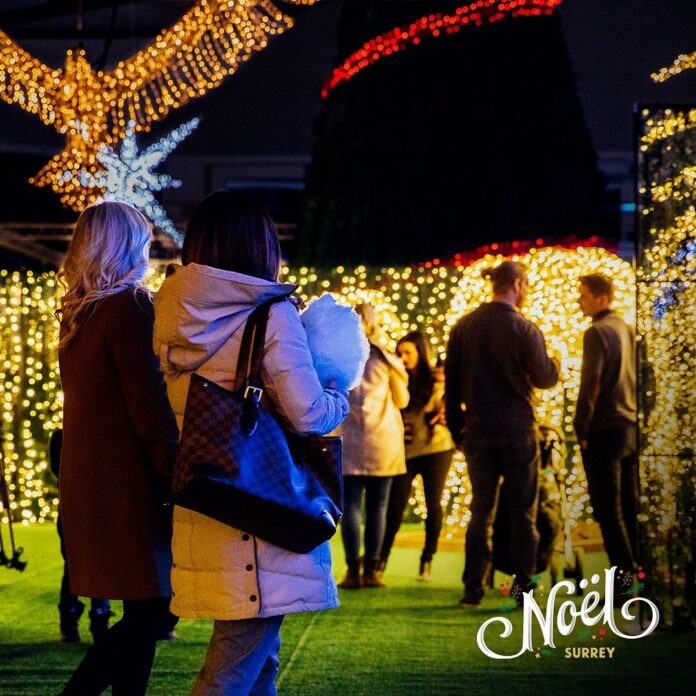
Two women with their backs to the camera wandering around an outdoor space filled with small, golden yellow lights.
PHOTO: Courtesy of @noelfestival / Instagram

The weather may be getting colder, but that doesn’t mean there isn’t plenty to do. Visiting a holiday market or festival is a great way to spend a cold day — you can shop for gifts, admire artwork and decorations, and spend time with friends. Whether you’re celebrating this season or just enjoying winter, consider checking out these markets in the Lower Mainland.

Noël Holiday Light Festival & Market
Cloverdale Fairgrounds, 17905 62 Ave. #17607, Surrey
November 28–December 23, 4:00 p.m.–10:30 p.m.
Tickets: $20 for adults, $15 for youth and seniors, free for children six and under

If you’d like to see some beautiful light displays, check out the Noël Holiday Light Festival and Market, held in Surrey. Not only is there a market, but also food trucks, live music, and exciting rides such as a ferris wheel and bumper cars. You can also participate in the holiday light walk, a 1 km walk to see all the dazzling displays around the festival. With over one million lights, this festival will surely be an amazing experience!

Winter Indigenous Artisans Market
Bill Reid Gallery of Northwest Coast Art, 639 Hornby St., Vancouver
December 7, 11:00 a.m.–4:00 p.m.
Tickets: Included with gallery admission ($13 for adults, $10 for seniors, $6 for youth, free for SFU students)

Come to the Winter Indigenous Artisans Market at the Bill Reid Gallery to find “unique jewelry, artwork, apparel, and more” created by Indigenous artists! Some of the over 18 vendors selling their handcrafted items here include Tanya Gregoire, Cory Hunlin, and Sacred Soul Apparel. You can also appreciate the many Indigenous art exhibits at the Bill Reid Gallery, as access to the market is included with gallery admission (which is free for current SFU students)! Come support Indigenous creators at this market!

Vancouver Black Therapy & Advocacy Foundation’s Winter Flea Market
79 W 3rd Ave., Vancouver
December 13, 5:30 p.m.–9:30 p.m.
Tickets: $15

Celebrate the season while getting some shopping done at the Vancouver Black Therapy & Advocacy Foundation’s (VBT&AF) winter flea market! Here, you can purchase gifts from more than 100 Black vendors and eat some delicious Afro-Caribbean food. It’s also a chance to support the VBT&AF, which provides “high quality mental health care” and free counselling to Black communities. All ticket sales fund this initiative, so you know your money is being used for good!

African Christmas Market
Moberly Arts & Cultural Centre, 7646 Prince Albert St., Vancouver
December 14, 12:00 p.m.–5:00 p.m.
Tickets: Free

At the African Friendship Society’s Christmas Market, you can find “organic fair trade shea butter and body care products, jewelry, baskets, fabric, clothing, and so much more” created by African artists. Not only are there shopping options at this market, but you’ll also get the opportunity to appreciate African cultures and art. In addition to free admission, attendees will also get free snacks. There are also free “cultural arts and crafts activities” for children under 12.

Buying the latest iPhone isn’t worth Congolese lives

0
Illustration of a hand holding an iPhone. A white skull replaces the Apple logo on the back of the phone.
ILLUSTRATION: Cliff Ebora / The Peak

Content warning: graphic descriptions of slavery, child labour, and amputation.

As millions of people rush to buy the newest iPhone every year, we fail to address that at the very core of its existence is exploitation of the Congolese people. 

With the advent of cellular phones came a new feature: rechargeable batteries. This was great for our carbon footprint, as it reduced a lot of waste. However, what these batteries contain is a mineral called cobalt, which is only found in a handful of countries. 70% of cobalt is extracted from mines in the Democratic Republic of Congo (DRC) and sold to a company in China to manufacture our phones. During the extraction process, Congolese people — including children — are forced to put their lives at risk in dangerous mines for a small amount of pay. This is something that isn’t new in our society; we can see the parallels with colonial occupation of land, and human lives for monetary return. 

In 1885, King Leopold of Belgium decided to occupy and seize Congo for a “development project.” This resulted in the so-called “Congo Free State,” where forced labour and displacement were used as tactics to get minerals like rubber or ivory. In the seizure of these materials, a lot of abuse and torture occurred. People would get limbs amputated as punishment, or end up suffering from disease. 

More than a century later, this abuse of power continues to play out in the DRC. These same power structures are still torturing and enslaving Congolese people, stripping them of basic rights. The systematic exploitation begins with forced evictions, where local communities are displaced from their ancestral lands to make way for mining operations. These evictions destroy entire ways of life that have sustained communities for generations. The environmental impact is just as devastating, as mining operations contaminate vital water sources and soil, making it difficult for displaced communities to maintain their agricultural practices or access food and water. Their connections to the land are completely destroyed for monetary gain that benefits wealthier countries, and this is what we support when we give money to Apple.

Mining corporations exploit class divisions by targeting vulnerable populations who lack economic alternatives. When faced with extreme poverty and limited options, many Congolese people are coerced into working in very hazardous mining conditions. This is not a choice; it’s a modern form of slavery hidden behind “economic opportunity.” More than 40,000 children are refused an entire childhood just for this. While Apple itself is not employing these workers, they knowingly fund this exploitation by continuing to source cobalt from the DRC. And although Apple is looking to India for future battery sourcing, India is also expanding their imports of cobalt from the DRC.

The smartphone industry’s murky cobalt sourcing practices show the darker side of technology, particularly in the DRC where most cobalt originates from. Tech companies claim to have sourcing efforts in Rwanda in attempts to sanitize their image, but evidence says otherwise — the vast majority of mined cobalt comes from the DRC. Cobalt is extremely toxic to humans, and the fumes from these mines have been found to cause reproductive health issues and birth defects. In a challenge to big tech’s claims, Congolese families have filed a massive lawsuit to show how their children are being exploited. Children have also been voicing their distress, saying they want a future free from mining. 

The good news is Apple promises to switch to recycled cobalt by 2025, but moving forward still requires a fundamental shift in how we approach resource extraction and technology production. Companies need to implement fair compensation and safe working conditions, and grant fair economic opportunities to the communities they source from. But what can we as individuals do? Apple isn’t the only smartphone company sourcing materials made through slavery and child labour. However, they are the most popular brand, and people buy new devices from them on a yearly basis. 

While it’s hard to make perfect decisions under capitalism, that doesn’t mean we can’t do anything. We can and should base our purchases on where companies source their materials for phones. Look into refurbished options if you need a new phone, or see if your phone can be repaired. Checking the repairability score of different models is another tip that can help guide your purchasing. At the end of the day, our society’s obsession with continually upgrading to the latest devices has conditioned us to believe overconsumption is a necessity. This not only leads to environmental harm, but contributes to injustices.