Home Blog Page 1037

MFA student collaborates with Mascall Dance for the remount of The Three Cornered Hat

0
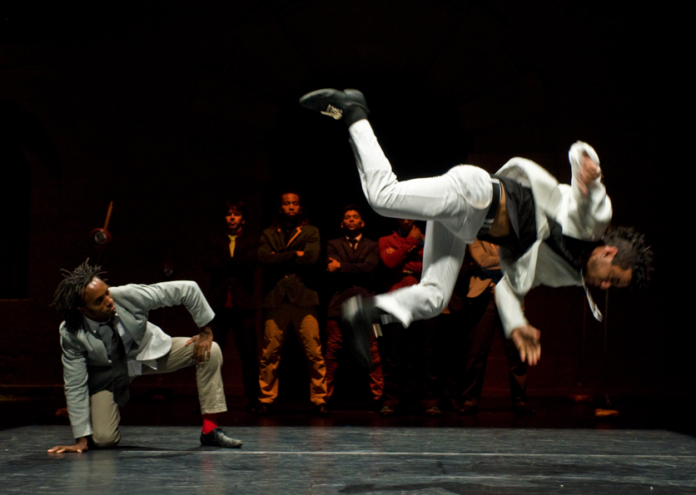
Photo courtesy of Mascall Dance.

Barbara Adler’s work doesn’t fall neatly into one genre. She’s working on her masters of fine arts in interdisciplinary studies at SFU, and regularly collaborates with other artists on a variety of projects. “The things we make are hard to pin,” she says.

Even within the interdisciplinary studies program, it is difficult to find a concrete definition of the field. “It’s a big question and we talk a lot about that, but never come to a consensus,” Adler notes.

Adler isn’t the only one involved in this show with a connection to SFU. Dancer Billy Marchenski graduated from the acting program, Mascall’s partner John Macfarlane teaches lighting design and technical direction, and composer Stefan Smulovitz is a staff member who also teaches music.

Focusing mostly on music and text-based mediums of poetry, prose, and spoken word, Adler was given the opportunity to explore the intersection of text and movement when she was invited to be a research participant with Mascall Dance. “There are intersections and commonalities, but there are also challenges with text. The audience tends to interpret the movement as a literal interpretation of the text,” she says.

During her creative process, Adler attended rehearsals at Mascall Dance and improvised with the dancers. Artistic director Jennifer Mascall wanted Adler to have sense of how dancers improvised, and there was a lot of back and forth among them during the collaboration.

Adler describes Mascall’s choreographic style as always pushing the dancers to the limit of what they’re comfortable with in terms of improvisation. “It’s one thing that makes it exciting to work with her — it’s exciting to be a little terrified all the time,” laughs Adler.

Adler is also interested in improvisation in her own artistic practice. She refers to her improvised moments of storytelling as a form of banter with the audience. “It’s all about conversation and less about bodies and space,” she explains.

Mascall Dance began working on this project almost two years ago, collaborating with many artists from a variety of disciplines. The Three Cornered Hat is a culmination of that work. The show was presented last year as part of the Dancing on the Edge festival, and this year it’s being remounted in its new evolved form.

Studying movement, space, and human interaction, The Three Cornered Hat studies the moments we might otherwise miss. “One of [Mascall’s] concerns is setting up movement that allows people to see spaces that they usually don’t notice,” says Mascal. For example, the space between people’s lips as they are about to kiss becomes very noticeable in that moment, but it is usually not given any thought. According to Alder, Mascall wants to find ways to make these unnoticed spaces legible and noticeable.

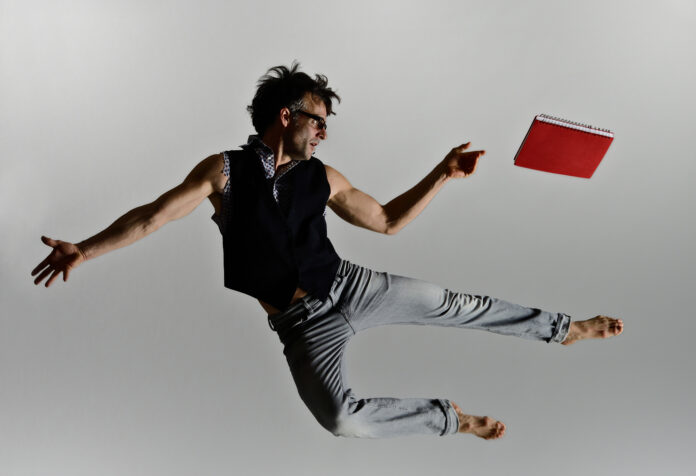
The show is humorous yet profound, and it presents intricate scenes of various abstracted human interactions. There is also plenty of audience engagement, and stacks of ubiquitous red notebooks are used as versatile props that become stools, stepping stones, and even a mop. This updated version of the show will be presented in a larger venue than last time around; it’s an intelligent work that deserves the larger audience.

The Three Cornered Hat will be presented by Mascall Dance April 9 to 11 at the Scotiabank Dance Centre. For more information, visit mascalldance.ca.

SFU football alumni impress at the CFL national combine

0
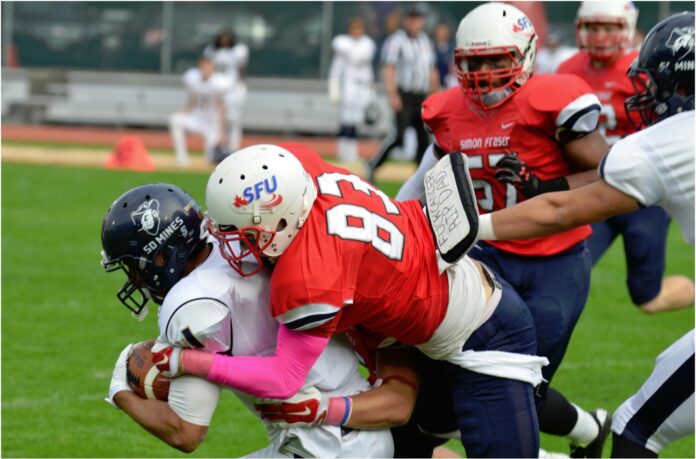
Defensive back Matt Isherwood made a total of 62 tackles and caught three interceptions last season. Image credit: Austin Cozicar /The Peak

The two-day CFL national combine came to an end on Sunday, March 29 with two prospects from SFU football vying for a spot on one of the nine CFL teams across Canada.

Wide receiver Lemar Durant (Coquitlam, BC) and defensive back Matt Isherwood (Abbotsford, BC) were invited to the national combine in Toronto, ON over the weekend, participating in various drills including the bench press, 40-yard dash, and vertical jump.

Leading all receivers, Durant made a name for himself as a top three receiver with 26 reps on the bench press, placing first among receivers and tying for sixth overall.

His rep score was three better than wide receiver and combine leader Sammie Coates’.

He also finished fourth overall in the 40-yard dash with a time of 4.55 seconds, once again leading all other receivers. Adding to his impressive showing at the combine, Durant earned a fourth-place overall finish in the vertical jump with a leap of 36 inches.

Durant’s draft stock has steadily risen and has culminated this weekend with his strong overall performance, and all nine teams took notice.

“The work that I put in the offseason, training for all aspects of my game, strength, speed, agility, and endurance are attributed to my work ethic,” said Durant. “I feel that I have a lot of knowledge of the game and can find ways to get open.”

In the eight games Durant played this season, he registered 55 catches, amounting to 685 receiving yards and four touchdowns. His combination of size, speed, and strength make Durant an appealing prospect. 

Matt Isherwood had his work cut out for him, competing against a particularly strong field of defensive backs that included Chris Ackie and Tevaughn Campbell. But for Isherwood, it was a chance to prove himself.

“It was a good experience and it helped to prove to myself that I can play with the top players in the country,” he commented.

Isherwood made a total of 62 tackles and catching three interceptions during the 2014 season.

Coming off a minor back injury, Isherwood displayed his skill and determination in the one-on-one drills, catching the attention of the BC Lions, Hamilton Tiger Cats, Saskatchewan Roughriders, Ottawa Redblacks, and the Toronto Argonauts, all of whom he earned interviews with.

So what’s next for these athletes? For both Durant and Isherwood, it’s only a matter of time until the May 12 CFL draft date arrives.

“I’m going to try [to] do a pro-day at SFU in the next couple weeks, and then it’s just training and waiting for the draft,” said Isherwood.

The SFU pro-day — where scouts from various professional teams come to SFU to look at Clan football prospects — is slated to take place early in April, and is the next opportunity for Durant and Isherwood to convince scouts to draft them.

BC music festivals for every type of music lover

0
Photo courtesy of 33mag.com.
Photo courtesy of whistler.com.

Raise your heart rate and take a deep breath of fresh air: It’s almost time to stock up on enough summer fun to get you through next winter. Every summer, BC attracts some of the biggest performers worldwide to its music festivals. Here is a rundown on some of the best festivals at whatever distance you want to travel.

For the homebody

The Vancouver Folk Music Festival (Jericho Beach Park, UBC)

If you are looking for that unplugged vibe, the Vancouver Folk Music Festival is set to feature the best folk artists from around the Lower Mainland. The chill atmosphere at the event is also ideal for those who don’t enjoy being jostled around by the crowd.

Vancouver International Jazz Festival (Vancouver)

The Vancouver International Jazz Festival will be held at several locations across Vancouver. This year’s festival is set to kick off with six-time Grammy winner Buddy Guy, and will feature artists for all jazz tastes at whatever venue you prefer.

FVDED in the Park (Holland Park, Surrey)

The unpronounceable but popular FVDED in the Park returns to Surrey this summer. This year’s lineup includes Deadmau5 and The Weeknd. If rap, hip-hop, or R&B is your thing, this festival is packed with some of the best around — it is sure to be a wild night for all of those party animals out there.

For the day-tripper

Squamish Music Festival

By far the biggest festival to hit BC this summer will be the Squamish Music Festival. The stellar line-up this year includes headliners Mumford & Sons and Drake, alongside indie sensation Of Monsters and Men.

This festival is ideal for top 40 music lovers, as they will get to hear some of the most popular hits from the past year. As always, indie fans will be overwhelmed trying to choose which bands to go see. 

Pemberton Music Festival

The Pemberton Music Festival has just released their outstanding lineup, which includes The Black Keys, Hozier, and Missy Elliot alongside an astronomical array of genres including indie rock, rap, electronic, and alternative.

Any music fan will be scrambling to choose which artists to go see.

For the adventurous soul

Center of Gravity (Kelowna)

The Center of Gravity beach festival in Kelowna is a big draw for fans in the interior. This July, the heart of Kelowna will be lit up by the festival’s many sports and music events.

Past lineups have included music sensations like Tegan and Sarah and Chromeo, so if you like (Canadian) indie pop, keep an eye out for this year’s line-up.

Sunfest (Duncan) and Rockin’ River Musicfest (Meritt)

Sunfest and Rockin’ River are two huge country music festivals that take place on the August long weekend on opposite sides of the province. Both of these festivals draw huge stars: this year Sunfest features Keith Urban, and Rockin’ River has confirmed Lady Antebellum. For any major country fans, deciding which of these festivals to attend is going to be a trial.

No matter your travel spirit, there is a summer music festival somewhere in BC just for you. When you go, make sure to snap a few photos to remind yourself just how great the summer of 2015 was for next winter.

DanceHouse presents “energetic” Kafig Brasil

0
Photo courtesy of Michel Cavalca.

Jim Smith, co-founder and producer of the DanceHouse contemporary dance series, describes Kafig Brasil as an antidote to the other shows that the series has presented this season. “The four shows this season have all had a dark and broody tone to them,” he said. “It’s a bit of a reflection of the world around us. There’s a bit more anxiety about safety and security.”

At last comes this show about movement for the sheer joy of it. “It’s highly athletic and energetic. They dance with audacity,” said Smith. “It’s gritty and natural – the joy of movement for the sake of movement.”

Combining elements of urban, street, hip-hop, and capoeira movement forms, Compagnie Kafig is made up of dancers from the favelas (slums) of Rio de Janiero. “They haven’t been trained as dancers all their lives; there is a rawness, [a] real talent,” said Smith. This background adds an element of authenticity to the show.

While there are some virtuosic acts and tricks in the show, it is not so much a circus format as it is a contemporary dance show involving specialized talents. The dancers use props, but these are used more to set the context than as gimmicks or as part of the choreography.

“You can sense that martial arts is a physical system that underlies the movement,” explained Smith. According to him, the different styles involved are ingredients that blend “like perfumes that swirl in the night. There are different essences that come together. There are no hard edges — the genres mix in a very natural way.”

The show features four different French choreographers in Anthony Egea, Céline Lefèvre, Octávio Nassur, and Denis Plassard, but it all comes together as one cohesive work. “You don’t see where one choreographer ends and another starts,” said Smith. “The range of choreographers makes for an interesting melange.”

Similarly, the soundtrack draws from a variety of sources. “There are a wide mix of influences; the sound design is very cleverly done,” explained Smith. “It’s nuanced and evolves around you.”

The genres of hip-hop and urban dance have undergone a recent evolution as they move from the street to the stage. These techniques have become more performative, evolving to include elements of contemporary dance and larger themes or messages conveyed through movement. “We’re seeing the evolution of hip-hop and street dance; these are now welcome forms of performance,” said Smith.

With such a diverse set of influences and talented group of dancers, Kafig Brasil is sure to be a stunning show.

Kafig Brasil will be presented April 10 to 11 at The Vancouver Playhouse. Speaking of Dance, a free public lecture, will take place April 7 at SFU Woodward’s. For more information, visit dancehouse.ca

Meet the SFU Clan Fan: Cedric Chen

0

CMYK_Cedric 5_Brandon Hillier_3

If you go to a Clan game, you would be hard pressed to miss SFU’s self-proclaimed superfan Cedric Chen. Easily spottable sporting a red SFU t-shirt signed by various Clan athletes, Cedric attends nearly every game for all of SFU’s teams, where he can be heard loudly cheering the Clan on.

The thing you will probably remember about him though, are his creative — if slightly outdated — taunts. Frequently heard are renditions of Justin Bieber’s Baby (just the “Baby, baby, baby, oh” part), disses involving either Miley Cyrus or Bieber again, and perhaps most notably, invoking the name of former New York Jets quarterback Mark Sanchez — making light of Sanchez’s butt fumble against the New England Patriots back in 2012.

“Basically [Sanchez] just ran into the butt of one of his offensive linemen, and he fumbled the ball, and the defensive player from the New England Patriots picked up the ball, and ran it to the endzone for a touchdown,” Cedric says, explaining matter-of-factly how Sanchez became part of his bag of tricks.

“Since the NCAA has pretty strict rules against profanity and SFU has been carrying them out pretty good, I have to turn on my brain matter to find words and phrases that are essentially pointless — they won’t be considered profanity, but hopefully they will distract the enemy players.”

Does Cedric ever get in trouble for the things he yells?

“More times than I can count,” he responds. “[One time] when I was talking about having a crush on their sisters — now it’s prohibited, so I can only talk about Kim Kardashian.”

For Cedric, the duty of being SFU’s superfan is not one he takes lightly. He measures his nights based on how well he is able to throw off the other team.

“Our teams are improving, but so are the enemy teams, so if you stick to your old tricks, sooner or later they will come up with countermeasures. So most of the time you have to improvise, but you also have to think ahead regarding what kind of tactics are the most effective in distracting the enemy teams,” he notes.

“If I was able to make the enemy team miss a lot of free throws, then I think I did a pretty good job. In contrast, if I wasn’t able to distract the enemy enough so they miss a lot of shots then I go like, [long sigh],” he says. “It makes me frustrated.”

Born and raised in Foshan, China, Cedric came to Canada in 2007 to study at Columbia College, and came to SFU in 2009 to begin his bachelor’s degree in linguistics. SFU also gave Cedric a chance to embrace his love of sports, by playing intramural sports such as dodgeball, soccer, and basketball, and of course, providing easily accessible games to watch.

“I grew up with this passion for sports, and I largely inherited that from my dad who has been a lifetime basketball and soccer fan. Whenever we’re watching sports games, he yells as loudly as I do,” he says. “When I was an undergrad I lived on campus, and for those that live on campus, the most easily accessible sport events are the Clan games.”

His initial interest with the Clan games wasn’t just out of sport. “Actually, I first went to the Clan games as a sport photographer for The Peak,” he notes, explaining that when he first came to SFU, his goal was to be a photographer for The Peak, having checked out the student newspaper before transferring here. He even earned an award in his first semester as a contributor. However, that was before Cedric’s inner sports fan became too big to ignore.

“That went on for about a season. And then for some reason, the athletic department told the then-photo editor [that] I was being too loud as a photographer, so he stopped giving me photo assignments,” he says. “I was like, ‘oh well.’ If a photographer can’t be loud, a fan can.”

“That’s how I started yelling and cheering, and I would say discovered my potential.”

His new vocation did have some challenges — particularly when he was the only Clan fan at the games.

“For the first two years — which were 2010 and 2011 — things were pretty dismal and SFU fans [were] easily outnumbered even on our home turf,” he notes.

“In my first year of being a superfan, during the volleyball season, when the Western Washington fans came to the West Gym en masse, that was the first time I felt so badly humiliated. I was almost the only SFU fan other than the parents and the relatives of the players in the West Gym,” Cedric explains. “Western Washington brought one battalion of fans, and West Gym practically became their home turf — [I was] so humiliated.”

Before long, Cedric became a part of the event himself.

“To be honest, at the beginning I didn’t pay that much attention to the fans around me,” he says. “That was until [. . .] one time I was at the Mountain Shadow, getting a drink, and the volleyball team recognized me.

“That’s how I started to realize I had a thing.”

Despite the confidence he exerts on the sidelines, belting whatever chant he can come up with as loud as he can with with no apparent care of what the audience around him thinks, Cedric describes himself as an introvert.

“In China, in a social situation, you are supposed to [be] outgoing, and be this, and be that, and be like, ‘Hello, hello.’ But I’m an introvert, and whenever I’m dining with my parents and their friends, I just want to sit quiet instead of joining their conversation, but sometimes that’s just not acceptable.”

“My parents sometimes blame me for being too westernized [. . .] in norms and values,” he laments. “Here in Canada, most of the time I get to decide when I get to hang out [and] with whom — I like to keep it in small groups of people of two or three, including me. Four maximum.”

For Cedric, the cheering provides a relief from the stresses and frustrations of school.

“As you know, as an undergrad student, you’ve got tons of materials to go over, several papers to write, and you have to study for exams. Over the time, you get quite stressed and since I’m not as social [. . .] yelling would be my primary outlet of stress.”

Part of that frustration was the feeling of having his creativity stifled by rigid academic writing policies — as opposed to the sidelines, where he could have some fun.

“The biggest challenge for me was writing papers in the proper styles. I mean, I can cover the points, but sometimes I just can’t help using a little bit of flair here and there in my papers, and my TAs really didn’t like it,” he says. “I didn’t like writing white-bread papers, you know what I mean? [Imitates sound of writing boring papers], straight, narrow, and tasteless.”

Despite still appearing at nearly every Clan game, Cedric received his bachelor’s degree in 2013. Now he does freelance work in translation and interpretation.

“I don’t like the looking-for-clients part, but when I get to sit down, open up the dictionaries, and start doing some actual translation work, that’s what I enjoy.” he notes. “It’s mostly helping somebody out, building up my profile, hopefully drawing some attention from some larger clients.”

Despite his earlier disdain for “white bread papers,” he admits that the Clan games still provide an escape from an increasingly complicated life after graduation.

“After I graduated, the real world has proven to be more stressful than undergrad [life] by at least two times,” he observes.

“It’s been challenging [to go to games not as an SFU student], three times as challenging as when I was living on campus. When I was living on campus, it was like a 10–20 minute walk from my room to the sight of competition. Now it’s an hour and a half.”

However, his heart is still with the Clan, and plans to be on the sidelines for a while longer — at least until he scores “a strictly nine-to-five job.” For now though, the superfan lives on, and you can be sure to catch him at the next Clan game.

Sports Briefs

0
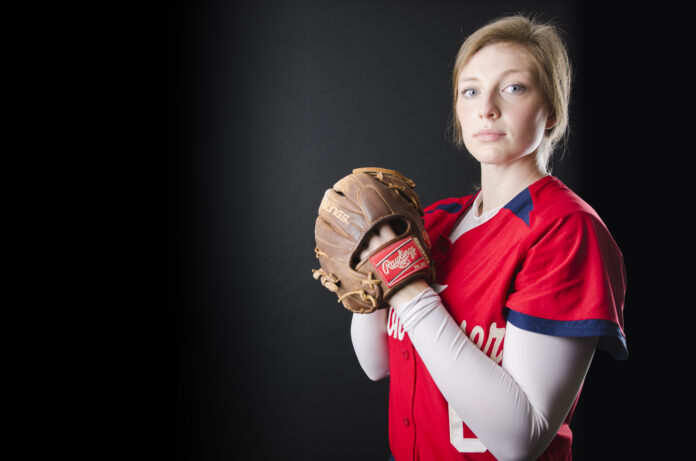
Shortstop Danielle Raison has proven to be a key part of the Clan’s success — she is currently second on the team in runs scored with 10. Image Credit: Brandon Hillier /The Peak

Softball

Before returning to Beedie Field to face the Northwest Nazarene Crusaders, SFU’s softball team participated in the Mizuno Tournament of Champions in Turlock, CA from March 27-29. The Clan went 2–4 and were outscored 37–14. During the tournament, the softball team played its 1,000th game.

Lacrosse

On a road trip down to Oregon, SFU lacrosse won 10–7 against the Oregon Ducks in Eugene, OR on Friday, March 27 before dropping a 19–5 result against Cal Poly. Against Oregon, midfielder Sam Clare led the team with four goals, but went goalless and only managed one point against Cal Poly.

Men’s Golf

Last week, the men’s golf team were named the Great Northwest Athletic Conference team of the week for their first place finish at the Cal Baptist Invitational on March 24. The men’s golf team have one more tournament — the Western New Mexico Invitational held in Goodyear, AZ this week — before participating in the GNAC Championship.

Wrestling

Sophomore Clan wrestler Mallory Velte placed third at the 63 kg weight class at the 2015 ASICS Women’s University Nationals held in Oklahoma City, OK on Saturday, March 28. Freshman Francesca Giorgio placed sixth in the 60 kg class.

Hockey

SFU Hockey announced last Wednesday that they have signed defenceman Darnel St. Pierre in the Kootenay International Junior Hockey League (KIJHL). The Kelowna native had 13 goals and 44 points in 48 games last season. “Darnel is a much-needed addition to the back end of our hockey team,” head coach Mark Coletta said in a press release. St. Pierre is the second announced recruit, joining fellow KIJHL defenceman Robson Cramer.

With files from SFU Athletics and SFU Hockey

A Peak Back in Time: The 1989 Christygate Scandal

0

With newly-elected SFSS president Enoch Weng preparing for his first term, he undoubtedly is feeling a combination of excitement and nerves. Whatever happens though, it will take a lot to have a more turbulent start than Christy Clark had.

It was 26 years ago this week that our current premier won the title of SFSS President. Her contentious stint as president would last less than two months before she was removed from office.

The shock of her win and her subsequent fall was recorded by The Peak’s team, including Andrew Tomec, writer of the April 6, 1989 front page headline “Grassroots gains, Unity upset” — the latter slate was Clark’s. It was an ironic headline in a polarized but largely apathetic environment for SFU student politics.

Christy Clark squeaked her way into the presidency by a margin of just six votes in what Tomec still believes to be “the most perplexing Student Society election results in recent history.” She was the only Unity candidate to win an executive spot, and was quoted following the elections as saying her slate “had great candidates, but a lousy campaign.”

Breaking down the election results, Peak contributor Bryan Bedford said “Clark did not win the election, Mendes lost it.” Paul Mendes, the Grassroots candidate and incumbent president, “had a whole slate of candidates that ran the place [SFSS] as a kind of a cabal,” according to Tomec. But that was just the nature of SFSS politics at the time. Still recovering from its fanatical roots in the 1970s, by 1989 SFU hosted a healthy population of unapologetically left-wing student politicians.

“SFU was the hotbed of revolutionary thought” explained Tomec. “[Even] The Peak was being run as a kind of socialist collective.”

Right-winger Christy Clark was all too aware of what she was up against. “The left-wingers on campus have a solid constituency of nine or 10 percent of the student population,” Clark was quoted as saying before the election. “When we [moderates and right-wingers] do well, that’s when you see an added six or seven per cent tacked on to the popular vote.”

According to Tomec, the SFSS was led by the civically-engaged, leftist Grassroots slate with a largely apathetic majority of students “barely aware that there was a student government at all.” Grassroots, with their years of steady hold on student government, had been using student money to “support left-wing causes — unions, labour groups, political causes in Central America,” remembered Tomec.

“Students like Christy Clark were really, deeply offended by the way that money was being spent by forum, [Clark] was saying ‘spend it on student issues or don’t spend it at all.’”

And so Clark fought her way into the Grassroots-dominated agenda. Before she ran for SFSS president, she had already served a term as Internal Relations Officer. “She was a bit of a pitbull, she was very articulate, very forthright and did not mince words about her displeasure with the way student politics was being run,” remembers Tomec. “People were mobilized by her personality; she was a very effective student politician.” 

Nevertheless, the politics of apathy won out and Grassroots still dominated the SFSS executive board after the 1989 election. Despite her disappointment, Clark tried to be positive about the outcome, stating following the election that “there are a lot of new people [on forum], and I don’t see a lot of confrontation ahead . . . our goals are the same.”

That optimism turned out to be very naive. “It didn’t take long for a group of recently elected forum members to begin scheming to discredit Christy Clark’s election victory,” wrote fellow Unity member Gerald Christendom in a Letter to the Editor in May of that year.

During their campaign, the Unity Slate had broken some election rules and Clark was slapped with a $60 fine. On April 10, Clark received notice of the fines by mail. SFSS election rules stipulated that all fines must be paid within 30 days of the notification date. However, there was a discrepancy in the Electoral Standing Committee’s requirements. Clark was notified that her fines were due on April 30, in 20 days rather than 30.

Clark paid on May 8 — 29 days after she had received notification of her pending fees. Following her late payment, the Grassroots-dominated forum moved to give the Electoral Standing Committee the power to enforce the rules that govern SFSS elections. Clark’s stature as SFSS President was declared void.

“I’m a student, I’m not made of money,” complained Clark in The Peak in the first week of May. “I paid late last year.”

The decision to cancel Clark’s candidacy was coined the “Christygate” scandal by The Peak — Clark called it “a partisan move” and “a power grab on the part of Grassroots.”

Clark wasn’t going to go away quietly. “I will pursue legal action immediately if forum defeats me,” she declared. “I have a responsibility to those who voted for me. I owe it to them to fight and to win.”

The decision held, and in subsequent Peak interviews, Clark maintained that she had full intention of going to court, paying the legal fees out of pocket. “I’m going into debt. I thought of selling my car, but it’s worth about $50. If it’s got a full tank of gas and a couple of textbooks in the back seat then it is worth about $100. So I’m borrowing money from private sources like friends and family who believe in what I’m doing.”

But her court case was not heard in time for her to regain her presidency. “I couldn’t have the case heard this summer because of court scheduling, and now we’re facing a by-election,” she explained in her by-election campaign run.

In the November by-election that year, Clark lost her bid for Presidency by 112 votes to Grassroots. Her loss signaled the end of her career in student politics at SFU. She left SFU soon after, before completing her degree, and went on to be elected as a BC MLA six years later.

Though Clark’s run for SFSS president was a disaster from start to abrupt finish, it did not dissuade her from a long and rocky career in BC politics — most recently as our honourable, and often scorned, premier.

Illegal drug users should remain behind bars

0
Photo Credit: Daniele Devoti

Picture yourself walking to a local pharmacy to purchase MDMA, cocaine, heroin, LSD, marijuana, amphetamines, or any of the other common illegal substances stated under the Controlled Drug and Substances Act. If these substances were made available under pharmaceutical supervision, would this really improve public health?

Bruce Haden, an award-winning Vancouver-based architect, argued at a TED conference March 18 that we should decriminalize hard drugs in favour of a different system of regulation.

Haden claims that “a strategy guided by public health practices that makes substances carefully available, but does not promote the use, is one that’s proven to reduce use, abuse, addiction and the terrible social consequences of prohibition.” Haden’s argument rests on the assumption that individuals will obtain and use drugs regardless of the law.

While I agree that people will continue to use drugs regardless, I disagree that we should make these substances readily available. I believe that if drugs like ecstasy, cocaine, or other ‘hard’ substances are made available, risks to public health will dramatically increase.

Now, I understand that a moderate dose of cocaine, heroin, ecstasy, amphetamine, or any other popular illegal drugs, if taken in a safe environment, is far from life-threatening. Some of these so-called ‘hard’ drugs are even prescribed by physicians to patients who have medical illnesses. For example, MDMA is sometimes prescribed to treat post-traumatic stress disorder, and procaine, a derivative of cocaine, is commonly used in dentistry.

Under controlled conditions, these drugs aren’t the evil, addictive, deadly substances they’re made out to be. However, if used improperly, these drugs pose serious risks.

To legalize these drugs may increase risks for those who wouldn’t have used them if they were illegal.

It’s logical to assume that hard drugs would have more potential to be abused, overdosed on, or cause fatality if legalized. While a majority of users probably wouldn’t experience these consequences, making these drugs more widely accessible may increase risks for certain individuals who would never have used them while they were illegal.

In addition, if hard drugs were made publicly available, there could be a rise in poly-drug use. While moderate alcohol intake isn’t life-threatening, if one uses cocaine alongside alcohol, it forms a new drug in the liver called cocaethylene. Cocaethylene results in higher euphoria and higher cardiovascular toxicity than cocaine alone. Users may unintentionally put themselves at risk if unaware of the harmful consequences of certain drug interactions.

Using these substances can also greatly impair one’s ability to function properly while carrying out everyday tasks. For example, driving under the influence of any of these drugs could result in fatality. While I’m almost certain Bruce Haden would argue that it should remain illegal to ‘drug and drive,’ if hard drugs were made legal otherwise, this illegality would do little to deter users from driving or operating complex machinery under the influence.

There is certainly a lot to consider in discussions on decriminalizing hard substances, and I’m fully aware of the problems that result from throwing drug users behind bars. However, I disagree with Haden’s idealized policy to make drugs publicly available, as I feel the risks most certainly outweigh the benefits.

Letters to the Editor

0

Dear The Peak,

[Your article endorsing SFSS candidates] was published under Opinions and I would never argue that anyone should not have the right to voice their opinion or have it published. That said, The Peak is the only student newspaper and the sad truth is that there are likely more students who read the opinion section of The Peak than who read candidate platforms or watch the election debates.  The opinions of Peak writers and editors have the power to sway the vote, and this is a power that should be taken more seriously.

I implore The Peak to remove this article from their website immediately. In its place I would like to see an article outlining why it was wrong for The Peak to endorse certain candidates and not others, and how it intends to ensure its articles (even opinions) are neutral and unbiased for the remainder of the election period.

In addition, I would like The Peak to release an apology to all the candidates for their behavior. If The Peak would like to run an article regarding endorsements, I would like to see them find someone to endorse each of the candidates and make sure they are all fairly represented. Alternatively, I would recommend polling the student body and making election predictions based on this poll. Again, opinion or not, The Peak has a responsibility to emphasize fair exposure to all candidates.

Thank you for your time,

Tennille Lewis

____________________________________________________

To The Peak,

I am writing to express my support for and approval of the opinions piece published in last week’s issue endorsing candidates in the SFSS elections. I write this as an individual SFU student, not as a representative of any organization, nor on behalf of anyone else. The opinion expressed here is my own and mine only.

I believe the media, especially student media outlets, have an important role to play in student union elections. With low levels of student participation in SFSS elections, much of which is attributable to a lack of awareness, any attention to candidates and issues is positive.

Endorsements play a particularly important role, in my opinion. Firstly, they distill the large amounts of information available into an easily digestible format for students who are not highly involved in student politics.

Second, by paying attention to all the various election materials and events, they provide an incentive for candidates to attend debates and produce better researched platforms in the hopes of getting an endorsement. Endorsements elevate elections from a popularity contest to a more experience-based competition.

Thirdly and most importantly, it allows student journalists to act as opinion leaders. Having people who are informed about issues speaking publicly about their views is an integral component of democracy. This is especially true during election times.

I should note that I do not necessarily agree with all the endorsements you made, but I am very supportive of your decision to make them. I hope you will continue this practice moving forward.

Sincerely,

Chardaye Bueckert

SFU’s Legacy Song Contest is a sham

0
Photo Credit: Brandon Hillier

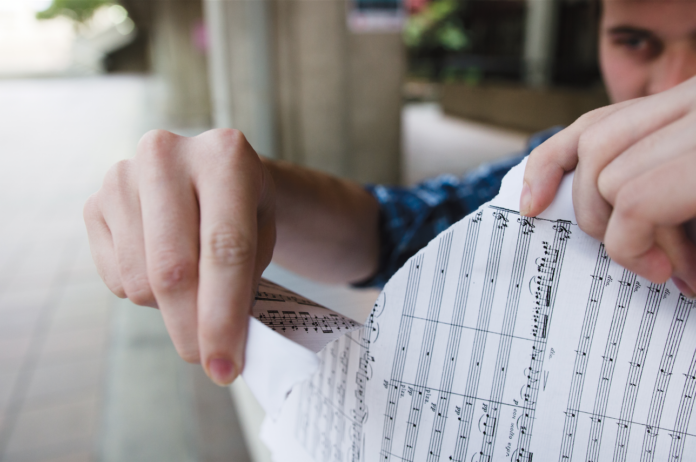
By the year 2065, SFU will be closing for good. At least, that’s the only explanation I can come up with to justify SFU’s 50th anniversary Legacy Song Contest: it must just be a mid-life crisis.

While it may seem like an innocuous move on the part of the administration’s Ceremonies and Events Office, instigating the creation of a school anthem is a poor if not insulting way to celebrate this institution’s half-century milestone.

President Andrew Petter clearly understood and exemplified the spirit of our school in his online letter launching the 50th Anniversary Campaign on September 5, 2013. He stated that “SFU has grown up without growing old; we still have the same spirit of adventure, hunger for new ideas, and willingness to do things differently that characterized SFU from the beginning.”

Unfortunately, this contest is a clear betrayal of that idea.

A school song is not in tune with the bold and unconventional nature for which SFU is known. In Canada, universities with official ‘school songs’ seem limited to very old and proper institutions, such as McGill, Bishop’s University, and Trinity College — all of whom were established prior to the 20th century. While ‘fight songs’ (chants tied to athletic programs) are more common, SFU’s history of anti-war pacifism renders this style inappropriate to adopt.

Quite simply, an anthem is not a tradition that matches the spirit of a school that opened so recently, and was made famous through its activism and radical figures.

As the “instant university,” SFU’s original chancellor Gordon Shrum also insisted the school have “instant tradition.” Though artificial and sudden, elements like our school’s crest and its Scottish themes were instantly made traditional, and have remained so since. However, a school song just wasn’t one of these instant elements.

SFU’s history of anti-war pacifism renders an anthem inappropriate to adopt.

In 1967, at SFU’s first convocation ceremony, an instrumental piece entitled the “Simon Fraser March” premiered. The suite was a gift from New York composer Paul Reif, and was performed by the Kitsilano boys’ band. While this could have become SFU’s song, clearly an anthem just wasn’t a tradition that people cared about enough to continue with. To try and resurrect the idea now doesn’t reflect our history; it ignores it.

This isn’t to say that SFU should not attempt to create new traditions. New traditions are great, but it doesn’t make sense for SFU to make new old traditions. In fact, the new song’s goals listed in a press release — including something to chant during sporting events and at convocation — have already been achieved through traditions that have evolved naturally.

As someone who has attended many Clan sporting events, I know that the audience has never been at a loss for what to chant at the end of the game. Cedric Chen’s off-key rendition of Justin Bieber’s “Baby,” meant to get in the heads of opposing players, will always inspire more pride in me than anything this contest could possibly generate.

And when it comes to something to play at convocation, SFU’s internationally renowned pipe band will surely make this new song look silly. The SFU Pipe Band is an enduring part of a real tradition and pride at our school.

I’m for chanters, not chants. I’ve always been proud that SFU has a different culture than that of a standard university, and a school song will do nothing but move us closer to being like everyone else.

So when it comes to the Legacy Song Contest, I’m singing an out of tune “baby, baby, baby, no.”