Home Blog Page 1021

SFU’s bullies to begin accepting Bitcoins

0
Photo by Phoebe Lim

With the SFU’s bookstores now accepting Bitcoins in exchange for textbooks and other callously over-priced course materials, several campus bullies who regularly beat students up for their lunch money are reporting that they will also be accepting Bitcoins effective immediately.

“We were skeptical when Bitcoins first came onto the scene,” said Travis “Knuckles” Barkley, a second-year Communications student and self-proclaimed wedgie king, “but over the years we’ve watched Bitcoins develop into something we’d be foolish not to embrace.

“I saw the slogan ‘new money for a new world’ on one of the new automated vending machines in the bookstore. It’s a saying I like to think we embrace as the social regulators of SFU.”

With Bitcoin vending machines unveiled at each of SFU’s three campuses late last month, it’s never been easier for students to acquire or transfer Bitcoins — a move that could also bring change to the bullying landscape at SFU and beyond.

“It’s really the natural progression for bullies to take,” Sarah Lebowski, a financial planner for Vancity credit union told The Peak. “The target demographics for most bullies are nerds and dorks, two groups who are among the most enthusiastic about a digital currency becoming more popular. If bullies want to take full advantage of this trend before it takes off, now’s the time to be tripping people they think might be smarter than them and tormenting them in ways that’s both scarring and financially beneficial.”

First made available in 2009, Bitcoins are a form of digital currency that allows for immediate transactions between individuals without the involvement of a third-party. Other benefits to Bitcoins also include lower fees than most banking institutions and a greater transparency to users through an online database that includes information on all Bitcoins.

But some critics are saying it’s too early to tell which way Bitcoins are heading, and that the safest thing for bullies to do is keep shaking down dweebs for cold-hard cash instead of Bitcoin redeemable codes.

“People love jumping on bandwagons they think are great but know very little about,” says Steve McBride, one of the few bullies at SFU who only accepts physical money or cigarettes as payment, “that’s all Bitcoins are. Some millennial jerkoffs trying to convince you Bitcoins are worth something while they take your real money.

“If any nitwit tries to give me Bitcoins instead of his actual money, I’m just going to beat them up even more!”

When asked to comment if he or his similar-minded cronies were worried about the long-term sustainability of Bitcoins, Barkley said that it wasn’t a concern and that The Peak should really stop hitting itself.


Twelve other types of currency the SFU bookstore should start accepting

0
AVMs have been placed in bookstores on SFU’s Burnaby, Vancouver, and Surrey campuses. - Phoebe Lim

With our university’s bookstores now accepting Bitcoins, it seems SFU is on track to a future less dependent on traditional institutions like regular money. While itís at it, here are 12 other types of currency we would like to see SFU accept in the future.

1. Magic beans (just no family cows)

2. Galleons (should goblin workers be next?)

3. Galactic credit standard (Jedi mind trick)

4. Gil (is this real life, or Final Fantasy?)

5. Rupees (better get smashing pots)

6. Schrute bucks (#Dwightatorship)

7. Pogs (remember those?!)

8. Canadian Tire money (finally useful)

9. Pennies (they’re making a comeback)

10. Monopoly money (duh)

11. Beanie Babies (until we flood the market again)

12. I.O.U.s (you know we’re good for it)

Why Saudi Arabia is the right choice to head UN Human Rights Council

2
Photo courtesy of Wikipedia

Last month Saudi Arabia announced their bid to behead head the United Nations Human Rights Council, following the end of its current leader Germany’s term. Though some choose to label the move as outrageous due to the alleged “non-humanist conduct” practiced by the nation, there are always two sides to the stoning rock.

The council’s head regularly rotates through continents, the next being Asia. Saudi Arabia’s rivals for the running include Bangladesh, China, the United Arab Emirates, India, Indonesia, Japan, Kazakhstan, the Maldives, Pakistan, South Korea, Qatar, and Vietnam. (Unfortunately, fan-favourite North Korea was too busy maintaining their totally existent submarine missiles to participate.)

Though some may be skeptical of Saudi Arabia’s running, going so far as to describe it as “the final nail in the coffin for the credibility” of the HRC, I think this is a step in the right direction for the infamously complacent UN. For these naysayers, I have one piece of critical advice: don’t be so closed-minded.

Media outlets have pointed out the “irony” of Saudi Arabia announcing their bid just a few days after releasing job postings for eight new executioners. Though the media social justice warriors are quick to criticize, they really aren’t taking the time to understand the macro benefits of this announcement. Each executioner is a Saudi citizen who, as is permissible under the nation’s law, most likely has between one and four wives. By supplying an income to those wives’ husbands, it’s plausible that some of the money earned from the jobs will go towards supporting them. Are you against supporting Saudi women?

Saudi Arabia is simply more advanced than their fellow UN members at understanding the benefits of gender roles. Since women cannot handle the money, they don’t have to worry about their emotions and period blood getting in the way of managing expenditures. That’s how the fiscal safety-net of patriarchy works. It’s basic economics.

Looking back to my 10-year-old prime, I lament not fulfilling the universal female ambition of becoming a child-bride, instead having to settle for receiving an education, now stuck unmarried with my withering 21-year-old body. Thankfully, many Arab nations, including Saudi Arabia, actually understand women’s need to be looked after. The country has seen past the delusional wish-wash of democracy, instead giving power to a far more concise and straightforward method of governing: hereditary autocracy.

By avoiding citizen input in their legislation, Saudi Arabia has much less trivial bureaucratic trumpery to go through when implementing the nation’s law. While many h8ers call such traditions outdated and immoral, they fail to see the innate equality that is systemic within it. Saudi culture punishes women, children, sodomists, hedonists, sorcerers, and guys-that-just-look-at-you-funny alike. It does not discriminate against who it discriminates against. The UN’s mantra literally revolves around equality, therefore it is only fitting that the most equal nation lead the organization responsible for ensuring equality.

So for the appraisal of who should head the HMC, I’m putting my support behind Saudi Arabia. Their logical judgement and refutation of Western morals renders them clearly superior for making decisions on how to uphold worldwide justice. Personally, I’m thankful that Germany’s finally getting the boot — because, y’know, Nazis.

SFU mourns VP finance and administration

0
Pat Hibbitts, convocating in June, 2009. - SFU President's Office

SFU’s VP finance and administration, Pat Hibbitts, passed away suddenly last Tuesday after serving as a senior executive member for over a decade.

Hibbitts began her academic career in Ontario, earning her BA at the University of Toronto and her MBA from York University. In 2009, she received her EdD from SFU’s faculty of education.

She was joined in her SFU convocation by her daughter Kelly — graduating with a BA in history — who played a key role in her doctoral thesis. Hibbitts’ thesis documented her personal experience with the K–12 system as a mother who saw labels and disability assigned to her children as their family moved between a number of mine sites across Canada.

President Andrew Petter’s statement on her passing highlighted that Hibbitts also “wrote extensively on the power of narrative and the human experience in the education system and was active in issues of Aboriginal and health policy.”

She also served as an Affiliated Scholar in the Centre for Studies in Educational Leadership and Policy. In Spring 2010, Hibbitts was the visiting scholar for the University of Bath’s International Centre for Higher Education Management.

Before arriving at SFU, Hibbitts was VP business and finance at the University of Northern British Columbia and director of finance and administration of Sir Wilfred Grenfell College at Memorial University.

On behalf of SFU, Petter conveyed, “Our thoughts are with Pat’s family and friends at this difficult time.”

SFU recognizes Komagata Maru incident

0
Photo courtesy of SFU University Communications

Students, political leaders, and community members congregated at SFU’s Vancouver campus on May 23 to honour the 101st anniversary of the arrival of the Komagata Maru.

A memorial of the Komagata Maru incident was erected in 2012. It remains in Coal Harbour to the honour immigrants who were turned away from starting a new life in Canada.

That same day in 1914, the overcrowded ship from Hong Kong carrying 376 passengers was denied docking at a Vancouver port. Of the 376 Sikh, Muslim, and Hindu passengers on the vessel, only 20 were allowed to remain in Canada due to the Continuous Passage regulation, which had been enacted in 1908.

The regulation came at a time when the Canadian government was discouraging the immigration of people of Asian descent, and disallowed the immigration of people not travelling directly from the country of their birth.

The Komagata Maru was led out of the harbour by the Canadian military on July 23, 1914, and the crew was forced to sail back to Budge Budge, India. However, upon arrival in Budge Budge, nineteen passengers were shot and multiple others imprisoned.

SFU has been commemorating the Komagata Maru since 2010. Brian Owen,  Associate University Librarian at the SFU Library, spoke to the The Peak about the university’s participation.

“The SFU Library undertook a very large digitization project commencing in 2010 to collect, digitize, and provide a wide array of historical content and resources on the Komagata Maru.

“We worked with a wide range of community participants from the South Asian community, including interviews with community pioneers and others familiar with the event,” explained Owen.

The SFU Library, along with Citizen and Immigration Canada, launched an educational website about the Komagata Maru in 2010.

The website shares historical documentation about the event and the passengers on board the ship. Recently, 50 new photos and a lost diary of J Edward Bird, a lawyer for the Komagata Maru passengers, were posted to the site.

Owen shared, “The intention of the site is to provide a comprehensive and balanced resource for anyone wanting to find out more about the Komagata Maru and the issues associated with it.”

The library will continue to update the site with new additions from specific populations involved in the event, and has educational resources for children from kindergarten to grade 12.

“The latest additions include several diaries from the local South Asian community. There are also lesson plans that were developed for use by K–12 teachers,” Owen continued. “All of the content is open to the general public; in the last 12 months the site had almost 29,000 visitors from 117 different countries.”

Owen further stated objectives of the Komagata Maru memorial and website are to expose the significance of the event in Canadian history, to capture the struggles of Indo-Canadian community, and to support the spread of knowledge through the public education system and the community at large.

Think before you borrow

0
Photo courtesy of GotCredit (Flickr)

A report from the Fraser Institute states that Canadians are carrying a large amount of debt, and that this may not be that bad. Philip Cross, a former chief economic analyst at Statistics Canada, states that our debt is generally being used as an investment for financing an education, obtaining a mortgage, or starting a business.

He believes that taking out loans for such ventures will pay off, and that our debt is under control — especially given that Canadians are “locking into low rates,” thus decreasing the risks of their overall debt.

I agree with Mr. Cross that loans taken out for education, a mortgage, or starting a business can be beneficial, but it really depends on whether your education, mortgage, or business will become a true asset — generating income — or remain a liability.

To take out loans in order to learn a trade or an applied science is generally going to guarantee financial independence. However, it’s financially risky to take out tens of thousands of dollars to pursue whatever other academic studies that might not guarantee you a job.

If you happen to major in one of these fields, it may leave you unemployed or working three low-paid part-time jobs just to live. Meanwhile, compounding interest begins to accumulate on those loans. A Bachelor’s degree can be an asset, but majoring in a field that is low in demand and taking out massive loans to pay for it can also be a liability.

To take out tens of thousands of dollars to pursue certain academic studies that don’t guarantee you a job is financially risky.

Even if you manage to put your college or university education to good use, another form of debt awaits: your mortgage. The Canadian Real Estate Association states that Canadians have taken on nearly $8.3 trillion in mortgage debt. And while the average individual income according to Workopolis is $49,000, the average cost of a house is roughly $450,000.

Even if one has a spouse to help pay for the mortgage, it could take more than a decade to pay off. And this excludes a lot of other sizeable expenses such as utilities, educational loans, vehicles, children, and unexpected events such as unemployment, spousal separation, or career change. While some people believe that their house is an asset, it is actually a liability, unless you’re renting it out.

If you’re interested in starting a business, I think this is a fantastic idea. But know it is associated with a lot of risks.It usually takes at least a few thousand dollars, yet, according to statistics published by the Small Business Administration, roughly half of all business establishments endure for only five years, and only a third make it past 10.

So, if a business is part of your plan, it might be a better idea to save enough money to start your own, being that it only takes a few thousand, than to take out loans. This way you won’t be indebted to the bank if your business isn’t successful.

Philips Cross seems a bit optimistic about our supposedly overblown debt crisis. So I’ll be the voice of reason: using loans for the aforementioned reasons can definitely be beneficial, but doing so  really requires knowledge, reason, and foresight.

Board Shorts

0

50th anniversary engagement team

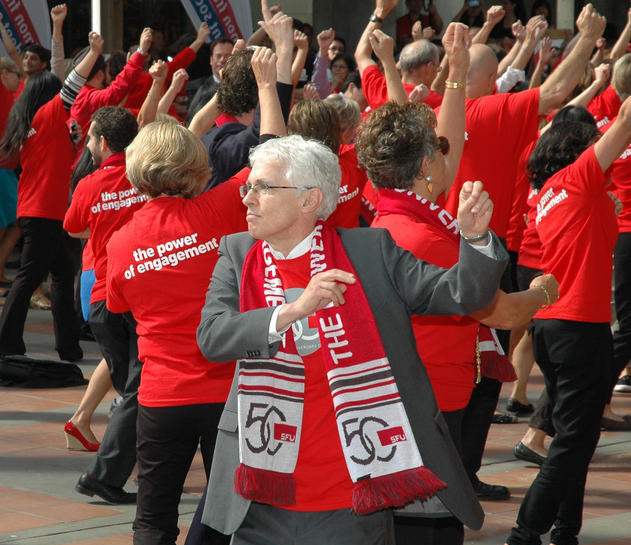
Associate project director of SFU’s 50th anniversary project, Adam Brayford, approached the board to discuss collaborating to increase student involvement in the university’s celebrations.

SFU is looking to form a group of 15 students to assist in engaging the student body in 50th anniversary activities.

The team of 10 undergraduate and five graduate students will work to promote celebratory events and will have the opportunity to bring their own ideas to the table for encouraging student involvement across multiple disciplines and all of SFU’s campuses.

Each of these students will be awarded a $750 honorarium for their participation. Brayford encouraged people looking to get involved to find more details on SFU’s “My Involvement” page.

Meet and greets are sweet

The board approved the concept of an “SFSS Meet and Greet” event to bring together SFU clubs.

The social event would be an opportunity for members of SFU’s myriad of student clubs to share ideas and get to know each other and the society. SFSS president Enoch Weng emphasized the importance of connecting with these groups and making the society more accessible to them.

Directors will now begin the planning process and start reaching out to different groups. Specific details for the event are to be announced.

SFU students tour BC to promote recycling

0
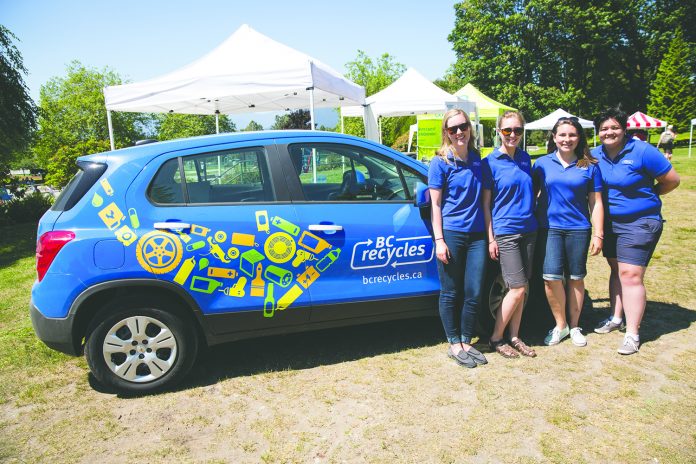
The SFU student ambassadors from left to right: Sarah Pratt, Kathleen Belton, Ali Russell, Courtenay Miller - Burnaby NewsLeader

Last weekend, Confederation Park in North Burnaby saw the kickoff celebration for the BC Recycles Summer Ambassador Program.

This year, the program will send four SFU co-op students on a whirlwind tour of British Columbia to promote recycling.

The program has been in existence for nine years prior under the banner of the BC Used Oil Management Association, but this year it has been rebranded as “BC Recycles” to represent the new union of product stewardships it represents.

The students, Courtenay Miller, Ali Russell, Sarah Pratt, and Kathleen Belton will be visiting various communities, including  Kamloops, Prince George, and Prince Rupert. They hail from a range of faculties and academic backgrounds, but came together through the co-op program.

Russell, a fourth year communications student, explained her motivation behind applying for the position: “The one thing that sparked my interest is that my family has always been very eco-friendly. [. . .] So when I heard about BC recycles, I thought, ‘Oh that’s awesome!’ I’m actually really curious about how BC does it.”

Belton, a student in the faculty of environment, said, “I really want to work in public education and awareness with the environment, so I found that it was a really good opportunity to get out there and get some practice.”

“One big problem is that people drop off oil outside of business hours. [. . .] That can spill and create a mess.”

Sarah Pratt,

SFU student

Miller, an English major, explained that the ambassadors intend to engage with local communities and ask them questions about their experience with recycling. She said, “It becomes a conversation, as opposed to me just saying ‘Hi. Here’s a website. Please use it.’”

The BC Recycles program represents 15 product stewardships, including Tire Stewardship BC, Electro Recycle, Canadian Battery Association, and the Health Products Stewardship Association.

These stewardships facilitate diverting used products away from landfills and towards being recycled responsibly. They are supported by the provincial government and each focuses on a unique set of products, such as tires, small electronics, medicine, batteries, and antifreeze.

The ambassadors also liaise with businesses under these stewardships to compile feedback about how the recycling program is working for them. Pratt gave an example:  “One big problem is that people drop off oil outside of business hours, and that can spill and create a mess [. . .] we’re trying to help business out with that.”

She continued, “[We’re] flagging which stores are having the biggest issue with that and seeing what we can do to address their concerns.”

This summer, the Ambassadors will be promoting the BC Recycles app, which uses GPS to find the location of the user’s nearest recycling centre for whichever recyclables they have.

Miller elaborated, “It’s so much more than just bottles and plastics now. Everything that’s outside of that blue bin that you feel guilty throwing away, almost, there is [a] place for it to have another life, and that’s what were really trying to promote.”

“All the stewardships are making sure that they’re expanding the locations that will actually accept these products. So I think that that is actually really key,” said Belton.

“The more places that can accept the products, the easier it is for people, and the more people are going to do it.”

Vancouver isn’t boring

2
Photo Credit: Phoebe Lim

A recent article published in The Economist describes Vancouver as “mind-numbingly boring.” The author, under the alias “Gulliver,” later states that the more “cities strive to become nicer places in which to live [. . . the] less interesting they become.”

Vancouver continues to score high on the Livability Index, creating a global image of Vancouver as a fantastic place to live. But has this livability come at the price of fun? The answer is that it depends on where in the city you travel — it could be argued that East Vancouver is a much more interesting area due to its economic and cultural diversity.

Firstly, Gulliver attempts to relate the diversity of individuals with an excitable urban environment. Though debatable, the connection is not to be ignored.

It is true that in the Vancouver’s downtown core, the residents of the area are among some of the wealthiest in the city, a homogenized class of business professionals making on average $10,000 more per household than the average Canadian one. This fact results from a highly controversial process: gentrification. As the rich move in to Vancouver, the less wealthy are forced to look elsewhere.

Downtown, one is bombarded with the same professional individual on their way to or from the office.

Gentrification is a global phenomenon. Those who can afford it — many of whom live a wealthy business culture frequently associated with a Western caucasian lifestyle — move into highly livable locations, and in the process create a living space where economic and cultural diversity wanes.

Due to this homogenization, these areas suffer from a lack of diversity and can be viewed as somewhat monotonous or boring. Look downtown on a Tuesday, for instance: one is bombarded with the same professional individuals on their way to or from the office, or on their way to one of the region’s high-end restaurants.

This pattern is true of many areas in Vancouver’s downtown core, and several other neighbourhoods throughout the West Side. However, as one travels elsewhere in Metro Vancouver, the vibrancy of the city’s diversity shows.

In East Vancouver, the range of cultures is astounding, and allows for many opportunities for residents. From enjoying a meal at a Jamaican restaurant, to celebrating an event at the Italian Cultural Centre, to enjoying a show at the Rickshaw Theatre, the experience created by the area’s diversity has resulted in a unique and entertaining area of the city.

Fortunately, Vancouver is touted as one of the most multicultural regions in Canada. Though due to increased gentrification, this diversity has been somewhat subdued in certain regions and exaggerated in others.

Vancouver is not “mind-numbingly boring.” The regional distinctiveness of its inhabitants makes it vibrant.

Think twice about posting your provocative Instagram photos

1
Photo Credit: Momo Lin

When you post a picture on Instagram, your main concerns are most likely how sweet it looks with the brand new filters, and whether or not it’ll be ‘liked’ a coveted 11 times or more. You aren’t typically concerned with the fact that people could take these Instagram photos — which don’t actually belong to you — and do whatever they’d like with them.

Most people do not recognize Instagram as an extension of the public sphere; it is, and it needs to be treated as such. Is an artist who takes a photo of you from Instagram really that different from a candid photo taken on the train? I would argue no. The image cultivated by a person on social media should not be any different than the image you create through one’s daily life.

If you wouldn’t be willing to walk down a street during rush hour in the same provocative position, maybe you shouldn’t be posting an image of it on Instagram.

Recently, artist Richard Prince caused a stir when he took Instagram screenshots, many of them sexually charged, and made slight changes to them, and sold them in a public gallery for around $90,000 each, all unbeknownst to the original owners of the images. Instagram’s Terms of Use states that “once you have shared user content or made it public, [it] may be re-shared by others” — a line that permits anyone to do things like this with your photos, no matter if you like or benefit from them.

I find the idea of artists appropriating our Instagram images to be less concerning than the lack of awareness on part of the people who originally posted the photos. The number of listicles that sites like BuzzFeed post containing public Instagram photos should be a dead giveaway that what goes on the Internet can be easily found, classified, and appropriated for a purpose other than what the original poster may have intended.

Hence, it may be best to keep well-mannered photos of yourself online, and ditch those that make it look like you’re about to ‘fool around.’ The adage that you shouldn’t post something you wouldn’t want your current or future employer to see doesn’t seem to resonate with people enough to deter them from posting these images.

I suggest a new adage: don’t post something that you wouldn’t be willing to send in the Christmas card to grandma. Having met numerous grandmothers in my life, I can attest to the fact that they are much more intimidating and capable of instilling guilt than any employer.

So when posting images to social media, remember two key points. First, if grandma saw this, would she write me out of her will,  or lecture me for hours on how I am a better person than this image would suggest? Second, would I get arrested for a criminal offence if I did this while walking down the street? If you answer ‘yes’ to either of these questions, turn off your phone, and don’t post.