Go back

The closure of Vancouver Mural Festival leaves a gaping hole in Vancouver’s art landscape

By: Osna Hadef, SFU Student

On January 24, 2025, the Vancouver Mural Festival (VMF) team announced their closure after nine years of contributing enormously to the public art scene in Vancouver. In their announcement, the team explained how they “have faced growing financial challenges in the past years.”

VMF, a non-profit arts organization, was founded in 2016 with a mission of connecting art and people. Initially starting as a summer festival, the organization transformed into an agency that organized several events yearly. Aside from murals, their portfolio includes many community events, commissions, and projects.

One of Vancouver’s visible characteristics is its collection of murals and public art pieces. Painted walls of buildings, alleys, basketball courts, or stairs are not unusual sights for residents of the Lower Mainland. Metro Vancouver is home to over 400 murals and public art pieces that VMF has produced across various locations in its period of operation. 

Public and mural art is more than just for decoration; it echoes the stories of its residents and what they want to communicate through the art.”

Among the best-known artworks created by VMF is The winds and the waters will always call us home by Ocean Hyland, which is on display at Canada Place. This piece uses Coast Salish art influences and elements of nature to depict the interconnectedness of all life, as well as of the ocean with the people. Another is Earth Justice by Shepard Fairey, a 20-story mural located near Burrard SkyTrain station bringing awareness to climate justice and reminding Vancouverites to protect the environment. 

A person with long black hair, decorated with formline-drawn fish, stares out at blue waters. In the waves, two orca whales rise.
PHOTO: Amirul Anirban / The Peak

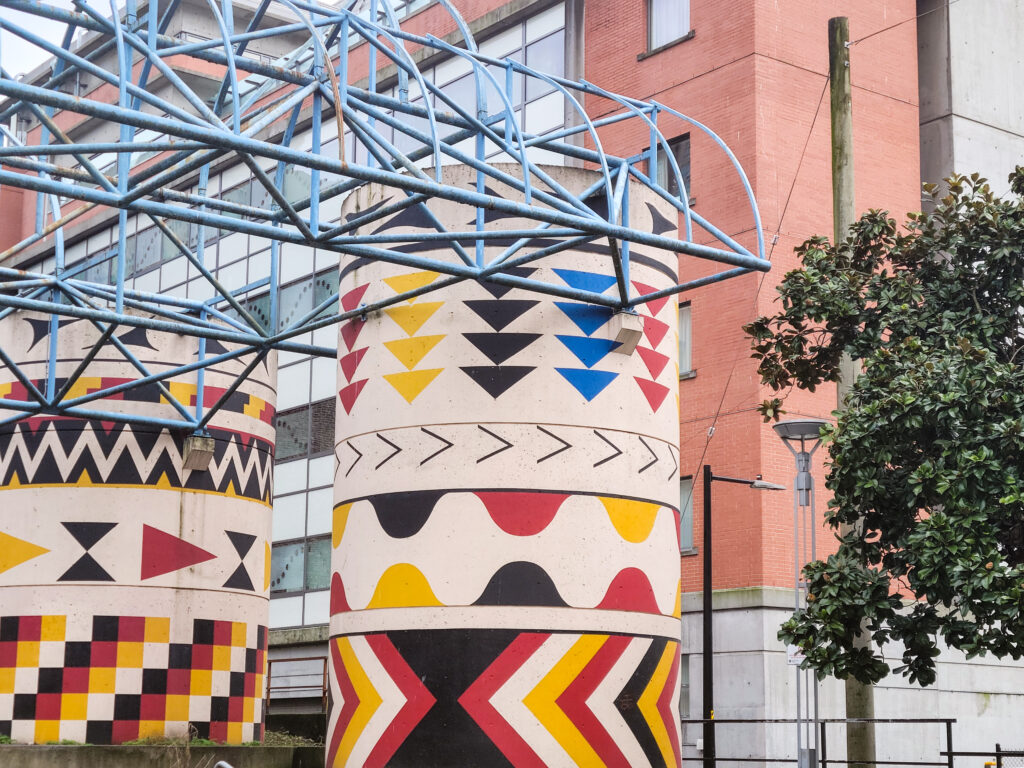
VMF has contributed significantly to the development of art and community building in the Lower Mainland. They served as a platform for artists from traditionally marginalized groups by employing Muslim and Indigenous artists. This can be seen in the Blanketing The City project, a mural reconciliation process process created in partnership with Debra Sparrow, a “xʷməθkʷəy̓əm (Musqueam) weaver and designer.” As part of the project, Sparrow produced five murals as well as a series of light displays illuminating iconic landmarks of Vancouver (Canada Place, Science World, and BC Place) and showcasing Coast Salish weaving patterns and stories

Two concrete pillars are decorated with red, black, blue, and yellow triangles arranged in downward-pointing columns. Red, black, and yellow swirly and triangular patterns wrap around the pillars in thick bands.
PHOTO: Amirul Anirban / The Peak

Another project is Why Can’t They See Us?, a collaboration between VMF and SFU’s Centre for Comparative Muslim Studies (CCMS). Painted by Doaa Jamal, a graphic designer and photographer, the mural was a multicoloured calligraphic Quran verse beneath the R-Space Gallery in Vancouver. The project, which was pitched in 2018, intended to address Islamophobia and convey a message of pluralism while introducing Arabic calligraphy and Islamic geometric designs to public Vancouver spaces. 

Yellow, green, white, orange, and blue Arabic calligraphy and geometric patterns trace a maze-like pattern against a red background.
PHOTO: Courtesy of Vancouver Mural Festival

Public and mural art is more than just for decoration; it echoes the stories of its residents and what they want to communicate through the art. The closure of VMF leaves a noticeable gap in the art scene and communities of Metro Vancouver. VMF’s absence will be highly felt this summer; however, their legacy will not be easily forgotten after the service it has done for artists and community members alike. It will inspire the creation of and guide many more art organizations to come. 

Get the Vancouver Mural Festival mobile app for free access to 400+ murals and to find all the information about the artists and the artwork as well as their locations. 

Was this article helpful?
0
0

Leave a Reply

Block title

Burnaby apologizes for historic discrimination against people of Chinese descent

By: Heidi Kwok, Staff Writer On November 15, community members gathered at the Hilton Vancouver Metrotown as the City of Burnaby offered a formal apology for its historic discrimination against people of Chinese descent. This included policies that deprived them of employment and business opportunities. The “goals of these actions was exclusion,” Burnaby mayor Mike Hurley said.  “Today, we shine a light on the historic wrongs and systemic racism perpetuated by Burnaby’s municipal government and elected officials between 1892 and 1947, and commit to ensuring that this dark period of our city’s history is never repeated,” he stated. “I’ll say that again, because it’s important — never repeated.” The earliest recorded Chinese settlers arrived in Nuu-chah-nulth territory (known colonially as Nootka Sound) in 1788 from southern China’s...

Read Next

Block title

Burnaby apologizes for historic discrimination against people of Chinese descent

By: Heidi Kwok, Staff Writer On November 15, community members gathered at the Hilton Vancouver Metrotown as the City of Burnaby offered a formal apology for its historic discrimination against people of Chinese descent. This included policies that deprived them of employment and business opportunities. The “goals of these actions was exclusion,” Burnaby mayor Mike Hurley said.  “Today, we shine a light on the historic wrongs and systemic racism perpetuated by Burnaby’s municipal government and elected officials between 1892 and 1947, and commit to ensuring that this dark period of our city’s history is never repeated,” he stated. “I’ll say that again, because it’s important — never repeated.” The earliest recorded Chinese settlers arrived in Nuu-chah-nulth territory (known colonially as Nootka Sound) in 1788 from southern China’s...

Block title

Burnaby apologizes for historic discrimination against people of Chinese descent

By: Heidi Kwok, Staff Writer On November 15, community members gathered at the Hilton Vancouver Metrotown as the City of Burnaby offered a formal apology for its historic discrimination against people of Chinese descent. This included policies that deprived them of employment and business opportunities. The “goals of these actions was exclusion,” Burnaby mayor Mike Hurley said.  “Today, we shine a light on the historic wrongs and systemic racism perpetuated by Burnaby’s municipal government and elected officials between 1892 and 1947, and commit to ensuring that this dark period of our city’s history is never repeated,” he stated. “I’ll say that again, because it’s important — never repeated.” The earliest recorded Chinese settlers arrived in Nuu-chah-nulth territory (known colonially as Nootka Sound) in 1788 from southern China’s...