

By: Hannah Davis
The $7 Coffee
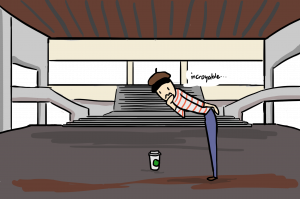
This is a performance art piece that will last 10 hours. This art piece starts with a simple empty generic coffee cup sitting in the middle of Convocation Mall. Students will pass it by, taking no notice, maybe even occasionally kicking it over. After exactly five hours, a hired performance artist will appear out of nowhere. They will be dressed as any SFU student is — in a hoodie, jeans, a rain jacket, and semi-messy hair. The performance artist will then begin trying to pick up the coffee cup . . . but every time they get it off the ground, they drop it because it is too heavy. They repeat the line: “Coffee weighs heavy on my wallet and on my mind.” Students will walk by and see themselves in the fake student, inspired (but probably not) to stop drinking coffee. This really is a humanistic piece, if I, the artist who has no recollection of what it was like to be a student, do say so myself.
A giant butt sculpture
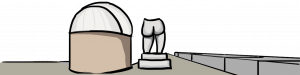
This piece is a giant butt sculpture to be placed beside the observatory on the SFU Burnaby campus. This is to demonstrate that, yes, while we are studying science, astronomy, and the infinite mysteries of the ever-expanding universe here at SFU — we are all still simply searching for some booty.
Who’s Tired?
This is a series of paintings to be hung around the SFU Academic Quadrangle. Each painting will be titled Who’s Tired? — and this will be indicated by a plaque hanging above the frame. When a student walks up to see the painting, they discover it is no painting at all, but a mirror. To this, the student will roll their eyes and walk away. This piece is jarring, reflective, and might (but, again, probably won’t) help students get more sleep. If we really wanted to help students get more sleep the university could lay off with all the irrelevant readings and random assignments . . . but that’s not how university rolls.
Free food performance piece
This is another performance art piece to occur at SFU. This one will demonstrate the ways in which students, burdened with some sort of financial instability, are always grateful to be fed for free. The piece will seem like a free food fair, because different tables will be giving away a variety of meals. In reality, the cooks are all performance artists who ACT like real cooks. All the students who eat for free will be taking part in a beautiful live performance, but they won’t even know it — they’ll just be appreciating a good meal.
Free money performance piece
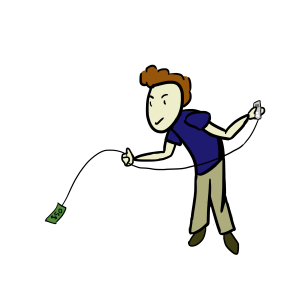 Another performance piece, consisting of a whole new cast of performance artists and actors. These actors will be handing out $50 bills to any student who walks by. These $50 bills will be attached to a fishing line, and once the student walks far enough away, the performance artist will yank the money out of their hands. In exchange, another actor will throw an iClicker at the student, which the student can keep. The student will inevitably say something like “I’d rather have the $50,” to which the actor will reply, “Sorry, you have to keep the iClicker instead, and you’ll use it in maybe one class for assignments that count for maybe 3% of your total grade.” This piece illustrates the ways in which university students must give up insane amounts of money for things that do not make sense. Every student who unwillingly participates in the piece will hate it.


