Home Blog Page 861

University Life Hacks: Keys to Success

2

Reign in the next three months of the semester with four more spruce pointers to that’ll keep you styling and profiling on campus!


  1. Wear deodorant! And I don’t mean just under the arms, either. Wear that stuff like perfume: on your wrists, neck, tummy, pretty much everywhere. Smelling like clean laundry is a clear sign that you’re an adult who’s got it together.


  1. Memorize the name of as many cheeses as you can. The class keener might know every line of the textbook by heart, but can they name three different types of cheese that aren’t cheddar, mozza, or swiss? Looking Gouda, girl.


  1. Carry something leathery. May I suggest a good leather-bound journal. You don’t have to use it for class or anything; just scribble in it every once in awhile and carry it around like a trophy. Not only does it make you look educated, it also makes you look like a sophisticated human.

     4. Borrow the oldest book you can find from the library and flip through it when you’re at the coffee shop. Nothing is                   more alluring to the opposite sex than well-read coffee drinker caked in the scent of Dove deodorant.

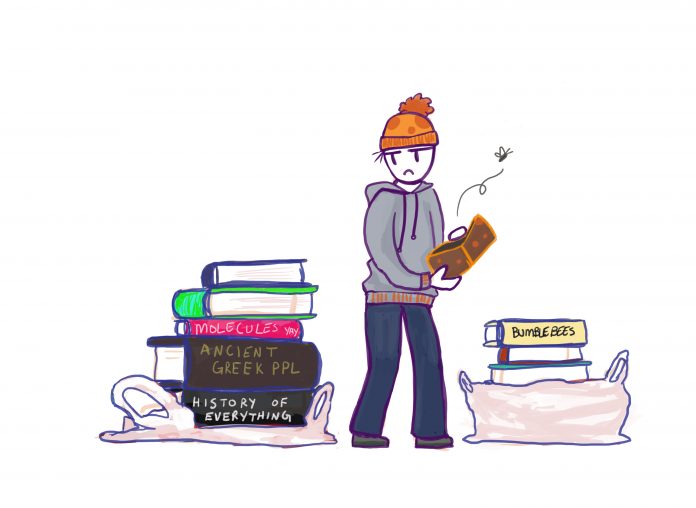
Are SFU students #textbookbroke?

0
There are serious efforts to keep from being a reality for students.

What would you do with a couple extra hundred dollars a semester? A pipe dream for most students, it’s a question the Simon Fraser Society is starting to throw out there with the interest of helping students save a bit more money.

During the first few weeks of school, SFU students scavenge to find a copy of their required course materials, only to be met with the heartbreaking realization that the class has upgraded to the newest, shiniest, and most expensive version of the textbook.

The #textbookbroke campaign has found a home at SFU after popping up across various post-secondary institutions, and is being championed by the Simon Fraser Student Society (SFSS). Students across campus are being asked how much they’ve spent on textbooks in a campaign to petition for the use of Open Educational Resources at SFU by demonstrating the amount it truly costs to purchase mandatory course materials.

Hundreds of tweets displaying the hashtag #textbookbroke show students in schools across the country and even beyond Canada demonstrating their support for the movement for open source textbooks. Various university and college student societies are asking students to join and pledge their support, while also including how much they’ve spent on textbooks. Some of the images posted on the SFSS Facebook page show how much students are really spending, ranging from $12 to $780.

The movement took up their fight across the hall from the SFU Burnaby bookstore at the start of this semester, encouraging students to leave post it notes with their stories for all to see.

Said one arts student, “I could’ve bought groceries for the whole month with the $300 I spent on textbooks, and that amount is almost half of my rent for the month.”

Another note left by a sciences student read, “[If I didn’t have to pay for textbooks] I would feel a lot more freedom to take classes with extra costs or where I need extra supplies.”

Open Educational Resources are “freely accessible, openly licensed documents and media that are useful for teaching, learning, and assessing as well as for research purposes.” The goal is ultimately to offer students affordable and accessible educational resources that don’t break the bank.

VP University Relations Brady Yano explained that the provincial government has in the last year invested in 40 educational resources that could be used for “up to 40 undergraduate first- and second-year courses at postsecondary institutions.”

Said Yano, “The number has now grown to 150. If adoption [of these resources] took place in larger first- and second-year courses it could save them up to $100,000.”

Yano went on to say, “over the past two weeks the student society has been tabling outside of the bookstore educating students on the availability of these [open education] resources, and we started a photo contest on the SFSS Facebook, and whoever got the most likes will get their textbooks paid for by the SFSS, in this case saving the student $410 and hopefully generating more buzz and support for this campaign.”

In addition, the Library and the Teaching and Learning Centre will fund three grants of $5,000 to incentivize faculty to use open educational resources.

For more information on how you can get involved, sign your pledge at sfss.ca/OER, search the hashtag on Twitter, or contact VP University Relations Brady Yano.

Comics!

0

Peers (Leslie Lu)

Week6(2)

First Order of Business (Eric Smith & Justin Stevens)

unnamed

Creator’s Pet (Destiny Hsu)

CP_020

The Crapside (Darien Lechner & Ryan Stella)

coffee man 2

Why we need more LGBTQ+ transitional shelters in Canada

0

[dropcap]W[/dropcap]hen we think of someone who is homeless, we tend to have this image of a scraggly man with an unkempt beard, pushing his belongings in a shopping cart. While this image may certainly be a reality on Vancouver’s streets, another facet of the homeless population is largely ignored and unaddressed.

These are the homeless youth who identify as lesbian, gay, bisexual, transgender, queer, or various other identities (LGBTQ+). These are people that look like the classmates and friends whom we see everyday, but are going through struggles that most of us cannot even begin to imagine.

The very first transitional shelter for LGBTQ+ youth in Canada is set to open at YMCA’s Sprott House in Toronto on February 1. The shelter will provide safe, respectful housing for LGBTQ+ youth ages 16 to 25, supporting them in their transitions to their next steps in life. This is an important milestone for a population that has traditionally been marginalized, ridiculed, and shunned by society.

A study conducted in 2013 on Toronto’s homeless youth population found one out of five of them identified as LGBTQ+. Several had experienced abuse and discrimination within Toronto’s current shelter system, suffering homophobic abuse at the hands of fellow shelter residents.

These people are going through struggles that most of us cannot even imagine.

Unfortunately, the world is still coming to accept the LGBTQ+ community. While major steps, such as the legalization of gay marriage, have been made in many countries, these are only small victories in the heteronormative world that we live in. To identify oneself on the LGBTQ+ spectrum immediately distinguishes someone as being ‘other’ than the norm, a point of difference that will sadly be contested and judged by many.

It is no small wonder that LGBTQ+ youth, who are already going through the challenges of their formative teen years and have to cope with society’s stigma against their sexual orientation, need spaces of acceptance and respect. Trans folk also often have the added physical challenge of transition combined with the social pressures of people trying to define them according to their terms.

Locally, Vancouver has a prominent shelter in the Downtown Eastside called Covenant House, which provides shelter for young people who have experienced trauma or abuse. Social housing and program provider Rain City Housing also dedicated a two year pilot project in 2012 to providing housing and employment for LGBTQ+ youth ages 18–25, on the basis of not only respecting young people’s identity and life choices but also providing them with a community of care.

We at SFU are also lucky enough to have Out On Campus, an organization that facilitates dialogue and education regarding the spectrum of gender identity and sexual orientations, while providing valuable resources and lounge space.

However, more of these transitional shelters should be opened across Canada in order to not only provide shelter and relief, but to create a space for dialogue and awareness about the LGBTQ+ community. Positive and open spaces like these can only serve to benefit everyone, and are a small step towards acceptance, rather than simply tolerance, of a community that has been marginalized for far too long.

Most importantly, in spaces like these, people can finally feel at home.

Satellite Signals

0

                                                       Harbour Centre

vancouverOn January 26, noted academics and researchers Alexandru Balasescu and Apurv Jain will present the lecture “Financial Bubbles and their Magic: Asset Price as a Heroic Journey in the Financial Markets” at Harbour Centre.

The lecture will use examples of human behaviour, mythology, and economic models to explain why financial crises happen when they do.

Woodward’sWEB-woodward

Andrew Nikiforuk, investigative journalist and author of Slick Water, will present at the Djavad Mowafaghian Cinema at the Goldcorp Centre for the Arts on January 28.
He will speak about the environmental impacts of hydraulic fracturing, a method for extracting crude oil from the ground. Nikiforuk will draw on the 20 years he has spent covering Canada’s energy sector and will look at specifically what how “fracking” could trigger seismic activity.

Get off Tinder and try love the old-fashioned way

0

[dropcap]I [/dropcap]remember when ‘90s TV shows used to made fun of matchmaking services. They would show various scenes of men introducing themselves in their best outfits to potential mates that left my braces-laden teeth exposed as I sat cringing, wondering if people really took part in those dating videos.

Now that I’m all grown up (and with straight teeth!) I find myself, and the majority of my friends, signed up for the online version of these dating technologies. It is no longer taboo to use dating apps for help finding someone to get to know, but is this advancement necessarily a good thing?

Various dating apps make it easier to find people who are close to you that are — more often than not — single. Some argue it’s taking all the fun out of dating. Countless couples now have stories in which they openly admit meeting on Tinder. Or better yet, they come up with a half–assed lie, remarking that they met at The Keg. Some people even go on to get married. Are we all going to be 80 years old telling our grandchildren that we met their grandpa or grandma by swiping right?

The concept of talking to someone based almost entirely on his or her pictures is allowing us to become more superficial than before. To compare and contrast men and women’s dating habits on Tinder, it has been found that women are very selective, declining nearly every opportunity, whereas men barely even look and swipe right until a match is formed. Is selecting a partner based entirely on the quality of a few pictures really an adequate way to approach dating?

Without these apps, however, one really has to put oneself out there to swing a date. Tom Greaves, a man in Britain, documented his adventures in approaching women on the streets to ask them out on dates in The Daily Mail. Most women laughed and declined, not because they were being rude, but because they seemed almost embarrassed.

A personal friend of mine admits she appreciates when someone puts the effort in the traditional way. She tries to make the experience positive for both parties while being polite and courteous to the one putting themselves on the line. I since have adopted this ideal and if someone has the gusto to appropriately approach me on the street, I give them the benefit of the doubt and don’t simply blow them off. If women keep rejecting men in the physical realm, why would there be any reason to keep trying?

No matter how you feel about dating apps, the truth is that everyone is using them now. Once a technology is put in place, it’s very hard to retract it. I doubt anyone would be in favour of the messenger pigeon in a time when the telephone took off.

That being said, I think it’s important to uphold the sanctity of actual spontaneous human interaction. You never know who you’re going to meet when you turn off your phone and leave the house, and it is guaranteed to result in a better story than “Oh, we met on Tinder!”

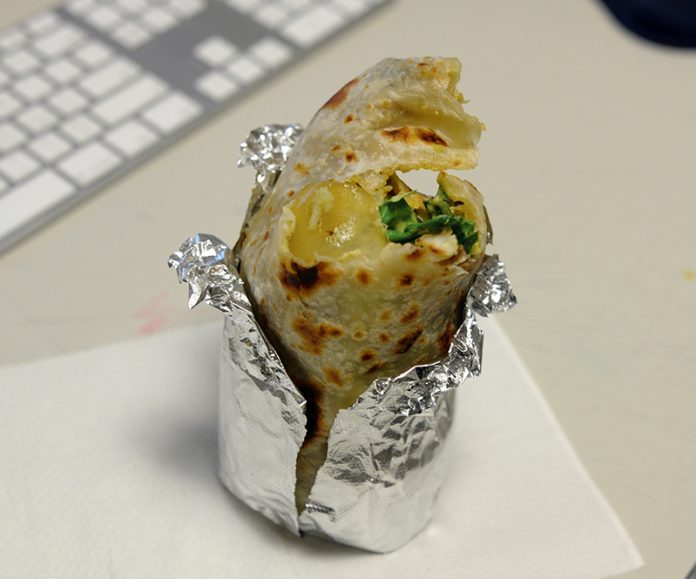
An open letter to Guadalupe burritos

1

Dear Guadalupe burritos,

You don’t know me, but boy, do I know you. My name is Max Hill. I’m the editor-in-chief of the very newspaper you are currently reading. And I have a favour to ask of you.

From the moment you opened your doors in the Maggie Benston Centre of SFU’s Burnaby campus, I knew things were about to change at The Peak offices. For too long, we had argued ceaselessly over dinner choices for our Friday production nights. There was the one editor who always wanted pizza. The one who pined for the sushi place that doesn’t deliver. The one who loved the burgers at the Highland Pub, despite our two vegetarian staffers. I thought we would never be able to find a dinner choice that we could all agree on.

Then you came along, Guadalupe. You changed everything. For the first time, my staff was happy. They had found a food they could all agree on. Chicken, steak, grilled vegetables, guacamole. You had it all. Finally, the only beefs in my office weren’t between co-workers — they were folded between generous helpings of lettuce, sour cream, and shredded cheese.

But you weren’t open for dinner. You provided us with lunches, the lifeblood we needed to make a newspaper on deadline with three hours of sleep, five cups of coffee, and about four computers that actually worked. I didn’t want to be greedy — as the great rock group Poison once sang, every rose has its thorn, even the most beautiful rose of all. In my heart, I knew we would never sample the sweet taste of carnitas past four o’clock, and I had made my peace with that. We all had.

Until one day, you announced you had extended your hours.

My joy upon hearing this news was quickly replaced by reckless, explosive anger when I learned you would remain open until 7 p.m. every day except the one day we needed you: Friday. Production day. Our day, Guadalupe.

I know I have no right to ask you to change this policy. Surely you’ve done your research and concluded that staying open late on Friday is not economically feasible — after all, the only kids on campus late Friday night either live here or have devoted their weekends to working on a campus newspaper barely anyone reads. Why stay open just for their sake, you may ask?

When I became editor-in-chief of this newspaper, I knew I would have to fight for my staff. For my paper. I knew there would be challenges, and that it would be up to me to advocate for the freedom of the press. And that includes the freedom to sample delicious, delicious burritos on Friday nights. It’s not an easy road — no one ever said that it would be. But at the end of the day, I know in my heart that it will all be worth it.

So I’m asking you, Guadalupe, to reconsider. I know our paper doesn’t always seem like much. We may struggle to appeal to our readers, and we may not always make the best choices. But at the end of the day, we’re passionate students who are working tirelessly to make a difference on this campus. And part of that difference is making sure that we, and all others at SFU, have access to your burritos on Friday nights.

Please remember that, the next time you close your doors early on a Friday night, that grumbling you hear isn’t just the sound of your ovens powering down. It’s the sound of all of our stomachs, yearning for a taste of freedom. A taste of Guadalupe.

Cordially,

Max Hill

Editor-in-Chief of The Peak

Sean Molle: perseverance on and off the mat

0
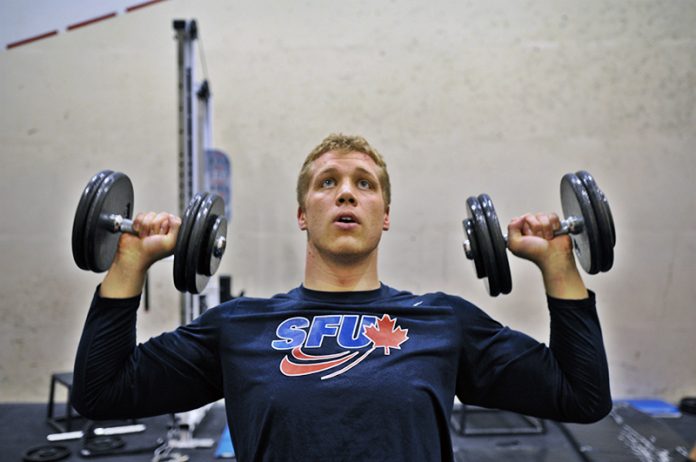
A redshirt junior, Molle has one more year left of eligability.

Wrestling is a unique sport, and requires a unique set of skills. It is like golf, highly individualistic, but much more physically demanding. It is as physically taxing as football or rugby, but you sink or swim entirely on your own abilities.

Sean Molle possess all these attributes. He wrestles in the heavyweight class, has an impressive mentor who has taught him how to come back from two different injuries, and has become an integral part of the SFU wrestling team.

“Sean is a pleasure to coach because he is super committed to the sport,” said his coach Justin Abdou. “He will do anything you ask him to do, and of all the heavyweights I’ve coached, he’s one of the most committed to fitness. He runs hard with the team, he’s good shape, [and] he can push the pace.

“He’s got a youthful energy. He’s like a big kid. He’s someone that everybody likes, and he’s a good teammate.”

“The first time I was out for six months,” said Sean to The Peak about his injury. “The second time I was out for nine months. [The first one] was during a practice. I just twisted it the wrong way and the knee popped. The second time was during a match.”

Molle started wrestling in high school, and hasn’t looked back. “My junior high coach got me into it, and I had had some family ambition to get into it. I thought it would be something to try out.”

Family ambition is an understatement. Molle’s father, Robert Molle, was an extremely accomplished wrestler, competing for SFU in the 1980’s and winning four NAIA championships, and also winning a Silver Medal at the 1984 Olympics in Los Angeles.

“Oh yeah. He shows it all the time,” said Sean commenting on his Father’s Silver Medal. “The match is on YouTube and I’ve seen it multiple times. I’ve seen multiple videos of him wrestling.

“I [learned] a lot from him, and he did teach me a lot so I tried to take advantage of that.”

Molle tried to follow in his father’s footsteps by playing football here at SFU as well. Robert was a dual sport athlete, and actually went on to play in the CFL, winning two Grey Cups with the Winnipeg Blue Bombers.

“I tried out for defensive line, and then they put me on the offen- sive line. But I think I was a little too small to compete for offensive line,” said Sean. “I thought I could try it out. But it was too much work, especially with school. I wasn’t enjoying it, so I just put my eggs in one basket.”


“We are at the mats probably five times a week, probably six times depending if we have a tournament.”

That is because school for a wrestler is a unique balancing act. Unlike sports such as football, basketball, or soccer — which all have a fair amount of home games — wrestlers compete primarily on the road. Of the 23 meets that the men’s wrestling team will participate in, only two are in Burnaby. This means many nights on the road travelling and away from school.

“Being on the road you kind of have to just pick and choose,” explained Sean. “You have to make sure you’re done your assignment before you leave, because you’re not going to get much work done on the road, and you’re not going to have WiFi everywhere you go. You’re going to have to make sure you’ve done all your readings or make sure they’re all saved on your computer.

“I usually try and avoid Friday classes, [. . .] and distance courses are always a must when it comes to being an athlete, especially on the road.”

Days where the team is not travelling are very demanding; it’s no wonder why distance courses are very valuable to any student athlete.

“We are at the mats probably five times a week, probably six times depending if we have a tournament,” explained Molle. “Monday we go hard, we run in the morning, and then practice in the afternoon. Tuesdays we usually go at 7 a.m, and then a lift in the afternoon. Then [it’s] the same thing for Wednesdays [as it is Monday], and Thursdays is the same thing as Tuesday. Friday is the same as Mondays [and] Wednesdays, or it’s usually a travel day for the tournament.”


Molle is also very happy about the International Olympic Committee reinstating wrestling for at least the next two Olympics. The sport was originally going to be out of the 2020 Olympics, but was reinstated after complaints from various groups.

“It’s great,” said Molle. “It’s another reason to compete. Wrestling is not a very professional sport; there’s not a lot of money involved. With football you get to go pro, with hockey there’s the NHL. In wrestling, the Olympics is a big deal. It’s the big show.”

With the Olympics as the ultimate benchmark for success, Sean hopes to become an All American for this season and win the NCAA in his final year next year.

Fun Fact

Sean’s pre match meal is half a dozen eggs. His favourite pump up song is “Molly” by Tyga.

Dear Dr. Breakup

0

Dear  Dr. Breakup,

My partner of three years just dumped me for some shrimpy little hairball with a manbun. I don’t know how he could do this to me. Dmitri said he wanted to spend the rest of his life with me when he drunk texted me from Cuba. I  literally just got a tattoo of his name on my ankle, too. I feel like the world’s biggest idiot. Should I like try and go after him or should I spend my energy finding another man named Dmitri?

–Chad, 23

Dear Chad,

Your actions are proof alone that love makes idiots of the best of us. I would advise against going after Dmitri. Any person that finds a man bun sexy sounds basic as fuck. I would suggest putting your energy into brainstorming up something to cover up that tat. May I suggest a singing cheese burger?

– Dr. Breakup

Dear Dr. Breakup,

After New Year’s eve, I decided to cut ties with my boyfriend of six months. He was just too stupid. Like oh my god, I shouldn’t  have to tell him to get me a chocolate bar when I want one — he should just know by, like, my mannerisms and body language and stuff. Now he’s like, calling me wanting to get back together and I don’t know what to do. Like he was really good in bed and stuff but he’s like just the biggest idiot I’ve ever met.

–Priscilla, 21

Dear Priscilla,

You’re a woman with high standards and you deserve nothing short of the best. In celebration of your new single status, I prescribe the “Basic B” spa day. It starts with you getting your alignment re-adjusted so your cranium will sink less within your anal cavity. It then finishes with an invigorating high colonic that will purge you of all that shit you’re full of.

Treat yourself and do it twice.

-Dr. Breakup

Dear Dr. Breakup,

My dirty rotten stupid douche canoe boyfriend just dumped me over facebook. He didn’t even have the cajones to do it over the phone or to my face. I can’t find the strength to get out of bed, I feel emotionally destroyed. My heart feels like a crushed beanie baby. I wish I were dead.

–Carol, 16

Dear Carol,

So do we.

–Dr. Breakup

Dear Dr. Breakup,

I’ve been so lonely since my youthful pool boy, Rodrigo, decided to leave me and go back to Honduras. I’ve just been beside myself in my big old mansion drinking chardonay all by lonesome. While I was going through my daughter’s room looking for her stash of weed brownies, I stumbled upon your column. Hmmm, I’ve never written to a doctor before 😉 It kind of sexy when you think about it. Are you single, Dr. Breakup? I would really like to get up on your operating table and get tested on my cardiovascular. 😉

XOXO

–Brandy Jay, 43

Dear Brandy Jay,

If you’re looking for cardio, walk your drunk ass in any direction that isn’t mine.

–Dr. Breakup

Feeling heartbroken? Book a diagnoses with Dr. Breakup today at [email protected]!

Opera Warriors explores traditional Chinese theatre

0
Chinese dance and culture shines in Opera Warriors

Opera Warriors, performed on January 5th and 6th at the Queen Elizabeth Theatre, was a well-executed production. It featured the athletic abilities of the performers, elaborate set design, detailed costuming, and beautiful lighting.

Set in China during the early 20th century, the story follows three brothers as they learn the art of classical Chinese dance. The plot focuses on the love between the youngest brother, Heidou, and the master’s daughter, and the reunion of the elder brother with a concubine. Ultimately, though, it tells of the glory of the youngest brother who reshaped Chinese theatrical performance.

Opera Warriors was presented as a “drama dance” and contained elements from the different styles of classical Chinese dance and theatre. It was largely accompanied by orchestral music and centred around the theatrical and athletic abilities of the performers, similar to ballet. The performance also utilized the structure of a “play within a play,” where the characters would perform “on stage” within the performance itself.

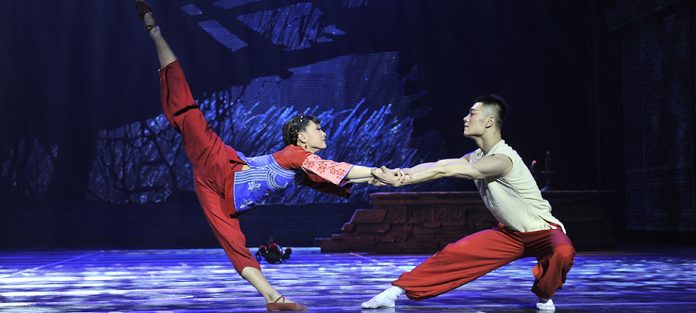
In one scene, the eldest brother is performing “on stage,” while his childhood lover, the concubine, is watching from afar. As the scene progresses, the platform of the concubine moves closer to the “stage” of the eldest brother, and she enters “onstage” to dance with the elder brother. This moment merges the two characters and their different states of being, where one is living in reality while the other is living in a dream.

Despite the term ‘opera,’ the performance did not include the sort of “opera singing.” This is not surprising, as it is likely more difficult to comprehend without a fuller understanding of the Chinese operatic style. However, to aid in the understanding of what was occurring on stage, screens were set up at both ends of the stage and, prior to each act, displayed a summary of the act in English.

If there was one thing that may have detracted from the overall experience, it would have been the amount of history and symbolism integrated within the performance. As such certain aspects of Chinese theatre and dance were not fully explained. Yet, the performance provided enough information to create interest for the story, while withholding enough information that the audience, if interested, could easily conduct research into the subject of traditional Chinese Opera.

Lastly, the overemphasized emotions although excellent at certain moments in the performance, their continued use throughout may have been slightly over-dramatic in others. This coupled with the lack of subplot development gave the performance more of an action movie feeling than a theatrical one.

Despite these shortcomings, Opera Warriors showed a glimpse into the culture and wonder of Chinese theatre. The story was easy to latch onto, and the viewer was able to follow the splendid dancing, that moved with the ebb and flow of the orchestral music. Overall, it was an excellent performance to have witnessed.