Home Blog Page 801

Tanks farms, pipelines, and the safety of the SFU community

3

Hidden in plain sight

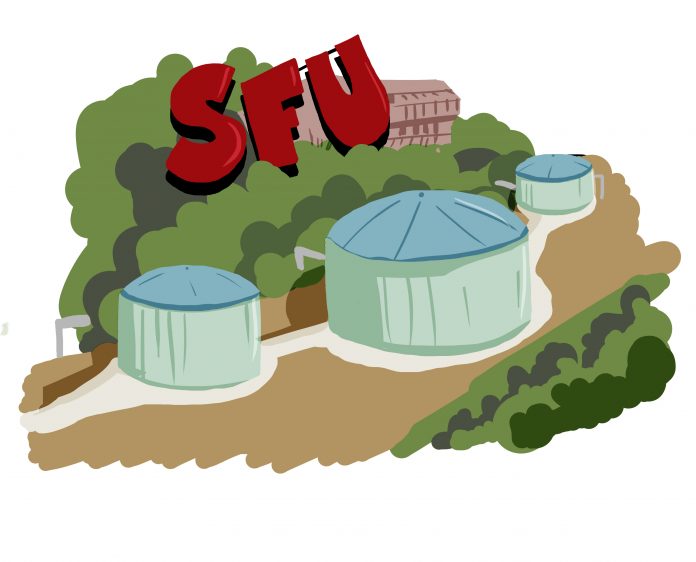
Upon starting your post-secondary studies at Simon Fraser University’s Burnaby campus, you might not notice at first that it is located above a tank farm. It is tucked away just below the Gaglardi Way and Hastings Street exits, where 13 barrels hold approximately 1.685 million barrels of crude oil and other refinements for Kinder Morgan’s Trans Mountain pipeline system.

What you might be aware of is that Kinder Morgan wishes to expand their pipeline. This expansion includes an additional 13 tanks, to double the Burnaby tank farm if the federal government rules to approve the expansion on December 19. The proposal produced by Kinder Morgan intends on building a $6.8 billion pipeline that will carry diluted bitumen — a kind of crude oil which has been diluted for transport — from Alberta to British Columbia.

Recently, The Peak reported that the Burnaby tank farm poses a potential safety risk to students and the Burnaby Mountain community if the controversial expansion is built. Grayson Barke, council representative for the Environmental Resource Student Union, explained “the risk of something terrible happening will go from one in one million to one in 2,000 after this expansion is done.”

Indeed, many residents, faculty, and students have been opposed to the pipeline expansion plan. Many individuals are asserting that the SFU community should be made more of aware of the potential hazards if the pipeline is expanded.

Stephen Collis, SFU English professor, protester, and a recipient of the Nora and Ted Sterling Prize in Support of Controversy award, explained that initially “at the global end of things I was deeply concerned about climate change, I take very seriously what scientists are saying. We literally cannot build a pipeline right now and still say you are doing something about climate change.”

Collis was previously threatened with legal action by Kinder Morgan during the 2014 protests on Burnaby Mountain.

Collis didn’t initially oppose the pipeline due to safety concerns at SFU; rather, they shifted towards that. “Once you start hearing reports from the Burnaby Fire Department and then [SFU] that there is no real escape plan if there is a serious fire, and there is a real chance there could be a fire, that’s all super alarming.” He added that the safety issue “is a bit under the radar.”

As a member of the Burnaby Mountain community and activist for opposing the Kinder Morgan pipeline, Ann Jarrell expressed her concerns about the lack of public consultation regarding safety. “The problem is, we don’t want to scare people,” she said. “But they need to know that this is happening so we can prevent it because it’s so scary.”

Looking at potential risks for students and Burnaby Mountain residents

The most recent report from the Burnaby Fire Department in the Trans Mountain Tank Farm Tactical Risk Analysis in 2015 outlined that the “Burnaby Mountain terminal is not the appropriate location for the expansion.” The report broke down the risks which further endanger the SFU community and Burnaby Mountain residents.

In expanding the pipeline, the possibility of exposure to sulphur-based gases will increase, exposing many residential areas where “Smoke outfalls from fire event may contain sulphur dioxide (SO2), in which KMC [Kinder Morgan Canada] analysis shows a potential health concern could be felt up to 5.2 km downwind.”

The chemicals which students and residents may be exposed to could increase the likelihood of asthma and cardiovascular illness for those living in the area. In the longer term, the potential effects are as yet undetermined, but could include an increased likelihood of developing cancer, the report explained.

In an interview with The Peak, Barke explained that he heard complaints during hearings in regards to the air quality surrounding the tank farm. “I heard about a dozen people say that just when they have been walking around, just being in that area, they are smelling strong gasoline fumes, to the point where it’s suffocating and they have to move out of the area.”

Jarrell, a resident of the UniverCity condo complex, has submitted a 10-page document to the National Energy Board as a commentator. She expressed that the tank farm was of particular concern because she wasn’t even aware that the tank farm was located on Burnaby Mountain until she had some breathing problems. She explained to The Peak, “I was driving up Burnaby Mountain one evening in October and I suddenly started coughing violently and  momentarily lost control of my car”.

Not only is the SFU community likely to experience an increase in health-related concerns if the pipeline is approved, but the Burnaby Fire Department has also reported increased possibility of tank farm “boilover” leading to forest fire and toxic smoke plumes.

A major concern for students is the contents of the new oil mixture that will be stored at the tank farm. In the November 1 report from the Ministerial Panel for the Trans Mountain Expansion Project, “presenters reported that the mixture is much more explosive than crude oil and more difficult to clean up when it spills.” There is also increased likelihood of boilover and fire due to the explosive nature of the the mixture that will be in the tanks on Burnaby Mountain.

Jarrell also pointed to an ongoing issue of the land on which Simon Fraser University is located: “the possibility of an earthquake.” She cited that “the fire department describes it as located on an unstable mountain slope susceptible in an earthquake area.” She added that she has researched and tracked that “there are 400 earthquakes or so in BC, so far, this year.”

Jarrell also stressed that the risk assessment previously conducted by McCutcheon and Associates for Kinder Morgan describing the Burnaby Mountain area is thoroughly inaccurate.

She mentioned a specific part of the Risk Assessment Final Report that states  “[. . .] the probability of an incident happening is low enough when compared to the acceptable level of risk identified by the MIACC [Major Industrial Accidents Council of Canada]. This probability equates to [. . .] up to about 86–224 metres from the dike wall for a fully involved dike fire, which is acceptable for an industrial area.”

However, Jarrell said “this is not an industrial area. There are residents in this area on a regular basis. I’m not sure if the Forest Grove Elementary School is within the 86–224 metre area.” Not to mention the tens of thousands of students who are on the Burnaby campus each day.

What SFU plans to do about it

Collis shared his thoughts on SFU’s stance over safety for the SFU community and the pipeline: “I don’t think they have talked about it nearly enough, frankly, and as far as I understand there has been a kind of lack of transparency.”

The latest statement from SFU’s chief safety officer Mark LaLonde stated in an email to The Peak that “SFU’s position consistently remains that we view as unacceptable, any expansion that would result in an increased risk to the health and safety of the SFU community.”

The report from the Ministerial Panel for the Trans Mountain Expansion Project outlined that the location of the tank farm and the limited access to SFU by only two roads “creates a scenario in which thousands of students and residents would have to ‘shelter in place.’” The report cited that “officials from SFU suggested that the tank farm expansion should only be considered with the provision of an alternative public access to — and egress from — the mountaintop.”

According to LaLonde, “SFU has a comprehensive emergency plan that is updated annually and provides for a range of emergency situations that could occur. We also conduct a series of regular training events to practice and test various emergency plans, which include the involvement of emergency first responders such as fire and police at our campus locations in Burnaby, Surrey, and Vancouver.”

Recently, LaLonde told the Burnaby Now, “If it’s a large event, we’re probably going to have to shelter in place, so where do we put people? What HVAC [heating, ventilation, and air conditioning] systems can we turn on quickly to stop the fumes from coming inside?” In the article, the Burnaby Now expressed that the pipeline expansions remain top priority and that LaLonde is developing a plan, hopefully by September 2017 when construction on the project would begin, if it is approved.

What the next few months hold

“In terms of what the SFSS [Simon Fraser Student Society] is doing, we are very close to having a survey come out [. . .] This seems like the best way to inform students and engage their level of concern, in a time-sensitive way, so that should be happening pretty soon,” Barke said to The Peak.

There “is one thing that we definitely need to do, is get some people out here in the next month to look at the area and see how just unsuitable it is for the expansion,” Jarrell said. On why she moved to Burnaby Mountain, she said, “it’s beautiful up here and I think that what my husband and I are trying to do is ensure that it stays beautiful for everybody.”

Most recently, an organized rally and march which started at Vancouver City Hall through to Library Square, invited people to walk in solidarity in opposition to the potential approval of the Kinder Morgan pipeline. Roughly 3,000 protesters marched from City Hall along the Cambie Street Bridge. Speakers including Vancouver Mayor Gregor Robertson and Tsleil-Waututh elder Amy George talked about their opposition to the pipeline. Other attendees included Grand Chief Stewart Phillip and Green Party Leader Elizabeth May.

The overall message of this march called for Trudeau to keep his commitments as prime minister, even though many feel that this pipeline project will be approved. At the protest, Phillip said to Global News, “from what we’ve been hearing through the grapevine, we’re anticipating Prime Minister Trudeau to approve the Kinder Morgan Trans Mountain pipeline project.” Both Collis and Barke expressed that they feel this project will be approved.

Collis said that in the activist world, “there is a lot of opposition out there, but a lot of work to do to get people organized. I expect that if the pipeline does get approved, I expect it will, that we are into a phase with a lot of protests [. . .] because people really do not want this.”

Barke said that he intends to focus on “prevention, mitigation, and adaptation” following the approval of the pipeline. While safety risks are posed to SFU students and the Burnaby Mountain community, both Barke and Collis mentioned there will be increased engagement from faculty members and students at SFU; some wish to organize a town hall meeting at SFU in the near future, to educate students and the Burnaby Mountain community to have greater awareness and concern for safety if the project is approved.

It is clear that both residents, faculty, and students of SFU and Burnaby Mountain are increasingly concerned over the upcoming decision that is to be made by the federal government.

Collis described the ongoing speculation over the pipeline approval as a “shell game”: “Why are we even in this game if we recognize climate change as a real thing, if we recognize indigenous rights, and if we have these local dangers to these projects? Why are we even trying to play the shell game of trying to sneak one past the public?”

SFU hockey wins 5–1 over Selkirk College

0

It took just one week for SFU to find the goals that they were looking for. After scoring only one goal last week against Trinity Western despite having 35 shots, the Clan got five against Selkirk College in a penalty-filled game.

“It was kind of a tale of three periods,” said head coach Mark Coletta after the game. “I thought the first period we were good. Second was [. . .] I think it was indicative of everything. Poor officiating, poor play by us, and the third period was outstanding, especially when guys are hurt and guys are filling different roles and we did a good job.”

The first period was controlled by SFU, who ended it with a 2–0 lead. Tyler Basham opened the scoring at 9:31, with Sam Chatterley scoring just over a minute later. It was the second straight game Basham scored in after returning from a shoulder injury.

“Basham puts a lot of pressure on himself to score goals” Coletta commented. “[. . .] I think guys just have to realise, look, you’re going to play, you’re going to get opportunities to score goals, and when you do, score them. Especially when you’re a goal scorer. Tyler is, and that’s what he is doing.”

However, the second period was marked by a flood of penalties, 68 minutes of them in total. Coletta was honest on his thoughts of the officiating afterward.

“Refs are human, no different than us,” he said. “We all make mistakes. I just think he was not in control of the game and some of the calls he made, I think, were just not well thought out in my opinion.

Perhaps the strangest call came on Jaret Babych. The forward appeared to say something to the officials and was promptly given 30 minutes of penalties and tossed from the game.

“All I know is that at the NHL, NCAA, CIS, Junior, WHL, whatever it is, officials have to have thick skin,” said Coletta on what happened in that instance. “Didn’t look like anything was said. I would imagine Selkirk would have the same things to say about the refereeing tonight.”

In the third, SFU was able to buckle down and kill the game off with a three-goal effort. Newcomer Daniell Lange got two of them, after being bumped up to the top line with Adam Callegari and Brendan Lamont.   

“Wherever he’s playing, he’s playing with a skilled guy,” said Coletta on what’s working for Lange. “We know what his attributes are, his nice hands, his ability to score goals. We have to feed off that and that we are putting him in positions to succeed.”

“You always play hunches as a coach, and sometimes it works.”

Next up for SFU is the University of Victoria in a back to back situation next Friday and Saturday. Two wins by the Vikes and they are back in the first place conversation, while two wins for SFU will give them some much-needed breathing room entering the holiday break.

Coletta remarked on the keys to get two wins: “Team speed and we can’t have an emotional letdown.”

“This was an emotional game, and it’s going to take six days to get back at it. But we have to keep that intensity for the week and end the semester on a high note. Two wins is important, and like I told the guys, anything less than that is not successful. We have to finish off with two.”

SFU women’s basketball wins its two-game series against Cal Poly Pomona

0
Tayla Jackson (#12) finished the game with 10 points and three rebounds.

Anyone who has seen SFU women’s basketball team defend its home territory knows what they’re capable of on a basketball court. The Clan took over Cal Poly Pomona Broncos for the second time in a row on Saturday in a 56–47 win.

“We came out with a totally different game plan today,” said Head Coach Bruce Langford. “That was a challenge because it takes us out of our style. When push came to shove, we did hit some shots in a crucial time — but that came despite [the fact] that we were annihilated on the boards, we shot a poor shooting percentage, and it wasn’t one of our best performances overall.”

The Clan played a total of four games in five days and are now on an eight-game winning streak, with only one loss on the table against California Baptist University for the 2016/2017 season so far. SFU displayed a much stronger performance defensively, but their offence was not at its peak, with a 36.7 percent shooting percentage.

Ellen Kett stood strong in the defense with a total of five steals. The senior guard, who played 40 minutes, had seven rebounds and eight assists during the game.

The Bruce Langford era continues to provide some talented players on the court. Ozi Nwabuko, who was described as one of the fastest players by head coach Bruce Langford, made the storyline against Cal Poly Pomona during the first contest of the two-game series. Nwabuko filled the score sheet in both games with 19 on Friday and 13 points on Saturday.  Freshman guard Tia Tsang notched 11 points, while Tayla Jackson added 10.

“I think [they are] all contributing in some various ways. I’m pleased with our rookies, they’ve come along nicely. I think we just need to get a consistent performance out of everybody. We are going on a hell of a hard road trip,” said Langford.

“I thought we had a reasonable number of skills, more than we usually get, so that was a bit of a positive thing. I think our turnovers were down. That piece was good.”

Despite a tight point difference at the beginning of the second stanza, sophomore Sophie Swant and freshman Tia Tsang came back with some quality shots from behind the three-point line and increased the difference to 14 points (50–36) with approximately five minutes left into the contest. A late-game effort from Cal Poly Pomona was not enough to get around the Clan’s skill set, and the game resulted in a nine points difference victory.

The Clan, who faced major issues with lining up healthy players on the court last year, is currently deprived of Vanessa Gee and Elisa Homer. An official statement on the player’s’ ability to play against Alaska Anchorage has not been made yet, but head coach Langford said he thinks “they’re both going to travel, but we still haven’t heard officially.”

The Clan will head to Alaska, as they prepare to take on Alaska Anchorage Seawolves. The game is scheduled for Wednesday, November 30.

Living abroad, studying abroad, thinking broadly

1

“Setting foot on campus is like entering into a different world,” were the words my roommate translated from Arabic over coffee. And in the midst of my first semester abroad, those words could not have rung more true.

From the moment I arrived in Morocco, I felt my experience was atypical. After all, I am (almost entirely) anglophone and have only ever lived in a so-called Western society. On my university campus, I do not feel that either of these factors have changed.

My classes are conducted in English. My peers and our professors come from all over the world. We fulfill our role as students by complaining about cafeteria food and readings on weekdays and heading out for drinks on weekends. The local student confessions page is often a venue for the constant debate between conservative and liberal voices. The only thing I have found inescapable is the ascribed gender identity which arises from living in sex-segregated dormitories.

However, I think it is accurate to conclude that beyond the campus grounds, Morocco is a relatively conservative country. The freedom I experience here is not shared by every woman. That said, living here has challenged many of my own views which I had thought to be progressive, in very unexpected ways.

There are many stereotypes and preconceived notions about a country like Morocco, especially if you group it in with other countries in the “Middle East.” For some, this may conjure up images of oppression, especially of women, or a susceptibility to violence. Coming here, I hoped to find these stereotypes discredited. And I did.

The personal beliefs of the people I meet are as varied as in any other society. Choice of clothing ranges from the more traditional djellaba to a look that resembles something you would find on a street in any of Canada’s major cities. I have never felt my safety was threatened walking city streets at night in my neighbourhoods. To be honest, at first things did not seem this way but, if anything, it was only my own lack of understanding that was dangerous to me.

Morocco also, interestingly, has another reputation for being a leader in the region, taking steps to uphold the rights of women and allowing young people the freedom to express themselves. But this is not something I can get behind either. These are a few of the realities: sex outside of marriage is criminalized, as is homosexuality, and alcohol is, in some ways, if not prohibited, at least taboo.

Now, I want to be clear: such restrictions are not something that I as a foreigner experience. But they are human rights concerns and adopting them as my reality has been more challenging than I expected.

Before going abroad, I figured I had solved my ongoing moral dilemma about cultural sensitivity by resolving to at minimum respect, if not push myself to see the rationale behind others’ prevalent values, particularly those which are not so easily digested by secular, liberal society. But this is not so simple.

It soon became apparent that this was easy enough for me to do. There is a huge divide between the rules set for me as a foreigner and those for locals. When you are not affected by something, it is much easier to accept it.

Applying cultural sensitivity became, for me, just as problematic as defining a society by its conservative values or making a value judgement on something you are not familiar with. I found myself asking: how do I reconcile that?

This is not a problem I can confine to Morocco. At home, I am often torn between challenging others on their beliefs or trying to accept them. If anything, I am going home with more questions than answers, and quite possibly feeling I know less about Morocco than I thought I did in the first few weeks.

My time at Simon Fraser University has taught me many things. But what it couldn’t teach me was the experience of being here.

Graduate Student Society election to take place this week

0
Graduate students will have three days to vote on three different Directors for the executive committee, as well as a referendum question.

With the undergraduate students of Simon Fraser University just recently wrapping up their byelection for their student society, the graduate students are preparing for their biannual election.

The Graduate Student Society (GSS) roles of Director of University Relations, Director of Finance, and Director of Graduate Services are all being voted on. While University Relations is running unopposed, there are some choices for the other two positions that grad students will have to make.

Director of University Relations

Chantal Turpin, a third year PhD student in criminology, is the lone candidate for University Relations. A council member for the GSS since 2015, she has also been “very involved in the currently ongoing sexual violence and misconduct policy consultation process as a strong voice for graduate student concerns,” according to her platform.

Director of Finance

There are four students who are running for the position of Director of Finance. Here are a snapshot of the candidates, based off the statements they submit for the election.

  • Heather Baroody, a PhD student in computational electrochemistry, focused her platform on financial transparency, honesty, and responsibility.  
  • Francisco Caniego, who touts serving as CIO for PUBLIESPAÑA (a media company in Spain) as his main platform point.  
  • Diana Leung, first-year student in the Graduate Liberal Studies Program, advertises that as a trained accountant, she is a designated CPA, CGA, and also holds an MBA degree.
  • Panjak Tiwari, an international student in his second year of a Masters program at the Beedie School of Business, wants to ensure all GSS students know their available resources.

Director of Graduate Services

For the position of Director of Graduate Services, there are only two candidates running: the incumbent Michelle Aslan and newcomer Dewi Tjin.

During Aslan’s term, arguably her biggest project was implementing the GSS mini school, which offers “one to two hour workshops to graduate students as a perfect energy booster for reducing anxiety, and finding much-needed relief from the general stress inherent to studying at a university,” according to its website. She is a Masters student in Education and Curriculum Planning, and wants to get re-elected to bring together all three campuses for inclusion and to make the lives of all graduate students better.

A student in the Management of Technology MBA program at SFU, Tjin promotes herself as a skilled communicator and someone who is passionate about software programming. According to her platform, she will “work diligently with the Committee to ensure the strategic direction of the Graduate Services benefit students, research and propose opportunities to improve our existing services, and liaison with as many students as possible” if elected.

Referendum Question

Finally, there is only one referendum question, and it comes from the same group who just got a referendum question approved in the SFSS election. Embark is seeking the same deal they just got from undergraduate students, as they want to up their levy to $3.50 per semester for full-time students, and $1.75 for part-time. They currently collect $2 and $1 from those groups respectively.

The vote for this question and all candidates will be open from 8 a.m. on November 29 to 11:30 p.m. on December 1. Announcements will be announced on December 2 at 5 p.m.

SFU Board of Governors approves to decrease its carbon footprint by 30 percent by 2030

0

CORRECTION: In a previous version of this article, we stated that SFU will be “divesting” from fossil fuels by 30 percent by 2030. In fact, the university plans on reducing its investments in companies that rely on carbon and fossil fuel investments, rather than divesting entirely. We regret the error.

SFU’s Board of Governors (BOG) has given the green light to reducing SFU’s carbon footprint by 30 percent by 2030. This comes after a long process of committee and advocacy meetings.

This choice is intended to match Canada’s climate commitment, where the BOG’s responsible investment committee is still working to develop a baseline report of SFU’s carbon footprint. Once this is completed in January, the committee plans to have a detailed plan of the targets to be made to reduce carbon investments by 2030.

SFU has also increased its funding towards sustainable investment holdings within the endowment portfolio by $8 million, to be added to the previous $12 million in late 2015.

SFU isn’t the first university in Canada to adopt this plan. The University of Ottawa adopted a similar plan in April.

President Andrew Petter stressed at the meeting that he hopes this impact inspires “others join with us and the University of Ottawa; universities, but perhaps other institutions as well, because what it’s really saying is that we expect companies to make progress to reducing their carbon footprint.”

Tyler Carson, graduate representative on the BOG, added “that this has been a very significant issue for a lot of students,” and explained that this approval “makes me very proud to be an SFU student.”

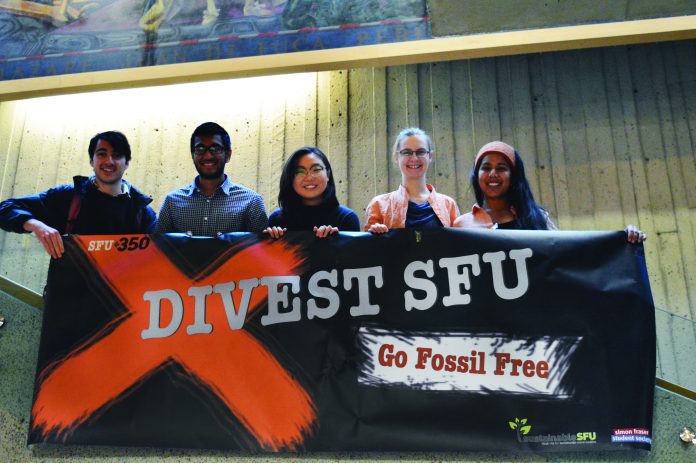
Petter also thanked the various advocacy groups at the university, including SFU350 — a SFU student climate action organization aimed to encourage SFU to divest from fossil fuels — for pushing and helping the board “to think of ways that you can develop an investment policy that will in fact contribute towards reductions in carbon investment and achieve climate change targets.”

Board chair Bill Cunningham said that “this is probably, more than anything on my time on the board, symbolizes what it means to be a part of the SFU community.” He added that groups like SFU350 and Embark have all been a part of “helping us get to this point.”

Deven Azevedo, former undergraduate representative for the BOG in 2014–15 and chair of Embark, said to The Peak following the announcement, “it’s been the culmination of about three years of work and two and a half years since SFU350 last attended [the] March 2014 BOG meeting, when the issue was first brought to the board.”

Azevedo explained that it’s been an evolutionary process from the point where the board was not previously as positive about this issue, but remained open to speaking about it. “[I]t definitely allowed us to continue our advocacy.”

Petter addressed some of the issues that complete divestment poses, which is the goal of the SFU350 organization, and explained that much of the university’s investments are located in “pooled funds”; so, “we can’t aggregate or disaggregate the carbon components of those funds [. . .]  and it would put the university at risk in terms of getting a return.” He added that the direct investments that the university does hold are not within any fossil fuel companies.

Tessa Ramburn, president of the SFU350 organization, said that “SFU350 is very happy that the motion has passed and it’s a positive first step forward in the right direction. We are also looking forward to continue to work with the board of governors in pushing for full fossil fuel divestment.”

Jessie Russel, social media coordinator for SFU350, added that “this is a huge first step, but 30 percent by 2030 is not fast enough [. . .] I think moving forward, really looking at the endowment as a whole and also looking at benchmarks that are much closer than 2030.”

Ramburn explained that research coming out of the university itself by Kirsten Zickfeld, an SFU professor and climate scientist, indicates that “30 percent by 2030 is just not enough.”

However, she explained that the president’s commitment to inspiring other universities to follow suit is “one aspect of divestment that make it such a powerful movement [. . .] All of this work is not just SFU350 or just Embark, it’s the entire support of the Divest SFU movement, and that’s huge.” This includes the “thousands of students and faculty members that have put time and energy into this [. . .] so we are really grateful that we have the support of the entire SFU community.”

Quality and quantity: New B-Line to replace 135

2

CORRECTION: In a previous version of this article, we stated that the 95 B-Line will have three-door boarding at all stops. Translink has informed The Peak that three-door boarding will only be available at SFU stops. We regret the error.

Change is in the air for SFU students. The 135 bus will soon be no more than a distant memory as it’s replaced by a successor: the new 95 B-Line.

This deeply contested lifeline between Harbour Centre and SFU Burnaby has been a hot topic for years, having come into question for replacement as far back as 2009. Due to frequent changes and pushbacks, the concept of the B-Line hasn’t come to fruition until now. It will be released on December 19 to coincide with the Millennium Line Evergreen Extension that will service Coquitlam, as the 135 is discontinued.

In an email to The Peak, TransLink explained that the 95 B-Line is intended to be a more reliable and direct service, with fewer stops along Hastings Street than the previous 135 bus route. It will also run more frequently, operating every five to eight minutes during peak hours and 12–15 minutes in off times, as stated in TransLink’s 10-Year Vision Public Consultation Summary Report, published earlier this year.

According to TransLink, the 135 was the sixth most-crowded bus route in 2015. It has among the least punctual performances in their system as well, due to high congestion on Hastings Street. As a result, it is subject to some of the worst bus bunching in the Lower Mainland, where users cite waiting tirelessly for a delayed bus, only to have two or even three show up at the same time. By moving to limited stops, TransLink hopes that customers will notice significant improvements to reliability and efficiency of the service.

Travis Cheney, a fourth-year SFU student living in Burnaby Heights, often experiences this. “As somebody who needs to be downtown at a specific time to make it to work, I definitely opt into taking the SkyTrain instead of the 135 because it offers greater consistency,” he said. “I’d be more inclined to take the 95 B-Line knowing it wasn’t going to stop every 500 metres.”

While the 95 B-Line hopes to solve a lot of the problems that student face on their commute, there will be questions of concern. “On the 135, I’ve experienced intense verbal assault,” said Shmygol.

For many SFU students, the issues that the 135 brings up about inefficiency is an important part of their everyday life. “The thing that bothers me is that it’s labelled an express bus, but as soon as it gets to Burnaby it still stops every block,” said Sarah Duggan, a third-year student who commutes from North Van.

Scout Shmygol, a student who lives in Mount Pleasant, often has classes on both campuses, and sometimes on the same day. “I think a B-Line to SFU is necessary, and about time. It can take an hour to get from Harbour Centre to Burnaby Mountain on the 135 right now,” she said.  “It’s such a popular route, and SFU is a major university in BC, which is quite frankly a hassle to access. Easing and expediting this is very exciting.”

While the 95 B-Line will ultimately improve user experience, it also means a loss of stops that are important to accessibility for residents, particularly for elderly residents or those with disabilities. “Walking that extra few blocks might not mean much to a lot of us, but it will to them,” said Duggan.

According to TransLink’s notice boards on the 135 route, busses stopping locally after December 19 will be the 14, 144, or 160, which some users have expressed they’re not aware of. However, there are a lot of other busses near that route, especially in East Vancouver where student Grace Lam lives. “There’s the 14 and 16 on Hastings, but there’s also the 4 and 7 primarily on Powell and Dundas. They run parallel to Hastings and are only two blocks down [. . .] Many people don’t know about that,” she said.

The new bus will also feature three-door boarding at SFU stops, a trademark of the other B-Lines in the city. This should make boarding more effective, particularly during peak hours at the SFU Burnaby transportation centre. The majority of SFU students have Compass cards, making the feature more feasible.

While the 95 B-Line hopes to solve a lot of the problems that student face on their commute, there will be questions of concern. “On the 135, I’ve experienced intense verbal assault,” said Shmygol. “This B-Line is fast, but does nothing to address the unsafe climate of that bus route that many women feel.” She also noted that the three-door system might not be all that it’s cracked up to be: “It removes the ‘gatekeeper’ element intended to monitor access to transit services; it takes away another element of safety.”

Only time will tell how people react to the big changes coming to the popular Hastings Street route, but for many students like Duggan, it’s an excited anticipation. “The whole purpose of a B-Line is to get you from A to B as quickly as possible, and that really benefits everyone.”

The 95 B-Line will stop at:

Burrard Station, Granville Street (Waterfront Station), Cambie Street/Abbott Street, Main Street, Commercial Drive, Nanaimo Street, Renfrew Street, Kootenay Loop, Gilmore Avenue, Willingdon Avenue, Hythe Avenue, Holdom Avenue, Kensington Avenue, Duthie Avenue, and SFU Transportation Centre.

Indigenous voices highlighted at Media Democracy Days

0

Following the election of Donald Trump in the United States, the word “democracy” has been mentioned a lot in the last few weeks. What does democracy mean to us in Canada? Is it making sure all citizens have an equal voice in society?

These were the very questions asked at Media Democracy Days (MDD) 2016 on November 15–16 and 19, hosted by SFU Vancouver and the Vancouver Public Library (VPL). The multi-day event held workshops, screenings, and public lectures around the democratization of media in Canada. It urged people to consider the ethics of media coverage, asking whose stories get told or ignored in contemporary Canadian society.

MDD was founded in 2001 by the Campaign for Press and Broadcast Freedom in Toronto and Vancouver. Now OpenMedia, the group has joined forces with VPL and the School of Communication at SFU to produce this annual event for independent and alternative media in Canada. This year, MDD covered topics like “Decolonizing the Media,” “Protecting the Right to Protest: Free Speech versus Corporate Power,” and “Amplifying Stories of Displacement.”

The keynote speaker was Ryan McMahon, an indigenous media maker and comedian who is the host of the acclaimed podcast Red Man Laughing.

McMahon began his talk by singing a traditional “trade song,” filling the room with his deep voice and the striking of his hand drum. He then chillingly told us that tribes in Northern Ontario had sung this song to welcome the first settlers, who they believed had come to help them.

His lecture, “Digital Media, Bush Tea, and Dibaajimowinan,” filled the seats of the lecture theatre at Harbour Centre. He raised important concerns regarding indigenous representation in media. Though many times during his talk, McMahon had the room laughing, at the heart of his message was a sombre appeal. He said it is the cultural stories and collective sharing that keep indigenous culture alive, and indigenous media initiatives provide that much-needed platform.

Janet Rogers had a similar message later in the afternoon in her public lecture “Native Waves Radio.” A Mohawk broadcaster and producer, Rogers has been involved in indigenous initiatives all over the country for decades, most recently co-creating the podcast series NDNs on the Airwaves. Rogers stressed that media has power, and “creating and maintaining indigenous presence on the airwaves is of utmost importance” to reclaim that power.

The MDD slogan this year is apt: “Know the media, be the media, change the media.” As Stuart Poyntz, associate professor in the SFU School of Communication, pointed out in his introduction to the event, media democratization today is a real concern as right-wing public policy gains momentum following Trump’s election.

Media Democracy Days shed light on a time when social justice and democracy are internationally under threat. This event stressed that media represents the plurality and complexity of our Canadian society, more important now than ever.

“Santa is real,” and other acceptable lies to tell children

0

I don’t have a favourite child

Those of us who have siblings remember a time when our sibling received special treatment, and out of jealousy, we accused our parents of preferential treatment. Depending on how well your parent lied, you either walked away knowing that wasn’t the case, or hardened and emotionally scarred.


We later grow up to learn that parents do, actually, prefer one child over the other, and that changes depending on circumstance. Remember that time when you yelled and screamed because you didn’t want broccoli and your brother ate his without any fuss? Yeah, you were not the preferred child in that situation.  


I do it because I love you

Ah, if it isn’t the old justification for corporal punishment.  This one is often interchangeable with “This hurts me more than it hurts you” — as if Mom pulling down your pants and giving you a spanking somehow injures the moral fabric of her soul.  

“I do it because I love you” translates more directly to “You’re being a shit and I’ve run out of ways to express it.”

They don’t sell batteries for that toy anymore

Remember that one musical toy you kept winding up and letting go while Dad was trying to get work done? You may appreciate how annoying that was now (and also find that some of your colleagues never grew out of the behaviour), but back then the lie was traumatic and heart-wrenching. You mean I may never experience the joy of Simon the Cymbal-playing Monkey again? The one that Uncle Stan got me for Christmas?


Your parents never told you at the time, but it’s very likely they never got over their hatred of Uncle Stan.

The important thing is that you participated

Remember the first time you went to a track meet, and you came dead last in the 100m dash closely following Carl, who easily managed to outrun you despite having a stunted leg? Mom or Dad may have hugged you and told you that winning doesn’t matter, but that’s only because they’re hoping that your high grade in math would somehow help you in the job market, and that the glory showered down upon the winner of the race was as short-lived as possible.

Your parents basically learned to play the long game at an early age, but that isn’t to say that winning something athletic would hurt every now and again.

You can’t have sex before marriage

Perpetrators of this lie tell their children that they can’t have sex before marriage as if it is a universal, physical maxim that all society follows innately.  

It actually holds just about as much truth as “You can’t have any dessert until you finish your vegetables.” You can, in fact, have sex before marriage just as much as you can steal the tub of ice cream from the freezer while Mom isn’t looking.  

At some point, you grow up to learn that your parents’ morals aren’t universal truths, and vegetables, like sex, can be consumed in whichever order you please.


12 Days of Finals

0

On the first day of finals
The stress brought to me:
At least one mental breakdown.

On the second day of finals
The stress brought to me:
Two-day extension
and at least one mental breakdown.

On the third day of finals
The stress brought to me:
Three hours sleep
Two-day extension
and at least one mental breakdown.

On the fourth day of finals
The stress brought to me:
Four study groups
Three hours sleep
Two-day extension
and at least one mental breakdown.

On the fifth day of finals
The stress brought to me:
Five failing grades
Four study groups
Three hours sleep
Two-day extension
and at least one mental breakdown.

On the sixth day of finals
The stress brought to me:
Six snack plates
Five failing grades
Four study groups
Three hours sleep
Two-day extension
and at least one mental breakdown.

On the seventh day of finals
The stress brought to me:
Seven cups of coffee
Six snack plates
Five failing grades
Four study groups
Three hours sleep
Two-day extension
and at least one mental breakdown.

On the eighth day of finals
The stress brought to me:
Eight more readings
Seven cups of coffee
Six snack plates
Five failing grades
Four study groups
Three hours sleep
Two-day extension
and at least one mental breakdown.

On the ninth day of finals
The stress brought to me:
Nine hours of Netflix
Eight more readings
Seven cups of coffee
Six snack plates
Five failing grades
Four study groups
Three hours sleep
Two-day extension
and at least one mental breakdown.

On the 10th day of finals
The stress brought to me:
10 weak excuses
Nine hours of Netflix
Eight more readings
Seven cups of coffee
Six snack plates
Five failing grades
Four study groups
Three hours sleep
Two-day extension
and at least one mental breakdown.

On the 11th day of finals
The stress brought to me:
11 late assignments
10 weak excuses
Nine hours of Netflix
Eight more readings
Seven cups of coffee
Six snack plates
Five failing grades
Four study groups
Three hours sleep
Two-day extension
and at least one mental breakdown.

On the 12th day of finals
The stress brought to me:
12-page papers
10 weak excuses
Nine hours of Netflix
Eight more readings
Seven cups of coffee
Six snack plates
Five failing grades
Four study groups
Three hours sleep
Two-day extension
and at least one mental breakdooooown.