Home Blog Page 648

Student-run literary magazine Lyre launches its eighth edition

0
A previous issue of The Lyre. (Image courtesy The Lyre)

SFU-based, student-run magazine Lyre launched its eighth edition on Thursday, November 2.

     Lyre Magazine is an annual publication that has published short fiction, screenplays, poetry, translations, and photographs since 2009. The magazine is edited, designed, produced, and published by a team of student volunteers from different programs and faculties at SFU. This year, the Lyre’s theme was “Questioning Memory and Nostalgia.”

“It’s a topic very close to my heart,” co-editor-in-chief Iulia Sincraian said. “I find nostalgia very interesting, in the way that people look at the memories that exist and how they reconstruct them through time.”

     The Lyre’s editorial team had its hands full while putting together this edition in particular as over 200 submissions poured in. Contributors came from all different walks of life and majors, and were based anywhere from SFU and UBC, to other Canadian universities; there was even work from New Delhi’s Indian Institute of Technology.

“This is huge for a student-run magazine that’s associated with a fairly small program [World Literature],” Sincraian said. “That’s a lot of people who have trusted us with their work and with their memories, and what’s closest and deepest to them, so I think that’s really beautiful. And it’s a great example of how literature brings people together.”

One such contributor, second-year English major Brittany Barrell, had her short story Set in Stone published in this year’s edition of the Lyre.

“I really wanted to get something published and so I was like, ‘OK, what kind of publications are there around SFU?’” she said. “And at first I was kind of disappointed because I couldn’t really find anything for fiction or poetry, and then I found the Lyre.”

“I think it really encourages students to write and to become involved,” Barrell said when asked about the merits of having a student literary publication on campus.  

     The Lyre’s launch party was combined with a gala celebrating a decade of World Literature (WL) at SFU, as the program turned ten years old this fall. Contributors and WL students were invited to mingle and celebrate with refreshments, book raffles, and literary trivia.

     You can read Lyre Magazine: Questioning Memory and Nostalgia through Open Journal Systems online, and printed copies can be picked up for free outside the World Literature offices in the humanities department on the fifth floor of the Academic Quadrangle.

If you’re interested in publishing your own work in the Lyre Magazine, the next call for submissions will be going out sometime in Spring 2018.

SFU students report mysterious yellow orb floating in the sky on Burnaby campus

0
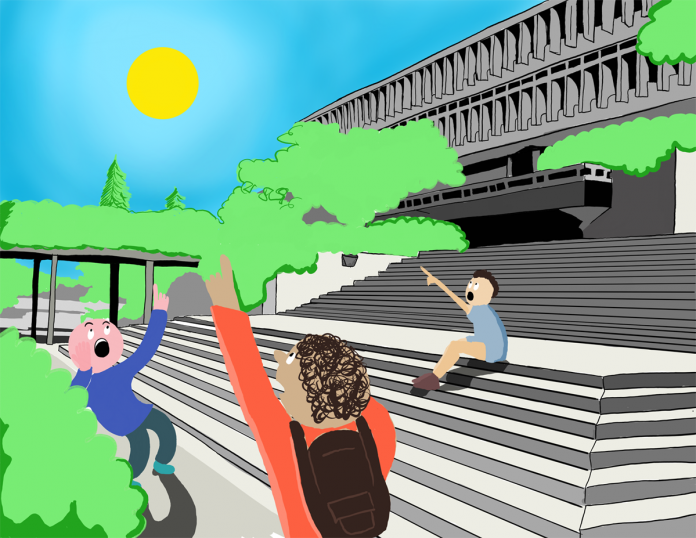
Illustration by RESLUS

Students at the SFU Burnaby campus have been reporting sightings of a large yellow orb floating in the sky. Many have reported that the presence of this floating orb has generally coincided with the campus being bathed in light, which very strangely causes the campus to seem less grey. It has also been noted that being exposed to the light emitted from this orb often results in a subtle, yet (reportedly) pleasing warmth to spread across your body. Some students have even gone so far as to say that its presence has raised their moods and has caused higher levels of joy than is regularly experienced on campus.

SFU administration would like to firmly state that the presence of this glowing orb is not normal. An investigation is currently being conducted on why it has been spotted, what ulterior motives it may have, and what SFU administration could possibly do to prevent its presence in the future.

This institution hopes to inform students that the floating yellow orb should be avoided at all costs. Although the current investigation into the origins of this orb is far from complete, there have been some initial findings that indicate that it is a threat. There have been multiple severe dangers that accompany this orb. Examples include:

  • Burning of the skin
  • Pain experienced in the eyes when observed directly
  • A profound and new sense of optimism
  • Dehydration
  • A sense of purpose in life

If you have been experiencing any of these symptoms, it is likely due to prolonged exposure to this mysterious orb. These symptoms are dangerous, and if they are experienced, you should be checked immediately. The clinic will be holding extended hours, and staffing has been increased. SFU has made relieving students of these symptoms its top priority.

If you have experienced these symptoms, but are unable to make it to the clinic due to an overwhelming amount of homework and exam preparation for your classes, here are some tips to help relieve these symptoms on your own:

  • Instead of looking at the mysterious orb, look at the campus around you. This will relieve any pain in your eyes, while simultaneously reminding you of the drab hell hole constantly surrounding you.                                                                                                                                                                                                      
  • Contemplate the magnitude of the homework that is preventing you from receiving the medical/mental aid and assistance you need.                                                                                                                                                                 
  • Avoid spending stretches of time outside socializing with your friends. While spending time with friends outside in the warmth might seem appealing, it is one of the surest causes of these symptoms. Instead, stay inside, cold and alone.

SFU football comes so close in 24–21 loss to Western Oregon

0
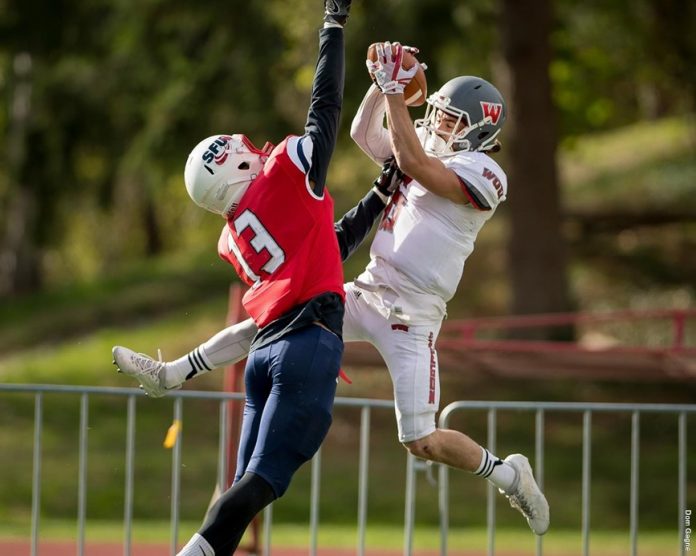
In a season filled with many blowouts, this was the closest the Clan came to a win. (Photo courtesy of SFU Athletics)

For a moment, fate seemed to be on SFU’s side.

Down by three, with 50 seconds left in the game, SFU probably got a bit lucky with a pass interference call against Western Oregon. With a throw that probably wouldn’t have been caught on third and 24, SFU instead gained 11 yards and a first down to continue their last drive of the game.

Just before that, SFU had been lucky to keep the drive going, after Great Northwest Athletic Conference tackle-leader Bo Highburger forced a fumble from Nathanael Durkan’s hands, only to have Gavin Cobb right there to scoop it back up for the Clan.

Now, a 20-yard pass to Durkan, two catches by Rysen John, and a face mask penalty against Western Oregon had them lined up first and goal, just seven yards away from their first win of the season.

But then, it seemed that the luck scales took an inopportune time to balance out.

Quarterback Miles Richardson had to escape a sack by fumbling a ball out of bounds. The loss of four yards wouldn’t have been the end of the world, but then freshman Brayden Gatland was assessed a 15-yard foul, putting them out of range for any easy play with five seconds left.

Even from the further distance, SFU still decided to go for the field goal. Without their starting kicker Patrick Hegarty — who left the game injured, when Western Oregon took a roughing the kicker penalty — it was up to freshman wide receiver Ethan Beselt to make the 47-yard kick.

It was an admirable attempt by Beselt — who made three extra-point kicks in the game — but it fell short of the goal posts. 24–21 was the final score, and for the third straight season, SFU left without a win.

“It’s very important to understand that to be realistic about the game. I think we probably let one slip away. I don’t think we were beat, I think we beat ourselves,” said head coach Kelly Bates.

It was a loss that probably stung like no other during the season. While each blowout loss must hurt, by the end of the game, the loss was a long foregone conclusion. This was a game that SFU could have, maybe even should have, won.

But in such a tough season, this game can’t be looked at as anything other than positive. For the first time this season, SFU was competitive all game against Division II competition. This was a team that had beat them 82–21 at home. If nothing else, it was exciting football to watch.

“We finished on a high note, even with the loss, just by being competitive in a game of that nature on the road, and I think that experience is invaluable,” said Bates. “What it should show them is that by sticking to the process and understanding the process and the long-term vision, that they showed growth throughout the year.”

Richardson had a solid game, throwing for 238 yards and only giving up one interception and three sacks. The ground game wasn’t great, but it wasn’t a huge negative, with 70 yards of rushing offence — 38 of them by Richardson.

“It came down to the offensive line battling much more consistently, giving our quarterback some time to take a look down field and see the big targets,” explained Bates. “It gave us a chance to work down the field.”

The game started on a series of weird, quick turnovers. Richardson fumbled the ball on the first play of the game, giving it to Western Oregon, who then fumbled the ball and gave it back just three plays later. Then, Richardson tossed an interception two plays later. At SFU’s five-yard line, one pass was all it took for Western Oregon to open the scoring  at 7–0.

Neither team scored the rest of the first quarter, thanks in part to a missed 28-yard field goal attempt by Western Oregon.

Western Oregon did end up putting up a field goal in the second quarter to make it 10–0.

Gabe Lopes intercepted a Western Oregon pass at their 20-yard line with about six minutes left in the second to give SFU the ball. Dionte Simon ran it in for a touchdown to put SFU on the board.

Western Oregon answered back the next drive to go up 17–7.

SFU started gaining positive momentum in the third quarter. After stopping Western Oregon’s first drive, SFU marched down the field for their second touchdown, starting at their own 20-yard line. A 12-yard catch by Cobb gave SFU the score.

On the next drive, SFU’s Jaryn Bailey intercepted the ball on the second play, giving SFU the ball back just 40 seconds later.

The Clan took 4:08 to get it down the field, with Richardson running it in for the touchdown, and their first lead of the season at 21–17.

While SFU was able to sustain the momentum for a bit into the fourth quarter, it seemed to dissipate during Western Oregon’s second drive of the quarter, and the defence wasn’t able to put a stop to the Wolves’ rush down the field, and what would turn out to be the game-winning touchdown.

John, who has shown signs of being a go-to receiver this season, put 88 receiving yards on five receptions. Lopes led the team defensively with 12 tackles (seven solo) and an interception.

Hopefully this game can be something to build on next season. While one of the Clan’s big weaknesses was a small junior and senior class, it means that the majority of the players should be back next season — 67 of the 71 players will be eligible to return.

While the season has ended, the work begins immediately.

“Now that the off-season has started, and make no doubt about it, it has now started, [the players] must come together and work their butts off to get ready for next year,” said Bates.

The coaching staff can now set their full-time focus on recruiting.

While there are certainly pressing areas that SFU needs to recruit for — the offensive line, for one — the biggest thing they need to do is add numbers, to have a full roster and enough depth to account for inevitable injuries.

“Everything is about recruiting, we must build our depth and we must bring in another large class and push our roster towards 100,” said Bates. “It’s about creating consistent turnover, it’s about bringing in top-level talent and all levels of talent that will compete to be better and make this team better.”

Vancouver eats

0

I love food and I spend far too much money on it. While intellectually, I understand that it is cheaper and healthier to pack a meal from home, I admit that I am weak. I am easily seduced by seasonal coffees and fresh-baked goods. The siren sizzle of fried meats is so much more appealing than my lacklustre ham sandwiches. An Instagram-able salad is far superior to the wilted mess I’ve tried to dig out of a Tupperware container. Food is one of my easily justifiable indulgences.

For the past four semesters, the majority of my classes have been at the Harbour Centre campus. Interestingly, for the past four semesters I have consistently over-extended my food budget.

Instead of beating myself up about my lack of meal-planning and financial self-control, I have decided to reach a medium ground that marries my love of food with my dwindling budget. Most students have the deals on Burnaby campus down to a science; Vancouver campus is an entirely different beast. The easy route is to remain in the building and descend to the food court or Tim Hortons. That gets old extremely fast. However, once you venture outside you can easily be swept into Gastown, overpriced cafes, and long waits.

This is intended to be a list of suggestions for reasonably priced food within a walking distance of SFU Harbour Centre. Ideally, one would be spending less than $10 for any meal, and walking for less than five minutes to get to the establishment.


  1. Bon Chaz: 426 West Hastings Street
    Walking time: 1:45
    Breakfast/lunch/dinner
    Vegetarian options

If you arrive before 10:17 a.m. precisely, with the purchase of a hot beverage you receive a complimentary specialty sweet bun. These are buttery and delicious and light — a perfect morning snack. I typically get a large americano before my 9:30 a.m. lecture, and am able to slowly wake up for less than $3! Take that, Starbucks.

This place is so great it gets you through lunch and dinner as well. Something like a soup or sandwich individually run for more than $5. This isn’t a terrible price, but it gets better! The deal allows you to get any two entrees for $9. I usually get a sandwich and a pasta dish, and that has the benefit of being two meals because the portions are decently sized. You can also select a soup or salad; it’s all great value. Start a rewards card with them and you can, over the course of the semester, earn free things!


  1. Bean Around the World: 175 West Hastings Street
    Walking time: 3:15
    Breakfast/lunch

If you have a bit more time to kill before a morning class, grab your coffee and a breakfast sandwich from here! The breakfast sandwiches are delicious, and only $4.25. A light lunch here won’t break the bank either.

Tip: if you go to this location, maybe cheat a little and skip a few doors down to Pure Bread and get a decadent pastry for later.


  1. Pholicious: 550 West Hastings Street
    Walking time: depends on decisions involving jaywalking and crosswalks, but around 1:00
    Lunch/dinner
    Vegetarian options

I cannot stress enough how convenient and cheap this place is. Almost every item on the menu is less than $10. For the price, the quality is not bad and I would definitely recommend this place before its ‘competition’ in the food court. The subs are packed with meat and cost less than $5. It is literally across the street from the main entrance to school. I’m not suggesting jaywalking, but the crosswalks are technically a detour because it’s that close.


  1. Goldies Pizza: 605 West Pender Street
    Walking time: 2:05
    Lunch/dinner

While this is a great place to share some pizza as a sit-down meal, the ‘student-friendly’ feature is the walk-up window. For around $3 a slice you can get a variety of gourmet pizza. Fast, cheap, and delicious!


  1. The Rogue: 601 West Cordova Street
    Walking time: about 1:00
    Lunch/dinner
    3 p.m.–6 p.m. happy hour

OK, this one’s for when you want to treat yourself and not feel guilty when you look at your card statements! Happy hour at the Rogue has some great deals — almost all of the food menu comes in below $10, and it’s a great place if you’re feeling up to a light snack before or after a class. In addition, there are some very attractive deals on the drink menu. An added benefit for those students that come in on the train is that the Rogue is in Waterfront Station, so it’s extremely easy to find.


  1. Brioche Urban Eatery: 401 West Cordova Street
    Walking time: 3:00
    Lunch/dinner
    Vegetarian options

If you’re just scanning the menu, this place comes across as fancy. The pastas are homemade and over $15 a plate. Even I can’t justify that (most of the time). However, the discerning eye will notice that there are paninis on the menu. You can get a delicious panini for $9.75. It is absolutely huge! The bread is freshly-baked and the fillings are great quality. It’s also a nice place to study before they switch over to dinner, so take advantage of that every now and then!


  1. Kita no Donburi: 423 Seymour Street
    Walking time: 1:15
    Lunch/dinner

I love Kita no Donburi. Sometimes all you want is a fully loaded rice bowl — and this place has them all. The best value is the Gyuu Don for just over $8.00. If you can snag a table, it’s a great environment to relax and have a quick meal. However, they also have to-go. There are some pricier things on the menu, but if you stick with the simple stuff you can definitely fill up for a decent price.


  1. Momo Sushi: 6-375 Water Street
    Time: 2:45
    Lunch/dinner
    Vegetarian options

This place gets BUSY, so be warned. It’s very popular with Gastown tourists. If you have the time, stay and eat there because it is a really interesting place! I like to take advantage of their lunch specials because you get some really good cuts of fish for $9.40. You can wait for take-out or, if you’re really wanting to capitalize on time, order it for pick up and enjoy your sushi back on campus.


  1. Nuba: 207 West Hastings Street
    Time: 3:00
    Lunch/dinner
    Vegetarian options

Dinner can get slightly pricey here, but the food is so good. As its slogan says, it’s “healthy, fresh Lebanese.” I recommend a light lunch if you want to keep it under that $10 mark. There are a lot of delicious vegetarian options for pitas, which start at $8, and the $6 soups are excellent on a rainy Vancouver day. It also has a lot of great dishes for sharing with friends which helps cut down on costs.


  1. Finch’s: 353 West Pender Street
    Time: 3:00
    Lunch
    Vegetarian options

This is a favourite of mine for when you want a sandwich, but also want to feel fancy. There are some quality ingredients that go into these sandwiches, and quite a few come in under $10. The soups are also very good value. A big draw for this location is the vegan and vegetarian options. If you can snag a seat, it’s a very charming space. But if you’re strapped for time, they will bundle your sandwich up in some butcher paper and you can slip quietly into your seat after the mid-lecture break.


These are just ten suggestions for Vancouver campus students to try out, and I’m sure there are many more. There are so many great places to eat downtown, it’s a shame if you don’t take advantage of them every now and then. Whether you are buying something every time you go to class (guilty!) or saving for a once-a-week indulgence, try to get away from campus and get more of what the location has to offer. And, if there are any amazing deals that were not included in this small list, maybe drop The Peak a line because as you can probably tell, I love food.

SFU president visits Asia to expand university connections

0
SFU President Andrew Petter was welcomed to Beijing in 2015 by Hanhai Chairman Hanguang Wang.

SFU President Andrew Petter was recently in Asia visiting the university’s partner schools in Beijing, Shanghai, Hong Kong, and Singapore, looking at ways to bridge more connections with the institutions.

“By strengthening our ties in Asia, we will provide our students, researchers, and community partners with new and exciting opportunities to connect and collaborate on the world stage,” stated Petter in a press release.

On October 30, Petter signed a new memorandum of understanding with Hong Kong Baptist University, one of Simon Fraser University’s partner institutions in the region, as part of his visit. The agreement will facilitate new collaborations between the institutions.

The city of Hong Kong is home to the largest concentration of Simon Fraser University alumni — approximately 2,500 — outside of Vancouver. Signing the new deal will increase opportunities for SFU students and staff to participate in interdisciplinary and international projects, according to a press release provided to The Peak.

Petter also paid a visit to Hong Kong Polytechnic University, where he discussed ways to provide more collaborative projects for the institution’s staff and students.

The university has established a total of six partnerships with universities in the international financial hub and is considering the potential for pan-pacific programming in business in culture to link the two cities.

“The new [memorandum of understanding] with [Hong Kong Baptist University] reflects our mutual commitment to forge new collaborations, including double degree programs, to enhance opportunities for student exchange,” said Petter in the press release.

“Developing relationships in Asia has been a long-standing priority of SFU’s international engagement strategy, and we look forward to broadening and strengthening these relationships in the future.”

Petter will be reporting to SFU Senate in early December about his delegation to Asia, expanding on SFU’s collaboration with Fairchild Group in Hong Kong and mainland China, a renewed student mobility agreement with Renmin University and Shanghai Jiao Tong University, and the new regional SFU engaged alumni leadership award.

Thor: Ragnarok is an action-comedy thrill ride

0
(Image courtesy of Walt Disney Studios)

Are you looking for a worthwhile film to watch during the cold, frigid weather? If you are, I suggest you watch Thor: Ragnarok. Taika Waititi (co-director of What We Do in the Shadows) crafts an entertaining sequel to Thor: The Dark World. Filled with relentless action, impressive performances, and well-executed humour, this film is not to be missed.

     Through heart-pounding action, the film maintains an exhilarating rock ‘n’ roll vibe, especially with Led Zeppelin’s “Immigrant Song” playing during Thor’s hardcore fights at the movie’s start and end. The most epic action sequence is a brutal, gladiator fight between Thor and Hulk (Mark Ruffalo). This fight is as intense as it is groundbreaking. Not since Captain America: Civil War have I seen such a satisfying battle between heroes.

     Contrary to the film’s title, the story does not focus much on Ragnarok (the Asgardian end times). The film actually unravels into an action-comedy. Humourous, anti-climactic events and witty dialogue throughout the film’s many action scenes provide comic appeal in an otherwise serious story. Laugh-out-loud moments even ensue during Thor and Hulk’s gladiator fight, providing a light-heartedness that transforms their bout into an aesthetic balance of humour and action.

     Chris Hemsworth as Thor and Tom Hiddleston as Loki deliver amusing, confident performances. Portraying the famous Norse brother-god duo for the third time, Hemsworth and Hiddleston provide an energetic bravado and the occasional bit of semi-slapstick comedy. Hemsworth’s chemistry with Hiddleston is as strong as ever, enabling them to dive deeper into the complicated relationship between Thor and Loki. It’s not just about family drama though, as the narrative structure’s fast-paced style continues to pull us back into the fun atmosphere that the film strives to keep up.

     The other actors in the film also have impressive chemistry with Hemsworth. Newcomer Tessa Thompson’s portrayal of Valkyrie as a tough but apathetic warrior creates a compelling foil with Hemsworth’s performance of Thor as an optimistic hero. Ruffalo, who returns as Bruce Banner — the Hulk — creates a hilarious, dysfunctional social dynamic with Hemsworth.

     Cate Blanchett is viciously good as main villain Hela, the goddess of death. She portrays Hela as a dreadful megalomaniac and warmonger. Blanchett’s performance brings an overwhelming ferocity to her character. She raises the bar for the kind of power we can expect from a supervillain, especially in the scene (shown extensively in trailers) where Blanchett as Hela destroys Thor’s hammer with ease.

     A special treat in the film is Doctor Strange’s cameo, and Benedict Cumberbatch makes a captivating appearance. Strange’s encounter with Thor is layered with banter and awkwardness that is genuinely funny. This iconic moment between these two legendary Marvel characters sets the tone for the highly anticipated Avengers: Infinity War movie coming out in 2018.

With stylized action, impressive performances, and high-quality humor, Taika Waititi’s film is a must-see superhero adventure that just might be the best instalment in the Thor franchise.

Women’s and men’s cross country both finish fourth at regional meet

0
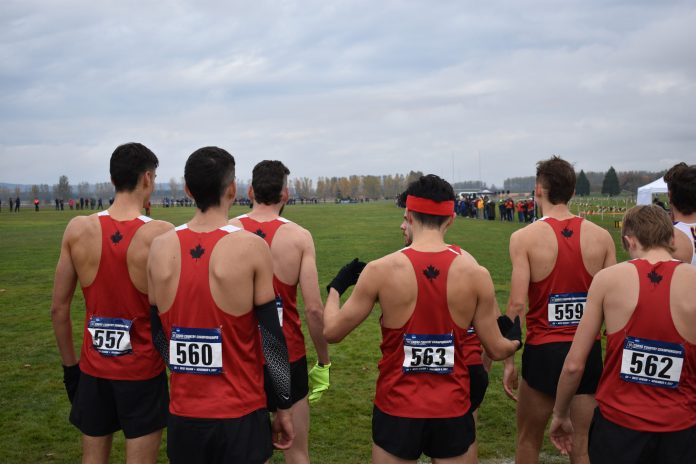
The men's side could not have been closer to going to the national tournament. Mateo De Dalmases / The Peak

The SFU women will be the only team representing SFU at the 2017 cross country nationals held next week in Evansville, Indiana.

After both teams prepared consciously for the most important race of the season, given that it’s the race that determines who gets the passport to nationals, the SFU cross country teams both had impressive performances at the regional meet in Monmouth, Oregon. Both teams placed fourth in their respective races, competing against a very deep field, given that the West Region is one of the most competitive regions across the entire National Collegiate Athletic Association Division II (NCAA DII).

The women were the first ones to race and had a very good performance in which they fulfilled the expectation and goal of qualifying for nationals that they had in mind. Julia Howley led the team again, with an impressive sixth place position. Howley has led the team in every race this year and is about to finish her last and most successful season of her university career. SFU is definitely going to miss Howley’s talent and sacrifice in following seasons.

Another senior, Miryam Bassett, was the second woman to cross the finish line in a strong 17th position. Bassett had an irregular start to the season but has shown in the last few years that she can really peak for the end, which is when it matters the most. Addy Townsend and Olivia Willett were the next two SFU women to cross the line together at 33rd and 34th, respectively. Chelsea Ribeiro closed the scoring team, coming in 37th. Sophie Dodd (74th) and Paige Nock (117th) completed the team.

On any other year, with the same results, both men and women would have earned a spot in the national championship. This year, however, the NCAA implemented a new system that changed the qualifications to reach the championship. The details of the system are complex, but the whole point of it is to supposedly favour teams in stronger regions in order to have the best teams of the NCAA DII in the national championship. The system was highly controversial as it resulted in only three teams from the West Region (SFU’s region and the strongest of the entire field) qualifying, while there were other regions who got up to seven teams.

The most frustrating part of it all for the men is that they had one of the best races of the season, and definitely their most successful regional championship yet with four of the five scorers in the top 25. The individuals who got in the top 25 were honoured with the all-region credit, and these were Oliver Jorgensen (15th), Sean Miller (16th), Rowan Doherty (19th), and Mateo De Dalmases (25th). Carlos Vargas completed the scoring team in a solid 46th position and was followed by Dawson Ribeiro (88th) and Chris Sobczak (101th).

The women’s cross country team will be back in action next week for the NCAA Cross Country Championships. This will be the last race of the cross country season. The championships will take place on Saturday, November 18.

SFSS prepares for student vote on U-Pass renewal

1
The referendum will need a five per cent turnout and a majority ‘yes’ vote in order for students to keep their U-Pass.

The Simon Fraser Student Society (SFSS) is holding a referendum later this month for undergraduate students to vote on the renewal of their Universal Transit Pass (U-Pass) agreement, which is slated to expire in April 2018.

The SFSS and other student societies in the province successfully negotiated to extend the current contract for student passes with local transit provider TransLink until the end of 2019.

SFU undergraduate students will continue to pay $41 per month to the student society for their transit pass if they vote ‘yes’ to extend the expiry date of the U-Pass program and agree to continue paying the fee. It is necessary for the society to put any change regarding a fee levied from students to referendum, according to Jimmy Dhesa, vice-president of student services.

“If the referendum question fails, the SFSS will no longer be able to collect the student society fee for the U-Pass,” Dhesa explained. “Consequently, the SFSS will not be able to accept the contract extension, and students will lose their U-Pass starting May 1.”

In order for the vote for the referendum question to be valid, a five per cent turnout from undergraduate students is necessary under society bylaws, which amounts to approximately 1,270 undergraduate students.

The cost of the U-Pass has increased over the past two years from $38 to $41 each month that a student is enrolled in classes, an increase of $1.50 each year. However, the current referendum question will not entail a fee increase and students will continue to pay $41 come next year.

“The SFSS has never had difficulty finding almost unanimous support for this program.” – Jimmy Dhesa, SFSS vice-president student services

According to Dhesa, the U-Pass is important to students because SFU is recognized as a commuter campus and having the student transit pass reduces a great deal of the expenses to students. The student pass costs only a fraction of a regular three-zone transit pass that TransLink currently prices at $172 per month.

The society is working towards getting the word out so that the referendum can meet its required voter turnout.

“The SFSS has never had difficulty finding almost unanimous support for this program,” said Dhesa. “The U-Pass is something that nearly everyone counts on for their transportation needs.”

Students who do not use public transportation are often unable to opt-out of the U-Pass program, unless they meet other requirements that make them exempt. Dhesa explained that “as with many social programs, everyone must pay into the program to make its benefits available. The U-Pass program and its prices are only possible because everyone contributes to it,” he emphasized.

Dhesa also noted that TransLink gives the university and the student society a quota on how much opt-outs they can give. Hence, the regulation is established to meet TransLink’s demands.

Online voting on the referendum question will take place from November 21–23 with the results being finalized on November 24, 2017.

SFU men’s basketball says mahalo for win against University of Hawaii at Hilo

0
Kedar Salam pitched in 13 points in 34 minutes for the Clan. (Photo courtesy of SFU Athletics)

The SFU Clan men’s basketball team played their first non-exhibition game of the season in Bellingham with a 87–75 win against the University of Hawaii At Hilo (UHH) on Friday night. This marks their second straight win (the other in exhibition play) as they were led by the strong, scrappy play of Iziah Sherman-Newson and the controlled leadership of Michael Provenzano.

In UHH’s first six possessions of the game, they attempted five three-pointers, but made none. SFU, on the other hand, got easy buckets through layups to take an early lead. UHH soon eased off from the arc, and utilized their size advantage to create second-chance points. Multiple in the first period ended with a four-point lead for SFU from great defence leading to fast break points.

The second period started the same way the first period ended. Michael Provenzano’s sticky hands snuffed any early buckets UHH were trying to get. Ignited by back-to-back three-pointers from N’Kosi Kedar Salam and Michael Provenzano midway through the second period, SFU went on a 12–2 run to take a 12-point lead.

UHH tried to get back into the game, but SFU denied them any chances of that, answering every basket. From then on, it was Hack-a-Clan. With college having the one-and-one rule (where you have to make the first free throw to gain the second), making free throws were key to winning the game. SFU did not waver as they ended the game shooting 74% (17–23) from the charity stripe.

Defence leading to easy offence seemed to be the theme of the game for SFU on Friday, as they forced 16 turnovers, leading to 25 easy points. A dark spot in the night’s win was that they lost the rebounding battle 38 to 35, while giving up 11 second-chance points. Despite this slight size disadvantage, however, SFU was still able to come up on top. To contend in the conference, they need to work harder on the glass to make up for their lack of size.

Senior forward Sherman-Newson led the team in points with 26 and also in rebounds with 12. Sophomore point guard Provenzano also had a strong game all around, narrowly missing a double double with 15 points, five rebounds, and nine assists.


SFU researcher investigates what draws enthusiasts to crop circles

0
At a recent conference for crop circle investigators, professor Paul Kingsbury observed a workshop where participants interacted with the circles through geometry.

An SFU professor is bringing together human geography and paranormal investigations with his latest research on crop circles. Paul Kingsbury, a professor in the department of geography, has observed that crop circle enthusiasts are less focused on the origins of the circles, compared to their beauty.

Kingsbury recently attended a crop circle conference in Wiltshire, England, an area where crop circles are often found, to investigate the research culture. In the summer that Kingsbury visited Wiltshire, thirty new crop circles appeared in the region.

Kingsbury made clear that his research did not focus on the validity of crop circles, but rather the research process itself. “I’m interested in how they work, why people get involved, and how they share knowledge,” he said at a lecture hosted by the geography department on November 2.

Geography professor Paul Kingsbury studies the culture around paranormal investigations.

The first recorded crop circle appeared in 1678 and since then tens of thousands more have been observed in fields around the world. What causes the designs to appear in the crops has generated a lot of attention — leading to one contemporary theory that they were created by aliens.

Kingsbury, whose research focuses on psychoanalytic, aesthetic, and paranormal geography, said that he thinks human geographers should take people’s social or cultural experiences in society seriously.

In an analysis of a geometry workshop, he noted how crop circle enthusiasts viewed the circles as having a sacred geometry, which they engaged with via drawing. This illustrates an area between the very tangible crop circles and the mystery of their meaning and origin.

During his visit to Wiltshire, Kingsbury visited some of the crop circles along with enthusiasts and spoke about the emotional reactions he witnessed when enthusiasts entered the crop circles themselves.

“People were hugging the crop circles, and tuning into the energy,” Kingsbury reported. “Desire is the key to people’s relationship with crop circles.”

Kingsbury’s research on paranormal investigators, which has led him to attend conferences and investigations on aliens, UFOs, and ghosts in North America, is funded by a grant from the Social Sciences and Humanities Research Council.

In the discussion section of the lecture, after an hour of Kingsbury interweaving crop circle research analysis with geography humour, an attendee asked Kingsbury if he planned to attend the Wiltshire crop circle conference again next summer. To that, the professor reported that next summer he will be attending a Sasquatch expedition.