Home Blog Page 628

Changes need to be made to SFU’s add/drop course policy

0
OLYMPUS DIGITAL CAMERA

This semester, if you experienced the unnecessary panic and frustration of needing to quickly decide whether or not to enroll in a course before the add/drop deadline, you are not alone. SFU consistently sets inappropriate deadlines that don’t give students enough time to evaluate a course and decide whether they are going to invest hundreds of dollars and endless hours into taking it.

With classes this spring semester beginning on Wednesday, January 3, I entered the second week of school not yet having taken three of the four lectures I was enrolled in. Shortly after classes commenced, I found out that the deadline to add or swap courses through goSFU, as well as the deadline to receive a full refund on any courses dropped, was Tuesday, January 9. I would have only a few hours after my first Tuesday lecture to decide on my final course schedule in order to avoid paying tuition penalties.

One lecture is not enough time to evaluate the workload, professor, and overall syllabus of a course. Some professors don’t even discuss the syllabus on the first day, so students have no idea how heavy the projects and assignments are going to be throughout the term. By the second week of classes, some of the lectures have not even had their tutorials yet. How is a student supposed to decide if they want to stay in a tutorial before they have even had it?

Compared to some other major BC universities, SFU has one of the shortest deadlines to change courses while receiving a full refund. While the deadlines to drop a course with a WD or W (withdrawal) standing on your academic record remain similar amongst other major universities, both UBC and UVIC give students two weeks on average to receive a full refund for any courses dropped. Although that still seems like too short a deadline for me, it at the very least gives students a chance to attend all their lectures and tutorials before deciding on what courses they will be taking.

In addition, the SFU penalty for dropping a course after the first week declares that students only receive 75% of their refund back. If a standard three-credit course costs $553.68, (unless you’re a business student; in that case, you have my greatest condolences), that leaves approximately $138.42 that SFU just gets to keep for absolutely no reason.

This is enough of an incentive to push students into sticking with a course schedule they may not entirely be comfortable with just so none of their money goes to waste. The current full refund deadline encourages students to decide their schedules quickly, rather than deciding them with their own best interests in mind.

On average, SFU students are given about one week to add or swap a course through goSFU, or to drop a class with no strings attached. The next drop deadline, to drop a course with financial penalty but without a notation on your record, follows soon thereafter, falling at around two weeks into classes. The order of these deadlines is not reasonable.

This semester, my best friend and I planned to enroll together in a fourth-year English course that would be the last one to complete our minors. However, with there being only 18 seats in the class, my friend didn’t manage to get in. With no waitlist available, she simply had to keep checking for the course to open again. Needless to say, it never did. At least, not until after the goSFU enrolment deadline had passed.

On January 10, someone decided to drop the course, but it was too late. My friend had already bought a $200 non-refundable textbook for her backup course, thinking that, since the enrolment deadline had passed, there was little chance that someone would end up dropping the course.

Having the goSFU enrolment deadline occur before the drop deadline is ludicrous and misleading. If the drop deadlines occurred before the enrolment deadlines, this would give students hoping to enroll in a class the chance to do so.

Overall, SFU needs to make changes to their course add/drop policy. Students are being ripped off and misguided, and it simply isn’t fair. At the very least, we should be given two weeks or more to amend our course schedules without paying any unnecessary tuition fees, in accordance with other BC universities that seem to be conducting things a little more fairly.
Condom Crew, a student-led club that provides sexual health information to SFU students

0

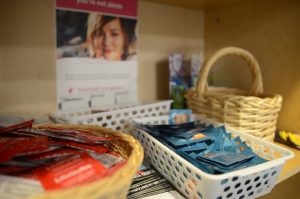
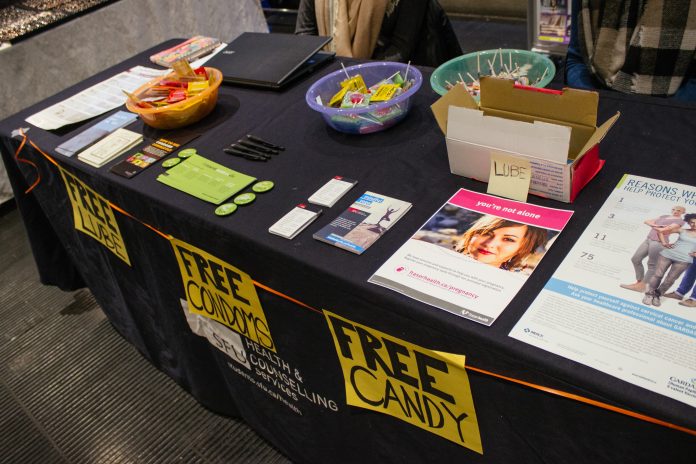
As Simon Fraser University students wandered through the Academic Quadrangle (AQ) on January 24, they might have bumped into a group of students who were distributing free condoms and pamphlets containing sexual health information and services that are offered at SFU. This student-led group is called Condom Crew and it is one of SFU’s Health and Counselling services’ Peer Programs.

     Condom Crew is an initiative that was found in 2008 by SFU’s Health and Counselling services and it is a sexual health focus group that promotes the sexual health services available at SFU.

     The club is currently comprised of nine members from various academic disciplines and operates during the fall and spring semesters. Condom Crew provides outreach programs once every two weeks, with the next one scheduled for February 7, 2018.

     In addition, the club’s outreach programs are theme-based, where they touch on a plethora of sexual health related topics such as birth control, sexual consent, and sexually-transmitted infections (STI) testing.

     “[We provide themed outreach programs] just to let students know what’s available to them here [at SFU because] some students don’t even realize that there are real doctors and real nurses [on campus],” said Belinda Aikenhead, team lead for Condom Crew. “[The Health and Counselling services are] a great resource and we just want to get the word out that it’s available.”

     Currently, the SFU Health and Counselling services provide STI testing, urinary tract infection testing, and Papanicolaou tests, as well as birth control consultations to eligible SFU students. The health and counselling services also educate students about STIs, birth control options, and pregnancy counselling, according to its website.

     There are clinics currently located at SFU Burnaby and SFU Vancouver, in Maggie Benston Centre and Harbour Centre, respectively. The clinics have drop-in hours but it is advised that students book an appointment ahead of time to avoid long wait times. In addition, the doctors at the clinics can do anything that a general practitioner can do, not just strictly sexual health, according to Aikenhead.

     “[Having a club such as Condom Crew on campus] makes it more approachable, when you have a peer, someone approximately your age . . . because if you have to go to the [health and counselling office] yourself it can be a little bit intimidating. So it’s like a friendly introduction as to what’s available on campus and [also] another way to provide support,” stated Aikenhead.

     Aikenhead also noted that the Health and Counselling services are very LGBTQ+ inclusive. “Some students who are LGBTQ+ may be a little hesitant to approach their healthcare providers but the staff [at the centre] are well trained and accepting,” she added.

     As for Condom Crew’s future, Aikenhead noted that she is trying to make the club more LGBTQ+ inclusive. “[This is] something that I am working on so that for future Condom Crew going forward, it will always be more explicitly inclusive,” said Aikenhead. “We want to make ourselves known and make students aware of what’s available to them,” she concluded.

Safer sex is sexy sex

1

Written and photographed by Winona Young 

Whether you’re short on cash and condoms or in a sex-health conundrum, students need to look no further than SFU’s resource centres for all of the above and more. So save the frantic Google searches or trips to Nesters, because SFU has got sex-health resources for you! I wandered through SFU Burnaby’s campus facilities, and compiled a list of the resources available for free at the Women’s Centre, Out on Campus, and the SFU Health and Counselling services centre.  

First on the stop was the tried-and-true SFU Health and Counselling services centre in Maggie Benston Centre Room 0101. Conventional resources you can find there are free pads, regular and flavoured condoms (when I visited, the only flavour available was banana), Band-Aids, lube, and calling cards for sexual health clinics around Burnaby as well as cards for the BC Crisis Centre with numbers listed in case you’re ever in an emergency (which are open 24 hours, confidential, and free). If you need a hook-up for a place to get screened for Sexually Transmitted Illnesses (STIs) and have a BC Health Card, then you can call up the centre or head on down to make an appointment. You can get tested for common STIs like chlamydia and gonorrhea on campus and you’ll hear back from them by the end of the week, or they’ll refer you to a clinic off-campus. For international students like me who may have not grown up in the Canadian school system, the clinic also offers free HPV shots to those in need!

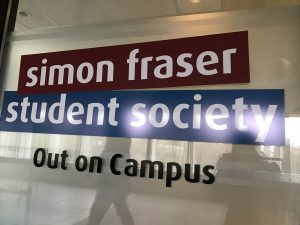
Moving on down, the next stop is SFU’s Out on Campus centre. The centre is open Mondays to Thursdays, 9 a.m. to 4 p.m. and provides free resources like razors, latex and latex-free external and internal condoms, dental dams, and consent toolboxes (which consist of two lubricated condoms, info on using external condoms, and a small written recap on how sexual consent works). Students are free to come in and pick up any of these resources, or grab a snack. If you need an interesting and informative read, Out on Campus also has books related to sexual health you could read or loan out. They even provide shorter pamphlets like “How to be an Accountable Man: A Handbook for Preventing Violence” and “Brazen: Trans Women’s Safer Sex Guide” for free.

Speaking of trans* as well as non-binary folks, Out on Campus also provides cards that list out the locations of all gender-neutral bathrooms on SFU’s various campuses, including athletic facilities. Harbour Centre, Burnaby, and Surrey boast at least 35 gender-neutral bathrooms, including those at W.A.C. Bennett Library 723, the bathroom by the Transportation Centre near Out on Campus, and West Mall Centre 0355 (third floor, adjacent to parking and across from the women’s washroom). All are cleaned regularly and are accessible by wheelchair. Out on Campus provides small info cards for the Trans and Gender Diverse Guide to SFU, which is available online.

Last but not least, is the SFSS Women’s Centre, in the Rotunda near West Mall. The Women’s Centre is rich with resources, many of which you may not know about. By now, it’s no surprise that the Women’s Centre provides sex-health resources like latex and latex-free condoms (external and internal), lube, consent toolboxes, pads, tampons, and students can ask staff members to provide pregnancy tests.

You probably don’t know that their shelves are also stacked with Goldfish cheese crackers, tea, and Nature Valley bars for hungry student in need. If you have bad menstrual cramps, they also have hot water bottles for you to use. Or if you need to keep looking glam-on-the-go for grad photos or a date, the Women’s Centre also has a hairdryer and a curling iron on hand!

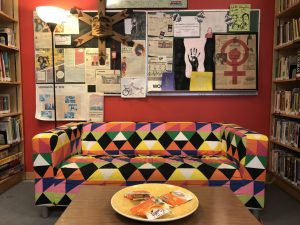
Toward the back of the centre is a colourful couch where you can cozy up with one of their many sex-ed books or even some erotica. If you’re in need of a nap (and we’re all uni students so, really, all of us are), they have a Quiet Zone where self-identified women can lay down for some quick Zzz’s.

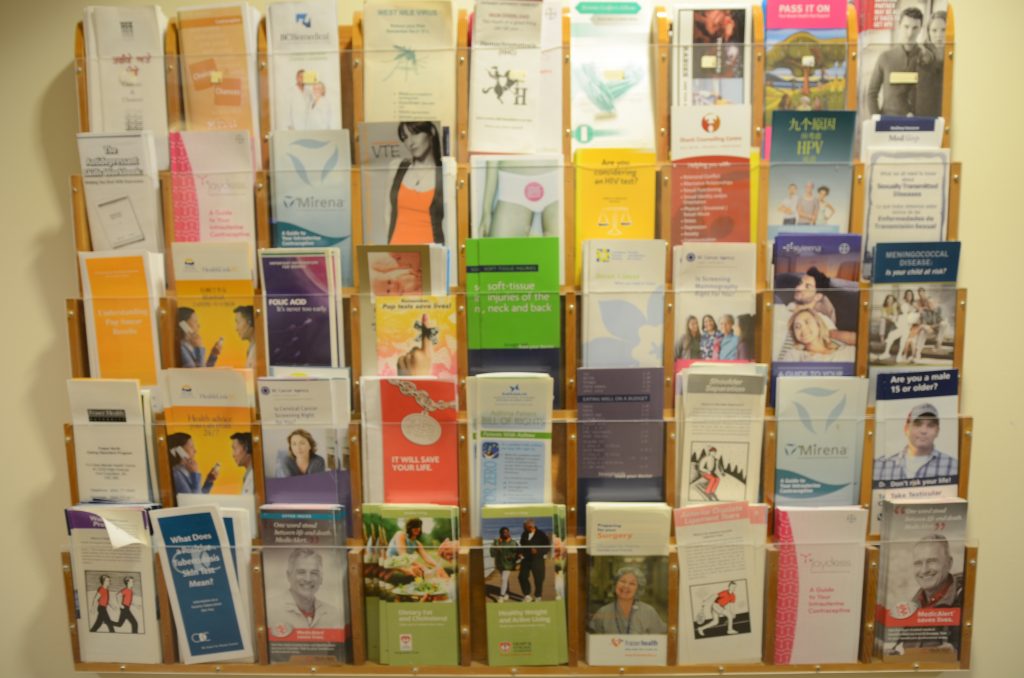
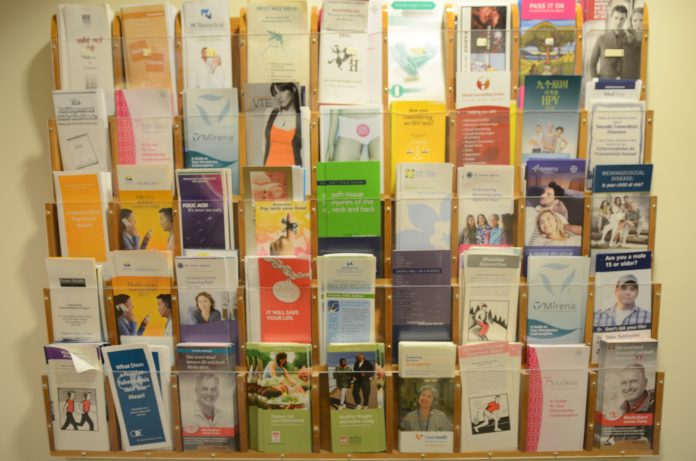
Further back from the Quiet Zone lies the lounge area, complete with a small kitchen with microwaves, an oven, and a stove top, as well as a few seats to relax in. There, you can also find a dizzying amount of pamphlet displays covering diverse topics from how to leave an abusive relationship, to sexual assault, to good places to store condoms. My personal favourite was the “Safer Sex Guide,” a colourful and quick read that listed various sex acts (for example, giving/receiving cunnilingus, penis-vagina/penis-anus intercourse, etc.) and what possible STIs can be contracted from performing those acts.

What all three resource centres have in common is that they were all welcoming, discrete, and shame-free environments. R.J. Doughty, the Women’s Centre resource assistant, emphasized the importance of such environments, saying, “Sex education and free safer sex resources are important because everyone has a body.” Doughty discussed the myriad misinformation and negativity around the topic of sex and sex education. To Doughty, counteracting this culture calls for a “comprehensive, inclusive sex education and an accessible variety of supplies offered in a non-judgmental way.”

So whether you’ll be cuddling up with your bae, playing the field, or replaying old reruns of The Office this month, all you SFU students grab what you can so you can be well-educated and stocked up for a sex-positive February!

Positive Space Network fills in the queer knowledge gap for SFU faculty

0
Out on Campus is SFU’s LGBTQ+ advocacy group. (Photo credits: Maxwell Gawlick)

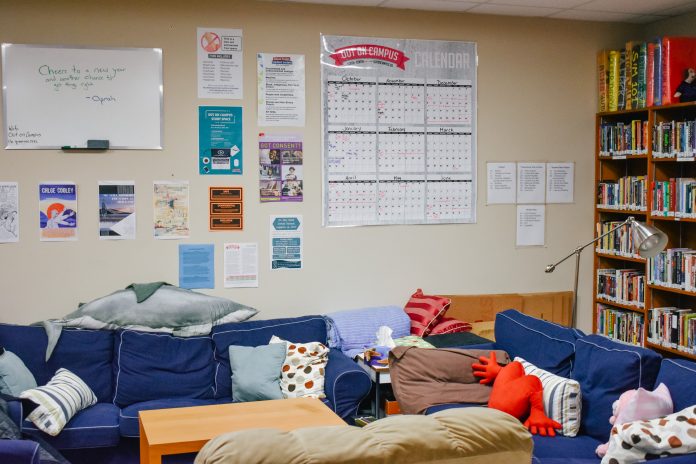
SFU staff and faculty have been receiving a crash course on the LGBTQ+ community and issues thanks to Out on Campus’ Positive Space Network Program. As SFU’s LGBTQ+ advocacy group, Out on Campus has developed an hour-long workshop in which they work with SFU faculty and staff to build up a greater knowledge of the queer community, starting from ground zero up to current issues and techniques on navigating what can be sensitive topics with students.

          The idea of the Positive Space Network workshops was originally introduced a few years ago as a series of three-hour long sessions aimed at SFU students. Last summer, however, the workshop was re-worked as an hour-long program to make it more accessible.

          “Primarily right now, [the workshop] is aimed at staff members, but hopefully down the road we can get students involved too,” said Kyle McCloy, Out on Campus’ current volunteer and program co-ordinator.

          The sessions begin by laying the basic groundwork required to understand the LGBTQ+ culture, and then move into specifics depending on which department is in attendance. McCloy outlined the general structure of the workshops: “They always start with kind of basics, like ‘what does LGBTQ mean? Why is important to talk about this in the context of SFU and SFU students?’”

“Some folks have never even gotten a definition of what transgender means.” – Kyle McCloy, Out on Campus’ volunteer and program co-ordinator

          After the basics, the workshops are more tailored towards what the staff has requested or identified as issues in their department. McCloy recounted a workshop he’d done with Student Central, a department that oversees campus tours, which had specifically asked on how to deal with parents on tours who make homophobic comments. In a workshop with Student Services, which provides a large range of services such as academic advising and facilitating co-op placements, staff were interested in how to conduct better face-to-face interactions with queer students in the context of preferred gender pronouns.

          Since McCloy has joined the Out on Campus team last summer, he’s reported doing an average of two workshops a month. The workshops have proven to be popular among SFU’s various departments, according to McCloy. “People are asking for it by name, or they might have heard it off hand,” he said. “Often, it’s people asking, ‘hey, we know your work and we want to gain some queer knowledge, what do you folks have to offer?’”

          The content shared in the Positive Space Network workshops is an accumulation of knowledge that Out on Campus has built up throughout the years substantiated by the most recent statistics, surveys, and research. As someone who has worked in the field of active bystander training and creating inclusive spaces, McCloy brings both his professional and personal experience to share.

          “There’s always a range of knowledge,” said McCloy. “Some folks are well-versed with everything to do with the queer community. Some folks have never even gotten a definition of what transgender means.” To bring everyone up to speed together, the workshops begin at square one and McCloy makes sure to emphasize that “there are no dumb questions.”

          “One person asked what it was like with gay dating apps. So it’s sort of like asking those questions that people are afraid to ask because sometimes it’s awkward to ask or admit that you don’t know what something is.”

          When asked for his perspective on SFU’s environment towards gender and sexual diversity, McCloy responded, “Since I was a student here, it’s definitely improved.” He noted the university’s effort to construct more gender-neutral washrooms, the inclusion of gender programs on intake forms, and students being given the option to change their gender on their official record. But he also noted that, while policy changes are coming down the pipeline, they’re doing so fairly slowly.

          A major concern McCloy has heard from students is pronoun usage in classrooms, and how to have the conversation of one’s preferred gender pronouns with a professor. He also brought up SFU’s social culture, which he admitted can sometimes be a hard place to build social connections in.  

          “If people feel disconnected from their community, it’s a continuous question of ‘where do I find people like me?’” To that end, McCloy and the rest of the staff and volunteers of Out on Campus are working to make their space, and ultimately the rest of SFU, a safe place for the LGBTQ+ community to find each other and connect.

Acting courses for porn stars

0
Illustrations by Reslus

Here at the Vocational Adult Acting Graduates Institute of North America, or VAAGINA, we embrace artists and actors alike to challenge the sexual status quo. Our artistic perspective encourages students, staff, and sluts alike to penetrate the passions that lie within themselves. We lead the dick-scovering and exploration of new acting techniques and methods at our institution. Here at VAAGINA, bold kinks, tricks, and talent are given an opportunity to develop into ideas that can change the face (and crack) of all pornography.

I am Chris “The Cock” Rock, the Academic Dean of VAAGINA, and I would like to extend a warm and wet welcome to our new students. Below are new courses that will be cumming in the following summer term.

How to Commit to Your Shit Role (Course #PEN155)
(Professor: Luke Skycocker, TA: Richard Dong)

Actors alike have always had to be subjugated to poor script writing. Whether it’s been ridiculous lines like “I’m not a twink, I’m a TWUNK, combination TWINK and HUNK” or “I hope those lemon-stealing whores haven’t been stealing from our precious lemon tree again” (which, are all real lines from from notable award-winning adult films, of course), actors often struggle to bring the genuine emotion needed for such poor writing. In PEN155, we explore the basic foundations of acting, chemistry with your co-actor, as well as repetition exercises that render you invulnerable to embarrassment. This course is also offered in our co-op course load.

How to Pretend You’re Attracted to Your Crusty-Ass, Mediocre-Ass, Ugly-Ass, Ass-ass, Male Co-Actor (Course #ASS143)
(Professor: Melanie Melons, TA: Clara Cuntslayer)

A truth which is universally acknowledged is that for every adult film actress that is a 10, there is a male counterpart out there that is a solid 4. While performing doggy style has been the conventional technique for avoiding direct eye contact with your aesthetically challenged co-actor, in ASS143 we tackle dynamic branches of acting (like Stanislavski, Brecht, Meisner, etc.) that challenge our students to feign genuine attraction to these unfortunate-looking men. Though men may get paid more than you and look considerably worse than you, we as educators believe that you can at least be better actors than them.

How to Moan (Course #UNH696)
(Professor: Forrest Hump, TA: Barbara Bush)

The days of moaning “Ahhh,” “Unhhh,” or “Are you done? I have work in the working” are long gone. In UNH696, we explore the vast soundscapes of guttural moans, shouts, screeches, and throaty croaks that dare come out of our mouth holes during penetration. Over the semester, we will study the technique of various singers, porn stars (both local and international), and even various animal sounds (from goats and gorillas to even emus). From rudimentary moans like “OWOWOWOWOWOWOWO,” to more multisyllabic moans like, “Ooh, eeh, ooh ah ah . . . ting tang, walla walla bing bang,” we challenge students to re-learn how to express sounds of pure pleasure. Students’ final grade will be determined by an oral exam.


SFU bounce back with 74–57 win over Western Oregon

0
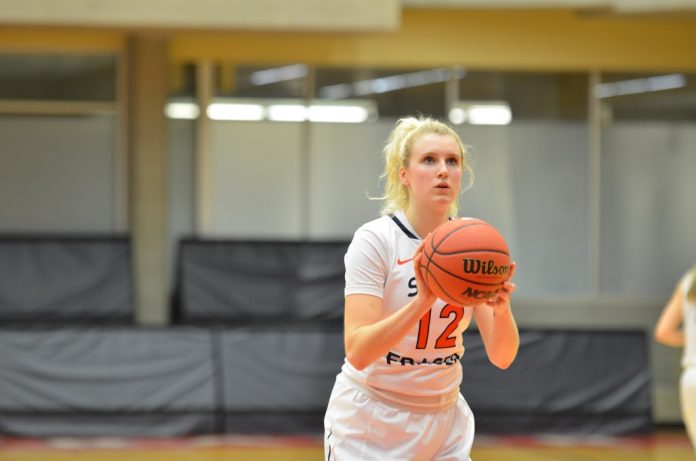
Tayla Jackson shot 7–11 from the field, and a perfect 8–8 from the free throw line. Kelsey Nikl / The Peak

On Saturday evening, the SFU women’s basketball team hosted Western Oregon for the second part of a two-game homestand. They regained some momentum after suffering a tough loss to Concordia University on Thursday night. After an ugly first quarter, SFU made a potent comeback in this game, eventually taking the win by a decisive score of 74–57.

The Clan “learnt a lot” from the past defeat, according to Jessica Wallace, assistant coach of the team. She added that from the very beginning, the team kept in mind to be strong on the defensive end rather than just offence.

The game started with SFU’s Tayla Jackson taking the lead by hitting a pair of free throws. However, the Wolves bounced back quickly, going on an eight-point run to make the score 8–2. Western Oregon would hold the lead for the rest of the quarter, ending the frame with a six-point lead at 20–14.

In the second quarter, however, SFU took control of the game. The Clan made sure to play together  “as a team and better than before”, according to Wallace. The team defence greatly improved, holding Western Oregon to only eight points. Tayla Jackson was dominant on the offensive end as well, as the Clan went into the half with a 32–28 lead.     

As mentioned by head coach Bruce Langford, “[Jessica] Jones was really good

defensively and offensively and Tayla was good offensively.” At this point, Jackson was leading the game with 12 points.

Keeping the strategy of strong communication, SFU didn’t give up many chances to the Wolves to score baskets in the third quarter, either. They went into the fourth with a 56–43 lead, and didn’t look back.

The game finished with SFU grabbing 32 rebounds, compared to Western Oregon’s 35, 11 of which were on the offensive glass. The Clan also took advantage of their free throws, making 20 of 22 on the night.

Jackson led the game with 22 points on 7–11 field goals, while going a perfect 8–8 from the charity stripe.

The Wolves are known for their “offensive habits” and were shut down by SFU’s “passion and pride,” and by keeping the “lethargic” approach aside, as experienced in the previous game, said Langford post-match.

They will next head on the road as they travel to Seattle to take on Falcons on Thursday night.

Tempers flare in big win for SFU hockey as they snap TWU win streak

0
SFU snapped TWU's 11 game winning-streak with the victory. (Photo courtesy of SFU hockey)

SFU hockey won 5–3 over the Trinity Western University (TWU) Spartans at Bill Copeland Sports Centre on Saturday night. The win was one of SFU’s best overall performances this season and it couldn’t have come at a better time, as the streaking Spartans were looking to extend their winning streak to 12 games and put to rest any hope that SFU had for a top two finish in the league. Instead, the Clan responded with a gritty win that snapped the Spartans streak and kept them afloat in the race for home ice advantage in the first round of the playoffs. Proving to themselves and the rest of the league that they are one of the elite teams in the BC Intercollegiate Hockey League (BCIHL) and capable of winning against any team on any given night, the Clan now look to continue their roll and climb the standings over the remaining six games of the regular season. While there were numerous stand-out efforts in this game, this was one win that genuinely felt like a full team effort in which every player simply put their work boots on and went to work to secure the much needed win.

The game got off to a flying start as the Clan took the lead early in the first period on a goal from Rob Izsak that was set up nicely by fifth-year Clan veteran Pavlo Zerebecky. SFU’s team defence was able to successfully keep the Spartans to the outside for most of the first period and when they did get through, starting goaltender Lyndon Stanwood was sharp in maintaining the one goal lead through twenty minutes. While the first period went largely as SFU had hoped, the Clan would face some adversity in the second, as the all too familiar parade to the penalty box would begin, allowing TWU numerous power play opportunities.

The second period saw five penalties called in the first minute of play. Like the games two weekends ago against the Spartans and the Vikes, in which the Clan had to constantly kill off an excess of penalties it was taking, the Clan would struggle through the second period with some inconsistent play and extended stays in the sin bin. Though the team would weather the initial first minute penalty storm, more minor penalties later in the period allowed the Spartans to strike quickly and take the lead. Scoring twice in the span of seven minutes, TWU forward Elijah Vilio, a first-year that has shown the capacity to be an elite player in the BCIHL for years to come, scored both second period goals for the Spartans as the Clan suffered from some of the inconsistency that has plagued them all year. Despite this adversity, the Clan were able to limit the damage to Vilio’s two goals and head into the third period down only one in what was easily the biggest and most important game of the season for SFU hockey thus far.

In the third, the entertainment level was kicked up a few notches with more scoring, penalties, fisticuffs, and dramatic incidents at both ends of the ice. Just like the first period, it didn’t take the Clan long to get on the board in the third as veteran Brendan Lamont would tie the game just one minute in. Lamont showed an extraordinary level of patience on the play as he took advantage of a defensive breakdown, caught TWU goaltender Silas Matthys out of position and calmly skated past him to deposit the puck in the yawning cage for a key game-tying goal. This was the beginning of the end for Matthys, who had been playing a decent game up until the third period.

Just a few minutes after the Lamont tying goal, Mathew Berry-Lamontagna would snipe off the iron and in on an odd defensive breakdown by the TWU Spartans in which they allowed two grade-A scoring chances without much resistance in the span of 20 seconds. These two quick goals culminated in an absolutely shocking and bewildering stick throwing incident in which Matthys was ejected from the game for violently launching his twig at the celebrating Clan. While it was unclear the exact reason for the Spartan goaltender’s enraged outburst, what was clear is that the Matthys’ confidence had been shaken, a turning point in the game had been reached, and, most importantly, the Clan had demonstrated their ability to come up big against their cross town rival in important games.

While the importance of the win versus TWU for team confidence and playoff positioning was unquestionable, the Clan must significantly ramp up their efforts and go on a run to make up ground on the Selkirk Saints for second place in the league with only six games remaining in the regular season. However, with two big matchups against the Saints coming up this month, the Clan know that with a few more big performances like this one, they can realistically make a run for second in the league.  

With the win, goaltender Lyndon Stanwood continued to quietly put together a respectable record this season especially given his outsized workload thus far. Stanwood made his 18th start the season, his 14th in a row. With the victory, he picked up his 11th win of the season while making 20 saves. The team continues to rely heavily on Stanwood as they fight for second place and home ice advantage in the first round of the playoffs with only six games remaining.

Overall, the Clan continue to roll in the second half of the season and are clearly building momentum for a playoff push. Captain Brandon Tidy thinks that the team just needs to “play with that same tenacity” as the regular season begins to wind down. Forward Brendan Lamont agreed that this “was a big win for [the team]” and that standing up for each other and not being too soft has played a big role in their second half success.

With the win over TWU, Simon Fraser moves to a 12–6–1 record in BCIHL regular season play. While a repeat as regular season champs is a long shot for the Clan at this point, the team is looking to peak come playoff time. The struggle for playoff positioning continues next week as the Clan will be back at it next Saturday when they face the Eastern Washington University Eagles at 7 p.m. at the Bill Copeland Sports Centre.

Dylan Webb is a member of SFU’s hockey team.

SFU researchers tackle HIV

0
Researchers explore the use of molecules to trigger antibodies that could target HIV. (Photo credit: Getty Images)


Are the sexual rights of women with HIV ignored?

In a paper titled “The Problematization of Sexuality among Women Living with HIV and a New Feminist Approach for Understanding and Enhancing Women’s Sexual Lives,” SFU PhD candidate Allison Carter explores how social and cultural factors are undermining the well-being and rights of women living with HIV.

Carter, who works at the BC Centre for Excellence in HIV/AIDS, was part of a team that looked at 32 studies involving 11,552 women living with HIV in 25 countries from 1997 to 2017. The team found that many women with HIV experience stigma, violence, poverty, and depression, which in turn negatively affects their sexual health and well-being.

The results point to social oppression as the main contributor to women’s challenges around sex and HIV. Such difficulties often go unreported as most HIV research deals with preventing the spread of HIV.

According to SFU associate professor Angela Kaida, the study “. . . highlights the need to completely reframe our approach to sexual health and pay greater attention to positive and rewarding [sexual] experiences such as satisfaction and pleasure, and the social environments necessary to support this.”

As a step towards the destigmatization of HIV, the researchers support decriminalization of HIV non-disclosure and a radical restructuring of the culture. Study co-author Jessica Whitbread stated, “A safe and satisfying sexual life — however women themselves want to define ‘satisfying’ — is a human right.”


SFU professor moves closer to creating HIV vaccine

Researchers are closer to developing an HIV vaccine using molecules that develop antibodies. These antibodies, as part of the body’s natural immune response, protect the body from infection by attacking the viruses.

Associate professor Ralph Pantophlet from SFU’s Faculty of Health Sciences, along with researchers from Austria and the USA, has published a paper in Nature Communications that explains how the immune system can be “tricked” into creating antibodies that target HIV viruses.

Pantophlet says that the team found “a molecule that is similar to one found on HIV.” During animal tests, the molecule helped “generate antibodies able to target the virus.” It is believed that similar techniques could be applied to develop new treatments for other viruses and cancers.

Pantophlet, whose laboratory investigates antibody responses to HIV viruses in host-virus interactions and anti-viral antibody responses, says the research needs further study before it can be tested on humans but is an important first step on the route to an HIV vaccine.

MiniDAYZ is not for the faint of heart

0
You can't shoot your way out of every situation in MiniDAYZ. (Image courtesy of Bohemia Interactive)

This sandbox zombie survival game put out by Bohemia Interactive takes many of the elements you would associate with console games and manages to distill them into a mobile-friendly format.

     In MiniDAYZ you start off on a beach with nothing but the clothes on your back. The goal is simple — survive — but the execution is nuanced. As you wander, you will find abandoned cities, survivors (or bandits), and zombies . . . lots of zombies. While you will feel more comfortable sifting through the wreckage of civilization with a shotgun clutched in your trembling hands, the real enemies are starvation and thirst, not the walking dead. One of the defining features of MiniDAYZ is that you are forced to search for food and supplies constantly, or face a slow death. On top of keeping track of food, every time you are hit by an attack you may start bleeding and will need to keep a supply of bandages on you — or rip your shirt into rags to make one.

     MiniDAYZ is clearly inspired by games like DayZ where patience and resource management are virtues. “Do I keep the oranges, the bear trap, or the bandages?” This is the type of question that MiniDAYZ will have you asking yourself. The game is sometimes tedious, but you are always kept on your toes. You will make tough calls, and undoubtedly there will come that moment when you find an AK-47 in pristine condition, only to remember that you dropped all your bullets to pick up a can of baked beans.

     One of the things that makes MiniDAYZ fun is its attention to detail. There is endless loot for you to find, such as clothes with more storage capability (for many men this will be the first time they actually appreciate having pockets), as well as food items like kvas that make it clear that you are in Russia if the cyrillic writing on the buildings wasn’t obvious enough. Items degrade, and have to be repaired or replaced, and some items can be crafted or combined. The one way that this is taken too far is that there is no explanation as to what cartridges the firearms you find shoot, and if you don’t already know about firearms then you will have to do some Google searches before you blast any zombies.

     The game has no overarching narrative, but is instead built around replayability. Each time you play there will be a different randomly generated environment, different foes, and different loot. While the concept of MiniDAYZ is ambitious for a mobile game, the simplicity of the 8-bit, side-scrolling graphics, coupled with the unforgiving nature of the game give the game its own unique . . . charm. There are also numerous unlockables, and the game is still being updated. Oh, and the game is entirely free, with minimal ads. The game manages to make an appeal to hardcore gamers and casuals alike. It is challenging, but rewards experimentation; and after some experience things will click into place. There are also guides available on the developer’s website.

MiniDAYZ is available at the app store, Google Play, and can even be played on a browser. As an added bonus, the browser version includes multiplayer (PC only), and driveable vehicles.

The ‘right’ women for the Olympics

5
South Africa's Caster Semenya has won two gold medals in the 800 metre. (Photo courtesy of Marco Verch)

The Olympics are a dazzling feat of globalization, one which inadvertently highlights global inequalities and discrimination. Though the host country’s tax dollars may funnel into dazzling spectacles of opening ceremonies and torch relays, the fanfare of Olympic prestige and glory appears to be a façade. A façade that cannot disguise the Olympic-sized obstacles faced by athletes whom the International Olympic Committee (IOC) deem to be of the incorrect gender. The IOC has kept up the practice of testing female athletes who have a muscular, masculine physique in the name of leveling the playing field, to make sure no woman unwittingly cheats with their unnatural levels of testosterone.

At least this is the rhetoric the IOC promotes.

This gender testing is often invasive and humiliatingly publicized. It does not achieve the altruistic goal of enforcing fairness in a sacred competition; instead it works to further police women and the female body. Every four years, the Olympics act as a highly televised microcosm of global sexism. Accrediting female-identified athlete’s accomplishments to their ‘manly’ attributes discredits the years of dedication and perseverance they spent perfecting a sport. The concept is also hinged on the largely contested notion of a binary gender spectrum, in which a person can only be male or female. However, the more athletes the IOC investigates and tests for female gender validity, the more the IOC runs up against the issue that not all human bodies — their chromosomes, organs, and hormones — conform to our criteria of what constitutes a man and a woman.

The medical diagnosis that sparks the largest ordeal around the gender of an athlete is known as hyperandrogenism. This is the result of a female body producing excessive amount of the male sex hormone testosterone. Both men and women produce testosterone, but when testosterone levels exceed the average level for women to have (10 nanomoles per litre of blood), that person becomes categorized as intersex.

 And thus the problems begin.

In 2009, the International Association of Athletics Federations’ (IAAF) investigation of Caster Semenya’s gender highlighted each problematic step of enforcing fairness through hormone levels. Semenya was 18 in 2009, a track and field star from South Africa, who brought home gold in the 800-metre race in Berlin. She ran the race in 1:56:72, a whole two seconds ahead of her next competitor. She was such a powerful athlete, with a masculine facial structure and muscular legs, competitors and critics openly questioned if she was even a woman at all. Semenya has been declared as an intersex athlete, though this declaration comes from the assumption that women, even at the height of physical human power, must conform to an acceptable level of femininity.

After the testing, Semenya was allowed to keep her medal. The result of the testing, however, was the creation of the Hyperandrogenism Regulation in 2011. This regulation essentially meant that women could not have androgen levels within the male range. There was never confirmation on whether drugs or surgery were undergone, but it is widely presumed Semenya agreed to the IAAF’s terms, as she appeared at the London 2012 games, where she won silver. However, in an ironic twist it was discovered the gold medal winner, Mariya Savinova-Farnosava from Russia, was cheating through doping, and so the gold medal was retrospectively awarded to Semenya.

The history of Olympic gender testing is long, but its presence was kept a secret as to mitigate the social backlash. Accusing athletes as masquerading as female dates back to the 1936 Berlin Olympics. Testing for gender validity required Olympic candidates to provide a ‘femininity certificate’ in the 1940s. By 1966, anxiety around physically powerful women had escalated to the point of instigating “nude parades” where it became mandatory to receive a genital examination before a panel of doctors, further stigmatizing cases of intersexuality. When complaints around the humiliating practice emerged, the IOC moved over to testing chromosomes as a black-and-white ground for outing cheaters. However, this test proved as fallible as the rest and was dropped in 1999, when it was deemed to be inconclusive.

As far as the Olympics has been attempting to defend fair play, they’ve been utilizing flawed, biased tests for a long time.

The insensitivity shown towards athletes with hyperandrogenism has led to no leaps forward in protecting other competitors from cheaters. In fact, the Court of Arbitration for Sports could not conclusively say whether the excess testosterone benefitted them significantly enough to bar them from the female category. To that end, a positive decision was made by the IAAF in 2011 and a consensus statement was released and verified in 2015. This statement concluded that there will be no sex or gender testing in the upcoming 2018 Olympics in Korea, and no regulations barring female athletes with hyperandrogenism for two years.

As for Semenya, she broke the national record for the 800-metre race at the Rio Olympics in 2016, coming in at one minute 55.28 seconds. She brought home gold.

The 2018 Winter Olympics will be held in PyeongChang, Korea, commencing on February 9. While the opening ceremony will be judged as hard as any competition and the usual drama will unfold over the environmental and economic toll, perhaps this year, with intersex athletes welcome to compete, we will see less debate around gender. Though there is still far to go as far as destigmatizing intersexuality, and accepting women’s athletic ability without sexist speculation, Semenya commented, “People should learn how to unite. Sport is all about uniting people and not discriminating.”