Home Blog Page 598

Adulthood 101: Know your BC produce

2
Illustration credit, Tiffany Chan

Have you ever wondered how people just seem to know when apples, or peaches, or other produce are in season? Or, even further, what does “in season” even mean? Have no fear, friends: as a culinary school graduate, I’m here to educate you on all things produce. Buckle up for a crash course in what’s in season when, how to choose good stuff, how to store your produce, and what you can make with it.

First thing’s first, “in season” refers to when a fruit or vegetable is naturally available or grown in a given climate. So if you can visit a local farm and buy it, that produce is in season, and usually it will be less expensive. Scope out some of your favourites fruits and veggies below, and let’s give your student life an adult twist.


Apricots

In season: July–August

How to choose them: Firm with a bit of give to the touch, golden-orange in colour, no bruising, no mould around the stem area, and as blemish-free as possible.

How to store them: Room temperature for a few days, or in a sealed container in the fridge for up to a week.

What to make with it: Grilled apricots. Cut them in half, remove the pit, and grill them. You can also make this easy apricot preserve.


Asparagus

In season: April–May

How to choose them: Firm stems, violet or bright green tipped stalks, and compact tips.

How to store them: Upright in a glass jar with an inch of water in it, covered with a plastic bag for up to a week.

What to make with it: Bacon-wrapped asparagus. Snap off the bottom end of the asparagus (it will snap off at a natural border between edible and inedible fibre). Wrap in bacon and roast in the oven for 30 minutes at 400 degrees Fahrenheit.

Protip: The thinner stalks of asparagus are sometimes cheaper (and called seconds because they aren’t the first picks) than the larger (first pick) stalks and are more tender to eat!


Beans

In season: July–September

How to choose them: Firm, bright green, no mould, and as blemish free as possible.

How to store them: In the fridge in a plastic bag or container.

What to make with it: Spicy beans. Trim the ends and cut them in half. In a pan, heat canola oil on medium heat. Add the beans and a tablespoon of chili garlic sauce. Stir. Add three tablespoons of water and cover for three minutes.


Beets

In season: June–December

How to choose them: Slender roots, small and crisp dark leaves, and firm to the touch. Blemishes are fine as long as there are no deep gouges, soft spots, or mould.

How to store them: Keep in a plastic bag in the fridge for up to three months.

What to make with it: Beet salad. Put whole, unpeeled beets in a baking pan. Drizzle with oil and cover with foil. Roast them at 425 degrees Fahrenheit for an hour. Let them cool, then peel them and cut into wedges. Mix them into a salad.


Blackberries

In season: July–August

How to choose them: Deep purple or black colour, shiny, firm, no mould, and tight clusters of drupelets.

How to store them: In the fridge in a ventilated container lined with paper towel.

What to make with it: This blackberry cobbler recipe


Blueberries

In season: August–September

How to choose them: Dark purple/blackish blue in colour, firm, no mould, and plump.

How to store them: In the fridge on the bottom shelf in a ventilated container lined with a paper towel.

What to make with it: Blueberry pancakes. Rinse the blueberries gently as they bruise easily, then sprinkle them onto the dollops of pancake batter in your pan.


Broccoli

In season: June–November

How to choose them: Bright green, firm stalks, tight florets, and no yellow flowers.

How to store them: In the fridge, wrapped loosely in a damp paper towel for up to three days.


Carrots

In season: June–January

How to choose them: Bright orange, smooth skin, firm to the touch, no mould.

How to store them: In the fridge, tightly sealed in a plastic bag for as long as they’ll last.

What to make with it: This carrot cake recipe


Cauliflower

In season: June–November

How to choose them: White or creamy white, firm heads, no dark or brown spots, and compact clusters.

How to store them: In the fridge in a loosely sealed plastic bag lined with paper towel for up to a week.

What to make with it: Trim off the leaves and place in a large pot, stem at the bottom. Pour in two inches of water, cover, and bring to a simmer. Steam for eight to ten minutes. In another pot, heat two cups of milk until it lets off steam, add one cup of grated cheese, a teaspoon of mustard, and salt and pepper to taste. Mix until the cheese is fully incorporated and you have a sauce. Pour sauce over the cauliflower. Die une petite mort.


Celery

In season: June–October

How to choose them: Green stalks, pale green leaves, and firm, tightly packed stalks.

How to store them: In the fridge, wrapped in aluminum foil for up to four weeks.

What to make with it: This roasted celery soup


Chard (Swiss)

In season: May–November

How to choose them: Dark green leaves and bright red stems.

How to store them: In the fridge in a plastic bag for up to five days.

What to make with it: Melt a tablespoon of butter and a tablespoon of oil in a pan. Add minced or slivered garlic and red pepper flakes. After a minute, add chopped Swiss chard and stir. Cover the pan, but stir occasionally for eight minutes. Mix in about a tablespoon of lemon juice, season with salt and pepper, and boom.


Cherries

In season: July–August

How to choose them: Bright or dark red, shiny, firm and smooth skin, and flexible green stems.

How to store them: In the fridge in a plastic bag.

What to make with it: In a pot, combine half a cup of orange juice, three tablespoons of sugar, and a cup of pitted cherries. Simmer for 30 minutes, then stir in a splash of balsamic. Pour your cherry sauce over ice cream.


Corn

In season: July–October

How to choose them: Plump, firm kernels, no missing kernels, brown and sticky top.

How to store them: In the fridge, husk on, uncovered.

What to make with it: Corn on the cob. Peel off the husks and the wispy hairs, place in a pot of lightly salted water, and simmer for seven minutes. Remove the cobs and dress with seasonings of choice.


Cucumber

In season: July–September

How to choose them: Firm, bright green, even colouring, no sweat, and no flexibility.

How to store them: On the counter, away from fruit (including tomatoes).

What to make with it: This recipe for Greek Salad.


Currants

In season: July

How to choose them: Firm, bright colouring, and round.

How to store them: In the fridge for up to three days or in the freezer for up to six months.

What to make with it: Freeze a bunch of currants, and use as ice in your lemonade (or sangria!)


Gooseberries

In season: June–July

How to choose them: Firm, bright colouring, and dry.

How to store them: In the fridge for up to two weeks.

What to make with it: Gooseberry sauce. In a small pot combine a cup of gooseberries, a cup of water, a pinch of salt, two tablespoons of sugar, and a dash of balsamic vinegar. Simmer on low for 30 minutes or until the gooseberries are soft. Serve with poultry or toasted bread.


Mustard Greens

In season: May–November

How to choose them: Green leaves, thin stems, and freshly cut.

How to store them: In the fridge in a crisper, in a plastic bag, wrapped in paper towel for up to five days.

What to make with it: Sauteed mustard greens. Saute a chopped half onion in oil until caramelized. Add two cloves minced garlic and cook for one minute. Add roughly chopped mustard greens and saute until leaves are wilted. Season with salt and pepper to taste.

Protip: When making sauteed mustard greens, use ginger and garlic and season with soy sauce and sesame oil at the end for an Asian cuisine flair.


Nectarines

In season: July–August

How to choose them: Golden or orange in colour, firm but with a bit of give to the touch, and blemish-free.

How to store them: At room temperature if not fully ripe (more creamy in colour). In the fridge if fully ripe.

What to make with it: This recipe for nectarine cobbler.


Onions (Red and Yellow)

In season: August–March

How to choose them: Shiny skin, firm, and dry.

How to store them: In a cold, dark, and dry place for up to four weeks.

What to make with it: Pickled onions. In a pot, simmer together a half-cup of vinegar (any type), a cup of water, a tablespoon of sugar, and a tablespoon of salt. If you have pickling spice, add one teaspoon, but it’s optional. Place sliced onions in a jar. Pour the vinegar mixture over the onions, seal the jar, and refrigerate. Ready to eat whenever.


Parsnips

In season: August–February

How to choose them: Firm, white, heavy, no discolouration at core, and intact roots.

How to store them: In a cool, dark, and dry place for up to several weeks.


Protip: Smaller parsnips are sweeter and more tender!


Peaches

In season: August

How to choose them: Vibrant colour, fragrant, a bit of give to the touch (ripe), or firm to the touch (unripe), and blemish-free.

How to store them: If unripe, store at room temperature, stem down for up to a few days. If ripe, store in the fridge for up to three days.

What to make with it: Peach and tomato salad. Slice peaches and tomatoes and red onion, layer on a plate, crumble feta over top, and season with a drizzle of olive oil and salt and pepper.


Pears

In season: August–December

How to choose them: A little soft at the stem, otherwise firm, even colour, and blemish-free.

How to store them: At room temperature for up to three days.

What to make with it: This recipe for pear and bacon grilled cheese or this recipe for pear and arugula salad


Peas

In season: May–June

How to choose them: Firm, green, glossy pod, nd plump.

How to store them: In the fridge in a plastic bag for up to five days.

What to make with it: This recipe for a pea bruschetta, if you’re trying to save up for a house.

Protip: Don’t get large peas. Medium peas will be more tender, more flavourful, and sweeter


Peppers

In season: August–October

How to choose them: Firm, heavy, glossy, vibrant colour, and blemish-free.

How to store them: In the fridge in a crisper or plastic bag.

What to make with it: Griled peppers. Quarter the peppers, remove the seeds and stem, oil and season with your preferred spices, then toss on the grill or in the oven for roasted pepper instead.


Potatoes (Red, Russet, and Yellow)

In season: August–December

How to choose them: Firm, soil smell, no sprouts, no green skin, and blemish-free.

How to store them: Cool, dry, and dark place with good ventilation.

What to make with it: Slice them to your desired fry size, toss in oil and your favourite seasonings, then bake at 475 degrees Fahrenheit for 30+ minutes, flipping once halfway.


Raspberries

In season: July–August

How to choose them: Even colouring, reddish-pink, plump, firm, and dry.

How to store them: In the fridge in a ventilated container lined with paper towel for up to four days. Or freeze them for up to six months.

What to make with it: Just eat them. Add them to your lemonade, iced tea, sangria, ginger ale, ice cream, basically anything.


Squash (Summer)

In season: June–August

How to choose it: Firm, glossy, yellow, and blemish-free.

How to store it: In the fridge in a plastic bag for up to a week.

What to make with it: Baked squash. Halve the squash and scrape out seeds. Drizzle with melted butter or olive oil and season with salt and pepper. Bake at 375 degrees Fahrenheit for 35 to 45 minutes depending on the size of squash. Sprinkle with brown sugar or drizzle with maple syrup and bake another ten minutes.


Strawberries

In season: June–September

How to choose them: Bright red, and fairly firm.

How to store them: In the fridge in a ventilated container lined with paper towel for up to four days, or freeze them for up to six months.

What to make with it: They’re just a fun snack. Dip your strawberry in icing sugar if you like. That’s it.


Tomatoes

In season: July–October

How to choose them: Firm, plump, heavy, even colouring, smooth skin, and blemish-free.

How to store them: At room temperature, away from sunlight, for up to five days.

What to make with it: See the peaches entry.


Zucchini

In season: June–October

How to choose it: Dark green, heavy, smooth skin, and blemish-free.

How to store it: In the fridge in an unsealed plastic bag for up to a week.

What to make with it: This recipe for ratatouille, just like the movie


Don’t see your fave on the list? These fruits and veggies are also in season!

Apples: August-December

Artichokes: August–October

Cabbage: (Green) August-December, (Red and Savoy) September-January)

Crab Apples: August–October

Fennel: June–October

Garlic: August–October

Kale: January–December

Leeks: July–February

Lettuce: June–November

Melons: August–September

Mushrooms: January–December

Onions (Green): May–September

Plums: August–September

Potatoes (New): May–July

Potatoes (White): July–December

Prunes: August–September

Radishes: April–October

Rhubarb: April–August

Rutabagas: August–December

Salad Greens: April–November

Saskatoon Berries: June–July

Shallots: August

Spinach: April-October

Turnips (White): May–December

SFU student raises money for cancer through athletic challenges

0
Mihalik has planned eight athletic events for his 2018 campaign. (Chris Ho / The Peak)

Imre Mihalik is an SFU Beedie student who is running, paddling, cycling, and more to raise money for the BC Cancer Foundation. Mihalik hopes to raise $3,500 for his campaign, #EPICIMPACTYEAR, wherein he will participate in at least eight local athletic events.

     In an interview with The Peak, Mihalik explained that with #EPICIMPACTYEAR, he hopes that everyone creates a personal commitment to pursuing a challenge in their life. “I just wanna see people fight some challenges and strive to overcome them and to make this year their healthiest yet,” he said.


The vision

Mihalik is acquainted with cancer in his personal life. He noted that while he is lucky that his immediate family does not suffer from the disease, his surrounding loved ones were not so lucky.

     “The peak thing for me though [is] that my [high school best friend’s] dad passed from cancer,” he said. Shortly after he passed, the family of his friend’s father set up a campaign for “The Ride to Conquer Cancer,” and this August, Mihalik decided he wanted to show his support by participating. However, participation in the event required Mihalik to fundraise money as well. Undeterred, Mihalik decided not only to join, but also, not to let his athletic events stop there.

     “I decided, ‘Hey, I also wanna do [a] marathon and there’s this long paddle board race I wanna do in the summer,’” he explained. “I just kind of decided to compile everything.” Mihalik chose the BC Cancer Foundation as his charity of choice, and thus, #EPICIMPACTYEAR was born.


The plan in action

So far, Mihalik has completed three of his eight athletic events, and he made sure to choose his events carefully. “I feel it’s a little bit catered to athletics I’ve always admired,” he told The Peak.

     In the preparation for his events so far, Mihalik has relied on previous skill from his hobbies as well as formal training. Given the variety of sports Mihalik will be tackling over his campaign, he talked about the importance of focusing whichever event is coming up and prioritizing it.

     “A lot of things aren’t transitional obviously,” Mihalik said, “[like] having a marathon then doing like a paddle boarding event, but in a lot of ways, you’re still able to have that level of push that you can transition.”

     The Peak interviewed Mihalik on May 11, the day before his third event of the year, Board the Fjord. Mihalik was fresh from the BMO Vancouver Marathon that he participated in on May 6. The Peak asked how he was feeling about the next day’s race.

     “Yeah I’m feeling alright,” he laughed. “I mean, this week has definitely been a bit of recovery after [the BMO Vancouver Marathon] for me, so I wanna make [sic] something left in the tank for tomorrow.”  

     While Mihalik races for BC Cancer Foundation, he also races for his personal fitness. Mihalik told The Peak that he hopes to better his time by 10 minutes or so, and also hopes to beat a few colleagues.

     “I’d be really stoked if I caught up to a guy I work with called Tim because he’s quite a good racer,” he laughed.

     “And for me, I’m running and I’m waking up and this is about my fundraiser and I have to get moving because I need to raise money,” he added.


The lessons learned

With five months left until Mihalik’s last event, Mihalik reflects on both the lowlights and highlights of the past few months. While a lowlight had been exam season for Mihalik, given that he had to balance school, and work, and this campaign, he did note that one of the highlights has been the support he’s received so far.

     “I’ve definitely gotten support from friends [. . .] I’ll always post a recap, or long run, or training session on my Instagram story, [and] some friends have been commenting [on] that since January,” he said. “It’s definitely helped me push onwards since this halfway point now.”

     Mihalik has also seen a fair share of surprises over the past few months. Not only has he been amazed to see others’ ability to further push and challenge themselves physically, but also at himself.

“I’ve surprised myself I’d say in the way you’re able to find a sixth gear,” – Imre Mihalik

     Mihalik added that while he was confident with his athletic abilities before, with #EPICIMPACTYEAR, it gave him an extra boost that he never had before.

     Mihalik advised his future self that he doesn’t see #EPICIMPACTYEAR as the “be all, end all for training.” Mihalik hopes to keep this level of athleticism up for the rest of the year and to finish the year off having hosted events around the community to garner support.

     “Thank you to everyone, especially to SFU, who’s been supportive lately for me, reaching out and taking interest in what I’ve been doing — that’s been really special to me [. . .] and just all the friends and family who’ve been amazing to me the last little bit. A lot to look forward to and be thankful about,” he said.


You can support Imre Mihalik’s campaign #EPICIMPACTYEAR for BC Cancer Foundation by donating to his cause.

Lemony Snicket’s famous work is reinvented through TV

0
Photo courtesy of Netflix

The Netflix original A Series of Unfortunate Events artistically captures the bleak yet hilarious world that was first created by Daniel Handler (AKA Lemony Snicket) in his novels. Even though the story focuses on the lives of three orphan children whose parents died in a fire, the casting, art direction, and writing make this show entertaining and appropriate for all ages.

     The entire cast makes this show exciting and comedic, but Patrick Warburton and Neil Patrick Harris deserve additional praise. Warburton plays the narrator, Lemony Snicket, and faithfully captures the same charismatic style Daniel Handler executed throughout his novels. He constantly begs the audience to look away from the horror presented in the story, and he also offers definitions of words and phrases in his narration in a similar manner to how he does so in the novels.

     Having Warburton walk through the various settings and engage directly with the camera further makes the narration engaging and compelling. Rather than having Snicket speak through voice-over, Warburton’s physical presence pushes his narration towards breaking the fourth wall.

     In addition to Warburton’s character and performance, Neil Patrick Harris plays Count Olaf perfectly. His character is goofy yet disturbing, although maybe it’s just the unibrow that’s off-putting. Harris truly brings out Olaf’s wit and silliness working alongside Esmé Squalor, Olaf’s trendy lover, played by Lucy Punch.

     The sets, props, and costumes also contribute to the joys of watching this series. They make use of colour to better set the tone, using lots of greys to make scenes feel gloomy. The extravagance of some settings, such as Aunt Josephine’s house and Esmé’s “fashionable” penthouse, make the show more aesthetically pleasing and captivating. The props even bring to life some of the most unrealistic elements of Handler’s story — such as the self-sustaining hot air mobile home.

     The costumes are also extravagant, and they add further comedy to the story as Olaf and his crew dress up time and time again to successfully conceal their identities. Olaf has some of the most absurd outfits . . . but I’ll let them be a surprise!

     What makes this show a true piece of art is the writing. I like to attribute the wit and story to Handler, but adapting those novels into only a couple of episodes each is a difficult task that deserves praise. The episodes have a fluid, forward momentum; there are no filler episodes that leave you begging for them to get to the point. The story captures the style of Handler in a short picture of time.

     If you enjoyed the book series, you have no excuse. Watch the first two seasons of this Netflix series as soon as possible!

SFU opens its doors for national science fair

0
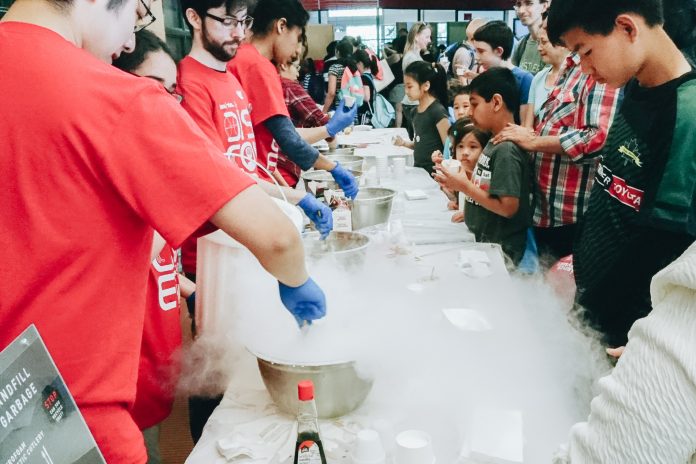
The event held at SFU on May 12 was one of over 300 held simultaneously across the nation. (Nathaniel Tok / The Peak)

School was in session on Saturday last week when SFU opened its doors to the public as part of its participation in Science Rendezvous, one of Canada’s biggest science fairs.

     Science Rendezvous began in 2008 when the University of Toronto, Ryerson University, York University, and the University of Ontario Institute of Technology saw the potential of working together to create events to engage the world in science and engineering research, and to increase scientific awareness and literacy.

     Science Rendezvous has since grown to involve over 40 Canadian research institutions and 85 community partnerships organizations throughout Canada. Apart from SFU, the Science Rendezvous event took place in over 300 locations across Canada on the same day — including UBC and KPU in the Lower Mainland — engaging visitors with experiments, demonstrations, and lab tours.

     Cynthia Henson, the Outreach and Engagement Manager for the Faculty of Science at SFU, is the organizer of SFU Science Rendezvous. According to Henson, SFU decided to participate in Science Rendezvous to help engage the community, and to create a “more integrated science learning environment.” The event also allowed SFU to connect and work with community partners.

     The theme this year was “Full STEAM ahead” and it incorporated arts into STEM learning. The event saw around 6,000–8,000 visitors, ranging from young children and their parents to high school students and seniors. Henson explained that the “event is promoted heavily in nearby communities and school districts and tries to get as many young learners as possible.”

     This year, SFU was also able to collaborate with other organizations, such as the  Royal Astronomical Society of Canada, to celebrate International Astronomy Day, which takes place around the same time as Science Rendezvous. In celebration of astronomy, attendees also experienced all-day solar viewings and tours of the Trottier Observatory.

     The participants were treated to 60 different exhibitions and hands-on activities at SFU, including the Infinity Glow Chemistry Magic Show by The Chemvengers, a tour of the Trottier Observatory, and a liquid nitrogen ice cream booth.

     “Kids were just thrilled to come to SFU as a lot of them are first time visitors of the campus,” said Henson.

     SFU faculty members and student volunteers also enjoyed the event. Every year, the Faculty of Science puts a call out for exhibitors and volunteers and these calls are always fruitful. In fact, Henson said “the enthusiasm to participate [. . .] now becomes an issue as campus space and facilities may be a challenge to accommodate everyone.” SFU staff members were exhausted afterwards due to the large number of visitors, but they thought the event productive and fulfilling.

     Henson was pleased with the event, calling the event “a very promising community engagement opportunity that we hope will continue for the many years to come.” She hopes to continue growing the event, adding even more activities catered to additional demographics, such as a beer brewing event for adults, and cultural events for diversity.

At the Rio Theatre

0
Image courtesy of The Rio Theatre

Ambience: B-

Picture it. The stench of stale sweat is paired with the confusingly appetizing smell of fresh popcorn. Performers in costumes are selling raffle tickets by the single, triple, or butt-or-bust-circumference. Weird Al Yankovic covers are serenading you with extra repetitions of the Star Wars-inspired parodies. One poor lady named Raquel is being run off her feet by the booze-demanding attendees.

     It’s like you were there, right?

     Having never attended any sort of comic convention or other nerd-tastic event, the 400-ish geeks in one place was the largest gathering of the kind I’ve ever seen. The speakers and emcees were on point, using “guys, gals, and non-binary pals” as their greeting and making corny meme references throughout their preliminary introduction.

Music and dance: A+

Did the cast and crew of Geekenders perform their own music? Of course not. But it was still really awesome to see up to 30 geeks perform choreography to crowd-pleasers such as “Under Pressure,” “I Will Survive,” and “Do You Believe in Magic?”

     Now, to the butt-shaking, breast-whipping, and overall shimmying, all of which is what you’re truly reading this for: they were all top-notch. There was no fear of baring a little too much, and each performer was energetic, enthusiastic, and committed. Plus, it was the first burlesque show I’ve attended where someone didn’t lose a nipple covering. Good glue jobs, all!

Acting: B

Basically, if you ever wanted to see The Last Jedi, but with dance battles and tasteful stripping instead of special effects, it was great acting. They even brought out toy blasters and lightsabers for some of the more battle-based scenes. BB-8 came out on a unicycle, R2D2 wore roller skates, and it was hilarious watching them navigate the stairs leading up to the stage without injuring themselves.

     While it was clear that the performers are fans of the franchise, they had no problem referencing memes like Poe ‘Hot’ Dameron, nor did they refrain from calling out the franchise’s stupidity regarding easy plot fixes that apparently no one, except every single audience member, could figure out (see: vice-admiral Holdo unnecessarily dying with the ship instead of using autopilot).

     Special shout out to the person who played General Hux. Not only was my friend in love with his fuckboy portrayal, but he easily commanded every scene which he graced with his presence. To echo the performers, “You can’t fix shitty dudes!”

Bar service: C

They didn’t have Growers Peach Cider which was the first flaw, and honestly, the fatal flaw for my friend. The second was that poor Raquel the server was overworked, and my friend and I, who had already made the people near the aisle let us in and out no less than three times, could not evict them yet again to go to the bar. Otherwise, it was fairly standard.

Accessibility: A

With zero stairs leading from the entrance to the seating, this place is fairly accessible. They even cleared out front row seats back in the day to have permanent wheelchair seating at the front. They don’t get an A+, however, because while their washrooms are somewhat accessible, for truly wheelchair- or scooter-accessible washrooms, they ask that you go two doors down to Broadway Sushi to use their accessible washrooms instead.

OVERALL: A-

For $20 a person, this was a great night out filled with non-stop laughs, fellow nerds, and a pleasing variety of nipple tassels. What more could you really want?

World News Beats

0

Malaysia’s former prime minister banned from travelling

After losing an election, the former prime minister of Malaysia, Najib Razak, has been banned from travelling. The new prime minister of Malaysia, Mahatir Mohamad, who is also the oldest elected leader of a country, stated that Najib was under investigation for mismanagement of state funds. Najib, who had recently announced he would be going on holiday with his family, said he would respect the travel ban. He also resigned from his position as chairman of Barisan Nasional, the coalition which had lost the election and which had held power in Malaysia for 60 years.

With files from Al Jazeera.


Hawaii volcano erupts

As feared by experts, Hawaii’s Kilauea volcano erupted in the early morning of May 17, hurling ash and boulders as high as 30,000 feet into the air and releasing more ash, steam and sulphur dioxide. Since its first eruption on May 3, the volcano had been releasing lava for a week, destroying over two dozen structures and causing the evacuation of almost 2,000 residents in the district of Puna. Some residents did not evacuate due to the risk of their homes being looted in their absence. While there are no homes in the proximity of the summit crater, the Hawaii Volcanoes National Park is located in the surrounding area and has announced that it will not be open on Friday. Kilauea is considered to be one of the most active volcanoes in the world.

With files from ABC News Australia and AP News and CNN.


A new cure for baldness is in the works


A drug originally designed to treat osteoporosis might hold the key to curing baldness. In a study published in PLOS Biology, researchers in the lab found the drug had an ability to stimulate hair follicles, making them grow by targeting a protein that is related to baldness. The drug, WAY-316606, which was originally intended for the treatment of osteoporosis, was able to cause 2mm of hair growth in less than a week. Future clinical trials will determine if compounds in the drug are safe for human use to treat baldness. Only two drugs are currently used to treat baldness — minoxidil and finasteride — and both have side effects, and are often ineffective.

With files from BBC News and New Zealand Herald.


Donald Trump and Kim Jong Un summit planned, then threatened, but continues


The summit planned in Singapore between United States President Donald Trump and the North Korean leader, Kim Jong Un, was threatened due to the US’s call for nuclear disarmament from North Korea. The military request was rejected by North Korea’s disarmament negotiator. However, in absence of any official schedule changes, US officials have publicly claimed that Un is “posturing,” and plan to move forward with the talks. This will be the first meeting between a current US President and a North Korean leader. Singapore was chosen as the site due to its neutrality between the two countries and its experience hosting high-level talks, including the annual Shangri-La security dialogue. The announcement came after North Korea released three US citizens from its prisons. Trump announced the location of the meeting on Twitter, stating “we will both try to make it a very special moment for World Peace!”

With files from The Straits Times and CNN.


Although some may try to forge a future without higher education, a university degree is worth it

0
Courtesy of SFU

The concept of higher education has existed since the ninth century, when Fatima Al-Fihri, a woman who moved from Tunisia to Morocco, created the first university. Nearly 1,160 years later, a university education is considered an essential milestone in a successful life trajectory. However, in recent years, more and more arguments are being raised that a degree is not required in order to make a career, and certainly not to make a life.

From what I’ve heard, the no-school camp reasons that one can build a successful life, saving all the years of grueling effort and time spent in university, by being enterprising and innovative. They also claim to argue that the supplementary years spent after high school gaining an institutionalized education creates conformists, prevents people from taking risks, and stifles creativity. They use the many cases of jobless university graduates as an example of university not working out. 

“Why bother following the traditional route,” some ask, “when the end result is the same?” This school of thought usually seeks to earn its bread and butter through entrepreneurial and innovative ways, and its graduates have seen both sides of success and failure.

I am going to argue against this notion. If this model has worked for centuries, and the vast majority of people still attend school, then we cannot call university completely useless. While everyone has their own reasons for going to university, with the most common being finding well-paying employment, there are two reasons that I feel are the most pertinent.

Firstly, a university education provides students with skills and experiences, both inside and outside the classroom, which put them on the path to professional success. At the classroom level, students must juggle multiple courses that require high levels of commitment, read through incredibly dense content, complete assignments, and study for tests on short, stressful deadlines. Most students also work part-time jobs, sometimes taking on multiple jobs at a time, which only add to the already hefty schedule on
their backs.

With all these responsibilities and commitments, students are forcefully put into a position where they must learn to manage their time well and spend it productively, milking the little free time they have to do things that they enjoy. As a result, students adapt to an accelerated lifestyle that builds character and teaches professional work ethic. Students are better suited for the workforce than their no-schooler counterparts.

Furthermore, the university experience opens the door to creating connections and forging relationships that are important in a professional life. As the no-schoolers argue, a degree is not sufficient in order to obtain a good job and one’s personal networks are infinitely more important in realizing a successful career, a fact embodied by the common saying “it’s not what you know, it’s who you know.”

The expectation, or at least the hope, is that the students pursuing a post-secondary education are the brilliant minds who will become the movers and shakers of our communities once they graduate. Being in a university setting is the best way to get in touch and build connections and friendships with these people. This is not to say that all our friendships are for self-serving reasons, but there is no doubt about the fact that connections and networks are important for professional success.

Bill Gates and Mark Zuckerberg, globally renowned for their success, dropped out of university before finishing their degrees. While this seems contrary to my argument, it is important to note that they dropped out of Harvard University, one of the best universities in the world, after having created the foundations for their respective softwares with their peers. If they had not been influenced by the bright minds at Harvard, it is possible that Facebook and Microsoft would not exist.

Overall, is a university education helpful for a successful life in our day? I do not think that anyone can deny that it is, though there will always be risk-seekers among us who will embark on the journey to go out and create their own futures. The university experience allows students to gain coveted skills and experiences, and it opens the doors to professional networks and connections, which are essential in the professional world. If you are reading this, you probably believe that a degree is useful to some
extent, too.

SFU mural is an unwarranted reminder of Canada’s colonial past

2
Photo courtesy of SFU

What do you do when you get a pair of pants as a present and they don’t fit? Most people ask for a receipt and return them. They don’t empanel a number of experts and talk about what they can learn about the pants’ perspective. They don’t talk about how these pants remind them of the importance of going to the gym regularly or eating better. They don’t talk about how important a gift these pants were even though they didn’t fit. Instead, they offer a teachable moment for considering how modern society has shaped our eating and exercising habits. They don’t hold onto this un-Comfortable, awkward, and ill-fitting gift as a reminder/memorial.

Now imagine that instead of pants, we are talking about a mural, specifically the British Columbia Pageant mural painted by Charles Comfort in 1951. This piece of corporate art was donated to SFU by the Toronto Dominion Bank in 2004. I am not going to question why, given all that we knew about the history and impact of colonialism in 2004, a university named after a colonial exploiter — sorry, I mean explorer — would accept this uncalled-for gift. However, I will point out that there has never been a time when Indigenous students and staff were not questioning the installation of this mural. Never a time when we were Comfortable with it.

I am not going to question why a vice-president university relations — Warren Gill, in 2005 — would say: “Being painted over 50 years ago, it can be seen to be male-centric and to glorify colonialism, thoughtless resource exploitation and environmental degradation in a way that we all would question today. On the other side, the mural is an important piece of Canadian art and contains some progressive elements for its time.” If I had to question that statement, I would have to wonder how a mediocre piece of corporate art, created for a bank by someone who was once an interesting and provocative artist but is no longer so, is still considered an important piece of Canadian art.

Is there any inherent value to a piece that glorifies colonialism, resource exploitation, and environmental degradation in the present? I would have to ask why a male-centric piece of work that glorifies colonialism, resource exploitation, and environmental degradation was accepted in the first place. I could raise these questions but, like the other Indigenous people who have already been consulted, I suspect that no good answer would be forthcoming.

Let me be clear: Indigenous students, staff, and their allies are not asking SFU to burn the mural. They’re not asking SFU to denounce the artist. They’re saying that at this time and place, they do not want to be confronted with a second-rate memorial to colonialism. They do not have the energy to continue having this conversation about the challenges of colonialism and racism over and over again. We’re already having that conversation in class, and it is often exhausting and painful for us all to constantly do the work to teach others. We don’t need another “opportunity” to have this conversation. We have to get to class.

The “teachable moment” upheld by this university is hurting the same people SFU claims to want to teach. These are not people in the abstract. These are people who have to walk past this affront every time they walk through the Academic Quadrangle. The price of this “teachable moment” comes at the expense of some of the most marginalized students on the SFU campus. Our pain and discomfort is a “learnable moment” that those in power never seem to learn.

Instead of wasting our time and energy by “re-setting the cedar table” or empaneling experts to talk about ‘Why Art Matters’, SFU can put the Comfort mural in that closet with the awkward fitting pants and the itchy sweater that you only wear when your mom comes to visit. Heck, I bet if you read the SFU Abroriginal Reconciliation Council’s (ARC) report, there might even be a call to action that would echo this idea. I would suggest starting on pages 31 and 75.

WHAT GRINDS OUR GEARS: Tim Hortons in 2018

0
Courtesy of The Peak

Let’s face it: Tim’s is not the champion of Canada that it used to be.

If you’ve kept up with Tim’s in 2018, you’ve probably heard of the public outcry, and the protests that erupted after it was announced that the heirs of the franchise would be cutting paid breaks and benefits for employees in Ontario due to increased minimum wages. Don’t you hate it when the government cuts into your profits in order to pay your employees a better living wage?

These events, coupled with rounds of layoffs along with animosity between franchisees and the parent company, have resulted in the company’s reputation disappearing faster than their best donuts — seriously, they’re always sold out of all the good kinds — sinking to number 50 on the Leger Reputation Study in 2018 after coming in at number four in 2017.

The cherry on top? Tim’s has completely ruined their sandwiches by introducing their new “rustic bun.” Trust me Tim’s, the only thing rustic about your bun is the fact that it tastes like dry, chewy shingles that somebody ripped off of an old barn in the countryside.

Sorry Tim’s, but I think I’ll be taking my business to Starbucks this year.

Gallimaufry brings an exciting jumble of art to SFU Woodward’s

0
Paige Smith / The Peak

A weirdly wonderful assortment of works was presented at this year’s first-year Master of Fine Arts candidates’ spring showcase, Gallimaufry. Four artists from a range of disciplines attempted to expand their viewers’ understanding of art.

     Entering the Audain Gallery at SFU Woodward’s, I’m immediately jostled by the overwhelming soundscape of Minahil Bukhari’s After Aftermath, a video installation where abstract images of crumpled paper are projected upon large sheets of hanging fabric and papers.

Paige Smith / The Peak

     The projected images first hit the sheets nearest them, and then slip around the edges and through large ripped holes in the sheets, allowing the light to hit every layer of them. The holes are messily patched with transparent papers, never allowing the stressful images of the crumpling to escape any of the sheets. Walking around and through the work allows the viewer to experience how the light affects the sheets in surprising ways.

     The second work one might notice is Jennifer Anderson’s Instrumental Alchemy, which consists of both viewer experimentation and Anderson’s performance of playing her handmade instruments. Five different bowls sit upon a table, some glass and some ceramic, each with a wooden rectangle strung with piano wires placed atop them.

     Guests are encouraged to try plucking the wires of these bowl instruments, along with piano wires strung into an oddly shaped wooden piece. When plucked, the wooden piece echoes back, striking a curiosity for further exploration. The handmade aesthetic of the pieces allows for a playful interaction between the viewer and the instruments, where each pluck can bring new questions.

     Anderson’s performance utilized electronic looping to create a cacophony of melodies from the vibrations of both the plucked wires and the bowls, now filled with water. Slamming the wooden rectangles upon the bowls, donning some sort of vibration-detecting glove that was electronically wired into her computer, and splashing pots of water upon her instruments, Anderson never failed to incite new imaginings of what an instrument can look like, or how one should play an instrument.

Paige Smith / The Peak

     Stumbling deeper into the gallery, guests encounter small fields of fungi-filled rugs, hanging artworks, and plastic bags. Amy Wilson’s Living Objects melds human structures made of metal frames or plastic containers with the organic construction of mycelium from the fungi. The works seem to ask us to question human and non-human forms of making, and how the two interact together to create objects. The rugs were of particular interest, showcasing the beautiful textures and colours that mycelium can create.

Paige Smith / The Peak

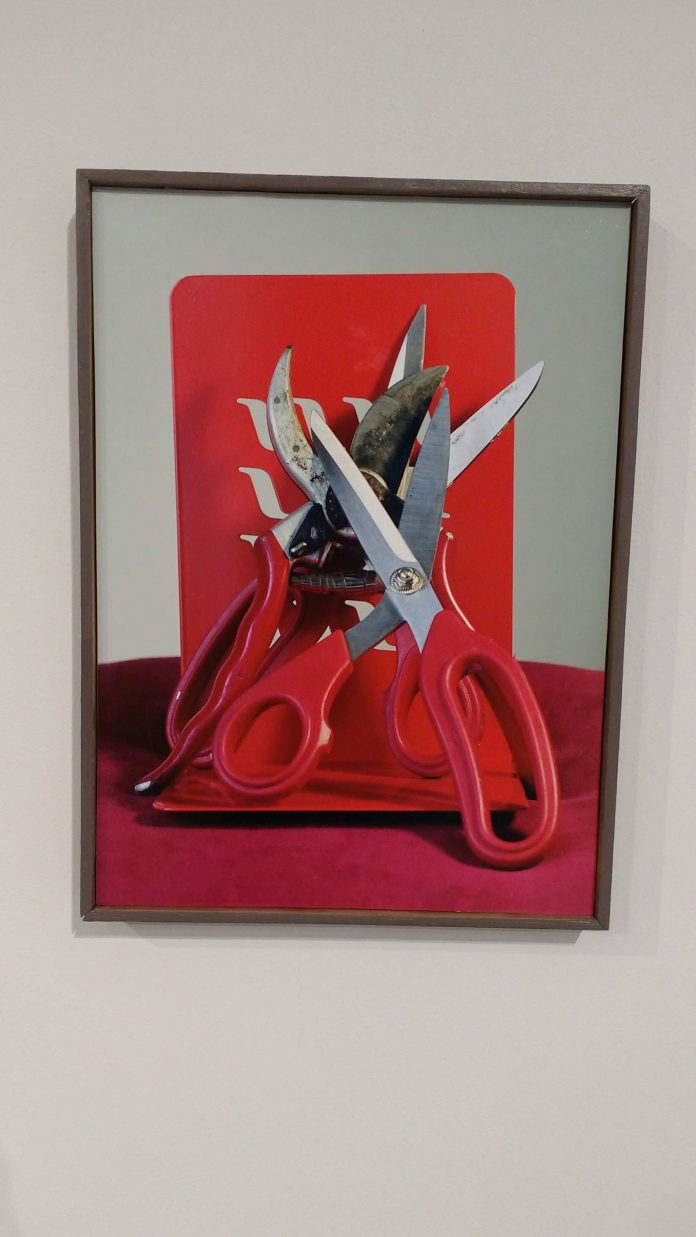
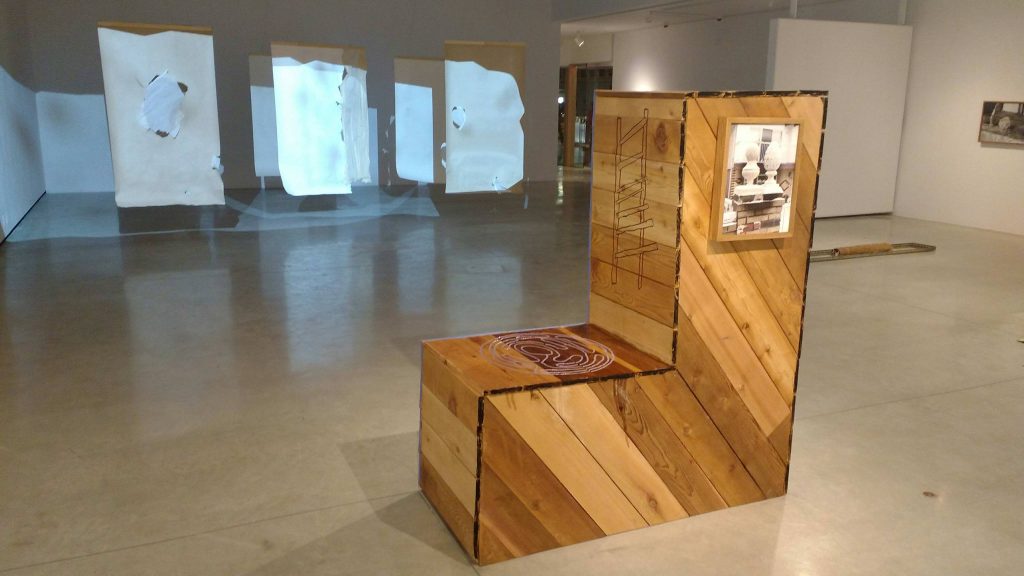
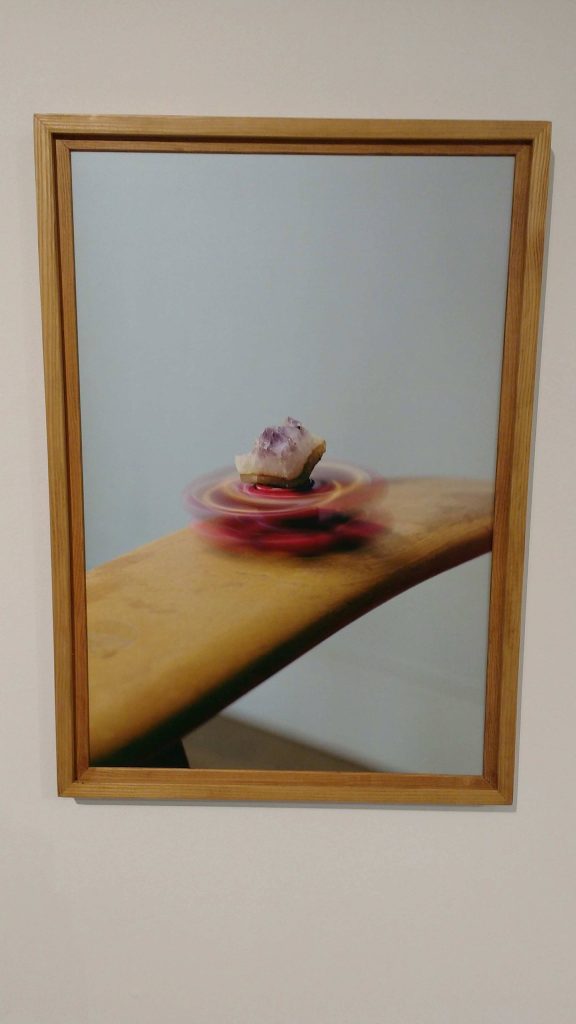
     The final artist on display at the gallery was Graeme Wahn, with his work Wrap Around Patio, which asks viewers to encounter the many wooden-framed photographs hanging on the walls from the vantage point of an L-shaped bench. The bench itself has patterns and sketches scratched into it, and the photographs depict objects ranging from bright red scissors to stacks of Kokanee playing card pyramids.

     The photographs seem unconnected other than their object-oriented aesthetics, but with the vantage point of the wooden bench, Wahn challenges viewers to question how the material structures surrounding the images affect the images’ meanings.

     The showcase was definitely a gallimaufry, with all the works mixing together to create a wonderfully odd collection of works all aimed at evoking curiosity in their viewers.

Paige Smith / The Peak