Home Blog Page 563

Album Reviews

0


K.T.S.E. by Teyana Taylor

K.T.S.E., just like Teyana, is lovable for three reasons: it’s dynamic, honest, and unabashedly authentic.

     In 2014, Teyana Taylor released her debut album, VII. Although a great contribution to R&B, the record was immensely underappreciated. Nevertheless, this past June, Teyana released her second studio album, K.T.S.E. (Keep That Same Energy). With it, Teyana made one thing certain: she will no longer be ignored.

     The album begins with the sexy “No Manners,” where Teyana boasts over her sybaritic relationship with her husband. The following track entitled, “Gonna Love Me,” has Teyana singing from a much more vulnerable place where she sincerely asks, “Are you gonna love me?”. Further along the tracklist, Teyana celebrates her sexual liberation with tracks like “Hurry,” and “3Way.”

     However, the album’s preeminent track, “Rose In Harlem,” stands as the highlight of the album. With lyrics like, “Grew out the concrete, you know it ain’t sweet,” the song seems to warn her musical counterparts that thanks to her Harlem upbringing, Teyana is more than capable of overcoming any curveball Hollywood throws her way. -YA


Troye Sivan – Bloom

      If you mix amazing pop music, romance, and unapologetically queer representation into a piece of music, you get the beautiful floral arrangement of an album that is Troye Sivan’s Bloom.

     On this album, you get songs like “My My My!”, “Lucky Strike,” and “Plum” that explode with energy and passion both in the album’s rhythm and beats. But you also get slower songs like “Seventeen,” and “Postcard” which serenade listeners with the emotions attached to young love and relationships.

      Bloom comes out a little under three years after Sivan’s premiere album, Blue Neighbourhood (2015), but you can hear both the growth and maturity Sivan underwent during his astronomical rise to musical fame.

      I definitely recommend leaving this album on repeat because of how seamlessly the songs transition into one another, and how easy of a listen the album is as a whole. – GM


Love Me/Love Me Not by HONNE

     If you love music that gets you grooving or puts you in a mood to dance, then this album is definitely for you. HONNE’s Love Me / Love Me Not takes their synth pop- and R&B-fuelled style to the next level with more featured artists and a more vivid sound than their previous album.

     The vocals on this album seem to be sharper and more pronounced than their first, bringing a lightness to each song that always puts me in a good mood. Songs like “Location Unknown,” “Me & You,” and “Crying Over You” get my body swaying and head bobbing along. In addition, featured artists on the album like Tom Misch and Nana Rogues were all paired to their respective songs beautifully.

     For anyone who enjoys music best for dancing in the comfort of their bedroom, or jamming along to on their commute, this album will pleasantly fit that category. – GM


Silk Canvas by VanJess

     Many may believe that R&B is “dead.” But with artists like VanJess, this couldn’t be further from the truth.

     This year on July 27, VanJess dropped their LP titled Silk Canvas. Packed with 14 beautiful tracks, Silk Canvas is quite arguably one of the best R&B releases in recent memory. The hypnotizing melodies, the luminous 808 drums, and enchanting harmonies which Ivana and Jessica Nwokike showcase throughout their album makes Silk Canvas the masterpiece that it is.

     Perhaps the greatest feat that VanJess accomplishes on Silk Canvas is their ability to integrate traditional R&B, Afrobeat, and soul into an alternative audio-sensory collage. As a result, listeners take a musical journey that is far too difficult to compare with anything released on the pop charts.

     Tracks include the sensual “Control Me”, the infectious “Through Enough” featuring GoldLink, and triumphant “Best Believe” which altogether make Silk Canvas a terrifically diverse record. – YA


Women’s soccer kick off GNAC season with convincing 4–1 win over Western Oregon

0
Emma Pringle is one of the favourites to lead the GNAC in scoring this season. (Photo courtesy of SFU Athletics)

Things could hardly have gone better for the Clan as they held their home opener on Saturday, September 15 against Western Oregon. The team dominated in all aspects of the game, and showed off the attacking style of play that head coach Annie Hamel discussed to The Peak in a preseason interview. With the win, SFU is now 1–0 in the Great Northwest Athletic Conference (GNAC). Here’s how it happened.

Jenna-lee Baxter got the GNAC season started on the right track, scoring a goal into the top-left corner of the net six minutes and 11 seconds into the season. Before the end of the first half, she would show off her playmaking abilities, putting in a perfect cross to Emma Pringle who headed it in for the second goal of the game. The teams would go into the half with a score of 2–0.

Things weren’t as easy to start the second half, as a goal for Western Oregon by Alexie Morris made the score 2–1 in the 63rd minute. Less than 10 minutes later, however, Pringle responded in a big way. She took a pass at the top of the box for Baxter and could not have placed it better into the net, as the ball hit off of the crossbar and in. Shortly after, Teagan Mackay’s first goal of the season ended all possibilities of a comeback, making the game 4–1, which would end up being the final score.

When asked after the game what it means for the team to start the season off so strongly, Hamel responded with:

“It was good performance. Good and bad moments today throughout the game but thankfully we were able to capitalize on some great opportunities and put the game away on Emma’s second goal to make it 3–1.”

Peak player of the game: Emma Pringle/Jenna-lee Baxter

The attacking tandem was at its best today, and both players played excellently. The pair continuously made each other better last season, and this season looks to be no different. When asked after the game on their efforts, this is what Hamel had to say:

“Emma and Jenna have a great partnership, it just clicks. The fun thing this year is that we are getting production from different players at different times, something we’ve struggled with in the past.”

When asked about Pringle’s scoring abilities, Hamel responded with:

“Emma is an extraordinary player, she is always a threat for the opponent and a player they have to account for. Her work ethic and positioning are brilliant. We are so lucky to have her on our team.”

What’s next:

Next, the team will travel to Western Washington University to face off against the Vikings, a team that will also look to compete at the top of the conference. The game is on Saturday, September 22 and kicks off at 4 p.m. This is what Hamel had to say about SFU’s next opponent:

“Western Washington [is] a tough opponent with quality players. We will be looking to build off our performance today and fine tune some detail in our defensive and attacking structure to limit the mistakes in our next game.”

Peak Speak: What Do You Think You Were in Your Past Life?

0

On this week’s episode of Peak Speak, we ask students what they think they were in their past lives.

Created by Gene Cole and Dino Dang

Meme culture around our student politics is getting in the way of taking it seriously

0
Photo by Maxwell Gawlick / The Peak

In 2018, millennials have found a primary method of communication on social media can be through recurring jokes.  Meme culture, the habit of conveying messages through captioned and/or edited images and jokes, is often a go-to method for articulating opinions online. Although this form of communication usually stems from a light-hearted foundation, it isn’t uncommon to come across a meme that pokes fun at a rather serious incident.

As many of you may know, on September 24 the Simon Fraser Student Society (SFSS) will have their annual general meeting. At this particular meeting, in light of certain claims, it will be decided whether or not the current SFSS president will be impeached.

Under the given circumstances, the potential impeachment of the SFSS president stands as a fairly serious situation, one which should carry a particular level of seriousness, correct?

Well, it doesn’t seem to be so far.

In recent weeks, the popular online group SFU Dank Memes Gang has posted memes that make light of the possibility of the SFSS presidential impeachment. These memes have accumulated a fair number of likes, and have become a fairly common topic for the page in the past several weeks. One recent example from the page is an image of the president’s face photoshopped on top of a muscular cartoon figure. A caption underneath reads, “Better back the fuck up before you get smacked the fuck up.”

The Internet is a chaotic place. We are all well aware of this truth. Nevertheless, when it comes to issues of allegations and grave conflict, the constant flow of memes may have harmful consequences.

What needs to be vehemently considered is the degree to which individuals receive their news from meme pages. Believe it or not, some SFU students receive their news and information of what’s transpiring at school through SFU Dank Memes Gang. With such a light-hearted tone, it fails to provide a refined outlook of what’s truly occurring within the SFSS, which can greatly misrepresent things to students who are trying to learn and keep up with the situation.

This has already been a significant point of discussion throughout the recent political climate of the US. Proceeding 2016’s election of Donald Trump, the US has become inundated with a number of vexing presidential decisions. Consequently, many Americans have taken upon themselves the task of alleviating the severity of such political decisions with the manifestation of comedic memes and meme pages. By now we’ve all seen many depictions of Trump as a Cheeto, but it distracts from the greater issues by falling on jokes that get endlessly repeated.

Just like America’s comically charged political atmosphere, the creation or distribution of memes, that cover the claims and incidents of the SFSS may need to be reconsidered. Sure, these posts are intended to be innocuous and funny. But the content of SFU Dank Memes Gang is both belittling the ardent affairs of the SFSS, and raises a concern of meme-viewers failing to conceptualize the severity of such instances.

Zombie apocalypse fashion journal

2
Illustrated by Phoebe Joy Lim

Dear Diary,

It’s been eight days since the zombie apocalypse. A small group of unlikely friends, including myself, are living in an abandoned weapons and survival gear factory, so we’ve been able to successfully fend off the zombie hordes outside, as well as reenact scenes from Saving Private Ryan.

The other day I met a really nice zombie named Benjamin, and I’ve been keeping him hidden in the rafters since then. He’s a really good guy, but the other survivors wouldn’t understand: they’re all “we must avoid getting The Infection” this and “Rebecca, we’re afraid you’re going to contaminate us all if you keep trying to touch the undead” that.

Needless to say, they don’t know about Benjamin, my rafter zombie boy, because they wouldn’t approve. It doesn’t matter though: I sneak up to see Benjamin when nobody’s looking and we make out. Maybe I will even give him my flower one day, but that’s a story for another time.

What I am really writing to tell you, diary, is that something amazing is happening. Ever since the zombie apocalypse, I’ve realized that all those Hollywood survival movies are really accurate. Take it from me, those characters on screen look exactly like actual apocalypse survivors.

I started to notice the changes slowly. On the first night of the apocalypse, I had run out of my house wearing pyjamas when an undead mob came through my neighbourhood one moment, and the next, I was suddenly in a completely new set of clothes. My flannel bottoms turned into heavily pocketed, durable cargo pants . . . my housecoat turned into a form-fitting black tank top and an army style jacket . . . strangest of all, I was suddenly equipped with a utility belt filled with pocket knives, can openers, and even some band-aids.

When I would get dirty pre-apocalypse, it would get everywhere: all over my face, my arms — wherever dirt could stick, it would be there. But now, I get this thing I like to refer to as dirt contour. It’s a phenomenon I mysteriously have no control over.

Whenever dirt gets on my face (and there is always dirt on my face, duh), it sticks only to the places that are most flattering. It smudges in the hollows of my cheeks and along the sides of my nose, acting as a sort of magical mucky bronzer. Similarly, sweat will only shine on my cheeks, the top of my lip, anywhere that will make me look glowy but not gross. Even the cuts on my face look nice. I got a scratch the other day, right along my cheekbone, but its placement absolutely complimented the shape of my face.

These last few days have been very weird, diary, and Benjamin is a very bad listener, so I am glad I have found a friend in you. I wish I could hear what you think about the fact that my hair never, ever gets greasy, and that my bra is more supportive and push-uppy than ever (which is especially great when I decide to run in slow motion). I feel like there is a Hollywood make-up artist watching over me . . . doing all they can so I do not look, gasp, unattractive.

Thanks for listening, diary. Until next time,
XOXO
Rebecca

Seven-Minute Majors: Find out what SFU students like about their majors (part one)

0
Image courtesy of Youth Change

By: Tessa Earnshaw, Michelle Gomez (Staff Writer), Amneet Mann (News Editor), Gabrielle McLaren (Features Editor) and Nathaniel Tok

Engineering

This major is going to help you become the nerd you always knew you could be.

If you’re anything like me, you have zero tech background as you consider joining engineering. Contrary to common perceptions of engineering students, you don’t need an intimate relationship with your operating system to do well in engineering. You just need to be open-minded towards experiencing the beauty of math, and before you know it, you’ll be saying things like “beauty of math” and building filters and coding instruction sets of your own.

The best professor I’ve had during this degree is hands-down Brenda Davison. Brenda is actually a math professor, but after taking four courses with her, I think she qualifies for this category. Brenda is clear, reassuring, and unrelentingly curious about the subject. Her knack for explaining equations in a way that makes them relevant turned me from a person merely ambivalent about math to someone who now has a deep appreciation for the subject.

The best classes I’ve had in engineering are the ones that make you stop and reflect on the fact that, wow, you actually are doing it — you are building the circuit, solving the equations, and doing whatever other tech-y thing you never imagined you’d be good at doing. For me, these classes have been ENSC 220 and ENSC 320 (Electric Circuits I and II), MACM 316 (Numerical Analysis), and ENSC 225 (Microelectronics I). These are classes that push you to use your classroom knowledge — the seemingly never-ending math, physics, and circuits courses — to design and build your own circuits and evaluate numerical techniques to reach meaningful conclusions about robustness and efficiency.

If you can put up with the trial-and-error and frequent googling that comes along with the learning process in this degree, then maybe engineering is for you too. – AM


English

If you love reading, writing, and critical thinking, then you should consider majoring in English. You get to read the best literature ever written, have interesting discussions with others who actually appreciate it, and analyze it for both your enjoyment and your assignments. You also learn about multiple other subjects such as history, politics, religion, and geography in the context of what you read, leaving you with a better understanding of the text and the world around you.

The English department consists of some of the best professors at SFU; they are all extremely passionate about their fields of study and are always willing to help students. I have loved every professor I have had, but some of my favourites include Paul Budra, Jon Smith, Peter Cramer, and David Coley. My favourite classes so far have been ENGL 385 (Across Time, Across Space), because of its wide variety of fascinating literature and history, and ENGL 311 (Early Shakespeare, because what English major doesn’t love Shakespeare?)

SFU’s English program is truly remarkable; it has fantastic, helpful professors, interesting classes that you actually want to attend, and passionate students who will quickly become some of your best friends. Most importantly, English allows you to look at situations from many different perspectives and improve both your writing and critical thinking, which are essential skills for any career. It prepares you for the future, regardless of your career path. – TE


Health Sciences

My department, or rather, faculty, is Health Sciences. For those who are unfamiliar with us, it’s the glass hallway at Blusson Hall you barely think about when you are dashing to and from the bus loop.

We are a weird mix of scholars. There are professors and researchers who specialize in almost anything you can think of: philosophy and ethics, policy and healthcare, geography and geological information systems, economics, microbiology, psychology, sociology . . . as long as it can be related to healthcare, we probably have someone who does it. This leaves students (or me at least) feeling a little lost, since although we study health and the human body, there are courses we can relate to in many departments.

Profs and classes are generally pretty good. I am biased, but my experience in health sciences classes often feels better compared to when I do classes outside my faculty. My favorite class so far is probably HSCI 305 (The Canadian Health System). The prof teaching our class kept things relevant and connected lecture topics to current news. Assignments were broken up so you didn’t hand in an entire term’s worth of work at once just before exams.

An interesting book I read in a health sciences course was The Big Necessity by Rose George. The prof insisted that we read something in the popular science book category rather than journal articles, to make it easier for students. The book was about problems and potential solutions on how to deal with human biological waste. I never really thought about this topic before, so it was eye-opening to see how such an important issue was often overlooked. Well, that’s my major in seven minutes or less. – NT


History 

Confession time: I hated history in high school. I hated reciting lists of events, I hated the boring textbooks, and I hated memorizing all the damned dates. But because I liked museums, historical books, and movies set in the past, I took a history class in university and fell in love — hence why I’m currently pursuing a double major in world literature (read more on that next week) and history.

I liked how history, to me, felt like a series of stories. The history department helped me pick those stories apart and understand their details, the causalities precipitating them, and the complexities of how they got to us and why. Interesting characters, wildly different worlds, hilarious anecdotes, and complicated storylines all come up on a regular basis.

My critical thinking skills have always been pushed in history classes, where there are not only facts and undeniable realities, but also complicated sources, repercussions, motives, causalities to understand and discuss. My research skills have definitely been sharpened thanks to the nature of the work I’m assigned. Classes tend to be reading-intensive, but also very much discussion-based.

What I appreciate at SFU is that you need to take classes from a variety of course types (Europe, The Americas, Africa/Middle East/Asia, and Global/Comparative), which means you get a little bit of everything, and get pushed out of your comfort zone and into new interests. I had no idea when I started this degree that Indigenous history and environmental history would be so interesting to me. Professors whose classes I’ve actively planned my schedule around to take again include Dr. Joseph Taylor and Dr. Mary Ellen Kelm. – GM


International Studies

What attracted me to the international studies (IS) department was the broad range of topics that it covers, allowing each student to study specifically what they are interested in. There are three streams in IS: international security and conflict; comparative world politics, culture, and society; and international development, economic, and environmental issues.

Since IS is such an extensive program, having these streams allows students to narrow down their studies and focus on a specific interest area. Students in all of the streams have to take similar lower-division courses, which are usually overviews of a wide topic. As it is with most degrees, the upper-division courses vary and are more specific. In fact, IS upper-divisions get so weirdly specific that there really is something for everyone.

The most interesting lower-division courses are IS 209 (Latin America: The National Period), and IS 220 (The Wealth and Poverty of Nations). Keep in mind that many first- and second-year courses in IS involve a decent amount history in the curriculum, as it is very important to understand context and background when studying foreign countries.

For upper-divisions, you are able to choose courses from a list that includes other subjects, such as sociology and anthropology, political science, and history. The one downside for me was that all streams require at least one ECON course — it was all fun and games until I had my first macroeconomics midterm.

My favourite part about being in IS is that there is a sense of engagement and respect in classes when students partake in friendly debate. It is obvious that most IS students are passionate about what they study. -MG


Editor’s note: More Seven Minute Majors will be coming next week! Check online for our full selection, including some submissions not in print this week.  

Removal of at-large representative linked to sexual misconduct allegations

1
The removal of the at-large representative was previously attributed to abandonment of office. (Chris Ho/The Peak)


The removal of former Simon Fraser Student Society (SFSS) at-large representative Wareez Ola Giwa as a director, which was previously attributed to him missing two board meetings, has now been linked to sexual misconduct allegations.

The allegations have been brought forward by vice-president external relations Jasdeep Gill, business representative Jessica Nguyen, and a third board member who requested to remain anonymous.

The female board members submitted a formal complaint regarding Giwa’s behaviour to SFU’s Sexual Violence Support and Prevention Office (SVSPO) on July 30. The report, which has been provided to The Peak by the women involved, details incidents in which Giwa engaged in misconduct.

These included Giwa setting up a one-on-one meeting with Gill and then using the time to ask her “personal and inappropriate questions,” putting his hand on one board member’s thigh, and asking Nguyen if she could be his “superwoman” or call him “daddy” while cornering her in the board office.

In their report to the SVSPO, the women asked for a formal restraining order against Giwa, an evaluation of his status as an SFU student, and increased security in Maggie Benston Centre.


“We were basically brushed under the rug”

In an interview with The Peak, the women expressed frustration at how the situation was handled within the board office.

According to Nguyen, when she approached SFSS president Jas Randhawa, who was one of the human resource (HR) representatives for the board office at the time, he was not willing to take disciplinary action against Giwa for fear of public backlash.

“He’s more concerned about the SFSS reputation rather than the three females who are trying to work here and have a safe place,” said Nguyen. She said Randhawa told her to “just ignore it.”

“We were basically brushed under the rug, not taken seriously.” – Jessica Nguyen, SFSS business representative

The women involved expressed that during this period, they avoided coming to the board office and felt their work was affected.

“I would like to start off by questioning the integrity of the directors who are bringing forward such allegations by asking why allegations are being brought up this late,” wrote Randhawa in an email interview in response to these statements by Nguyen. “The allegations being made here are disgusting and of severe desperation.”

Randhawa stated that he immediately contacted the SVSPO upon hearing the women’s complaints. Randhawa provided screenshots of email correspondence between him and the SVSPO dated June 24, in which the three female directors were CC’d. In the email, he asked to set up a meeting time with the office. According to Randhawa, none of the three female directors followed up with scheduling a meeting.

Nguyen responded that she did not follow up to schedule a meeting with the SVSPO because she did not believe it would lead to a removal of Giwa as a director, which is what she “wanted and needed.”

“I personally did not need any of the services offered by the SVSPO office (counseling, referrals to off-campus support, information packages, etc),” wrote Nguyen. “What I needed was to have Ola removed from the board because he was constantly harassing me which was not being done. So the SVSPO just seemed like a lost cause.”

The three women stated that Randhawa withheld their complaints from vice-president university relations Jackson Freedman, the board’s second HR representative at the time, and CEO Martin Wyant.

Gill stated that the women had recently found out that Wyant had offered to sit down with them to find a solution to the problem, but that Randhawa had told Wyant the women did not want his help. “We were never told that Martin had ever offered us any help,” said Gill.

Wyant confirmed that he had offered help to the women and was told by Randhawa that “the three female board members did not want to meet with me.”

Randhawa responded that his only intervention was to ensure Wyant did not “force a decision onto these women as I did not want Martin to control what action these women take.”

Nguyen said that after receiving little support from Randhawa, she then went to Freedman.

“Our other HR representative had no information at all, and it wasn’t until Jessica told Jackson that something was actually done,” stated the third board director.

Freedman corroborated the women’s claim that he was “not adequately consulted or involved in the decision-making process over the resolution of this dispute.” He stated that Randhawa had reassured him that the board members’ concerns had been appropriately addressed and a resolution found.

“This was clearly not the case,” added Freedman. Upon learning about the complaints, he had recommended that the women contact the SVSPO.

Randhawa alleged that Freedman had been involved throughout the entire process and was mostly concerned with helping Giwa draft apology letters for the women.

The women then filed a complaint to the SVSPO and received apology letters written by Giwa with Freedman’s help. The women did not accept the apologies.


A quiet resignation

Following the registration of their complaint, the women stated that they still did not feel safe in their workplace.

“So that was done and still we have events, like socials for the board and stuff like that, [and Gill and the third board member are] not showing up and that’s not fair because we still have this one guy,” recalled Nguyen.

In this period of time, the women stated that they found themselves working in close proximity with Giwa. He was assigned to work on the Surrey Campus Committee with Gill and the third board member, a subcommittee with Gill, and seated next to the third female during a meeting.

“So it just goes to show that [Randhawa] didn’t care,” said the board member.

Nguyen stated that Randhawa continued to refuse to remove Giwa from board.

According to Randhawa, he did not have the authority to remove Giwa as a director without resignation, impeachment, or abandonment of office as per SFSS by-law 17.

“The issue regarding the now inactive board member was resolved in no small effort from my part.” – Jas Randhawa, SFSS president

Nguyen stated that after she continued to advocate for herself and the women, threatening to approach The Peak, Freedman and Randhawa approached Giwa and told him “he could resign quietly” by missing two consecutive board meetings.

“Technically, that’s what happened,” said Nguyen referring to Giwa’s official removal from board at a previous board of directors meeting, “but [this is] the backstory, because they wouldn’t remove him because of this issue.”

According to one of the board’s current HR representatives and science representative Natasha Birdi, there is no protocol in the SFSS’s by-laws and policies nor in the BC Societies Act that outlines a response to sexual harassment in the board office. “For situations like this, we would refer to SFU’s general guidelines and take any incidents to SFU’s Sexual Violence Prevention Office,” she wrote in an email interview.


Leaked information

The women told The Peak that they decided to come forward with the sexual misconduct allegations after they had learned that Randhawa had begun circulating information regarding these allegations to the public without their permission.

“He’s jeopardized our own safety and confidentiality,” stated the female board member. “Obviously this is something we don’t want our names to be attached to as well. It’s something so personal; he invaded our space.”

“He told Ola if he resigned quietly, which is what happened, then none of these [documents] would be released [. . .] [but] he released them,” added Nguyen.

Randhawa denied that he had circulated information regarding the incident and called the claims “entirely baseless.”

He stated that asking Giwa to resign privately was made in the interest of the “women in the workplace [who] did not want this to go public. [. . .] [The three women] continuously stated that it would be embarrassing for them if the story went public and I respected this until these directors decided to switch around the narrative to try and push me out.”

The Peak had received details regarding the sexual misconduct incidents and how they were handled within the board, including screenshots provided as evidence, from Randhawa prior to this interview with the female board members.


Allegations against president in regards to women in the workplace

The third board member added that Randhawa himself did not seem to be considerate towards women in the workplace. She stated that Randhawa often cut her off in meetings. She cited a meeting in which she was the only female board member in the room where Randhawa “made the meeting about how [she] takes things too personally and [. . .] based [it] on [her] feelings.”

Randhawa denies that a meeting like this ever took place and questions the legitimacy of the claim without any evidence.

In a document addressed to the SFSS membership by the board of directors, the mishandling of the sexual misconduct allegations and the circulation of confidential information relating to these allegations was cited as one of the concerns which led to the proposal of Randhawa’s impeachment.

The board has declined to comment on the official reason for Giwa’s removal from the board in light of the sexual misconduct allegations being made public.

The Peak reached out to Giwa for comment on the allegations made against him, but received no response by the publication date of this article.


 

The Hanging Girl is a gripping story that will keep you on your toes

0
Image courtesy of Good Reads


      The Hanging Girl follows seventeen-year-old Skye Thorn, who often gave tarot readings for her classmates throughout her life. And when their small town’s golden girl Paige Bonnet goes missing, Skye decides to use her so-called “abilities” to feed information to the police. But the small prank goes awry, and Skye realises she has to soon figure out who the true perpetrator is.

      The novel may be a classic mystery, but the heart of The Hanging Girl centers on characters’ and the relationships between them instead. While the characters do follow certain tropes — the outcast main character, the supportive best friend, the school bitch — none of the characters feel two-dimensional. Throughout the story, Skye struggles with her friends, and her enemies. She stands conflicted about  her feelings towards her mother, someone she loves but is also embarrassed by. The main conflict almost seems to parallel her personal struggles.

     However, the novel is lacklustre when it comes to the plot. Cook attempts to mislead the reader through the placement of red herring perpetrators, but all of them are embarrassingly easy to spot. The pacing of the novel could also be improved — it isn’t until the second half of the book that the story really starts moving, which means muddling through a lot of monotony before getting to the satisfying bits.

     The Hanging Girl stands as an unexpectedly poignant story, featuring an incredibly diverse cast, grapples with complex relationships, and what it means to tell a lie.


Staying In: The Mindy Project

0

     Are you a sappy, hopeless romantic who recites the lines alongside Meg Ryan as she declares her love to Tom Hanks? Are you down to kick your feet up and laugh alongside a strong feminist heroine? Well, good news: The Mindy Project is the next lighthearted comedy to fill the deepest of your Saturday night couch potato desires! Mindy Kaling was hailed as a groundbreaker for creating and starring in her own television show as an Indian-American woman, and in The Mindy Project, Kaling offers an exaggerated version of herself to the audience.

     Her protagonist, Mindy Lahiri, is a melodramatic, egotistical, totally extra hot mess who will keep you laughing with her sharp quips and embarrassing exploits. Mindy is a successful OBGYN working in a professional practice alongside kooky and lovable characters, often rushing to the hospital to deliver babies as well as punchlines. As an established career woman, audiences are asked to join Mindy as she searches for love and self-growth in a haze of smart and satirical rom-com tropes.

     This show delivers clever, self-deprecating humour in an upbeat way. Mindy’s fearless and unapologetic jokes hit hard as she promotes body positivity, feminism, independence, and self-love. Laugh along with Mindy, and wallow alongside her on the pink rug of her office during times of heartbreak and despair.

Best for:

  • Hopeless romantics
  • Comedy goofs
  • Unapologetic feminists

Available on: Netflix (all six seasons)

SFU should use its social media pages to improve students’ real-world social lives

0
Photo by Gene Cole / The Peak

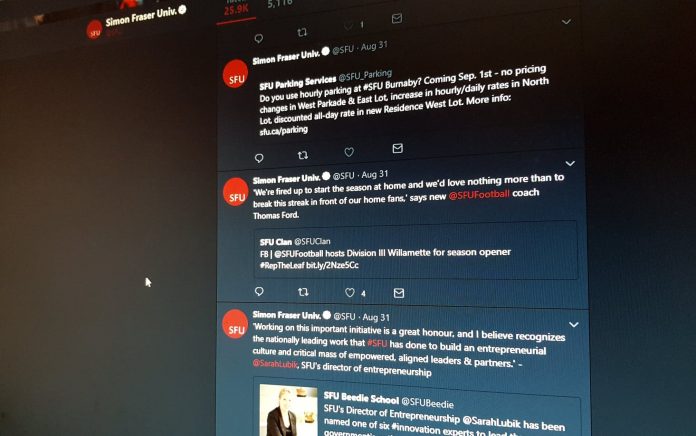
As a school that boasts of being Canada’s most “engaged” university, one thing we can’t deny SFU’s its apparent engagement on social media. SFU’s various departments, faculties, student programs, student services, and even clubs are everywhere on social media. Several departments have their own social media pages, followers, and regular updates.

Much of the content on SFU and SFU-branched social media pages is student engagement — posts which the pages’ operators perceive as relatable to the everyday SFU student. These are usually pictures around campus, mentions of student accomplishments, or even the occasional corny meme.

While this content technically makes our university live up to its slogan, it isn’t always relevant to SFU students. We follow these pages and see these posts, but scroll past them without a second thought. They’re nice for a quick glance, maybe a like, but usually aren’t engaging enough to look into more deeply or share. They mostly serve as placeholder content to keep the page active and make it look pretty for the occasional interested viewer, maybe a prospective student.

Of course, there’s nothing inherently wrong with this. There shouldn’t be a need to engage students on social media when they’re physically at an SFU campus, or busy with things related to SFU. We consume enough from our school as it is without also needing to see more of it in our faces when we’re on social media to relax and take a break.

SFU and its branched social media pages shouldn’t spend great amounts of effort trying to engage students exclusively online, because there really isn’t a need. To try to do that would be to try to occupy the students’ online social lives, and that just isn’t necessary.

Instead, the core goal of SFU social media should be to update students on things that could help their social lives offline.

Our school is known for its students having non-existent social lives. Its reputation as a commuter school could be changed if social media was used as a complement to students’ social lives.

The “commuter school” reputation only stands because students leave right after class. This leads to few people being on campus long enough to know what events are happening. The ones who know, meanwhile, don’t want to bother going to an event if it means they’ll have to commute home late or during rush hour.

If social media were used, it could help mitigate this problem. A student could come across the event beforehand on Facebook, read what it was about, then invite a few friends to make plans to go with them together. Moderators of these pages can help facilitate this discussion and detail events with people posting about it who seem unsure. Things like this could be a powerful tool for encouraging student engagement, and it should be utilized as effectively and extensively as possible.

Most of the content from SFU social media pages does little more than fill up our social media timelines, but it has the ability to do something far more tangible and beneficial. It needs to shift away from these unsubstantial posts, and create a more social atmosphere on campus through focus on events and student life.