Home Blog Page 544

Conversations around cultural appropriation sparked at SFU

0
(Image courtesy of Teen Vogue/Party City)


This Halloween season, SFU’s intercultural engagement team is working alongside other university departments, such as Residence and Housing, to prompt conversations around cultural appropriation.

The intercultural engagement team is promoting a #notacostume campaign around the university to educate students about how certain costumes can be culturally appropriative or otherwise offensive.

“Most people do not pick out a costume with the intention of being offensive,” reads the campaign page on SFU’s website. “However regardless of intention, costumes can still perpetuate harmful stereotypes. [ . . . ] Cultural appropriation can take many forms, but around Halloween it often refers to people wearing ‘costumes’ that may reduce cultures to jokes and/or stereotypes.”

The campaign included putting up posters around the university, holding an information session on October 23, and offering additional informational resources for students online.

“I believe it’s the first time that I’ve seen a campaign like this at SFU that is being marketed as well as this one, and is accessible as this one is to our students,” said Zoe Woods, associate director of residence life for SFU’s Residence and Housing department, in an interview with The Peak.

“I think [it] gives us a platform to be able to have the conversation in an even more tangible way,” Woods added.

The campaign this year is being supported throughout SFU’s residences, but Woods explained that the topic of cultural appropriation was not new for the residence staff. She stated that student staff in residences receive consistent training throughout the term to prepare them to have conversations that may be sensitive to residents.

“I know there have been conversations that occurred in our residence communities in the past on a smaller scale around cultural appropriation, so I’m excited to see it happening on this level and to [see it] be talked about as much as it is in our community,” said Woods.

According to Woods, between 40% and 60% of residents are international students, making it “an even more important topic within our residence halls and on our campus than in other areas of our Burnaby community.”

The conversation around cultural appropriation has been opened up in the university in other ways, such as by SFU archaeology professor George Nicholas who recently published an article on the subject in Sapiens digital magazine.

While Nicholas acknowledged that stereotypes perpetuated through culturally appropriated costumes may be harmful, he argued that Halloween “is essentially a display of cultural anarchy,” which makes the topic difficult to objectively approach during the season.

“Is a Pocahontas costume more or less acceptable than a slasher? What if the child wearing it is Native American? Is a zombie costume so far removed from Haitian folklore that it no longer counts as culturally derivative? Is a white child dressing up as a black superhero from the recent Black Panther movie a positive counterpoint to years of black children dressing as white superheroes?” Nicholas asked in his article.

Nicholas moved on to the distinction between “cultural borrowing,” a benign practice, and “cultural appropriation,” which involves the commodification of another’s heritage and ultimately ends up harming the culture being appropriated.

Both Woods and Nicholas expressed that it was good to open up conversations around the subject and let students reflect on their own understanding of cultural appropriation.

Woods believed that the biggest impact of the campaign so far had been felt in the conversations heard between students on residence.

“[Our front desk staff] had a lot of conversations with students about, ‘oh, I didn’t recognize that a vampire costume may be inappropriate,’ or ‘hey, I was going to dress up as XYZ for Halloween and maybe I should think about that a bit more,’” said Woods.

“I think becoming more aware and [ . . . ] getting those conversations started and providing the language for students to explore that has been really important.” – Zoe Woods, associate director of residence life, SFU Residence and Housing department

Woods encourages students who have had negative experience around this issue to seek out university resources. For residents, Woods noted that their community advisors or front desk in the housing office would be available to support students. For SFU students who are not residents, Woods encouraged them to reach out to either SFU’s International Services for Students office — whether or not they are international students — or the Health and Counselling department.
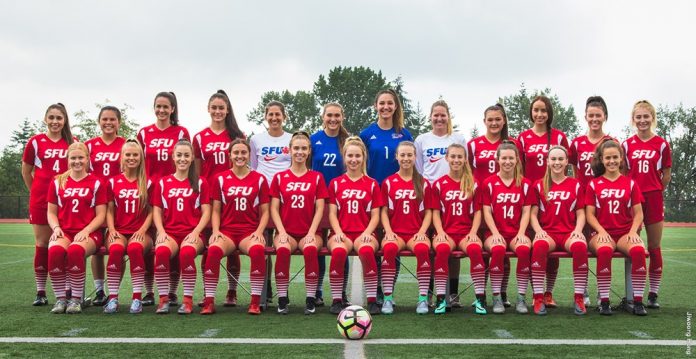
 

SFU women’s soccer team’s excellence displayed in GNAC awards

0
Seven SFU players were recognized in the GNAC awards. (Photo courtesy of SFU Athletics)

Despite losing a heartbreaking match on Thursday in the GNAC Semi Finals, there is still reason to be excited about the SFU women’s soccer team’s season. On Tuesday, October 30, the Great Northwest Athletic Conference (GNAC) announced the award winners for women’s soccer.

Given the SFU women’s soccer team’s fantastic season, finishing tied for third in the GNAC and leading the conference in goals scored, it was expected for the team to take home some of the awards. Nonetheless, it was exciting to see just which awards, and how many of them, the team received. Here are the highlights:

Jenna-lee Baxter wins GNAC player of the year

If ever there was a shoe-in for a player of the year award, this was it. Baxter led the GNAC in points with 32, tied for first in goals with 11, and tied for first in assists with 10. Watching her play this year, it was clear that she made everybody around her better.

On attack, she was capable of drifting into the wing or playing behind striker Emma Pringle in a supportive role. She was the team’s primary free-kick taker, and created countless opportunities on corners and other set piece plays.

Her presence also created opportunities for other attackers, as the defense was forced to defend her closely from up to 30 yards out given her shooting ability, leaving other attackers open. All in all, Baxter was clearly the best player in the GNAC this season, and arguably one of the best players in the entire nation in 2018. What a way to go out for the senior.

Emma Pringle named to GNAC All-Conference first team

Emma Pringle tied for the GNAC lead with 11 goals on the season. (Photo courtesy of SFU Athletics)

Two things are certain on Burnaby mountain come the fall: it’s going to rain, and Emma Pringle is going to score.

For the second straight season, she finished among the top two in scoring in the GNAC. Last year, she was one goal shy of Western Washington’s Gabriela Pelogi, while this year she finished tied with Baxter at the top. Her ability to score in a multitude of ways made her the perfect striker for this year’s Clan, as she was able to consistently finish off crosses from the team’s wingers, get behind the defence, and use her cannon of a shot from outside the box.

Scoring truly comes naturally to Pringle. For example, in a game where head coach Annie Hamel thought Pringle had an off night, the striker was still able to get a hattrick. Only special players are able to do that, and we look forward to seeing her continuing her Clan career as she goes into her senior year next season.

Katelyn Erhardsen named to All-GNAC second team

Katelyn Erhardsen tied for the GNAC lead with 10 assists. (Photo courtesy of SFU Athletics)

While Erhardsen may not have been one of the leading goalscorers in the GNAC this season, her importance as a winger for the Clan this year cannot be understated. Erhardsen finished the season tied for the GNAC lead with 10 assists, and also contributed with four goals of her own.

Her ability to beat defenders down the wing and put in picture-perfect crosses created havoc for opposing teams, and often ended in a goal by Pringle or another Clan attacker. She gave the Clan speed and width that opened up room for Pringle and Baxter to operate centrally, capping off the most dynamic trio of attackers in the conference.

Erhardsen took the next leap forward as a player in her senior year, improving on a three-goal, six-assist season in 2017. Another great way to end her Clan career.

Annie Hamel wins GNAC coach of the year

When speaking to the head coach before the season started, Hamel told The Peak, “Right now, we have the players and the experience to be playing an attacking brand of football, we want to play at pace, be mentally strong and grind.” This season, the team did that and more under her guidance.

There was not one game this season where the Clan did not look like an offensively dominant team, and while they certainly had some fantastic players up front, it is up to the coach to use their skillsets. Without Hamel’s attacking game plan, it is quite possible that we would not have seen the seasons that we did from Baxter, Pringle, Erhardsen and others. On attack, the team operated as one, often dominating possession and the scoring chances in a game.

This exciting brand of football made the Clan a must-watch team this year, and their place in the GNAC Championships is evidence that it worked.

Honourable Mentions

Four SFU players were also selected as honourable mentions to the All-GNAC team: goalkeeper Nicole Anderson, defenders Allyson Dickson and Carli Grosso, and forward Christina Dickson.

Anderson was tasked with the starting goalkeeper role in her freshman season for the Clan, and surpassed all expectations. She won the starting role at the beginning of the season and never looked back, and will be a key player for SFU in the upcoming years.

Allyson Dickson had a fantastic senior season for the Clan, and was a valuable member of the teams back line throughout the season. Her ability to defend and attack made her a versatile asset, and she was imperative to the attacking style of play that SFU played with, despite her role as a defender.

Grosso was a rock on defence all season, and displayed a high soccer IQ when playing as a centre back this season. Her ability to play the ball as a centre back can not be understated, and she cut out scoring opportunities for SFU opponents with consistency.

While other attacking players may have received more credit this season, Christina Dickson had a great year for the Clan. She scored four goals and had one assist, and also contributed defensively throughout the campaign.


Hamish and Jo’s adventures in France: Still no schoolwork, but a new continent!

1
Illustration by Siloam Yeung

Much has changed since our last update. For starters, we have not cut our hair in several months. In fact, it seems we have embraced the nomadic ways of expert travellers by growing it out. Next thing you know, we might be bathing in streams, sleeping in caves, and eating the berries off bushes.

Since we last spoke, we have been to four new countries. Sadly, among these is Monaco. (We have nothing, we repeat, nothing against Monaco. It’s just that this means we are counting the teenie-weenie microstate — still a state! — completely surrounded by France that also happens to be a mere few minutes away from us by train.)

That is not to say we aren’t proud of the places that we have seen so far. We have been lucky enough to visit wonderful places, ranging from Milan in Italy, with its beautiful churches and ancient Roman ruins, to Tunis, capital of Tunisia, with its giant Medina bustling and overflowing with the smells and sounds of the city . . . and of course, more ancient Roman ruins, which seem to be a bit of a theme around the Mediterranean.

All in all, it’s been another month here on the sunny south coast of France, and so naturally, we’ve not done much of any schoolwork, knowing full well that it will all be coming in the next month. Rather, we have preferred to spend our time here basking in the sunshine on the beach and exploring as many different cultures and countries as possible.

We began our travels with a trip to Saint-Tropez, a town on the French Riviera which was just a train and a short boat ride away. With multimillion dollar yachts lining the marina and luxury brand-name boutiques mirroring them along the city centre, immense wealth was on full display. Nevertheless, we managed to find ways to make our trip work for budget-wary millennials.

After strolling through the streets and admiring the beauty of Saint-Tropez, we bought some bread and sandwich fixings and hiked to the top of the hill where the Saint-Tropez Citadel is located. We made our way down to a secluded beach where we stayed for hours, before bringing our sunburnt bodies back to the boat and across the bay and to the train, bringing us back to our home away from home in Menton.

The next trip we went on was a whirlwind of activities. In just a few days, we went from Menton to Nice, Tunis, Amsterdam, and back.

We were only in Tunis for about 36 hours, but we managed to do a lot in that time. Not only did we meet up with a friend of ours from our days working in Parliament over the summer, but we also did quite a bit of exploring. We experienced the Medina, a marketplace dating from the arrivals of the Arabs in the area hundreds of years ago; saw the ruins of Carthage, which date back to when Tunis (or Carthage, as it was known) was an ancient Roman city; and walked through Sidi Bou Said, a town atop a nearby hill painted in the whites and blues of a Greek island village.

On our way back to Tunis, the children in our train car would have provoked even the most indifferent North American mother’s anxiety. They were hanging out the doors of the moving train, climbing on the roof, seeing how far they could swing their legs out. At each stop, they’d run alongside the train as it departed to see how late and at what speed they could still manage to slip between the propped-open doors before the platform suddenly dropped off.

After our short journey to Tunis — and let the records show that this will not be our last time in North Africa— we made our way to Amsterdam.

Now, before diving into detail about what happened in Amsterdam, let us note how hard it was to plan this whole trip.

As we are budget travellers, always looking for the cheapest flights, we had booked our trips on websites that are less than trustworthy in the omniscient eyes of credit card companies. For the first leg of our journey, Nice to Tunis, we booked directly through an airline that we had never heard of, NouvelAir, which offers budget flights between France and Tunisia. So even though we got to the airport in Nice two hours early (as per any good traveler’s norm), we were waiting a needlessly long time for a flight we weren’t sure actually existed.

On the French side, everything was a breeze, and they even allowed us to drink our pre-purchased beers on the flight to Tunis. Once we arrived and entered the airport, we were greeted with what might affectionately be called Dante’s eighth circle of Hell, but was actually four seemingly endless lines for customs in what resembled a fluorescent-lit hangar. Also worth mentioning was the lack of cell service and Wi-Fi, leaving us with no way to contact our Airbnb host after our two-hour delay. Thankfully, after getting ripped off by a fake cab driver and a decent amount of aimless walking, we managed to navigate to where our friend was staying and contact our host via hotel Wi-Fi.

For the leg of our journey from Tunis to Amsterdam, things were just as sketchy. This time, we were flying TunisAir, an airline with a little bit more exposure, so we were more reassured that the flight actually existed. However, this time, we had to book through a third-party website, one so suspicious that the bank suspended the credit card we used for a week following the attempted purchase, while neglecting to reply to any inquiries as to why. Third-party website purchase aside, it’s likely that it’s just a red flag in general to book multiple cross-continental flights all on the same day.

In any case, apparently arriving two hours in advance at the Tunis airport was not enough time, and we were left asking other passengers if we could budge in front of them in the customs line, in order to not miss our flight that had already begun to board and was issuing last call messages.

Once we made it to Amsterdam, we met up with our new exchange friends for a weekend of [something that is now legal in Canada, so it’s fine] and culture! After eating as many [something that is now legal in Canada, so it’s fine] brownies as possible, we made our way to the Sex Museum, followed by the Cannabis Museum, where we learned all about the usefulness of hemp, the medical benefits of cannabis, and the impact of cannabis on popular culture throughout the last half-century.

We also went to the Van Gogh Museum, which was incredible. If you’re going to be there, we highly (hehe) recommend the audio guides, available for just a few euros more and in a variety of languages. The guides really allowed us to appreciate the history of the art and get an inside look into the life of Vincent Van Gogh (as well as the lives of Gauguin and Laval, who featured in an amazing side exhibition).

Getting home from Amsterdam could also have proved challenging. One of the aftereffects of the TunisAir debacle and mercy-killing of our credit card was that we were, for the longest time, unable to book our return flights from Amsterdam! We had flights to Tunis, and from Tunis to Amsterdam, but no way of returning to Nice. Thankfully, a mere two weeks before the trip, the card was reinstated and we were able to purchase easyJet flights home to Nice.

To sum things up, we are quickly realizing that not even 1500 words is enough to get the full low-down on the life of Jo and Hamish because every day we find more new things begging to be tried and places begging to be visited. There remains so much we have yet to see, and so, to address this very issue, we are about to do the impossible, something that if you know us at all, is utterly unheard of.

Soon.

Very soon.

This amazing duo…

…is going to SPLIT UP.

We will be going our separate ways in just a few days time during our reading week, and we can’t wait to tell you about all the adventures (and inevitably awkward situations, run-ins with the law, near death experiences . . . the usual) to come. For about a week of activities, Hamish is heading to the beautiful, busy, and bedazzled city of Barcelona while Jozsef takes off to the humble, homely and heatless Helsinki.

‘Til next time!

Get to know Vancouver’s Chinatown

0
Photo courtesy of Culture Trip

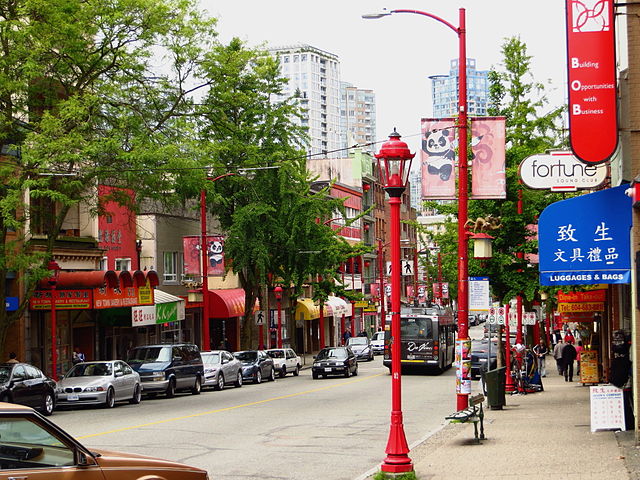
Chinatown is one of Vancouver’s most cultural neighbourhoods, and it carries a significant history. Not only is this part of the city famous amongst tourists, but it is also a favourite among locals, because it is the third largest Chinatown in North America.

Chinatown shares borders with Gastown, the downtown financial district, and Strathcona. Its history takes us back to 1886, to Vancouver’s incorporation, though Chinese settlers had arrived in Canada much earlier. By the 1910s, Vancouver’s Chinatown had grown bigger than Victoria’s, becoming the largest Chinatown in Canada. Existing parallel to Chinatown were Canton and Shanghai Alley, which were known as the “deviant alleys” of Vancouver at the time because they were booming sites of the sex trade. These notions solidified pre-existing stereotypes against Chinese Canadians, who faced an incredible amount of violence and discrimination which affected their abilities to work, own certain businesses, vote, own property in certain parts of Vancouver, or run for public office.  

Chinatown has always featured a mixture of Western elements and Chinese architecture, which is one of the reasons that it became a National Historic Site of Canada in 2011— and for good reason! If you walk to Chinatown from Gastown, you will enter the neighbourhood through the massive and majestic Millennium Gate (inaugurated in 2002).

Among other things you can do in this neighbourhood, you can visit the Dr. Sun Yat-Sen Gardens. Opening hours and prices depend on the season, though students with a valid student ID receive a discount. The garden is a model of a Ming Dynasty scholar’s home, and every element that fills the garden, from the plants and rocks to the traditional lattice doors, has been shipped in from China. Surrounded by the elegant architecture, the large koi ponds and the beautiful Penzing trees at these gardens, you find yourself in a quaint haven in the middle of a rather bustling Chinatown.

For fun, if you want to hunt down the narrowest commercial building in the world, you’re in the right part of the right city! The Sam Kee building on Pender Street is supposedly the “shallowest commercial building in the world,” and was mentioned in the Guinness Book of World Records for being only 4’11’’ wide on the bottom most floor, and 6’ long on the second floor. The building goes by many fun nicknames, such as “Slender on Pender.” If you have trouble recognizing it, it’s the building that says “Jack Chow Insurance” just as you enter Chinatown through the Millennium Gate!

One wonderful attraction is located in Shanghai Alley  — it’s the West Han Dynasty Bell. This bell is a replica of an original that was excavated from the city of Guangzhou, dating back to the second millennia. The cities of Guangzhou and Vancouver are considered sister cities, the former gifting the bell to Vancouver in 2001. In Guangzhou, the bell archaeologically confirms the establishment of the first-ever urban settlement in the Pearl River Delta area, while closer to home it symbolizes the origins of Vancouver’s Chinese community.

If you’re interested in bringing something home, you can stop by the Chinese Tea Shop on East Pender, which boasts an impressive assortment of tea and teaware. The owner is deeply invested in the shop and knowledgeable, and will be happy to tell you more about the tea you’re buying and its origins.

Now, to cover the food options of Chinatown!

The first is a dim sum house, called Jade Dynasty Restaurant, and they sell some mind-blowing dim sum! Personally, I am a fan of the shrimp dumplings and the atmosphere inside the restaurant. The ambience is busy and bustling, the staff are nice and attentive, even though the restaurant can be loud due to flurry of waitresses running around with trays and trolleys of food. It is all a very different brunch experience. In addition, the dim sum menu has a 20% off before 11 a.m., so try heading there for brunch!

You can also go to Chinatown to find one of the best, most highly rated restaurant in the area, Phnom Penh. They are rated 4.9 out of a 5, on Zomato (an app I live by), and serve authentic Cambodian noodle soups and rice dishes, as well as Vietnamese spring rolls and buns. Some of their most famous dishes, though, are the fancily served butter beef, the oyster pancakes, the beef luc-lac, and the deep-fried chicken wings.

Something surprising to run into in a neighbourhood called Chinatown is a famous German bakery! Bestie is a German café that serves up sausage in all possible ways. You can have the bratwurst or a currywurst on fries, stuffed in a pretzel, or just on its own. They have beer on tap and even serve a Chinatown iced tea, made of the tea available in the neighbourhood.

Crackle Crème is another spot in Chinatown that is one of the most famous dessert spots in the city. The café serves some of the cutest macarons I have ever seen, in the forms of tiny, round Pikachus, minions, emojis and other animal motifs. Their main attraction is the various flavours of crème brulée, such as the Vietnamese coffee, Earl Grey, pandan coconut, Bourbon, and white chocolate rose. They also serve coffees and teas and affogato, so there is something for everyone to enjoy.

There are definitely a ton of other places to visit, eat and drink at, but if you decide to take a day and stroll around Chinatown, you could make a day out of this list!

SFU women’s soccer season comes to a heartbreaking end against Western Washington University

0
The Clan came so close in their last match of the season. (Photo courtesy of SFU Athletics)

A fantastic season has come to an abrupt end. On Thursday night, the SFU women’s soccer team travelled to Portland, Oregon to compete in the GNAC Championship Semi Finals. Unfortunately, they were matched up against defending GNAC champions Western Washington, who also finished this GNAC season at the top of the table with a 10–1–1 conference record. In other words, the Clan were in for a tough game.

Despite this adversity, SFU played admirably. The first half saw a stellar performance from SFU goalkeeper Nicole Anderson, who did everything possible to keep Western Washington off the scoreboard. She made four saves in the first half, three of which were over a three minute stretch early in the game. Her efforts gave the Clan a fighting chance going into the second half with a score of 0–0.

This momentum was quickly stopped at the beginning of the second half, as the Vikings were able to get off to a quick lead. The goal came off the foot of defender Lindsay Fujiwara, who let a shot fly from 30 feet out. The ball flew over the head of the unsuspecting Anderson, for a rare goal for the WWU defender.

The highlight of the game for the Clan came after a hard-fought 30 minutes by SFU. In the 80th minute, Jenna-lee Baxter lined up for a free kick. After putting the ball in the box, Vikings keeper Natalie Dierickx attempted to punch the ball into safety. Luckily for the Clan, the ball landed on the foot of Samantha Donald, who calmly placed the ball into the net for the late equalizer.

This excitement would be very short-lived, however, as Western Washington answered back almost immediately. Again it was via a free kick, as defender Taylor Hallquist was able to find forward Emily Bunnell in the box, who scored her first goal of the season. While SFU were able to create one more chance with Katelyn Erhardsen dribbling into the box, they were unable to find another late goal.

This final battle marked the end of the Clan season, but there is still a lot to be excited about with how the team played this year. The team finished with a 10–6–1 overall record, and a 8–3–1 conference record. Their attacking style of play was exciting to watch, and it often produced great results for the team. Check out our article on the awards that the SFU women’s team won this season, and be sure to catch the men’s soccer team as they continue on their quest for a national title.

A Tale of Missing Halloween Candy

0
Illustrated by Momo Lin

One of the great things about Halloween is that we all can think of spooky stories to share with each other. Some of us may even be lucky enough to harbour a particularly scary experience, one that we can share to really frighten our loved ones each Halloween.

If you’re in to Halloween tales that start scary but end up being hella funny, then you’re in the right place.

Growing up, my siblings and I would trick-or-treat like it was a part of our religion. Do you know how fun it was to draw maps and mark down the houses in our neighbourhood that were infamous for giving out the biggest candy bars?! Some years, we’d even be so extra that we’d wear two different sets of costumes so that we could go around and collect candy twice. If trick-or-treating was the NBA, we’d have more championship rings than fingers.

Deadass, trick-or-treating was always the most fun experience! Although, every year, the most mysterious occurrence would take place. Granted, these incidents weren’t as frightening as a Tobe Hooper movie or a US election. However (from the perspective of an 8 year old child), this story was definitely a nightmare.

See, I was once haunted by Argusto, the candy-stealing monster from Cedar Hills.

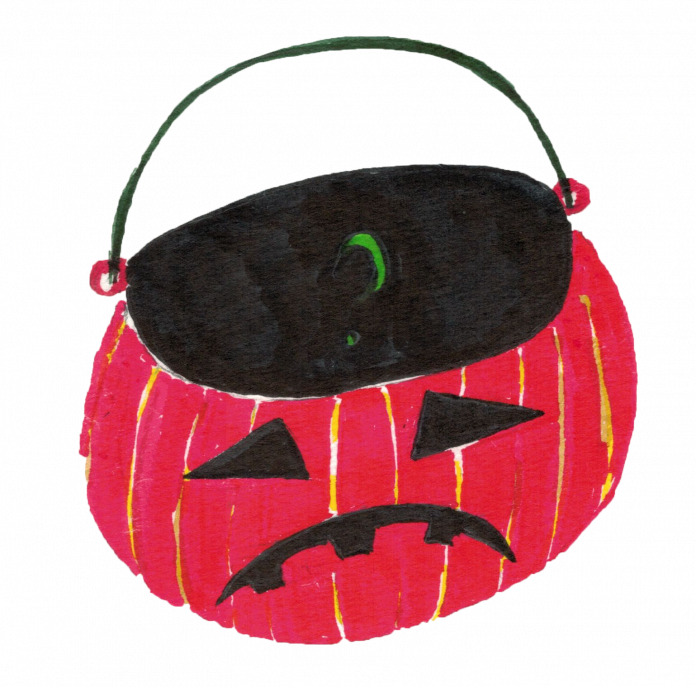
Every Halloween, before I’d go to bed, my parents would tell me a scary story of how a monster, one who resided in our neighbourhood, would go around to each house and steal candy from children. His name was Argusto. My parents told me that no child knew if Argusto would visit them. You can only imagine the fear that Argusto’s arbitrary candy-stealing would instill.  

Year after year, I’d grow terrified from this story. Nevertheless, I would be most terrified when I woke up the next morning to find not a single lollipop or Reese’s peanut butter cup left behind. As the years passed, my fear eventually turned into frustration. I thought, “How the hell would this bunk-ass monster think he could steal all my candy when I’M the one putting in the hard work of trick-or treating? He’s not even a scary monster, he’s just straight-up lazy!”

One Halloween,  I did what I should have done years earlier: I stayed up all night with a rolling-pin and shaving cream. I was ready to fight this monster. In spite of my best efforts, I fell asleep before midnight. I woke up the next morning and my candy was, once again, gone.

Two days after that Halloween was my 11th birthday party. Having a birthday on November 2nd means that the week of Halloween is truly the best week of the year.  On this particular birthday, however, I was fairly upset. I kept asking myself,  “How did I not catch him? How much longer will this crap happen?”

Before leaving for my birthday party, I asked my parents where my favourite hat was, and they told me it was in their closet. When I went into their room to find my hat, I solved the greatest mystery of my boyhood.

This was the day I left my childhood behind. I became a man.

Strewn out in my parents’ closet was a number of goodie bags for the guests of my birthday party. Every goodie-bag was completely filled with an eclectic array of candy. At the corner of my parents’ closet was my favourite, trusty, trick-or treat bag.  It was completely empty.

I was shook. Do you know how mad I was?! There was no monster! My PARENTS were Argusto.

You better believe that, in order to make up for experiencing the worst betrayal known to man (disregarding Kevin Durant joining the Warriors), I ended up with a fairly extravagant Christmas gift that year.

Medical research breakthroughs at SFU

0
(Justin Sullivan/Getty Images)


Cannabis may help provide pain and seizure relief

Recent research led by SFU faculty revealed how cannabis may help relieve pain and seizures. The study was led by Reza Ghovanloo and Peter Ruben from SFU’s department of biomedical physiology and kinesiology. They partnered with scientists from Burnaby-based Xenon Pharmaceuticals to conduct their research.

The researchers examined proteins that control electricity in the nervous system, finding that cannabidiol (CBD), which is present in cannabis in significant amounts, interacted with proteins that control pain and seizure signals. CBD halted the activity of the proteins, therefore providing relief from pain and seizures.

The researchers hope their findings will lead to further research on the use of cannabis to help patients with epilepsy.

The study was published in the Journal of Biological Chemistry.


New genetic mutation related to Non-Hodgkin Lymphoma identified

A new study has given further insight into Non-Hodgkin Lymphoma (NHL).The lead authors of the study are Ryan Morin, professor and researcher at SFU’s department of molecular biology and biochemistry, and PhD candidate Sarah Arthur.

NHL is one of the most common types of cancer in Canada. The researchers focused on the most common form of NHL, diffuse large B-cell lymphoma (DLBCL), and looked at the genetic mutations that can cause it.

According to Morin, mutations in over 100 genes can trigger the onset of DLBCL. Researchers in the field of cancer genetics have traditionally concentrated on the mutations that occur in the “coding” areas. However, these areas make up only about 2% of the genome. Morin and Arthur took a different approach and examined whole genomes, leading them to their findings.

They found that a third of participants in the study, who had a specific sub-type of DLBCL, had a mutation in a region of the gene known as the three prime untranslated region. This mutation resulted in an abundance of a protein which Morin and Arthur believe may make patients resistant to certain cancer treatments.

The study was published in the journal Nature Communications.

The lost campus of SFU

0
Illustrated by Shannon Foss

October 3, 2018

I first heard rumours of the lost campus of SFU a couple months ago, but I dismissed the idea instantly. A campus that wasn’t on Burnaby Mountain? Preposterous. However, over the past few days, I’ve heard of students supposedly taking classes on this lost campus. It was a ridiculous idea, but one I couldn’t get out of my head. Against my better judgement, the search begins tomorrow.

October 8, 2018

I’ve been scouring documents left by SFU Administration looking for any mention of this lost campus or its location, but to no avail. There has been no mention of its existence by those who run the school. If it exists, they do not know of it. The search continues.

October 12, 2018

I thought that perhaps the SFSS might make some reference to the campus, as they claim to represent and provide aid for all students. But once again, no luck. In fact, I seem to have found evidence that there is only one campus. To pay for the new Student Union Building, the SFSS is charging all students. If all students are paying for the Student Union Building, and the building is on Burnaby campus, then surely all students go to class in Burnaby. It would be such an odd decision otherwise!

Once again, I must look somewhere else.

October 23, 2018

A break in the case! I decided that perhaps speaking to students might be the best option. If it does exist, there are bound to be some students who would know of it. It took over a week of walking around campus and talking to students before a single one had any knowledge of a campus other than Burnaby Mountain. But finally I found them! Students in the Publishing program told me that it resides in Vancouver, and in Harbour Centre of all places! Right under my nose. I begin my voyage tomorrow.

October 24, 2018

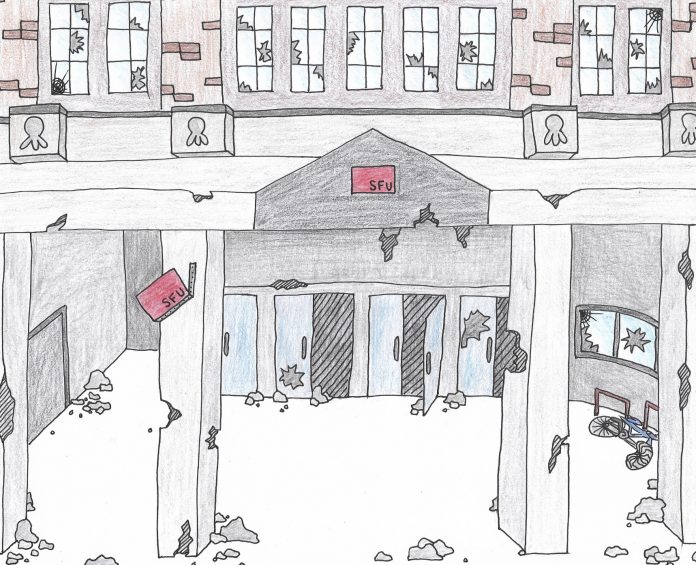
Making my way downtown, I kept my eyes on the tower of Harbour Centre, waiting to discover what treasures may await me there.  When I arrived, I stood in awe at the entrance. It was indeed abandoned. No more than a handful of people would file in and out of the doors in a couple minutes. Inside, there were barely more than a dozen people on the main floor, and a library that actually had vacant chairs and computers.

Where were the throngs of cramped students running from class in one building to another over a kilometre away? Where were the students unloading out of the sardine cans we call buses sweating from the latent heat of strangers’ sticky bodies pressed up against them? Where was the omnipresent noise of construction and screaming children that filled the campus from one end to another? There was no question about it: this place had been abandoned for a long time. But at least I found it. Finally, I can forget all about its existence once again.

October 29, 2018

My victory did not last. Once again, I heard rumours of another SFU campus — this time in Surrey. I don’t know how reliable these rumours are. But they are worth investigating. The search begins again.


What grinds our gears: Jump scares and unnecessary gore in horror movies

0
Illustration by Irene Lo / The Peak

When I tell people I like horror movies, I mean horror movies. I want the horrific, the macabre, and the downright disturbing.

What I don’t want is gore so graphic that it borders on kinky. Too often, the blood and guts seem like they’re there purely for shock value, rather than genuine audience terror.

The same goes for jump scares. They’re a lazy way of scaring the audience that just makes for an unmemorable kind of adrenaline. I want to feel emotionally uncomfortable, not just as if my roommate snuck up on me in the kitchen.

These tired-ass tropes hardly constitute a horror movie. At best, they’re barely bearable, and the movie will only be remembered for odd torture porn. At worst, they make a movie tedious and nauseating to watch. Few horror movies know the right ways to build tension and fear, and the films that fail at this also fail to separate themselves from the cheap scares you could find across the Internet.

Have some fun and wear your Halloween costumes to class

0
Photo by Chris Ho / The Peak

I think it’s safe to assume that we’re all exhausted from midterm season. The luxuries of reading for fun, nutritional meals, and eight hours of sleep are replaced by lecture notes, coffee, and power naps on transit.

The campus itself becomes just as dreary as the students feel. September’s exciting start-of-semester events are long gone. Now, the campus is once again the site of a daily grind where we all just attend lectures and tutorials. Needless to say, October at SFU is fairly sombre.

Halloween, and all the goofy dressing up that comes with it, should be a good way to get rid of this melancholy. Instead, though, lots of us just hold onto our outfits until we party in the evening.

Halloween only comes once a year. It’s the only holiday where we can dress up as different characters and be as silly as we want to be. Sure, we may have grown too old to continue the fun tradition of trick-or-treating, but we can still have fun through the personalities we choose to embody. Not that you need to imitate Dracula while you ask your prof to explain an equation, but you might as well get some use out of your costume while you can.

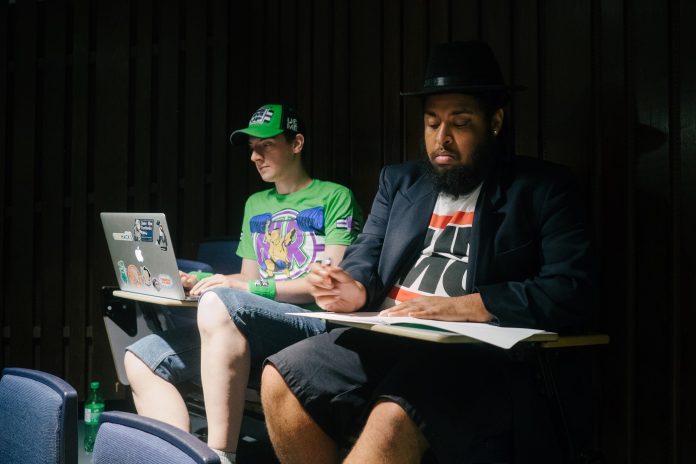
Besides, the lectures in October are almost always half-empty, since people have finally realized they may not be as motivated as they thought they’d be in September. People are tired from the hours of studying they put in the night before, and odds are they may not notice your wig and powerful colours. Those classmates who do will have something other than coffee to give them a bit of energy to start their class.

For those who think that wearing a Halloween costume to class is a vacuous, childish act: would you rather have Tim come to lecture in his regular Fila shirt and sweatpants, or a two-piece suit, a floppy toupé, and a Michael Scott nametag? I get the need to treat school seriously, especially with work piling up at this point in the semester. But briefly encountering a cryptid in MBC won’t kill you. If you wanna worry about yourself, go right ahead, but Tim’s doing nothing wrong and you should let him run.

Of course, like with any outfit you wear, there’s still an etiquette to what you bring to school. You shouldn’t be taking up an extra seat with eight spider legs, or wearing offensive costumes — though the latter shouldn’t be welcome anywhere to begin with.

Wearing a Halloween costume, or seeing someone in theirs, won’t magically erase the hells of school. But getting to be a TV character, a movie monster, or even a celebrity can make campus a far cheerier place. I’m tired of friends and peers who only associate Halloween with parties and trick-or-treating. Putting on a costume is the best part, and it’s a perfect opportunity to bring more energy and flair to our daily grinds.

If nothing else, I plan to lighten up Burnaby campus with a backwards hat, Jordans, and an inside-out uniform blazer to proudly bring some Fresh Prince into my morning class. I’d love not to be the only one.