Home Blog Page 514

SFU men’s basketball pull off clutch victory against WWU

0
Singh filled in beautifully for Julian Roche. who was unable to play. (Photo courtesy of SFU Athletics)

The SFU men’s basketball team kept their winning ways going on Tuesday night as they hosted Western Washington University, coming up with another huge win to position themselves for a playoff spot. Coming into the game, the Clan and the Vikings were tied for fifth place in the conference. With the win, SFU now has sole position of the spot and have a great chance of playing in the GNAC postseason.

The win was huge for standings purposes, but it was also huge when you consider the adversity that SFU were under. Missing starting centre Julian Roche, the leading scorer and rebounder on the team, it was clear that somebody had to step up to lead the team. That man would be Jasdeep Singh, who led the team with a season high 31 points, seven rebounds and two blocks in a game high 39 minutes.

After the game, head coach Steve Hanson told The Peak, “Adversity hits every team and you have to be ready. Julian brings rebounding, communication and scoring every night and the rest of our team had to bring a little more of that tonight. I think we did that.”

He added, “Jas had some pressure tonight with his front court partner out. He had to play tough, stay out of fouls trouble and be efficient. He did that plus more. We’re proud of his performance.”

The team’s were neck-and-neck the entire game, and finished the first half with a score of 36–34 in favour of the home team. The Vikings held a slight lead for the majority of the second half, but clutch play down the stretch would eventually help the Clan prevail with the win.

Tyler Payne did his best to give Western Washington the win, scoring each of his team’s final 11 points, but was unable to single-handedly defeat SFU. He was countered by two three-pointers by Singh down the stretch and a three from Othniel Spence, as well as a couple free throw makes by Bongani Moyo and Michael Hannan. With seven seconds left and a three-point lead for the Clan, Payne attempted to tie the game with a three. He missed, and Singh grabbed the rebound to end the contest with a score of 76–73.

“It was a tough battle the entire game,” said Hanson, “What we expected this time of year with two teams battling for a playoff spot.”

The win gives the Clan a 9–9 GNAC record on the season, and more importantly, sole position of fifth place in the conference. The top six teams qualify for the GNAC Championships, but SFU’s position in the postseason is far from guaranteed. Three teams behind SFU in the standings have eight or more wins, meaning that the next two home games are very important to ensure that the Clan make the postseason.

The team is definitely playing their best basketball of the season so far, winning six of their last seven GNAC games. That being said, Hanson believes the team has room to grow, saying, “I don’t think we are peaking but we are playing tough and smart basketball. We had to play that way to be in this position.”

Peak player of the game: Jasdeep Singh

Singh had to step up on Tuesday night with Roche out, and he did that and more. His 31 points were a season high, and he played big for team missing their starting centre, grabbing seven rebounds and blocking two shots. He also did a great job of avoiding foul trouble, playing a game high 39 minutes (he only rested one minute!) while also playing strong defence. His two threes down the stretch were key in SFU’s ability to grab the win, it what was the most important game of the season thus far.

What a performance.

What’s next:

The Clan have two more games this season, both at home, and both later this week. They will host the 4–14 Concordia University Cavaliers on Thursday, before taking on the 12–6 Western Oregon University Wolves on Saturday. Both games are at 7 p.m, and both have huge playoff implications for the SFU men’s basketball team.


Reading breaks aren’t a vacation

0
Illustration by Alice Zhang/The Peak

During the past week, I’ve spent an unnecessarily large amount of time writing apology notes to a classmate over a group presentation, because I’d yet to finish my section of the PowerPoint in time due to some other assignments. While I’d be panicking on any other week of school, reading break was thankfully here to save me. Without the time required to travel to and attend my lectures, I could finally recover from everything I was behind in.

But to those people who reserve reading break for a big trip, I feel like you may be misusing this time a bit. The amount of work we have to do as post-secondary students is massive, and a week out of class is often just enough to keep us from drowning in stress and textbooks.

SFU’s learning commons recommends that students spend two to three hours per week studying outside of lectures for each credit we’re taking that semester. This can add up to at least 18 hours for full-time students — and at least 30 hours with a maximum course load — to be working on our own time to learn and practice, which becomes more difficult when you have a job, family responsibilities, or long travel times to campus cutting into your schedule. Reading break gives us a time to allocate our hours more freely, and be as constructive as we can on our own clocks.

Sometimes, this reorganization means you put a little extra time into the newly empty spots where your classes usually are. Now, you can fill up your “lecture blocks” with better constructive learning time. If you aren’t as behind as I usually am, it means you get a bunch of extra free time by just maintaining your normal study schedule, and you can at least relax a bit. We’re in school to succeed, and reading break is a tool for achieving that.

This isn’t to say you shouldn’t travel if you think you can afford it, or if you need to for the sake of family. If you can somehow get ahead of your work enough to take that time away, then power to you. But given how much time you need to put into school to begin with, you’re either going to be packing a lot of extra work into a short period of time before you leave — something the SFU Learning Commons also recommends against — or putting yourself way behind. Alternately, you could maybe plan to do some work while you’re on your trip, but the last thing you want to do is go back to a hotel room to work on a research paper.

I realize how preppy and paranoid I sound, and it’s definitely still important to make some free time to relax. After all, I would be lying if I said I hadn’t used some parts of this week to visit friends and cross things off my Netflix list. But this is a week for reading, not from reading. Take a safer bet and buy your plane tickets after finals.

Political Corner: Doug Ford’s suspended MPP is disappointing and embarrassing to have happen in a Canadian government

0
Photo by Chris Young/The Canadian Press

On February 20, 2019, Ontario Premier Doug Ford suspended MPP Randy Hillier from his Tory caucus. This was in response to his behaviour while answering questions from parents of children with autism at Queen’s Park regarding changes to Ontario’s Autism Plan (OAP), which he ended by saying “yada yada yada.” Following his suspension, and an apology to the parents by Ford for Hillier’s behaviour, Hillier tried to explain he directed the phrase towards NDP MPP Monique Taylor, who he accused of taking advantage of these parents. But it doesn’t change how dismissive and offensive it came across to the parents.

Something this informal amidst such a serious issue is nothing short of embarrassing and disappointing to see in a Canadian government when handling concerned Canadian parents. The changes to the OAP to spread funding to more families, but many parents are concerned because they seems unlikely to solve the problems with the past OAP, namely decreasing the waitlist for families to receive financial assistance to seek effective therapy for their children. Those parents at Queen’s Park that day had valid and serious concern for the care of their family, and deserved a little more formality than “yada yada yada.”

This isn’t to say politicians need to be exclusively robotic and official, but it shouldn’t be this difficult to read the room. In America, senator Alexandria Ocasio-Cortez has gained a lot of popularity for having a more blunt and approachable tone in her political career, recently even starting a serious speech in Congress about political corruption with “let’s play a game.”  

The difference between her and Hillier is that Hillier didn’t take caution or consideration with how he was speaking, to ensure it was a space where something would be welcome and fine to use less formal tone and language. Instead, by using a phrase like “yada yada yada” to concerned parents, he belittles a serious issue in a way that someone with political authority and power should rarely — if ever — be doing.

Album Reviews

0


thank u, next by Ariana Grande

Ariana Grande released her new album thank u, next (2019), a short six months after Sweetener (2018). Much, however, has happened since, including her break up with fiancé Pete Davidson and the tragic passing of ex Mac Miller, both of whom she appears to be referencing in “ghostin.” She also namedrops both in the titular track “thank u, next.” In “imagine,” Grande’s vocals, especially her whistle notes, are a standout.

The album is a blend of pop, R&B, and trap. From the very first listen, it sounds nothing like Sweetener. It’s also her most personal and cohesive album to date, one that primarily deals with heartbreak, self-empowerment and growth. It goes to show that Grande is one of not many pop stars who could pull off two distinct, hit albums in the span of six months. Standouts include “NASA,” “bloodline,” and the chart-topping “7 rings.” – AG


Head Above Water by Avril Lavigne

Head Above Water (2019), Avril Lavigne’s first album in 5 years, details the singer’s personal struggles in recent years, including her battle with Lyme disease. It’s apparent from the lyrical content and the production that she’s headed in a very different direction than past hits such as “Girlfriend” and “Sk8er Boi,” albeit not the most exciting one. In the titular track, a pop-rock piano ballad, she details her relationship with God.

“Dumb Blonde,” a song about female empowerment that features rapper Nicki Minaj in an unlikely pairing, gives the album some much needed energy. Other highlights on the album include “Tell Me It’s Over” and “Birdie.” However, tracks such as “Warrior” and “Bigger Wow” are weak and prevent the album from amounting to much. Head Above Water is bland and lacks personality, and in a year that is bound to have some big releases, it is likely to be forgotten. – AG

Nicki Minaj’s “Barbie” tracks
On February 2, Nicki Minaj hosted the 11th episode of her wildly successful radio show, Queen Radio. Throughout the duration of the show, Nicki premiered two new freestyles titled “Barbie Drip” (a take on Lil Baby & Gunna’s “Drip Too Hard”) and “Barbie Goin’ Bad” (a remix to Meek Mill and Drake’s “Goin’ Bad”). Then, on February 6, Nicki dropped a new freestyle titled Bust Down Barbiana (an ode to Blueface’s Thotiana). With the consistent releases of hard-hitting freestyles, fans and music critics were treated to a reminder of just how in tune Nicki Minaj is with hip-hop culture.

Whether it’s a guest-feature or a deep-cut on an album, Nicki’s pen is always something to notice. Her intelligent flow and witty wordplay are especially discernable when she’s having fun on a remix, a truth discovered in her three recent freestyles. Nicki’s skills were particularly evident in Bust Down Barbiana as she rapped lines like “I been a bad bitch, cockiana/ And I’m still winnin’, Pacquiana . . . killin’ everybody beat/ Thank you, next, Ariana.”

With the sounds of these recent freestyles, Nicki’s upcoming album is sure to keep showing the power of her pen. – YA


SFU men’s basketball pull off two clutch victories on Alaska road trip

0
The Clan now have three huge home games in the last week of the season. (Photo courtesy of SFU Athletics)

On Thursday and Saturday last week, the Clan played two of their most important games of the season in Alaska. Facing off against the University of Alaska and the University of Alaska Anchorage, the Clan won both games by five or less points. With the wins, their playoff hopes live on as they go into an exciting three-game home stand to end the season this week.

Game one:

SFU got off to a good start on Thursday, taking on the two-win University of Alaska Nanooks. They won the game 71–66, helped by clutch play down the stretch in the fourth quarter.

In the first half, the Nanooks got off to a seven-point lead in the first five minutes. Despite this, an 11–0 run by the Clan at the end of the first half got the away team on top. After this, the teams went into the break with SFU up 44–36.

The University of Alaska got back into the game in the second half, despite the Clan going up by as much as 15 points. With 1:41 left in the game, the Nanooks were up by one point, with SFU wanting to do everything possible to avoid a comeback win.

Point guard Michael Provenzano stepped up to the plate, delivering a clutch three-point shot with 1:12 left to put the Clan up by two. He then hit two big free throws to stretch the lead to four with 24 seconds left. After strong defense from SFU on the ensuing Alaska possession forcing a miss, Othniel Spence put the team up by five, 71–66.

Spence led the team with 17 points, with Julian Roche (15), Wilfried Balata (13) and Provenzano (10) joining him in double-digits.

Game two:

Coming off an exciting win, the Clan managed to top themselves with their win on Saturday over the Seawolves.

This time, it was SFU completing the second half comeback, coming back from 10 points in the second half to force overtime. Spence came up clutch at the end of regulation, hitting an and-one three pointer to put the Clan up 61–60 with nine seconds left. Shortly after, however, he fouled Alaska’s Tobin Karlberg while he was attempting a last-second game winner. Hitting only one of two free throws, the game went into overtime.

Amazingly, SFU won the overtime period despite not hitting one field goal in the frame. All six points for the Clan came from the free throw line, with Balata going 4–4 from the line and Provenzano hitting both of his attempts. With this, the team pulled off a thrilling 67–63 comeback overtime win.

Balata led the team with 18 points in this one, with Jasdeep Singh (15), Provenzano (11) and Roche (11) also scoring double-digit points.

What’s next:

The team has a huge home stand this week to end the season, playing Western Washington University on Tuesday, Concordia University on Thursday, and Western Oregon on Saturday. All games will be in the West Gym on Burnaby Mountain.

If the season ended today, the SFU men’s basketball team would be granted one of the six playoff spots available in the GNAC, as they are 8–9 and tied for fifth spot in the conference. Their game against Western Washington on Tuesday will be their biggest game of the season, as both teams have the same record and are fighting for the final two playoff spots. Both Alaska Anchorage and Montana State University Billings sit right behind the teams with 8–10 records.  

This should be fun.

SFU women’s basketball split two-game road trip

0
Tayler Drynan had a 14 point, 10 assist double-double in the win on Saturday night. (Photo courtesy of SFU Athletics)

After finishing their home schedule, the SFU women’s basketball team set out on the road to play out the remaining season. The playoff-bound SFU faced Northwest Nazarene (24–1) and Central Washington (16–9) this weekend as the Clan looked to continue their four-game winning streak.

Game one:

On Thursday, Simon Fraser walked into the home of the number seven ranked Nighthawks, a team they had delivered their only loss to, but could not repeat the effort, losing 84–61. SFU struggled to shoot all night, shooting 42% from the field and 21% from 3. Sophie Swant and Jessica Jones lead the way with 11 points, but it was a tough night shooting for Swant, who finished 4–16.

The game started optimistically as a basket by Ozioma Nwabuko (4 points) gave SFU an early 7–5 lead. But the Nighthawks Mckenna Walker answered with a three to take back a lead NNU would never relinquish.

Nwabuko hit another lay up and Kendal Sands came off the bench and hit a three, but that was the extent of SFU’s scoring as they went into the second quarter down 22–12.

SFU chipped away at the lead in the second, as a three by Jessica Jones brought the score to 30–23 with five minutes remaining in the half. SFU’s increased aggression lead to nine free throw attempts in the quarter, but despite hitting them all SFU could not draw closer as the half ended 39–29.

It was in the third quarter that the floodgates opened, as the Nighthawks poured in 27 points as the Clan’s defense was helpless to stop NNU’s attack. Danielle Jardine led the way for NNU, finishing with 15 points on 6–9 shooting. It was a balanced attack for the Nighthawks however, with each active player recording a field goal.

The lone bright spot for SFU was their showing at the charity stripe, shooting 16–17 from the line. While SFU’s three-point attack was shut down, the game was won in the paint with the Nighthawks outscoring SFU 44–14.

Game two:

After the tough loss, SFU turned their attention to Central Washington, the team just below them in the standings. With seeding implications on the line, SFU stood tall beating the Wildcats 83–73.

SFU bounced back from their cold shooting night, shooting a blistering 53% from the field and 56% from three. Jones led the way with 23 points and 7 rebounds, she was a sharpshooter from deep hitting 5–11 from behind the arc. Sophie Swant also had a strong game finishing with 21 points and six assists.

The first quarter was a back and forth affair, with both teams responding to each run. After a turnover lead to a lay up for the Wildcats’ Kaelie Flores, SFU found themselves down 18–13 early. Tayler Drynan answered with one of SFU’s 13 three-pointers, closing the gap, and a layup by Jones would tie the game at 20 all. Sienna Lenz (six points) hit a lay up before the buzzer to tie the game 24 heading into the second quarter.

Swant hit a couple of early threes to push momentum SFU’s way, and back-to-back three-pointers by Jones halfway through the quarter gave the Clan a 39–29 lead. The Wildcats, led by Flores, tried to chip away, but a late three by Swant gave SFU a 47–37 lead at halftime. Jones did most of her damage in the first half, finishing with 17 of the 47 points SFU scored.

The Wildcats came out strong in the third, and a three-pointer by Alexis Pana shrunk the SFU lead to five. With momentum turning, it was Swant again who answered in the fourth, starting the quarter with a jumper and then a deep three extending the lead to 70–60. The Clan never allowed the Wildcats to get close again, calmly finishing off the victory.

What’s Next:

SFU closes out the regular season this week with their final two games of the year. On Tuesday they will head to Western Washington (9–9), before ending the season against Montana State University Billings.

SFU’s SOCA discusses the significance of Black spaces

0

On Saturday, February 16, SFU’s Students of Caribbean and African Ancestry (SOCA) facilitated a panel discussion titled Black Spaces Matter at the Burnaby campus.

The event is part of SOCA’s Black History Month, which aims to educate SFU students, faculty, and staff, about the accomplishments and history of the African-Canadian community. The month of February was officially recognized as Black History Month by the Simon Fraser Student Society earlier this year.

With the incentive of having discourse on the significance of Black communities having access to and possession of their own communal spaces, the event aimed to also highlight the similarities between the displacement African-Canadian communities have felt in the city of Vancouver as well as SFU.

In an interview with The Peak, Giovanni HoSang, president of SOCA, provided insight on the parallels in displacement between SFU’s SOCA and Hogan’s Valley (a former Afrocentric community that was once readily accessible to Vancouver’s African-Canadian citizens). HoSang explained that the panel discussion included conversation on “the historic displacement of Black Communities in Vancouver such as Hogans Alley in the 70s, [and how it] has stark similarities with the current eviction of the SFU Students of Caribbean and African Ancestry, our decades-long home and comfort-place on campus.”

HoSang further elaborated on the recurring struggle SOCA has had in maintaining its existence at SFU. “Previous presidents had to fight to get the space, then subsequently had to fight to keep it on different occasions, raising the importance of building solidarity and strong numbers as institutional racism is constantly showing up in very subtle forms.”

Those who also led the panel discussion shared their knowledge on the issue of displacement within Black communities. Dr. Joy Walcott-Francis, who was president of SOCA in 2010-2012, and in 2015-2016,  talked about the issue of Vancouver being portrayed as a diverse, “racism-free” city.

Walcott-Francis articulated that although Vancouver may appear as a diverse city, the issues of racism and anti-Blackness are still present.

“Yes — Vancouver is a multicultural city. We can see that [ . . . ] but for me, that’s pretty much where it ends. It’s about what we can’t see. In terms of diversity and celebrating the diversity — and for persons who are of different ethnicities — not all of these ethnic groups feel or share the same experiences that they’re also celebrated,” said Walcott-Francis.

Lama Mugabo, president of SOCA in 1997-1998, stated in the discussion that these Black spaces are essential in helping Afrocentric individuals combat the forms of racism and anti-Blackness in Vancouver.

“I must admit that being together in a room talking about the future of the Black community and the issues that come up in the media or everyday in our lives has been huge,” Mugabo noted.

“Undoubtedly, spaces where we meet and are able to organize and talk allow us to really flourish.”

When asked about potential solutions that could help cease acts of displacement for both SOCA and other Black spaces in Vancouver, HoSang told The Peak about the importance of Black representation on the decision making teams of institutions and organizations.

“We need proper representation at the decision making tables, fighting on a number of fronts [so that] Black professors and Black student representation are in the decision-making bodies of the institution. [We need to] make sure that decisions about us have us at the table.”

HoSang also shared with The Peak that the notion of allyship can significantly assist disenfranchised communities in times of erasure and displacement.

“[It’s important to] keep building allyship and solidarity with multiple people to ensure that voices are heard and that we push on the decision makers to centre the voices of Black and Indigenous voices, which often get left behind in discourse,” he concluded.  

SFU and Swiss researchers build an eco-friendly and 3D-printable IoT sensor

0

In February 2019, SFU researchers collaborated with scientists from the Swiss Federal Laboratories for Materials Science to 3D print wireless Internet-of-Things (IoT) sensors.

The new prototype, named “3D sustainable sensors,” is built from wood-derived cellulose materials, instead of the petroleum-based plastics that are common in most electrical devices.

IoT systems utilize web-powered technologies that “collect, send and act on data they acquire from their surrounding environments using embedded sensors, processors and communication hardware,” according to an article written by Design and Development Today.

Dr. Woo Soo Kim, a mechatronic systems engineering professor at SFU and a Brain Pool Fellow selected by the National Research Foundation of South Korea, along with his Swiss collaborators, were able to transform the numerous sensors that IoT systems rely on to receive digital data and to “connect machines and equipment to the internet,” into biodegradable products.

“Building those systems with naturally derived materials [. . .] could allow manufacturers to dispose of old sensors without contaminating the environment,” according to an article written by Design and Development Today.

Kim stated in an email interview with The Peak that the new product is environmentally-friendly and it can be safely disposed of in any compost bin once it has reached its lifespan. The 3D sustainable sensors can last for several months, but if they are tested with chemicals, then their lifespan decreases, he added.

“Chemicals can damage sensors’ surface after several use. If those sensors are in use for several times [with chemicals], then those [cannot last] for a long time . . . [This is the] objective of disposable sensors,” said Kim.

Kim’s research lab is currently based at SFU Surrey and Surrey’s PowerTech Labs, and his team has been working on the 3D sustainable sensors for about five years. In addition, Kim’s work focuses exclusively on 3D printed electronics and sensors.

When asked what an IoT was in greater detail, Kim said that it is a conceptual approach of collecting and integrating environmental information from various sensors to a wireless “cloud” network.

“[The information that is sent to the cloud] can be mechanical sensing data, chemical sensing data, or environmental sensing such as weather, air pollution, etc,” said Kim.

“You can think that we require lots of different sensors for IoT. What if all the sensors are the eventual hazardous electronic waste later because we cannot [reuse] those sensors? That is why we need to generate bio-compatible and eco-friendly sensors for IoT applications,” he further added.

In terms of pricing for the new product, Kim said that: “Fabrication cost in the University and in the company [cannot] be compared. If we can do mass production, one sensor can cost way less than 50 cents.”

Kim also mentioned that this project was initiated by his lab as they searched for alternative materials of plastics in 3D printed electronics.

“. . . Lots of petroleum based plastics are currently utilized for 3D printing. If we want to reduce electronics’ waste coming from plastics such as green board in printed circuit board, we should reduce plastics. Only way is to replace plastic materials with reliable wood-derived natural fiber-based materials,” stated Kim.

Kim also shared in the email interview that he intends on expanding the eco-friendly sustainable electronics concept to other electronics fields.

“We may replace all the petroleum-based plastics in electronics with eco-friendly wood-derived cellulose materials. [A] new project has been launched with 3D printed cellulose circuit board with local industry partners,” stated Kim.

Kim concluded the interview by sharing that at the moment, his lab is currently working on a few unique 3D printing projects. One of those includes building 3D-printed cellular structures for robotic finger and robot gripper applications.

With files from Design and Development Today

Twitter’s reactions to the affair between WWE’s Corey Graves and Carmella show how sexist people can be about cheating

0
Photo by Chris Ho/The Peak

There’s a lot of reasons people cheat on their partners. It’s a horrible thing that should come with a lot of guilt, but each situation is different, and it’s often the sign of serious problems within either of the partners or in the relationship. This isn’t to say cheating’s ever OK — it never should be — but it can happen for a lot of different reasons, and it’s important to keep that in mind.

Despite how complicated it can be, I see a lot of people really like to oversimplify cheating when they see friends or celebrities do it. Especially in straight relationships, I frequently see people treat the women as a perpetrator, and the man as just a “dog” who’s doing what comes “naturally.” This habit of slutshaming women, while failing to hold men equally accountable, is an undoubtedly sexist default, and the number of people who seem to fall back on it is infuriating.

These are attitudes I’ve seen before in my social circles, but they can show up in their clearest forms over social media when infidelity comes up in celebrity news. Just the past week, I saw it best represented when World Wrestling Entertainment (WWE) commentator Corey Graves was accused of having an affair with WWE performer Carmella. This allegation was made by Graves’s wife of 11 years, Amy Polinsky, in a now-deleted Instagram post, but was trending on Twitter for me throughout February 16 when she posted it.

What followed was a lot of harsh comments and characterization of Carmella. Some made jokes about how Graves’ wife was ready to pick a physical fight with Carmella. Others accused her of explicitly not caring about Graves’ marriage and children, treating her like some sort of homewrecker. A few even used it as an excuse to criticize her prior known sexual history, even though her previous partners are unrelated to this specific situation.

All of these posts have a shared theme of treating Carmella as the perpetrator, but none of the posters seemed to know anything about Carmella’s side of the story. Graves might have told Carmella his wife was OK with it, or she might not have known him too well when it happened. Even if she was fully aware and intentional, none of the people posting would have known that. Several posts like these were made entirely based on these stereotypes around cheating.

Graves, meanwhile, got an unsettling amount of support from multiple people saying Carmella was so attractive, that people shouldn’t blame Graves for cheating on his wife. Despite his serious infidelity, they treated him as if he was an innocent guy who just got lucky, and didn’t bother putting any of the guilt on him.

This isn’t to say people were exclusively supportive of him, but nonetheless there was a clear and unfair difference in how people reacted to Graves compared to Carmella. It’s proof of an unfair default we have when it comes to cheating in straight relationships, and one that people clearly need to work on.

If you hear about people cheating on a partner, I simply ask that you think a little more about the situation before making accusations or posting about it online. Cheating is still a horrible thing to do to a partner, regardless of the reasons, but these unfair stereotypes help nobody and shouldn’t be perpetuated further than they already are. Attitudes like this lead men to find it logical to cheat in the first place, and it benefits no one to keep those stereotypes around.

New SFU pub announced to open in the next few weeks

1
Photo courtesy of Marcus Blackstock

The Study Public House, SFU’s new on-campus pub, is set to open within the next few weeks.

The Study Public House will be run by the Joseph Richards Group, a B.C.-based hospitality company that was selected by SFU to run the space. It will be in the same space as the former Highland Pub, which was run by the Simon Fraser Student Society (SFSS) and closed in 2017. 

The Peak sat down for an interview with The Study’s general manager, Samantha Baker.

Baker explained that the pub will have a wide variety of food and drinks, including 24 beer taps and happy hour offerings. She described their food as “pub style with a bit of flair,” at a competitive price. They will have a gluten-free menu, a vegetarian menu, and vegan options as well.

Additionally, The Study will have brunch service. “We’re famous for our $5 breakfast special, which I think is going to be really competitive,” said Baker.


Baker said that “we want to bring a really fun and energetic vibe to campus. We have a really awesome space that we want to be able to utilize.”

She explained that they will rent out space to clubs and departments for pub nights — however, they will treat it more as a reservation, in the sense that they will rent out a part of the pub rather than the entire establishment. This is because they want to have some space available always for walk-in guests to avoid turning customers away.

Samer Rihani and Jackson Freedman, vice-president student services/acting president and vice-president university relations from the SFSS, said in an email interview with The Peak that “the SFSS Board of Directors is permitted to host 15 pub nights per year in the space, and the SFSS student groups are permitted to host 150 total — without being charged for the space.”

Baker said that The Study will host their own events and theme nights as well.

In addition to their pub services, a catering service will operate out of The Study’s kitchen. Janit Livera, who will run the catering division, explained to The Peak that “The Study will be our hub for anything in the Tri-Cities area and the SFU campus in particular.”

He noted that catering is expected to be in demand on campus, as faculty often use their offices for catered meetings.


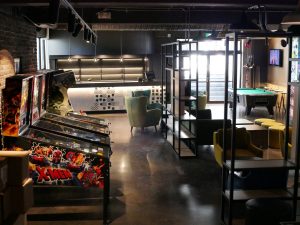
Livera explained that the goal of the space was to have two different feels: the upstairs area is brighter and “more of the traditional study.” The bottom space, which is darker, “will give [students] the opportunity to be a bit more relaxed and let loose.”

In an interview with The Peak, Mark McLaughlin, Chief Commercial Services Officer of SFU Ancillary Services, outlined SFU’s main criteria in the search for a company to run the pub. Their criteria included friendly service, a menu with competitive pricing, happy hour options, an operator that would hire SFU students, a company with strong sustainability practices, ethical procurement of ingredients, and a community-minded company.

“We were very impressed by what the Joseph Richard Group put forth [ . . . ] it’s very much student focused.”

McLaughlin explained that although The Study is a liquor primary, minors will be allowed in accompanied by a parent or legal guardian until 10 p.m., which McLaughlin noted is good for families.

McLaughlin also said they are hoping to hold a few dry events, where they do not serve alcohol and allow guests of all ages to come in.

“Our goal has been to create a fun place on the Burnaby campus where students can meet up, make new friends, and enjoy the social aspects that are part of student life outside the classroom.”

In a phone interview with The Peak, the Executive Director of the Graduate Student Society (GSS) Pierre Cenerelli explained that while the GSS was consulted in the early stages of the decision-making process in the form of a presentation from the JRG group, the decision was entirely SFU’s in the end. Additionally, he said that graduate students were “not consulted in a systematic way.”

He noted that he is “cautiously optimistic” about the pub.

Rihani and Freedman said that “we would like to see more considerable efforts taken on behalf of ancillary services to involve students more broadly in meaningful decision-making.”

Rihani and Freedman explained that since the SFSS surrendered ownership of the pub to SFU following the closure of the Highland, they “have been largely kept out of the decision making process with respect to the opening of the pub.” They stated that their agreement with SFU included “the understanding that the pub would be opened promptly and that student groups and the SFSS Board would have access to the space, which to date has not occured [ . . . ] we are disappointed at how we came to today, and how long it took to come to the opening of this important student element.”

Cenerelli said that “it’s a bit of a mystery to me why it has taken them so many months.”

McLaughlin said that the opening of the pub took much longer than anticipated, and that “when you deal with old buildings you encounter problems. We lost some time with some of those issues.”


Despite the delay in opening the pub, Rihani and Freedman said that “We have begun to develop a positive relationship with Joseph Richards Group and look forward to building on that in the future.”

“What we really tried to do is create a vibrant hub here at the center of campus [ . . . ] we’re really focused on creating a great student experience,” said Mark McLaughlin.