Home Blog Page 507

The real classes of SFU

0
Illustration by Jarielle Lim

Bard:

When the academics of academia aren’t for you, you are destined to be a Bard.
This character champions a C+ in all their classes, sprints late into midterms with headphones flying, and has never purchased a textbook in their entire life. However, what they lack in scholarly finesse, they make up for through extracurriculars. They are the captain of the Quidditch team, a member of the SFSS, on the board of a plethora of clubs, and they spearheaded a student revolt (for extra credit in POL 150).

Barbarian:

A barbarian does not fear 11:59 p.m.  The adrenaline of deadlines and anger at their own procrastination sustains their productivity. If they have an exam at 12 a.m. on Tuesday and haven’t studied by Monday evening, they have the fearsome ability to transcend the mortal world in a state of rage, studying without a single shit, pee, or snack break until they have crammed a whole 1560 minutes of lecture material into their brain.

Monk:

They turn up to class with the tiniest backpack in the world, but when they sit down in class, they take out a colour-coded notebook, a pencil case with every highlighter colour, a set of gel pens, some gym clothes to go do some yoga after class, a David’s Tea mug, a Swell water bottle, and all the readings printed out, annotated and pristinely preserved in a folder.

If you are stressed in class, they will send you “good energy,” and somehow it works. They tell you they’ve failed every assignment, but are maintaining a 4.0 GPA. Their Instagram is littered with minimalist aesthetic and pictures of their study set-up. They had Marie-Kondo’ed their life in 2017. Their skin is clear.

You hate them.

Paladin:

In your darkest university times, a paladin may appear in the form of a saviour TA. This TA is endowed with eternal patience for your idiocy when you stutter across a response in tutorial, spinning your nonsense into an insightful claim. When your professor puts the midterm right after reading break, a Paladin TA will rise up, fearless even in the face of a tenured professor, to petition the prof to give the class an extension. Their everyday vindication could inspire a cult, and yet they live as a saviour for the betterment of humble undergrads.

Ranger:

In the morning, as you get ready, you clip a carabiner onto your water bottle and slip it into your MEC backpack. It knocks against several Cliff bars on its way in (mint chocolate chip). You then ride your bike to the SkyTrain, get off at Production Way-University Station, put your bike on the front of the 145, and get to class 75 minutes early so you have time to refill your thermos with Fair Trade coffee. You can always successfully find your way around the AQ and always find the library books you need.

After a day of hydration, you bike down Burnaby Mountain and go home without breaking a sweat. You are a Ranger.

Rogue:

If you laugh at danger and thrive on the edge, you are a Rogue. You once saw a Rogue do the readings in the elevator on their way to seminar, and when they got there, they swore in front of the teacher. The Rogue always has a PDF of the $300 textbook you can’t buy used, will submit their essays late without the TA questioning late penalties and never takes notes. They always know what bathrooms to poach free pads and tampons from, what student lounges give out snacks, which days deliver free pancakes, and what clubs are suckers for handing out free pens and supplies on campus.

Wizard:

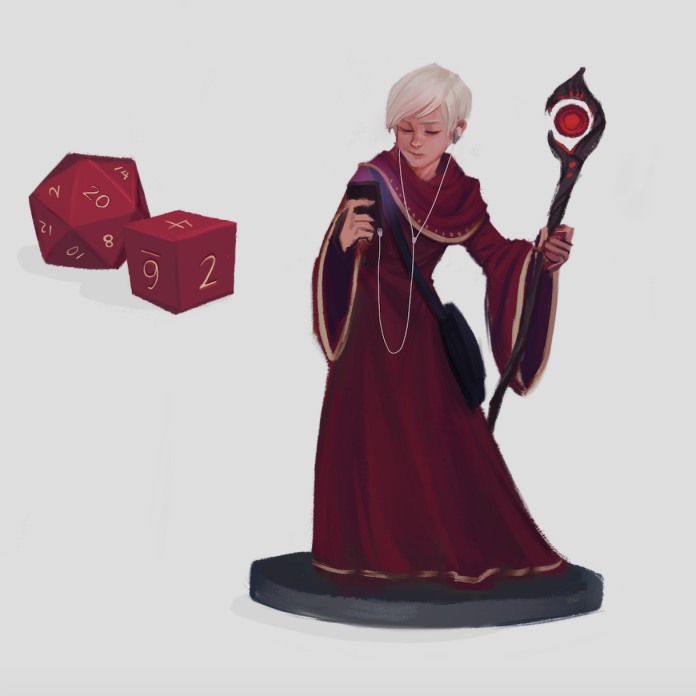
In the most asbestos-ridden, concrete-heavy corner of the AQ: the Wizard is able to summon perfect Wi-Fi. When they close their eyes and concentrate, wielding their staff, the Wizard is able to clear the traffic of a crowded staircase. Only they can hush the roar of construction or Divine the next bus’ arrival. There is no other explanation as to why this bitch is on the President’s Honour Roll with no study skills whatsoever. Did they just get another scholarship? Yes, yes they did.


Board Shorts

0
Irene Lo / The Peak

SFSS Fall 2019 Kickoff Concert Discussion

During Friday’s meeting, the board discussed making plans for the SFSS’s 2019 Fall Kickoff Concert.

“As we all know convocation mall will be under construction [ . . . ] so I just wanted to find out which space [sic] at the campus we can use,” said Dipti Chavan, Member Services Coordinator for Events. She noted that the concert could also be held outside of campus, however this option holds a higher risk due to insurance.

Samer Rihani, acting president noted that SFU has mentioned that Strand Hall Parking Lot could be an option. Chavan noted that they might consider the North Parking Lot.

Jackson Freedman added that “with convo mall being unavailable, it comes down to the question of, ‘Do you still want to hold the concert in a place that is risky in respect to weather, in a place that’s never been done before?’”

Freedman suggested that they ask SFU to give them two different space options to reserve and then have the next board figure out the other details later.

SFSS welcomes its new executive director

On March 13, 2019, the SFSS released a statement on their website announcing that Sylvia Ceacero has been hired as the student society’s new executive director.

According to the student society’s website, Ceacero has worked on multiple non-profit and for-profit initiatives at the provincial and national level with more than 20 years of experience.

“Sylvia brings to the role extensive experience in strategic planning, national, provincial and municipal advocacy and stakeholder relations; strategic and business planning; financial and fiscal management; risk management and human resources and labour relations management,” according to the student society’s press release.

“I’m thrilled to have been appointed the executive director of the student society, it’s very thrilling so far [ . . . ] It’s been quite engaging and daunting at times [for my first week],” said Ceacero in the board meeting.

The Peak will conduct an in-depth interview with Ceacero regarding her visions and plans for the student society.


A rundown on the SFSS 2019 election debates

0
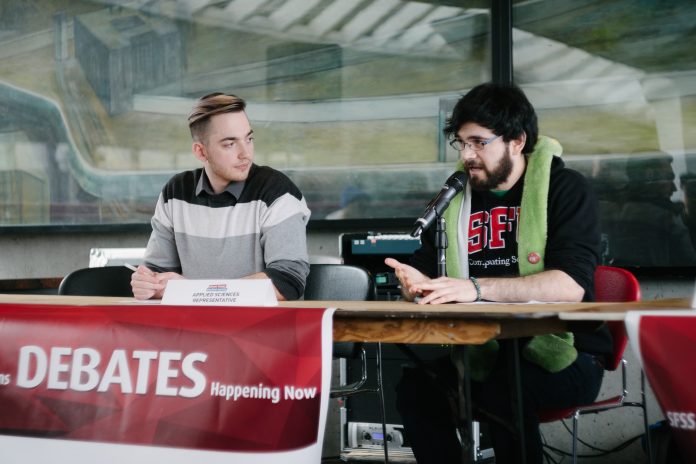
Photo Courtesy of Chris Ho

Every year, the SFSS hosts a debate in which the candidates for each position get the opportunity to share their platform. Each candidate makes an opening statement, asks a question to their opponent, answers audience questions, and makes a closing statement.

The SFSS 2019 elections debate took place on Wednesday, March 13 at 1:00 p.m. in West Mall Atrium. Here is a debrief on each of the candidate’s platforms.

Faculty of Applied Sciences

Nick Chubb and Sheldon Bond were both present at Wednesday’s debate. Chubb started his opening statements noting, “despite what some may say about me–that I’m just a kid with a meme page– I actually have quite a bit of experience advocating for students.”

Chubb asked Bond if he has had enough experience at SFU to advocate for students, as Bond is currently in his second semester at SFU. Bond responded that he has been involved with the CSSS, has attended engineering meetings, and has reached out to WIX, SSSS, and MSESS.

Bond questioned Chubb on one aspect of his platform, asking “why do you think parking is the biggest issue facing applied science students?” Chubb responded that parking wasn’t necessarily the most pressing issue, and noted that he also wanted to promote the gondola and tuition freeze.

Faculty of Arts and Social Sciences

Simran Bining and Jennifer Chou are both running for this position, however Chou was unable to make it to the debate.

“My goal for this term is to increase student engagement with clubs and DSUs, greater access to physical and mental health resources, as well as improve communication between the SFSS and students.”

Faculty of business

Willson Leong and Abhishek Parmer were both present at the debate. Andrew Wong was not able to make it.

Leong explained that he has gained “a lot of valuable insight on the problems here with the SFSS and the general student population” due to his involvement in MISA and enactus.

“My goal is to bring Beedie closer to other faculties around and build better connections with the other reps,” said Parmer. He also hopes to plan events with other faculties, such as economics and computing science.

Faculty of communication representatives

Silke Billings was the only FCAT candidate present at the debate as Fiona Li was unable to make the debate.

An audience member asked “how can you use your skills in communication to help the SFSS improve its communication?” Billings responded that there is a lack of communication between departments, and she would like to improve this through meetings.

Faculty of education representatives

Emerly Liu was present at the debate as the only candidate running for education representative. In her opening statement, Liu explained that she is the current president of the Education Student Association, and that she wants “to help improve the social and academic well being of all undergrads.”

A main issue she addressed is that the faculty of education has made adjustments to their Professional Development Program requirements and hasn’t communicated this well with undergrads, which she hopes to improve through student engagement.

Faculty of environment representatives

Julian Loutsik and Lex Grandan were both present at the debate.

Loutsik’s mentioned that he has been shadowing the current environment rep over the past few months, during which he has learned a lot about the position. Grandan noted that he is an active member of both the Bachelor of Environment Student Union (BESU) and the Environmental Science Student Union (EVSCSU), and that he is “hoping to implement environmental education engagement and advocacy.”

Grandan’s question to Loutsik was “you plan on having a close relation to departmental student unions that you claim on both The Peak questions and your platform, however myself and many EVSCSU members have never seen you at any of our weekly meetings. Are you aware of when and where they are?” Loutsik responded that “instead of attending these meetings I have taken the route of being close with the current faculty of environment representative, as I believe it sets me up better.”

Faculty of health sciences representative

Both of the health science candidates, Osob Mohammed and Roopan Garcha, were present at the debate.

Mohammed mentioned that she hopes to advocate to supply health products (such as menstrual products and contraceptives) in bathrooms around campus, and supports Tuition Freeze Now.

Garcha said “as a health sciences representative I hope to create a welcoming and reassuring atmosphere for students where they can openly communicate their concerns without any hesitation.”

Faculty of science representatives

Jason Spence, Kasey Stirling, and Simran Uppal, were all present at the debate.

Spence demonstrated involvement in his faculty, as he is involved with the Biology Student Union, as well as the Science Undergraduate Society (SUS). “I have listened to the requests and suggestions and complaints about the SFSS and I am prepared and I plan to take those right to the university level,” he explained.

Stirling’s mentioned that she wanted to improve mental health care for science students. In her closing statement she encouraged the audience to “vote for someone who will bring new ideas to SFU science. It’s quite stagnant at the moment.”

Simran Uppal’s three main points include increased science opportunities, development of the surrey science union, and increased campus wide events.” She also noted, “I would like all students at all campuses to be provided with science opportunities and be aware of them.”

At-large representatives

Of the at-large representatives, Maneet Aujla and Stephanie Chiakwelu were both present at the debate. Rayhaan Khan was unable to make it.

Chiakwelu explained that her main concerns include “a sense of community at our school, tuition freeze, job placements for graduating students, open-source textbooks to get rid of the expensive textbooks sold to students, and making the bursary and scholarship programs more accessible to low income students.”

Aujla mentioned that she wants “to create and build a sense of community amongst everyone here.” She is a member of the active bystander network and additionally has been involved on the SFSS events committee.

They both agreed that the SFSS has faced a tough year, and is not currently in good standing.

VP Finance

Tawanda Nigel Chitapi is the only student running for vice-president finance this year.

When asked by the IEC if he would choose to prioritize bursary funding or club funding, Chitapi responded that he would prioritize funding clubs, stating that “we can only foster community and engagement through clubs and student unions.”

In his closing statement, he remarked that “we just need to change the narrative of the student society [ . . . ] It’s a good feeling to be running alone, but [it’s bad optics on the society], people should not be refraining from running for these positions because of fear of dirty politics.”

VP Student Services

All three candidates for vice-president student services, Christina Loutsik, Simran Randhawa, and Prince Cheema were present at the debate.

Randhawa asked Cheema, “On your platform, you talk about a community, and considering the SFSS has no sexual violence prevention policy and you never mentioned it and I have honestly never seen you work on it, how do you plan on building a community that is safe?” Cheema responded that he does in fact mention sexual violence on his platform. He noted that SFU has various services and that the problem is communicating the existence of these student services to the student body. To this, Randhawa rebutted that his response did not answer her question.

Samer Rihani, audience member and SFSS’s current acting president, asked what the candidates think about the current provision of the health and dental plan, to which all of the responses mentioned negotiating a more affordable plan.

An audience member inquired about what the candidates would do to create a long-awaited sexual violence policy for the SFSS. To applause, Randhawa said that “this is personal to me. Most days I am more victim than I am a survivor. In fact, just last Saturday when I got awarded as the SFSS Women of the Year from FASS, one of the board members said to me that he would F my life up [ . . . ] I am here to stand for the people who have been victimized.”

VP Student Life

Balqees Jama was the only vice-president student life candidate present at Wednesday’s debate. In her opening statement, she noted that “my goal this year is to rebuild that faith that has been damaged over the years.”

The main points that she made included getting a headstart on planning a Fall Kickoff, planning consultations with different types of student groups, and increasing core funding for clubs and student unions.

Although there were some distractions from an audience member during her debate, Jama remained calm and was able to successfully answer all the questions.

VP External Relations

Both the candidates for vice-president external relations, Ali Versi and Jasdeep Gill, were present at Wednesday’s debate.

“In your platform last year, you pledged to increase the indigenization of our campus as an issue that is close to the hearts of many,” Versi asked Gill. “My question to you, therefore, is why should the students trust you again when you acted in complete opposition to your campaign promise by evicting the FNSA and denying them space in the student union building?”

To this, Gill responded that the FNSA does currently have a space in the student union building, and “a lot of my year has been learning and meeting with the FNSA every month.”

“I think it’s hard for students to put their faith in a candidate who does not fulfill their campaign promises again,” rebutted Versi.

In closing statements, Versi expressed his intent to advocate for a tuition freeze as well as his support for an SFU gondola.

VP University Relations

Russell Dunsford and Shina Kaur were both present at the debate. Harman Batish, who is also running for the position, was not present.

Kaur explained that the main points of her platform include encouraging professors to use open-source textbooks as well as subsidizing books. Dunsford explained that he is working with a student group to advocate for banning plastic water bottles on campus, as well as to work with safety and risk services to improve lighting on campus.

They both agreed that SFU should be more receptive to the needs of students.

President

Giovanni HoSang, Amrita Mohar, and Kia Mirsalehi were all present for the debate.

Mirsalehi explained that his platform is based on giving the power back to students and student clubs, as well as implementing by-law reform to set standards on how board members can act. He described himself as honest and straightforward, and emphasized the importance of not making decisions himself, but consulting board members and the SFU student body. Mirsalehi noted that he will continue to fight for by-law reforms even if he doesn’t get elected.

HoSang explained that his campaign focuses on a collaborative process, not only with all of the SFSS board members, but with the entire student body. He emphasized the importance of transparency, advocating for students, and restructuring the SFSS’s decision-making process. In particular, he wants to get rid of the current model where all decisions go directly to the Executive Director. “I think we can build a very positive relationship with the Executive Director by the Executive Director recognizing that students voices are supposed to be heard, and the last Executive Director didn’t do that,” said HoSang.

Mohar wants to support and facilitate whatever projects and initiatives the board members need. In terms of sexual harassment, she noted “I don’t want any board member to experience what I went through.” Mohar said if she doesn’t win she will sign up for various committees and still holds a seat on senate.

They all expressed that the SFSS is currently lacking in a sexual harassment policy, and  importance of creating an SFSS sexual harassment policy. Additionally, they all expressed the importance of developing a positive relationship with the executive director. Furthermore, they all agreed that the SFSS should do more to create opportunities and services for students with disabilities through better consultation and involvement.

In terms of the ongoing struggle for certain student groups to get space in the SUB, they were divided. Hosang explained that as there are six Rotunda community groups and seven available spaces, they should be allocated accordingly. Mohar explained that the shared-space model is supposed to build community and spread awareness of all the clubs and groups on campus, however, she would be open to negotiation as a president. Instead of answering the question directly, Mirsalehi said “we should take it to the students and offer a referendum question,” a motion which he previously brought to the board.

Free menstrual products in New Westminster schools is fantastic, and should go further than high school

0
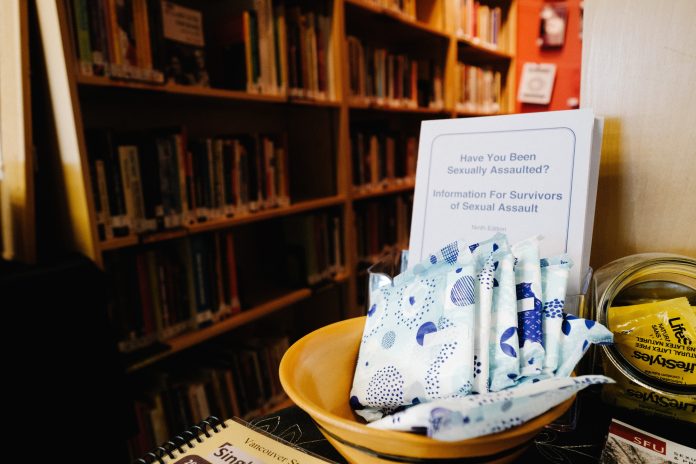
SFU's Women's Center (Photo by Chris Ho/The Peak)

When I heard New Westminster would be offering free menstrual supplies across its elementary and high schools, I was proud that my hometown would be the first school district in B.C. to adopt this new policy. The way they’re being provided is through coin-free tampon and pad dispensers in all B.C. schools, reducing the stigma around menstruation and publicly confirming that which women already know: menstruation supplies are a necessity, not a luxury.

Resources like this are important and immensely powerful for young women. We learn quickly that everyone gets their periods at varying, seemingly random times in their journey through girlhood and adolescence, and so the pursuit of a tampon or pad in an emergency could at times prove difficult and awkward.

But in going through the benefits to having free and available menstrual supplies in high school, I can’t help but wish they were just as free and easily available in post-secondary too.

When I was 12 years old and needing period supplies, trying to acquire some simple menstrual products was complicated. The tampon and pad dispensers in our spooky school washrooms were perpetually out of order, but even if wasn’t it’s unfair and intimidating for spare change to get in the way of using something as necessary as any other paper product in the washroom.

The only other option was approaching friends, and it was a riddle of remembering who had gotten their periods, figuring out who was close enough to me that I could ask discreetly to borrow a pad or tampon while simultaneously not drawing too much attention to myself. Once I acquired the aforementioned menstrual aid, I felt the need to shove it into my pocket quickly enough so that no one could detect that I was in danger of bleeding into my pants.

Part of my impulse to hide the fact I was on my period as a young person may be tied to the fact that menstrual health was simply not talked about terribly openly in middle and high school. I think this new system of supplying free menstrual supplies will help alleviate some of this tension and help young women get more comfortable with their periods. It’s a way for the school to say “hey, bleeding from your vagina probably seems very weird, but don’t worry, it is normal, and here are some supplies to help you and show that we support you”.

Even aside from that relief, the money it saves students is also more than enough to be envious of from post-secondary. In making room in the budget to provide free menstrual supplies in secondary schools, they’ll be doing students a huge service by lowering their need to purchase products on their own dime and stockpile their own supply.

Providing these products is a relatively simple change in budget allotment for a large institution, but makes an enormous difference to a student who isn’t working full-time and living on a non-existent salary. Even with the greater number of students and campuses, I can easily see just as much thankfulness and benefit to coin-free tampon and pad dispensers in all university washrooms.

Currently, menstrual supplies, safer sex supplies, and pregnancy tests are available at SFU’s Women’s Centre. These are supplied free of cost to those who need them, and I’m very thankful for organizations like the Women’s Centre and their providing these sorts of products. But I simply think it is not enough for them to be the only ones taking responsibility for menstrual, and overall women’s’, health. Knowing that some schools are achieving that makes me just want to see it everywhere else where it could help.

What grinds our gears: People recording videos of their daily drive

0
Photo by Airman 1st Class Elizabeth Baker / U.S. Air Force

I enjoy watching Instagram stories from time to time, especially to start the day. Your morning cup of joe aesthetically placed beside the newspaper you never read? Almost cute. Birds’-eye view from your waist down showing your shoes and pants of the day? OK. Picture of the wild roses in front of your house? Why not.

Filming your drive up the mountain to SFU, while you divide your attention between testing your ability to take a non-shaky video with one hand, and swerving unseeingly on the road with the other? Not cool.

Really, your daily drive is not that interesting. Save that concentration and mind power for when you can take your next dog-filter selfie once you’ve made it to campus in one piece, without running anyone over. Or you could save the energy to work on your next co-op job application, whichever is more pressing in your life.

Whatever you do with your saved-up photo energy, just stop putting yours and others’ lives at risk for a shaky and unexciting five-second video of your drive. Your followers are going to be watching your story with no volume and half their attention anyway.

Financial incentives and mandatory reporting of vaccinations are the strongest ways to prevent another measles outbreak

0
Photo by U.S. Air Force / Airman 1st Class Matthew Lotz

Measles is a highly infectious, contagious disease, spread by the measles virus. The symptoms tend to resemble that of a flu, but it can be quite dangerous to children if they haven’t been immunized. According to the CDC, there is still a 3% chance to get measles even if you’ve received two doses of vaccine. Nonetheless, the MMR (measles-mumps-rubella) vaccine has kept the number of cases low since its introduction in the ‘80s.

Unfortunately, the new wave of anti-vaccinators have increased cases of measles exponentially. Measles has had a sudden outburst in B.C., with the assumed reason being a lack of children being vaccinated because of parents fears of vaccines themselves risking their child’s health and causing autism. In response, there’s been outcry to make vaccination mandatory. This is far from a new idea, as there are already nine countries in Europe that take a hard stance on vaccination, which range from having MMR being recommended to fully mandatory.

While this would be a beneficial policy, it could be hard to establish, given the pushback from anti-vaccination advocates that may have caused this measles outbreak to begin with. Some countries, particularly Australia, offer financial incentives to encourage parents to vaccinate children by their own volition.

Similar financial incentives might be the direction Canada should be taking before going directly into a mandatory policy.

The measles outbreak in B.C. is nothing in comparison to the recent outbreak in Europe, but it could be on its way in Canada. According to the World Health Organization, the cases in Europe increased to nearly 24,000 in 2017, compared to only a little over 5,000 in 2016. B.C. is not hitting those numbers yet, but could reach that point given enough time and little responses.

But countering this through mandatory vaccination may be the best way to avoid more cases, as it’s a hard stance that may not be openly accepted by parents who still believe that vaccination causes autism. Diving directly into pushing mandatory vaccines on those who still reject vaccines may create more push-back, meaning it’ll stay just as difficult to prevent preventable diseases.

In the meantime, there is a middle ground in some places of Canada between mandatory and optional vaccinations. In Ontario and New Brunswick, they follow a mandatory reporting model where the parents keep track of the vaccines their children have received (or haven’t) through a vaccination card to provide to schools and healthcare providers. With this standardized form of information and notification, the non-vaccinated children can be required to stay home until the outbreak ends, and the extent of vaccinations can be known to the institutions involved.

This may not solve an ongoing outbreak, but does inform the healthcare system of everything they need to know so that they prevent outbreaks from spreading too far. While this guarantee vaccination, it at least takes a step towards safety for those refusing to vaccinate. Financial incentives on top of this mandatory reporting policy may therefore be a smoother and safer way to prevent outbreaks like in B.C., while leading to more children getting vaccinated over time.

According to CBC, this sort of mandatory reporting is being strongly considered in B.C. In an ideal world, people would be vaccinating their children by their own volition, which a mandatory policy will probably not accomplish right away. As it is, though, the prospect of mandatory reporting and options like financial incentives could get us closer to that point than making vaccines themselves mandatory out of the gate. Hopefully things don’t get worse before they get better.

Recipients of the inaugural SFSS Women of the Year Awards unveiled

0

March 19, 2019 correction: The original version of this article stated that Simran Sanghera was the winner from the Faculty of Arts and Social Sciences. This has been corrected to Simran Randhawa. 

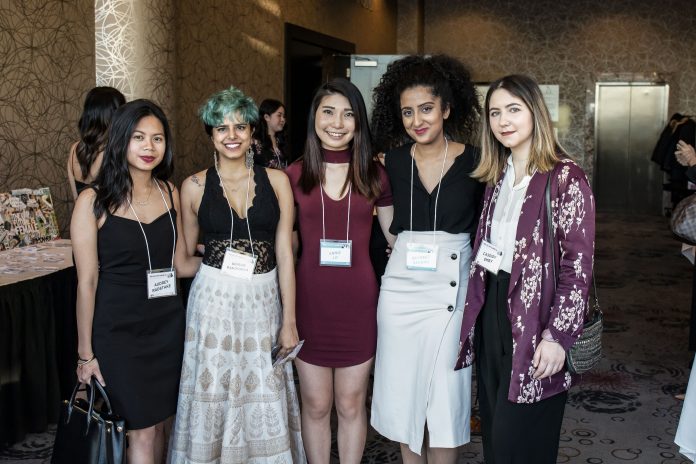
On March 9, 2019, the winners of the inaugural Simon Fraser Student Society Women of the Year Awards were announced at the Young Women in Business SFU International Women’s Day Gala held in Vancouver.

The Women of the Year Awards were presented to seven undergraduate students from several SFU faculties. The recipients were: Dawn Chandler, Simran Randhawa, Cameron Lust, Edna Batengas, Mireta Strandberg-Salmon, Zahra Haq, and Krista Bohlen.

The student society’s definition of the women of the year is “a self-identified [woman] who has demonstrated leadership in the SFU community and actively advocated for positive changes in society, particularly for women. Also more broadly this year’s theme was focused towards how they have raised, reached, or redefined the glass ceiling for all women,” stated Tawanda Masawi, vice-president student life in an email interview with The Peak.

According to Masawi, the SFSS events committee decided to create these awards because they “wanted to move away from the traditional approach of engaging students through regular events [ . . . ] to find a more progressive approach to engaging with students around campus.”

“By launching this initiative, we were able to use the questions that we asked nominees as a platform for them to think about their roles when it comes down to making the SFU community a more equitable campus for women,” said Masawi.

“The awards serve to increase the profile of outstanding women and champions of women in our community. The purpose of these awards is to recognize outstanding student efforts to create a climate that encourages women to succeed at Simon Fraser University,” he further added.

Masawi shared that there were over 50 submissions for the awards and the selection process was carried out by a committee that consisted of SFSS staff.

“The purpose of this was to ensure that no [SFSS] board members could influence the outcome of the awards . . . SFSS Board members were also not eligible to be nominated for the awards,” he explained.

The nomination process was opened from February 14–24, 2019, and it required nominators to submit an online application form for their nominee and self-nominations were also permitted, stated Masawi.

Two finalists were chosen from each faculty by the selection committee (in total there were 14 finalists) and the seven recipients of the awards were voted by students during a three-day open voting period, explained Masawi.

The winners included students from the Faculty of Applied Sciences, Faculty of Arts and Social Sciences, Beedie School of Business, Faculty of Communications, Art, and Technology, Faculty of Health Sciences, Faculty of Environment, and Faculty of Science.

The recipients were provided with complimentary tickets to Michelle Obama’s Becoming Tour and they were invited to the International Women’s Day Gala where they received a glass award for their achievement, said Masawi.

When asked about the reception of the awards, Masawi shared: “The awards have only received positive feedback and will only continue to grow and get better as the years go on. This was the first time that they have been hosted so there is room for improvement in many places.”

In terms of the continuation of the awards in the future, Masawi stated that it will depend on the future board’s decision.

“The SFSS is excited to have launched this initiative, the project will only continue to grow. To our current knowledge the SFSS is the first student society to do something in this capacity for students. Hopefully we will be able to serve as an inspiration to other student unions and share our experience with them,” noted Masawi.  

The Peak had the opportunity to interview some of the winners regarding their thoughts on winning the award.

Strandberg-Salmon, winner from the Faculty of Environment shared: “I feel fortunate to be studying at a school that is so encouraging of student leadership and engagement. I hope that my efforts and the work of all the women in the Faculty of Environment and at SFU more broadly continue to inspire others to take action to help promote resilience and sustainability in their communities.”

Lust, another recipient of the award, stated: “I was extremely flattered to be nominated for this award alongside these other truly impressive, passionate and accomplished women across a multitude of faculties. I believe this initiative [. . .] will bring immense value to the SFU community as we continue to shine light on female leadership.”

Chandler, a computing science student at SFU commented: “When I was a high-school student, I never could have dreamed that I’d end up here, that I would have: learned to code and excel in math, developed so many skills that I’m proud of, and helped so many women along the way. Having come so far, and having met so many inspiring technical women who’ve accomplished far more than I have, I’ve made it my goal to help other women and girls realize that they’re capable of so much more than they think.”

Haq, recipient from the Faculty of Health Sciences said: “I am grateful to not only SFSS and the team who made this happen this year, but to also to everyone who took the time out to vote and reach out. I’m immensely proud to be part of the SFU community, and grateful to everyone who has made these last five years incredible.”

Randhawa, winner from the Faculty of Arts and Social Sciences mentioned: “Being nominated in itself was one of the most gratifying feelings of all, especially considering that around 5 people  nominated me [ . . . ] My heart skipped a beat when I won and was honoured amongst such fantastic women, and so many people who believed in me being deserving of this award.”

Lastly, Batengas, winner from the Faculty of Communication, Art, and Technology said: “I am so pleased, honored and humbled to accept this award for FCAT. A huge thanks to those of who supported my nomination, couldn’t have gotten here without them.”

The Peak did not receive a response from Bohlen in time for our print publication.

Hamish and Jo’s Adventures in France Part 6: A fruitful February

0
Illustration by Siloam Yeung

As it turns out, February on the French Riviera is pretty neat given that February is typically a boring filler month with dreary weather and only 28 days — bringing into question why we pay a full month’s rent…

Anyways, Hamish and Jozsef here, once again reporting live from the quaint town of Menton, France where the Science Po campus we attend is. Because of the French university schedule’s system, February marked our first full week of classes. Six classes to be exact, and no, we haven’t transferred to engineering. The two of us actually managed to rock a snazzy three-class course load just last semester, so some of you may be wondering what caused our seemingly uncharacteristic shift in lifestyles… the answer is transfer credits.

Transferring credits, as many of you likely already know, is a complicated business. The ETCS (European Credit Transfer System) is the credit system used in most of Europe. This, of course, is to make it easier to transfer credits between European countries. Unfortunately, it remains difficult to transfer them back to North America. One reason that this has been frustrating for us is that classes at our university are either 10 or five ECTS credits, which in turn convert respectively to five and . . . two SFU credits.

This means that with our goal of 12 SFU credits each semester, with only five ECTS courses being offered to exchange students this semester, we now need to take six courses. This spike in our course load is most notably leading to significant cutbacks in travel time (which, as we mentioned in the last article, isn’t that much of a problem due to our empty bank accounts — a quick shout out to SFU and the OFFA/BAFF for their exchange bursaries which have kept us afloat).

In any case, now that we’re nearing the end of February, we actually are getting back into the swing of classes. This semester, we are taking three law classes, with focuses on jurisprudence, French constitutional law, and public international law. We are also taking a class called States and Societies in the Middle East, as well as one about political participation in Europe.

However, our strangest, most interesting class goes by the name “Design Impact” : a course we thought was strictly arts and crafts but has turned out to be about using “design” to create and organize effective humanitarian projects. Sadly, this is a brand new course, and our prof has yet to let us in on how she intends to grade us or what kind of assignments we might encounter (always fun).

While we’ve been busy at school, life in Menton and on the Côte d’Azur in general has been picking up. February, in case you didn’t know, is when lemons come into season here, and so all of the lemon and orange trees that line the streets of town have been getting progressively more colourful. The townspeople have been engaging in carnaval-esque festivities here every February since 1875 (in 1882, even Queen Victoria attended), and by 1928 the Carnaval of Nice had become incredibly famous. The local hoteliers proposed a festival that celebrated the fact that Menton was the primary exporter of lemons in all of Europe. This festival, in 1928, was the first edition of the Lemon Festival that has been occurring here ever since.

We have once again lucked out, because our house is across the street from the park where the majority of the decorations are. Part of the Lemon Festival is the creation of massive sculptures out of lemons and oranges, depicting scenes relating to each year’s specific theme. This year’s theme is “Fantastic Worlds,” and so, over the past several weeks, we have been witnessing the creation of gargantuan citrus sculptures depicting such things as witches flying around castle towers alongside various fantastical beasts such as dragons and griffins.

Besides the sculptures, there are six parades that happen throughout the three-week Lemon Festival, with truckloads of pastel-coloured confetti being thrown into the streets covering both the massive crowds of onlookers and the gigantic animatronic floats cutting through them. To top it off, the complementary light shows and fireworks happen a stone’s throw away from our apartment.

Less than an hour away, in nearby Nice, the citizens are also celebrating (evening parades seem to be spaced on opposite days to allow people to travel to both), but instead of lemons, they’ve got Carnaval! Carnaval undoubtedly has some of its roots in Catholic tradition, but we won’t dive into that, because frankly, nobody writing this article is that interested in that. What is important to note, is that the Carnaval de Nice was… kinda tame. It seemed that, perhaps partially due to the increasing need to securitize public events like this, there was much less of a party or celebratory atmosphere than could be expected from a Carnaval that has consistently ranked amongst the best of Europe. That is not, however, to say that the actual content of the parade wasn’t fantastic. There were enormous animatronic floats and people wearing giant costumes depicting caricatures of world politicians, including an animatronic Trump the size of a building, disguised as the clown from IT. There were also dancers and huge balloons that looked like dragons swooping down to eat the audience.

While we mentioned we have been doing less travelling, that is not to say we have been doing no travelling. In fact, we are writing this after spending five days in Andalucia, Spain during our reading week. Our original plan involved couchsurfing in Cinque Terre in Italy, and doing a lot of hiking, but unfortunately nobody responded to our couchsurfing requests, hostels became ridiculously expensive, and we accidentally left our tent (for camping, as a backup plan), on the train the same day that we bought it… So the day before we were supposed to go to Cinque Terre, we bought flights to Seville and booked a hostel in Cadiz, on the Atlantic Ocean. Neither of us knew that much about the region, so it was certainly an exciting trip, learning lots about the local culture and forcing us to learn some basic Spanish that we didn’t know two days prior.

When we arrived in Cadiz, it was quite windy, but we already knew we were in for a nice warm vacation. We spent the first two days wandering around Cadiz, hanging out at the beach and playing in the waves. We saw the old town and its two seaside castles, the beautiful Parque Genovés and its collection of tropical plants, and ate as many tapas as we could while lounging in sun-drenched patios.

We also learned about some of the city’s history. It’s the oldest continuously inhabited settlement in Western Europe (having been settled some 3,000 years ago by the Phoenicians), it served as an important Spanish port during the Age of Exploration, and finally, it was the setting for the proclamation of the Spanish Constitution of 1812.

On another day, we checked out one of the nearby towns, Jerez de la Frontera. There, we saw two beautiful churches, and climbed one of their towers to get a better view of the city. Like many cities in Andalucia, the majority of the town was painted white, similar to a Greek town, but had distinctive yellow and orange accents and strikingly colourful patterned tiling throughout. We also caught a glimpse of a flamenco dancer doing a photoshoot in one of the town squares, her bright red dress contrasting beautifully with the white walls behind her.

Finally, on our last day in Spain, we took a rideshare to Seville, where we met up with two friends from our school in France. There, we went to the Cathedral of Seville, which is the main cathedral of the city, and the largest Gothic cathedral in the world. Formerly a mosque constructed in the 12th century, the cathedral retained much of its Islamic influence after it was Christianized and rebuilt as a cathedral between the 13th and 16th centuries. The bell tower is the most obvious example of its retention of its Islamic characteristics, as they simply added the bells and the upper floors to the original minaret of the mosque.

Unfortunately, the end of our trip brought us back to Menton where our sizable pile of schoolwork was happy to bring us back to reality. In other words, playtime is over for now, but certainly not forever. We promise to get back to ignoring our schoolwork as soon as possible and can’t wait to share more stories from our time here in France.  

SFU’s convo-mall construction timeline is cutting things too close

0
Photo by Chris Ho / The Peak

If you’re a deep-cut Legend of Zelda fan, you might remember one of the game series’ 2001 instalments, Oracle of Ages. In this game, the wicked sorceress Veran advises (and later possesses) Queen Ambi, hijacking her big construction project.

Though Ambi was building her tower so she’d have a tall enough vantage point to find her lost love, Veran used the construction project to bring misery to the queen’s country. Her goal was not to finish the tower, but to force the builders to work on it forever, making it a permanent source of pain for the people. So the tower was built higher and higher, with no end in sight.

Though SFU Burnaby isn’t exactly the Black Tower, there are some similarities. SFU construction projects never end on time and they bring pain and misery to their students. We’ve seen this again and again.

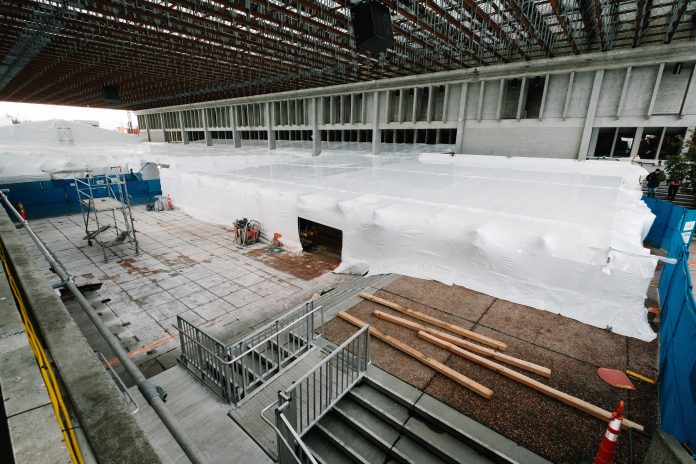
Recently, project manager James Bremner talked to The Peak about the timeline of the ongoing construction in Convocation Mall and how that will affect this summer’s convocation ceremony. According to Bremner, the area in front of the stage will be finished early in June, prior to convocation. The stage itself will be filled in with temporary tiles for the ceremony.

To me, this is pretty horrid for any June graduates. I’m not graduating this summer myself, but the construction situation sabotages the summer 2019 convocation on several levels, and it does our soon-to-be grads dirty.

Don’t misunderstand: I trust Bremner’s intentions, and the work he and his team are doing is invaluable. But while I believe in their honesty and work ethic, the reality is that we just can’t take for granted that things will go according to plan. Haven’t we established concretely that campus projects don’t always stay on schedule? The student union building was projected to be finished in fall 2018; now it won’t open until summer 2019.

While this might have been due to understandable and unexpected barriers, unexpected things happen all the time. That’s why you need your projects to have a reasonable margin of error. Convocation is supposed to start on June 11; an “early June” projected completion date leaves only days of margin for if anything goes wrong. What will the school do if Convocation Mall isn’t ready in time?

On top of that, the stage itself certainly won’t be finished. It’s unclear what these “temporary tiles” will look like, so I’ll withhold judgment there — but I can only hope they make that stage look flawless.

Adding insult to injury, let’s also remember that graduates normally take their post-ceremony photos in the AQ by the water. While finding spots to pose away from the construction shouldn’t be too hard, the fact remains that if convocation does happen as planned, hundreds of grads and their loved ones will be congregating in a space that simply isn’t going to look its best. Admittedly, this would be a problem no matter what, given that AQ construction won’t be finished until November — but it exacerbates the other concerns.

Now I’ll admit it’s not easy to cast blame here. The construction team can only finish their job so fast. While it could be said that the planning was poor, they can also only work with the timeframe they’re given by the school.

Likewise, while SFU may have jeopardized convocation, the renewal project would have had to happen sooner or later. No matter when they did it, it’s unlikely they could have avoided disrupting anyone’s graduation.

But I’d hope to see some contingency plans arranged early on for if any complications arise closer to the date. Could convocation be held at another venue? Could the ceremony have been pushed to a later date? Though I understand SFU might not want to look further behind schedule than they actually are, I would rather see evidence of a backup plan than worry that things will fall apart last-minute. I think many students would feel the same.

Right now, just leaving students to trust that everything will go to plan is a little unfortunate. For now, I suppose we can only hope that this time, SFU gets things wrapped up on schedule.

The poor representation of Black Canadians in tech is lacking attention

8
Photo courtesy of Black Boys Code

I have been in the Bachelors of Science in computing science at SFU since transferring here from Jamaica’s University of the West Indies in 2015. In that time, the culture shock I’ve experienced has been massive. I’ve found it rather difficult to be comfortable in certain spaces as the (at most times) only Black student amongst other students, some of whom don’t particularly understand certain issues in the Black community, sometimes belittling our experiences.

The technical aspects of university in Canada haven’t been too troubling, but the social culture that makes fun of my community and myself absolutely has been. Both myself and people in my social circle have encountered tons of light “jokes” made around the campus, regarding neo-Nazis “not being as bad” and critiques of Black people in the industry being deserved. “Jokes” like that are troubling, but when the people making them are called out, they automatically brush it off as you trying to enforce “censorship.”

These sorts of attitudes don’t make for a comfortable education space. It’s dehumanizing, and their prominence in computing science and engineering is definitely impacting why there’s so few Black Canadians pursuing jobs in tech.

Black tech professionals make up only 3% of the total Silicon Valley workforce in the U.S. In Facebook and many other Silicon Valley companies in the U.S., this is at least starting to improve. Many now hire individuals to act as diversity advocates, which are supposed to allow for critical engagement amongst the companies to make them more welcoming, as well as to branch out into the Black communities to find talent. They have a challenging task, but are a step in making the field more open and accessible.

However, there are far fewer such initiatives in Canada, with our tech companies not even collecting much information about the issue. With many companies not working to remedy or look further into it, Canada has a long way to go in implementing equitable hiring practices for Black people in tech companies. This is very much due to the current social culture, which in turn fails to create a safe space for the Black community to flourish.

That said, this toxic culture can be remedied with better Black representation by incentivizing Black youth-to-peer programmes, working with each other, creating a sense of normalcy in the field, and making them feel safe in these spaces. One of these came earlier this year, when the National Society of Black Engineers (NSBE) hosted their 12-hour hackathon in Toronto. At the event, Black Canadian students could work together on fast tech projects and network. As an NSBE member, this had me excited and wanting to attend, but because of the cost of travel and the number of things I had to do this semester, the opportunity missed me.

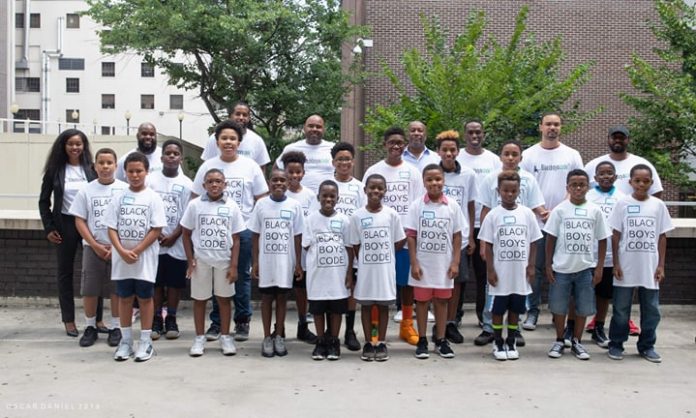
But as great as these events are, they can be few and far between in Canada. Their scarcity is one of the reasons I quickly jumped at the opportunity to get involved in and within spaces that allow me to flourish and connect with other tech professionals that look like me, and to volunteer for organizations who aim to change the scope of the tech industry to encourage youth who look like me. For example, organizations like Black Boys Code, aimed at making things more comfortable for marginalized communities to get involved, do a great service by providing a necessary and welcoming social climate.

In any case, there’s a deep need for more opportunities and support for Black Canadians across technology fields. Canada needs to start ramping up its data collection and do away with the “visible minority” category, and more companies need to recognize the need to partake in specific hiring practices to attract and encourage Back technology enthusiasts. They need to also see the need to recruit and hire more Black tech professionals in their companies. Better representation in this workforce can lead to an industry that everyone can feel happier and more welcome in.