Home Blog Page 483

Reserved seats at enrolment makes internal transfers frustrating

0
Sampling other disciplines is necessary but often difficult. Photo courtesy of Daniil Kuželev via Unsplash

Author: Kitty Cheung, Staff Writer

As enrolment comes around, my love/hate relationship with the School of Computing Science rears its ugly head. I’ve had my fair share of enrolment difficulties as an intended internal transfer student. To give a bit of background, I entered university with an intended program of world literature. While exploring other courses and pursuing my WQB requirements, I decided I wanted to switch majors into computing science (CMPT).

Part of what makes this particular transfer process difficult is the number of seats in CMPT courses that are reserved for declared students in CMPT or associated programs, such as engineering, data science, and mathematics and computing science. As a designated arts student, when it comes to course enrolment, I can only add myself to the waitlist. It won’t be until the second week of classes that I’ll actually be added to the course. This is assuming there will still be space at that time.

I do not say this to boast, but my enrolment date is usually pretty damn early. Despite placing myself on the waitlist early though, enrolment priority still goes to the students listed above (those studying engineering, data science, etc.). This means that if I place myself on the waitlist at spot number one and someone declared in engineering waitlists after me, they will get pushed in front to spot number one and I get bumped below.

The irony that many intended internal transfer students face is that you’re not allowed to directly enroll in your program’s courses unless you’re a declared student in that program. The thing is, in order to complete the transfer process and declare your major, you need to have completed a certain number of courses . . . the ones you can’t get into because of these bureaucratic processes.

It’s a headache, for sure. If SFU prides itself on being “Canada’s leading comprehensive university,” specifically by making it a requirement for students to take Writing, Quantitative, and Breadth (WQB) courses to give us a more well-rounded breadth of knowledge and generally prepare us for our careers, why is it so difficult to explore different options? 

I do believe that space should be made for declared students to enroll in their required courses. However, this system makes it difficult for intended transfer students or even students merely wanting to explore different subjects to actually try out these courses.

In a perfect world abstracted from budget constraints and university politics, we could solve these issues by hiring more professors and expanding course offerings to accommodate students trying to get into obviously popular classes. 

Working within the realm of reality, however, SFU could do more to work with students at the course planning phase so that students looking to internally transfer or explore other academic avenues aren’t necessarily disadvantaged by declared students. This could involve polling the student body on its intended academic pathways either via web survey or as part of the course evaluation process. The university could also set percentage limitations for courses that don’t have them and adjust them for the courses that do (60% for declared students, 20% for students in associated programs, and 20% for students who fall outside of these characteristics, for example).

Students shouldn’t feel pigeonholed into their first program of choice due to course allocation limitations. The ability to sample a wide variety of courses and disciplines is one of SFU’s advertised strengths. It should do more to make internal transfers easier for its students.
 

Gaglardi needs protected bike lanes and more consideration from drivers

1
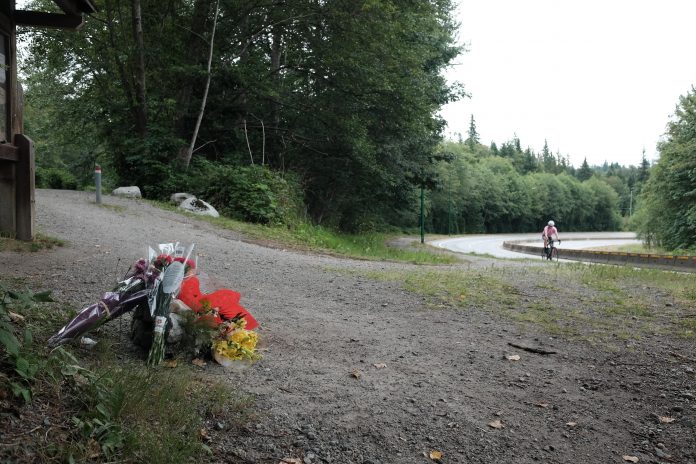
A memorial near the accident site honours the cyclist who was killed. Photo by Chris Ho/The Peak

On June 29, a cyclist was struck and killed by a vehicle on Gaglardi Way. The incident is undoubtedly a tragedy, and doubly unsettling due to its proximity to our university community, but it’s not surprising. Anyone who commutes up and down the mountain by any form of transportation can easily see that the cyclist/vehicle relationship on Gaglardi is an accident waiting to happen.

High speeds on the winding road are such an issue that a speed trap was installed to politely remind motorists that the speed limit is 60 km/h. This has hardly stopped drivers from whipping down the mountain as though they are fleeing a Hollywood-style natural disaster, however. Even some of the buses zip down Gaglardi at white-knuckle speeds. And all the while, the cyclists who share the roads have only a white line of symbolic safety to protect them on a road that both encourages dangerous driving and has poor visibility conditions. 

Gaglardi Way is a popular road for cyclists who use it to commute to the university or take advantage of the many hiking trails that branch off from the street. Why then, on a road with frequent dangerous driving conditions and a high population of unprotected commuters, are there not secure bike lanes to delineate a clear boundary between motor vehicle traffic and cyclists? This is not the first time this question has been raised, and it certainly won’t be the last, as the City of Burnaby admits that implementing such infrastructure changes isn’t currently in the plans.

To be fair, the responsibility isn’t on the City of Burnaby alone. Drivers also need to be more aware and considerate of other people sharing the road space, including cyclists, pedestrians, and individuals in motorized wheelchairs. The accident on June 29 was the fifth serious pedestrian road accident Burnaby has suffered in the month of June alone. The temptation to dominate road spaces from a place of relative safety needs to be addressed among motor vehicle drivers so that more vulnerable travelers aren’t put at risk by aggressive or inconsiderate driving practices.

SFU has an active cycling community, nurtured by the beautiful scenery we are surrounded by, a keen sense of environmental preservation, and the more well-developed cycling infrastructure in neighbouring municipalities. 

But our detached location on Burnaby Mountain also distances us somewhat from the public safety concerns that occur in more dense urban environments. Until the City of Burnaby physically makes roads safer for cyclists, we must demand that motorists respect the rules of the road, and all the people who share the space with them.


GSS Council Corner: July 10

0
Chris Ho/The Peak

SFU gives a presentation about the gondola project during GSS meeting 

Joanne Curry, SFU’s vice-president external relations, and Navjot Sanghera, SFU’s external relations coordinator, gave a presentation to answer the  Graduate Student Society’s (GSS) previous questions about the Burnaby Mountain Urban Transit Gondola. The potential for having representatives from the university present to the GSS was discussed at the previous GSS meeting.

This presentation was prompted by questions asked at a previous GSS meeting, such as how a gondola would affect bus routes, specifically the 145 and 143, and the project’s environmental impact. Curry stated that upon the return of their main technical representative, questions that require answers from TransLink would be answered if required. Curry went on to ask the GSS to support the project.

“We would love to have the GSS, a very important part of our student body… support this project.”

Editor’s note: The Peak is working on a more comprehensive summary of the material presented, to be published in the future. 

New International Students Working Group (ISWG) introduces themselves to GSS 

The ISWG is a new GSS working group addressing issues concerning graduate international students. Such issues include working to aid graduate students with visa extensions and providing graduate students with MSP coverage during implied status.

A written statement in the agenda stated  the new working groups goals.

“Our intent is not to compete with or duplicate any of the resources already offered by the university [ . . .] but to help fill in any gaps that may exist, identify the barriers of international students, and raise awareness for them.”

The ISWG intends to establish a constructive relationship with the GSS that both groups could benefit fro.m

The group is made up of SFU students Rahil Adeli, Cameron Pearson, Mona Mehdiza, a mixture of domestic and international students in addition to SFU alumnus Zachary Strom. 

GSS discusses possible involvement in 2019 federal elections 

Matt McDonald, director of external relations, raised the possibility of GSS co-sponsoring an all-party debate for this fall’s federal election. McDonald believes the SFSS is already working on setting up a debate, citing SFSS president Giovanni HoSang’s Twitter activity. 

“He’s been tweeting at people and getting them to agree, so I think that the local MP, the liberal party, NDP Canada, and the Green Canada have already agreed in principle to a debate,” McDonald said.

While  many GSS members are neither permanent residents nor citizens of Canada, there are up to 3000 members who are. 

“In the coming weeks and months . . . I’d like to delve into the possibilities of public-spirited GSS involvement in the federal elections,” McDonald wrote in the agenda. 

Aside from the proposed debate co-sponsorship, McDonald suggested other initiatives like supporting graduate students who want to register as voters and get involved.

Following this discussion, McDonald told Council that he planned to bring a clearer proposal to the GSS in August. 

Parcel 21 wins NZERC along with 10 other construction projects

0
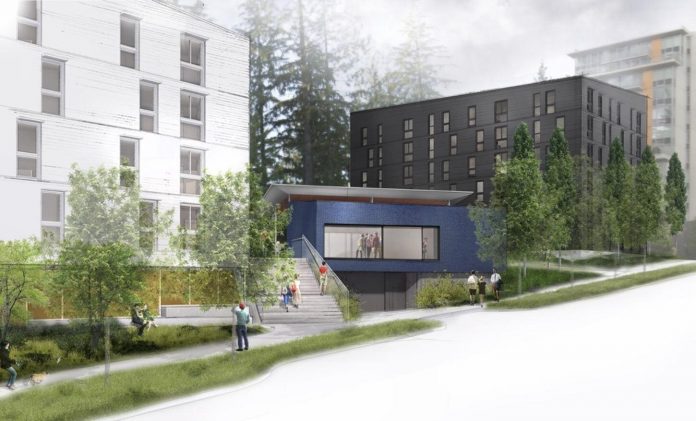
Artist rendering: Courtesy of Local Practice Architecture

On July 4, 2019, the Parcel 21 housing project, also known as Lot 21, won the Net-Zero Energy-Ready Challenge (NZERC), along with 10 other housing projects in the province.

Parcel 21 will be built for graduate students and mature students with young children. The NZERC award is part of the Net-Zero Energy-Ready Challenge, an incentive-based program that, according to Better Builds BC, rewards buildings “that are designed to achieve the top tier of the BC Energy Step Code.” The latter is an optional code, that according to its website, “goes above and beyond the requirements of the BC Building Code.”

The Peak reached out to SFU Community Trust for comment on the announcement and spoke to Dale Mikkelsen, vice-president of development for SFU Community Trust.

“We were excited to apply for it. We’re always looking for opportunities to bring additional value to a project, which either helps us create more energy-efficiency or more value to the project itself,” Mikkelsen said.

The Net-Zero Energy-Ready Challenge program, administered by Integral Group Consulting, carries a value of $2.5 million and will give up to $390,000 in incentives to its winners. 

In addition to meeting a number of criteria, those who were interested in being considered for this program had to send an expression of interest by November 30, 2018. Financial incentives were offered to 16 projects during this preliminary phase according to Mikkelsen.

“16 projects received that phase one incentive, which was $18,000 to do all of that extra modelling and energy design that typically isn’t included in a normal project budget,” he recounted.

 After the preliminary phase, participants then had to submit a full application by March 30, 2019. 

“As noted, there [were] 11 projects out of the 16 that did the preliminary work that were awarded the full incentive value,” Mikkelsen stated.

The $390,000 is comprised of design incentives capped at $40,000 that all full applications were eligible to receive, and $350,000 of NZER incentives which only the 11 winners will receive.

The value awarded to each winner is directly tied to the type of building and its size. As such, Parcel 21 will receive approximately $100,000 from the province, which Mikkelsen says is different than other funding sources.

“What we appreciated with this one versus other funding is that it truly is cash into the project, so we’re allowed to take the $100,000 and use it for those energy performance standards within the building itself.”

According to the backgrounder attached to the press release, Parcel 21 will be mainly framed with wood, built with Forest Stewardship council-certified local timber. It will also have outdoor dining space, a common courtyard, and shared commons.

Some of the energy improvements that will be in Parcel 21 include high performance windows, sunshades, a heat-recovery ventilation system, and a super-insulated building envelope.

Other recipients of the ward included construction projects at the University of Victoria and the University of British Columbia’s Okanagan campus. All the winners will showcase their projects at an open house later this year.

The full press release can be found on the B.C. government’s website. More information on the Parcel 21 project, including a few artist renderings, can be found through the engineering firm Associated’s website, which has been retained to provide structural and electrical engineering services on the project. 

The project team working on Parcel 21 is composed of Local Practice, Space2place, Associated Engineering, Rocky Point, Gage Babcock, RDH, Heatherbrae, and Peak Construction Group. 

SFU student fails

0
Image courtesy of jessica45 via Pixabay

By: Kitty Cheung (Staff Writer),  Mishaa Khan, Vivien Ying Qi Li, Jennifer Low (Features Editor), Nathaniel Tok

I fell into the Academic Quadrangle (AQ) Pond… and it’s kind of my fault

Over my time here at SFU, it’s become something of a yearly tradition for me to walk on the frozen AQ pond during winter. Why? I’m not sure. Maybe I like snow, maybe I like to show my dominance over the koi fish in the pond, or maybe I just like walking on water.

I remember that the first time I went to go walk on the pond, I was super careful. I gave the pond a few cold days to freeze over thoroughly and I threw pebbles on the ice to test it. I put one foot first on the ice, took off my bag and heavy clothing, and inched slowly and timidly onto the ice. Success! 

Every year thereafter, I reduced my level of precaution for the annual tradition. This year, I gave the ice less time to freeze; I kept hold of my bag (containing some medium-weight textbooks and my laptop) and my heavy-duty jacket. It probably didn’t help that I  proceeded to do tuck-jumps on the ice while trying to film myself with my phone. Then I heard a deep but faint cracking sound . . . oops.

– N. T. 


Follow the leader does not pay off 

In my first semester at SFU, I was still learning to navigate campus effectively. I was walking to the AQ from my residence through the second floor in West Mall when I realized I didn’t know where to go. I saw a group of people exiting the second floor of West Mall and decided to follow them. 

I would later learn that these people were SFU’s football players.  I ended up walking into the Athletics and Recreation office in the Transportation Centre building. I soon realized I was in the wrong place and ran out embarrassed. 

-M. K. 


Oops… Wrong classroom 

Walking into the wrong room on the first day of class is by no means the most embarrassing thing that could happen to you. 

In fact, it’s not even close. 

You can, after all, just exit the classroom inconspicuously like any sane human being and find the correct room. However, the word “inconspicuous” doesn’t seem to exist in my vocabulary, because that is exactly what I didn’t do when I found myself in the wrong classroom at the beginning of my second semester.

In my defence, I had tried to make a graceful exit… but when you’re notorious for being clumsy, you know things are bound to go wrong somewhere. Just as suspected, instead of leaving quietly like I had planned to, I managed to drop my notes, trip over the nearby chairs, and nearly spill scalding hot tea on myself before I could even make it to the door. By then, everyone’s attention was already on me and my plan to leave unseen was ruined. Long story short, what started off as a small mistake turned into one of the most embarrassing situations in a matter of seconds, all thanks to my clumsiness.

– V. L. 


I hit someone with the microwave door… 

I’ve had my share of embarrassing, student-fail moments at SFU. Dropping a water bottle in the new lecture hall where it rolled all the way to the prof’s feet, not closing my coffee lid tight enough and letting it leak as I walked down the hallway . . . the list goes on and on. But no moment quite makes me cringe like the time I hit someone in the face with a microwave door.

It was lunchtime in the Learning Hub at Education Central. I was distracted by my phone as my chicken pot pie heated in the microwave. As soon as I heard the beep, without looking up, I instinctively reached up and opened the microwave door ― smashing it right into the face of some poor guy reaching for a paper towel. With a quick apology, I ran back to my seat, only to realize that he and his group of friends were seated right beside me. To make matters worse, I forgot cutlery that day and had to use my emergency chopsticks to eat my microwavable chicken pot pie. 

– J. L. 


Apparently, I’m just unlucky… 

Last winter, Burnaby campus got cold enough that the AQ pond froze over. Walking across the concrete path, I could see footprints on the snow over the pond ― evidence that others had made the daring trip over the ice. 

Enticed and excited, I felt bold enough to step away from the concrete path only to have my entire leg submerged in icy water as my weight broke its frozen surface. I floundered around for a bit between the fractured ice and concrete, one leg hopping in the frigid pond water, before grasping the pathway tiles. Pulling myself back up, I remember crawling across the concrete, eyes darting around to see if anyone had noticed. 

Thankfully, it was a weekend afternoon, so the AQ was mostly deserted. Aside from a couple of Burnaby Mountain residents walking their dogs, my tomato-red face and icicle-crusted nostrils were somewhat saved from embarrassment. I was also fortunate enough to have been living in residence at the time, so I trotted back to the west end of campus with my one very soggy leg to warm my frozen toes. 

– K.C.

From Surrey campus to Silicon Valley: an interview with designer, Sean Leach

0
Photo courtesy of Sean Leach

Fast Facts

Name: Sean Leach

Pronouns: He/Him

Department Affiliation: School of Interactive Arts and Technology (SIAT)

Hometown: Coquitlam, BC

Hobbies: Cycling, animation, woodworking, travelling, and gaming

Fun Fact: Despite being a designer and working with colour, Leach is actually deuteranopic; a type of colour blindness which causes him to have trouble differentiating between most reds/greens, blues/purples, and greys/pinks.

Favourite Instagram Filter: Leach’s favourite Instagram filter is “Hologram” because it was made by his friend (@joekndy)!


Recent SIAT graduate Sean Leach will be moving to Silicon Valley to work as a product designer at Instagram. During his degree, Leach had several international learning experiences in the Netherlands and Italy, even completing three internships in San Francisco. In an email interview with The Peak, Leach discussed his design process, valuable lessons learned in the SIAT program, and his upcoming job at Instagram.


The Peak: What drew you to study design?

Sean Leach: That’s a very hard question to answer. I don’t think I always knew that I wanted to pursue design. But I do remember that back in high school, my favourite class was Media Arts, where we learned the classic Adobe programs such as Photoshop and Illustrator. I enjoyed it so much that I decided to apply to the School of Interactive Arts and Technology at SFU hoping that I would get the chance to utilize those skills. A few years later, I eventually found myself in IAT438, a class which studied User Experience design [UX], and was introduced to the potential career of being a UX designer. I think that above everything else, my curiosity for how things work and my love for problem-solving allowed me to get a grasp of this type of design quite quickly.


P: What was the most valuable design lesson that you learned during your time in SIAT?

SL: DO INTERNSHIPS! Throughout my seven years in SIAT I had the opportunity to do three internships in San Francisco to take my learning outside of the classroom and apply it in the real world. Without a doubt, these internships were some of the most valuable learning opportunities that I had during my undergraduate degree.


P: I understand that you worked as a TA for SIAT. Were there any key concepts that you found to be most important to share with your students? 

SL: Working as a TA for IAT 233 was one of the most rewarding experiences that I had in SIAT. I always tried to communicate to my students that when you’re learning a new language —in this case, it was “design” as a language — it requires relentless practice.


P: Can you tell me more about the design field schools that you completed in the Netherlands and in Italy? What were the most memorable experiences that you had during your travels?

SL: I participated in two field schools during my undergraduate degree, the 2015 dutchDesign and 2018 italiaDesign field schools. These field schools are seven-month programs and they explore culture and design in the context of the Netherlands and Italy. Each field school consisted of a group of 12 students. Our director, Russell Taylor, gave us the opportunity to work with and conduct interviews with the top designers and thinkers in their region. Between the two field schools, I had too many memorable experiences to list them all but a couple of memories that stood out were interviewing Ronan Bouroullec with one of my best friends Robyn Goodridge in 2015 and cycling to Montepulciano in Tuscany with Russell Taylor.


P: Can you tell us about your favourite design project that you’ve worked on? I’m particularly interested in the process behind your ideas. How do you approach finding creative solutions to design problems?

SL: My favourite design project that I worked on would have to be the Crisis Center for the American Civil Liberties Union (ACLU). I was lucky enough to work with two of my best friends, Chris Elawa and Robyn Goodridge, over the course of nine weeks on a proposal for the ACLU. This project would introduce a hub on their existing website that is the keeper and deployer of legal resources for individuals in urgent need of help in protecting their civil liberties. This project was in response to the 2016 “Muslim Ban,” where thousands of individuals were being illegally detained at multiple airports throughout the United States and many were without access to legal representation.


P: What are you most looking forward to with regards to joining Instagram? In particular, what about being a product designer excites you?

SL: I am most looking forward to the mentorship at Instagram. I’ll be working alongside some of the industry’s most experienced designers and I’m so excited to pick their brains. Aside from the mentorship, I think having the opportunity to design a product that has over one billion people on the platform will challenge me to practice inclusive design.


Note: Responses have been edited for clarity and length. More of Leach’s projects can be found at iamseanleach.com.

Do you hear the students sing?

0

Illustration by: Marissa Ouyang 


“Do You Hear The Students Sing?”


[Business:]

Do you hear the students sing?

Singing the song of undergrads?

It is the war cry of stressed youth

Who are the school’s broke comrades!

The slamming of books shall then

Drown out the drills of construction

No finals will be held again

When semester ends!


[Liberal Arts:]

Will you follow our movement?

Who will leave class and march with me?

For our own improvement

Don’t you wish parking was free?


[Health Science:]

Come enter the cause

Let us fight against those textbook fees!


[Business:]

Do you hear the students sing?

Singing the song of undergrads?

It is the war cry of stressed youth

Who are the school’s broke comrades!

The slamming of books shall then

Drown out the drills of construction

No finals will be held again

When semester ends!


[Social Sciences:]

Can you sacrifice your marks

So we can stand up to the profs

And escape the school in sparks

This time, they will have to back off

The cries of us scapegoats

Will fill the halls of SFU!


[Every faculty:]

Do you hear the students sing?

Singing the song of undergrads?

It is the war cry of stressed youth

Who are the school’s broke comrades!

The slamming of books shall then

Drown out the drills of construction

No finals will be held again

When semester ends!


Henry Petter and the Horcruxes of SFU

0

Illustration by:Jarielle Lim

Once upon a time, in a caring, construction-free land called SFU, there studied a miserable tenth-year student named Ted Misermort. After being unable to get into his required courses for the 15th semester in a row, Misermort decided to ensure that no one else would graduate, either. 

He consulted the dark magic present in the hidden corners of RCB and split his bad luck into seven deadly pieces. These horrible Horcruxes were hidden around campus, resulting in student apathy, a mental health decline, bad grades, constant construction, and late enrollment dates. As time passed by, construction and fog enveloped the campus to cover the voices of the Screaming Students and the site of GPA-sucking Dementors.  

Henry Petter was summoned by the SFU Forensics team to destroy the Horcruxes before SFU is obliterated by the dark forces of endless construction. Each Horcrux was hidden in a place that represented a devastating part of Misermorts’s life during his time at SFU. After going through the memories of other SFU students who knew Misermort, Petter began his 100-day adventure, trekking through the endless construction to destroy the Horcruxes and save SFU.

His first stop was a location responsible for every student’s misery: IT Services. Petter burnt down the IT Service Room while spending four hours on the phone with the SFU administration to distract them. This allowed the first horcrux, the SFU server, to crash. With goSFU down, no student could get a late enrollment date. 

Petter proceeded to the office of Professor McFoggnall, who had once given Misermort 2% for his final PSYC385 exam. He used his Invisibility Cloak to not-so-stealthily enter McFoggnall’s office. Brandishing his pen-shaped wand, he destroyed the Horcrux with Fiendfyre hotter than the roasts the Professor had left in their comment on Misermort’s exam.

Petter then dived into the AQ pond to retrieve a legendary item notorious among students for its wasteful attributes: the iClicker. On his way down, Petter was nearly drowned by the infernal koi fish haunting the pond. As he succeeded in his quest, Petter was able to use the iClicker to destroy the third Horcrux: a syllabus with mandatory participation. 

He then staggered quickly into the AQ’s 6th floor bathroom to dry off before any of the Muggles saw him. When he was drying up, he heard a hissing sound coming from the stall behind him. He slowly walked to the door and kicked it open only to see Misenmort’s loyal familiar, the raccoon Ragini, ready to attack. He quickly fed her some food he snuck out of the Dining Hall, causing her to shriek and collapse into a lifeless corpse.  

Petter ran to WMC to find his next Horcrux: a Beedie lanyard, in the possession by a Beedie snake Animagus. He knew Parseltongue, and could hear faint whispers when he stopped to get his Iced Capp. He explored the area to find the Beedie snake sitting on a table, trying to sell unnecessary Beedie merchandise to broke students. Petter quietly approached the snake and whispered a spell in Parseltongue, turning the snake’s skin white with fear. With Petter’s Accio, he tore the Beedie merchandise from the snake’s hands and destroyed the pieces of Misermort’s misfortune residing within. Out of embarrassment, the snake dropped out of Beedie and regained his human form.

The next stop was every student’s favourite place to stress nap: the fifth floor of the library, also known as the Chamber of Misery. In the Chamber of Misery, Petter found the academic journal that was ideal for Misermort’s PSYC 385 exam that he failed, but he had been unable to access because it was behind a paywall, resulting in him receiving a big fat F. Petter bled the paper with a Starbucks latte and dropped 10 student tears on each page to destroy the horcrux.

Due to SFU’s inconvenient location, Petter — despite being a wizard — had to wait for the 145 bus at the Upper Bus Loop for longer than the scheduled time. Before arriving to the Muggle World, Petter had purchased a transit version of the Marauder’s Map, the Muggle’s Map, from Weasleys’ Wizarding Wheezes. Once he located the bus on the Muggle’s Map, he used the spell Wingardium Leviosa to move the bus to the top of the mountain despite TransLink trying to resist arriving on time as much as possible. This destroyed the last Horcrux, the concept of TransLink buses’ eternal lateness. Thus, Petter lifted Misermort’s curse preventing anyone from graduating.

Despite Petter’s success in saving SFU from dark forces, there are still occasions of students taking over eight years to graduate. This is because there are still Student Eaters lurking around on campus covertly, trying to complete the mission Misermort began and waiting for his return. 


SFU WUSC marks World Refugee Day with an event to raise awareness for refugee students

0
Courtesy of SFU

“I was born as a refugee,” said Wafaa Zaqout, Refugee and Newcomers Program coordinator at SFU, when asked where her interest and passion for refugee rights began. Zaqout was born in a camp that was called Canada, in Egypt, near Palestine. “It’s a part of my identity.”

June 20 is internationally known as World Refugee Day. This year, the SFU chapter of World University Service of Canada (WUSC) marked the day by holding an event in the Diamond Alumni Centre called “Pursuing Equity In Education for Refugee Students.” 

“WUSC’s Student Refugee Program (SRP) has allowed people who have had their education interrupted by conflict and persecution continue their studies in post-secondary institutions across Canada. SFU has been sponsoring students since 1981.”

Their first year’s tuition and living expenses paid through semesterly student levies: $2.50 per full-time student and $1.25 per part-time student.

“[Refugees] have been deprived of their basic rights in education, security . . . Everything you take for granted, they’ve been deprived of,” said Zaqout, who helped organize the event, on why holding it was so important.

“To mark one day is not enough. We need to keep reminding people that there’s this huge group of people that’ve been forced to flee their houses. We need to try to help out, do something, anything.”

That evening, three short films highlighted different issues affecting refugees and at-risk and vulnerable youth. The event also featured a brief workshop and discussion led by three facilitators from the Access to Media Education Society: Ayan Ismail, Valeen Jules, and Vida Nacho.

Zaqout also announced at the event that because the costs of bringing refugee students to SFU are rising, WUSC SFU will be seeking an increase to its student levy from the current $2.50 to $5 dollars per student per semester. According to a previously reported article by The Peak, the part-time student levy would implement a $1.50 increase. 

A student levy increase must be voted on via referendum the student body. It is not yet confirmed when WUSC plans to seek the increase.

“It’s a collective responsibility,” said Zaqout on why SFU students should support the referendum. “There are [millions] of refugees across the world. Among them, they have lots of dreams.

“I was dreaming of being an astronaut . . . but I was dreaming only. I can’t be an astronaut, because I’m a refugee. We need to make sure that some of these people have access to education and have another chance. A second chance.”

Makeover on the mountain: Club Ilia reopens after renovations

1
Gurpreet Kambo/ The Peak

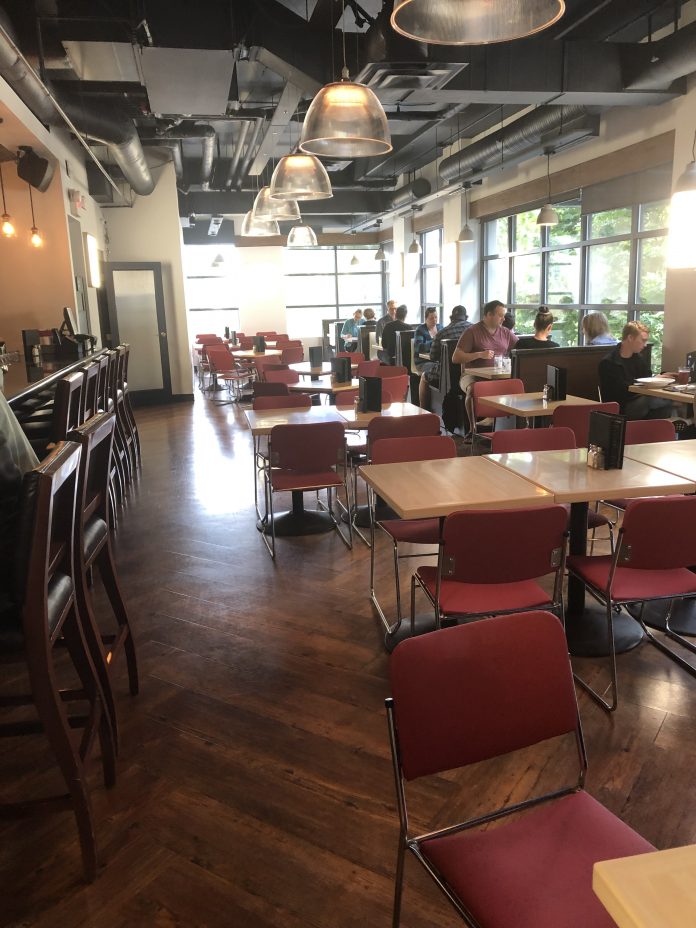
Club Ilia reopened last week after being closed for two months for renovations. The restaurant/bar was closed for May and June due to changes that were made to the dining area, kitchen, and menu. Inside, a closed balcony area has been removed and opened up, while a carpeted closed “meeting room” has been built in the back of the venue. 

“We’ve changed [ . . . ] the concept based on community feedback,” said Club Ilia general manager, Tina Blakeman, on the subject of the restaurant’s reopening. 

“[Some patrons said] areas were too loud, and it [was] hard to hear each other for meetings that were happening. We created spaces, that are either meeting areas or areas that allow separation from the noisier areas of the restaurant [ . . . ] Our sound system allows for different zones to be set up, to change the volume of music, [which] will also help with that.”

Along with the dining area, the menu has been changed to reflect modern tastes and recent changes to the Canada Food Guide. 

“Healthier options on our menu was probably the number one thing that people were looking for. More and more people are looking for plant-based protein options, vegan and vegetarian offerings. Being mindful of people who have gluten-intolerance [ . . . ] we wanted to take those people into consideration,” said Blakeman. 

“[We’re] trying our best to be available to everyone in the community, and have something that everyone can have something to eat.” 

She also noted that the kitchen has added an additional fryer specifically meant for gluten-free frying. 

“Anyone that has a gluten intolerance or Celiac’s disease, they can actually have fries. One of the fryers might be used for calamari or fish and chips, where the breading can create cross-contamination in that fryer. 

“Having that specifically dedicated fryer so no gluten goes near it, it gives you that option that somebody that comes that has Celiac [disease], they can have a burger, we make our patties here, no gluten in it, gluten-free bun, and they can have fries too.”

Blakeman also adds the kitchen has a new flame-broiled grill.

A keg fridge visible when walking to the entrance of the restaurant has also been built. Massive kegs lay inside that feed the taps in the bar, expanding from eight to 18. 

However, she notes, “The food concept has mostly stayed the same. We still have the same customer base; there are favourites on there that we didn’t want to change.” 

Club Ilia has been on campus since 2009, though Blakeman has worked for the business for 19 years. 

Reflecting on how Club Ilia has changed since opening, she says, “Initially I think we didn’t know what we were.“

“Perhaps we thought we were a wine bar,” she says, noting that there was a wine glass in the old logo. “We thought there was going to be more charcuterie board, tapas, and wine. That was all well and great, we had a handful of professors that would come in,” she added.

“I said to our first general manager, ‘There’s a lot of students walking around, why don’t they come in here?’ [ . . . ] I thought it was a good idea to start marketing to the students [ . . . ] so we started out doing our poutine coupons,” she says, referencing the coupons for free poutine that Club Ilia gives out at the start of each semester.  

“It kind of changed the concept from being a wine bar, to being a community space,” she says, adding that the current changes are meant to further this goal that was identified so many years ago.  “Anybody is welcome.”