Home Blog Page 472

It’s not worth complaining about not getting to use the new SUB

0
Instead of griping about what you won’t have, be thankful for the things you have now. Photo: Zeh Daruwalla/The Peak

The new Student Union Building (SUB) has been in construction for the entire time I’ve been a student at SFU, breaking ground in 2016 and continuing development ever since. Its delays have essentially become a meme to students, with new estimated dates seemingly dropping every few months — the most recent pushback being to Spring 2020. To many, this probably comes across as a big waste of money — especially to students like myself who will be graduating without getting to spend any time in the SUB.

This is definitely not to say we all need to accept or feel good about these delays — they add another $60 to your tuition each semester, the construction is an eyesore, and it’s certainly disappointing to not be able to enjoy something after being told over and over that it’ll be done soon. More immediate problems include the fact that many student groups located in the Rotunda were unexpectedly told in 2017 that there would not be permanent student group space in the SUB for them. Groups like SOCA and SFPIRG have been fighting hard the past few years to make sure they don’t lose their offices, a problem that’s still being worked on and made worse by yet another delay.

But the fact is, a piece of your tuition in any post-secondary institution goes to pay for toys and infrastructure that you don’t get to use. It sucks, but investments in lengthy building projects are a relatively natural part of an expanding university campus – and it’s maybe not the best hill to choose to die on.

While many students won’t get to use the fancy new SUB, they are already using the new features that past students have paid and waited for. Even during this round of building upgrades we’ve gotten more than plenty to play with: we have gorgeous new lecture halls across the AQ (including the Images Theatre); Harbour Centre got some desperately needed (and gender-neutral) bathrooms to replace its perpetually dirty and cramped ones; and we’ve seen the opening of the successful Study Public House, after its space had remained empty for ages.

Students now, as then, are just doing their part — paying for and waiting patiently for a building they may not see, but others will. Eventually, as comically long as this particular project has been, the school will get its new SUB. Students further down the line will get a new stadium — a similarly large project that I wouldn’t be surprised to see subject to just as many delays over the next several years. Along the way, SFU is going to get repairs and renovations to existing buildings, on top of tons of other services and rooms that individual students might not even notice or care about. 

Yes, it feels bad to pay for future students’ toys, but that’s just the cycle of school construction.

If you want to be mad about the delays to the new SUB, don’t let it be because you don’t get to use the nice new facility. Paying for subsequent cohorts’ spaces is something we all need to do as students. Instead, be frustrated that we’ve had to pay for and put up with a project that has posed a risk to student groups, and has been more costly because of the unusually slow speed this construction has taken — those are the things that we shouldn’t have to put up with as students.

 

CONFESSIONALS: I convinced my professor to start the tapeworm diet

0
Illustration of a closed envelope, with the text, “Confessionals”
ILLUSTRATION: Marissa Ouyang /The Peak

Forgive me, SFU trash-panda gods, for I have sinned. 

Disclaimer: I’m actually a PRETTY GOOD student with a decent enough GPA — well, I’m not on academic probation, at least. And I know that classes require a lot of effort. But sometimes they’re just way too hard and the professors . . . well, they don’t make things ANY easier!

Okay, I’ll just come out with it — I manipulated my professor into starting the tapeworm diet.

Look, I know that sounds insane. But what’s more insane is just how hard it is for me to dig this shady, underground matter back up after hiding it for half a year! 

It all started last fall, when I entered my third year as a kinesiology major. (Are you feeling a bit more sympathetic now?) I took on my usual full course load, thinking things would be fine. Well, spoiler alert: by the midpoint of the semester, I swear my professors were co-conspiring to ruin me with project after project. On Week 7 of the semester alone, I stretched out so many assignments to meet the length requirement mark that you’d think I was directing another season of 13 Reasons Why.

I thought I had things somewhat under control. . . that is, until after exams, where I found out the final marks for one of my classes. I was just a hair away from a solid B+. Yet, when I so nicely asked my professor to bump it up to save my GPA, he flat-out refused. Imagine that: constructing a nice, thoughtful email in which I politely called him a kinesiology fraud who got his PhD out of a cereal box, and all I got back was “no — sent from my Samsung Fridge” in response.

So, I constructed a plan out of pure spite. I started coming to him under the ruse of research for my honours thesis that focused on diet and nutrition — specifically, the tapeworm diet. It was going to be titled “My Parasite and Me: WormFast Regime” and it was exactly what it sounds like. I hyped up my professor by providing “peer reviewed” benefits, like rapid weight loss, clearer skin, a new parasitic friendship, and ascension to a spiritual world.

Truth be told, a lot of these peer reviewed articles came from the blogs of various recondite cultists, but who am I to doubt their professionalism? 

Anyway, somehow, this son of a bitch bought into it and decided to try it so I could have “data” for my faker-than-ever thesis. A week after this email exchange, I met up with him during his office hours and saw that he had actually bought tapeworm eggs and already ingested one, waiting for that nasty bitch to hatch. That’s when I knew I had to bounce . . . My work was complete. 

I quickly changed majors to avoid ever having to see his face, but last I heard, he was a walking and talking zombie (a slim-thicc zombie). Allegedly, he keeps falling asleep during lectures, grading things late, forgetting the names of students and spacing out mid-conversation. In other words, not much of a change compared to when I had his classes. . . 

I was told that he was taking a leave to undergo extensive surgery to get that demon worm removed, but I am just happy I won’t have to accidentally run into him in the line-up at Tim Hortons or something. 

Now you may be wondering . . . if I had a chance to do it all over again, would I? The answer is YES! No one gets between me and my grades — he deserved it for not rounding up my 55% to a B+! 


Quiz: Am I baby or am I just trying my best?

0

“Baby.” A one-word concept that has swept Twitter like renewed wildfire. The innocence, the dreaming, the heartbreak, the meme-ing . . . when that adorable little photo of Kirby points to the blackboard, millions scream back “IM BABY” in solidarity.

But not everyone who’s baby understands that it’s come time to answer their calling. They know who they are in their bones, but their brains haven’t caught up. “Am I baby?” these emotional castaways query themselves. “Or am I just a broke, lazy bitch?”

If you don’t know who you are, then this quiz is here to coddle and guide you. Answer these questions to find out whether you really are baby, or if you’ll have to settle for one of THREE totally arbitrary consolation options designed to distract you from the fact that, wait a second, you actually have to be accountable for your own actions.

1. Have you done your readings this week?

a) I’d rather just ignore them and wing my thoughts in the tutorial!

b) I’ve already accepted that I will transcend my body and assume the form of an illiterate ghost this semester.

c) Of course! I’ve added extensive notes from various outside sources. I work so hard to earn gold stars — it’s not easy being me!

d) Miraculously, my books are actually a time machine. I’ll read a sentence, find myself detaching from this reality, and reawaken thirty seconds into the past,  back when my eyes were still glaring at the start of the long, long run-on. 

2. You have a paper due in two weeks! What are your ideas . . . do you have any?

a) What’s a paper? I’m a princess.

b) Time is too big a strain for me to spare a minute on trivial, mortal things like papers. Leave that for the spirited freshmen.

c) Don’t know why the TA even considers marking any other papers when they have a student like me — I’ve got my papers planned for the next five years, sweetie!

d) Sure, I have some ideas: I plan to exacerbate my stress levels until the very last day, where a decent paper will simply print itself from the slit between my brain’s two hemispheres. Works like a charm!

3. How do you feel about your major?

a) [Sonic voice] Heh, that’s… no good!

b) How do I feel? I don’t — the campus has been draining my emotions for years, and I am just a husk dredging my sweats to class. It’s less cathartic than it sounds.

c) I’m so passionate about the work I’m doing, and know that this is only the next stepping stone for something greater! Like Broadway.

d) I’m not sure. I’m just making ends meet in a blind crawl toward graduation.


4. How many hours of sleep do you get?

a) Enough to remain functional, but not nearly the 12+ hours I deserve.

b) [Wry chuckle] That’s cute. If I can get my numb, grubby hands on a nice bench at the bottom floor of WMC, I can get a few hours in.

c) I get a full night’s rest, and wake up refreshed for my 8:30 a.m. classes! Morning classes are great, guys, you get the whole day to pamper yourself! And I’m used to them after taking early-morning dance classes since I was five years old.

d) [Visibly shaking] That depends on how much time I devote to worshipping my eldritch horror of choice: the all-seeing fog that swallows SFU whole. 

5. What’s your ideal professor?

a) Someone who is ready to create for me a world where student loans don’t exist and there are no financial obligations EVER.

b) Someone who can directly ascend me to my rightful place in the immaterial realm. Please. 

c) Someone who realizes how much untapped potential I have! Seriously, where are those internship offers? I’m the star of the show here.

d) Someone who will fall for the façade and mystique of size-12 Times New Roman font, never noticing that it’s all just chicken scratch. 


If you answered mostly “A’s”. . . You are BABY.

You’ve assumed the role of baby . . . you no longer wake up in a cold sweat thinking about your final papers, but in ignorant bliss of your responsibilities. I get it, work is nasty and scrolling through Twitter feeds yelling “mood” is . . . one hell of a mood. Be sure to take responsibility by dropping the phrase, “I’m soft uwu” in your papers to remind your professors.

If you answered mostly “B’s”. . . You are A TIRED GHOST POSSESSING A STUDENT’S BODY.

So you’re at the point in your education where you’ve become a shell. You’re just trying to get by, but the handy-dandy deadline demon doesn’t scare you anymore. But hey, it’ll be over one day. Even though summoning the motivation to care has become even harder than the ritual the summoned you back to the earthly plane, you’re not going to be in this money-sucking hellhole forever. And with luck, you’ll be able to keep clinging to your borrowed mortal shell long enough not to end up in the actual hellhole. Cheers!

If you answered mostly “C’s”. . . You are GLEE ICON RACHEL BERRY.

Where do you get that energy from? The rest of us wish we had enough perseverance to be just like you. You have so much unquenched motivation in you because you haven’t lost your focus, and that’s cool. You probably host a studyspo blog where you share your favourite supplies that the rest of us just follow enviously. Keep doing you!

If you answered mostly “D’s”. . . You are JUST TRYING YOUR BEST.

Hey, honestly . . . you’re a hot mess, but that’s okay! There’s a never-ending pile of work at your desk, and I promise you that one day, it’ll be gone. Sometimes, while pulling ideas out of your ass, you might accidentally pump out a mind-boggling academic thought! And if that’s not what being an academic is about, I don’t know what is. 


I dared to venture into the human traffic jam between MBC and AQ. YOU WON’T BELIEVE WHAT HAPPENED NEXT

0
Photo by Iwona Castiello d'Antonio / Unsplash

SFU students would be some of the first to perish in a zombie apocalypse, I think to myself while walking from the AQ to the Maggie Benston Centre. It’s not just because of the heavy backpacks and sleep deprivation slowing them down; our demise will stem from the construction-induced congestion causing literal human traffic jams on this very narrow walkway between construction sites. As I would find out later, and as SFU Reddit users noticed, the situation was far from ideal.

Humour me as I paint the picture of heading to class on a lovely weekday here at SFU: As I head through campus, I am enclosed by a sheer wall of Fall Kickoff promotional posters plastered across the future entrance of the Student Union Building on one side, and blue construction fences on the other, just in front of Freedom Square. Indeed, the narrow walkway is reminiscent of a mining tunnel with the caged lights hanging above. It’s a cozy environment hidden amongst all the concrete and melancholic students. This path is the only way to reach Convocation Mall, West Mall and other buildings at the Burnaby campus (besides cutting through the Dining Hall parking lot and around to the outer stairwell, but don’t tell anyone that doesn’t read our little paper that). Walking into the madness feels like entering the boss’s lair in a video game — but even more anxiety-inducing. 

Much like the G4 Beijing-Hong Kong-Macau Expressway that begins with 50 lanes and eventually ends in four, the pathway leaves little room for the flow of students during busy lunch hours. See also: me, a poor soul stuck in the Pauline Jewett residence building, having to venture to the other end of campus, while the Fall horde of students is huge. “How big is it?” some may ask. Well, it’s so big that such a condensed area results in slow-moving lines going both directions. It’s not about size, though. It’s how you use it. Included in these lines are phone-wielding students who refuse to look where they are going and those three or four people who try to walk more quickly in the middle of the walkway, resulting in them bashing everyone with their elbows. Just know that everyone hates you if you do these things.

The only noise louder than silently screaming students whose days were ruined by the human traffic jam is the deafening construction in the area tactfully labelled a “HIGH NOISE AREA.” I find myself wondering who a student should talk to to get compensated for missed class time. I’m asking for a friend who needs their tuition paid for.

It’s me. I’m the friend.

The stands that that hold up the construction fencing litter the already narrow walkway, and may be a tripping hazard. Weaving between pylons like a show pony and avoiding students stepping out from Maggie Benston is an extreme sport that I am losing at. By the time I make it out of the AQ, I am either sweaty from having to rush to Blusson after the traffic jam, drenched from the rain, or a nasty mixture of both. Combine that with being claustrophobic, and walking through the jail corridors of the AQ makes my 9:30 a.m. lecture a little less mandatory.

Reddit users have taken to the social media platform to share their memes and suggestions about the Great Freedom Square Traffic Jam of Fall 2019™. “At the very least they should put some rope up and separate foot traffic in both directions. It doesn’t help that students merge in both directions in the dead middle of the blob,” Reddit user TheTrevLife says. 

User tabeh0udai adds that “the whole school is a safety risk. Current evacuation plan is to walk down the mountain.” It’s a fool-proof plan if you’re a billy goat. The construction that is inevitable across the Burnaby campus presents safety risks in terms of escape routes in the case of fires. 

The SFU Risk and Emergency Planning website advises to learn the building’s escape plan. It fails to regard that these plans could be disrupted by 600 students all trying to merge into a narrow walkway to avoid burning alive.

With the soothing sounds of construction urging those walking along this path forward, the AQ walk seems, in my rather macabre inner monologue (with which I’ve had plenty of time to converse), more like a slow walk to the electric chair rather than a history class. 

Next time: The alternate route.


SFSS talks “conversion therapy” in Canada

0
Image courtesy of sfss.ca

In June 2018, Vancouver became the first Canadian city to ban “conversion therapy.” Now, SFU’s Out On Campus is pushing for more: a complete ban on “conversion therapy” throughout Canada. The Simon Fraser Student Society, with a push from Ashley Brooks of Out on Campus, put out a statement calling for a nation-wide ban on conversion therapy in August of 2019. As reported previously by The Peak, the SFSS board discussed taking this step in July 2019. Notably, there has recently been a wave of public support for this kind of ban, including a petition on change.org 

What is “conversion therapy”?

“Conversion therapy,” sometimes known as “reparative therapy” or “the ex-gay movement,” refers to methods employed in order to try to change a person’s sexual orientation or gender identity. Historically, conversion therapy has included a myriad of pseudoscientific approaches to changing individuals’ identities, including lobotomies, electroshock aversion therapy, and chemical castration. Today, even though it is not backed by any major science or health professionals, practices may involve encouraging victims to engage only in traditionally gendered activities, one-on-one counselling, spiritual intervention, or aversion therapy, in which the person is subject to the ‘unwanted’ stimulus while being subject to some kind of discomfort simultaneously, among other means. 

Studies have shown that conversion therapy is evidently detrimental to its victims. Young survivors are at significantly higher risk of depression, suicide attempts, substance abuse, and contraction of STIs. In a Beyond Ex-Gay survey, 84% of survivors reported that they are “still affected by the harm” caused by conversion therapy.

Conversion therapy discussion at SFU

Though the practice is banned in Manitoba, and in Ontario and Nova Scotia for minors, the current Criminal Code of Canada does not address the practice of conversion therapy as a federal crime, leaving many LGBTQ2+ youth vulnerable across the nation. In early August, the BC Ministry of Health called on Canada’s minister of justice to make conversion therapy illegal federally. This letter is part of a larger movement to end the harm caused by often traumatizing practices.

Days after this letter was released, on August 8 Ashley Brooks, Out On Campus coordinator, brought a statement to the SFSS board of directors meeting. The SFSS board passed a motion at this meeting to make a public statement advocating for a nationwide ban on conversion therapy.

One thing stressed by Brooks is that it is important to bring awareness to this issue, because it often goes unreported. He pointed out that the difficulty in bringing awareness of conversion therapy to SFU is that it continues to be “a largely underground practice inflicted on often invisible communities.” It is a widespread movement to stifle a range of non-heterosexual, transgender, and non-binary identities. This then becomes a problem for scientific researchers, as LGBTQ2+ people can be difficult to find due to a lack of disclosure. 

The practice of conversion therapy often works to isolate LGBTQ2+ young people from people like them. In talking with Brooks, he suggested that the “best way you can resist this is to embed yourself in your chosen queer family who will love and value you for who you are.”  

Out On Campus is a safe space for all LGBTQ2+ people, and can be found in TC 314-N from 10 a..m – 4 p.m. Monday through Friday, or contacted at [email protected].


Hungry? Try SFU’s Newest Eatery: Vij’s Indian Cuisine

3
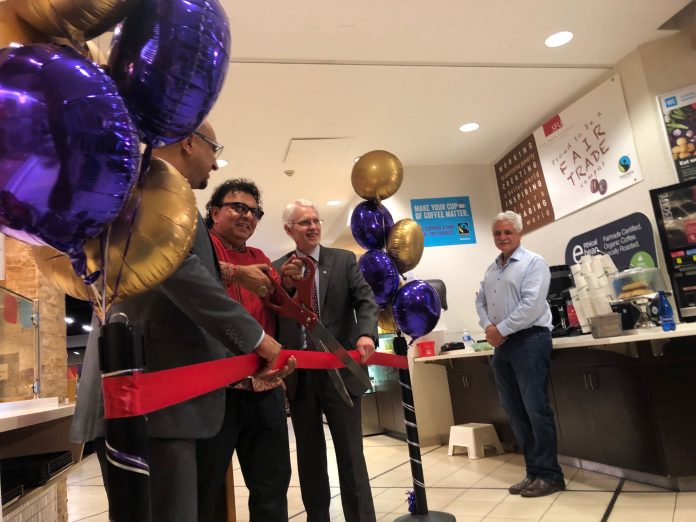
Celebrity Chef, Vikram Vij cutting the ribbon alongside SFU President Andrew Petter

It’s 12:30 in the afternoon and your three hour lecture just finished. You knew from experience that the 145 was going to be late this morning and didn’t have time to pack food for your six hour long school day. Either Cornerstone is too far, you’ve already had Tim Hortons every day this week, or the construction will just add time to your 50 minute window to find another place to eat. At this moment, you’d want something that is warm, filling and flavourful.

Mackenzie Café had a busy morning on Friday September 13, with crowds of media, cameras, lights, and excited guests. Chef Vikram Vij opened up his new restaurant, Vij’s Indian Cuisine, this past week at SFU’s Mackenzie Café with a big celebration that included a ribbon cutting ceremony, Bollywood-style dancing, free henna, televised interviews, and an appearance from SFU President Andrew Petter. Vij has restaurants in Vancouver, South Surrey, and Vancouver Island. He also has written cookbooks and made multiple appearances on TV — one of which was Dragon’s Den. 

The renowned chef’s career successes were highlighted amongst various speakers. President Petter stated that “food is a very important component of campus life” and Vij’s food “is worth lining up for.”  

Vij also made a speech to highlight the purpose and vision of his food, but more importantly, how food in general affects student life on campus. He noted that students from all over the world leave behind their parents, siblings, partners, and friends to study at SFU. In an interview with The Peak, Vij said, “universities that embrace that culture of breaking bread together with people from different cultures actually embrace diversity.” He continues, “As an immigrant, I know it’s not easy [ . . . ] to fly away to a foriegn land without [knowing the] language.” 

Through his food, Vij wants to bring a similar feeling of home to students for co

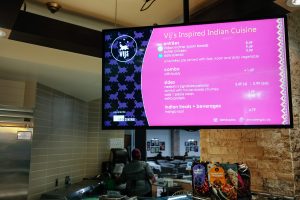
The menu at Vij’s Indian Cuisine

mfort. He adds, “I wanted to serve home cooked meals [to students] who are either missing their homes or [ . . . ] want to try something different so they feel they are apart of this beautiful country.” 

Another main focus for Vij and SFU is sustainability. To this end, Vij’s restaurant offers Eco-Box, a reusable container to package food. 

Vij and SFU have had quite the relationship over the past few years. He tells The Peak, “SFU has always had a special place for me because I am actually not even a graduate from India. SFU is the first one to recognize the hard work that I put in and then they gave me an honorary degree. . . It was so overwhelming and touching for me.” 


He also touched on the impact his mother had on him with the food she cooked. Vij recalls how his mother would make chicken curry at home, cover the pot with a plastic bag, and deliver it to her son’s restaurant by bus — which, as he notes, made the whole bus smell of Indian food.  

“For twenty years, she never told me that everyone made fun of her on the bus,” Vij remarks. “That love of a mother is what made [sic] me so touched. And all these students are away from their mothers, and their fathers, and their families. So why not give them that comfort of home, of the spices [ . . . ] The food is meant to bring you comfort.” 

Vij notes that diversity is a core mission of SFU, and that it’s an important ingredient in his cuisine too – “diverse, deep in tradition, respectful of everybody else, and most importantly [allows] people to have food from different parts of the world,” said Vij.

“When you break bread with people you are sitting with, you build tolerance towards each other [and] you learn to respect each other.” 

Vij’s Indian Cuisine is now open in SFU’s Mackenzie Café on the Burnaby Campus. The menu has items such as butter chicken, ‘daily special entree,’ pakoras, and mango lassi, with the highest price menu item being $9.99. The Mackenzie Café is open from Monday to Thursday 7:30 a.m.– 8 p.m. and Friday 7:30 – 6 p.m.

Molé, wiener schnitzel, and me: what it means to be biracial 

1
ILLUSTRATION: Danielle Ragas / The Peak


I was in high school and coming back from Europe. My family planned to pick me up at baggage claim, excited to hear all the stories from my two weeks abroad. I walked out of the terminal with my friend — someone who I had known for years and traveled with many times. When my family finally arrived, my friend asked me, “Where is your dad?” I remember squinting my eyes at him, annoyed. 

“He’s right beside my mom,” I said, sarcasm dripping from my voice. I pointed over to where my parents were. My mom looked just like me, the same dark curly hair and pale complexion. My dad, on the other hand, had similar curly hair but was very tanned; slap on a cheesy Mexican moustache and a sombrero, he could be in a stereotyped advertisement for Taco Bell. 

There was an awkward pause as my classmate put two and two together, and realised that my father was definitely not white. “Oh, that’s different,” was all they said to me before running off to their family. All this time my classmates thought I was white because of my pale complexion. But really, I was half-Mexican. 

Back then, any time someone asked if I was white, I would just agree. Telling people that I was half-Mexican made things so much more complicated and made me feel out of place. I just wanted to be like all of my friends, and I don’t think they wanted me to be different from them either. People struggled to understand my mixed heritage for as long as I can remember, but it never seemed to be an issue for myself growing up. As a kid, it just seemed normal. The combination of both these cultures didn’t seem foreign or weird; it seemed normal to celebrate Cinco de Mayo and Oktoberfest (which was always disappointing since I could not partake in the beer drinking). I would wait for Dia de los Reyes Magos, checking my shoes for candy that the Three Wise Men would leave while my mother spoke German on the phone. This was just normal life to me. 

The thing is, I don’t look look like my father all too much. I inherited his curly hair and the awful sense of humour that all dads seem to have, but our resemblance ends there. At a surface level, I’m white just like my mom. Of course, I can’t ignore the incredible amount of privilege I have received being white passing, but just because I look white does not mean that I am white. 

At home, my world consisted of molé and weiner schnitzel for dinner — from celebrating my namenstag to being disappointed that boys typically do not celebrate quinceñeras. But the second I stepped outside the confines of my own house, all of my fond cultural traditions would disappear. 

Explaining what I did on the weekends would be accompanied by a short history lesson of my heritage. I felt the constant need to prove that I was in fact Mexican. The worst part was the countless questions people would bombard me with, asking me to prove my Mexicanness. 

“Do you speak Spanish? Say something in Spanish! Have you been to Mexico? What’s your favourite Mexican food?” It felt like I was at the circus and the crowds were yelling, “Dance, monkey, dance!” Why did I need to prove myself to these people? It was like being one thing or the other was okay, but being both was unthinkable. 

The problem is that I never felt fully included in either of my cultures to begin with. I had pieces to two different puzzles — enough to create some sort of vague image of what my culture was but not enough to understand it.  Culture is often a large part of how people identify themselves, and it felt very alienating not having just one to fully call my own. Somehow this opened the door for others to identify me in their own view, people telling me, “You don’t look very Mexican,” or “Nah, you’re just white.” Comments like these made me feel so alone. 

This mindset didn’t just include my peers, but my extended family, too. I would dread holiday dinners with them. All of them spoke Spanish and made no attempt to include me in their conversations. My family knew my Spanish was not as good as theirs, and that I should learn it if I really was “Mexican.” The same thing happened with my German family too. I would be shamed for not knowing the traditions and ignored while they had conversations in foreign languages that flew over my head. I would try to reach up and latch on to the few words I knew, trying to grab any sliver of conversation. But words would pass by in the blink of an eye and I’d feel even more alone than before. 

Coming into university I was anxious as to how my peers would react to my mixed heritage. There’s no club for Mexican-German kids, no cool Mexican-German fusion food trucks to normalize this mix, and no real term to neatly describe me either. “Mixed” is an umbrella term that others use to describe me, but it doesn’t feel quite right. I’m not some chocolate vanilla swirl ice cream cone — I’m just me. It really shouldn’t be this difficult but I keep finding myself facing the problem over and over again. I am half-Mexican and half-German. While I may appear to have my foot in both doors and not be fully immersed in the culture, I have every right to be involved like anyone else who is Mexican or German. I still don’t know how to refer to myself at the end of the day. If “mixed” isn’t the right word, then what is? But trying to figure out a better word has me more confused than ever. 

But over the years, I began to feel more comfortable in my confusion. I’ve started correcting people and saying that I’m two different races. More importantly, I’ve started loving the fact that I get to experience twice the amount of cultural holidays, twice the home cooked national dishes, twice of everything than other people around me ever will. At the end of the day, I’m the product of the kind of love that sees passed racial boundaries — I’m me, and that’s all there is to it.

SFU’s (literal) breakfast club

0
Photo by Heather Ford / Unsplash

International studies student drops out because he only knows the names of countries he’s vacationed in

0

SFU international studies (IS) student Blake Farther dropped out of his program as the latest victim of a common downfall: he can only name countries that he has vacationed in.

Like many students of the best breeding, Farther was shown the wonders of the world from a young age by his worldly parents. As a child, he saw such exotic places as Disneyland and Hawaiian resorts. During his teen years, he spent two summers in Europe. After graduating, Farther used his humble trust-fund earnings to explore Southeast Asia and South America. 

Having seen so many countries, however, he was under the impression he had been acquainted with most of them — or at least, “the ones that mattered.”

“I don’t really get where those other ones came from,” he said after we showed him a list of countries he had not posted about on Instagram, such as Myanmar and Bolivia. “No one in the hostels mentioned them at all. I think their search engine optimization must be terrible.” 

Farther had believed his breadth of knowledge would suffice for his academic career. But he tells us that his professors were concerned about the limitations of his preferred approach: studying the political economy of only First World countries and developing countries with beach resorts. 

“I wanted to write about the relationship of, like, the beaches of Vietnam, Brazil, and Spain. Like, how are the beaches connected? I bet there’s so much to learn from them.”

IS students concerned about situations like Farther’s have offered the department several proposals, including a pitched collaboration with Expedia.ca to help identify the countries most relevant for discussion or organize trips to see other countries before discussing them.

“My family owns properties in eight countries, but somehow my knowledge of the world is ‘still too limited’ — how is that even possible?” says Ryan, an IS student speaking under alias who believes himself to be at risk of being “pushed out” like Farther. “But collabing with Expedia would help so much. For one thing, I think if our professors actually visited these alleged . . . ‘other countries,’ they would take them off the syllabus for sure. ”

Farther also expressed support for the Expedia proposal.

“Yeah, that would only be fair,” he commented. “If we can all pay $10,000 or something to tour the more confusing places, that would make the discussions more accessible for everyone. SFU needs to make sure all students have a fair chance to participate.”

Farther’s situation joins an ongoing conversation about fairness and accessibility at SFU.

Political Corner: Boris Johnson’s no-deal Brexit strategy isn’t optimal for anyone

0
Canada’s current trade agreements are with the EU, not with the UK separately. Photo: Christopher Furlong/AFP/Getty Images

Boris Johnson has been prime minister of the United Kingdom for less than two months and things are already going terribly. With the current Brexit deadline of October 31 swiftly approaching, there does not appear to be a possibility of things improving for the country.

The problem with Johnson’s plans for the UK and Brexit is his claim that he has no intentions of seeking a third extension of the deadline, meaning that a no-deal Brexit is beginning to be a possibility. This would mean that instead of having 21 months to slowly transition out of the European Union (EU), as has been previously proposed, the UK would find themselves suddenly and completely out of the EU on November 1, without any renegotiated trade agreements with the remaining EU countries. Subsequently, shortages of essentials like medicine, massive standstills in trade, and a potential recession could be a very real possibility. This is not an ideal scenario.

Johnson reportedly has a withdrawal agreement that could avoid the chaos of the previously proposed Brexit deals. However, in an attempt to avoid having the deal attacked in Parliament — a difficulty faced by his predecessor Theresa May — Johnson suspended Parliament until October 14. In theory, this move would put pressure on all MPs to work with Johnson’s deal rather than allowing for lengthy challenges, giving the UK a better shot at an orderly exit.

The immediate aftermath was anything but orderly, however, as MPs immediately pushed forward a bill that would force Johnson to not allow the UK to leave without a deal. In response, Johnson suspended the 21 members who had voted for the bill from his Conservative party. Since then, several other members have left the party, including Johnson’s own brother, Jo Johnson.

In all of the Brexit chaos, we cannot forget that Canada also has a stake in this. The UK is Canada’s third largest trading partner. Their partnership was strengthened under the Comprehensive Economic and Trade Agreement (CETA) between Canada and the EU. This means that come October 31, the UK will be removed from both the EU and CETA. This would cause Canada to lose access to their existing UK partnership should a no-deal Brexit come to pass. In that case, unless Canada could quickly renegotiate trade deals with what would almost certainly be a UK in chaos, Canadian consumers would be hit hard.