Home Blog Page 470

Election rundown: Trudeau’s racism scandal is just one of many eroding voter trust

0
Illustration: Can voters still trust Trudeau’s many faces? Alice Zhang/The Peak

In mid-September, Times Magazine broke a story that included a photograph of Prime Minister Justin Trudeau in brownface at a school event. In the following days, two more images depicting Trudeau in blackface were released to the media. Soon after the scandal Trudeau issued an apology statement, where he acknowledged the racism embedded in the photos and asked the public to forgive him. 

But the idea of asking for forgiveness seems almost hypocritical given that days before the scandal broke, Conservative leader Andrew Scheer faced backlash from Liberals after he said that he would stand by Conservative candidates who had troubling pasts if they apologized. Yet now, the leader of the Liberal party is asking his own party, along with the rest of Canada, to do just that. So, should we?

This is not the first major scandal to hit the Liberals as a result of Trudeau’s poor judgement. Under his leadership, the government bought the Trans-Mountain Pipeline. Trudeau was at the center of the SNC-Lavalin affair, which is still creating waves. We also can’t forget about the India trip which wound up costing the government over a million dollars.

Each of these scandals has attacked some aspect of the image that Trudeau cultivated during the 2015 election. The man who we elected was a feminist who was also environment, pro-mulitculturalism, and looking to promote progressive policies. In the four years that he has been in office, this image has been slowly corroded, one scandal at a time. 

The new question is not so much one of forgiveness but one of trust. The brownface scandal speaks to the slipping image of a man who once was, among many things, someone who many voters felt could be trusted to respect all Canadians. Can voters say with the same confidence going into the October election that this same man holds that respect for all Canadians, regardless of race? Can we trust this man to work to fight climate change after his government bought the Trans-Mountain Pipeline? Can we trust him to keep the promises that he will make during the lead up to the election this time around? 

The federal election is rapidly approaching. So do we take the gamble that Trudeau will keep these promises because we don’t want to vote Conservative?  

This isn’t the only option. The Canadian political system is a multi-party system. This means that, unlike our southern neighbors, voters have more than two options. We have variety and more than one left-leaning party. Maybe this is the time to finally look to the other parties and give them a chance this time.


What SFU Needs: Vending machines that cater to any situation

0
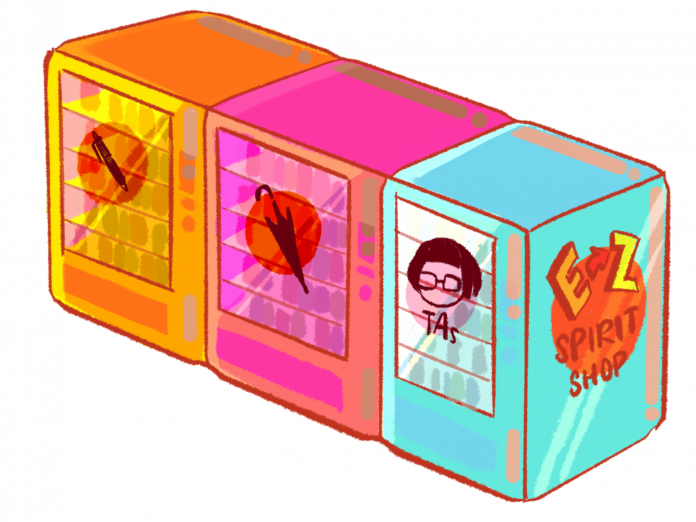
Vending machines selling only chips and pop are so last century. Illustration: Marissa Ouyang/The Peak

If you’ve walked down the main hallway of the Applied Science Building or Academic Quadrangle, you may have seen those old and sad vending machines selling pop, chips, and various other junk food snacks. But is that the best we can do? Students need more than just a fatty, sugary rush to get them through the slog of classes.

What We Lack

Diverse vending machines that dispense the following:

1) Food options that taste of more than salt and sadness
2) Healthy food choices — fresh fruit anyone?
3) Drinks like tea without added sweeteners, or at least ones that aren’t overly sweet
4) Stationary that is cheap and accessible
5) Umbrellas or fresh socks when the rain catches students off guard

The Vision

Let’s face it, SFU students are seriously pinched for cheap, convenient items in times of emergencies. Introducing the E-Z Spirit Shop, a series of campus-wide, all inclusive vending machines! Vending machines around the world already sell everything from newspapers to clothes to computer parts. There’s no reason why SFU can’t do the same and install some vending machines that sell more than the usual unhealthy food fare. Break your pencil in the middle of your exam? There’s a vending machine for that just outside the room. Or maybe the weather forecast lied to you and it’s not actually sunny? BAM! Umbrella vending machine around the corner. Or maybe you’re like me and you stack your classes one after the other so that you foolishly have no time to wait in line for overpriced sandwiches during lunch hour. Instead of being forced to eat chips or whatever else you can find in your bag (mmm, granola bars?) there’s a vending machine for that too — hot soup on the go.  

 Why We Need It

SFU can and should install vending machines that sell real and nutritious food, freshly brewed coffee, or things that students could actually use in class. Vending machines are fast, so busy students don’t have to wait in long cafe lines during their breaks. The technology already exists and is being used in other places. Modern vending machines can squeeze fresh orange juice or grind coffee beans after the customer inserts their money. They could even sell SFU themed umbrellas if it would make corporate leadership happy. Just please, give us more than chips, nuts, ice cream, and soda in the machines. With these E-Z vending machines selling cool things that students actually want, first years will be overawed, students will be happy, and SFU can use the profits to fund their eternal construction around campus.


To make the most out of university, students should take morning classes

0
ILLUSTRATION: Cora Fu / The Peak

Finding the motivation to get up and go to class can be hard, especially if you happen to have lecture scheduled at an inconvenient time. Is it better to get up early and get school over with, saving the rest of your day for more pleasant activities, or is having time to carefully work through your daily routines before class the optimal route? Here are my thoughts on the best and worst times to have class.

8:30 a.m.: Going to class at 8:30 a.m. can mean waking up at least two hours before the class. Living away from university in Metro Vancouver takes between minutes and hours on public transport during normal rush hours. This means rushing to make breakfast and get ready before the bus leaves. One bonus that comes with this time is waking up with the sun in preparation for a future of co-op studies, or a professional career.

10:30: Classes held slightly later in the day give students some room to stay up later at night — for partying or studying purposes, whatever. It also allows students enough time to complete morning rituals like showering, getting ready, carefully choosing a weather-layered outfit, and preparing notes for class. As a bonus, there’s still enough time after class for social activities.  

12:30 p.m.: Most of my peers prefer to go to class at this time because it allows for a comfortable amount of time to do exercises in the morning. Students are thus able to go to class with a fresh mind. One possible downside is having to postpone lunch, especially if the professor doesn’t allow eating in class. 

2:30: It’s the middle of the day for most students, which means students having to manage schedules for various activities before and after the class. This kind of break up makes it hard to motivate oneself in the morning while waiting for class to start, and even harder in the evening, after class ends. The result is that not a lot actually gets done aside from going to class.

5:30: Evening and night classes are obviously beneficial for night owls and those with part-time jobs. These classes give students a lot of room to do all the things they need to during the day — whether that be test preparation or hangover recovery. For some students, this time slot can be annoying as they look forward to night as the time they get to relax. 

Overall, the best times to take classes are in the mornings. It’s best to get classes over with early to have time to do other things in the afternoon, such as volunteering and socializing. This helps to break up the monotony of school and also establishes consistent routines throughout the week and into the future. Later morning classes have the added benefit of allowing time at the gym, which boosts metabolism and helps the body and the mind to get through the day with full energy. Afternoon or evening classes leave students with the temptation to spend most of the day sleeping, which disturbs daily rhythms.  

SFU needs to find better ways to update students on construction changes

0
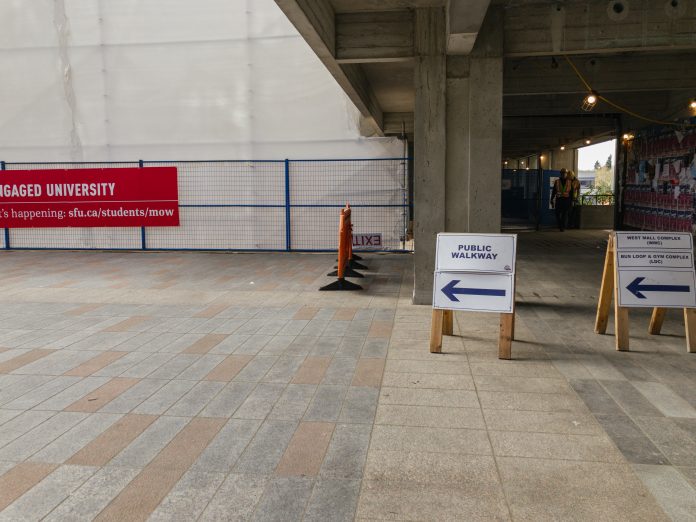
SFU is a place of learning first and construction needs to work around us. Photo: Andres Chavarriaga / The Peak

Campus-wide construction has made SFU a maze of public walkway signs and blue fences. In addition, the beginning of the fall semester also brings about a whole new set of challenges with increases in student foot traffic and poor weather making navigating around construction sites even more difficult and frustrating. Poor first years scuttle across campus with maps that don’t indicate blocked areas. Returning students realize that their usual short cuts and routes are inaccessible or ruined by the sounds of jackhammers. And all the students trying to get to the upper bus loop are forced to take the same depressing muddy path through that creepy blue pyramid. 

Honestly, I didn’t expect to still be getting lost in my fourth year at SFU . . . OK, maybe I thought I’d lose my way in some God forsaken tunnel in Robert C. Brown Hall, but never in the wide-open spaces of the Convocation Mall or Academic Quadrangle courtyard! 

Recently, while walking from West Mall to the library, I hit a never before seen dead end next to the Rotunda. I, along with many other students, were rerouted around to the other side instead. But with only one way to get through to the other side of campus, the walkway beside the Maggie Benston Centre was packed with soggy students standing shoulder to shoulder and holding umbrellas still dripping from the rain. 

“At least this beats having to take the upper walkway,” I thought, remembering last semester and the unnecessary number of stairs and uncovered areas students had to traverse.  

SFU needs to step up and be more considerate of students’ needs, especially when it comes to student foot traffic in slippery, wet conditions. With no immediate solutions to construction rerouting in the near future, SFU can start by updating their paper maps and the SFU Snap app to comprehensively detail where students can walk to mitigate these problems. This may also include providing alternative routes in case of poor weather conditions.

I know that SFU looks like a medieval dungeon, and that we need the construction to improve and maintain our school’s infrastructure, but that doesn’t mean that students should be sacrificing their time and education to accommodate construction. 


SFSS scores with Fall Kickoff 2019

0
Fall Kickoff 2019 was a big hit with students

Rumour has it that SFU is boring. Period. 

Vice President of student life, Jessica Nguyen, wanted to challenge the negative stereotypes that have been brought upon SFU. Nguyen hoped to achieve this by bringing back Fall Kickoff and expressed, “we wanted to show that SFU can have fun.” 

Fall Kickoff was last held in 2017. But this year, SFSS events committee chair Monish Farswani said, “Fall Kickoff 2017 had many incidents that reflected badly on the SFSS and SFU.” 

But this year, Farswani and the events committee “wanted to create [a] sense of engagement for first year students and allow them to experience the fun activities the SFSS has throughout the year right within their first month of school.”

This year’s lineup was Snakehips, MadeinTYO, Outr3ach, Manila Grey, Illyminiachi, Eric Reprid, and Fuji Kyle. In collaboration with Timbre Concerts and CRESCENDO1, an events and entertainment company, SFSS “wanted a Rap/EDM vibe that would get students out and bring a festival type atmosphere,” said Andrew Araneta, who was also on the events committee prior to graduation. In previous years, the concert took place in Convocation Mall. However, due to construction, it took place in Strand Hall lot. 

Student safety was SFSS’ priority this year. There was heavy security, first aid, and an ambulance on standby. Farswani said, “we wanted to make sure that everyone inside the venue could enjoy their experience and feel like they were in a safe space.” 

The rappers and DJ’s had a hard time getting the crowd energetic in the first few hours. This was evident as the lot was fairly empty in the beginning hours and attendees had their own little groups spread out all over — talking to each other whilst the performances were going on. At one point, Illyminichi asked the crowd to come closer to the stage and said, “I need more energy!” The vibe was low and the transitions from performer to the next were long. 

When asked about what they were thinking of Fall Kickoff so far, student Amin Sharifi said, “lame, lame, and lame.” Ahmed, another attendee who preferred not to give his last name, commented, “I’m ready to bust out all the moves. . . [but] people are not dancing as much as I expected.” Things quickly turned around, however,  as more students came and the sun started to set. 

As Manila Grey, Outr3ach, MadeinTYO, and Snakehips performed, the crowd became larger and larger; there were always groups of people trying to snake their way through the front. At this point, it was so crowded that the only move that one’s own body could physically do was just stand and pump their fists in the air.  

“The best part was when everyone was singing loud, dancing, and just getting lost in the music,” said Medy Sin. 

Multiple mosh pits happened throughout the night consisting of a lot of pushing, falling down, and getting up to do it all over again. The crowd made an effort to sing, dance, and record this moment with their friends and lovers. The timing of the lighting, which was flashing in tune with the music, and the loud bass that one could feel in ones chest, gave the latter part of the evening a feeling of intensity.  

Ending right at nine o’clock with Snakehips’ All My Friends (ft. Tinashe and Chance the Rapper),  those with after party tickets headed to The Study for drinks and more dancing to a DJ hired by the SFSS. 

Following the event’s conclusion, students had many opinions. One student, Pooria Arab, expressed her gratitude for the event in “providing [her] mind, [her] body, and [her] hips with a break.” Arab stated, however, that “if [Kickoff] had started later, like around six and ended at midnight, then it would have been a whole other experience.”  

Some students like Bradeon Van Gorkom, however, decided not to attend Fall Kickoff. His decision was because of the ticket price. He said, “I didn’t want to spend money on an event that I would stay up all night for and possibly get sick. . . Fall Kickoff seemed fun and I would have gone for a little while if it was free.” 

Another student, Shana Edalat suggested to include more food trucks, designated areas to sit, and the performers’ merchandise to purchase for next Kickoff.  However, she was overall satisfied with the event. 

“I expected it to be a concert or rave-like event and was not disappointed.”


SFU can support trans* rights by not conflating free speech and hate speech

0
Transphobic feminist Meghan Murphy is set to speak at the November 2 event. Photo: /The Georgia Straight

I’m so sorry to all my trans*, genderqueer, nonbinary, and queer peers. You shouldn’t have to deal with noted transphobes speaking on your campus. 

Meanwhile, SFU is claiming neutrality vis-à-vis the “How media bias shapes the gender debate” event. Hosted by an SFU professor at the downtown campus, the lecture features a line-up of speakers known within the LGBTQ2+ community for transphobic discourses and ideals — including Meghan Murphy. She previously booked a room at the Vancouver Public Library, after which VPL was barred from walking in the Pride Parade. Why? Because performative allyship means nothing if you are, in concrete ways, giving hatred a platform.  

Following public outcry and concerns, SFU issued a statement that can only be described by my grandpa’s favourite ice cream flavour: vanilla. SFU claims that it “support[s] the right [ . . . ] to engage in free speech within the limits of the law” and respects the event because “freedom of expression is a core component of intellectual enquiry and central to the pursuit of knowledge.” Yet one paragraph later, SFU insists that it “support[s] the right of trans community members to define their own gender identity and to be respected . . .” You know that saying “you can’t have your cake and eat it too”? Well, you can’t stomp on queer rights and love us too. 

Here’s the thing: hate speech is never free. If you have the privilege to think so, it’s quite simply because you aren’t bearing its brunt. The existence and legitimacy of trans* folks is not up for “intellectual enquiry,” discussion, or debate — our school should know better. By tolerating an event where trans* rights and existences are up for debate, SFU is implying that there are multiple answers to the question “are trans* lives valid and valuable?” 

The only answer to that question is yes. We don’t need to host events to figure this out. We don’t need to cough up tangible resources — such as space on campus and audiovisual equipment — to mull this over. Our university shouldn’t entertain the notion that there’s room for debate where human rights are concerned.

As a foil to this and an example of institutional responsibility and authenticity, the Department of Gender, Sexuality, and Women’s Studies put out a statement expressing their disappointment, reaffirming their values, and announcing that they will support an event countering this one. Finally, they refer students to organizations working with and for trans* communities. This is how you make sure that your institution is not perpetuating violence. SFU should follow this example. 

I would encourage you to use your own right to free speech at the protest organized by SFU students against this event on November 2 instead.   

Speaking to SFU’s best and brightest: an interview with 2019’s SFU Outstanding Alumni Night awardees

0
Photo by SFU News

The 2019 Outstanding Alumni Awards took place September 20 at the Sheraton Wall Centre. It featured four awardees: Isabel Ge Mahe, Kathleen Hepburn, Hew Choy Leong, and Mark Okerstrom. Peter Akman, 2018’s recipient for Outstanding Alumni for Professional Achievement, hosted the awards night. 

All four awardees are exemplary in their own right, sporting an impressive list of accomplishments under their belt. I sat down with Isabel Ge Mahe and Hew Choy Leung separately, and they led me through the ups and downs in their career.

The first awardee I approached was Apple’s vice president and directing manager of Greater China region, Isabel Ge Mahe. We spoke in between the bustle of mic fittings and rehearsals. 

Mahe is a powerhouse: she was personally hired by Steve Jobs in 2008 to work as vice president on their Wireless Communications team at a time when Apple was preparing to release their first iPhone. Since then, she’s moved on to a managerial role. Recently, Mahe was selected to join Starbucks’s Board of Directors, too. 

Alumni advice — Isabel de Gahe: “Just persevere — because you will always run into problems and you need to learn to plow through that.”

While Mahe has an impressive resume, we chuckled as she recalled the long nights spent at SFU. “[Engineering science] was actually a really challenging program, I remember it required 160 credits to graduate.

“I remember working with my teammates in the labs through like, early mornings sometimes [until] 3 a.m. [ . . . ] I remember eating cold pizza in the Pit.” Apparently, the Pit was a hang out spot on campus that’s long been renovated over.

Mahe truly believes in what she is doing. She advised students to persevere through their mistakes and to do things they really believe in. Mahe ended our conversation by also telling me that you can never spend too much time with your family. After we finished our interview, Mahe later reaffirmed the importance of family in her acceptance speech. She told the audience about coming to Canada at the age of 16 with her father and learning English by bussing tables. In honour of her late father, who sacrificed his career as a doctor in China to help her purse her dreamsin Canada, Mahe created the Peng Tu Ge Scholarship for Women in Engineering or Computing Science at SFU. 

Alumni advice — Hew Choy Leong: “You have to be very patient with what you’re doing, and with the failure.”

I then spoke with Hew, who was charming and easygoing, over dinner. It was evident in just a few minutes of conversation that he built his career from his endless discipline. Hew is a distinguished scientist, renowned internationally for his discoveries about the antifreeze protein in salmon. Hew is from Ipoh, Malaysia, and studied at Nanyang Polytechnic in Singapore. I was born in Malaysia and briefly studied in Singapore too, so on a personal level, it was really inspiring for me to speak with a Malaysian academic. We bonded over this before launching into his extensive academic career. 

After graduating from Nanyang Polytechnic, Hew got a scholarship to study at the University of Manitoba. He then followed his supervisor, who got a job at SFU, to Vancouver. Hew then completed his degree at Simon Fraser University in one year, an institution which he credits for his work ethic in research. 

“So all my experimental work was done at Simon Fraser. The research culture in Simon Fraser and also the kind of advice I received from many of my professors, I still remember,” he said. “So my experience at Simon Fraser, even though it was short, it laid the foundation for my research interest. It also trained me how to do research.”

When asked how he dealt with challenges in his career, he responded that challenges were natural in his work. 

“As a scientist, when we do research, you look at the term, ‘research,’ [meaning] you continue doing it.

“It means you have to be very patient about what you are doing, and about the failure,” he said,
“the results may not be consistent with what you think it should be [but] these are the kind of issues that train you to be a sharp and critical thinker.” 

In his acceptance speech, Hew told an anecdote about one of his failures; he had imported about 200 cod into his lab for research, but they all died overnight due to the cold temperature. Hew joked that the fish everyone then ate at the research centre made him the most popular guy in the centre. Still, Hew persevered and closely observed some fish that didn’t freeze to death. And from there, the rest is history. 

Alumni advice — Mark Okerstrom: “[Work] hard, [pursue] your passions, [take] risks, and [get] comfortable with failure because that’s a part of life, and ultimately just [be] open to opportunities.”

I went on to speak with the two other alumni, Mark Okerstrom and Kathleen Hepburn, for pieces of advice they’d give to students. 

Okerstrom is the CEO of Expedia, and is quite down-to-earth despite helming the Fortune 500 company at a young age. He confessed to me that he wasn’t sure what to do in his twenties. 

“I had tons of different career goals over my life,” he began. 

Okerstrom explained that his curiosity drove his different career decisions. “Ultimately, I ended up pursuing things I had the most interest in,” he said.

“I had practiced law for four years, and I discovered more interesting things, then I went back to business school and I’ve been blowing through life.”

Okerstrom’s academic life had taken him from SFU, then to UBC for law school, and even to Harvard Business School at one point. 

“It was one of those times, when growing up in Canada, I thought ‘who gets to go to Harvard?’” Okerstrom recalled fondly. Still, no matter where he goes, Okerstrom praises SFU for guiding him. “My time here at Simon Fraser [ . . . ] was one of the most formative periods of my life.

“I studied philosophy and critical reasoning, and then psychology and calculus,” he told me. “The breadth of what I studied was phenomenal — SFU instilled in me a curiosity that still drives me today; but it also instilled a need to [be] disciplined, and to be self-motivated to get things done on time.” Indeed, Okerstrom’s constant willingness to push himself and to accept opportunities has taken him all over the world to find his next step. 

Alumni advice — Kathleen Hepburn: “Accept you’re going to fail.”

When I finally approached Hepburn and spoke with her, it was clear that she’s a passionate filmmaker. Having graduated in 2007, Hepburn is this year’s Rising Star recipient, an award that recognizes new talents among SFU alumni. Hepburn’s first feature film, Never Steady, Never Still, has premiered at the Toronto International Film Festival in 2017. The film won the awards for Best Canadian Film, Special Jury Prize, and Best Director. 

“I think I’m inspired by the world we live in — the social context of our lives and the ethical dilemmas,” Hepburn mused, when asked about what inspired her work. “But I’m really interested in [ . . . ] people living in complicated circumstances and having to make difficult decisions.” 

Indeed, these inspirations are reflected in her most recent production, The Body Remembers When the World Broke Open, a film wherein two Indigenous women in Vancouver meet each other by chance and come to lean on each other. This film is the culmination of Hepburn’s collaboration with Elle-Máijá Tailfeathers as writer and director. The Toronto International Film Festival describes The Body Remembers When the World Broke Open as “a brilliant, poignant collaboration between two of Canada’s brightest — and boldest — filmmakers.”

When asked about the most rewarding experience about working on the film, Hepburn talked about her actor’s growth — they were working with a 17 year old actress, Violet Nelson, who had never acted before in her life. “When we first met her, she was unbelievably shy and reserved, if you asked her a question, she would [ . . . ] shrink into herself. Throughout the process of making the film, [ . . . ] she emerged into this [ . . . ] amazing [person].” 

Hepburn really believes in her work, which is what keeps her motivated. “One of the things that makes a filmmaker successful is that they don’t give up [ . . . ] it’s a tough industry, and you have to not be afraid of putting yourself out there.” 

Even through the obstacles, Hepburn, really believes in her work, which keeps her motivated.

 “One of the things that makes a filmmaker successful is that they don’t give up [ . . . ] it’s a tough industry, and you have to not be afraid of putting yourself out there.” 

Her words, like those of the other alumni, can speak to all of us, no matter what point we are in in our academic journey. To see these phenomenal individuals light the way for SFU alumnus instils an indescribable pride; as a student, I’m elated to see how my work now could lead to greater things, and that feeling is a great gift.  It was especially a good experience to connect with alumni who are proud to show how SFU led them to their careers. Overall, when SFU feels like a commuter campus sometimes, it’s nice to have an event that remembers and celebrates our community here.


The full speeches of the 2019 Outstanding Alumni Awards recipients are available on Facebook.

You’re a student and a citizen: A cheat sheet on when, where, and how students can vote this 2019 election

1
Vector Images

Like a rare meteor that only appears when the Governor General calls — it’s election time in Canada; which means that all your relatives on Facebook are going to start acting up and you, my friend, are going to have to start thinking about where and how you’re going to vote. If you’re over the age of 18 and a Canadian citizen, that is. You can double check your voter registration online (something that you can do at the polls, but might want to check in advance if you’re living away from home). 

The Peak is here to help you do two things. First — figure out how elections and our system of representation work in the first place. Next — figure out how to make it work for you so that you can vote. 


In case your high school social studies failed you, here’s how our Parliament works:

Yes, I know, boring, but you need to know this so that you can understand where your vote is going and why it matters. 

Essentially, Canada is divided into 338 pieces called ridings. Ridings are geographical entities, but their boundaries are decided by population — which is why there are more ridings in Vancouver than there are in all three territories put together. This is also why federal and provincial ridings are different and why new ridings pop up as the population grows. 

Every riding gets a seat in the House of Commons in Parliament, which will be occupied by a member of Parliament (MP). When election season rolls around, Canadians vote for the candidate that they want to send to Ottawa through a first-past-the-post system: meaning that the candidate with the most votes wins the seat. That’s who you’re voting for; unlike Americans, we don’t vote directly for our head of government. And our head of state is a different person entirely.  

That being said, candidates typically represent political parties though a few run independently (it’s harder, due to lack of resources, but it happens). So at the end of the day, the party that has the most candidates in the House of Commons is invited by the Governor General, who represents the Queen, to form government, and the leader of that party becomes the Prime Minister. 

For a party to be considered an official party in Canada, it needs to hold 12 seats in the House of Commons — so the Liberals, NDP, and Conservatives are in while the Bloc Québecois, Green Party, and Peoples’ Party of Canada (thank God) are out. This affects their funding and the amount of time they get during Question Period among other procedural things.  

You’ll be able to hear party leaders debate on October 7, at the official English language debate, and at an informal debate on October 2.

With these procedures in mind: if the idea of voting in the federal election feels overwhelming and pointless, or if you can’t pick a candidate you love more than the others, think back to your riding. Think of the local issues, the local candidates, and the promises they’re making for your community. This is more manageable. One thing that this piece won’t try to do is hammer a kumbaya notion that every vote matters into you, even if I think it’s true; but I would encourage you to think of voting as something complex that has repercussions and implications on multiple levels. 


Here’s how you can vote if you’re . . . 

. . . a student from Vancouver in Vancouver

If you’re originally from the Lower Mainland or can get to your home riding to vote; great. Mark your calendar: election day is Monday, October 21. 

You could always vote during advance polling, which will take place from October 11–14. If you’re registered to vote at the address where you live, you should be getting a voter information card with details or, after October 2, you can check online for your riding’s advanced polling times and dates. 

You’ll want to start by finding your riding on Election Canada’s website. The site allows you to search for your riding by postal code, electoral district name, candidate name, map, place name, or by going down a list. There, you’ll find all your riding-specific instructions there; including a list of places where you can vote (and their accessibility features). This website also lets you see a full list of confirmed candidates for your riding and a list of past results if you’re curious about how your riding’s voted in the past.  

On election day: show up with the appropriate ID — a list of options is available online. Good news for students: a student ID is an acceptable piece, if you pair it with something like a bank statement or utility bill that has your address on it. If you don’t have ID, you can also have someone with ID vouch for you. 


. . . a student from out of town

Vote by mail: You have to apply to vote by special ballot by October 15 at 6:00 p.m. online (or at a local Elections Canada office). Do. Not. Miss. This. Deadline. You’ll be asked to submit proof of your identity, same as everyone else, and you’ll receive a special ballot voting kit in the mail. Essentially, you’ll get a blank ballot on which you write the first and last name of the candidate you want to vote for, and then you mail it back to Elections Canada. 


. . . a student outside of the country 

First off, congrats on your cool study abroad experience, your sudden streak of wanderlust, or that cool school outside of Canada you’re attending while still reading The Peak. You’ll want to get in touch with your local embassy or consulate (which you can find through Global Affairs’ website) so that you can vote by special ballot through them.   


. . . a student who will be on campus and can vote between classes through the Vote on Campus program 

Once upon a time in 2015, Elections Canada set up a pilot project to help make it easier for students to vote by opening polling stations just for us. 70,000 votes were cast on university campuses by special ballot vote. This year, Elections Canada expanded the program for students at 115 post-secondary institutions across the country to vote October 5–9.

SFU participated in the 2015 pilot project and boasted an incredibly high voter turnout. This year, SFU students will be able to vote at three separate stations at the Burnaby Campus, which opens at 9:00 a.m. throughout the Vote on Campus period, closing at 6:00 p.m. on Saturdays, 4:00 p.m. on Sundays, and 9:00 p.m. on weekdays.     


SIDEBAR: Voting timeline 

  • 1867 : In the first Canadian election ever, Sir John A. Macdonald becomes the first PM. That being said, only male British subjects over the age of 21 with certain property qualifications could vote, so . . . yeah . . . Elections were also run by provinces, meaning that the guidelines, procedures, and even timelines of elections varied from place to place which created a whole lot of confusion, nonsense, tomfoolery, and shenanigans. 
  • 1874: The Liberal government introduce a secret ballot instead of having everyone hop on stage and yell out their choice candidate in the village square. In a completely shocking turn of events, this also led to less violence at the polls and reduced corruption more generally. 
  • 1898: Achievement unlocked: universal male suffrage rolls out across the country, abolishing the property and income criteria that had kept many voters (especially people of colour) out of the voting booths. 
  • 1917: One step forward, one step back: women serving in the military or married to active members gain the right to vote. But since we’re in the middle of the war, people are feeling racist and a chunk of voters from “enemy countries” or who happen to speak too much German get disenfranchised. 
  • 1918: Women gain the federal vote, unless otherwise barred due to racial laws. The first woman ever elected, Agnes MacPhail, won a seat immediately after this. 
  • 1948: The last barrier against Asian Canadian voters is lifted, when the federal government decides that people being discriminated against by provincial voting laws (i.e. those in British Columbia) shouldn’t disenfranchise voters at the federal level. BC repealed their laws in 1949.
  • 1950: Inuit people gain the right to vote, though the absence of polling stations in the North means that this right couldn’t be practised. 
  • 1960: First Nations people with Indian status gain the right to vote without losing their status. 
  •  2019: You are here. 

Tools and useful links

Driver spontaneously evaporates while complaining about Vancouver climate strike

0

VANCOUVER, BC — On Friday afternoon, Richard Sunnyvale, 39, dissolved into vapour right in the middle of a Yaletown nightclub, to the shock of his fellow Gen X debauchees. Witnesses report that Sunnyvale had been partway through a tirade on the traffic disruptions caused by Vancouver’s Friday climate strike, one of a long series of climate change protests held internationally this month, at the time of death.

Sunnyvale’s remains were not available for comment, having vanished into the air as rapidly as performative climate activism from students in SFU classrooms when the semester ends. Despite this, bar staff managed to recount the events for The Peak. 

“You know, it’s just the worst,” Sunnyvale was reportedly slurring to a bartender just before his sublimation. “These hippies feel so entitled to the goddamn streets. Can’t even drive over here in peace after work to get sloshed in my own city . . . and for what?

“If climate change were real, then tell me, how come my damn glass of IPA is still chilled like a fuckin’ beauty, eh?”

Soon after this, as the rays of the setting sun streamed into the bar through a skylight, Sunnyvale suddenly transformed into a small white haze. According to managers, staff were slow to respond as they originally confused the lingering vapour for a cucumber cloud from a Juul. 

Authorities do not suspect foul play in Sunnyvale’s drastic change in state of matter — at least, no foul play beyond the rumoured consumer fraud and asset misappropriation of Big Greenhouse. However, they urge all Vancouverites to take safety measures when flagging down busy employees at bars to debrief them on personal problems, lest they, too, evaporate. Suggested measures include developing a sense of perspective on world issues and not being full of hot air.

At press time, Sunnyvale’s 2019 Corvette Stingray was still parked outside the club. A mix of climate action slogans and epitaphs for the vaporized Sunnyvale had been keyed into the chrome red paint job, including “PRIVACY IS FOR POOPING, NOT FOR TRANSPORTATION,” “GASSES TO GASSES, TAX CUTS TO TAX CUTS,” and “ugh my body is a nitrous oxide emission . . . let’s get it in the atmosphere </3”.

Federal election debate to be hosted on SFU Burnaby

0
A photo of the first federal leader's debate in the 2019 election

By now, students should have heard about the upcoming Federal Election happening this October. Some, however, may not know where their political standings lie or where their potential vote may go. Members of the SFU community might find that schooling, work, or a busy mixture of both does not allow a great amount of time to research the candidates of one’s riding. Hopefully, the upcoming Federal Elections Debate being held at the Burnaby SFU campus may help SFU patrons to decide on which name to check off on the ballot come election day.

The candidates will provide their standings on a variety of issues that pertain to post-secondary students and members of the community. Shina Kaur, Vice-President of University Relations for the SFSS, says “the event will have two parts, a session with pre-selected questions surrounding the federal government’s role in post-secondary education & tuition, housing & affordability, and the environment & climate change. The second part will be a Q&A with audience members.” Students are encouraged to come with any questions or concerns and get some answers from their future MP.

The event features candidates from the major parties running in the Burnaby North-Seymour riding. This riding stretches from Burrard Inlet to the southeast portion of North Vancouver, also including Seymour Creek Indian Reserve No. 2 as well as Burrard Inlet Indian Reserve No. 3 (globalnews.ca). The New Democratic Party’s Svend Robinson, Liberal representative Terry Beech, Green’s Amita Kuttner, and the Conservative candidate Heather Leung were all invited to partake. However, according to Kaur, “The Conservatives did not respond to our invite.”

Hosted by the Simon Fraser Student Society and the Grad Student Society, the Federal Elections 2019 Debate will occur on October 3rd from 5:30 p.m.–7:30 p.m. in the evening in room C9001. The event is free, but registration is required. Free tickets to attend are available online. 

To learn more about the debate, contact the Student Society at [email protected]. Moreover, voters are encouraged to additional research on what their vote will go toward beforehand.