Home Blog Page 458

Political Corner: India’s Citizenship Amendment Bill is a horrific case of Islamophobia

0
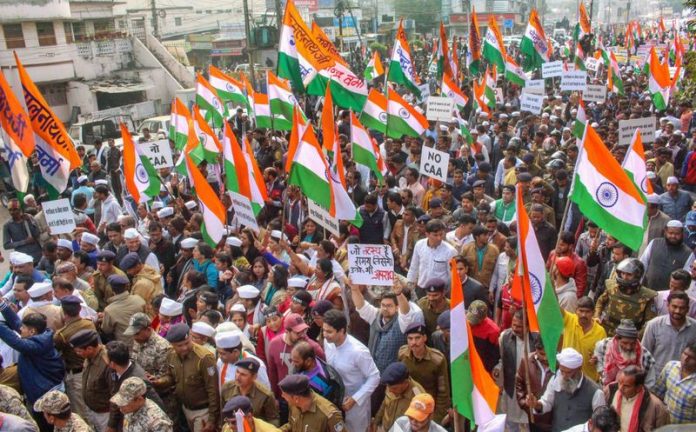
Protests against the controversial bill have resulted in bans on public gatherings. Photo: PTI

Under Prime Minister Modi’s leadership, the Hindu nationalist group Bharatiya Janata Party (BJP) has undergone a tremendous effort to institutionalise the persecution of Muslims in India. Further fulfilling this agenda, the Citizenship Amendment Bill (CAB) was passed on December 11, 2019. The CAB revises part of the Indian Citizenship law, which previously prohibited all illegal migrants fleeing persecution from becoming Indian citizens. 

With the changes passed in the bill however, non-Muslim illegal immigrants from Pakistan, Bangladesh, and Afghanistan will be eligible for citizenship by naturalisation. The bill specifically pertains to individuals of select religious minorities — Hindu, Sikh, Buddhist, Jain, Parsi, and Christian. If they have lived in India for at least six years, they may now apply for Indian citizenship. This bill relies on stereotypes and religious discrimination as a precondition for citizenship. It is outrageous and should not be tolerated in any modern, democratic society.

This law is regarded by many to be unconstitutional, as secularism has always been considered to be a core tenet of the Indian Constitution. The government claims that the amendment will protect religious minorities, and, according to an address in parliament, that Muslims “have not been persecuted on the basis of religion.” This statement is grossly Islamophobic as it implies that Muslims are always the oppressors. Their claim also overlooks Muslim minorities, such as the Ahmadis from Pakistan and Rohingyas from Myanmar, who have historically been victims of discrimination on religious grounds.

BJP’s Hindu nationalist agenda is clearly clashing with fundamental human rights. Modi’s India is increasingly being compared to Nazi Germany, which begs the question: have we really learned nothing from history? 

Subsequently, nationwide protests have erupted in India in response to this highly controversial law. Some protest signs were seen to compare Modi with Hitler, and a German exchange student was ordered to leave India after he joined the protest with a “we have been there” sign. Many unarmed protesters have faced police brutality and hundreds have been arrested. Consequently, the government has prohibited more than four people at a time from congregating in selected areas across the country, and suspended internet service in 73 districts. 

It is particularly alarming when any form of discrimination becomes legal. The Indian government is seeking to exclude select minorities through CAB, so that violence against them becomes justified in an incredibly crude way. In short, what we’re witnessing is the blatant disregard of secularism in the modern world.


What Grinds Our Gears: How holiday gifting has turned into a capitalist chore

0
A bank balance isn’t an indicator of love. Illustration: Michelle Chiang/The peak

I’ve noticed something alarming this past holiday season. People rushed to get last minute gifts. They didn’t know what to buy, and just settled for the most convenient item. Wash, rinse, repeat. It’s a loop where folks hurried to fulfill an annual commercial obligation.

Why is this the new norm? The holidays should be a time of winter cheer, spending time with loved ones, and relaxing before the start of a new year — not a time of sadness, spending, and stress. 

Instead of giving gifts maybe we should give time to our loved ones, and not just for one week of the year, either. Why do people think that spending money shows more care than spending time? Overall, the latter is way better because it builds relationships and doesn’t rely on the ability to buy a “good” gift. And I’m not just saying this because I’m a broke university student (though still relevant), I just think that we shouldn’t have to spend money to show that we appreciate someone.

I know that not everyone practices this kind of retail affection. Some people do prioritize enjoying their loved ones’ company over giving hollow gifts. But when I see that Canadians have a $643 holiday gifting average, it seems that most people fall victim to pacifying the needs of capitalism rather than actually trying to support the ones they love.

In the end, love shouldn’t be found in compulsory gift exchanges. In this new year, let your presence be your present.


If the rain isn’t paying tuition, it needs to stay out of SFU classrooms

0
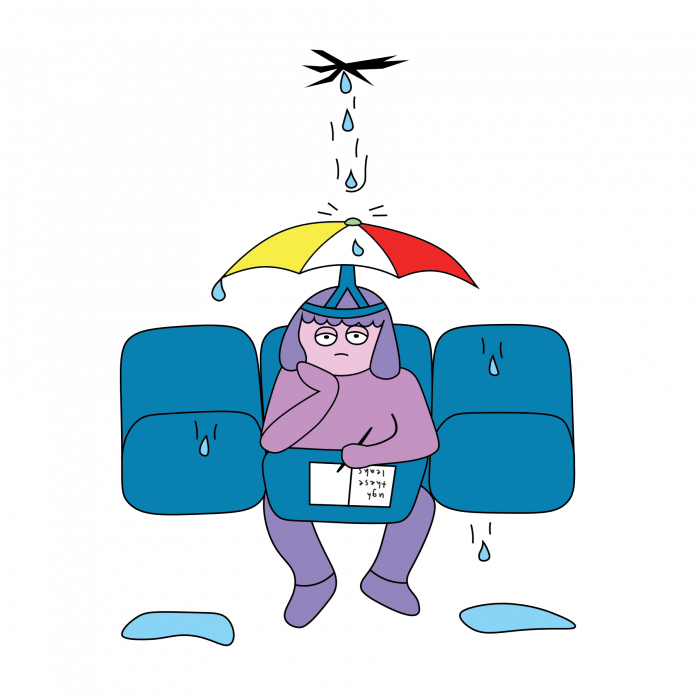
Students shouldn’t have to fight for dry spaces at their university. Illustration: Kitty Cheung/The Peak

As if the bitter cold, the constant rain, and the brutalist architecture of SFU Burnaby could not dampen (ha) the mood more, students are finding themselves standing off against yet another increasingly prominent enemy to public morale: leaking. 

In the AQ. In bathrooms. In classrooms. In all the areas where umbrellas or hoods are (sometimes surprisingly) needed. When strolling on campus, it’s hard to ignore that the school grounds are littered with yellow “caution” signs and half-full red pails of leaky water. There are substantial puddles on the supposedly rain-protected areas between the Maggie Benston Centre and the West Mall Centre, sitting like land mines for students not wearing heavy duty rain boots. The inconvenience of these puddles is made worse by the sheer number of fenced-off construction areas that decrease available paths, forcing students to step in the clumpy mud water if they want to make it to class on time. 

Reddit user u/veraesia recently shared that during a final, a wall started to leak, causing “most of the left side” of the classroom to be soaked. While u/veraesia escaped relatively unscathed, with the exception of a wet backpack, it is implied that other students were not so lucky. It is pure poetic justice that SFU has a misery-inducing, prison-resembling reputation.

As a commuter to SFU, getting to school dry is already a pretty impossible task between October and May. But now, staying dry in classes is a whole new quest to tackle as well? Three (and counting) years of relentless construction, of putting up with the deafening sounds of shouting, hammers, and drills during classes and exams, of dealing with increasing tuition costs, and all we get is a school that leaks even more. 

Everywhere. 

While I understand that some leaking during the winter is inevitable given the age of the buildings and the sheer amount of rain on the mountain, is it really fair for students to choose between finishing their finals or waddling out to change their clothes? The unending construction may be a testament to SFU’s dedication to improving the educational environment for its students, but the seemingly unstoppable leaking frustrates this ambition. 


Dinner with a View gives the rich a place to burn their money — and little else

0
The rich have literally moved into a bubble with this controversial pop-up. Illustration: Tiffany Chan/The Peak

A new pop-up restaurant opens on January 15 in Vancouver that advertises a novel perspective on dining. Organizers of the event call it “Dinner with a View.” For one hour and 45 minutes (and a $200 reservation fee), guests can sit in a plastic bubble located outdoors and indulge in a three-course meal that costs a staggering $110. It boasts a spectacular view of the Vancouver skyline and Lion’s Gate Bridge. What it doesn’t show, however, is how this pricy “experiential” dining hammers in yet another wedge between Vancouver’s rich and the poor, in order to maintain the facade of an extravagant urban lifestyle that only a few people can attain.

Dinner with a View doesn’t explicitly advertise “rich people only” as a requirement, but it’s clear that the restaurant only caters to the upper class — those fortunate enough to be able to spend hundreds of dollars for a single dinner. The pop-up venue is intended to be a limited time, one-of-a-kind dining experience, for consumers in such metropolitan locales as Toronto, Montreal, and now Vancouver. Dinner with a View emphasizes the potential social media recognition its guests can gain from the event. However, promoting the event this way centers it in a socially detached splinter of reality that normalizes temporary “experiences” without acknowledging the disparity and inequality around them.

While the wealthy absolutely have the right to spoil themselves with lavish experiences, it’s worth keeping in mind that Metro Vancouver is already in the grip of economic equality. Regardless of the event’s intention, sequestering the rich in their own bubbles of privilege creates further divides within the region, where accessibility to the venue — and by extension the luxurious Vancouver life — is dependent on the increasingly difficult ability to afford it. 

The pop-up fine-dining chain first faced controversy when it opened in Toronto last April. The event was held near an area where many people who were homeless had settled for shelter. Upon learning that their tent encampment had been expelled prior to this event, several members of the community gathered in front of the temporary venue to express their concerns, calling their protest, “Dinner with a View . . . of the rich.” Hosting Dinner with a View in this particular location was especially upsetting for anti-poverty advocates, who have long demanded the construction of shelters in the area. 

Dinner with a View isn’t the first time that extravagant endeavours have been prioritized in Vancouver over the interests of the most vulnerable in the community. The city faced similar concerns a decade ago with preparations for the Winter Olympics; street youth were pushed to more dangerous areas of the Downtown Eastside to make room for the occasion. Similarly, neighbourhoods like Chinatown that are filled with so much cultural and community significance are now under threat by urban development. Dinner with a View represents yet another form of gentrification in Vancouver — one that doesn’t even stay long enough to contribute to the city that hosts it.

Events like Dinner with a View put wealthy affairs on a high pedestal, disregarding Vancouver’s growing homeless population in favour of cultivating a false perception of luxurious living in the city. Before Vancouver residents decide to spend hundreds of dollars on this trendy pop-up, perhaps they should try a few unique local restaurants and support the businesses and people who are already in their community.

“Death of the author” doesn’t negate the need for critical readings and re-readings

0
The Harry Potter series deeply impacted an entire generation. Photo: Chris Ho/The Peak

When I was in fourth grade I had to do a presentation on “my hero,” which is a pretty standard assignment for a kid’s first foray into PowerPoint. I picked J.K. Rowling, who was my absolute favourite author. Later, when professors first noticed that I was a strong and avid writer, the greatest compliment they could give me was throwing her name in my general direction. 

If I had one of Rowling’s time-traveling time turners in hand, I would go back and tell fourth grade me two things:

  1. You’re gay (this matters in general, but for this story in particular), and 
  2. Heroes fall. Yours in particular is going to disappoint you. First as an artist, by money-grabbing at franchise expansions and adding unnecessary yet unforgettable (and unforgivable) canon about how wizards shit. Then, and more importantly, as a person. 

I don’t know how I’d explain to my younger self how Twitter works, or how to break down the legal court case that Rowling was commenting on — one in which she chose to support a woman who was terminated for tweeting transphobic comments. I encourage readers to do their own research on Maya Forstater, the woman in question, her history, and the human rights case that ensued. Then, scroll through Twitter to see the absolutely heartbreaking messages left to Rowling by trans fans who had previously found solace in her books. 

To be clear, this isn’t the first time trans, queer, and other marginalized Harry Potter fans have pointed out gaps and failings in Rowling’s politics. I’ll be honest, I didn’t want to believe the first few online discussions I stumbled upon about Rowling’s transphobia — and that’s my own fault as a cisgender woman, for not listening to trans folks’ concerns more attentively. 

The truth is, being critical would have been much harder than clinging to a favourite book series, a gateway and foundation for many of my friendships, and a comforting cast of characters, storylines, and quotes. When Rowling first discussed how her depiction of werewolves had metaphoric links to the stigma around AIDS, it gave me something to cling to when I still had questions about what my queer identity meant about my life and the way the world would see me. More generally, the Harry Potter series preached values of equality, tolerance, and peace, which I do think heavily shaped me as a young reader. But my experience doesn’t negate the hurt Rowling inflicted elsewhere. 

Going forward, I’m going to think twice about following and supporting Rowling’s newest creative projects and works, or buying new merchandise that Rowling might get royalties for. But that’s not enough. It’s my responsibility as someone who was influenced by Rowling’s work and who enjoys the world she created to poke at it and look for the cracks that I’ve seen in my old hero. 

It’s my job to listen when, for example, Indigenous people call out Rowling for cultural appropriation and imperial ideologies, or worry when fans point out that the speech of Rowling’s “happily enslaved and happy to serve” house elves presents as an imitation of African American slave dialects. I have to think about what gendered or colonial ideologies I may have passively absorbed elsewhere in her work. If I reread my favourite scene from Prisoner of Azkaban on a bad day, I have to use what I know now — as a more mature and critical adult and as someone who’s seen disappointing sides of Rowling — to worry about what ideologies may have bled into her work and influenced me. 

It is too easy to simply declare the death of the author and pretend that Harry Potter hasn’t profoundly shaped generations of young readers who were hoping that Hogwarts would always welcome them home. 


Affordable housing, not gaudy art, is what Vancouver residents need

1
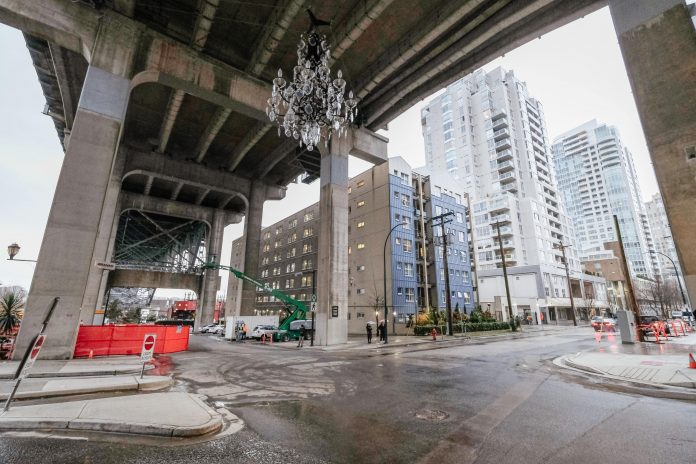
The decision to hang the installation under a bridge where people seek shelter is cruel. Photo: Chris Ho/The Peak

Picture this: a 3,400 kilogram chandelier shining brightly on the faces of those peering through the lenses of their newest iPhones, attempting to capture the best picture for the gram. On the periphery, homeless folk who once occupied the space are now in the shadows, largely ignored. This is the spectacle the city of Vancouver created when deciding to erect a $4.8 million dollar chandelier under the Granville Street Bridge.

This art piece makes a mockery of a city facing increasing unaffordability and a growing housing crisis. Under the city’s Private Development Program, developers who are rezoning areas over 100,000 square feet are required to install a public art piece or contribute to a fund for future public art pieces. These developers are “artwashing” Vancouver in order to hide the freedom they have in shaping the city to maximize their own profits at the expense of the majority of the existing population. And Vancouver is facilitating this.

Behind the chandelier’s dazzling lights, units in Vancouver House (the building the chandelier is tied to) will go for $6.9–9 million. Vancouver House and other ultra-luxury developments only attract the wealthy, which in turn will invite more expensive businesses into the neighbourhood. This makes it impossible for many to afford both housing and the cost of living in this area.

Instead of public art, why not have public housing? The city should require that developers invest in social or public housing, instead of asking that they erect garish installations to somehow make it seem like they care more about the city beyond a site of profit making. 

The chandelier installation highlights the staggering disparity between the demographics of the city and its recent development decisions. Vancouver is underperforming massively on reaching its housing targets, as reported by The Tyee. Regionally, Metro Vancouver likewise failed to build enough rental units to meet the needs of its residents. It’s safe to say that many of us upon graduation will not be making enough money to fit into a high income bracket. Unless the city wants to chase away new generations of young adults, it should prioritize much more of its allowance for private developments into truly affordable housing.

As students, if we want to live in a place without seven roommates, we need to hold city council to a higher standard. Our politicians need to be asking more of developers. Ultimately, it is our place in Vancouver that is threatened by the city being handed over to developers whose bottom line is profit.


Paying to cheat is a sign of laziness and immaturity

0
Earn your grades, don’t buy them. Illustration: Joy Tian/The Peak

University is hard work. This is my fifth year flailing around on this mechanical bull of stress and self-imposed poverty, and with the current educational requirements of a tightening job market it likely won’t be my last. It’s difficult and frustrating. It requires stamina, dedication, and discipline. Sometimes it feels nigh on impossible.

But if some students aren’t mature enough to get through university without cheating their way out of the slog, maybe they should wait a few years before wasting the time and resources of students and faculty who are actually ready to put real effort into this crazy endeavor.

At the end of the exam cycle last semester, news broke of a student who had paid to have someone else take their exam. The RCMP subsequently arrested the paid test-taker for possession of forged documents — in other words, for claiming to be someone she’s not on official documents. While no charges were filed, the test-taker will still face legal ramifications over the incident.

While it may not seem like such a big deal if one student cheats themselves out of actually learning anything at university, academic dishonesty has some pretty serious ramifications for the rest of the SFU community. Cheating not only spits in the face of students who actually work hard for their grades, but it also skews class curves, devalues the worth of the degree, and tarnishes the reputation of the university and the students associated with it. Additionally, if not caught, cheating promotes a dangerous lack of ethical care and competency in future careers cheating students may enter.

And while these are all very good, objective reasons to both discourage and punish cheaters, I’d actually like to take a slightly lower road with this issue and just say the following to students who have cheated, continue to cheat, or are considering cheating:

Grow the fuck up.

You think university is hard on you? We’ve all been there. We all have our own personal horror stories of half-killing ourselves to scratch out a decent grade at this school. We may bitch and complain about this class or that professor. We whine about how our grades could have been better and vent to our friends about how frustrating it all is, but at the end of the day, honest students pull up our adult pants and we try harder. If you can’t deal with that, then get out of the deep end and go play in the kiddie pool.

Despite the tunnel vision that the university rat-race forces on us, this experience is about much more than one’s place on a GPA ladder. We’re actually supposed to be learning here. Learning not just how to craft essays or solve equations, but how to prioritize tasks, manage our time, and deal with the stress that comes with being an adult in this particular cultural and economic epoch. Cheating on an exam or a paper demonstrates that students are not even mature enough to handle cut and dry ethical decisions, let alone the complex responsibilities of adulthood.

But above all else, paying to cheat shows not only a critical lack of maturity, but a profound vice of laziness. Spend that money on a tutor if you’re struggling. Put the effort in and actually earn a grade, rather than buying one. Work for it like the rest of us, and own the grades you get. Learn from the grades you get, and be a better person for it.

What are SFU students looking forward to in 2020?

Image courtesy of pxfuel

I want to live my twenties without guilt about taking time to rest.

Hi there, 2020. 

2019 was a year of many firsts for me: it was the first time I allowed myself to take my writing seriously, I got my first few tattoos, and I vacationed with friends rather than family for the first time.

Despite all this, in the last months of 2019, I really lost touch with my mental health. I would brush off unhealthy coping mechanisms and persist into bad habits that ultimately wore me down into an unrecognizable husk. It’s a place I do not want to be in again — not when I’ve learned that there’s so much love for me here in the people I love and the things I create. 

There are many new things I want to try in 2020: I will be performing in a burlesque show, trying to save more money, and I will be getting more plants. I’d like to travel more. I will love my friends the best way I know how. I want to live my twenties without guilt about taking time to rest. Learning each day that my value isn’t my productivity is difficult, but I am trying. – KC

I would like to politely decline on becoming a “new” me, and instead continue the journey of resistance I started in 2019.

Welp! It’s here again. That time of year for all the “new year, new me” posts, subscriptions to gym memberships, and committing to signing up for a million things to help you on your journey to the new and improved YOU! 

This year, however, I would like to politely decline on becoming a “new” me, and instead continue the journey of resistance I started in 2019. I’ll be doing this by prioritizing rest over our hustle and grind culture, and respecting my body instead of conflating weight with value. I will not buy into diet and fitness culture. I will say no to the anxiety of overextending myself. In 2020, I am prioritizing not feeling guilty for not filling up every hour of my day, refusing to buy into the “you can sleep when you’re dead” mindset, and dismissing the notion that rest makes you lazy. 

I will continue to cultivate an Instagram feed of positivity and compassion, prioritize my mental health, strengthen my friendships, become a better ally, listen more, dance wildly, sing terribly and out of tune, wear flashy clothes, and embody Kurt Vonnegut’s ideal that “we are here on earth to fart around, and don’t let anybody tell you different.” – ME

I’ve decided I want to spend more time alone in 2020. Whether that be by going to a restaurant or café solo, hiking on my own, or simply just putting my phone on Do Not Disturb and taking a bubble bath, I’ve set a personal goal to do a “me-date” once a week.

Upon ending a long-term relationship a few months ago, I discovered something about myself: I can’t stand to be alone. Whether I’m grabbing some food at a restaurant, there’s a movie in theatres I want to see, or I need a new pair of shoes, I’ve realised recently how much I rely on partners and friends to do these things with me. When I’m not physically present with these people, I am constantly messaging them and browsing social media, simulating the experience of company.

The idea of going to a coffee shop solo and sitting down with my drink makes me feel uncomfortable. In fact, as I am writing this I am trying to find someone who’s free to get bubble tea with me tonight; I’m craving some oolong milk tea and don’t want to go by myself. In my opinion, having a friend by my side makes any experience more enjoyable than if I was alone. That being said, I also acknowledge the importance of being alone with oneself and one’s thoughts and feelings. I’ve heard from newspaper articles, YouTube videos, mental health enthusiasts, and fellow students about the benefits of spending time alone: increased productivity, decreased stress and sadness, opportunities to reflect and know yourself more deeply, and so on. 

After some reflection, I’ve decided I want to spend more time alone in 2020. Whether that be by going to a restaurant or café solo, hiking on my own, or simply just putting my phone on Do Not Disturb and taking a bubble bath, I’ve set a personal goal to do a “me-date” once a week. It’s my hope that by 2021, I can see some of these aforementioned benefits in my own life, and feel a little more comfortable with me, myself, and I. – VL

As 2020 closes one decade and opens another, I’m faced with a year of endings and beginnings. This will be my last year as an undergrad at SFU. The journey began in 2009, was returned to in 2016, and has bounced me through multiple successes and failures.

As 2020 closes one decade and opens another, I’m faced with a year of endings and beginnings. This will be my last year as an undergrad at SFU. The journey began in 2009, was returned to in 2016, and has bounced me through multiple successes and failures. I’ve made so many wonderful friends and an abundance of experiences both fascinating and painful. This ride has sucker-punched my health, tested my endurance, stretched my emotions, and opened my mind. 

There are no more twists ahead. I can see the end of my time at SFU clearly in a distance that was once a far away horizon, now rushing towards me far too fast. And I can’t help but feel that tiny seizure of fear. Will I be able to find a good job after this? Have I made the right choices? Will the sacrifice of time, money, and sanity (which at times distressingly hemorrhaged out of me) prove to be worth it in the end?

University is a tunnel, connecting one phase of life to another. I’ve been finding my way in the dark for over four years. I’m accustomed to it now. The rhythms, the walls, and the voices. When I finally step out, blinking against the light, what will I see? – NM

This year, I wish to continue to challenge myself to step out of my comfort zone as well as travel to new places. I usually don’t make any new year goals, but I’d like to continue to travel, apply for Co-op, and live a more sustainable life. 

For me, the past year has been a journey of growth. Being an international student, it was the first year that I’d lived away from my family. I was a wreck at first, but over time I’ve actually come to enjoy some parts of adulthood. I’ve realised that even though challenging myself to step outside of my comfort zone may be daunting, it provides me with a tremendous learning opportunity. Other than that, looking back on the year, some of my best memories are from travelling —be it exploring Vancouver, the new city I’m learning to come home, or other beautiful places.

This year, I wish to continue to challenge myself to step out of my comfort zone as well as travel to new places. I usually don’t make any new year goals, but I’d like to continue to travel, apply for Co-op, and live a more sustainable life.  – LM

At the end of the year, I realised that I had given myself zero days off to actually do things that I enjoyed.

That’s why in 2020, I’m making a personal oath to allow myself more free time outside of my busy schedule.

I definitely had some of the best experiences in the first half of 2019, from learning how to snowboard in the winter, visiting Maui in the summer, and seeing my favourite bands live for the first time. 

However, the later half of 2019 was when I hit some of the most stressful moments of my life. I was juggling between full-time school, 30-hour work weeks, and extracurricular activities— all while attempting to maintain my social life, relationships, and quite frankly, my sanity. At the end of the year, I realized that I had given myself zero days off to actually do things that I enjoyed.

That’s why in 2020, I’m making a personal oath to allow myself more free time outside of my busy schedule. To make sure that I achieve this goal, I made myself a checklist of all of the new activities and hobbies that I hope to try out. This includes going wine tasting, trying out pottery, developing my own film, and even salsa dancing. My goal is to keep building on to this list so I can motivate myself to continue exploring new activities that will spark more joy in the later years to come. – KR

Silent protest takes over SFSS Meet and Greet event

1
Chris Ho // The Peak

Photo: Chris Ho // The Peak

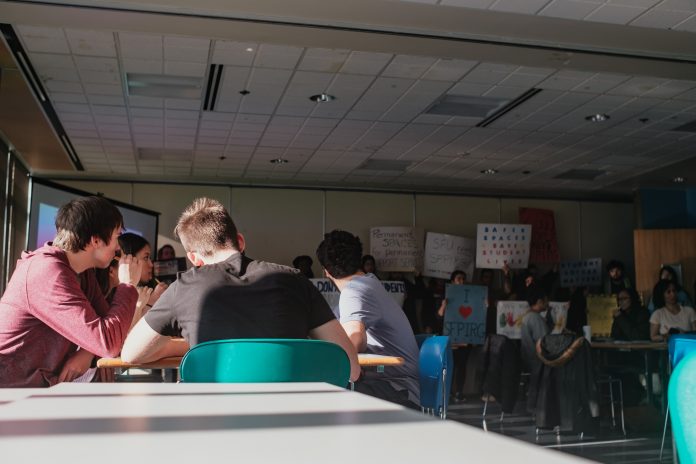
On Friday November 22, the Simon Fraser Student Society (SFSS) hosted a Meet and Greet event for Club executives. Silent protesters arrived in reaction to the Board defeating a motion on November 1 to house CJSF, Embark, SFPIRG, and SOCA in the Student Union Building (SUB).

Club executives had a chance to “meet the SFSS staff and Board members while enjoying a free lunch,” and enjoyed “the opportunity the ask to [sic] questions, give feedback, participate in icebreaker games and get more resources,” as advertised on Facebook.

A group of about 15 protesters arrived shortly after the event started and lined the walls of MBC 2294 with posters, boasting slogans such as “Student leaders don’t evict students” and the names of board members who did not support the motion. Protestors outnumbered club executives in attendance, and despite multiple Board members being present, they did not interact with the protestors. 

Despite the protestors’ silence, even when they were approached by curious club executives, the air was tense as the event went on as scheduled. The spokesperson for the protestors stepped outside to speak with media on a few occasions. 

After the event, The Peak asked multiple SFSS board members for comment on the silent protest, though all declined to comment.

Professors form “OK Boomer” support group as millennial students grow stronger

0
Illustration by Ashley Yien

BURNABY, B.C. — SFU Security has confirmed an increasing amount of calls from tenured professors regarding threats to their superiority in the classroom, as early as November 7.

“At first I thought I was just slipping because of the carpal tunnel syndrome I have from years of groundbreaking research and publishing,” economics professor Al Douglas, who has personally placed nine distress calls, told The Peak. “Then I realized I was just as terrifyingly stern and intimidating as always in my lucky tweed jacket. It was the millennials. Something about them had . . . changed.”

“It didn’t make sense at first,” said the first SFU Security employee who would talk that The Peak could find. “The first call came from an ENGL 100 lecture, a class we didn’t even know students needed to attend to pass. And yet the professor sounded scared for their superiority complex.” 

When personnel arrived on the scene, they found the professor struggling to explain to a blue-haired student how The Lord of the Flies, a book about a cluster of middle-to-upper class white British school children, offers the sharpest insight into the heart of humanity.

“OK Boomer,” the student eventually shrugged before swinging her pin-studded backpack on her shoulder and calmly following SFU Security out.

According to Douglas, he has been “Boomer’d” three times since the situation began. The first time had been after he’d refused to move a midterm scheduled during a climate march. The second time, he had expressed his deep-set anxieties about political correctness stifling the bulk of his personality. The most recent came after he’d advised the class that a few summers working at the club house could comfortably fund post-secondary education and at least one raunchy spring break trip. 

Reportedly, the reporter that The Peak sent to Douglas’ office hours was the first person under the age of 40 to contact him since the incidents began.

 “It just doesn’t feel safe to go out there anymore. The kids these days with their ripped jeans and almond milk. . . you can tell they read The Hunger Games or something. Someone told them about postcolonialism and it’s been downhill ever since,” Douglas confided to our reporter. “But I figured that I couldn’t be the only one that this is happening to. That’s how the group got started.”

According to Douglas, a group of tenure professors from multiple faculties have started meeting in an unspecific Burnaby campus location at an unspecified weekly day and time to help each other work through the advent of OK Boomer. While members aren’t sure how to cope with their students’ uprising and can’t figure out how to use TikTok to fight back alone, knowing that they’ll spend an hour without having to challenge their worldviews is a relief.  

“We call it White Tower Anonymous. We take turns bringing snacks,” Douglas said. “We spend time looking through the SFU library catalogue for academic proof that trigger warnings are useless — aside from highly specific cases of ageism, such as ours. Last week, someone brought a very well-written op-ed about the millennial victimhood complex. It wasn’t peer-reviewed, but nonetheless made some fascinating observations.”

Douglas shared some additional insights of his regarding how self check-outs were at the root of millennial entitlement, but we ran out of space to print the rest.