Home Blog Page 402

Your Halloween Horrorscopes

0
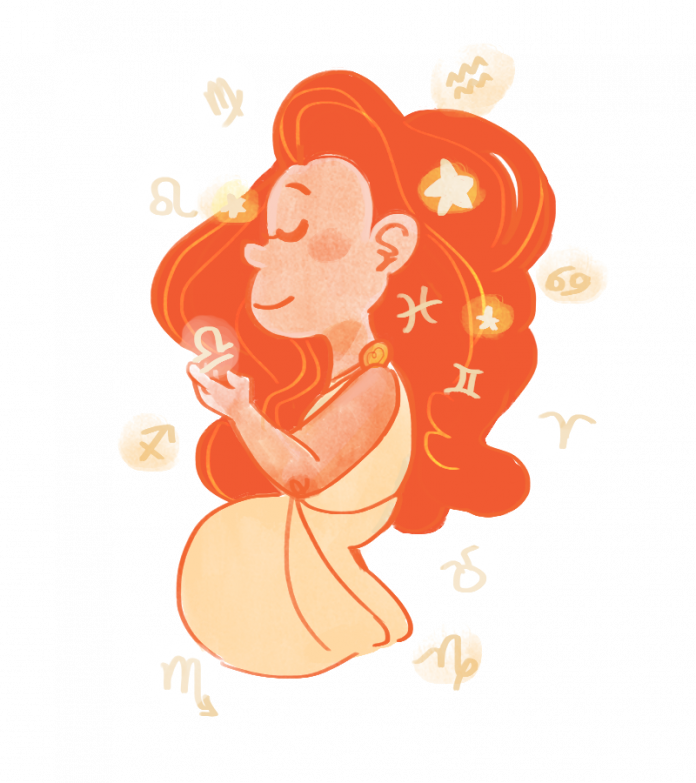
An illustration of a girl with long flowing hair. Astrological signs and stars shine around her.
ILLUSTRATION: Marissa Ouyang / The Peak

Aries: You just had to ask, “how could 2020 get any worse?” Now, we’re looking at a year-end zombie apocalypse thanks to your cynicism. Why pay for therapy to be told you’re “a threat to society” when you could just transform into a loud, violent creature and feel more like yourself than ever before?

Taurus: The stars are telling you to express how you really feel, Taurus. Cut off all your friends. Scream into a moldy pumpkin. Commit to your organic, GMO-free diet by eating the hearts of everyone who says dressing up as a cop for Halloween “isn’t even that bad.” 

Gemini: Is that really your Halloween costume, or are you looking to be casted in a porn parody of Zootopia? Either way, Halloween is the perfect excuse to rock bunny ears, pretend you aren’t a furry, and then sadly take jello shots and crank Megan thee Stallion all alone thanks to ‘rona. Happy Halloween!

Cancer: You’ve made some pumpkin-spiced lube from the tears of your classmates hearing you be the devil’s advocate, and you’re ready to try it with your boo. Your “boo” may be a BPK lab skeleton dressed in an off-brand Pikachu costume, but it beats your typically fragile ego every other cuffing season. 

Leo: Pumpkins aren’t the only guts you’re getting into this Halloween season. You know the drill — keep the seeds away at all times. If you’re looking to spice things up in the bedroom, you could try some sexy Chucky/Chucky’s-bride roleplaying. Or just stop being such a pillow princess for once.

Virgo: If you were in a horror movie, you’d certainly never move into a haunted house on top of a hill to finally be left the fuck alone. Mind you, even if you did, any demons bugging you certainly beat the people you’re forced to be around during your monthly Wal-Mart runs.

Libra: Your dream of recreating Romeo and Juliet in the 1996 Baz Lurhmann film doesn’t have to be ruined by the pandemic, Libra! Find your own bootleg DiCaprio — probably some business major still gelling their hair for Zoom classes. Then, die side-by-side at a Halloween party from COVID-19 instead of poison. 

Scorpio: It’s your season, and all eyes are on you, Scorpio. No, seriously. Where did you get all those eyes you’re holding? I know you’re ~dark and edgy~, but this is kind of disturbing. Can you — can you put them back? Wait. Back up. What are you doing with that scalpel? Someone hel—

Sagittarius: Happy Halloween, Sag! Well, “happy” is a bit of a reach, since your crush decided to ghost you this spooky season. But you still have time to get cuffed! Remember, if all else fails, you could always dress up as a video game controller this Halloween. Maybe then someone will finally hold you. 

Capricorn: Nothing could ever scare you —  except the ghost haunting you because you didn’t forward chainmail in 2007. But don’t forget: fear is an aphrodisiac. Give the ghost a chance! Your friends might all have “loving relationships” and “a life”, but they can’t say they’ve been railed by the supernatural.

Aquarius: I hate to break it to you, Aquarius, but Beetlejuice is a TikTok thing now. Put away that pinstripe suit you spent hours trying to find at Value Village. Save your green hair dye for when the Joker becomes a niche costume. Look for something a little more unique in your life — once your glasses stop fogging up from your mask. 

Pisces: The Halloween full moon will influence you, Pisces. Invest in a flowing nightgown. Sneak into the abandoned asylum downtown, wailing loudly down its halls. You’ll still be crying about forgetting to buy Pilsbury pumpkin sugar cookies, but at least your mysterious aura will drown out how narcissistic you are. Almost.

Senate Report: October 5, 2020

0
Photo from Peak archives

Exam invigilation software for the Fall 2020 term

During the question period, Senator Gabe Liosis discussed proctoring software. SFU expressed interest in implementing new exam invigilation for the Fall 2020 term. Liosis asked if there were any updates on what exam software would be used in the Fall term.

Senator Elizabeth Elle noted that instructors have the most knowledge of whether an exam is needed for their course. She added that if an exam is required, proctoring software is necessary to prevent cheating. SFU is currently piloting a new software to meet BC privacy requirements. Elle added that the software must be integrated into Canvas. The software is currently being piloted in 12 courses, which began the last week of September. 

Possible appointment of an Associate Vice-President of Equity, Diversity and Inclusion

Senator Liosis posed a question regarding the possible appointment of an Associate Vice-President of Equity, Diversity, and Inclusion (EDI). He asked what the process would look like, what the timeline would be, and whether President Johnson would consider a Vice-President of EDI rather than an Associate Vice-President.

President Johnson stated that her comments regarding EDI were said in a casual conversation about how to improve the structure of SFU. While she has not ruled out the possibility of a Vice-President of EDI, she stated that it is currently in the consulting phase. President Johnson said she would like to move forward with a recommendation later in the Fall.

Process to report academic dishonesty

Senator Eric Gedajlovic posed a series of questions related to the issue of academic dishonesty, discussing the significance of academic dishonesty in the Spring semester, what is being done to avoid this issue in the future, and the process for professors to deal with such instances. 

Vice-President, Academic and Provost pro tem Johnathan Driver stated that there have been concerns from professors and students alike regarding academic dishonesty. It was recommended that a working group be established to address the issue of academic dishonesty and any gaps currently present. The membership of the university board on student discipline has already been increased to address the greater number of cases of academic dishonesty. He added that, “We won’t solve all the problems by technological means, such as online proctoring software, but we will obviously be taking a look at this.”

According to Driver, the Centre for Educational Excellence has also developed resources for professors to deal with academic dishonesty and possible alternative forms of assessment that would make academic dishonesty less common. Professors can also receive guidance from the academic integrity advisors, department chairs, and the student conduct office to determine what an appropriate penalty would be for a specific offense.

Senator Rummana Hemani stated that there were 275 reported cases of academic dishonesty in the Summer 2020 semester, with two courses involving multiple students, classified as “mass-cheating.” Senator Hemani also described that the process for reporting academic dishonesty is already present in current policy. 

Driver also responded by stating that the amount of academic dishonesty that goes unreported may be anywhere from 20% to 60% of students and 50% of instructors speculate that cheating may have occurred in their courses. 

Driver did not state how instructors will be compensated for their increased workload as negotiations are ongoing with the faculty union, however he encouraged professors to document the additional time spent dealing with academic dishonesty.

The status of the student to faculty ratio in relation to tuition

Senator Gord Myers explained that more than 93% of the universities ranked in Quacquarelli Symonds have a greater student to faculty ratio than SFU. He added that the amount of tuition revenue has increased by 89% in the last 11 years, where the increase in the amount of tenured positions has been insignificant. Myers concluded by asking whether there was a plan for hiring more tenured professors. 

Vice-Provost and Associate Vice-President, Academic Wade Parkhouse responded by providing an overview of how SFU plans for an increase in faculty hiring. It was stated that the student-to-faculty ratio is part of the planning process. Senator Parkhouse affirmed that the numbers of faculty members from March 2020 show relatively no change. He noted that this is due to hiring usually occurring either in July or September, therefore, the statistic that Myers cited was indicative of the number of staff in the 2018/19 recruiting year. As of September there has been a net increase of 30 faculty members. 

The next senate meeting is planned to occur on Monday, November 2.

What happens if the “Local Women in Your Area!” actually find you?

0
PHOTO: Priscilla Du Preez / Unsplash

Would you spend a devastating seven more bucks a month on a new streaming service for a show unavailable on Netflix, or do you risk some harmless little malware and maybe a housecall from the FBI on a pirating site? I know my pick.

If you’ve been to these sites, you’ve inevitably seen the ads that say, “Local Women in Your Area can’t wait to meet you!” They feature busty women with hungry grins who promise a good time — and they’re just a quick credit card entry away.

When I started episode one of What We Do in the Shadows on one of these sites, they were 10 kilometres away. As I loaded up the second, just eight. I didn’t think much of it: probably just some attempt at getting my attention. 

For episode three when they were only six kilometres away, it started to feel like a countdown. My double chins reflected in the computer screen tensed with mild fear.

Still, I did what I do when any stressor in my life risks rearing its head: I click on the next episode. Can’t hurt me if I’m watching a vampire sitcom. 

“Local women in your area! Now in your home!” the advertisement told me. Yeah, sure. 

Suddenly, my door shot open as though a gust of wind blew through. Only, I swear my door had been locked.

The distinct clacking of heels on wood signalled someone — something — approaching. It came in a seemingly endless rhythm, as if a whole army was on their way. Maybe if I hid under my desk still unused this semester despite it being October already, the monsters wouldn’t find my smooth brain appetizing.

My bedroom door slammed open. To my surprise, it was just one woman. Long, luscious black hair, perky breasts that caught my normally-respectful eyes, and as I continued looking down . . .  at least a dozen legs, distinctly insectoid in nature, each perfectly slid into a red-backed Louboutin heel. At least the horrifying (but hot?) insectoid about to rip open my flesh was stylish.

“Ready for a fun time?” She asked, leaning in closer, joints clicking as her neck and face neared mine. I realized her face didn’t move, as though it were a mask. From under her mask-like face (surprisingly blended for the gods?), a black tongue snaked out.

All I managed was to shake my head. I was not trying to find out what this creature meant by a fun time. 

“Then we’ll just sssssskip that and get more . . . comfortable,” she cooed. She patted my cheek with a cold, leathery hand. “You know what I’m talking about, right?” 

Again, I shook my head. Man, I just wanted to watch What We Do in the Shadows. Couldn’t she have picked on some guy watching hentai or something?

Her visage fell, almost revealing whatever lay underneath. “We’re gonna live here now. Our offspring will hatch and mature under your roof. And either you can bring us raw meat . . . or you can be the raw meat.”

Honestly, all this talk of raw meat just had me staring at her boobs again (respectfully).

Before I could object, she continued. “Also, I bricked your computer. For a laugh. But ssseriously, either feed us or we’ll literally eat you.”

In short, don’t pirate unless you want the sound of a stampede every time your roommate wants a midnight snack. And don’t complain, or you’ll be the midnight snack.

Guidelines on having a safe Halloween encourages trick-or-treating in small groups

0
PHOTO: @freestocks / Unsplash

The BC Centre for Disease Control (BCCDC) has released safety guidelines for a low-risk and fun Halloween this year. To prevent the risk of further COVID-19 outbreaks in the community, they recommend that no indoor Halloween parties — big or small — should take place. However, the BCCDC notes that trick-or-treating can be a safe activity for kids in small groups of no more than six people. 

As the BCCDC states, regardless of Halloween plans, those with any symptoms should stay home and keep the lights off to avoid having trick-or-treaters approach your residency. 

Trick-or-treating this year should take place in small groups of kids who consider incorporating non-medical face masks into their costumes. The BCCDC notes that it isn’t necessary to sanitize every treat, rather kids should sanitize or wash their hands after touching candy and not touching their face. Additionally, small groups should be distancing themselves from other groups.

Households handing out candy to children should consider using tongs or making a candy slide starting from the door to give extra space between themselves and kids. The BCCDC says that only sealed, pre-packaged treats should be distributed this year and sanitizing both your hands and the door should be done regularly throughout the evening, in addition to wearing a mask. They also recommend that people handing out candy stay outside to limit the amount of children touching and approaching their doors at once. 

The BCCDC notes that all indoor trick-or-treating, such as in the mall or community centres, is discouraged. 

It is recommended that all parties or gatherings are limited to six people and take place outside. Parties held on heated patios or fires are best as fresh air and social distancing lowers the risk of COVID-19 transmission. They also note that providing individual servings of food is optimal to avoid buffet-style food sharing. Additionally, the BCCDC states that no drinks, smokes, tokes, and vapes should be shared with others. 

For those that want to go out on Halloween, the BC Government’s Gatherings and Events Order states that restaurants and businesses can remain open as long as they follow safety guidelines. Events must be limited to no more than 50 people and social distancing of two meters from others in the establishment is mandatory. Patrons of events must be recorded and monitored for contact tracing. Establishments must supply hand sanitizer for patrons and indicate with floor markers two meters of social distancing. Additionally, tables in restaurants must not be occupied with more than six people at a time, liquor may not be served after 10:00 p.m, and no dance floors, karaoke, and dancing or singing is allowed in public spaces.

Don’t be spooked by trick-or-treating

0
Crystal Sing / Getty Images

If one of the goals of trick-or-treating is to bring some scares, they may not be too successful with kids this year — but they’re knocking it out of the damn park with adults. It’s difficult to imagine how a holiday tradition revolving around children roaming the streets in hoards, breathing in the homes of strangers, and asking for unsanitized goods could be done in a manner that doesn’t result in outbreaks of COVID-19 in both kids and adults. I think it’s natural for anyone to be nervous about this sort of thing. But according to the opinions that really matter, it can be done. Considering the amount of kids and adults that children come into contact with at school, it becomes more and more understandable. 

The British Columbia Centre for Disease Control (BCCDC) released an outline for how usual Halloween festivities can take place, with a section dedicated to trick-or-treating. For an activity that seems to defy the interpersonal laws of social distancing, the list is short, to-the-point, and has practical advice on how to do it safely. 

According to the guide, the key components to most Halloween activities, for both trick-or-treaters and those giving them their goods, are staying outside, masking up, staying with a group of six people or less, and keeping your hands clean. As long as everyone follows those guidelines, Halloween should be a safe-as-possible event that doesn’t stop kids from missing out on some of the best days of childhood. 

Parents have the best judgement on how this works for their own children, but there seems to be little reason for Halloween alarm. Don’t just take it from me, a childless 19-year-old with no personal investment in this; take it from Dr. Henry and her team. 

If you wish to hand out candy and help these crazy kids have a safe night, the BCCDC recommends using tongs, individually wrapped bags and other methods to reduce surface contamination. If combined with the conventional guidelines of being outdoors, wearing masks and tips like avoiding decorations like smoke machines that could cause coughing (Huh! Never would have thought of that! These people are smart!), Halloween can be a healthy holiday for all. 

If fellow childless 19-year-old adjacents are looking for something to do beside go to house parties (please don’t go to house parties) and find themselves in a residence that trick-or-treaters will likely visit, why not go to town creating a socially distant fun way to give candy to neighbourhood kids? Put a fence six feet away from the door and make a game of throwing it to them; hang goody bags on a clothesline; put a slide at your doorstep and slip candy down to kids; the possibilities are endless. If you’re anything like me, solving a fun, creative problem that has no bearing on outside life is an unmatched mental escape. And if you take up this one, you’re contributing to your community while you’re at it. 

I know it can be easy to panic about the possibility of a virus infecting the kids in our lives, but as long as we follow the guidelines set out by the BCCDC, this should be a perfectly safe way for them, and the adults facilitating it, to have fun and stay healthy.

It’s time to cancel offensive costumes

0
PHOTO: Catherine Delahaye / Getty Images

Topics surrounding culturally appropriative Halloween costumes, and the general audacity of what some people choose to dress up as, have floated around in past years. With that in mind, a lot has happened in the world since last Halloween — one major event being the Black Lives Matter movement, sparking increased discussion and action on racial justice. It is so important to be particularly conscious of how some stereotypical costumes can be harmful to the communities they are intended to represent. 

We’ve all seen the “Native American princess” costumes on the racks at Spirit Halloween. Really, it is an offensive and Americanized depiction of traditional Indigenous clothing, frankly far from accurate and honestly just a gross example of how neo-colonialism flourishes through capitalism. 

It is probably unrealistic to expect Halloween costume companies to just suddenly stop selling every single problematic costume. But we as consumers can do our part in boycotting the brands that sell culturally insensitive costumes, as well as by speaking out about the costumes that continue to plague the Halloween season. We have the freedom to choose a costume from a seemingly infinite amount of possibilities, so there’s absolutely no excuse for a racist or offensive costume if you can just pick something else. 

I understand that sometimes it can be confusing to know if a costume has offensive connotations. But at this point in time, where every social media platform is flooded with information about allyship and anti-racism, it’s not hard to find sources that clarify this sort of confusion. 

Yet, sometimes even a quick Google Search is not necessary. All it takes is to just read the room a little in order to understand that dressing up as a sexy cop might be insensitive and tone-deaf right now as it eroticizes and glorifies an oppressive institution. But then again, if you ever feel that your costume might not be entirely appropriate, chances are that it isn’t. 

Indigenous culture is not a Halloween costume; Black culture is not a Halloween costume —  especially not for someone who is not of that origin. Maybe, the intent behind these costumes isn’t to harm anyone. But, the reality is that regardless of intent or knowledge, a “Native American princess” or a “sexy cop” is problematic and hurtful to BIPOC, who directly face the true challenges of costumes like these being normalized. These aren’t “just costumes,” but they are dismissive portrayals of cultural symbols, mockeries of sacred traditions, and a glorification of violent systems. 

Costumes that portray racial stereotypes have not been OK for a long time now. It is especially problematic that costumes like these still exist in a time where there is a growing awareness of the oppression BIPOC communities face. But then again, it is just a costume and you can dress up as whatever you want. So, just be a fucking cat, and don’t flaunt your bad taste and racism on Halloween this year.

Haunted locations across Vancouver

0

Frequently, the notion of a “haunted place” brings to mind images of decrepit old houses, abandoned hospitals, or perhaps decaying castles along a stormy coast. While I could certainly see myself choosing to haunt such a place given the choice, I can’t imagine many ghosts have the luxury of meeting their forever home in a place predisposed for dramatics.

As a matter of fact, rumours of hauntings span far further in context, as well as closer to home in proximity, than one might expect. Here are a few haunted locations local to Vancouver that have managed to captivate my imagination.

The Vogue Theatre

Image courtesy of ghostsofvancouver.com.

Originally opened in 1941, the Vogue Theatre is well loved as a live performance venue. I can personally say that I’ve seen some of my favourite artists perform within its walls, and partaken in a few too many drinks as I’ve cheered them on. Unbeknownst to me, however, a spirit may have been in attendance as well. 

It has been said that a ghost of unknown identity haunts various locations within the Vogue. Though he has been sighted on the audience-level occasionally, primarily he is spotted within the working areas of the venue, including the stage, the projection booth, the catwalks, and the basement hallways. A narrow corridor has even been nicknamed the “Haunted Highway” by staff members due to the paranormal activities experienced there, as well as the generally creepy atmosphere the area possesses. 

Gastown’s Old Spaghetti Factory

Image courtesy of gastown.org.

One of my favourite fun facts to tell friends when the topic of ghosts arises (surprisingly frequently) is that there are two locations of the Old Spaghetti Factory that are supposedly haunted. I suppose I can’t blame ghosts for wanting to eternally stay for spaghetti dinner, that garlic butter bread is to die for! One of the two haunted Spaghetti locations is in Gastown, and actually hosts four spirits within its dining halls. 

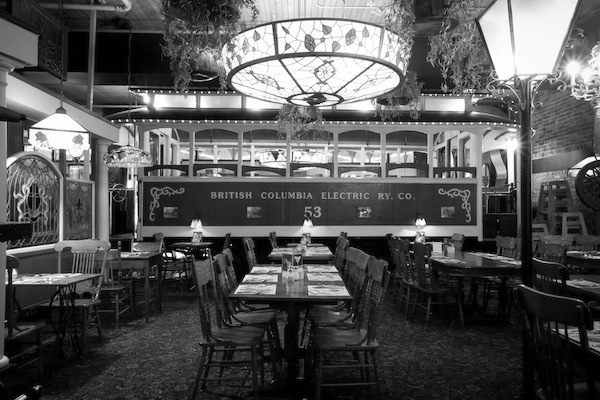
The most notorious of these spirits is the ghost of a uniformed tram conductor in the trolley car situated in the restaurant. While a few differing theories exist to explain his presence, he has nonetheless been spotted after hours once patrons have left. 

The second ghost is a mischievous red-haired ghost who resides in the kitchens, allegedly following employees and calling them out by name! The third ghost is a young boy who has been spotted running amok between tables after hours, even bending cutlery. Finally, the fourth spirit is that of a little girl holding a balloon near the front of the restaurant. While she appears to be harmless, the image of her would personally terrify me. 

Fairmont Hotel Vancouver

Image courtesy of ghostsofvancouver.com.

From approximately the late 1880s until the 1950s, a series of grand railway hotels were built across the country, designed to service the guests of the cross-country rail service in luxury. The Fairmont Hotel Vancouver, constructed between 1929 and 1939, served as Vancouver’s premier destination after the closure of two preceding Fairmont locations. Given the multitude of guests coming and going over the years, perhaps it is no grand surprise that the hotel has attracted some mysterious guests from the other side. 

The structure is said to be haunted by a lady in a red dress who is frequently spotted on the 14th floor and the ground lobby. Interestingly, these floors are the only remaining floors to be linked by a dummy elevator shaft. It has been theorized that this spectre is the spirit of a Vancouver 1940s socialite, Miss Jennie Pearl Cox. 

She was said to attend a great number of parties within the hotel, and loved it so much that she chose to permanently check-in post-mortem. She has been spotted many times throughout the years by a myriad of guests and employees, even making the news back in 2017 when she was caught on camera. To be fair, if my broke self were to be invited to party it up in such a lavish hotel, I don’t know if I would be keen to leave anytime soon either.

Waterfront Station

Image courtesy of ghostsofvancouver.com.

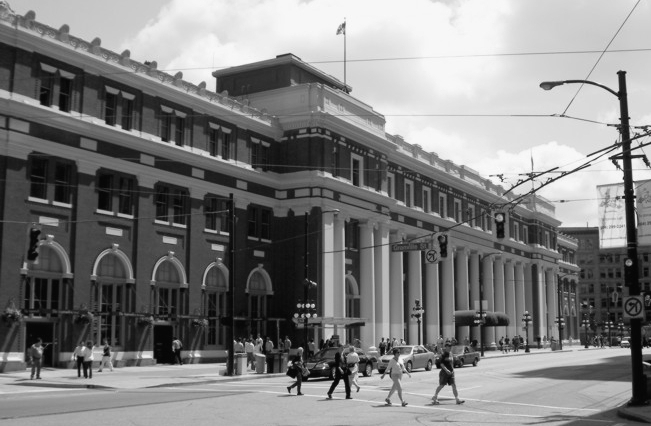
Now used primarily as a SkyTrain station, Waterfront Station has existed far longer than TransLink. Built in 1915, it has since hosted several creepy spirits, as well as phantom footsteps heard throughout the building.

Once, a guard of the station encountered a 1920s flapper on the west side of the building, dancing to jazz music. Apparently, once he approached her, she vanished.

On the Northwest end of the structure, another security guard encountered the spectre of a glowing, older lady, looking rather mournful. However, much like the flapper, she vanished once the guard got too close.

The last two ghost stories are what happen to fascinate me the most, the first of which is the tale of a spectre of another old woman who appeared before yet another security guard on patrol in the old kitchens. However, after this encounter he began to see her in mirrors and windows, even in his dreams. He then developed an uncanny urge to paint her. 

After the painting’s completion, his ghostly stalker ceased, and the painting was hung in the kitchen. Now, if anyone is to move the painting from its location, the person that does so will be haunted with similar images as the original painter until the artwork is once again reinstalled in its rightful place. 

Also, it has been said that a headless worker holding a lantern has been spotted outside the station and along the tracks. It has been theorized that this may be the spirit of Hub Clark, who died in 1928 when he slipped on a wet track, unfortunately knocking him out cold and rendering him helpless when a train came speeding along and decapitated him.

Samhain: the roots of Halloween and how to celebrate it in 2020

0
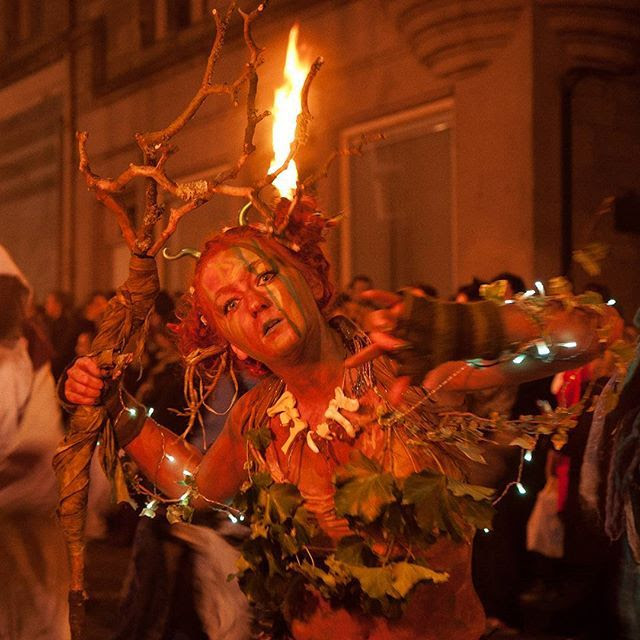
Photo courtesy of Beltane Fire Society.

In honour of the spooky season and all the little rituals we are used to during Halloween, I thought it would be well-deserved to look at the roots of this holiday. Since we all are social distancing and keeping it safe this year, you can celebrate Samhain (/ˈsaʊ.wɛn/) without jeopardizing anyone’s health. 

A Brief History of Samhain

What some people might not know is that Halloween could have Celtic Pagan origins — an idea that is often challenged. Due to the term “Celtic” forcibly positioning all the regions that belonged to the “Celts” under this name, we cannot assume the cultures within this limiting word share their significance. 

While Irish medieval literature and the Welsh medieval tales might have similar festivals, they are actually quite different from one another. It is important to note that most of the archaeological or historical evidence that we have available are either written by Christians or Romans, and are either often biased against Pagans — or they’ve been passed on in oral tales, which was common in the past. 

Halloween (Hallow Even), and All Saints’ Day are, in simple words, the Christianized version of Samhain, but not necessarily derived from it. 

Based on Tochmarc Emire (The Wooing of Emer), a 10th-century Irish mythology tale, Samhain is the first of the four “quarter days” in the Irish medieval calendar and the ancient Celtic calendar, which essentially marks the beginning of the year. In this ancient calendar, the year is divided into two; the light half when they celebrated fertility and embraced warmth, and the dark half when they prepared for the winter and the cold months ahead by gathering crops, making Beltaine and Samhain the most important feast days of the four. 

Today, the four quarter days include Samhain on October 31/November 1, Imbolc on February 1, Beltaine on May 1, and Lughnasadh on August 1. 

Additionally, the ancient Celtic calendar is also a highly debatable topic, as one of the oldest pieces of evidence being held in a museum, the Coligny Calendar, demonstrates summer as the beginning of the year, and even that is not conclusive. 

“[S]leepless from Samain, when the summer goes to its rest, until Imbolc when the ewes are milked at spring’s beginning; from Imbolc to Beltine at the summer’s beginning and from Beltine to Brón Trogain, earth’s sorrowing autumn” (Homer and the European Epic, 2011, p. 70).

So far, there is nothing deadly or scary about this occasion, so the question is: why and how is it relevant to jack-o’-lanterns? 

Like with many old manuscripts, there was a misunderstanding with the definition of Samhain. Some would say it simply means “summer’s end”, but some claimed that it’s referring to the name of a Celtic god called Balsab, meaning “Lord of the Dead”; but the latter claim lacks proper support. 

Another question that pique’s everyone’s interest: did they sacrifice humans? While Romans such as Julius Caesar believed they did, some others are opposed — and again, we are left with no reliable clue to answer this question.

The Rituals

Regardless of all the uncertainty about Samhain, we can be confident to declare it a three-day harvest festival that involved feasting, drinking, and bonfires. Furthermore, the “Celts” believed that during this time, the veil between this and the spirit world was at its thinnest and basically, something like Pixar’s Coco would occur where the ghosts and fairies (called “sidh”) would come to visit. 

When the sky is dark and spirits are roaming the earth, the logical solution would be lighting some bonfires to keep the dark at bay, and dressing up in costumes to either hide from or scare the spirits away. In actuality, we know so little of what precisely happened in Samhain, and whether it was all devoted to the dead. 

The assumption that Samhain was the festival of the dead belonged to James Frazer in his book, Golden Bough. Frazer explains how dead people revisit their old homes, but that could have been easily misunderstood with All Souls’ Day, which is a Christain time of praying on behalf of the dead who are in purgatory, a place between heaven and earth. Nonetheless, Kevin Danaher, in his book, The Year In Ireland, claims that portions of their crops used to be left on the ground for the spirits. 

Ritual bonfires are assumed to be one of the highlights of this event. The symbol is quite similar to that of Chaharshanbe Suri (The Scarlet Wednesday), which is a festival on the eve of the last Wednesday before the Persian New year. Jumping over these bonfires would purify and destroy all the harmful virtues in both cultures. In addition, Ronald Hutton, a historian in this field and the author of The Stations of The Sun, believed the bonfires were also used in divination. 

Hutton also claimed that people would wear costumes and sing songs in exchange for food, and they supposedly imitated the spirits and received the offering on their behalf, while staying protected from them. 

It is believed that in southern Ireland, someone would dress as the hobby horse, Láir Bhán, and lead a group of young people reciting verses from one farm to another, who were to be given food. If the farmers donated food, they would be rewarded by Muck Olla, an ancient Celtic god, and if they didn’t, tragedy would be bestowed upon them. 

Pranks were said to be also a part of this event, which brings us to trick-or-treating and Seán Na Gealaí (turnip lantern) that worked as jack-o’-lanterns. As mentioned before, these traditions vary between the Celtic-speaking regions. 

Modern Samhain

COVID-19 has limited the number of ways we can celebrate Halloween this year, so why not add some of the Samhain traditions into the mix? You don’t have to necessarily jump over a bonfire (although you should try it if you haven’t, it’s incredibly fun), but take some of the ancient rituals, as well as Celtic Reconstructionist, Neopagan, and Wiccan rituals, into account this year. Here are some ideas for this year’s Samhain:

  • Gather food for the winter, but make it a household event. Once you’ve harvested your crops with the members of your household or close friends, make dinner together and have a “dumb supper”. Invite your ancestors and leave empty seats for them. Take turns sharing beautiful memories you’ve had with your loved ones. Update the dead on the year’s events. (There is a lot to cover!)
  • Wear a costume, even if you’re not going to a Halloween party or trick-or-treating. An idea for a costume would be Láir Bhán.
  • Instead of conforming to the over-consumerism culture around holidays, decorate your home with items you can find or make.
  • Visit your friends and relatives that travelled all the way from the underworld to see you at the cemetery. Don’t forget to bring an offering. 
  • Sit close to your fireplace if you have access to one to get rid of harmful influences, and burn incense, candles, or sage to cleanse and purify your home. 
  • Fall in love with mortality. 
  • Listen to the Halloween themed Monday Music on The Peak and throw a private Witches’ Ball. 
  • Get in touch with your witch heritage, and summon the ancient gods so they’ll grant you a blessing for the winter. 
  • Have a seance with an Ouija board, or a divination ritual with a set of tarot cards.
  • Meditate, reflect, and face your fears to prepare for the new year.

SFYou: Christa Ovenell talks death, education, and where they meet

0
Photo courtesy of Christa Ovenell.

Name: Christa Ovenell

Pronouns: She/her/hers

Departmental Affiliation: English

Occupation: Apprentice funeral director and community educator

Hometown: East Vancouver

Fun Fact: When talking to her kids, it never takes Christa more than three minutes to mention her potential grandchildren.

After graduating from SFU with a BA in English (2004), Christa Ovenell has continued to grow an incredible career in education. Getting a Master’s in Education at UBC (2010), Ovenell was the director and principal of Fraser International College for six years. Recently, Ovenell decided that she wanted to have a career in death-care, which refers to funeral and death-related services.

She graduated from the Canadian College of Funeral Service this September. Ovenell’s experiences in education and death-care made her realize that as a society, we tend to avoid conversations about death. That’s why Ovenell started doing workshops at The Learnary so that people can prepare for death in a comfortable and practical way.

Ovenell’s extensive career initially made me intimidated to speak with her, but her warm personality was immediately apparent, even over text. At times, her words felt as if they were reaching across the screen to pat me on the back. That hospitality made her very easy to speak to — even if the topic of our conversation was unconventional. While educating me on death-care, she gave me some background on how people joined the funeral business in the past.

“Back in the days of the family funeral home, most people came to the business through the business: funeral homes had names like “Smith & Sons” and Mr. Smith’s son really didn’t even have a choice in his career path!” Ovenell joked. 

“Now, it’s far more common for people to come to funeral services as [a] second or, like me, even [a] third career, and many of us who are new to the business actually come from some pretty diverse background,” Ovenell told me. She said that many people who joined funeral services usually came from hospitality backgrounds, or what she calls, other “helping professions.”

I asked Ovenell to elaborate more on her favourite memories in her career in education, and at SFU specifically. 

“Graduation,” Ovenell said decisively. Fondly, Ovenell recalled the memory. “My young children were in the audience and my sister — who had worked with SFU for years — had gotten my whole family VIP seats,” she said.

“Then, when I was FIC’s principal, it was every single graduation. I got to witness the proud, extremely hard-working international students who had started at our college cross the stage. A couple years after I left FIC, my own son was valedictorian for the Faculty of Environment. It probably won’t surprise you that I think his speech was the very best I heard at any of the many, many, many convocations I have sat through!” 

I could tell from her answer that Ovenell valued her work in education, and it showed when we talked about her career path.We then talked about Ovenell’s reasons for going into funeral services. Part of it was that her career, first in hospitality and then in education, allowed for a good transition. 

“When I’m serving families in the funeral home and when I’m facilitating death education workshops, I use skills I honed in both previous careers. Our society is so death-averse that we really don’t know how to deal with it when it happens. And I mean, come on: our mortality is the ONE thing every single one of us has in common! I am equal parts educator and servant leader in this role: it’s truly perfect for me,” Ovenell explained.

She was right — death was something I avoided thinking too much about.

My personal aversion to death largely had to do with the fact that at this point in my life, I haven’t experienced many personal losses. A former staff writer at The Peak, Kim Regala, had expressed a similar sentiment when she went to Ovenell’s death workshop. 

READ MORE: “SFU alumni Christa Ovenell hosts a four part series engaging in open and honest conversations about death.”

 I asked Ovenell if age pushes her to approach the death conversation differently in her workshops, as the workshops often take place in groups.

“Currently most of my educational endeavours are indeed group-oriented, but I’m also more than able to work either in one-on-one settings or in very small groups. It’s not just youth who change the way I talk about death — the conversation changes based on who is in the room. Queer folks have their own special concerns, sometimes. Older people often take an extremely pragmatic approach. Boomers are their own special breed . . . as us Xers, millennials, Y’s, and Z’s know!” she said, lightheartedly. 

“My mission is to have exactly the kind of breakthrough that Kim [Regala] had at The Learnary: talking about death should be one of the easiest and most natural things in the world. And let me tell you, I have not picked an easy goal!”

Lastly, I asked Ovenell to give some advice on life in general. She first stressed the importance of an education in the liberal arts, and the value that this had given her.

“I am a huge proponent of a liberal arts education. I think the relentless quest for credentials is actually killing formal education,” Ovenell told me. “I took a BA with an English major and a women’s studies minor, and I remember a lot of people wondering what I would ‘do’ with that degree. I’m sure I surprised everyone — I’m a death educator and a 50-year-old apprentice after all — but virtually everything I do now and have done through my previous rich and rewarding career has been informed by my early, broad studies that introduced me to concepts instead of teaching me specific requirements.

“My advice is not specific to young learners, but to any learner who is trying something new, whatever age they are. And it’s pretty simple, really: your successes probably won’t matter as much as you think they will. But your failures will matter far less than you can ever imagine.

“Don’t be afraid to be inexperienced at anything, at any point in your life. If you are lucky enough to become an expert at something, give it up. Try something new. You’ll be striving every day like you did when you first discovered your drive, your passion. And it will be invigorating. It will make you want to do more, try harder, reach farther, and be far less afraid while doing all of those things.”

Political Breakdown: A friendly reminder of all the negatives from each party and their ideologies

0
Voting concept - Ballot box with Canadian province flag on background - British Columbia

A snap provincial election has been called for October 24, and while voting during a pandemic is less than desirable, so are the options of who to vote for. Despite this, elections remain an important, but singular form of political action. The purpose of an election is to vote for a party that one believes is rooted in activism and malleable enough, that the political action that occurs after the election is effective. So, take into account the ideology and the drawbacks of each party and then decide who to vote for.


BC NDP                                                                                          

Party Leader: John Horgan

The BC New Democratic Party is the party currently in power. Elected in 2017, the NDP currently has a minority government. The reason we’re prepping for an election is due to NDP leader John Horgan announcing on September 21 a snap election would take place. While the ethics of holding an election during a pandemic is questionable at best, John Horgan currently has the highest approval rating of any premier in Canada at 69%. The high approval rating is likely the result of the party completing 79% of its campaign promises in their first term. The promises not kept include: replacing Surrey portables with classrooms, freezing BC Hydro rates, building 114,000 affordable rentals and co-op homes, providing funding for school supplies, amongst others. Although these failures are significant, by far the most significant issue with the NDP is their betrayal of Indigenous peoples. He has continued the cultural genocide of Indigenous peoples by supporting the Trans Mountain pipeline and being complicit in the RCMP’s brutalization of the Wet’suwet’en people.


BC Liberals                                                                          

Party Leader: Andrew Wilkinson

The BC Liberals are the current official opposition party. After the Liberal party’s defeat in 2017, Christy Clark the previous premier of BC, announced her resignation. Andrew Wilkinson won the resulting leadership race with 53% of the vote and became the leader of the official opposition in 2018. It seems that the irony of winning a leadership race through ranked choice voting, while simultaneously being in staunch opposition of proportional representation, is lost on Wilkinson.  But it is not the only time his views and actions have been out of touch. Wilkinson has claimed that 70% of post-secondary students complete their studies without any debt and that the campaign donation system is one that works, in light of a New York Times article entitled “British Columbia: The ‘Wild West’ of Canadian Political Cash.” He has also faced backlash for stating that students should be paying interest on students loans, that renting is “fun,” showing full-throated support of continuing the cultural genocide against Indigenous peoples, and being complicit in sexism aimed at Bowinn Ma. The BC Liberals current platform consists of the typical neoliberal values of reducing regulation, while investing in private industries. 


BC Green                                                                                   

Party Leader: Sonia Furstenau

In the 2017 provincial election the BC Greens won three seats, where the BC Liberals and the BC NDP won 43 and 41 seats, respectively. The party made the decision to provide confidence and supply to the NDP, making them the minority government. While the Greens had negotiating power and threatened to defeat the NDP government over their support of LNG (liquid nitrogen gas), little came of the Greens’ influence. Andrew Weaver stepped down as party leader in 2019 and Sonia Furstenau was elected in 2020. The Green Party has yet to release a full platform, but Furstenau touts the need to “stop subsidizing the fossil fuel industry and invest in clean energy, value-added resources, and the creative economy.” In practice, however, the Green Party has voted for increased fossil fuel extractions, fracking, and continuing subsidies for oil and gas corporations. Weaver has claimed this is a result of fear that the Greens would lose the few seats they have. While there are passionate environmentalists and ecosocialists within the party, this can vary wildly from candidate to candidate. 


Conservative Party of BC                                                                

Party Leader: Trevor Bolin

The Conservative Party of BC has not held a seat in the legislative assembly since 1975. In their current iteration, they currently serve as a spoiler party siphoning votes from the BC Liberals. The party’s platform consists of scrapping the carbon tax, introducing private competition to ICBC, continuing to invest in fossil fuels and non-renewable energy, while somehow aiming to reduce greenhouse gas emissions by 30% in one year. Essentially, the party looks to conserve finances and social views of the past, while continuing their progress in being largely irrelevant.