Home Blog Page 386

What Grinds Our Gears: Breakout rooms are the worst way to learn

0
Nothing ever happens in these grey-box-laden sessions anyway. IMAGE: Victor Tran / The Peak

Full disclosure: I think group work and discussions are the biggest waste of time. 

Breakout rooms are especially the worst. I thought that after a semester or two of online trials professors would have started to realize that. But nope, here I am being forced into a group of complete strangers to discuss a book none of us have even read, in a time period none of us have ever studied. Why am I paying premium prices for this nonsense when instead I can just go to GradeSaver or SparkNotes and get a more in-depth summary for absolutely free? 

Breakout rooms are a scam used by professors who are trying to fill up time because they don’t have enough content to lecture on. If there is less lecture content, let us out early so I can complete the 100 pages of readings that you need me to complete by next week. There are so many more productive things I could be doing instead than trying to start a conversation with three grey boxes on my screen. 

We are literally in a pandemic. Please professor, if you are reading this, throw me a bone. End break out rooms before I breakdown.

Asynchronous classes accommodate students’ unique circumstances

0
ILLUSTRATION: Cora Fu / The Peak

Synchronous online learning offers virtual face-to-face interaction that has often been missed during the pandemic. However, in the context of online education, synchronous learning is prone to more technical issues than any benefits can override. Asynchronous online learning offers more flexibility to students, and should be utilized more frequently across all SFU courses.

Asynchronous classes give students the opportunity to access their classes on demand. For example, pre-recorded lectures give students time and space to replay and rewind lectures. In contrast, live lectures require a strong internet connection, and students’ internet connection can crash at any time. Only 36% of rural communities in British Columbia have access to high-speed internet. Even in urban areas, the internet can be unreliable. In early January, my telecommunications provider had to repair damaged equipment in the neighbourhood, which disconnected the Wi-Fi for two days. Downloadable video or audio recordings offset these consequences and allow leisurely access to material without internet access. 

Recordings also allow students to listen to lectures while they are doing other tasks, such as riding the bus, which helps them maximize their time. Additionally, students without strong internet connections are at a disadvantage for live course components with participation points. These students may not be able to easily participate because of potential audio or video failures. While the chat feature is an option, it delays students’ responses and tends to be cluttered.

Students living in areas hit hard by BC’s storms are particularly disadvantaged. According to BC Hydro, 220,000 customers on Vancouver Island, the Gulf Islands, and in the Lower Mainland and the Southern Interior lost power due to a storm in early January. These kinds of storms are not one-time occurrences either; it is safe to say that their frequency means that power outages will continue to happen. 

Pre-recorded lectures also accommodate international students in different time zones. While already struggling to get the recommended seven or more hours of sleep, students with time differences risk the consequences of sleep deprivation, which include lower grades and poor memory. Even students living in different Canadian time zones may not be able to adjust their sleep schedules over time. 

Asynchronous classes also take into account that students have different schedules and living situations. A survey conducted by the SFSS in April 2020 found that only 35.5% of respondents had access to a quiet study area. Yet, students have to either stay in their distracting environment or risk exposure to others at public study locations. Students with full-time responsibilities, such as with family members or employment, are also more susceptible to time conflicts and may face burnout from having to attend live classes. 

Because of these reasons, professors should strongly consider asynchronous teaching when planning their courses. Early in the semester, they should give their classes multiple choice surveys asking about factors like time zones and access to technology. With more information regarding students’ circumstances, professors can make informed decisions regarding asynchronous teaching.

As students face challenges including, but not limited to, unemployment, poor mental health, ineffective technology, and time differences, they require flexible course schedules that take into account their respective circumstances. Asynchronous learning demonstrates that adaptability must be mutual between educators and students to promote a flexible learning environment.

SFU-inspired cocktails to drown your university-related sorrows

0
ILLUSTRATION: Siloam Yeung / The Peak

CW: Mentions of blood, mental health

The Midterm Season

An iced-coffee inspired cocktail that is basically a $9 Starbucks drink with pizazz AKA an illegal amount of caffeine

Ingredients: 

  • A handful of caffeine pills, crushed
  • Two handfuls of Brain Boost, which I’m pretty sure is just legal Adderall, crushed 
  • A cup of oat milk, you healthy student <3
  • Black coffee (but not from the SFU Dining Hall, I know you’re broke but that is Not Coffee) 
  • Whiskey. How much does your Canvas homepage tell you to put?
  • Ice, but the tasty cubed ice because you’ve earned it for reading two pages

Directions: 

  1. Put the crushed caffeine pills, crushed Brain Boost, oat milk, coffee, whiskey, and ice in a blender. 
  2. Blend for 30 seconds while fervently repeating mnemonic devices to yourself. 
  3. Pour into a cute Starbucks cup, so when you log into Zoom for that midterm you’ll have something aesthetically pleasing to distract from your eyebags and tears. 
  4. Consume. Congratulations. Is your heart rate just that high or can you smell the other people in your Zoom call from here?

The SFU Health & Counselling 

A play on the classically disgusting Bloody Mary, this drink is sure to leave a bitter taste

Ingredients: 

  • A cup of nap drool from your desk after another lecture on classical conditioning
  • Copious amounts of vodka to cope with the waiting time to get an appointment 
  • Three cups of the blood I hacked up in the residence sink when I had pneumonia and SFU Health & Counselling had no available appointment slots for me 
  • ½ of a Naked smoothie to make like Marina and get some Froot

Directions: 

  1. Rim your glass with your spit. This will give you a nice taste of salt, similar to the internal saltiness you feel when going to Health & Counselling. 
  2. Put the blood, smoothie, and vodka into a blender. Note: it will not be hard to find the blood as I did not get the chance to clean it up, given that I nearly passed out and had to go to the hospital.
  3. Dissociate as you blend it. Has it been three minutes or three hours? SFU doesn’t really care, so why should you!
  4. Drink while on hold with Health & Counselling as they offer you an appointment for October 17, 2023. 

The Student Athlete 

You might be chasing the prize, but you’ll need a chase for this strong cocktail. 

Ingredients: 

  • Six cups of protein powder
  • Creatine, whatever the fuck that is 
  • EIGHT CUPS OF WATER. REFUEL. RECHARGE. GLUG GLUG
  • This is a cocktail, so there has to be alcohol, so add 2oz of rum. But be careful bro, I heard from Hunter that we’re gonna get drug-tested on Tuesday and you don’t wanna be put on second string, bro
  • A raw egg, because that’s good for you, apparently
  • A red backpack. No, it’s not going to be in the drink, but are you really a student athlete if you don’t obnoxiously have it hanging visibly in your Zoom background?

Directions: 

  1. Grind that creatine just like you rise and grind every day.
  2. Mix the creatine and protein powder into the water. 
  3. Mix the egg and the rum separately. No whisk, no reward.
  4. Combine the two mixtures, just like how you combine your cardio and your weight-training in practice.
  5. Put on the red backpack. Look in the mirror and repeat: “I am a beast. I stay hustling. ‘You miss 100% of the shots you don’t take. -Wayne Gretzky. -Michael Scott. -Andrew Petter.’”
  6. Chug 10 minutes before The Big Game. 

The 95 B-Line

The only reason we get blackout drunk anyway is to forget it’s called the R5 now, so . . .

Ingredients: 

  • Mint leaves, to replicate the smell of the people vaping at the bus stop 
  • A full bottle of rosé. Remember pregaming on the bus before going to Fortune? Wow, that made me sad to write . . .
  • A shot of gasoline. You’re not riding the 95 B-Line. You are the 95 B-Line

Directions: 

  1. Put on your favourite outfit.
  2. Put in your headphones.
  3. Take the 95 B-Line with no direction or end in mind.
  4. Begin taking careful yet dramatic sips out of your flask. 
  5. Press your head against the window as the rain drips down it. 
  6. Gaze longingly and mysteriously out at the night sky.
  7. Catch the eye of the entrancing stranger sitting across from you. Romanticize them. Create a life together in your head in which you get married, adopt dogs together, and they make you breakfast in a sunlit kitchen on a Sunday morning. 
  8. “And I need you, and I miss you . . .” 

The EDI 

Equity, Diversity, and Inclusion who? 

Ingredients: 

  • “E” is for egg whites, a cocktail ingredient about as appealing as going to an SFU Senate meeting
  • “D” is for dark rum. Remember to include at least six shots of it. Yeah, you’ll be hungover, but it won’t be as bad as the headaches you get from receiving yet another EDI email
  • “I” is for Irish cream liqueur, which is actually what SFU administration has in their coffee every morning! Our tuition has to go somewhere . . .

Directions: 

  1. As you stir in the egg whites, chant: “We are an open, inclusive university whose foundation is intellectual and academic freedom.” 
  2. When mixing in the dark rum, whisper: “Our scholarship unites teaching and research: we celebrate discovery, diversity, and dialogue.” 
  3. Finally, when adding the Irish cream liqueur, howl to the moon: “We are a university where risks can be taken and bold initiatives embraced.”
  4. Maybe then you’ll believe those things are true.
  5. Keep drinking. It’ll happen if you just keep drinking.

Jeremy Stone: “‘Buy Local’ isn’t just for Christmas!”

1
Illustration courtesy of MCA.

Jeremy Stone, director of the community economic development (CED) program at SFU, uses the concept of ecological resilience as an analogy for economic resilience within communities. The former refers to the capacity of an ecosystem to respond and recover from disturbances such as natural disasters. The current ‘disturbance’ in relation to economic resilience within communities is the pandemic. After these disturbances, the hope is for things to go back to normal. However, “You can only adapt to the changes that have happened [ . . . ] You will never be able to recover perfectly,” explains Stone in the first President’s Faculty lecture of 2021, The Hidden Gifts of Retail: Resilience and Planning for Community Life hosted by SFU Public Square and Joy Johnson.

Stone has 20 years of experience in economic development and resilience, including planning business recoveries for disaster horror stories like Hurricane Katrina, the Deepwater Horizon oil spill, and the 9/11 attack. He received an MPA in international economic development from New York University and a BA in anthropology from Reed College. Currently, Stone is completing a PhD in community planning at UBC. Stone humbly acknowledged that the information being shared by him is from many group contributions within his career. 

In the past year, local retail businesses have experienced harsh impacts due to the COVID-19 pandemic and government regulations around it. These consequences include gentrification, inequity, environmental concerns, and so much more. Like a destroyed grove of trees, Stone suggests that “if we lose these stores, we start to lose critical functions for society.” 

In particular, we risk losing cultural creation and development within our communities. Stone showcased multiple businesses within Vancouver which are keystones for art and cultural development, including Rokko Sarees, an Indo-Canadian fabric store on Fraser Street. It’s a store that my mother frequents as she tailors traditional dresses for the South Asian community in Vancouver. As I realized how much my own family relied on these businesses to express our culture, I found myself agreeing with him that “retail businesses are really critical [to support art and culture] and we haven’t necessarily deemed them essential in these ways.” 

Stone isn’t suggesting that British Columbia’s health guidelines need to be challenged. However, he is suggesting that municipalities need to do more to support and help local businesses recover as retail “is essential to our cities and our culture.” A point he emphasized throughout the lecture is that we should all be buying local.

 Stone makes it clear that we need to view entrepreneurs as local problem solvers for our community well-being. Their economic performance cannot be assessed solely by sales figures, and that’s why the CED program prioritizes the “needs and values of the community and how those are being met,” explains Stone. Compared to multinational companies, our local entrepreneurs and their businesses produce eight times more jobs on a square foot basis, give 24 times more philanthropically back to our communities, and keep 63% of revenue (compared to 14% for multinationals) in B.C. These statistics help prove that our local businesses are sustainable, but this circulation of credit in the local economy as an investment is not necessarily considered by consumers.

To be fair, even with my three years of experience working in multinational and local retail stores, I was still unaware of the importance of local businesses. Stone’s lecture was refreshing considering that local businesses provide people with the ability to grow, learn skills, and experience successful mentorship, all the while serving different demographics, trades, and geographic communities. 

Stone makes it clear that there is a priority towards supporting specific communities, such as Chinatown in Vancouver, which continues to face a great deal of gentrification pressures. In case of any disaster, Stone explains that “traditionally marginalized communities always suffer [greater] impacts. They have less long-term resources in order to dig themselves out.” Oftentimes, local businesses may not only be struggling due to the COVID-19 pandemic. This is why where we shop is so important.

A 10% shift of consumer purchasing to local businesses would result in approximately 14,000 jobs, 25% more to local charities, and an additional $4.3 billion in B.C.’s economy. Furthermore, a shift would increase the chances of profits being reinvested in our own communities. The 10% shift to spending locally would be a good start to decreasing orders from Amazon or large online retailers. Alongside this consumer shift, Stone recommends that small businesses should increase business to business procurement and treat one another as vendors to ultimately increase the economic resilience of the community.

Stone also spoke about emergency management plans, referencing a ResilientVille program completed in San Francisco, in which municipalities map and identify keystone local businesses that provide critical functions for the surrounding community. He called for municipalities in B.C. to replicate this program as many cities in Canada — including Vancouver — are lacking an economic resilience plan in the case of a disaster. 

Stone’s recent collaboration with Community Futures Central Kootenay and the Applied Research and Innovation Centre (of Selkirk College) processed plans for economic resilience in the Kootenays with the inclusion of eight municipalities. Stone shared details from this plan, including  small business financing, technical assistance, and mental health support. It was surprising to hear that in Stone’s past experience, he’d found that governmental bodies were not responsible in the case of recovery from disturbances; instead, the responsibility was placed on bottom-up community initiatives.

Economic resilience is often ignored by municipalities within plans of economic development and emergency management. Conceivably, this is why there was so much disarray for local businesses during the first pandemic lockdown. Stone accounted for this disarray in the recent Vancouver Economic Resilience Study done by the CED and Local BC, which conducted focus groups with Business Improvement Areas and cross-city business surveys. 

Their findings documented shortcomings by the City of Vancouver as there was lack of communication, complications to receive support, a lack of mental health support, and “essential” was not clearly defined. Stone was adamant that mental health support be prioritized as small business owners suffer from “double losses”; they are in the position to experience personal and business tragedies due to the pandemic. 

As long as we support our local businesses, we are working towards economic resilience and we avoid losing critical functions in our community. In defending local businesses, he expressed, “‘Buy Local’ isn’t just for Christmas!” Stone stressed that “the City of Vancouver needs a plan for economic disruption” as we are still in the midst of the pandemic and prone to future disasters without an effective plan in place to support local businesses. 

Course repeat limitations are harmful to students

0
Why is SFU stopping us from learning? ILLUSTRATION: Siloam Yeung / The Peak

Currently, SFU maintains a punitive stance on course repeats, allowing one repeat per course and five in total. Exceptions can be made for students willing to go through the difficult task of seeking the permission of their faculty’s dean — but that may increase potential feelings of shame from failing a course. Regulating duplicate courses also limits students’ ability  to progress through education at their own discretion. These policies are ultimately restrictive and serve no purpose other than to add unnecessary stress to students’ studies.

Passed by the SFU Senate in 1982, this policy on course repeats was one of a series of highly controversial changes by then-Dean of Arts Robert C. Brown. The limitation on course duplicates was said to be a prevention method for students attempting to boost their GPAs. However, this notion was at best misguided, and at worst, willfully destructive. By implementing these changes, the university legitimized the notion that a GPA is a goal unto itself, and is more sought after than the education it is supposed to represent. At the same time, this limit made obtaining and maintaining a high GPA more difficult. This is incongruent with SFU’s role as a school, which should be to embrace the educational value of repetition and failure, not punish it. 

A student cannot take the time to properly question and absorb the material offered if they are studying to avoid failure. Rather than learning material out of pure interest, or desire for knowledge, a student under threat of failure can resort to tragic questions like, “Will we be tested on this?” This fixation on testing shows that priorities have moved away from self-guided learning, to simply being able to regurgitate needed information. This may be appropriate for an institution whose goal is producing degrees, but it’s not for one aiming to produce well-rounded students.

While it is possible that a student would retake a course a number of times to boost their GPA, is that not the entire purpose of education? That students practice material and repeat it to the point that they understand it? If a student deems it appropriate to submit another four months of their life to a course’s workload, we should applaud their commitment, not restrict them from it. 

SFU should encourage the idea of learning from failure, rather than enforcing the notion that anything but immediate success is a flaw that could jeopardize a student’s academic career. It is due time that we rekindle the debate around limitations on course repeats because it’s clear they’ve never been for the benefit of students.

UBC allegedly erases Dr. Amie Wolf’s reports of behaviour among teacher candidates reinforcing white supremacy

0
PHOTO: Gudrun Wai-Gunnarsson / The Peak.

Dr. Amie Wolf is an adjunct professor at the University of British Columbia (UBC) teaching two sections of a required course in the teacher education program, EDUC 440 Indigenous Education in Canada. In a recent controversy, Dr. Wolf, an SFU alumni and a member of the Mi’kmaq First Nation, made public an allegation that UBC erased interim reports of 12 teacher candidates who were transferred out of her class last fall. In a press release published January 20, soon after the controversy, Dr. Wolf wrote a detailed account of the events from her perspective. 

In the release, she stated that she had “observed that the participants were not ready to teach Indigenous subject matter, citing their unwillingness to critically examine their own biases, attitudes, beliefs, and values to facilitate change, as stipulated in the BC Teacher’s Council, Professional Standards for BC Educators.”

The students were transferred out of the class because they had complaints about Dr. Wolf that they took to the course supervisor for EDUC 440, Dr. Shannon Leddy. On the reddit post regarding this issue, users have alleged that she “wanted to use her power as a UBC instructor to wield political power, shaping the education system according to her own whims” and that “she told her current students that students with conservative political views would fail her course.” The Peak could not get in touch with any of her former students. 

In an interview with The Peak on January 20, Dr. Wolf said that she was not told about these complaints until she went to Dr. Leddy in November of 2020 to discuss what was transpiring in her class. According to Dr. Wolf, after tensions in the class got worse and worse, the director of the Teacher Education Office, John Yamamoto, said, “Let’s just cut bait[,] [. . .] let’s just put them in another Indigenous education course and they can just finish the term.”

Dr. Wolf was then tasked by Yamamoto to write interim reports on the students. According to Matthew Ramsey, Director of University Affairs at UBC Media Relations, “[i]nterim reports are used for a variety of reasons, such as when student[s] move from one section to another, or when instructors have specific concerns pertaining to students enrolled in a pass/fail course. When these matters are addressed and the student has passed the course, the report is considered fulfilled and no longer applicable or part of the student’s file.” Additionally, the policies and guidelines of the teacher education program state that “copies of interim reports will be filed in the Teacher Education office.”

She said that Dr. Leddy, Yamamoto, and herself “all agreed what the report was, and all three of us signed it,” a claim that the university did not comment on. She told The Peak that she agreed to pass the students on the condition “that they continue to try to learn how to teach Indigenous education respectfully because [they’re] not there yet.” 

According to Dr. Wolf’s first press release, she was instructed by Dr. Marianne McTavish, the Associate Dean of the UBC department of educational studies, to delete the interim reports she had written for 12 teacher candidates from her course EDUC 440 — reports signed off by Yamamoto and Dr. Leddy. 

“The fact that they signed-off on my documentation of the students’ push back was meant to make me feel that I had been supported,” said Dr. Wolf. “The intention was to let me slide into quiet oblivion so that I would not resist, thereby helping them solve the Indian problem as conveniently as possible.”

She was told that this decision stemmed from a letter from an anonymous parent of one of the teacher candidates “expressing concern that the interim reports could negatively impact their adult-child’s employment opportunities.” 

The university did not confirm nor deny the existence of the letter.

On January 15, she made it clear that she would not delete the assessments. Five days later on January 20, she took this issue public with her first press release.

In a second press release dated January 24, Dr. Wolf stated that she received an email from the dean of UBC’s department of educational studies, Dr. Frank Blye. According to Dr. Wolf, the email noted that as a part of the Privacy Act included in her contract with UBC, she was “not entitled to speak about identifiable individuals with third parties or the press” and that doing so would expose the university and herself to liability under privacy legislation. In the second press release, Dr. Wolf stated, “[Blye] is pretty much telling me to shut up or I’ll be sued. It’s a threat.”

In 2016, Dr. Wolf was employed by the UBC Sauder School of Business and her first press release alleges her contract was terminated after she stated to the CBC that “a course requirement on First Nations rights and title is needed, campus-wide.”

“I know that speaking out will probably cost me again,” she expressed.

On January 25, Dr. Wolf was placed on administrative leave by Dr. Blye, meaning the remainder of her contract will be paid out but she will have no teaching duties.

Lynnne Tomlinson, Assistant Dean, pro tem, of Professional Development and Community Engagement in the faculty of education, a non-Indigenous person, has now taken over instruction of EDUC 440.

Dr. Wolf calls for the resignation or dismissal of Dr. Leddy, Yamamoto, and Dr. Blye (among others), citing the hire of non-Indigenous person to teach her Indigenous Education course, “citing corruption and incompetence.”

She added, “I did not have the chance to say good-bye to my classes nor was a reason for my disappearance provided to them. My students told me the class without me didn’t pick up from where we left off. I feel terrible for how this situation has impacted them, and I am helpless to make things different. This is everything that should not happen in Indigenous education, which emphasizes relationships of trust and healthy community engagement that is safe for everyone.”

Interim Reports

The nature of the concerns outlined by Dr. Wolf against the teacher candidates included participation, communication, classroom climate, and intolerance. She confirmed that all 12 interim reports were identical, highlighting the same concerns for the 12 students as they had formed a “clique [that] was behaving in ways that created an intimidating classroom environment, [. . . ] compromising [her] instruction and the culture of the classroom in general.”

Regarding communication, the students “demonstrated an unwillingness to communicate openly with [her] and with their peers.” Dr. Wolf stated she made attempts to communicate with them, sharing her cell phone number and encouraging students to contact her. “The choices to avoid speaking with me in good faith, with an intention to resolve issues amicably, appears to be reactive and short-sighted behaviour unbecoming of a teacher candidate.”

The interim reports for the students stated, “At best, choosing to leave [the] class, rather than making an effort to understand what [she is] actually teaching and why, reveals an intolerance for ‘otherness.’ At worst, it points to the possibility of unconscious and unacceptable biases, the reinforcement of white supremacy, and/or Indigenous specific racism and misogyny. This intolerance shows a lack of compassion and thoughtfulness that will not serve Indigenous students in a classroom setting.”

On the reddit post regarding this issue, the comments were riddled with questions of her inclusion of the term white supremacy in the interim reports.

“I talked about the reinforcement of white supremacy,” Dr. Wolf said, placing emphasis on reinforcement. “I was never calling anybody a white supremacist [ . . . ] Our colonial institutions are all white supremacist institutions [ . . . ],” expressed Dr. Wolf.

She did add however that, “I did see white supremacy in spades in their participation and assignments. This is just the biased belief that Euro-centric culture is more true/real [sic] than Indigenous culture. It is a widespread and common attitude in Canada.”

She cited one comment from a student to a class discussion board question, “What are the realities for Indigenous students in the public education system today?”. The student allegedly commented, “How should I know, I’m white?”

“I was one hundred per cent right in my assessments of these students,” stated Dr. Wolf. These are not the kind of people who are going to support the success of Indigenous students in a classroom setting.”

White Supremacy

To understand Dr. Wolf’s comments about the reinforcement of white supremacy, they must be situated in the broader meaning of what white supremacy really is. According to Frances Lee Ansley, a critical-race-theory scholar, “By ‘white supremacy’ I do not mean to allude only to the self-conscious racism of white supremacist hate groups. I refer instead to a political, economic and cultural system in which whites overwhelmingly control power and material resources, conscious and unconscious ideas of white superiority and entitlement are widespread, and relations of white dominance and non-white subordination are daily reenacted across a broad array of institutions and social settings.”

Indigenous Education

“I don’t think that Indigenous pedagogical approaches to education [in a university context] have ever existed. Indigenous cosmology, [ . . . ] the way that our families are, [our] governance, economics, spirituality, relationships, [and our] teaching [ . . . ] [I don’t think] could ever be integrated into a Western mainstream education system,” expressed Dr. Wolf.

If it were to be integrated, however, she mentioned three levels to adapting Western frameworks of education to be more inclusive to Indigenous peoples: system restructuring, the integration of soft content, and the integration of hard content.

“[System restructuring], which is the integration of restrictions, [means] that the Federal government will finally do what it is obligated to do under the United Nations Declaration on the Rights of Indigenous Peoples [UNDRIP] [ . . . ] [and ensure] we have the money to have and run our own schools that are taught in our languages, emphasize our histories and the holidays that are important to us, [helping] us with our goals of self-determination and self-governance,” stated Dr. Wolf. She also mentioned how Indigenous educators should be given “opulent salaries[,] [ . . . ] benefit packages, and [the] status of being teachers.”

Regarding the integration of soft content and hard content, she explained that soft content includes “cultural inclusion, [ . . . ] food, dances, [and] traditions,” while hard content includes, “studying legislation like [UNDRIP] that translates into policies and procedures for restructuring a nation to nation relationship between Indigenous peoples and the state.”

“[Soft] content keeps us in a position of assimilation, [hard content] is about empowerment, self-determination, resource flows, land use, and sovereignty.”

In an email to her students about this conflict, she stated that, “What has happened to me directly relates to the course learning outcomes [and] exactly [ . . . ] where we’re at in the course, which is [the] theme [that] indigenous peoples have distinct ways of seeing and doing things that don’t fit into the institutions of Canada. And one of the sub questions under that is, what are the current educational frameworks in Canada? And how [do] those barriers [ . . . ] make it difficult [for the Indigenous teaching of Indigenous knowledge]? This case is a direct example.”

In her second press release, Dr. Wolf expressed, “The push back I am receiving from the highest levels of the UBC administration is indicative of a problem at all levels of education in the Province of BC. Incompetent administrators are giving lip service to promoting Indigenous [e]ducation while suppressing our voices. They get away with it because there is no accountability and because Indigenous people are usually disempowered, scared, and lacking in supports for recourse. Future classroom teachers will be dealing with this problem as they try to teach Indigenous [e]ducation. I want to prepare them for the real world.”

According to Dr. Wolf, she is no longer residing at her home address because “she and her chosen family fear for her safety.”

System Change at UBC

By talking to The Peak and other news media outlets about this story, Dr. Wolf is hoping that “systemic change will be spurred to actualize at UBC.”

In the 2020 UBC Indigenous Strategic plan, UBC President Dr. Santa Ono, wrote that UBC “can produce system change [ . . . ] by developing and implementing innovative and path-breaking research, teaching, and engagement with Indigenous communities.” However, Dr. Wolf understands these statements to have a different meaning.

“Indigenous people[s] are experts in seeing lip-service. We know when promises like this are put down on paper, they don’t mean anything in terms of how our lives change for the better. It’s the same battle, different piece of paper. We are the one who are stuck with doing all the work, and we meet the same barriers every time. People say they are committed to equity, diversity, and inclusion, but they want to keep their privilege at the same time. It doesn’t work.”

She noted in her third press release that her “greatest wish” is for “resourced bodies [to] be established throughout the university to ensure that the UBC Indigenous Strategic Plan, which focuses entirely on fulfilling the legislation laid out in the UNDRIP, [is] established this year.” She added, “I never want another person, Indigenous or otherwise, to endure the discrimination for teaching the facts about the UNDRIP.”

“In every colonial system in Canada, there are no established policies or procedures to protect Indigenous people[s] from white supremacy. When we are eliminated for trying to create change, the institution can just spit [us] out; there are no avenues within the institutions for recourse or for accountability.” She added, “Indigenous professors who are willing to assimilate are the only one[s] left in all levels of the B.C. education systems.”

According to Dr. Wolf, her personal email has been flooded with support from people around the world.

“People are appalled and outraged by UBC’s attempt to erase me, and they promise that they will not allow me to become a Missing Indigenous Woman. Their activism is glorious. I know change will happen.”

“My goal right now is just to not disappear,” she voiced. “My message matters, and my student assessments are correct. I’m an Indigenous scholar and leader, and I deserve to be paid fairly for what I do and to be protected and helped as I make the changes the President of UBC says it supports. Policies, procedures, and monetary provision to implement these must be adopted at the highest levels of all Canadian institutions.

To stay informed on the current situation, subscribe to Dr. Wolf’s newsletter on her website, www.perceptionwork.com, or follow her on Twitter.


Your weekly SFU Horoscopes: February 1–7

0
An illustration of a girl with long flowing hair. Astrological signs and stars shine around her.
ILLUSTRATION: Marissa Ouyang / The Peak

ARIES: BARK! BARK! BARK! WOOF WOOF! BARK!

TAURUS: Try split-dyeing your hair, Taurus. All the cool kids are doing it. You’ve never been one to start trends, just snatch them away from every fire sign in your life and claim them as your own. Well, not the new eye bags trend. That’s all you, buddy.

GEMINI: My editors actually told me to dial back on bullying you, Gemini. I thought you could take it. I had faith in you. Well, something something manifest greatness, believe in yourself, oh, uh, your fly is undone.

CANCER: The second you’re faced with simple mathematical problems, your brain seems to shut off completely. 7×13? Come on, you can do it. Don’t open that calculator app, coward. No, wait, don’t tear up, no, I was only kidding—

LEO: Easy, breezy, beautiful . . . well, you have the beautiful part down. Nothing seems easy about your life right now. Nothing. Nothing. Girl.

VIRGO: You can make your wallpaper a live photo! If you press and hold the screen, it plays a video! What emotional support fictional character popped into your head for that suggestion? Hey, you’re the one in charge of pushing your screen and your friends’ buttons with references of your favourite shows.

LIBRA: You may be the scales of the Zodiac, but the only thing you should be worried about is whether your professor will scale that last quiz. You really closed your eyes and clicked the answer your mouse gravitated to each time, huh? Divine intervention or defining inattention?

SCORPIO: Watching ASMR videos until three in the morning does not define you. Well, actually, you’re always tired, and now you’ve started whispering all the time like them. Honestly, you’re just too scared to ask who in our ancestry took the plunge and fucked a monkey.

SAGITTARIUS: Anything I write here you’ll just scoff at, so go eat your seventh baked good this week and leave me alone to talk with the signs I can actually tolerate.

CAPRICORN: It always seems like you’re missing something. A missed discussion post? A missed sale at Superstore? A missed strike in Wii Bowling back in 2010 that haunts your perfectionist ass to this very day? You can still hear the Miis’ sounds of disappointment echoing in your head . . .

AQUARIUS: Treat yourself to a Pepsi this week, Aquarius. You can live out your dream of being everyone’s hero à la Kendall Jenner, and we all know your superiority complex would just love the refreshing taste.

PISCES: Your creative side is screaming for attention this week. And no, acting out fake arguments in the shower doesn’t cut it. Try making potions out of all the shampoos like you did as a kid. That’ll wash away your boredom and the haunting sense that you may never return to what once was.

Top Ten reasons I’ve been unable to catch some shuteye

0
Very calm, very cool. Nothing wrong here. Illustration: Siloam Yeung / The Peak
  1. The collapse of liberal western democracy

Imagine waking up to find the Scottish unicorn on your passport in your room helping itself to your SFU acceptance letter. You know, that same one you left in your hastily purchased suitcase. Doesn’t make sense, does it? 

Well to catch you up, a series of recent events, only worthy of appearing on Homeland (they already did a “patriots” vs. government storyline), occurred. A man that could only be described as “dressed like a Viking,” roamed the halls of the United States Capitol. It was simply an attempt to subvert democracy by reminding us all that the first Europeans to set foot on this continent were indeed Vikings. Apparently, he’s now been arrested for this terrible insurrection but has access to a requested all-organic diet. 

On the plus side, now we all know from one famous image, what “Out Of One, Many” is in Latin: E Pluribus Unum. In God We (have to) Trust because, if this is only the start of many unimaginable incidents and escalations, we’re in for a ride.

2. The border is closed, but what about the Peace Arch gates?

I know they are never meant to be closed in a grand gesture of symbolism, but there’s an opportunity here to take symbolism to the next level. Imagine the headlines, the coverage, the buzz. Think of a picture (or Snapchat story) in which two people are on opposite sides of the gate, one an American, another a Canadian. A pictorial representation of these truly unprecedented times! The Peace Arch will be an absolute tourist attraction once the gates reopen. Everyone will want a slice of that history and to say, “I went to the place where it happened.” The pictures, at that moment, will be telling of our current troubles. Where can I buy a commemorative t-shirt?

3. An alternative and totally plausible plot for the second Sicario film

A film that tries to establish a conflict based on a vague and constructed connection between radical Islamic terrorism and the human/drug trafficking at the US-Mexico border only manages to build castles in the air. As the pandemic has many of us watching films for entertainment or passing time when needed, watching the follow-up to the 2015 hit film was not a very sound idea. Could there possibly be a trivialization and misrepresentation of the issues associated with both topics and areas of concern? Wouldn’t be Hollywood’s first foray into such territory . . . Perhaps the writers should watch a bit more news and leave the cultural incompetency to small things like having Tostitos not just with salsa or guac, but hummus, too. They could get chipotle flavoured hummus for an added extra effect to tie that all together very well! Maybe, that is the film . . . ?

4. Robert. C. Brown Hall

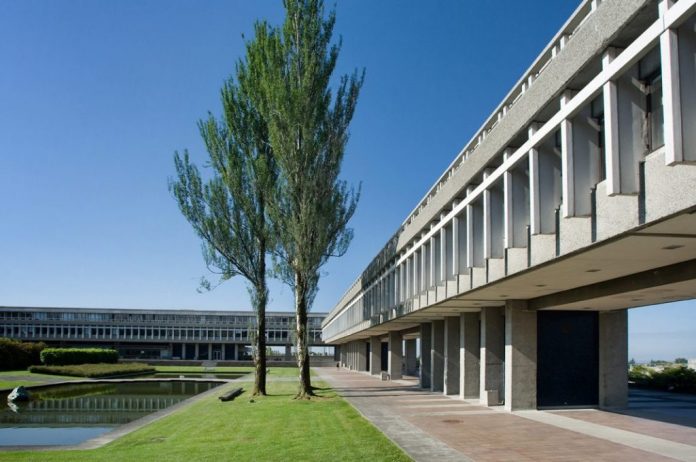
I haven’t been, but it’s apparently a rendition of Daedalus’ most famous creation: the labyrinth. Unfortunately, instead of a minotaur, I’ve found myself concerned there’s a really buff kangaroo with boxing gloves that’s going to hop after me late at night to recreate Rocky Balboa vs. Apollo Creed, and against that beast, “there ain’t gonna be no rematch.” On the plus side, the bus loop is nearby, and many fine medical establishments are within reach as soon as I leave the confines of the mountain. Suddenly, the gondola makes a lot of sense in any catastrophic situation that may befall those on Burnaby Mountain — especially with kangaroos.

5. How are snow days going to work this semester?

For obvious reasons, there will sadly be none; however, if you look deep within and channel your inner optimist, you’ll most certainly see the positives in this. First, no perilous trips up the mountain with a significant chance of being stranded atop it. Second, no pushing buses, because my nine year-old Vans really won’t allow it. Third, no having to stress out about your pals at other universities having no classes while you do! Especially with an increased chance of camping in the AQ overnight rather than sleeping in your own bed. Hold on a minute, there’s nothing eager and academic about all that . . . I’ll stick with breakout rooms, unfortunately.

6. Gross income vs. net income

Self-employment (don’t forget being an artist) has never looked so daunting. Hopefully, the whole debacle doesn’t turn into those three infamous R’s. Rethink, Reskill, Reboot; because the pandemic killed your industry, and your next job could be in cyber. Oh, you were thinking of Reduce, Reuse, Recycle? Your customers will be reducing, all right.

7. Is the EU on the brink?

Everyone can’t stop talking about this (not really), but Brexit is official! Is the EU in trouble? No. Everyone’s going to be okay. Referendums are easy to hold and unfortunately effective on that little grey rainy isle if stuff isn’t working as it (inherently) ought to. Given that 2021 really isn’t working too well, either, maybe the UK will hold a referendum on whether to stay in or leave the year!

8. Why on Earth aren’t IKEA and Volvo doing business together?

No, not because they’re both Swedish brands! There’s an opportunity here to convince unsuspecting couch and coffee table shoppers to get a brand-new station wagon or SUV that will most definitely be safe for not only the entire family, but pedestrians too! The catchphrase could be, “you’ve sampled all our most wonderful furniture, our most wonderful cuisine while you were at it, how about also financing a car made with a most wonderful similar (unspecified) ethos!?” Ambiguous instruction manuals included, of course. Now, where’s that Allen key?

9. BC property assessment

How can it be that the Downtown Eastside single room occupancy hotels are as valuable as that? Aren’t such amazing living conditions supposed to drive up the value of real estate? Inflation, property taxation, real estate, oh my!

10. Should we start dropping apples on people’s heads when we’re angry? (gently, of course)

This sounds like a good way to let someone know you aren’t too happy with them. Maybe you could talk about Sir Isaac Newton after sorting out your beef? Maybe, gravity was discovered because one apple tree couldn’t stand this budding young physicist in its shade. Do we owe one of humanity’s greatest discoveries to anger? What else (both good and bad) has humanity discovered out of anger? Air conditioning? Drive-thrus? Aforementioned property assessments? The microwave? One explosive atom-splitting apparatus of doom?

Senate Report: January 11, 2021

0
Photo from Peak archives

Pass/credit/no credit grading implemented for elective courses 

The SFU Senate agreed to allow the option of pass/credit/no credit (P/CR/NC) grading for courses outside of a student’s major. This system is a pilot program to be put in place for the Spring, Summer, and Fall 2021 terms in order to accommodate the challenges students are facing during the ongoing COVID-19 pandemic. The motion was previously endorsed by the Senate Committee on Undergraduate Studies (SCUS) with the help of senator Wade Parkhouse and student senator Gabe Liosis. 

Concerns were voiced about students with GPA requirements for scholarships, students with prior academic integrity offenses, and how faculty might be held accountable given the lack of biannual reviews due to the pandemic. 

Senator Lyn Bartram brought up the issue of how the program affects students’ GPA in terms of “scholarships externally granted, co-op [ . . . ] and grad school admissions” as P/CR/NC does not count towards a student’s GPA. 

The matter of academic integrity was brought up by senator Eric Gedajlovic, who voiced concerns regarding students who may have failed a component of a course due to academic integrity and questioned whether these students should be permitted the option of P/CR/NC grading. These concerns were not resolved during the meeting, however, Vice-President, Academic and Provost Catherine Dauvergne noted that these issues had been considered during preliminary meetings. 

The benefits of P/CR/NC grading for electives were also discussed, with senator Daniel Leznoff noting that the program would be “an exceptionally healthy thing in normal times” as it allows students to take courses outside of their major without fear of dropping their GPA. The pilot program will be reassessed in a year and may continue beyond the pandemic.

The system set to be implemented for the 2021 year is referred to as P/CR/NC rather than pass/fail. Students with a grade of C- or higher may choose to have a “pass” grade, whereas students with a D will get a “credit” grade, and failing students will receive no credit. Pass/credit/no credit grades will not count toward GPA calculations. 

The motion passed with 91% of Senate members voted in favour of implementing P/CR/NC grading, with 5% opposed and 4% abstaining. 


Pass/credit/no credit grading rejected for core classes

The Senate moved on to consider an amendment to the motion that would allow all courses — both core and elective classes — to use the P/CR/NC system. 

Senator Matt Martell proposed that departments should be able to decide individually, stating that “core courses are not all created equally.” This compromise was backed by Parkhouse and senator Daniel Laitsch. 

Liosis had earlier spoken to the compromises that had to be made in order to bring the initial motion to the senate. Initially, the idea was to implement the same pass/fail grading that was put in place as an emergency response to the pandemic while “[tackling] some of the initial concerns that the original pass/fail system proposed.” However, after discussion with SCUS, Parkhouse, and Academic Vice-President Catherine Dauvergne, many of the components of the original system — including allowing all courses to have pass/fail as an option — were forfeited. 

The amendment requesting that the P/CR/NC system would be applied to all classes was voted via secret ballot, as requested by senator Stephen Spector. The motion was not passed, with 70% opposed, 29% in favour, and 2% abstaining. 


Convocation and summer semester dates moved 

Two motions were passed, shifting the dates of both the 2021 convocation ceremony and the start of the Summer 2021 semester.

The first day of classes for the Summer 2021 term was moved from Monday May 17, 2021 to Wednesday May 12, 2021. The date was initially shifted when it was decided that the Spring semester would start a week later. Spector stated that “moving the start date back to May 12 allows us to have the appropriate number of days in the semester without creating too small of a gap [between semesters].” 

The convocation ceremony was moved from June 8–11 to June 24–29. This change occurred because the Spring term ends later than it normally would. 


Changes made to English undergraduate curriculum 

During the meeting, the Undergraduate/Associate Chair of the English department David Coley discussed how the department has undergone external review over the past year and has been reassessing undergraduate course offerings. Additionally, course requirements, particularly for upper division courses, have been reviewed in order to make the courses more accessible for students outside of the major.

The reason for the reassessment, according to Coley, is because the “English [department] has undergone a great deal of change, methodologically, and culturally within the past 15 or 20 years since our curriculum was last revised.” The plan for the new curriculum is for it to be more culturally relevant, with courses in race and diaspora, gender and sexuality, and environmental literature. 

With 12 new courses added and 30 removed in the upper division, there were some concerns from senator Colin Percival. He noted that FASS students have previously struggled with getting certain courses in certain terms, extending their time at SFU or making their schedules more difficult to manage.

In response, Coley explained that this issue was one that the new revision is attempting to address. Due to the small number of faculty members, courses could not be offered in regular rotation. The new courses are more broadly conceived in order to attract students towards them so they can be offered more regularly and in multiple iterations. 

SFU professor Dr. Manolis Savva appointed as Tier 2 Canada Research Chair

0
Habitat: A Platform for Embodied AI Research [Savva et al. 2019]

Two years after starting as an assistant professor at SFU’s School of Computing Science, Dr. Manolis Savva was selected as a Tier 2 Canada Research Chair in computer graphics. The position increases funding and networking opportunities for his research on computer graphics and artificial intelligence (AI).

The Canada Research Chairs Program (CRCP) is administered by the Tri-agency Institutional Programs Secretariat and annually invests approximately $295 million to various research projects. 

In an email interview with The Peak, Saava expressed his gratitude for the appointment and the opportunity to further his research on “analysis, organization, and generation of 3D representations of objects, scenes, and people.” This reflects his teaching philosophy that visual representations best clarify concepts. 

Savva’s interest in computer graphics developed during his time at Cornell University, majoring in physics. He took a computer graphics class that incorporated physics and was intrigued by algorithms’ application in entertainment and simulations. He then became interested in pursuing further education in computer science. Acknowledging computer software’s increasing role in communication and knowledge, Savva recognized that his role as a researcher entailed great responsibility. 

By expanding the use of algorithms beyond simple simulations to incorporate 3D structures into 3D environments, Savva’s research intends to “teach AI how to dream in 3D.” His work addresses the lack of research on 3D simulations in AI and their applications by expanding the use of algorithms to build 3D environments.

Savva noted that “there is much knowledge about the world that we cannot yet represent well digitally and we therefore can’t understand or generate using algorithms [ . . . ] My work asks the question, ‘What data and algorithms do we need to understand and generate 3D scenes like these?’”

According to Savva, further improvements for AI in the post-pandemic world could include enhancing video-conferencing applications to incorporate high-quality 3D graphics. He envisions technology, “where two or more people can see each other in a rich 3D interactive way and be co-present in a virtual space, [allowing] us to work together more effectively while still being physically far apart.

“Software can allow us to create many new things, discover new knowledge, and help to connect us [ . . . ] That’s why I feel there is great power in a computer scientist’s role within society, and we should feel a great deal of responsibility as well.”